INTRODUCTION
Over the past 40 years, use of the wheat–rice system (WRS) has increased phenomenally and it has become a major cropping system, covering about 13·5 million ha in the Indo-Gangetic plains of South Asia (Ladha et al. Reference Ladha, Dawe, Pathak, Padre, Yadav, Singh, Singh, Singh, Singh, Kundu, Sakal, Ram, Regmi, Gami, Bhandari, Amin, Yadav, Bhattarai, Das, Aggarwal, Gupta and Hobbs2003). However, recent stagnation or decline in productivity of the WRS reported from India and other South Asian countries is a result of degradation of the soil and water resource base and inefficient nutrient management (Hobbs et al. Reference Hobbs, Sayre and Gupta2008). Adequate nutrient management is essential to enhance productivity of WRS since both crops have high demand, with annual total nutrient (nitrogen [N] + phosphorus [P] + potassium [K] combined) removals exceeding 500 kg/ha (Yadvinder-Singh & Bijay-Singh Reference Yadvinder-Singh and Bijay-Singh2001; Yadvinder-Singh et al. Reference Yadvinder-Singh, Bijay-Singh, Ladha, Khind, Gupta, Meelu and Pasuquin2004). Along with chemical fertilizers, repeated application of organic manures is often recommended in order to maintain soil productivity. However, due to their limited availability, locally available organic sources are applied mainly to high value crops. With the rising prices of commercial fertilizers, particularly P fertilizer, locally available biomass ash remains a valuable alternative to commercial fertilizers for resource-poor farmers to sustain the productivity of WRS in South Asia.
Bagasse (the fibrous matter that remains after sugarcane or sorghum stalks are crushed to extract their juice) and rice husk are two important agro-industrial by-products that are generally used as fuel in the sugar and rice mill industries, respectively. It is estimated that 45 million tonnes of bagasse are produced annually by the sugar factories in India (NAAS 2008) and bagasse ash (BA) constitutes 0·05 of total bagasse production. Rice husk, the main by-product in rice mills, is being produced in large quantities in Asian countries (Natarajan et al. Reference Natarajan, Nordin and Rao1998): the annual world output is 116 million tonnes (FAO 2002) and its use as a furnace fuel produces 0·16–0·23 of rice husk ash (RHA). Disposal of BA and RHA has become a serious environmental problem and large quantities of these ashes are regularly dumped into rivers, ponds and open spaces, thereby endangering fragile ecosystems. Strict environmental regulations and prohibitive costs associated with landfill demand alternative, sustainable and less costly methods of disposal for RHA and BA, such as application to agricultural land. Both RHA and BA contain significant amounts of P, K, sulphur (S), iron (Fe), calcium (Ca), magnesium (Mg) and sodium (Na) (Kapur Reference Kapur1985; Jenkins et al. Reference Jenkins, Baxter, Miles and Miles1998; Natarajan et al. Reference Natarajan, Nordin and Rao1998). The use of different biomass ashes as soil amendments has been shown to increase crop yield due to increased pH, increased supply of plant nutrients and improved biological and physical health of soil (Vance Reference Vance1996; Demeyer et al. Reference Demeyer, Nkana and Verloo2001; Saarsalmi et al. Reference Saarsalmi, Malkonen and Piirainen2001; Mozaffari et al. Reference Mozaffari, Russelle, Rosen and Nater2002; Patterson et al. Reference Patterson, Acharya, Thomas, Bertschi and Rothwell2004; Prakash et al. Reference Prakash, Nagaraj, Guruswamy, Vishwanatha, Narayanswamy, Gowda, Vasuki and Siddaramappa2007). In addition, their recycling on agricultural land will reduce environment pollution and save vast areas of productive land that would otherwise be used for their disposal. Recycling of nutrients to agricultural soils is especially important for those plant nutrients produced from essentially non-renewable resources such as P, having no biological or technological substitute and where global commercially available stocks will eventually become scarce and costly (Van Vuuren et al. Reference Van Vuuren, Bouwman and Beusen2010; Neset & Cordell Reference Neset and Cordell2012). Therefore, possibilities for recycling of P from waste biomass ash back to agriculture have to be explored (Neset et al. Reference Neset, Drangert, Bader and Scheidegger2010). Recently, a study by Thind et al. (Reference Thind, Yadvinder-Singh, Bijay-Singh, Varinderpal-Singh, Sharma, Vashistha and Singh2012) revealed that RHA and BA can be recycled successfully in WRS to improve crop productivity, with significant increases in P availability in the soil. The major objective of the present 3-year field study was to quantify the savings in fertilizer P when BA and RHA were applied to wheat grown in an annual sequence with transplanted rice. An additional objective was to estimate the removal and balance of P in the soil–plant system and build-up of available P in the soil due to application of BA and RHA.
MATERIALS AND METHODS
Experimental site
A 3-year field experiment on irrigated WRS was conducted during 2009–2012 on a Typic Ustipsamment (Fatehpur loamy sand) (Raj-Kumar et al. Reference Raj-Kumar, Sharma and Sidhu2000) at the experimental farm of the Punjab Agricultural University, Ludhiana (30°56′N, 75°52′E, 247 m a.s.l.) in the Indo-Gangetic plains of Northwestern India. Soil (0–15 cm depth) of the experimental field at the start of the experiment was alkaline (pH 7·26, 1 : 2 soil/water suspension) with 0·21 dS/m electrical conductivity, 2·93 g/kg organic carbon (C), 7·76 cmol/kg cation exchange capacity, 2·86 mg/kg Olsen P (Olsen et al. Reference Olsen, Cole, Watanabe and Dean1954) and 51 mg/kg ammonium acetate extraction K (Knudsen et al. Reference Knudsen, Peterson, Pratt, Page, Miller and Keeney1982). The infiltration rate of the experimental site was 15·6 mm/h. The site had a sub-tropical, semi-arid continental monsoon climate with an annual mean precipitation of 760 mm, with of which 80 percent received from June to September. Long-term averages (30 years) for minimum and maximum temperatures were 6·7 and 22·6 °C in the wheat growing season (November–April), and 18 and 35 °C in the rice growing season (July–October). Mean monthly temperatures during the wheat and rice-growing seasons for each individual month did not differ much between the years during the study period.
Experimental details
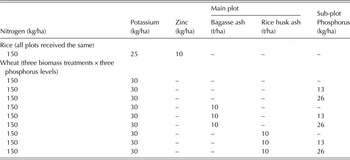
The experiment was laid out in split-plot design with two biomass ash materials (BA and RHA) applied at 10 t/ha on dry weight basis) and a no-ash control as main plot treatments (Table 1). Three levels of fertilizer P (0, 13 and 26 kg P/ha; designated as P0, P13 and P26, respectively) were applied as single super phosphate to wheat and constituted sub-plot treatments. No BA, RHA or inorganic P was applied to succeeding rice crops. There were three replications and treatments were maintained in the same plots every year. The plot size was 3 × 10 m2 with a 0·4-m alley surrounding each plot. The BA and RHA were applied to wheat in the last week of October, after rice harvest and immediately incorporated into the soil before sowing of wheat. Land was prepared by disc ploughing twice followed by ‘planking’ to level the soil and pre-sowing flood irrigation. The seedbed was prepared with two passes of a spring-tyne cultivator followed by planking to level the soil. The standard fertilizer N and K recommendations for both wheat and rice in the WRS are 150 kg N/ha and 25 kg K/ha and were applied as urea and muriate of potash, respectively. Fertilizer P recommendation for WRS in the region is to apply 26 kg P/ha for wheat and no P to the succeeding rice crop so in the present investigation, N and K were applied to wheat and rice but P was applied to wheat only. A basal dose of 10 kg zinc/ha as zinc (Zn) sulphate was applied to all rice plots at planting. The wheat variety DBW 17 and rice variety PAU 201, the varieties most commonly grown in the region, were planted in the first week of November and the third week of June, respectively, in each year.
Treatment details

Urea N was applied to wheat in three equal split doses (at planting, and then at 21 and 56 days after planting, coinciding with post-sowing irrigations). Fertilizer K was applied to all plots at planting. A seed rate of 100 kg/ha was used for wheat, which was seeded in rows at a distance of 20 cm between rows. Depending upon the amount and frequency of rainfall, four or five irrigations were applied to wheat in each year. Nitrogen was applied to rice as urea in three equal split doses at 2, 21 and 42 days after transplanting. All of the K and Zn was uniformly spread prior to primary cultivation and thereby incorporated into the soil. Tillage for rice included two dry disc ploughings followed by wet tillage and planking, and 30-day-old rice seedlings were planted at a spacing of 15 cm within rows and 20 cm between rows. Rice was irrigated daily during the first 15 days and thereafter as needed to prevent the soil surface from being without overlying water for more than 2 days. A total of 20–24 irrigations were applied to rice per season depending on the amount of rainfall. All other recommended practices to control weeds and insect pests were followed according to commercial practice. The rice crop was harvested between 5–20 October and wheat was harvested between 18 and 24 April in each year. Rice and wheat were harvested close to the ground with sickles, and all harvested biomass was removed from the plots. Grain and straw yields were recorded from a 2 × 7 m2 area in the centre of each plot. After estimating moisture content, the rice grain yield was reported at 14% moisture content, whereas wheat grain yield and straw yields were reported on oven dry weight basis.
Soil, plant and grain analysis
Soil samples were analysed for Olsen P and ammonium acetate (NH4OAc)-extractable K by the methods described by Olsen et al. (Reference Olsen, Cole, Watanabe and Dean1954) and Knudsen et al. (Reference Knudsen, Peterson, Pratt, Page, Miller and Keeney1982), respectively. Soil organic carbon (SOC) was analysed by the Walkley & Black (Reference Walkley and Black1934) method. The BA and RHA were analysed for total nutrients by the method described by Miller (Reference Miller and Kalra1998). Sub-samples of grain and straw were oven-dried at 65 °C for 48 h to a constant weight and ground to pass a 0·5 mm screen. Total P and K concentrations were determined in triple-acid (nitric acid : sulphuric acid : perchloric acid (HNO3 : H2SO4 : HClO4) 10 : 3 : 1) digests using the ammonium molybdate method for P (Nelson & Sommers Reference Nelson, Sommers, Sparks, Page, Helmke, Loeppert, Soltanpour, Tabatabai, Johnston and Sumner1996) and flame photometery method for K (Westerman Reference Westerman1990).
Phosphorus balance
Phosphorus balance (kg/ha/year) was estimated for the three wheat–rice cropping cycles by considering different inputs and outputs measured during either the current study or other studies using the following equation:
 $$\eqalign{\hbox{ P balance} & = \hbox{ P input (fertilizer P} + \hbox{ ash P)} \cr & \quad - \hbox{ P output (P uptake in grain} + \hbox{ straw)}}$$
Nutrient (P and K) uptake was calculated as the product of grain and straw yields and nutrient concentration at harvest and summed. The P contents in mineral fertilizer, biomass ash and irrigation water were measured directly in the current study.
Statistical analysis
All the data for crop yields, nutrient uptake and soil parameters were analysed using a split-plot design with biomass ash as main factor, P levels as sub-factor and interaction of ash × P levels for analysis of variance (ANOVA) using the IRRISTAT data analysis package (IRRI 2000). The differences among treatments were compared at P ⩽ 0·05. Using MS Excel (Microsoft Corporation, Redland, CA), regression analysis was carried out to examine the relationship between the mean annual P balance and Olsen-P in different soil layers.
RESULTS
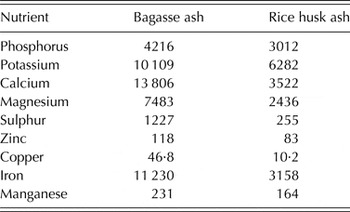
The nutrient content of BA and RHA used in the current experiment are shown in Table 2. Bagasse ash had 40 and 61% higher content of P and K, respectively, compared with RHA. Similarly, BA was also a better source of other plant nutrients such as Ca, Mg, S, Zn, copper (Cu), Fe and manganese (Mn). The ash of both BA and RHA contained only traces of C, as most of it present in the biomass was lost during intense burning.
Mean total element concentration (μg/g) in bagasse ash and rice husk ash

Wheat yield
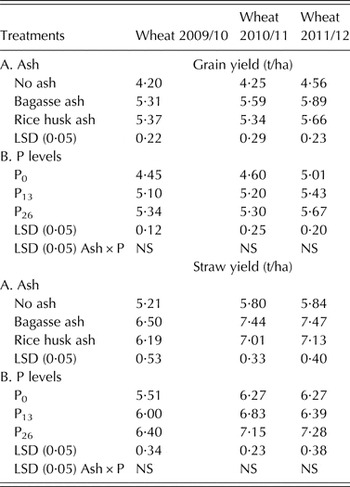
Application of fertilizer P increased wheat grain yield significantly (P < 0·05) up to P26 in the absence of ash in all 3 years of the study (Table 3). However, significant (P < 0·05) responses to P application were also observed up to P13 in the presence of BA or RHA in all years. Both BA and RHA increased grain yield significantly (P < 0·05), even without fertilizer P application (P0), over the no-ash control fertilized with P26 (the recommended rate in the region) treatment.
Unlike grain yield, there was no significant interaction effect of biomass ash and fertilizer P treatment on straw yield of wheat in any of the 3 years (Table 3). Straw yield of wheat increased significantly (P < 0·05) with increasing level of P up to P26, irrespective of biomass ash application. The application of BA and RHA, irrespective of fertilizer P application, resulted in significant (P < 0·05) increases (25–28% in BA and 19–22% in RHA) in mean straw yield when compared with the non-amended control treatment (no ash and no P) (Table 3). However, the increase in wheat straw yield with the application of BA, irrespective of P application, was significantly (P < 0·05) higher compared with RHA.
Effect of different sources of ash and fertilizer P application to wheat on grain and straw yield (t/ha) of wheat during different years

LSD, least significant difference.
Rice yield
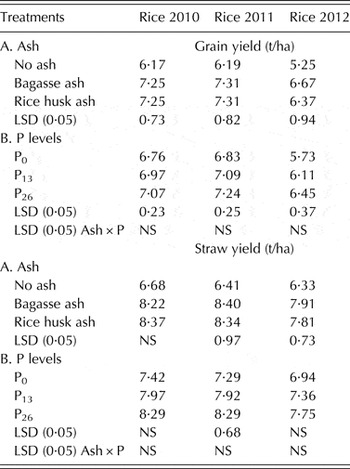
The application of BA and RHA to wheat, irrespective of P application, resulted in significant (P < 0·05) increase in grain yield of the subsequent rice crop in all the 3 years of experimentation (Table 4). The P13 applied to preceding wheat significantly (P < 0·05) increased grain yield of the subsequent rice crop over P0 in all 3 years. Mean rice yield (averaged across years) increased by 19–21% with application of BA and RHA to previous wheat compared with no-ash treatment. As with grain yield, significant (P < 0·05) residual effect of BA and RHA was observed on the straw yield of rice. Both BA and RHA along with P13 applied to previous wheat crop increased the rice straw yield by about 12·3% over that produced with the application of P26 and no ash (Table 4).
Effect of different sources of ash and fertilizer P application to wheat on grain and straw yield (t/ha) of subsequent rice during different years

LSD, least significant difference.
Nitrogen, phosphorus and potassium uptake
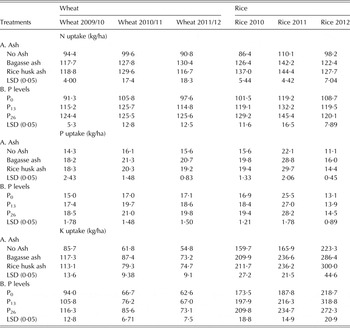
The ANOVA showed no significant interaction effect of ash and P levels on N, P and K uptake in any of the years. Therefore, the main effects of ash and P levels are reported in Table 5. Nutrient (N, P and K) uptake by wheat was significantly (P < 0·05) affected by both biomass ash and fertilizer P application. Mean N uptake of wheat on RHA and BA amended plots increased by 25·5–42·9% over the no-ash treatment in three seasons. Application of P26 increased N uptake by 18·9% in 2010/11 to 36·3% in 2009/10 over the P0 treatment, irrespective of biomass ash. Total P uptake of wheat was 23·1–28·0% higher in plots amended with RHA and BA compared with no ash. Total P uptake increased by 8·8–21·5% with the application of P26 over P0, irrespective of biomass ash application (Table 5). Application of BA and RHA to wheat, irrespective of fertilizer P application, resulted in significantly (P < 0·05) higher K uptake compared with no ash. Similarly, fertilizer P at P26 increased mean K uptake of wheat by 24% over P0.
Effect of different sources of ash and fertilizer P application to wheat on total nutrient uptake in wheat and rice in different years

LSD, least significant difference.
As with grain and straw yields, both biomass ash and fertilizer P applied to the previous wheat significantly (P < 0·05) increased total N, P and K uptake in the subsequent rice crop (Table 5). The increase in N, P and K uptake with application of BA and RHA in three seasons ranged from 24·6 to 58·6%, 24·4 to 34·4% and 31·4 to 42·6%, respectively, compared with the no-ash treatment. The differences in nutrient uptake between BA and RHA were small. Fertilizer P (P26) applied with wheat increased the mean (averaged for three seasons) total N, P and K uptake of subsequent rice by 19·9, 11·9 and 23·6%, respectively, compared with P0.
Phosphorus balance
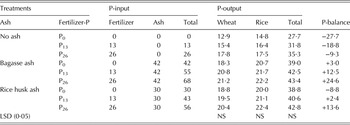
Nutrient balance provides first-hand information about the sustainability of land use systems and potential environmental effects (Oborn et al. Reference Oborn, Edwards, Witter, Oenema, Ivarsson, Withers, Nilson and Stinzing2003). In the present investigation, average P balance ranged from a negative of 27·7 kg P/ha/year in P0 without any biomass ash to a positive balance of 24·6 kg P/ha/year in BA with P26 (Table 6). However, when recommended fertilizer P (P26) was applied to wheat without any biomass ash, the average annual total deficit decreased to 9·3 kg P/ha/year. Total P inputs for the treatment receiving BA alone to wheat (42 kg/ha) were 8·0% more than the output, resulting in a surplus of 3·0 kg P/ha/year, which increased to 12·5 and 24·6 kg P/ha/year when fertilizer P was also applied along with BA at the rate of P13 and P26, respectively. In the case of RHA applied with P0, the result was a negative P balance of 8·8 kg P/ha/year; however, when RHA was applied to wheat along with P13 and P26, it resulted in a positive P balance of 2·4 kg and 13·6 kg P/ha/year, respectively.
Effect of different sources of ash and fertilizer P application to wheat on mean annual P balance (kg/ha/year) for the 3-year study period

LSD, least significant difference; NS, not significant.
Organic carbon, Olson phosphorus and available potassium in soil
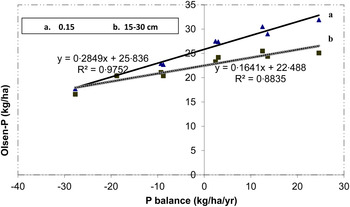
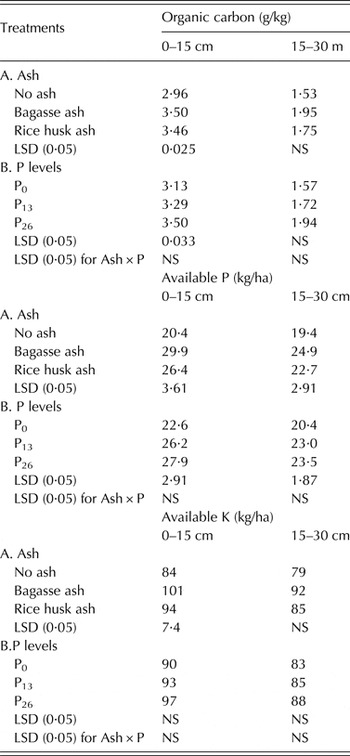
Application of biomass ash and P fertilizer caused significant (P < 0·05) increases in SOC, Olsen-P and available K content in the 0–15 cm soil layer after 3 years of WRS (Table 7). While an increase in Olsen-P with biomass ash and fertilizer P application was also observed in the 15–30 cm layer, no such effect was observed in SOC or available K. No significant (P < 0·05) interaction effects of biomass ash and fertilizer P were observed on these soil parameters. Soil organic carbon content in the 0–15 cm layer increased from 3·0 g/kg in the no-ash control to 3·5 g/kg in both the BA and RHA treatments. Fertilizer P (P26) compared with no P (P0) also caused a similar increase in SOC. In the 0–15 cm soil layer, BA and RHA increased the Olsen-P from 20·4 kg/ha in the no-ash treatment to 29·9 kg and 26·4 kg/ha, respectively (Table 6). Similarly, fertilizer P (P26) increased the Olsen-P content by 23·5% compared with no P (P0) in the same layer. A similar trend in Olsen-P was observed in the 15–30 cm soil layer, though the magnitude of increase was small. A strong linear relationship (R 2 = 0·98 for top-soil at 0–15 cm; R 2 = 0·88 for sub-soil at 15–30 cm) was observed between P balance and Olsen-P build-up in soil (Fig. 1). Application of BA and RHA increased the available K from 84 kg K/ha in the no-ash control to 101 and 94 kg K/ha in the 0–15 cm layer, respectively. No significant (P < 0·05) effect of fertilizer P was observed on the available K content in either layer.
Relationship between the mean annual P balance and Olsen-P in top soil (0–15 cm) and sub-soil (15–30 cm) in different treatments at the end of the experimental period.

Effect of different sources of ash and fertilizer P to wheat on soil organic carbon and available phosphorus and potassium after 3 years of experimentation

LSD, least significant difference; NS, not significant.
DISCUSSION
The beneficial effects of RHA and BA in increasing crop yields in WRS were consistent across years. The significant increase in grain yields of WRS with the application of RHA and BA can be attributed to the increased availability of a number of key plant nutrients and the favourable effects of ash on soil physical conditions and microbial processes (Demeyer et al. Reference Demeyer, Nkana and Verloo2001). A higher yield increase from the application of RHA and BA to wheat than to rice is probably due to the fact that wheat is grown in winter, when climatic conditions lead to low soil P availability; therefore the application of RHA and BA has a greater impact, even though much of the P will be bound to varying degrees in the soil and only a small amount is available to the crop in the year of application (Yadvinder-Singh et al. Reference Yadvinder-Singh, Gupta, Thind, Bijay-Singh, Varinderpal-Singh, Gurpreet-Singh, Jagmohan-Singh and Ladha2009). The availability of soil P to rice is much greater due to ‘reduced’ soil conditions (i.e. low redox potential observed in submerged paddy soils) and at high soil temperatures; therefore, rice showed a smaller response to applied P compared with wheat grown under upland conditions during winter. Earlier studies showed that wheat grown after dry direct-seeded rice performed better compared with that after conventional, puddled, transplanted rice due to improved soil physical conditions (Gathala et al. Reference Gathala, Ladha, Kumar, Saharawat, Kumar, Sharma, Sharma and Pathak2011). Talashilkar &Chavan (Reference Talashilkar and Chavan1996) and Prakash et al. (Reference Prakash, Nagaraj, Guruswamy, Vishwanatha, Narayanswamy, Gowda, Vasuki and Siddaramappa2007) also observed significant increases in the grain yield and P uptake of rice with application of RHA. Similarly, Thind et al. (Reference Thind, Yadvinder-Singh, Bijay-Singh, Varinderpal-Singh, Sharma, Vashistha and Singh2012) reported increased crop yields accompanied by significant increases in nutrient (N, P and K) uptake with the application of BA and RHA in WRS. Rice husk ash and BA (10 t/ha) supplied 30 kg and 42 kg of P/ha to WRS, respectively, which is more than the recommended fertilizer P dose for WRS in the region. The agronomic value of P in biomass ash seems to be <0·5 of that supplied through water-soluble P sources such as single superphosphate, but it should be noted that it will contribute to the soil P pool and become available over a number of years. However, Schiemenz & Eichler-Lobermann (Reference Schiemenz and Eichler-Lobermann2010) observed that crop biomass ash can be an adequate P source comparable with that of highly soluble commercial P fertilizer in acidic soil. This could be due to favourable changes in soil pH brought about by alkaline ash.
As expected, P balance increased with an increasing rate of fertilizer P application, both with and without biomass ash. The phosphorus balance remained negative when no ash was applied but values decreased with the increase in the rate of fertilizer P application to wheat. In an earlier study, Yadvinder-Singh et al. (Reference Yadvinder-Singh, Doberman, Bijay-Singh, Bronson and Khind2000) also reported negative P balance when recommended fertilizer dose (P26) was applied to wheat in WRS. The expected increases in rice yield from 6–7 t/ha achieved in the present study to 9–10 t/ha in the near future will heighten the negative P balance, thereby adversely affecting the long-term sustainability of WRS in the region. With the application of biomass ash (BA and RHA) and fertilizer P, the P balance was positive in all treatments except for the P0 applied with RHA. When the amount of P applied from fertilizer and/or organic wastes exceeds that accumulated in the harvested plant parts, excess P will accumulate in the soil. The increase in water-soluble P as a result of positive P balance due to long-term application of RHA or BA would increase the risk of environmental problems associated with the runoff and leaching loss of P from agricultural soils in this region (Sims et al. Reference Sims, Edwards, Schoumans and Simard2000; Aulakh et al. Reference Aulakh, Garg and Kabba2007). Therefore, RHA or BA application to WRS should be commensurate with P needs rather than be used as an ash dumping site, so that high P build-up does not occur beyond a certain limit in soils. The increase in K uptake with the application of biomass ash parallels the amount of K addition from the ash. Thus, K fertilization practices would not change drastically when biomass ash is applied to WRS in the region.
The observed 13–17% increase in SOC with the application of biomass ash and P fertilizer in the 0–15 cm layer in the present study may be ascribed to increased productivity of WRS accompanied by greater production of stubbles and root biomass over control treatments (Benbi & Brar Reference Benbi and Brar2009). There was no direct addition of organic carbon to the soil either from biomass ash or P fertilizer. The relationship between Olsen-P and P balance showed that for each kg of positive P balance, the Olsen-P increased by 0·28 kg/ha in the surface layer (0–15 cm) and 0·16 kg/ha in the sub-surface layer (15–30 cm). Both of the sources of biomass ash increased available K in the 0–15 cm layer due to the addition of 63–101 kg K/ha each year in WRS. Biomass ash normally contains a high level of K in the water-soluble form, which is readily available to crop plants. However, the observed increase in available K in the soil of the current study is much lower than that of its additions from BA and RHA. This behaviour in available K in the soil may be ascribed mainly to the higher uptake of K (80 kg K/ha/year) by the WRS from the application of biomass ash over the no-ash treatment and leaching of water-soluble K to the layers below 30 cm in the highly permeable loamy sand soil. It may be concluded from the current study that 0·50 of the recommended fertilizer P (P26) in WRS can be saved when RHA or BA is applied at the rate of 10 t/ha to wheat. Biomass ash also helped to enhance the productivity of WRS under the experimental conditions. A positive P balance suggests that long-term application of biomass ash to crops will contribute to the accumulation of P even when applied at moderate rates. This may lead to P losses through leaching beyond the rooting zone of crops, particularly when applied on coarse-textured soils with low P retention capacity for nutrients. Thus, application of biomass ash to WRS should commensurate with P needs and monitoring of P status of agricultural lands which cannot be treated as dumping sites.
The authors are grateful to the Indian Council of Agricultural Research, New Delhi for providing financial assistance to carry out these investigations in the form of research project entitled ‘Niche Area of Excellence Programme on Soil and Water Management in High Intensity Cropping Regions’.