Introduction
Dementia is a syndrome characterized by loss of cognitive function, severe enough to interfere with an individual's daily functioning. The World Health Organization (WHO; 2012) recognizes dementia as an international health challenge and has called on countries to include dementia in public health planning. Dementia in developing countries, particularly in Asia, constitutes an even greater challenge as populations in many such countries are aging rapidly (Aggarwal et al., Reference Aggarwal, Tripathi, Dodge, Alladi and Anstey2012). East Asia now possesses the world's largest population aged 60 years and above, with a further 279 million people expected to fall into this age group between 2010 and 2050 (Catindig et al., Reference Catindig, Venketasubramanian, Ikram and Chen2013). The fastest growth in the older population has been in China and India, and their South Asian and Western Pacific neighbors (World Health Organisation, 2011; Duthey, Reference Duthey2013). Based on the World Alzheimer's report in 2009 (Alzheimer's Disease International, 2009), Western Europe was estimated to have the highest number of people with dementia (7.0 million), followed by East Asia with 5.5 million, South Asia with 4.5 million, and North America with 4.4 million (World Health Organisation, 2012). The Asia Pacific region, however, is expected to overtake Western Europe as the region with the highest number of people with dementia in the next decade, with an increase from 2.83 million in 2010 to 7.03 million in 2050 (Prince et al., Reference Prince, Bryce, Albanese, Wimo, Ribeiro and Ferri2013).
A survey conducted among general practitioners (GPs) in the United Kingdom found that GPs felt there were few screening tools available and more information was required about the full range of instruments available (Milne et al., Reference Milne, Culverwell, Guss, Tuppen and Whelton2008). A survey of doctors in Asian countries would likely echo this. As such, a comprehensive list identifying available validated cognitive assessment tools will be invaluable to clinicians assessing older patients having dementia on a regular basis as well as researchers. Such a list will also identify gaps that need to be filled.
The accurate identification of cognitive impairment (CI) using appropriate assessment tools is vital if effective strategies for the management of dementia in Asia are to be developed. Cognitive assessment tools have been developed to measure memory and how well individuals perform in other cognitive areas, including attention, decision-making, and language use. While many cognitive assessment tools exist, most of these have been designed and validated for use in populations in developed countries. As a consequence, the applicability of existing cognitive assessment tools may be limited in developing countries due to differences in educational levels and cultural factors (Verghese et al., Reference Verghese2012). For example, the clock-drawing test, which is a commonly used cognitive assessment tool, may not be an appropriate test for those with low levels of formal education (de Jager et al., Reference de Jager2008). Previous studies have suggested that conceptual errors may result in lower than expected scores in people with low levels of formal education (Kim and Chey, Reference Kim and Chey2010). Translated versions of tools designed for use in developed countries may also require appropriate adaptation and validation for the population in which they are to be used (Dominguez et al., Reference Dominguez2013). The aim of this systematic review was to rationalize the results of studies conducted to evaluate the validity of screening tools for the detection of cognitive impairment in Asia and to identify any issues surrounding the screening or assessment of cognitive impairment using these tools.
Methods
Search strategy
We search the CINAHL, MEDLINE, Embase, Cochrane Collaborative Library, and Science Direct databases for relevant articles published between September 1989 and June 2014.
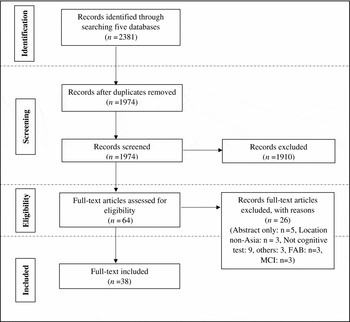
Relevant articles were identified by searching titles and abstracts using keywords containing dementia Or Alzheimer Or cognitive impairment And screen Or measure Or test tool Or instrument Or assessment. Searches were limited to the Asian continent and people aged 65+ years (e.g. for MEDLINE, CINAHL, and Science Direct). Truncation of search terms was used as appropriate (e.g. screen* and measure*). We did not limit our search to any language. The keywords used varied slightly between databases depending on the requirements of each search engine. A flowchart of studies identified at all stages is shown in Figure 1.
PRISMA flow chart for cognitive tools for dementia review.

Eligibility criteria
Cognitive tools were defined as any assessment, measurement, questionnaire, interview, or test used for screening with the intention of identifying individuals with cognitive impairment. The inclusion criteria were (1) studies including any participants aged 18 years and above, (2) involving cognitive tools used for detection of dementia/cognitive impairment/Alzheimer's Disease (AD), and (3) including participants of Asian ethnic origin resident within the Asian continent. Exclusion criteria included (1) studies which only included participants aged below 18 years, (2) tools not intended for use by non-specialist healthcare workers or intended to aid detailed assessment by a physician or designed for the identification of dementia subtype, (3) studies which were conducted outside the geographical location of the Asian continent.
Study screening and selection
Titles and abstracts of retrieved articles were independently evaluated by two investigators (Roshaslina Rosli and Maw Pin Tan). For articles thought to be of interest, full-text versions were retrieved and examined for eligibility (Roshaslina Rosli and Maw Pin Tan). Discrepancies were resolved by discussion until a consensus was reached between the investigators on the articles that should be included (see Figure 1).
Quality assessment
Risk of bias was evaluated using the Quality Assessment of Diagnostic Accuracy Studies version 2 (QUADAS-2) tool. QUADAS-2 comprises 14 items assessing the risk of bias, sources of variation, applicability, and quality. Each item is scored as “yes,” “no,” or “unclear” (Whiting et al., Reference Whiting2011). Two reviewers (Roshaslina Rosli and Maw Pin Tan) independently evaluated each of the included studies using agreed criteria based on the QUADAS-2 core signaling questions and concerns of applicability. The signaling questions used to assess the risk of bias were based on each of the following domains: (1) method of patient selection (consecutive or random selection, study design, and inclusion/exclusion criteria); (2) index test used, and blinding to results of the reference standard assessment; (3) is the reference standard appropriate, and were assessors blinded to the index test result; and (4) flow and timing (was there an appropriate interval between index test and reference standard, were all participants assessed with the same reference standard, and were all participants included in the analysis).
The applicability judgment was made with reference to review questions developed by the reviewers (Roshaslina Rosli and Maw Pin Tan) based on each domain: (1) patient selection (inclusion and exclusion criteria were appropriate, sampling procedure and age of participants were reported); (2) index test (was the index test score compared with a reference standard or any other cognitive screening tool, was there a comparison between people with and without dementia, and was the validity of the index test assessed with reference to the reference standard); and (3) reference standard (was the reference standard used to assess all participants before the index test). Any disagreement in the evaluation of quality was addressed through discussion until agreement was reached.
Data extraction
Data regarding country, language, study design, sample size, and population were extracted. The sensitivity and specificity of a tool at a given cut-off was also extracted. The cut-off value was defined as a point chosen along a score range that distinguished clearly and consistently the absence or presence of cognitive impairment.
Finally, data on educational bias were collected. Educational bias in this study refers to any significant influence of literacy level among the sample population on test performance. Education bias was classified as “affected by level of education,” “not affected by level of education,” and “not reported,” based on whether educational bias was evaluated, and whether the statistical analysis revealed the presence or absence of differences in test scores based on the level of education.
Data analysis
Data for all included studies were extracted and summarized with reference to mean value, standard deviation, median, inter-quartile range, and/or frequency as appropriate (Roshaslina Rosli and Maw Pin Tan). Pooled analysis was not possible due to the large variation in study design and populations between studies.
Results
Studies
Altogether 2,381 citations were obtained from the initial keyword search from the five databases (Figure 1). Following the removal of duplicates, 1,974 articles were screened by title and abstracts, and 1,910 records were excluded due to age of participants, geographical location, and papers written as letters to the editor and review articles. Sixty-four full-text articles were obtained and assessed for eligibility. Twenty-six articles were excluded after full-text evaluation. The reasons for exclusion are given in Figure 1. Thus, 38 full-text articles were selected for further evaluation.
Twenty nine studies (76%) included were conducted in East Asia, with nine studies conducted in South Korea in the Korean language, seven studies in China in the simplified Chinese language, six studies in Hong Kong in the traditional Chinese language, five studies in Japan in the Japanese language, and two studies in Taiwan in the traditional Chinese language. Cognitive tools had also been assessed in three South East Asian countries: Malaysia in the Malay language (two studies), the Philippines in Tagalog (one study), and Singapore in English, Malay, and Chinese languages (two studies). The remaining studies evaluated cognitive tools in Southern Asia: India in Malayalam language (three studies) and Sri Lanka in Singhalese language (one study).
Quality assessment
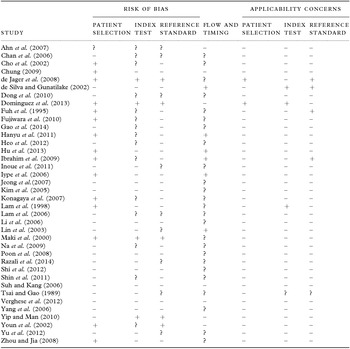
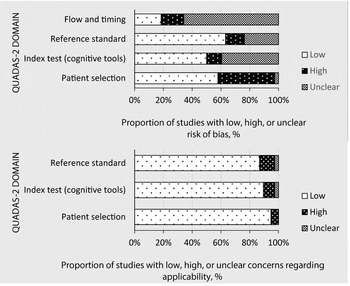
Selected articles were screened with the QUADAS-2 checklist to determine risk of bias (Table 1 and Figure 2). The reference standards used to diagnose dementia and patient selection methods were generally considered at low risk of bias with low concern regarding applicability. The index test used showed a generally high risk of bias, but risk of bias in terms of applicability was low. Fifty-eight percent of the studies did not clearly report the interval and sequence of testing, and so the risk of bias was considered unclear within the flow and timing domains. In addition, many studies did not clearly report whether the cognitive tools had been interpreted without knowledge of results of the reference standard.
Quality assessment for risk of bias using QUADAS-2 (n = 38)

Notes: “+” = High risk.
“–” = Low risk.
“?” = Unclear risk.
Quality of assessment (QUADAS-2).

Characteristics of cognitive tools
A total of 28 different cognitive assessment tools were assessed within the studies included (Table 2). The Mini-Mental State Examination (MMSE) was the most widely evaluated tool (included in 15 studies), followed by the Montreal Cognitive Assessment (MoCA) tool (six studies), the Hasegawa Dementia Scale-Revised (HDS-R; three studies), and the Clock Drawing Test (CDT; two studies). The number of items and domains, score range, cut-off score, and administration time for each tool are presented in Table 2.
Characteristics of cognitive tools, cut-off score, and education bias based on studies (n = 28)

Notes: 7 MS = 7-Minute Screen, ACE = Addenbrooke's Cognitive Examination, ADAS = Alzheimer's Disease Assessment Scale, BPMSE = Baylor Profound Mental Status Examination, BDRS = Blessed Dementia Rating Scale, CVFT = Category Verbal Fluency Test, CDT = Clock-Drawing Test, CFT = Clock-Face test, CDST = Computerized Dementia Screening Test, ECR = Enhanced Cued Recall, EXIT25 = Executive Interview, FOME = Fuld Object Memory Evaluation, Hierarchic DS = Hierarchic Dementia Scale, Hasegawa DS = Hasegawa Dementia Scale, HDS-R = Revised Hasegawa Dementia Scale, HVLT = Hopkins Verbal Learning Test, IQCODE = Informant Questionnaire on Cognitive Decline in the Elderly, ICAS = Intelligent Cognitive Assessment System, KDSQ = Korean Dementia Screening Questionnaire, MMSE = Mini-Mental State Examination, MoCA = Montreal Cognitive Assessment, NUCOG = Neuropsychiatry Unit Cognitive Assessment Tool, PMIS = Picture-based Memory Impairment Screen, RUDAS = Rowland Universal Dementia Assessment Scale, SIB-S = Short form version of the Severe Impairment Battery, SMQ = Short-Memory Questionnaire, TICS = Telephone Interview for Cognitive Status, TYM = Test Your Memory, TDAS = Touch Panel-type Dementia Assessment Scale, M-MMSE-7: Malay Mini-Mental State Examination – Serial 7, M-MSE-3: Malay Mini-Mental State – Serial 3, and M-MMSE-S: Malay Mini-Mental State Examination – spell “dunia” backwards.
“+” = effects of education, “–” = no effects of education, and “?” = not reported.
Only five studies evaluated tools which were designed de novo within Asian populations: the Korean Dementia Screening Questionnaire (KDSQ; one study), the Picture-based Memory Intelligence Scale (PMIS; one study), and the revised Hasegawa Dementia Screen (HDS-R; three studies). The remaining 33 (87%) articles evaluated tools that had been translated into languages relevant to their populations by the method of forward and backward translations. The validity and reliability of the translated version of each tool was reported in most of the included studies as showing good internal consistency in that setting, and therefore considered suitable.
Cut-off scores
The sensitivity and specificity of the reported scores are summarized in Table 2. The cut-off scores for the diagnosis of AD alone or the presence of dementia using the MMSE were reported by 14 studies (3 Korean, 4 Chinese, 2 Japanese, 2 Singaporean, 1 Malaysian, 1 Indian, and 1 Sri Lankan). One Malaysian study only reported the cut-off score for the diagnosis of mild cognitive impairment (MCI) using the MMSE. The proposed cut-off scores varied from 17 in Sri Lanka to 28 in one Chinese and one Japanese study. Within countries, the proposed cut-off scores differed between studies, with the range of cut-offs proposed from Chinese studies being 19 to 28. Shi et al. (Reference Shi, Tian, Wei, Miao and Wang2012) proposed a variable cut-off for the MMSE based on the level of education. Five studies defined cut-off scores for the diagnosis of dementia using MoCA. The proposed cut-off scores varied from 21/22 to 25/26, with substantial variation within countries.
Sensitivity and specificity were highest for the Malay-MMSE spell “dunia” backwards (M-MMSE-S) (100.0%; 100.0%), while sensitivity was lowest for the Malayalam 7-minute Screen (7 MS; 48.0%), and specificity lowest for the Malayalam-MMSE (M-MMSE; 48.0%). Four included studies did not report sensitivity and specificity for their proposed cut-off score (Tsai and Gao, Reference Tsai and Gao1989; Maki et al., Reference Maki2000; Shi et al., Reference Shi, Tian, Wei, Miao and Wang2012; Razali et al., Reference Razali2014).
Educational bias
Educational bias was assessed by 19 (50%) of the included studies. Of these, 13 studies (74%) reported the presence of educational bias in the tools employed. The presence of educational bias was evaluated by these studies by comparing the difference between groups with lower and higher levels of education using different measures such as the total mean scores or domain scores (de Jager et al., Reference de Jager2008), visual comparison of difference in cut-off scores (Yang et al., Reference Yang, Lai, Lin, Tai and Liu2006), and controlled or uncontrolled correlation analysis (Tsai and Gao, Reference Tsai and Gao1989; Lam et al., Reference Lam1998; Chan et al., Reference Chan, Chiu and Lam2006; Lam et al., Reference Lam, Ho, Lui and Tam2006; Jeong et al., Reference Jeong2007; Ibrahim et al., Reference Ibrahim2009; Shi et al., Reference Shi, Tian, Wei, Miao and Wang2012; Yu et al., Reference Yu, Li and Huang2012; Hu et al., Reference Hu2013; Razali et al., Reference Razali2014). Tools that showed the most bias were generally those that had been designed for populations from developed countries, which had assessments for drawing, language, or verbal fluency tasks. These included 7 MS, Blessed Dementia Rating Scale, Clock-Face Test, Category Verbal Fluency Test, Executive Interview 25, Hopkins Verbal Learning Test, MMSE, and MoCA as assessment tools. The HDS-R tool, which was developed in Japan, also showed educational bias. This may have been due to their participants’ demographic characteristics, which included those from rural and urban areas. Tools that showed the least bias were tools developed using developing country populations (PMIS) or in multicultural settings (Rowland Universal Dementia Assessment Scale (RUDAS) (see Table 2).
Discussion
This systematic review collates a comprehensive list of cognitive assessment tools evaluated in the Asian population. Only four studies were from India and five from South East Asia (de Silva and Gunatilake, Reference de Silva and Gunatilake2002; Iype et al., Reference Iype, Ajitha, Antony, Ajeeth, Job and Shaji2006; de Jager et al., Reference de Jager2008; Verghese et al., Reference Verghese2012). We found no studies originating from northern, western, or central Asia or Indochina. While a large proportion of the older population in Asia currently reside in East Asia, where the population has aged rapidly in recent decades (Catindig et al., Reference Catindig, Venketasubramanian, Ikram and Chen2013), the lack of validated cognitive assessment tools in Hindi and other South Asian languages, such as Urdu, Punjabi, Bengali, and Tamil, raises concerns for this highly populous region. We were unable to access non-English databases, which may have contained published data on validated tools in other Asian languages. However, all studies with an English translation of its title or abstract would have been retrieved and evaluated. Our findings highlight the lack of appropriate validated cognitive assessment tools and an urgent need to produce such tools for much of the Asian continent.
The risk of bias in cognitive tools was unclear in many studies since they had not reported whether the cognitive tool had been administered without knowledge of the findings from the reference standard. As most of the included studies had not clearly reported whether there were appropriate intervals between administration of index tests and reference standard assessment, the risk of bias from flow and timing was also unclear. We considered the risk of bias from patient selection as low and the applicability of the sample as high. However, the sampling methods used were mostly case-control, and so the participants were not necessarily representative of the background population. Moreover, sample sizes for some studies were relatively small (Inoue et al., Reference Inoue, Jimbo, Taniguchi and Urakami2011). With a notable exception of one study from South Korea, few studies involved a robust large cohort of older participants (Shin et al., Reference Shin2011).
The MMSE was validated most widely in Asia. Educational bias was, however, reported in all studies evaluating MMSE that had studied the influence of education on scores. Performance on the MMSE has been widely reported to be influenced by age and education as well as language, ethnicity, and cultural differences (Mathuranath et al., Reference Mathuranath, Cherian, Mathew, George, Alexander and Sarma2007; Ibrahim et al., Reference Ibrahim2009; Dong et al., Reference Dong2010), which may affect the accuracy of results (Ridha and Rossor, Reference Ridha and Rossor2005). The prevalence of cognitive impairment may, therefore, be overestimated in populations with low literacy rates (LoGiudice et al., Reference Logiudice, Haralambous, Vrantsidis, Lin, Tinney and Dow2010). In contrast, Sosa et al. (Reference Sosa2012) reported that the effects of age and education on prevalence of mild cognitive impairment were not significantly different across low- and middle-income countries, with little heterogeneity between nations using standardized scores for each country. This may reflect lower variance in the exposure or weaker underlying associations between education and other risk factor profiles in these samples.
Although the MoCA has been validated in many languages and is widely recommended as a screening tool for dementia (Dominguez et al., Reference Dominguez2013), the items used in parts of the test, such as picture naming, articulation, and word lists, require adaptation before they are applicable to other cultures. A number of validation studies in Asia have therefore specifically adapted the items to suit their local culture (Fujiwara et al., Reference Fujiwara2010; Yu et al., Reference Yu, Li and Huang2012; Dominguez et al., Reference Dominguez2013; Hu et al., Reference Hu2013; Razali et al., Reference Razali2014). This can result in differences in test scores between countries. Indeed, we have observed large variations in published cut-off scores for MoCA between the studies evaluated with the lower cut-off scores of 21 to 22 reported in Singapore and Beijing and the higher cut-off scores of 25 to 26 advocated in Eastern China and Japan.
The presence of educational bias, found in most of the tools evaluated (including MMSE and MoCA), is of particular concern. Literacy rates among older people in many Asian countries remain low (Liebig and Rajan, Reference Liebig and Rajan2013). This bias may result in an overestimation of prevalence of dementia, and lead to inappropriate referral or diagnosis. The two tools that displayed the least educational bias, the PMIS and the RUDAS, were either derived from developing country or multi-cultural settings. This suggests that the existing approach of adopting tools translated from western cultures, is not necessarily the most appropriate approach. There is therefore an urgent need to develop locally derived tools that are developed specifically for our culture and in Asian languages.
Conclusions
Validated cognitive assessment tools are required for most of the Asian region if cases of dementia are to be accurately identified. However, few of the assessment tools discussed in this review were non-educationally biased or took into account the cultural diversity and low literacy rates of some elderly Asian populations. The majority of screening tools used have been adapted and translated from the English language and were designed for use in European or North American populations. In order to produce robust, culturally and educationally sensitive instruments, new assessment tools derived from large Asian cohorts should be developed.
Conflict of interest
None.
Description of authors’ roles
R. Rosli carried out literature searches, data extraction, quality assessment, wrote the draft, and edited the manuscript. Maw Pin Tan conceived the idea, carried out data extraction, quality assessment, reviewed the paper, and edited the manuscript. William K. Gray reviewed the paper and edited the manuscript. P. Subramanian supervised this work. Ai-Vyrn Chin conceived the idea, and supervised and reviewed the paper.
Acknowledgments
This study was supported by the Longitudinal Research Grant Scheme (LR001-2-12 A) and High Impact Research Grant of University of Malaya, Malaysia (UM.C/625/1/HIRMOHE/ASH/02). The authors are grateful to all of aging and age disorder research teams for their time and effort.