Introduction
Late-life depression is often associated with cognitive impairment. The impact of comorbid cognitive problems is high and associated with worse treatment response (Pimontel et al., Reference Pimontel, Culang-Reinlieb, Morimoto and Sneed2012). Cognitive impairment in late-life depression is predominately expressed in slowed information processing speed, executive dysfunctioning, and memory problems (Thomas and O'Brien, Reference Thomas and O'Brien2008). These cognitive problems sometimes persist after recovering from depression and may lead to mild cognitive impairment or dementia (Jorm, Reference Jorm2000). Late-life depression, however, is a heterogeneous disorder. Specific aspects of late-life depression may thus be differentially related to cognitive functioning. Studying clinical characteristics such as severity, onset, comorbidity, and the use of psychotropic medication may provide a better understanding of the link between late-life depression and cognitive functioning. Heterogeneity of late-life depression might also be seen in the presence of specific symptom dimensions (Hegeman et al., Reference Hegeman, Wardenaar, Comijs, de Waal, Kok and van der Mast2012), which might be associated with decrements in different domains of cognitive functioning.
Several studies examined specific clinical characteristics of late-life depression and cognitive functioning. However, differences in the adjustment for relevant confounders and the use of different cognitive domains have led to inconsistent results. For instance, a greater depression severity is consistently negatively associated with processing speed and executive functioning (Butters, Reference Butters2004; Sheline et al., Reference Sheline2006), whereas the association with memory functioning is not always observed (Sheline et al., Reference Sheline2006). A higher recurrence of depressive symptoms was associated with an increased risk of dementia (Dotson et al., Reference Dotson, Beydoun and Zonderman2010). However, few studies examined the recurrence of depressive symptoms in association with impaired cognitive functioning without dementia (Paterniti et al., Reference Paterniti, Verdier-Taillefer, Dufouil and Alperovitch2002). In addition, some studies observed a higher age of onset to be associated with cognitive impairment (Rapp et al., Reference Rapp, Dahlman, Sano, Grossman, Haroutunian and Gorman2005) whereas other studies examining clinical characteristics simultaneously did not observe this association (Butters, Reference Butters2004; Sheline et al., Reference Sheline2006).
Comorbidity of late-life depression and anxiety disorders is high. A review of Beaudreau and O'Hara (Reference Beaudreau and O'Hara2008) showed that late-life anxiety is associated with cognitive dysfunctioning, especially (episodic) memory. However, few studies considered the comorbidity between depressive and anxiety symptoms in association with cognitive functioning. A study among 79 depressed older adults observed more memory decline when comorbid anxiety was present (DeLuca et al., Reference DeLuca2005). In contrast, in community-dwelling older adults, Bierman et al. (Reference Bierman, Comijs, Jonker and Beekman2005) observed a U-shape relationship of anxiety symptoms after adjusting for depressive symptoms, where mild anxiety symptoms facilitated episodic memory but severe anxiety symptoms impaired episodic memory. A recent study of Pietrzak et al. (Reference Pietrzak2012) observed that symptoms of worrying in community-dwelling older adults were associated with impairments in visual and paired associate learning but not with verbal memory and processing speed.
Older adults with depression often use psychotropic medication, which has shown to be associated with cognitive impairment. A review of Peretti et al. (Reference Peretti, Judge and Hindmarch2000) showed that tricyclic antidepressants (TCAs) were consistently associated with impaired cognitive function. Another review observed a consistent association with attention and processing speed whereas an association with memory function was less consistent and only observed at higher doses (Tannenbaum et al., Reference Tannenbaum, Paquette, Hilmer, Holroyd-Leduc and Carnahan2012). This study also showed that benzodiazepines were associated with cognitive impairment, especially in older adults, which is supported by a population-based epidemiological study (Bierman et al., Reference Bierman, Comijs, Gundy, Sonnenberg, Jonker and Beekman2007).
The association between symptom dimensions of late-life depression and cognitive functioning received little attention. Baune et al. (Reference Baune, Suslow, Arolt and Berger2007) studied this association in community dwelling older adults and observed a depressive symptom dimension to be associated with impaired processing speed and motor function, and a somatic dimension only with processing speed. In addition, a study of 89 depressed older adults showed that apathy was associated with executive functioning and processing speed (Feil et al., Reference Feil, Razani, Boone and Lesser2003) whereas a study with 29 depressed older adults found no association between apathy and cognitive functioning (Lampe and Heeren, Reference Lampe and Heeren2004).
The first aim of this study is to replicate the general established association between late-life depression and several domains of cognitive functioning. We expect that older depressed persons have poorer memory, processing speed, and executive functioning compared to non-depressed older adults. The second aim is to examine which clinical characteristics of depression contribute independently to poorer cognitive function in late-life depression. The third aim is to explore whether specific symptom dimensions of late-life depression are associated with different domains of cognitive functioning.
Methods
Study sample
Data from the Netherlands Study of Depression in Older persons (NESDO) were used. NESDO is a multi-site prospective cohort study, including 378 depressed and 132 non-depressed older persons (60–93 years). Recruitment of depressed older persons was from both mental healthcare institutes (86.2%) and general practices (13.8%) in order to include persons with late-life depression in various developmental and severity stages. Depressed persons were included when they fulfilled the DSM-IV-TR criteria for major depression (95.0%), dysthymia (26.5%), or minor depression (5.0%). Non-depressed persons were recruited from general practices and were included when no lifetime diagnosis of depression was present. Exclusion criteria for both groups were a primary clinical diagnosis of dementia, psychotic disorder, obsessive compulsive disorder, bipolar disorder, or severe addiction disorder, a Mini-Mental State Examination score (MMSE) below 18 (out of 30 points), and insufficient command of the Dutch language. Data collection of the baseline measurement started in 2007 and was finished in 2010. The population and methods of the NESDO study have been described in detail elsewhere (Comijs et al., Reference Comijs2011). The study was approved by the ethical boards of the participating institutes and written informed consent was obtained from all participants.
To examine differences in cognitive functioning between persons with and without depression, both groups were included (n = 510). When investigating the clinical characteristics and symptom dimensions of late-life depression, only persons with a current DSM-IV diagnosis (past six months) of major depression, dysthymia, or minor depression were included (n = 378).
Measurements
Depressive psychopathology
Diagnoses of major depression and dysthymia were assessed with the Composite International Diagnostic Interview (CIDI; World Health Organization (WHO) version 2.1; lifetime version) according to DSM-IV-TR criteria. The CIDI is a structured clinical interview and has high validity for depressive and anxiety disorders (Wittchen, Reference Wittchen1994). Questions were added to determine the research DSM-IV research diagnosis of current minor depression.
Clinical characteristics of late-life depression
The severity of depressive symptoms was assessed with the Inventory of Depressive Symptomatology (IDS) (Rush et al., Reference Rush, Gullion, Basco, Jarrett and Trivedi1996). The age of onset of the first depressive episode and the number of depressive episodes were assessed with the CIDI. The age of onset of the first depressive episode was used as a continuous measure. The number of depressive episodes was asked whereby only the periods were counted when symptom-free periods in between were at least two months. This was dichotomized into one and more than one episodes. The severity of anxiety symptoms was assessed with the Beck Anxiety Index (BAI) (Beck et al., Reference Beck, Epstein, Brown and Steer1988) and symptoms of worrying were examined with a revised version of the Worry Scale (Wisocki et al., Reference Wisocki, Handen and Morse1986).
Psychotropic medication used daily in the previous week was determined by inspection of the medication containers and classified according to the Anatomical Therapeutic Chemical (ATC) classification (World Health Organization Collaborating Centre for Drug Statistics Methodology, 2010). The use of selective serotonin reuptake inhibitors (SSRIs; ATC code: N06AB), TCAs (ATC code: N06AA), and serotonergic and noradrenergic working antidepressants (SNRIs, antidepressants classified as N06AX) were dichotomized into yes/no. When benzodiazepines (ATC codes: N03AE, N05BA, N05CD, N05CF) were used for more than 50% of the time, the use was considered present and this variable was dichotomized into yes/no.
Symptom dimensions
To examine different symptom dimensions of late-life depression, subscales of the IDS and the scores of the Apathy Scale (AS) were used (Starkstein et al., Reference Starkstein, Mayberg, Preziosi, Andrezejewski, Leiguarda and Robinson1992). Three homogenous subscales of the IDS were shown to have a good fit with factor analyses in the NESDO study. This three-factor structure consists of a mood (nine items), motivational (five items) and somatic factor (eight items) with adequate internal consistencies (α coefficient: 0.93, 0.83, 0.70, respectively; Hegeman et al., Reference Hegeman, Wardenaar, Comijs, de Waal, Kok and van der Mast2012).
Cognitive functioning
Episodic Memory was assessed with the 10-word test, a modified version of the auditory verbal learning test (Rey, Reference Rey1964). In five trials the respondent had to recall as many words as possible and after a distraction period of 20 minutes the respondent was asked to name the words learned before again. The episodic memory domain consists of the immediate sum score of the five trials (range: 0–50) and the delayed recall score (range: 0–10).
Processing speed was assessed with cards I and II of the abbreviated version of the Stroop color-word test (Stroop, Reference Stroop1935). This test consisted of three subtasks; the first card (I) had color words (red, blue, green, yellow) printed in black, the second card (II) had colored patches of the same colors, and the last card (III) had color words printed in incongruent colored ink. The time to read the words on card I and name the colors on card II reflected processing speed.
Interference control was assessed with the interference score of the abbreviated version of the Stroop color-word test. This score was calculated by the following formula: (tIII – 0.5 × (tI + tII)) / (0.5 × (tI + tII)) (t = time in seconds) (Klein et al., Reference Klein, Ponds, Houx and Jolles1997).
Working memory was assessed with the subtest digit span from the Wechsler Adult Intelligence Scale (Wechsler, Reference Wechsler1958). Respondents were asked to recall numbers forward and backwards, and the number of correct digits both forwards (range: 0–12) and backwards (range: 0–10) were used.
Possible confounders
Variables known to be associated with both late-life depression and cognitive functioning are age, sex, education, alcohol use, smoking status, and chronic diseases. Therefore, these were included in the analyses as confounders. Detailed information about age, sex, and number of years of education was collected. The number of drinks per day was used as measure for alcohol use and categorized into 0, more than 0 and less than 2, and 2 or more drinks per day. More than 0 and less than 2 drinks per day was used as the reference category because in previous research by our study group and the Longitudinal Aging Study Amsterdam it was observed that next to high alcohol use, alcohol abstinence was associated with depression possibly due to benzodiazepine use and poorer health (Comijs et al., Reference Comijs, Aartsen, Visser and Deeg2012; van den Berg et al., Reference van den Berg2013).
Smoking status was dichotomized into “smoker” (current smoker) and “non-smoker” (never smoked and former smoker). The number of chronic diseases was assessed by self-report questions about the presence of somatic diseases (cardiac diseases, cerebrovascular accident, hypertension, peripheral artherosclerosis, diabetes mellitus, chronic non-specific lung disease, liver diseases, thyroid diseases, epilepsy, intestinal diseases, arthritis/arthrosis, and cancer). The number of chronic diseases for which people were under treatment or received medication was counted. The accurateness of self-reports of these diseases was shown to be adequate and independent of cognitive impairment in comparison with data obtained from general practitioners (Kriegsman et al., Reference Kriegsman, Penninx, van Eijk, Boeke and Deeg1996).
Statistical analyses
Differences in demographics and clinical characteristics between depressed and non-depressed older adults were compared by using χ2 analysis for dichotomous variables, student's t-tests for normally distributed variables, and Mann–Whitney U tests for non-normally distributed variables.
The scores on the Stroop task were transformed (1/(Stroop card I), 1/(Stroop card II), natural logarithm (Stroop interference score)) to obtain a near-normal distribution. The other cognitive measures showed a normal distribution. To observe if the separate cognitive tasks covered the separate cognitive domains, an exploratory factor analysis was performed on the seven cognitive measures (immediate recall, delayed recall, Stroop I, Stroop II, interference Stroop, digit span forwards, digit span backwards). We used oblique rotation (promax) because the final factors were expected to be intercorrelated. Factors were extracted on the basis of high primary loadings on one factor, lower loadings on the other factors, differences between factor loadings at least 0.20, eigenvalues (>0.7) (Jolliffe, Reference Jolliffe1972), observation of the scree plot, and interpretability of the factors. Z-scores from the separate cognitive tasks were calculated, and the mean z-scores of the cognitive tasks representing one cognitive domain were computed. Participants were excluded when one of the tasks representing one domain was missing.
To examine differences in cognitive functioning between depressed and non-depressed older adults, separate ANCOVA analyses were performed with the different cognitive tasks and domains as outcome variable and depressed versus non-depressed as independent variable. Effect size measures (Cohen's d) describing the difference between older adults with and without depression in cognitive functioning were determined. To observe whether the severity of depressive symptoms in the total group (both depressed and non-depressed) was associated with cognitive functioning, linear regression analyses were performed with depression severity as the independent variable and the single cognitive domains as the outcome variable.
Subsequently, in persons with current depression diagnosis (n = 378), linear regression analyses were performed with the clinical characteristics as independent variables and the single cognitive domains as the outcome variable. For each cognitive domain, multivariable models were analyzed with all clinical characteristics showing bivariable significant associations (p < 0.10) with cognitive functioning.
In addition, in persons with a current depression diagnosis, separate linear regression analyses were performed for each symptom dimension and cognitive domain to test whether different symptom dimensions of late-life depression (mood, motivation, somatic, apathy) were associated with different domains of cognitive functioning. All analyses were adjusted for age, sex, education, alcohol use, smoking status, and chronic diseases.
Results
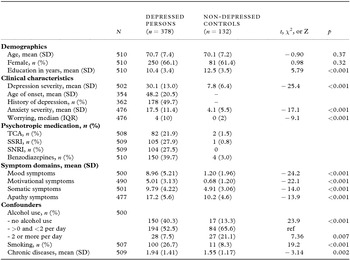
Differences in demographics, clinical characteristics, symptom dimensions, and confounders between depressed and non-depressed older adults are shown in Table 1.
Characteristics of the study sample

TCA = tricyclic antidepressant; SSRI = selective serotonin reuptake inhibitor; SNRI = serotonergic and noradrenergic working antidepressants.
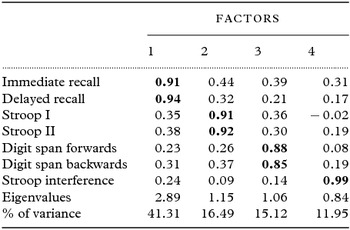
Table 2 shows the factor loadings, eigenvalues, and explained variances of the exploratory factor analysis. Four factors were retained according to the established criteria. These four factors explained 86.0% of the total variance and showed four theoretical domains. These four domains were interpreted as episodic memory (immediate and delayed recall), processing speed (Stroop cards I and II), and two domains of executive functioning: interference control (interference score of the Stroop) and working memory (digit span forwards and backwards). Few participants were excluded because of missing scores on one of the two tasks forming one domain (episodic memory: n = 1; processing speed: n = 3; working memory; n = 3). The interference control score was reversed to make sure that higher Z-scores reflect better cognitive performance in all domains of cognitive functioning.
Factor loadings, eigenvalues, and explained variances of the exploratory factor analysis on the separate cognitive tasks

The primary loading for each item is printed bold.
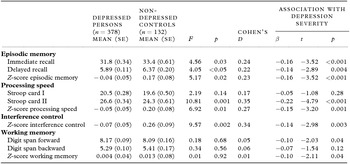
In Table 3 it is shown that depressed older adults have lower scores on the cognitive domains episodic memory, processing speed, and interference control but not on working memory, compared with non-depressed control participants. These results were largely comparable to the differences observed by the separate cognitive tasks. The associated effect sizes were modest, with the lowest effect size for episodic memory (d = 0.23) and the highest for interference control (d = 0.34). In the total group, higher severity of depressive symptoms was associated with poorer cognitive functioning on all four cognitive domains.
Associations between depression status and depression severity with cognitive functioning

Notes: Adjusted for age, sex, education, alcohol use, smoking status, and chronic diseases.
Degrees of freedom ANCOVA analysis; Episodic memory: 486, Processing speed: 474, Interference: 467, Working memory: 478.
Degrees of freedom Regression analysis; Episodic memory: 485, Processing speed: 473, Interference: 466, Working memory: 477.
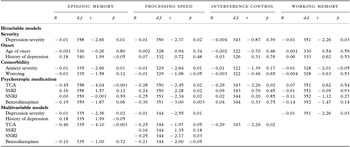
Table 4 shows the associations between clinical characteristics of depression and the four domains of cognitive functioning in the depressed group. A higher severity of depressive and anxiety symptoms was associated with lower scores on episodic memory, processing speed, and working memory; worrying was associated only with slower processing speed. Recurrent episodes as opposed to first episodes were associated with better episodic memory performance. Regarding the use of psychotropic medication, TCAs were associated with poorer episodic memory, slower processing speed, and poorer interference control, and the use of SNRIs and benzodiazepines with slower processing speed.
Bivariable and multivariable associations between clinical characteristics and cognitive functioning among currently depressed older adults (n = 378)

Notes: Adjusted for age, sex, education, alcohol use, smoking status, and chronic diseases.
TCA = tricyclic antidepressants; SSRI = selective serotonin reuptake inhibitor; SNRI = serotonergic and noradrenergic working antidepressants.
High correlations were present between depression severity and anxiety severity (r = 0.58, p < 0.001), and worrying (r = 0.41, p < 0.001), and the individual significant effects disappeared when depression severity and anxiety or worrying were examined together. Therefore, only depression severity, being the strongest bivariable predictor of the psychopathological variables, was added to the multivariable models. The multivariable models (Table 4) showed that a greater severity of depression, a first depressive episode, and the use of TCAs were associated with worse episodic memory functioning. A greater severity of depression, the use of TCAs, SNRIs, and benzodiazepines was associated with slower information processing speed. The use of TCAs was also associated with poorer interference control, whereas only depression severity was associated with poorer working memory.
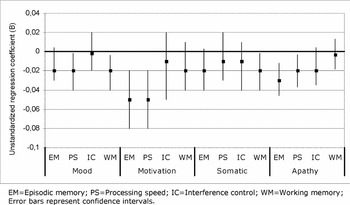
The different symptom dimensions of late-life depression were observed to have different associations with cognitive functioning (Figure 1). A higher score on the mood dimension was associated with worse working memory (B = –0.02, t(350) = –2.44, p = 0.02) and processing speed (B = –0.02, t(349) = –2.17, p = 0.03), a higher score on the motivational dimension and AS were both associated with worse episodic memory (motivational: B = –0.05, t(350) = –3.11, p = 0.002; apathy: B = –0.03, t(336) = –3.35, p = 0.001), and processing speed (motivational: B = –0.05, t(342) = –3.34, p = 0.001; apathy: B = –0.02, t(330) = –2.27, p = 0.02). A higher score on the somatic dimension was only associated with poorer working memory (B = –0.02, t(351) = –2.17, p = 0.03).
Associations between late-life depression symptom dimensions (mood, motivation, somatic, apathy) and cognitive functioning.

Discussion
In this large cohort of depressed and non-depressed older adults it was shown that depressed older adults have poorer cognitive functioning. A higher severity of psychopathological symptoms, having a first depressive episode, and the use of TCAs, SNRIs, and benzodiazepines was associated with worse cognitive performance. Poorer functioning in different cognitive domains was observed for specific symptom dimensions.
Our results contribute to the growing body of research emphasizing on impaired cognitive functioning in late-life depression (Thomas and O'Brien, Reference Thomas and O'Brien2008). In the depressed group, the severity of depressive, anxiety, and worry symptoms showed individually strong effects on cognitive functioning. However, these effects were no longer significant when examined together. This may indicate that high levels of anxiety and worrying reflect high severity of depression in our sample, and that high psychopathology severity was associated with poorer cognitive functioning in multiple cognitive domains.
Higher depression severity was associated with poorer episodic memory, processing speed, and working memory. Although some inconsistencies were observed in previous research, this is in line with studies whereby depression severity was associated with cognitive impairments when also other determinants of cognitive functioning in late-life depression were taken into account (Butters, Reference Butters2004; Sheline et al., Reference Sheline2006). The association between TCAs and poor cognitive functioning might be the result of the anticholinergic or antihistaminic effects of TCAs. This supports a preference for SSRIs in late-life depression compared to TCAs, which is in line with current Dutch psychiatry guidelines (Landelijke Stuurgroep Multidisciplinaire Richtlijnontwikkeling in de GGZ, 2008). Even though the use of SSRIs has increased enormously in the last decade, TCAs are still often used by older adults with depression (Sonnenberg et al., Reference Sonnenberg, Deeg, Comijs, van Tilburg and Beekman2008). Also, in the current study percentages of 21.9% were observed for TCAs compared to 27.9% for SSRIs. In addition, the use of SNRIs was associated with slower processing speed, which might be a direct effect of side effects such as tiredness and sleeplessness. Although we corrected for severity of depression, we cannot rule out the possibility that persons using TCAs and SNRIs, which are often used as second line following a non-response to SSRIs, have a more complex form of depression. In addition, in the Dutch psychiatry guidelines it is also stated that TCAs might be the first choice of antidepressant use when the depression severity is high, mainly when there are melancholic or psychotic features. Thus, it might be that TCAs and SNRIs are not causative factors itself in the association with cognitive functioning but might be the result of underlying depression complexity. In our sample also a high proportion of benzodiazepine use was observed (39.7%), which was also associated with slower processing speed. This is in line with results from a community-based study whereby especially chronic benzodiazepine use was associated with worse cognitive functioning (Bierman et al., Reference Bierman, Comijs, Gundy, Sonnenberg, Jonker and Beekman2007). Overall, these results suggest that it is important to carefully consider the prescription of psychotropic medication in late-life depression and that close monitoring on cognitive side effects is necessary. The cross-sectional nature of the current study precludes more fine-grained analyses to determine whether antidepressant medication precedes poorer cognitive functioning. Follow-up data of the NESDO study could give more information about cognitive functioning in depressed persons versus persons in remission and the role of psychotropic medication in this association. This might help in disentangling the causative relationships between psychotropic medication and cognitive functioning.
A history of depression was associated with better episodic memory, thus, a first depressive episode was associated with worse episodic memory. A first depressive episode in late life is associated with a later onset (mean age of onset first episode vs. history of depression: 56.2 vs. 40.8), and might be closer associated with underlying incipient neurodegenerative diseases (van Ojen et al., Reference van Ojen, Hooijer, Bezemer, Jonker, Lindeboom and van1995). However, in our study the age of onset of late-life depression was not associated with poorer cognitive function, which is in line with other research that excluded persons with dementia and examined multiple determinants of cognitive functioning together (Butters, Reference Butters2004; Sheline et al., Reference Sheline2006). Persons with a first depressive episode did not differ from persons with a recurrent depression on demographics, psychotropic medication, alcohol use, smoking status, and chronic diseases. However, persons with a first depressive episode had higher levels of worrying and motivational problems which might have contributed to a worse cognitive performance. Another explanation might be that the first episode already had a long duration, actually, about 30% of the persons with only one depressive episode reported a duration of more than 14 years. This suggests the presence of chronic depression which might be more unfavorable than experiencing recurrent episodes with symptom-free periods in between (Hetrick et al., Reference Hetrick, Parker, Hickie, Purcell, Yung and McGorry2008).
Symptom dimensions of late-life depression were associated with poorer functioning in different cognitive domains, suggesting that heterogeneity of late-life depression may lead to problems in different domains of cognitive functioning. Although we performed multiple analyses, the probability that our findings can be explained by chance alone is very low. In addition, the findings in our study are not unexpected and consistent with other research, therefore we have not made a correction for multiple testing.
Higher scores on the mood dimension were associated with impairments on working memory and processing speed which might be explained by deficiencies in mental effort and attention when mood symptoms are prominent. This is in line with a population-based study of Baune et al. (Reference Baune, Suslow, Arolt and Berger2007) who observed slower processing speed among those scoring high on a depressive mood subscale. Alternatively, higher scores on the motivational symptom dimension was associated with poorer episodic memory and processing speed, which was in line with the associations found for the apathetic symptom dimension. This may suggest that apathetic/motivational symptoms of late-life depression are associated with poorer episodic memory and information processing speed. Feil et al. (Reference Feil, Razani, Boone and Lesser2003) also observed apathy symptoms to be associated with slower processing speed. In addition, they observed that apathy symptoms were associated with worse executive functioning. However, the measures of executive functioning showing significant associations were closely related to processing speed and might as well reflect reductions in processing speed. Another explanation why we did not observe an association with executive functioning might be that apathy in late-life depression is more a marker of higher depression severity and less associated with neurodegenerative processes compared to apathy in non-depressed older adults. An apathy syndrome independent of late-life depression might have resulted in higher dysfunctioning in multiple cognitive domains including executive functioning.
A major strength of the current study is that a large and representative sample of currently depressed older adults with a diagnosis based on official DSM-IV diagnosis was examined and a wide range of clinical characteristics and cognitive domains was investigated. Some weaknesses should also be mentioned. First, cross-sectional data were used, therefore no causal inference can be made. Second, although persons with dementia were excluded, we cannot be sure that persons in very early stages of dementia were also excluded. Third, it might be difficult to state if a depressive episode was one long episode or several short episodes, and the number of depressive episodes might therefore be influenced by some recall bias. Finally, the most severely depressed or physically ill persons might be unwilling or unable to participate and conclusions should therefore not be generalized to the most severely depressed group.
To conclude, this large cohort of older depressed persons showed poorer cognitive function in late-life depression. Heterogeneity of late-life depression may lead to problems in different domains of cognitive functioning, whereby a higher severity of psychopathological symptoms, a history of depression, and differences in symptom dimensions are important characteristics. Our findings on the use of TCAs, SNRIs, and benzodiazepines suggest that close monitoring on cognitive side effects should be done when psychotropic medications are prescribed.
Conflict of interest
None.
Description of authors’ roles
H.C. Comijs contributed to the conception and design of the study. N.C.M. Korten undertook the analyses. B.W.J.H. Penninx and H.C. Comijs assisted in the analyses. N.C.M. Korten made the first draft of the paper, and B.W.J.H. Penninx, R.M. Kok, M.L. Stek, R.C. Oude Voshaar, D.J.H. Deeg, and H.C. Comijs contributed to revising the paper critically for important intellectual content. All authors contributed to and have approved the final manuscript.
Acknowledgments
The infrastructure for NESDO is funded through the Fonds Nuts Ohra, Stichting tot Steun VCVGZ, and NARSAD: The Brain and Behaviour Research Fund, and the participating universities and mental healthcare organizations (VU University Medical Center, Leiden University Medical Center, University Medical Center Groningen, Radboud University Nijmegen Medical Center, GGZ inGeest, GGNet, GGZ Nijmegen, GGZ Rivierduinen, Lentis, and Parnassia).