


Introduction
Disclosure of a mental health problem shapes access to social support, appropriate clinical care and reasonable accommodations in workplace and education settings. As a mental health problem is often concealable, the decision to disclose a diagnosis or experiences of symptoms is likely to be complex and to involve consideration of potential risks and benefits (Chaudoir and Fisher, Reference Chaudoir and Fisher2010; Baldwin et al., Reference Baldwin, DeSerpa and Marcus2023). The latter may include increased social support and reduced feelings of inauthenticity, stress, isolation and self-stigma (Corrigan et al., Reference Corrigan, Larson, Michaels, Buchholz, Rossi, Fontecchio, Castro, Gause, Krzyzanowski and Rusch2015). Disclosure of symptoms may facilitate labelling, help-seeking, access to treatment and ultimately, relief from distress (Wright et al., Reference Wright, Jorm and Mackinnon2011). There may also be benefits of disclosure in specific settings. For example, in workplaces these might include better matching of workers and job tasks or reasonable adjustments that support people to keep performing their work roles (Reavley et al., Reference Reavley, Ross, Killackey and Jorm2012). In education settings, disclosure may allow a person to access accommodations such as extensions to assignment deadlines or extra time for exams (Reavley et al., Reference Reavley, Ross, Killackey and Jorm2013). Risks include negative outcomes that otherwise might have been avoided, such as social rejection or other forms of discrimination (Reavley et al., Reference Reavley, Ross, McNaught, Green and Morgan2026b).
A decision to disclose is likely to vary according to the setting of disclosure, with, for example, disclosure to family and friends involving different considerations than disclosure in the workplace (Brohan et al., Reference Brohan, Henderson, Wheat, Malcolm, Clement, Barley, Slade and Thornicroft2012; Lyubykh et al., Reference Lyubykh, Turner, Weinhardt, Davis and Dumaisnil2025). Disclosure decisions are also likely to vary according to the sociodemographic and mental health problem characteristics of the person considering them (Chaudoir and Fisher, Reference Chaudoir and Fisher2010; Baldwin et al., Reference Baldwin, DeSerpa and Marcus2023). Stigma, including perceptions of stigmatising attitudes held by others, self-stigma, actual experiences of discrimination and anticipated discrimination (for example, fear of job loss or social exclusion), are also likely to play a role in the decision to disclose (Dewa, Reference Dewa2014; Evans-Lacko and Knapp, Reference Evans-Lacko and Knapp2014). Therefore, at the population level, disclosure patterns are important indicators of the social environment for people with mental health problems and of barriers to service use and recovery.
While anti-stigma and mental health literacy campaigns commonly aim to reduce stigma and discrimination and promote appropriate professional help-seeking, they should also aim to increase disclosure to people who can support someone with a mental health problem (Henderson et al., Reference Henderson, Robinson, Evans-Lacko and Thornicroft2017). Thus, disclosure may be viewed as an indicator of the success of efforts to create more supportive and less discriminatory environments for people with mental health problems. However, there is relatively scarce evidence of this from population-level studies. As an exception, evaluation of the UK Time to Change anti-stigma campaign showed that campaign awareness was associated with greater comfort in disclosing to family and friends (odds ratio [OR] = 1.27, 95% confidence interval [CI]: 1.14–1.43) and to current or prospective employers (OR = 1.20, 95% CI: 1.06–1.35) (Henderson et al., Reference Henderson, Robinson, Evans-Lacko and Thornicroft2017). Evidence from more intensive interventions also shows beneficial impacts. These include a Dutch study of a stigma awareness intervention for employment specialists that, when combined with a decision aid tool for employees, showed improved employment outcomes in the intervention group (Janssens et al., Reference Janssens, Joosen, Henderson, Bakker, den Hollander, van Weeghel and Brouwers2024). An Australian evaluation of Mental Health First Aid (MHFA) training for teachers showed reduced stigma and increased intentions to disclose (Jorm et al., Reference Jorm, Kitchener, Sawyer, Scales and Cvetkovski2010).
Population-based surveys that randomly sample members of the public are the best way to accurately measure population attitudes and behaviours such as disclosure (Carina and Michael, Reference Carina and Michael2018). With limited exceptions (most notably Time to Change UK [Henderson et al., Reference Henderson, Robinson, Evans-Lacko and Thornicroft2017]), relatively few robust studies have explored disclosure in a range of settings. Another exception is an Australian study conducted in 2014. This nationally representative survey of 5220 adults, 1381 of whom reported a mental health problem or scored highly on a symptom screening questionnaire, assessed disclosure of mental health problems to friends, intimate partners, other family members, supervisors or other colleagues in the workplace, teachers, lecturers or other students in the educational institution, health professionals and others in the community (Reavley et al., Reference Reavley, Morgan and Jorm2018b). Findings showed that, for friends and family, non-disclosure was relatively uncommon (81.4% of respondents disclosed to some or all friends, 91% disclosed to their spouse and 81.5% disclosed to some or all family members), whereas non-disclosure was most common in workplaces (only 43.5% disclosed to a supervisor and 45.5% disclosed to others in the workplace), education settings (62.2% did not disclose to teachers or lecturers) and to health professionals (67.7% did not disclose). In most other domains, non-disclosure was most common, including in the workplace, where non-disclosure to supervisors was more likely than disclosure. In the years since this study was conducted, Australia has invested in efforts to improve mental health literacy and reduce stigma, through funding of key non-government organisations such as Beyond Blue, Mental Health First Aid and SANE Australia. While, in most cases, these programmes do not explicitly aim to encourage disclosure (other than to mental health professionals involved in treatment), assessment of disclosures at population level allows for measurement of population norms, including in key settings and population groups.
This study, which forms a component of SANE Australia’s 2026 National Stigma Report Card, involved collection of data from a large representative sample of Australians who reported having a mental health problem or experiencing high psychological distress. These findings were compared with those of the 2014 National Survey of Experiences of Discrimination and Positive Treatment. We aimed to examine change over the preceding 10-year period, and also to examine whether any respondent sub-populations had experienced greater or lesser changes.
Methods
Study design
The study involved repeat cross-sectional surveys conducted in the general Australian adult population.
Participants
2014 sample
Details of the 2014 survey procedures have been published previously (Reavley et al., Reference Reavley, Morgan and Jorm2018b). In brief, the Social Research Centre carried out computer-assisted telephone interviews, using both mobile and landline numbers, with a nationally representative group of 5220 adults aged 18 years and over. Of these, 1381 respondents either self-reported a mental health condition or met criteria for elevated symptoms on a screening measure. Only those respondents who specified any of the following mental health problems were considered in scope: depression/major depression, attempted suicide or self-harm, anxiety/anxiety disorder, post-traumatic stress disorder (PTSD), agoraphobia, panic disorder, obsessive-compulsive disorder, social phobia, generalised anxiety disorder (GAD), eating disorder/anorexia/bulimia, schizophrenia/paranoid schizophrenia, schizoaffective disorder, psychosis/psychotic, bipolar/bipolar disorder/manic-depressive disorder, mental illness, personality disorder/borderline personality disorder, attention deficit-hyperactivity disorder (ADHD), Autism/Asperger’s and nervous breakdown. Data collection took place from October to December 2014, and the survey achieved a response rate of 37.5%.
2024 sample
The 2024 dataset forms part of SANE Australia’s 2026 National Stigma Report Card, with additional analyses described elsewhere (Morgan et al., Reference Morgan, Ross, McNaught, Green and Reavley2026; Reavley et al., Reference Reavley, Ross, Green, McNaught and Morgan2026a). Participants were drawn from the general Australian adult population (18+) enrolled in The Social Research Centre’s Life in Australia™ probability-based panel. A stratified random sample was selected using strata for age, gender, educational attainment and whether a language other than English was spoken at home. Panel members received invitations via email and, where available, SMS, and were reimbursed either $10 or $20 depending on survey length. All survey items were reviewed by SANE’s Lived Experience Advisory Group during a facilitated group discussion process, and revisions were made in line with their feedback. Data collection occurred in November 2024.
Survey questionnaire
The following sociodemographic information was collected in both surveys: state, capital city/rest of state, age, gender, citizenship status, Aboriginal and Torres Strait Islander status, country of birth, level of education, language spoken at home, marital status and employment status.
Mental health and psychological distress
Participants completed the 12-month version of the Kessler-6 Psychological Distress Scale (Kessler et al., Reference Kessler, Green, Gruber, Sampson, Bromet, Cuitan, Furukawa, Gureje, Hinkov, Hu, Lara, Lee, Mneimneh, Myer, Oakley-Browne, Posada-Villa, Sagar, Viana and Zaslavsky2010). This measure asks respondents to recall a month within the past year during which they felt most affected by depression, anxiety or significant emotional strain. They were also asked whether they had experienced any mental health difficulty in the previous 12 months, defined in the survey preamble as a period of several weeks or longer marked by feelings of depression, anxiety, or emotional stress that interfered with daily life. The full list of mental health problems considered in scope is provided in Reavley et al. (Reference Reavley, Ross, McNaught, Green and Morgan2026b).
Using these items, respondents were classified into two groups: (1) individuals who either scored in the ‘high’ range on the K6 (a score of 19 or above, which is indicative of a high probability of serious mental disorder under Australian scoring conventions (Australian Bureau of Statistics, 2012)) or who indicated experiencing an in-scope mental health problem; and (2) those who did not meet either criterion. Participants in the first group were then asked follow-up questions about whether a health professional had ever provided them with a diagnosis, the nature of that diagnosis and whether they had received any form of treatment.
Disclosure
In both the 2014 and 2024 surveys, those in the first group were then asked the following: ‘Have you told the following people about these emotional or mental health problems that you have had in the last 12 months?’ The questions covered the following people: Friends, spouse or intimate partner (only in those who reported being married or in a de facto relationship), other family members, your supervisor or boss at work and other people in your workplace (only in those who reported being in paid or unpaid employment), health professionals who are not involved in treating these problems and people in your neighbourhood or community’. Other than for intimate partner or supervisor (for which possible responses were ‘Yes’ or ‘No’), possible response categories were: ‘Yes, told everybody’, ‘Yes, told some people’ or ‘No, not told anybody’.
Weighting
Data were weighted to adjust for the probability of selection into the survey and to match key sociodemographic characteristics. For each year, weighting procedures involved computation of a base weight and subsequent adjustment based on population benchmarks for specific demographic characteristics, including age, gender, geographic location and level of education (see Reavley et al., Reference Reavley, Ross, Green, McNaught and Morgan2026a). A combined weight was generated using the final weight variables for each year.
Statistical analysis
Data at each time point were analysed with per cent frequencies and 95% CIs. Change over time in disclosure in each setting was evaluated with multinomial logistic regression with the reference category of no disclosure. We report odds ratios and 99% CIs and set the significance level at p < 0.01 to account for multiple comparisons and to strengthen confidence in observed effects. All change-over-time analyses were adjusted for the sociodemographic variables of age, gender, level of education, language spoken at home (English vs other) and country of birth (main English-speaking vs other) to investigate whether population changes between the surveys may have impacted the results. To adjust for differences in prevalence proportions of reported mental health problems, we also included the following covariates: any anxiety problem (any of anxiety/anxiety disorder, PTSD, GAD, agoraphobia, panic disorder, social phobia/anxiety disorder and obsessive-compulsive disorder), any severe mental health condition (any of schizophrenia, bipolar disorder, schizoaffective disorder, psychosis and personality disorder), depression/major depression and ADHD. All were coded as present vs absent.
To assess whether change over time varied according to sociodemographic and mental health problem characteristics, we conducted multivariable multinomial regression analyses as above, including interactions between survey year and each characteristic. Significant interactions were plotted to visualise the relationship between time and characteristics. All analyses were performed using Stata SE 18.
Results
In the 2014 survey, of 5220 people, 16.5% (95% CI: 15.2–17.8) were found to have K6 scores of 19 or above, and 23.9% (95% CI: 22.5–25.4) reported having a mental health problem considered to be in-scope. In 2024, these proportions were 27.0% (95% CI: 25.6–28.4) and 39.0% (95% CI: 37.5–40.5), respectively. Thus, in 2014, 28.8% (95% CI: 27.3–30.3) (n = 1381) participants met the criteria for being asked the questions about disclosure and in 2024 this was 44.4% (95% CI: 42.9–46.0) (n = 2613). Sociodemographic and mental health problem characteristics are reported in Supplementary Table 1. In 2024, the proportions of people reporting diagnoses of anxiety/anxiety disorders, PTSD, GAD, social phobia and ADHD were greater than in 2014.
Change in disclosure over time
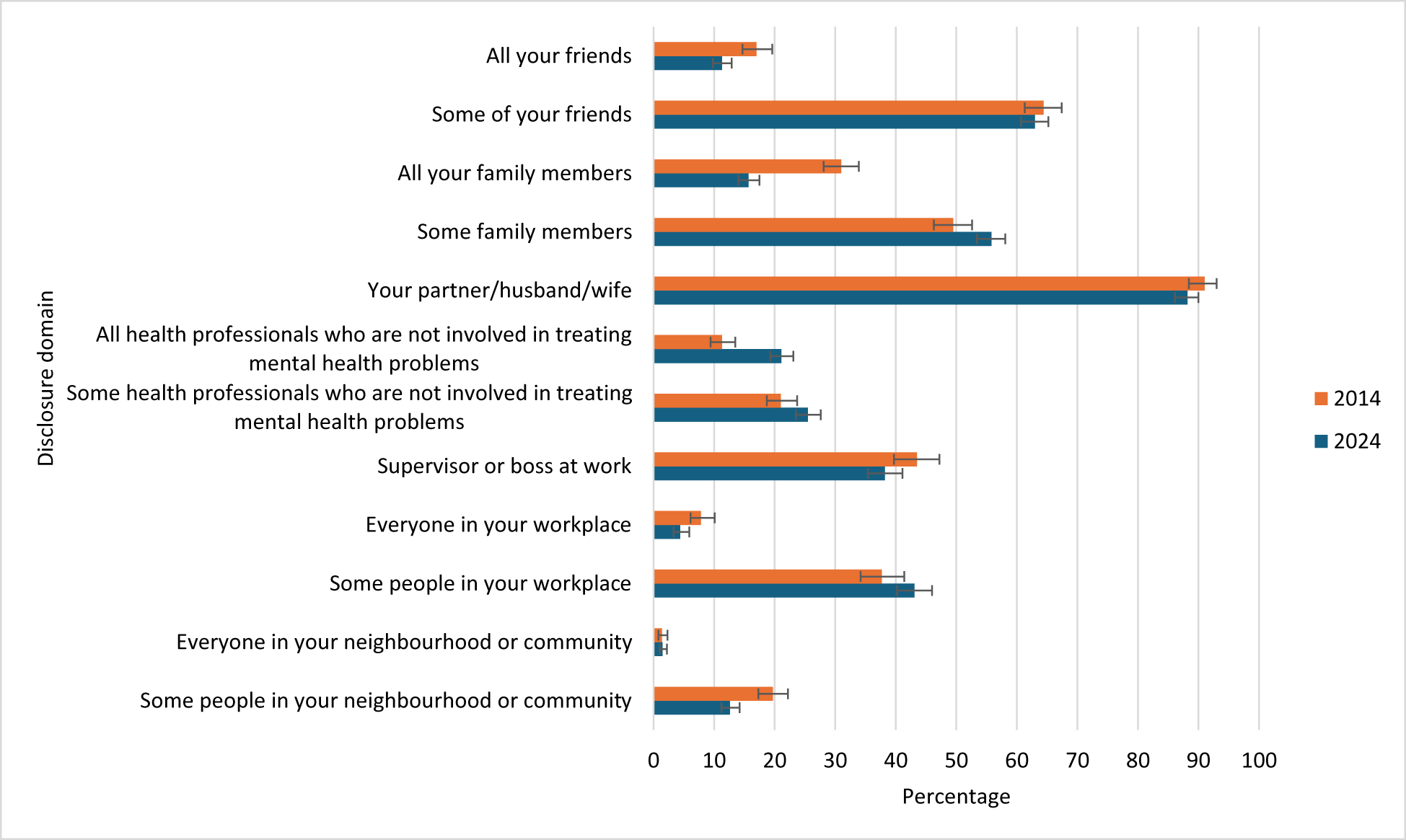
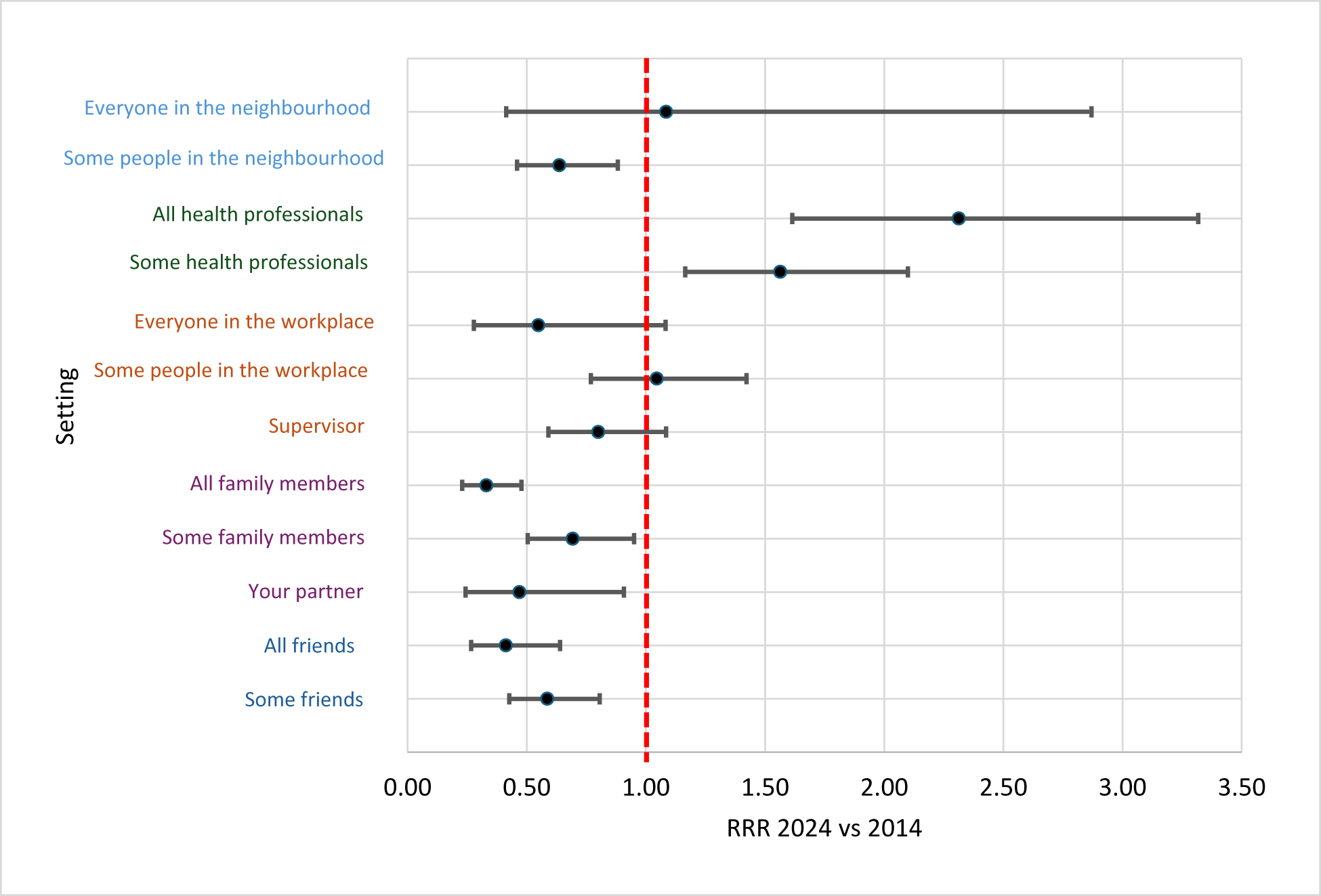
Figure 1 (and see Supplementary Table 2) presents the proportions of people reporting disclosure in various settings in 2014 and 2024, while Fig. 2 gives the relative risk ratios of changes in each setting, controlling for sociodemographic and mental health problem characteristics.
Disclosure of mental health problems in 2014 and 2024 (% and 95% CIs).

Figure 1 Long description
The horizontal bar graph compares disclosure of mental health problems across various domains for the years 2014 and 2024. The x axis represents Percentage, ranging from 0 to 100. The y axis lists disclosure domains: All your friends, Some of your friends, All your family members, Some family members, Your partner slash husband slash wife, All health professionals not involved in treating mental health problems, Some health professionals not involved in treating mental health problems, Supervisor or boss at work, Everyone in your workplace, Some people in your workplace, Everyone in your neighbourhood or community, Some people in your neighbourhood or community. Each domain has two bars, one for 2014 and one for 2024, distinguished by color. Key observations include: ′Your partner slash husband slash wife′ shows the highest disclosure rates, nearing 100 percent for both years. ′All your friends′ and ′All your family members′ have high disclosure rates, with slight increases from 2014 to 2024. ′Some people in your neighbourhood or community′ shows the lowest disclosure rates, with minimal change between the years. Notable differences are seen in ′Supervisor or boss at work′, where disclosure increased significantly from 2014 to 2024. Error bars are present, indicating variability in the data. The graph highlights trends in disclosure practices over the decade, emphasizing increased openness in certain domains.
Relative risk ratios (RRR) (and 99% CIs) of change in disclosure over time.

Figure 2 Long description
Relative risk ratios of change in disclosure over time. The y-axis is labeled, Setting. The x-axis is labeled, RRR 2024 vs 2014, with tick labels at 0.00, 0.50, 1.00, 1.50, 2.00, 2.50, 3.00 and 3.50. A vertical dashed reference line is drawn at 1.00. Everyone in the neighbourhood: point at 1.08 with whiskers from 0.44 to 2.85. Some people in the neighbourhood: point at 0.63 with whiskers from 0.48 to 0.85. All health professionals: point at 2.29 with whiskers from 1.60 to 3.30. Some health professionals: point at 1.56 with whiskers from 1.15 to 2.10. Everyone in the workplace: point at 0.54 with whiskers from 0.30 to 1.08. Some people in the workplace: point at 1.03 with whiskers from 0.78 to 1.42. Supervisor: point at 0.79 with whiskers from 0.58 to 1.08. All family members: point at 0.33 with whiskers from 0.24 to 0.46. Some family members: point at 0.68 with whiskers from 0.50 to 0.92. Your partner: point at 0.48 with whiskers from 0.30 to 0.88. All friends: point at 0.40 with whiskers from 0.28 to 0.62. Some friends: point at 0.58 with whiskers from 0.44 to 0.80.
For disclosure to partners, some people in the neighbourhood, family members and friends, the relative risk ratios (RRRs) of disclosure were lower in 2024 than in 2014 with RRRs ranging from 0.33 (99% CI: 0.23, 0.48; p < 0.001) for all family members to 0.64 (99% CI: 0.46, 0.88; p < 0.001) for some people in the neighbourhood. For disclosure to supervisors and people in the workplace, disclosure was not significantly different in 2024 than in 2014.
For health professionals not involved in mental health treatment, the RRR of disclosure were higher in 2024 than 2014 (RRR = 1.56 [99% CI: 1.16–2.10; p < 0.001] for disclosure to some and RRR = 2.31 [99% CI: 1.61–3.32; p < 0.001] for disclosure to all).
Associations between change in disclosure and sociodemographic and mental health problem characteristics
For partner disclosure, there was a significant interaction between age group and survey year. Predicted probabilities showed that disclosure increased among adults aged 18–34 between 2014 and 2024, while declining among those aged 34–64 and 65+ (see Supplementary Table 3). There were no other statistically significant findings at p < 0.01 for any domain (see Supplementary Tables 3–6).
Discussion
The findings of the first nationally representative study to explore population-level changes in disclosure of mental health problems over 10 years present a complex picture. In 2024, participants were less likely to have disclosed in most domains than in 2014, including to friends, partners, family members and some people in the neighbourhood. Workplace disclosure did not change significantly between 2014 and 2024, with the majority of people not disclosing to supervisors or others in the workplace. More encouragingly, they were more likely to disclose to health professionals not involved in mental health treatment. Assessment of sociodemographic and mental health problem characteristics associated with change revealed few significant findings, suggesting that the disclosure changes were largely consistent across all population groups.
As indicators of the social environment for people with mental health problems, these findings are in line with studies in other countries suggesting that stigmatising attitudes towards people with most diagnoses do not appear to have reduced in recent decades and may even have increased, particularly for those with severe mental illness (Pescosolido et al., Reference Pescosolido, Halpern-Manners, Luo and Perry2021; Schomerus et al., Reference Schomerus, Schindler, Sander, Baumann and Angermeyer2022). They also align with analyses of other data from the SANE Stigma Report Card assessing change since previous surveys. These include findings that, since 2014, increases in reports of experiences of discrimination outweigh the increases in reports of positive treatment (Reavley et al., Reference Reavley, Ross, Green, McNaught and Morgan2026a). It is possible that awareness of this, perhaps by observing others’ attitudes or experiences explain these findings. Other analyses show that, despite some stigmatising beliefs diminishing over time, willingness to interact with people with depression or schizophrenia has not improved since 2011 (Morgan et al., Reference Morgan, Ross, McNaught, Green and Reavley2026).
However, they are somewhat surprising in the context of community campaigns such as RU Ok day and others in Australia that encourage more conversations about mental health, including in workplaces (Ross and Bassilios, Reference Ross and Bassilios2019). Thus, study findings may point to the need for action at the organisational level to improve support for people who disclose in settings such as workplaces, particularly when economic conditions become more challenging, and for further research to explore this. Disclosure decisions in workplaces are likely to be complex, and trials of decision aid tools have shown beneficial impacts on disclosure behaviours and symptoms of mental illness in UK and Australian workplaces (Henderson et al., Reference Henderson, Brohan, Clement, Williams, Lassman, Schauman, Dockery, Farrelly, Murray, Murphy, Slade and Thornicroft2013; Stratton et al., Reference Stratton, Choi, Calvo, Hickie, Henderson, Harvey and Glozier2019). However, the perceived and actual supportiveness of environments into which a person might disclose are likely to be very important to any decision-making process and organisational policies and procedures are likely to be key to ensuring that disclosures have positive rather than negative outcomes. Supporting this, in a study of over 800 Canadian employees, low anticipated discrimination, visible resources and social support were positively associated with both willingness and actual disclosure behaviours, and with better mental health and work outcomes (Lyubykh et al., Reference Lyubykh, Turner, Weinhardt, Davis and Dumaisnil2025). Evidence-based mental health education programmes, such as MHFA training, have been shown to improve supportive behavioural intentions by individuals in randomised controlled trials (Reavley et al., Reference Reavley, Morgan, Fischer, Kitchener, Bovopoulos and Jorm2018a). Further research is necessary to explore whether implementation of these programmes has led to more supportive organisational environments more broadly.
The increases in disclosure to health professionals not involved in mental health treatment stand out from the findings seen in other settings and may offer guidance as to how to improve the situations in these other settings. Concern about stigma and discrimination in health settings has led to a number of policy and practice changes in Australia in recent years (Morgan et al., Reference Morgan, Reavley, Jorm and Beatson2016). These include health professional training packages aimed at reducing stigmatising attitudes and behaviours. These often include narratives or interactions with people with lived experience of mental health problems (Zhamaliyeva et al., Reference Zhamaliyeva, Ablakimova, Batyrova, Veklenko, Grjibovski, Kudaibergenova and Seksenbayev2025). Beyond training, there have also been efforts to target structural stigma and discrimination, which refers to policies and practices that work to the disadvantage of people with mental health conditions (Hatzenbuehler, Reference Hatzenbuehler2016). In Australia, these have included greater attention to the physical health of people with severe mental health conditions (Roberts et al., Reference Roberts, Lockett, Bagnall, Maylea and Hopwood2018), reductions in the use of seclusion and restraint (Brophy et al., Reference Brophy, Roper, Hamilton, Tellez and McSherry2016) and a greater focus on peer-led services (Reeves et al., Reference Reeves, McIntyre, Loughhead, Halpin and Procter2024). While these initiatives are targeted towards more severe mental health problems, our findings apply across a range of mild to severe mental health problems. There is also some evidence that health practitioners treating patients for other health conditions are more likely to ask about mental health, and therefore more likely to elicit disclosure (Isaacs and Mitchell, Reference Isaacs and Mitchell2024). It may also be the case that, because of greater awareness of privacy and confidentiality, people have become more open about disclosing to health professionals, as this is seen as less risky.
The findings relating to decreases in disclosure to friends and family may also have implications for population-level education to friends and family who may be in a position to support people disclosing high symptom levels of diagnoses. Better quality support has been linked with better mental health in recipients of help, better relationships and help-seeking (Morgan et al., Reference Morgan, Wright, Mackinnon, Reavley, Rossetto, Le and Jorm2025b). They point to the importance of education on how to provide non-stigmatising and non-judgemental support along with information about signs and symptoms and sources of help (Rossetto et al., Reference Rossetto, Jorm and Reavley2016; Jorm et al., Reference Jorm, Reavley, Lu, Tsiamis and Morgan2026).
These findings may also point to the value of including measures of disclosure norms (including intentions or comfort with disclosure) in interventions designed to improve mental health literacy or stigma, as they measure participant views about the environments in which they live and work (Morgan et al., Reference Morgan, Ross, Oostermeijer, Kelly, Nicholas, Pirkis and Reavley2025a).
Strengths and limitations
This study has several strengths, including two large, nationally representative samples of Australian adults. Most questions were consistent between time periods, allowing for accurate comparison over time. Analyses also controlled for change in population demographics, which are known to be associated with disclosure (Reavley et al., Reference Reavley, Morgan and Jorm2018b). Limitations include the differences in survey administration mode, which was computer-assisted telephone interview in 2014 and online in 2024.
Conclusions
With the exception of disclosure to health professionals not involved in mental health treatment, disclosure of a mental health problem has decreased or remained unchanged over the last 10 years, potentially reflecting both perceptions of, and actual, reductions in supportive social environments. These findings emphasise that improved population mental health literacy or reduced stigma do not guarantee disclosure or help-seeking but that structural, interpersonal and contextual barriers remain important. These vary by setting and are likely to require targeted actions to deliver improvements. Given the potential benefits of disclosure for obtaining appropriate professional help and other support, urgent action is needed to ensure that, for people who do disclose a mental health problem, the benefits strongly outweigh the risks.
Supplementary material
The supplementary material for this article can be found at https://doi.org/10.1017/S2045796026101061.
Availability of data and materials
Data are available on reasonable request.
Acknowledgements
We would like to thank SANE’s Lived Experience Advisory Committee for providing input into the survey questions.
Author contributions
N.R. led the research design, statistical analysis and manuscript drafting. N.R. and A.M. led the survey design, oversaw statistical analysis and contributed to the research design and drafting of the manuscript. G.M. and R.G. contributed to the research design and drafting of the manuscript. All authors reviewed and approved the final manuscript.
Financial support
The 2025 National Stigma Report Card survey was funded by SANE Australia. A.R. receives funding from NHMRC (Investigator Grant #2025181), A.M. from Mental Health First Aid International and Veski and N.R. from SANE.
Competing interests
R.G. and G.M. are employees of SANE, Australia. A.R. and N.R. receive some salary support from SANE, Australia.
Ethical standards
The authors assert that all procedures contributing to this work comply with the ethical standards of the relevant national and institutional committees on human experimentation and with the Helsinki Declaration of 1975, as revised in 2000. Ethics approvals for both surveys were obtained from the University of Melbourne Human Research Ethics Committee (2014: ID1442448 and 2024: ID30886).


 Open access

