Complete atrioventricular canal defects account for approximately 4–5% of people with CHD and are seen in 33–48% of children with Trisomy 21.Reference Freeman3–Reference Setty, Shen and Nichols6 They are among the most common cardiac abnormalities found in children with Trisomy 21.Reference Cetta, Minich, Allen and Driscoll4,Reference Clapp, Perry and Farooki7,Reference Freeman8 Complete atrioventricular canal defect, if untreated, may lead to progressive increases in pulmonary artery pressure and pulmonary vascular resistance leading to remodelling of pulmonary arteries.Reference Lopes9 This remodelling is more prominent and occurs at an earlier age in children with Trisomy 21.Reference Clapp, Perry and Farooki7,Reference Yamaki10,Reference Hals, Hagemo and Thaulow11 Without surgical repair, 80% of patients with complete atrioventricular canal defect will die by 2 years of age.Reference Mitchell, Korones and Berendes5,Reference Setty, Shen and Nichols6 Those who survive are likely to develop irreversible pulmonary vascular disease at a young age leading to the development of Eisenmenger Syndrome.Reference Rabinovitch, Keane and Norwood12–Reference Kozlik-Feldmann, Hansmann and Bonnet15
In children with complete atrioventricular canal defect, it has been demonstrated that pulmonary vascular changes commence as early as 6 months of age.Reference Newfeld16 The histologic changes in the pulmonary arterioles may prevent the pulmonary vascular resistance from returning to normal after surgical repair.Reference Setty, Shen and Nichols6 After surgical repair these patients remain at risk for morbidity associated with elevated pulmonary vascular resistance.Reference D’Alto17,Reference Frontera-Izquierdo and Gabezuelo-Huerta18 Pulmonary artery hypertension remains a significant risk factor for morbidity and mortality, and the long-term results after surgery depend on the pre-operative pulmonary vascular resistance.Reference Setty, Shen and Nichols6,Reference Lopes9,Reference D’Alto and Mahadevan14,Reference Haworth19 Early diagnosis and surgery are recommended to prevent irreversible progression of pulmonary vascular disease.Reference Yamaki10,Reference Hals, Hagemo and Thaulow11,Reference Kozlik-Feldmann, Hansmann and Bonnet15,Reference Frontera-Izquierdo and Gabezuelo-Huerta18,Reference Boening20,Reference Masuda21 Over time pulmonary artery pressures are thought to normalise; however, the timing of this event has not been clearly determined.Reference Haworth19 Many gaps remain in our knowledge regarding the timing to resolution of the pulmonary artery hypertension and whether Trisomy 21 is associated with suboptimal outcomes. The purpose of this study is to describe the evolution of pulmonary artery hypertension after complete atrioventricular canal defect and to assess whether patients with Trisomy 21 are at higher risk of prolonged elevation of pulmonary artery pressure after surgical repair.
Methods
Patient selection
The study was approved by the institutional review board at University of Maryland, Baltimore. We performed a single centre, retrospective analysis, involving all patients from birth to 18 years old diagnosed with complete atrioventricular canal defects and admitted for surgical repair at the University of Maryland from 2005 to 2015. We excluded patients from our study if the complete atrioventricular canal defect was associated with single ventricle physiology, congenital lung malformation, chronic lung disease, and those with missing data.
Data collection
We collected data from the electronic medical record and the echocardiographic database. The demographic information included the child’s age at the time of surgery, race, sex, weight, and height. We collected operative data including bypass time and cross clamp time. The post-operative data included the duration of mechanical ventilation, oxygen therapy, the use and duration of nitric oxide, the use of sildenafil, the ICU length of stay, the post-operative complications, and medications on discharge.
Echocardiography
Post-operative echocardiographic data were collected to look for signs of pulmonary artery hypertension, including tricuspid regurgitation jet velocity, presence or absence of septal flattening, atrioventricular valve regurgitation, and right ventricular dilation. Data from the echocardiographic report were compared with the reviewed images for consistency. The right ventricular pressure estimate was calculated with the Bernoulli equation (4(tricuspid regurgitation jet velocity)2 + right atrial pressure) using a right atrial pressure of 8 mmHg for all the patients. The right ventricular pressure estimate is a reflection of pulmonary artery pressure when right ventricular outflow tract obstruction and pulmonary valve stenosis are absent.Reference Yock and Popp22–Reference Parasuraman, Walker and Loudon24 We calculated the estimated right ventricular pressure over three time periods post-operatively (0–7 days; 8–30days; >30 days to 1 year), making sure to have at least one measurement for each time period.
The right ventricular pressure estimate/systolic blood pressure ratio was calculated for the three time periods. This ratio was used as an estimate of the severity of pulmonary artery pressure independent of age. For missing blood pressure, we used systolic blood pressure of 80 mmHg for less than 1 year old, and a systolic blood pressure of 90 mmHg for more than 1-year-old children. All data from the archive were reviewed by a single paediatric cardiologist. Each individual had several measurements for each time period, and these measurements were averaged to report the mean value. Thirteen estimated blood pressures were used for more than 140 data points.
Statistical analysis
The demographic, pre-operative, and post-operative data were summarised by using frequencies, medians, and means with the standard deviation as appropriate. Data were analysed using MedCalc Statistical Software version 18.5 (MedCalc Software bvba, Ostend, Belgium; http://www.medcalc.org; 2018). We performed t-test or Mann–Whitney test on parametric and non-parametric data as well as Chi Square or Fisher’s exact to compare the two groups (patients with Trisomy and patients without). Non-parametric data that were able to be logarithmically transformed to parametric data were evaluated using t-tests, and data are reported as geometric means. The repeated measures of analysis of variance and serial measurement analysis were performed to follow the variation of right ventricular pressure estimate over three time periods post-operatively (0–7 days; 8–30 days; > days to 1 year).
Results
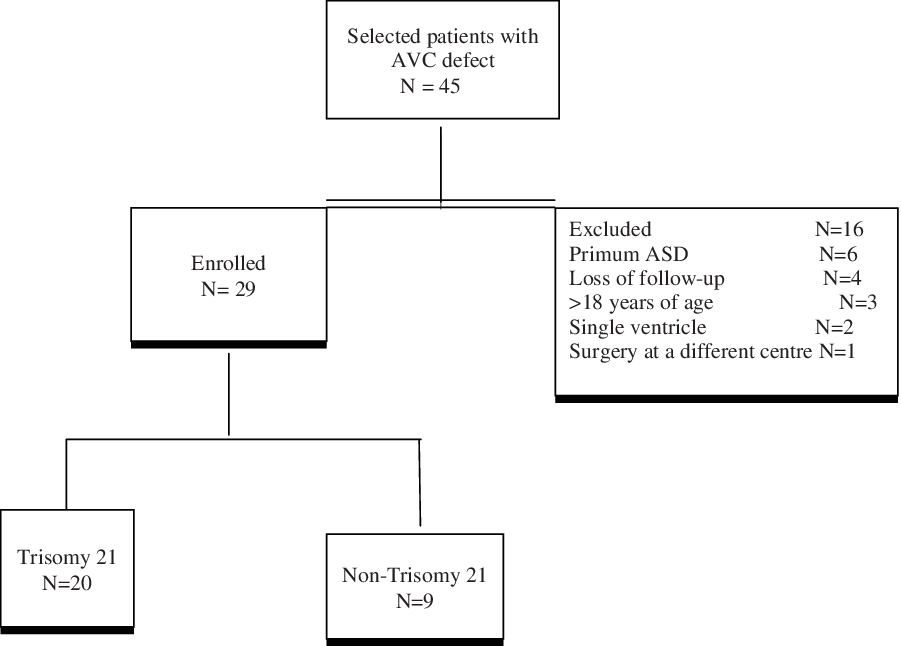
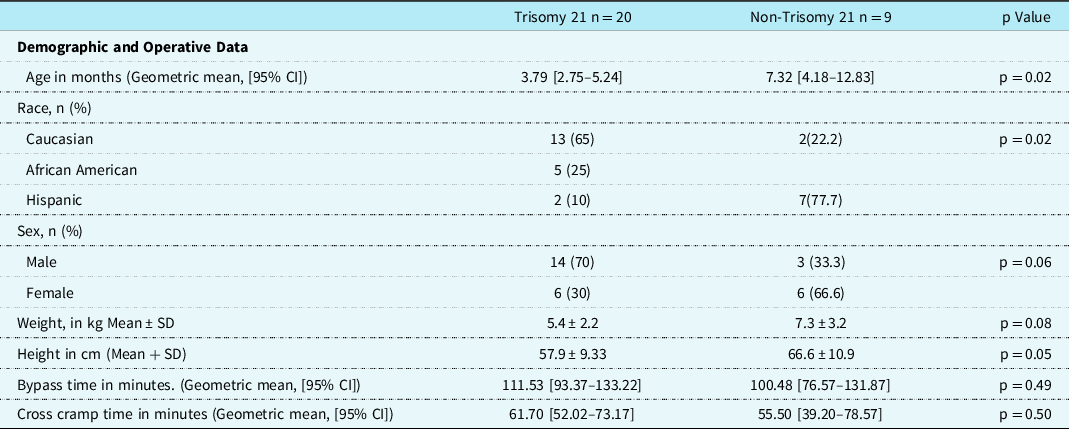
Forty-five patients were identified in our surgical database as having complete atrioventricular canal defects over the study period. Sixteen patients were excluded as the inclusion criteria were not met. The data from the remaining 29 patients were analysed. (Fig 1 ) 20 (69%) patients had a diagnosis of Trisomy 21 (Table 1) and 9 patients (31%) did not. The Trisomy 21 patients were statistically different from patients without that diagnosis based on race (p = 0.02) and age at surgery (p = 0.02). There were no differences between these two groups of patients regarding weight at the time of surgery, cardiopulmonary bypass time, or other intraoperative variables.
Study population.

Patient demographic data & operative times for patients who had AV canal repair.

Age presented a geometric means and [95th percentile confidence interval]
Sex- n and (percentage of the group); Weight and height –mean ± standard deviation SD; Bypass and cross clamp time – geometric mean and [95th percentile confidence interval]
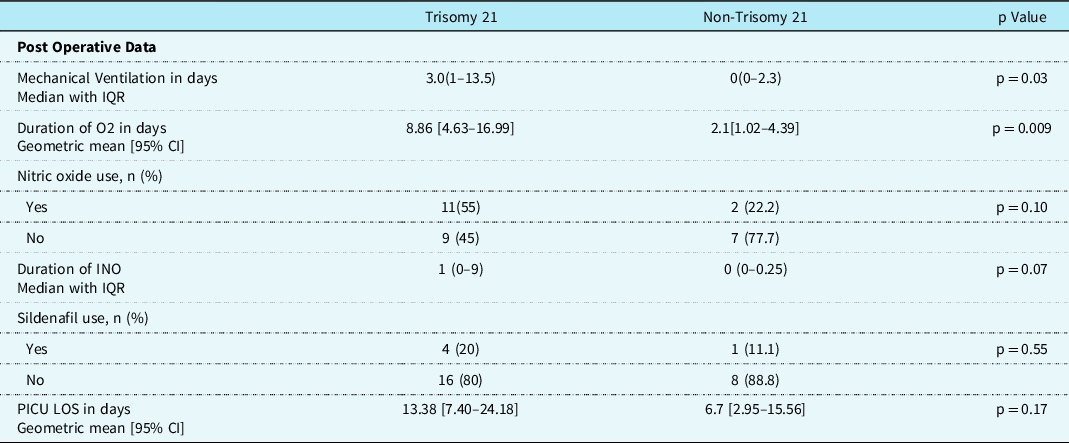
In the immediate post-operative period, patients with Trisomy 21 had a longer mean length of mechanical ventilation (3 days (1 to 13.5, interquartile range) vs.0 days (0 to 2.25, interquartile range); (p = 0.03). The duration of oxygen therapy for the Trisomy 21 group was almost 9 days versus 2 days for the non-Trisomy 21 group, p = 0.009 (Table 2). There were no differences between these two groups regarding the use of inhaled nitric oxide and sildenafil, inhaled nitric oxide, or overall ICU length of stay.
Postoperative data after repair of AV canal defect.
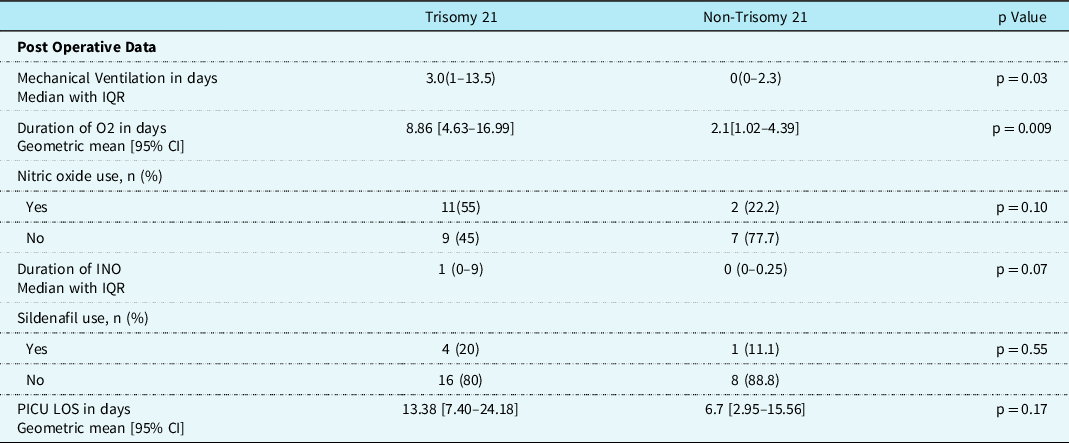
INO = inhaled nitric oxide; IQR = interquartile range; LOS = length of stay; O2 = oxygen; PICU = Pediatric ICU; 95% CI = 95th percentile confidence intervals
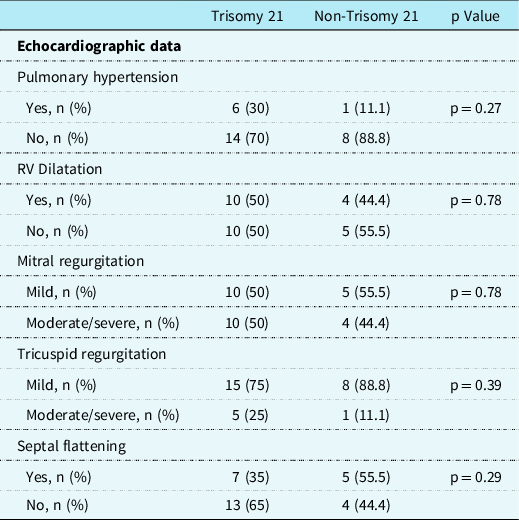
The were no echocardiographic differences between the two groups. Pulmonary artery hypertension was reported in 6 patients (30%) in the Trisomy 21 group versus to 1 patient (11.1%) in the non-Trisomy 21 group with a (p = 0.27) (Table 3). There were no differences between in right ventricular dilation, degree of mitral and tricuspid regurgitation, or septal flattening.
Postoperative echocardiographic data after AV canal repair.
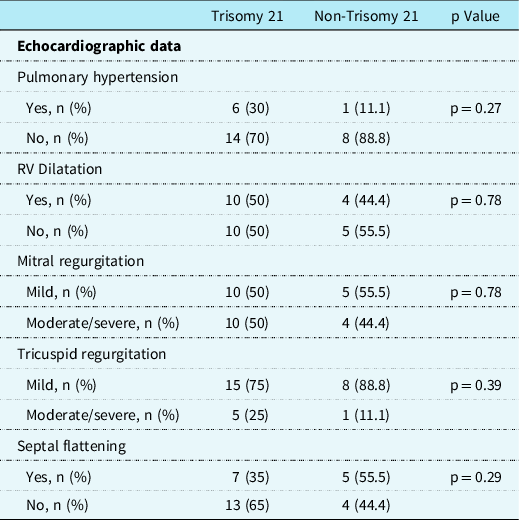
Number = n, (percentage of the group)
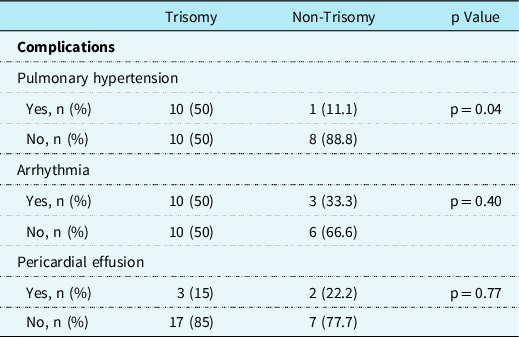
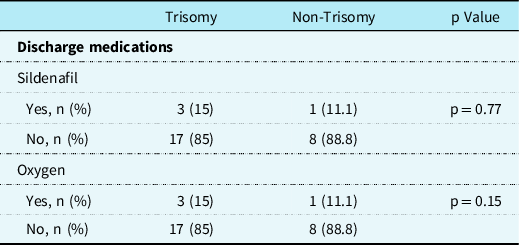
The Trisomy 21 group was more likely to have a clinical diagnosis of pulmonary artery hypertension during the post-operative period compared to the non-Trisomy 21 group with a (p = 0.04). There were no differences in other complications or discharge medications (Tables 4 and 5).
Postoperative complications after AV canal repair.

Number = n, (Percent of the group)
Sildenafil and oxygen use at discharge after AV canal repair.

n = number in the group, (percentage of the group)
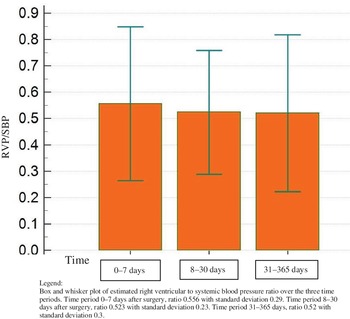
The right ventricular pressure estimate/systolic blood pressure ratios for all patients did not vary significantly over the three time periods and remained above 0.5 (i.e., greater than half systemic) for all thrr time points (Fig 2).
Right ventricular pressure estimate/systolic blood pressure ratio over 3 time periods.

Repeated measures of analysis of variance analysis factoring age in months and right ventricular pressures estimates showed a significant difference between the two groups (Trisomy 21 vs. non-Trisomy 21) for age at repair only (p = 0.001) but not for the RVP (p = 0.051). The time weighted right ventricular (RV) pressure from the Trisomy 21 group was 43 mmHg versus 48 mmHg for non-Trisomy 21 group. (p > 0.05) (Table 6).
Time Weighted average of right ventricular pressure estimate after AV canal repair by group.

n = number in the group; mean and 95th percentile confidence interval (95% CI); SD = Standard deviation; median and 95th percentile confidence interval (95% CI)
Discussion
The timing of normalisation of right ventricular and pulmonary pressures after surgical repair of complete atrioventricular canal defects is unclear. Sharma in 2012 reported that 14 of 19 patients with complete atrioventricular canal in his cohort developed pulmonary artery hypertension.Reference Sharma25 Children with complete atrioventricular canal defect are assumed to have near systemic or systemic RV pressures preoperatively depending on the size of the ventricular defect.Reference Cetta, Minich, Allen and Driscoll4,Reference Setty, Shen and Nichols6,Reference Kozlik-Feldmann, Hansmann and Bonnet15 None of our patients had cardiac catheterisations prior to surgery, and therefore, data on pre-operative shunt calculations and pulmonary vascular resistance were not available. It is expected that the pulmonary artery pressure should drop at some point after surgical repair. However, the timing and extent of this drop is not known. Our study suggests that in patients with complete atrioventricular canal defect, the right ventricular pressure estimate remains elevated up to one year after surgery. We used the non-invasive estimate of the ratio of right ventricular to systemic pressure as an indicator of severity of pulmonary artery hypertension.Reference Lee, Cha and Kim26 The ratio of right ventricular pressure estimate to systolic blood pressure remained greater than 0.5.
Patients with complete atrioventricular canal defect are at risk for developing pulmonary artery hypertension due to both volume and pressure overload.Reference Lopes9,Reference Kozlik-Feldmann, Hansmann and Bonnet15 If left uncorrected, patients may progress to development of pulmonary arterial hypertension associated with CHD.Reference Lopes9,Reference D’Alto and Mahadevan14,Reference Kozlik-Feldmann, Hansmann and Bonnet15,Reference Sharma25,Reference Latus, Wagner and Ostermayer27 It is widely believed that if surgical repair is carried out before 9 months of age the pulmonary artery hypertension will normalise within the next year.Reference Haworth19 In our study, we were not able to determine the exact timing of the drop in pulmonary artery pressure. However, it is evident that the pulmonary artery pressure remains elevated beyond the first month after surgery to 1 year post-operatively. Careful examination of a larger cohort needs to be performed to understand the timing of decrease of pulmonary artery pressure to normal levels.
Children with Trisomy 21 are at a higher risk of developing pulmonary artery hypertension due to the independent association of Trisomy 21 with pulmonary artery hypertension secondary to abnormal pulmonary vascular remodelling.Reference Setty, Shen and Nichols6,Reference Yamaki10,Reference D’Alto and Mahadevan14 At our centre, patients with complete atrioventricular canal defect associated with Trisomy 21 are operated on earlier in lifeReference Sherman1 and have longer periods of mechanical ventilation in the immediate post-operative period. However, their total ICU length of stay did not differ from the non-Trisomy 21 group. There was no significant difference in right ventricular pressure estimate/systolic blood pressure ratios on follow-up over time between the two groups (with Trisomy 21 vs. without Trisomy 21). Our results are consistent with findings by Toth et alReference Setty, Shen and Nichols6,Reference Toth28 who showed no differences in surgical outcomes in children with Trisomy 21 when compared to those without. St. LouisReference St Louis, Jodhka and Jacobs29 found that children with Trisomy 21 who underwent repair of CHD were more likely to survive to discharge than those without Trisomy 21. Consistent with other studies, our patients with Trisomy 21 were more likely to carry a clinical diagnosis of pulmonary artery hypertension in the immediate post-operative period. However, the echocardiographic data did not show a statistically significant difference between the two groups. None of the study patients received post-operative cardiac catheterisations to directly measure pulmonary artery pressure.
Children with history of significant CHD are at increased risk of readmissions within the first year after their surgery.Reference Islam, Yasui and Kaul30 Additionally, children with significant pulmonary artery hypertension are also at increased risk for readmission.Reference Awerbach, Mallory and Kim31 Many of these readmissions are secondary to respiratory infections.Reference Pongiglione, Possidoni and Paparatti32,Reference Cabalka33 This puts them at risk for significant morbidity and mortality from viral respiratory infections and requires ongoing vigilance to reduce risk of infections including the use of palvizumab.Reference St Louis, Jodhka and Jacobs29,Reference Awerbach, Mallory and Kim31,Reference Abman, Hansmann and Archer34 There were no re-admissions and no mortality during the study period.
In our study, children with complete atrioventricular canal defect associated with Trisomy 21 were significantly younger, had longer duration of mechanical ventilation and clinical diagnosis of pulmonary artery hypertension in the immediate post-operative period compared to those without Trisomy 21. There were, however, no significant differences over time between the two groups in regard to the right ventricular pressure estimate to systolic blood pressure ratio. In this cohort, we were not able to answer the question regarding the exact timing to resolution of pulmonary artery hypertension. A detailed prospective study may be able to answer this question in the future.
The data suggest that patients with repaired complete atrioventricular canal defect have pulmonary artery hypertension well beyond the immediate post-operative period.
Limitations
This was a retrospective, single centre study with a small sample size. In addition, there was a lack of uniformity in post-operative care over time during the study period including the timing of echocardiograms. There were two primary surgical operators, and surgical differences were not accounted for in this study. Sildenafil, the most widely used pulmonary vasodilator in pulmonary artery hypertension in children, was not used in the earlier enrolled patients. Chart review provided limited data on the dose and duration of therapy.
We used right ventricular pressure estimate/systolic blood pressure as a surrogate for pulmonary vascular resistance/systemic vascular resistance as no patients received cardiac catheterisation to allow for direct calculation. Though cardiac catheterisation assessment of pulmonary artery pressure is the gold standard, it is not always practical. Sohail reported correlation of 0.917 between cardiac catheterisation and echocardiography for the assessment of systolic pulmonary artery pressure.Reference Sohail, Korejo and Shaikh35 Echocardiography, therefore, provides very useful information about the estimation of right heart pressure given that the World Health Organization’s definition of pulmonary hypertension by cardiac catheterisation is an adult definition and cannot be easily or routinely applied to infants. We made assumptions about the right atrial and systolic blood pressures, which may be of limited accuracy. Left atrioventricular valve regurgitation may lead to pulmonary artery hypertension, and its effect may be difficult to quantify and may change with time. Although there were no reoperations for atrioventricular valve regurgitation in any of our patients, atrioventricular valve regurgitation needs to be accounted for in the evolution of pulmonary artery hypertension. Lastly, a prospective study with a larger sample size, with more uniform follow-up utilising a core echo lab, would be required to better assess the change in pulmonary artery pressure with time after repair of complete atrioventricular canal defects.
Conclusion
In summary, patients with complete atrioventricular canal defect were noted to have elevated ratio of the right ventricular pressure estimate to systolic blood pressure, up to 1 year after surgery.
Our study suggests that in patients who have had repaired complete atrioventricular canal defects, the right ventricular pressure does not normalise on echocardiograms performed up to 1 year after surgery and may suggest a sustained elevation in pulmonary vascular resistance.
Acknowledgements
We thank Alicia Chaves for her assistance in the completion of this project.
Financial support
This research received no specific grant from any funding agency, commercial, or not-for-profit sectors.
Conflict of interest
None.
Ethical standards
This research was reviewed and approved by the Human Research Protections Office of the University of Maryland.