

Introduction
The World Health Organization (WHO, n.d.) projected that chronic diseases would account for 89 per cent of all deaths in Canada in 2005. Since the prevalence of many chronic health conditions increases with age, we might anticipate that as the population ages there will be a rise in the proportion with one or more such conditions, and that their treatment will make increasing demands on the health care system. In the words of Epping-Jordan, Pruitt, Bengoa, and Wagner (Reference Epping-Jordan, Pruitt, Bengoa and Wagner2004, p. 299), “Chronic conditions are increasingly the primary concern of health care systems”. Such considerations led us to ask three questions: How much would the overall prevalence of chronic conditions increase in the next quarter century if age-specific rates of prevalence did not change? How much would the requirements for health care resources increase in those circumstances? And, finally, how much difference would it make to those requirements if people had fewer chronic conditions?
In this article, we note that there is no generally accepted definition of the term chronic condition and that measures of prevalence vary widely. We present measures based on one recent survey to show how prevalence varies by age for a wide variety of conditions that are defined as chronic in that survey. We also consider how the population-wide prevalence rates for those conditions will change over the next quarter century in consequence of projected changes in age distribution, all other things being equal.
As people age, it is not uncommon for them to have more than one chronic condition, and, as we have documented, the use of health care resources tends to increase not only with age but also with number of conditions. In the work we report on here, we explored that relationship further, providing projections of future requirements for selected health care services, and assessing the impact that a hypothetical reduction in the number of chronic conditions per capita would have on the use of health care resources.
Prevalence of Chronic Conditions
Many definitions of chronic conditions appear in the literature. For example,
“A chronic condition is … one that lasts or is expected to last a year or longer, limits what one can do, and may require ongoing care. …” (John Hopkins Bloomberg School of Public Health; http://www.partnershipforsolutions.org/problem/index.html
“one lasting 3 months or more” … adding that “Chronic diseases generally cannot be prevented by vaccines or cured by medication, nor do they just disappear.” (MedicineNet website; http://www.medicinenet.com/script/main/art.asp?articlekey=2728, quoting the U.S. National Center for Health Statistics)
“[any] long-term health conditions that have lasted or are expected to last six months or more and that have been diagnosed by a health professional.” (Gilmour & Park, Reference Gilmour and Park2005, p. 26)
Such proliferation of definitions has led O’Halloran, Miller, and Britt (Reference O’Halloran, Miller and Britt2004) to observe that “With the increasing prevalence of chronic conditions, there is need for a standardized definition of chronicity for use in research, to evaluate the population prevalence and general practice management of chronic conditions” (p. 381). That conclusion was echoed by van der Lee, Mokkink, Grootenhuis, Heymans, and Offringa (Reference van der Lee, Mokkink, Grootenhuis, Heymans and Offringa2007) who reported “… wide variability in reported prevalence rates, surprisingly enough, from 0.2 to 44.0 percent” [italics added] for chronic conditions in childhood, and conclude that “… international consensus about the conceptual definition of chronic health conditions … is needed” (p. 2741).
It is thus evident that definitions vary widely and that reported prevalence rates are extremely sensitive to what is measured and how the measurement is taken. Researchers are at the mercy of (and limited by) available survey data. Not withstanding the concerns, we found it informative to use the Statistics Canada Canadian Community Health Survey (CCHS) to investigate age prevalence patterns for a range of chronic conditions and to explore the implications for health care utilization. We used the confidential master file for CCHS cycle 3, which relates to the year 2005. The survey sampled approximately 130,000 individuals in the period January to December of 2005. The target population was persons aged 12 years or older living in private dwellings in the 10 provinces and three territories. Persons living on Indian Reserves or Crown lands, residents of institutions, full-time members of the Canadian Armed Forces and residents of certain remote regions were excluded from the survey. The CCHS covered approximately 98 per cent of the Canadian population aged 12 or older. Both personal and telephone interviews were conducted, using computer-assisted interviewing software.Footnote 1 The questionnaire presented to respondents contained the following statement:
Now I’d like to ask about certain chronic health conditions which you may have. We are interested in “long-term conditions” which are expected to last or have already lasted 6 months or more and that have been diagnosed by a health professional.
The questionnaire then proceeded through a checklist of conditions which Statistics Canada defined as chronic. The conditions were generally similar to those identified in population health surveys elsewhere, but we note that the checklist itself has varied somewhat, even from one Statistics Canada survey to another, and that the choice of what to include appeared to reflect the result of interdepartmental negotiations as much as a set of coherent principles. Nonetheless, in the work described in this article we worked with the conditions defined as chronic in CCHS cycle 3.
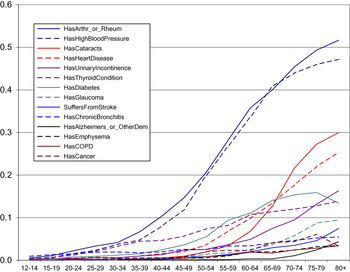
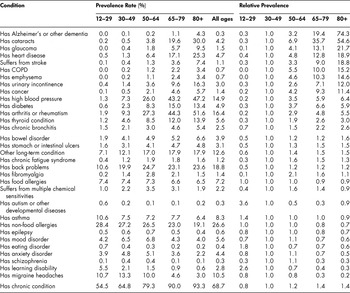
Table 1 shows prevalence rates in broad age groups for each of 32 conditions identified as chronic in the survey. They are ordered in terms of prevalence in the oldest age group (80 and older) relative to those in the age group 30 to 49. For the 14 conditions in the upper panel, the relative prevalence rates exceed two; it is evident from the table and from Figure 1 that these are conditions whose prevalence increases strongly with age. In the lower panel are 18 conditions less strongly associated with age.Footnote 2 In cases such as autism and learning disability, the age relationship is reversed. We might speculate that relative prevalence rates less than 1.0 are the result of lower survival rates for some such cases.Footnote 3
Prevalence rates for chronic conditions associated with old age, 2005

Prevalence of chronic conditions by age group, 2005

Note
This tabulation was prepared in the Statistics Canada Research Data Centre at McMaster University. It is based on the master file of the Canadian Community Health Survey, Cycle 3.1. Observations have been weighted to provide estimates for the target population for the Survey.
The overall prevalence rates are reported in the bottom line of the table (“has chronic condition”). They may seem high – more than two thirds of the population over the age of 12 reported having a chronic condition, and more than 90 per cent of those over the age of 65. However, similar numbers have been reported in various studies in the U.S.,Footnote 4 although the set of conditions included differed from one study to another. (As one example, “hearing impairment” was included as a chronic condition in the U.S. survey referred to in Note 5, but not in CCHS cycle 3.)
The overall prevalence rates were affected by the age distribution of the population as it was in 2005. Given that distribution, the highest all-age rates were for non-food allergies (26.6% of the population) and back problems (18.8%), two chronic conditions that were not concentrated at older ages but instead occurred in about the same proportions at most ages. Next in line were arthritis or rheumatism (16.4%) and high blood pressure (14.9%), both of which were about six times more likely to be present among those 80 and older than those 30 to 49. Most of the other conditions affected much smaller proportions of the population.
Of the 14 that were concentrated at older ages, arthritis/rheumatism and high blood pressure each affected about half the population aged 80 and older, cataracts and heart disease more than a quarter each, and urinary incontinence, thyroid problems, and diabetes more than an eighth. There were nine conditions for which the relative prevalence rates for the age group 80 and older exceeded 10. Each of the first nine conditions listed in Table 1 was more than 10 times as prevalent among those in the oldest age group as among those aged 30 to 49 and more than seven times more prevalent even among those aged 65 to 79. Overall, and not surprisingly, chronic conditions thus exhibited very strong age patterns.
Two general observations of a qualifying nature are in order. First, the prevalence rates related to the survey target population rather than to the entire population. Of particular importance for measuring the prevalence of chronic conditions was the exclusion of residents of institutions. Since such institutions include nursing homes and other long-term care facilities, the exclusion related to a segment of the population especially likely to experience multiple chronic conditions. This restriction of our analysis is regrettable because it means that the prevalence rates reported in Table 1 no doubt under-estimate the rates for the population as a whole and especially for older age groups. As an important example, the prevalence rate of 4.3 per cent for Alzheimer’s disease or other dementia for those 80 and older would undoubtedly be much higher if residents of long-term care facilities were included. Without appropriate survey information, we were unable to estimate how much higher.Footnote 5
The second qualifying observation is that the classification itself provided no indication of the severity of the conditions identified.Footnote 6 Thus, for example, while 30 per cent of the population 80 and older reported having cataracts at the time of the survey, we might expect that many of them could benefit from surgery and, in time, would not continue to have the problem. As a further example, a few months after the survey some of those who reported having cancer might have been free of symptoms, and possibly cured, while others would have died from the disease. Persons 80 and older are of course those who survived to that age, and their prevalence rates do not reflect the fact that chronic disease may have caused others to die at younger ages.
Projection of Prevalence Rates for Chronic Conditions
We turn now to the future. The expectation is that, as the large baby boom cohort moves into older age categories, the overall proportion of the population with chronic conditions will increase. The question we want to answer is how much – how much, that is, if the age-specific prevalence rates remain the same and only the population age distribution changes?Footnote 7
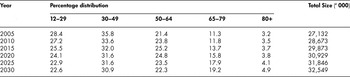
Table 2 shows the projected population to 2030 on which our calculations were based. The projection relates to the “target population” as defined in the CCHS; it was derived from a MEDS projection,Footnote 8 but adjusted to the target population of the survey by assuming that the fractions of the population at each age in the CCHS excluded categories remain fixed. Fertility and mortality rates were held constant in the projection. We might expect mortality rates to fall and, in consequence, life expectancy to increase somewhat over the projection period. However, keeping mortality rates fixed is a natural concomitant of the assumption that prevalence rates are constant. Mortality and disease prevalence obviously are not independent; we would expect a positive correlation between mortality rates and the prevalence of chronic conditions. Holding mortality rates constant allows us to focus strictly on the effects of changes in the population age distribution.Footnote 9
Projected population size and percentage distribution by age group, 2005–2030

Note
The 2005 values show the population targeted in the CCHS. The projected population holds fertility and mortality rates constant at 2005 levels, immigration at 240,000 per year, and emigration at 0.13% of the population.
Table 2 shows projected growth in the overall population of 20 per cent between 2005 and 2030. However, consistent with population aging and constant fertility rates (and in spite of high levels of immigration), the rate of growth declines from 5.7 per cent in the first five-year period to 2.2 per cent in the final one. Proportionate declines are observed in the age groups under age 50 and proportionate increases in those over age 65.
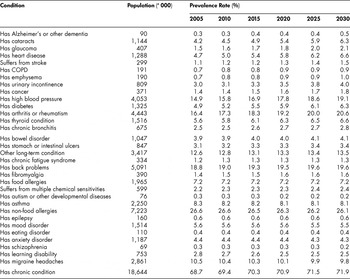
The projected overall prevalence rates for each of the 32 chronic conditions are shown in Table 3. Note that if the population in each age group had increased by 20 per cent, with unchanged age-specific prevalence rates, the number with each condition would also have increased by 20 per cent and the overall prevalence rates would have remained the same. However, with the projected shift in age distribution we would anticipate changes in prevalence.
Population with chronic conditions, 2005, and projected prevalence rates to 2030

Note
See note to Table 1.
That is of course what we find. In consequence of changes in the age distribution alone, the overall chronic condition prevalence rate (“has chronic condition”) increases by 4.7 per cent (from 68.7 to 71.9%) over the 25-year period. At the same time, substantial increases (more than 10%) occur in the prevalence rates of conditions associated mostly with old age (those in the upper panel of Table 3) and modest increases or decreases in other conditions (those in the lower panel). The increase exceeds one quarter for 12 of the 14 conditions in the upper panel, including the two that are most common in old age, arthritis/rheumatism and high blood pressure, and exceeds 10 per cent in all 14. There is a decrease in the prevalence rates for 11 of the 18 conditions in the lower panel.
Use of Health Care Resources
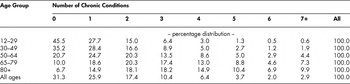
Table 4 shows how the number of chronic conditions varies by age. While almost three quarters of the youngest group had either no such condition or only one, more than three quarters of the oldest group (80+) had two or more. In what follows, we investigate the relationship between the use of health care resources on the one hand and the number of chronic conditions and age on the other. In doing so, we ignore which chronic conditions apply and consider only the total number, as reported by respondents.Footnote 10
Percentage of distribution of the population by number of chronic conditions and age group, 2005

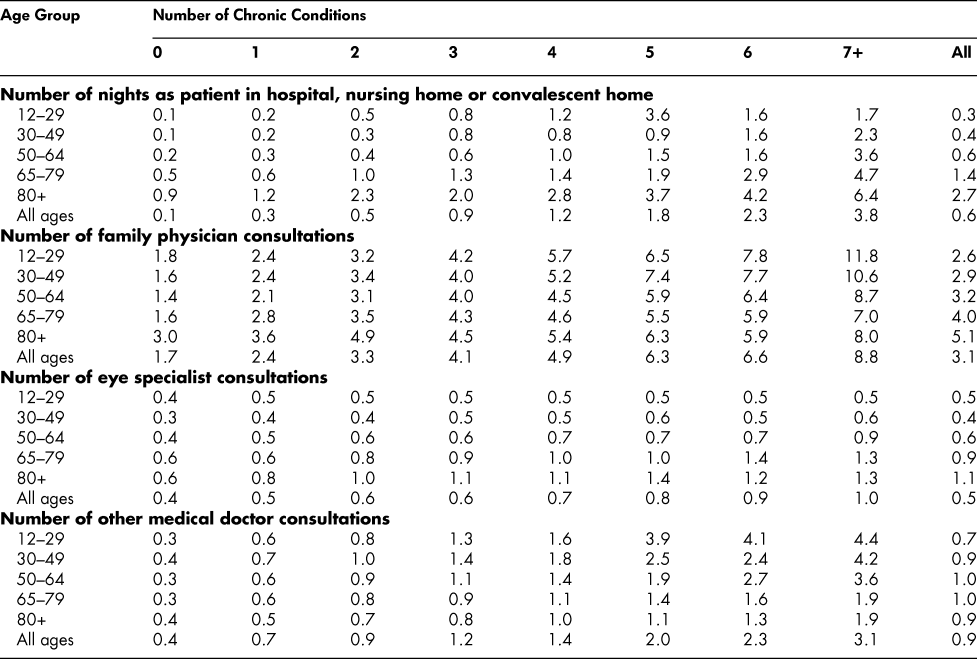
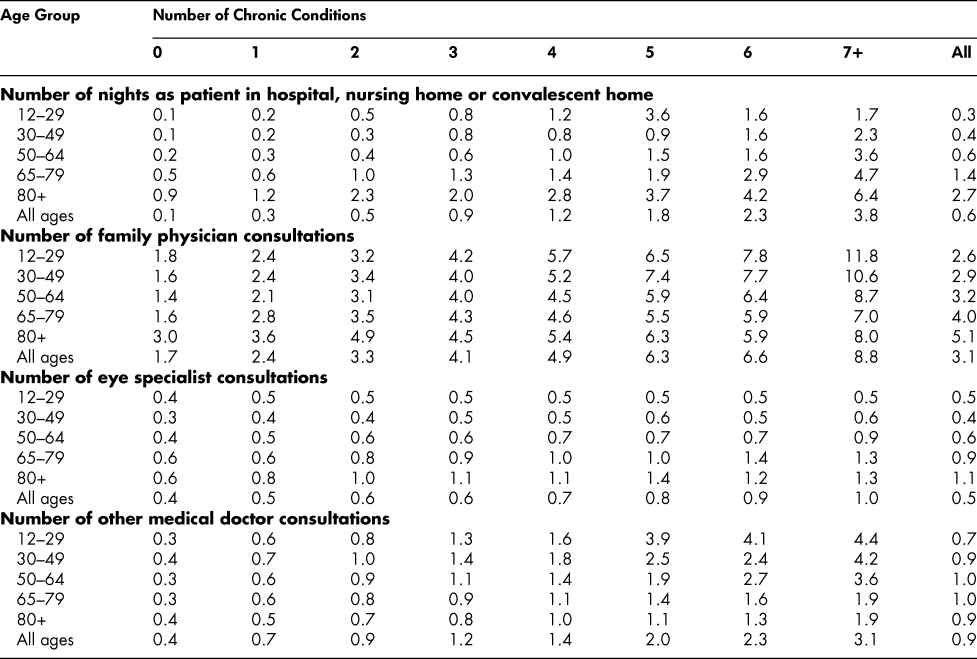
Survey respondents were asked to recall how many nights in the past 12 months they had spent in hospitals or other in-patient institutions and the number of visits to family physicians, eye specialists, and other physician specialists during that period.Footnote 11 Their responses are tabulated in Table 5. Those with more chronic conditions spent longer in hospitals or other health care institutions and had more consultations. The differences were pronounced: the 17 per cent with two chronic conditions spent nearly four times as long in institutions and had twice as many physician visits, on average, as the 31 per cent with no such conditions.
Use of health care resources in previous 12 months by number of chronic conditions and age group, 2005
What are the implications for future health care needs as the population ages? A considerable body of evidence suggests that there is room for improvement in the ways in which health care resources are used. In the words of Kane, Priester, and Totten (Reference Kane, Priester and Totten2005), “we live in a health care system that is out of step with current demographic realities” (p. xvii). The authors argued that the “… health care system [in the U.S.] … is world class in trauma, transplantation, and other high-tech care. But the majority of people who use the system … come with chronic illnesses that require on-going, long-term attention and management” (p. xvii). A similar conclusion is reached by Dorland and McColl (Reference Dorland and McColl2007) in the Canadian context: “… a system designed to respond to acute illness, however well-funded, well-staffed, and efficient, cannot deliver adequate results in managing chronic disease” (p. xvi). Speaking of the situation more broadly, the WHO (2002) made the same point differently: “Health care systems have evolved around the concept of infectious disease, and they perform best when addressing patients’ episodic and urgent concerns. However, the acute care paradigm is no longer adequate” (p. 6).
While there is considerable agreement on the diagnosed mismatch between health care needs and the services that health care systems are best able to deliver, progress in remedying the situation, according to Kane et al. (2007), “… has been agonizingly slow. The generally conservative health care industry presents formidable barriers to the changes in infrastructure needed to provide better chronic care” (p. xx). Even today, medical schools do little to prepare future physicians, the gatekeepers to the system, to deal with chronic conditions.Footnote 12 At the same time, it is not clear whether the benefits that would flow from a system better designed to meet the health care needs of those with chronic conditions would result in a net increase or decrease in resource use. As a reference case, we investigated the implications that population aging would have for the requirements for health care services on the assumption that current patterns of use continue to apply.
Table 6 shows what would happen if people in each age group had the same number and combination of chronic conditions in the future as in 2005, and if the treatment of those conditions involved the same use of resources as shown in Table 5. The number of patient nights would increase more than twice as rapidly as the population between 2005 and 2030 (45%) compared with population growth of 20 per cent, consultations with eye specialists would increase by 30 per cent, and consultations with family practitioners and other medical specialists by 25 and 22 per cent respectively.
Projected effects of population change on the use of health care resources with prevalence rates held constant, 2005–2030

What if people had fewer chronic conditions; what savings might then result? Many conditions result from lifestyle choices. Broemeling, Watson, and Prebtani (Reference Broemeling, Watson and Prebtani2008) referred to “… proven strategies to delay or prevent the onset of chronic conditions and to improve the quality of primary health care to prevent complications, reduce the need for more expensive health services and secure a better quality of life for Canadians” (p. 71). The World Health Organization claimed that the “most cost-effective interventions to reduce [the associated] risk factors are population-wide programmes to: (1) reduce salt in processed foods, cut dietary fat, particularly saturated fats; (2) encourage more physical activity; (3) encourage higher consumption of fruits and vegetables; and (4) cease smoking”.Footnote 13 That suggests that successful initiatives to reduce the proportion of the population that is obese, smokes, and is physically inactive would reduce the numbers with chronic conditions and the associated need for health care services. Indeed, a number of U.S. studies have found substantial reductions in the prevalence rates in the past decade and more.Footnote 14 That led us to consider hypothetical situations in which the population observed in the survey had fewer chronic conditions (perhaps as a result of changes in lifestyle or policy initiatives taken many years earlier), and to infer the impact that would have had on the use of health care resources.Footnote 15
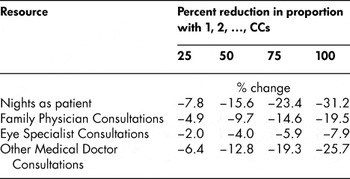
Table 7 shows the percentage reductions in selected health care services that would have resulted in 2005 if, within each age group in Table 4, a fraction of those with one chronic condition shifted to having none, of those with two shifted to having only one, and so on. The fractions assumed to be shifted are one quarter, one half, three quarters, and one. There is, of course, wide variation in chronic conditions. Some are highly debilitating, others not; some are costly to treat in terms of the health care resources that they use while others are not. Implicit in the calculations that follow, those remaining in each age category have the same combination of chronic conditions as before the assumed shift, and the same health care resources are used in their treatment. In similar fashion, those that are shifted down a category are assumed to have the same combination of conditions as those already in that category, and their care is assumed to involve the same health care resources.Footnote 16
The effects of hypothetical reductions in the prevalence of chronic conditions on the use of health care resources, 2005

It is evident that the savings from even a modest reduction in the prevalence of chronic conditions would be substantial. For example, patient nights are reduced by about 16 per cent and consultations with family physicians by 10 per cent if only half of those with the specified number of chronic conditions are moved to the next lowest category. As an indication of magnitudes, those amounts are equivalent to more than a third of the projected increase in requirements for the same services by 2030 with prevalence rates held constant (see Table 6). The potential savings are somewhat smaller for eye specialists, larger for other physician specialists, but nonetheless significant.
Not all (perhaps not even most) chronic conditions are preventable, but Table 7 is indicative of the potential reduction in resource requirements that could result over the longer term if fewer people were subject to the risk factors associated with chronic conditions.
Concluding Remarks
Health costs continue to grow more rapidly than most other components of public budgets. How much of those budgets, and the increases in them, are accounted for by the treatment of chronic conditions is hard to answer, especially given the uncertainty about what conditions should be included in the chronic category. However, by any reasonable definition the share is large.
Working with a somewhat arbitrarily defined set of 32 chronic conditions drawn from a large household survey, we find that the prevalence rates for almost half of the conditions increase with age and that the age patterns are strong. For example, there are nine conditions for which the prevalence rates are more than 10 times greater for the oldest age group (those 80+) than for those aged 30 to 49. We ask how the overall population prevalence rates would change over a quarter century, as the population ages, if the rates for each age group remained constant. Consistent with recent demographic trends, we project that the rates for almost all conditions that are associated mostly with old age would rise by more than 25 per cent.
Recent survey data show that resource use increases strongly with age and number of chronic conditions. If the number of conditions were to be maintained, our projection indicates that health care requirements would grow more rapidly than the population – more than twice as rapidly in the case of hospital stays.
The age patterns of both chronic conditions and resource usage will, of course, change, as will the relationship between them. What form those changes will take is uncertain, but we have explored the implications of hypothetical reductions in the average number of conditions at each age. We find that even modest reductions could result in substantial savings.