Introduction
Most cultivated yams in West Africa that belong to the species Dioscorea cayenensis Lam., Dioscorea rotundata Poir. and Dioscorea alata L. have been broadly investigated (Dansi et al., Reference Dansi, Pillay, Mignouna and Zok2001; Egesi et al., Reference Egesi, Pillay, Asiedu and Egunjobi2002; Obidiegwu et al., Reference Obidiegwu, Rodriguez, Ene-obong, Loureiro, Muoneke, Santos, Kolesnikova-Allen and Asiedu2009). Dioscorea dumetorum (Kunth) Pax, known as trifoliate yam or the bitter yam, has received little or no attention in research and development programmes. This species is found in the wild throughout tropical Africa between 15°N and 15°S and is cultivated in West and Central African countries, especially in Nigeria and Cameroon (Dansi et al., Reference Dansi, Pillay, Mignouna and Zok2001). This yam species has only recently been included in breeding programmes in many countries of West and Central Africa. D. dumetorum is promising in the pharmaceutical industry (Bevan and Broadbent, Reference Bevan and Broadbent1956; Corley et al., Reference Corley, Tempesta and Iwu1985; Iwu et al., Reference Iwu, Okunji, Akah, Tempeta and Corley1990). In ‘folk medicine’, extracts of D. dumetorum are used in the treatment of diabetes mellitus (Nimenibo-Uadia, Reference Nimenibo-Uadia2003) because of its hypoglycaemic effect.
Genotyping of specific populations achieved by robust phenotyping of key traits are two complementary tools for improved efficiency and efficacy in modern breeding programmes. In D. dumetorum, phenotyping of existing germplasm collection at the International Institute of Tropical Agriculture (IITA) has focused on morphological characterization for the development of a broad range of traits in order to improve what has been reported in the literature (Sahore and Amani, Reference Sahore and Amani2007; Mwirigi et al., Reference Mwirigi, Kahangi, Nyende and Mamati2009; Sonibare et al., Reference Sonibare, Asiedu and Albach2010). Preliminary metabolite profiling of yam species at IITA (IITA, 2009) has revealed the absence of dioscin in tuber samples of D. dumetorum. Diversity assessment based on metabolite profiling could provide a means for identifying potential gaps in the entire collection where the power of analyses on phenotypic and DNA markers would be limited. This would provide guidance for further germplasm collection missions, rather than the conventional approach of searching for new genebank accessions in the farmer's fields and markets.
Linking genotype with phenotype is a necessary strategy to uncover the genetic basis of traits. The effect of the differences in ploidy levels on the morphological and agronomic characteristics of yam has not yet been fully investigated or documented. This has been, in part, attributed to the difficulties in the determination of ploidy levels in yams by conventional chromosome counting. Yam chromosomes are small (0.5–2.7 μm), generally dot-like and most often clumped together, complicating the counting (Zoundjihekpon et al., Reference Zoundjihekpon, Essad and Toure1990). To overcome these difficulties, flow cytometry is used to determine ploidy levels in many plant species (Galbraith et al., Reference Galbraith, Harkins, Maddox, Ayres, Sharma and Firozabady1983; De Laat et al., Reference De Laat, Gohde and Vogelzang1987; Arumuganathan and Earle, Reference Arumuganathan and Earle1991a, Reference Arumuganathan and Earleb; Dolezel, Reference Dolezel1997), including yam (Gamiette et al., Reference Gamiette, Bakry and Ano1999; Dansi et al., Reference Dansi, Pillay, Mignouna and Zok2001; Arnau et al., Reference Arnau, Nemorin, Maledon and Abraham2009; Obidiegwu et al., Reference Obidiegwu, Rodriguez, Ene-obong, Loureiro, Muoneke, Santos, Kolesnikova-Allen and Asiedu2009, Reference Obidiegwu, Rodriguez, Ene-obong, Loureiro, Muoneke, Santos, Kolesnikova-Allen and Asiedu2010).
The objectives of this study were (1) to determine the ploidy levels of 53 D. dumetorum accessions collected from six countries in West and Central Africa for the first time, (2) to assess the profile of phytochemical contents (secondary metabolites) of the 53 accessions in association with morphological parameters of the accessions, and (3) to determine the usefulness of the association among the ploidy levels, secondary metabolite profiles and morphological characteristics in designing breeding strategies for this species.
Materials and methods
Plant preparation and experimental design
A total of 53 accessions of D. dumetorum (see online supplementary Table S1) from six West and Central African countries (Nigeria, Togo, Benin, Gabon, Congo and Ghana), comprising both male and female clones, were evaluated in this study. All the accessions were obtained from the yam breeding programme of IITA. For each accession, 4 to 12 tuber setts obtained from the head, middle and tail portions of the tubers were pre-sprouted before being transferred to the field. Three sprouted setts of each accession were transferred into the ridges at a spacing of 0.5 m × 1 m on an experimental plot of flat terrain at the IITA Ibadan station during the first week of May in 2010. The plot was arranged in a randomized complete block design with two replications. The plants were staked 4 weeks after planting. Plant authentication was done at the Forest Herbarium Ibadan (FHI), Ibadan, Nigeria where a representative voucher specimen was deposited (voucher no. FHI 108956). The reference germplasm materials have been maintained in the genebank at IITA.
Analysis of ploidy level: sample preparation and flow cytometric analysis
Fresh young leaves, about 5 g each of the 53 accessions, were harvested in labelled and tightly covered Eppendorf tubes. For flow cytometric analysis, samples were prepared according to the procedure described by Pillay et al. (Reference Pillay, Ogundiwin, Tenkouano and Dolezel2006) with slight modifications. About 50 mg of leaf tissue were chopped with a razor blade to homogenize the tissue and to release the nuclei in a glass Petri dish containing 0.5 ml of ice-cold Otto I buffer (0.1 M citric acid monohydrate and 0.5% Tween-20). The suspension of the nuclei was filtered through a 22 μm pore size filter into a plastic tube. Then, the suspension was incubated for 5 min at room temperature. The nuclei were stained by adding Otto II buffer (0.4 M Na2PO4 supplemented with 1 ml of 4′,6-diamidino-2-phenylindole) and 25 μl mercaptoethanol to each tube. Fluorescence of the nuclei was analysed using a Partec Ploidy Analyser (Partec GmbH, Münster, Germany) with an ultraviolet LED lamp at the rate of 50–60 nuclei/s. To standardize the Ploidy Analyser, the scale was calibrated with a reference (external standard) sample. The young leaf samples of accessions TDd 4118 and TDd 3100 with known diploid and triploid levels were used as reference standards, respectively. The gain was adjusted so that the diploid peak (G2), represented by the nuclei from the accessions, was set at channel 50, while the triploid peak G2 was expected at channel 75.
Morphological characterization
Data on 18 morphological traits from three individual plants of each of the 53 accessions were collected when the plants grew on the field and after the tubers were harvested. The selected characteristics included in the study were as follows: presence or absence of spines on the leaf; presence of spines on the stem; twining direction; distance between the lobes; leaf arrangement; leaf colour; leaf shape; leaf apex shape; number of veins per leaf; hairiness of the upper leaf surface; hairiness of the lower leaf surface; sex; days to shoot emergence; undulation of the leaf margin; adult stem colour; tuber shape; tuber flesh colour; inflorescence type (see online supplementary Table S2). Shoot emergence was assessed 10, 45 and 90 d after planting, respectively. Number of veins per leaf was scored using quantitative scales, while leaf shape, leaf apex shape, leaf arrangement, inflorescence type, twining direction, distance between the lobes and tuber shape were scored by qualitative (subjective) scales, following the internationally agreed descriptor list for yam (IPGRI/IITA, 1997). Leaf colour and tuber skin colour were determined using the Methuen Handbook of Colour (Kornerup and Wanscher, Reference Kornerup and Wanscher1978). Hairiness of the upper and lower leaf surfaces, presence and absence of spines on the leaf and stem were assessed by feeling with fingers. Data represent the average of three different healthy plants per accession. The characteristics and states selected for this study have been used over time in the passport and characterization data of yam germplasm collection at IITA. They have been found and compared with parents and offspring from one generation to the other (Sartie and Aseidu, Reference Sartie and Aseidu2014).
Phytochemical studies
Of the 53 accessions, 15 were selected for this study. The selected accessions appeared to be more diverse within the group as determined by the clustering procedure.
Sample preparation
Tubers of each accession were harvested 9 months after planting, washed and air-dried at ambient temperature in the yam barn at IITA for 2 weeks. Then, the dried samples were ground into powder and stored in airtight bottles at room temperature before analysis. The powdered samples were screened preliminarily to confirm the presence of saponins and other secondary metabolites using procedures described previously by Sofowora (Reference Sofowora1993) and Trease and Evans (Reference Trease and Evans2002). The 15 selected accessions were analysed quantitatively for the determination of saponin, alkaloid and phenolic contents based on standard procedures. The selected accessions were distantly separated on a dendrogram: three from clusters 1 and 2 each, and nine from cluster 3. A thin layer chromatography analysis (TLC) was carried out on these accessions. The dried powder samples were first defatted with n-hexane and extracted with methanol (redistilled) for 72 h.
Determination of saponins
For the determination of saponin content, 20 g of tuber powder of each accession were dispersed in 200 ml of 20% ethanol. The suspension was heated at about 55°C on a hot water bath for 4 h with continuous stirring. The mixture was filtered and the residue re-extracted with ethanol. The combined extracts were evaporated to a volume of 40 ml over a water bath at about 90°C. The concentrate was transferred into a 250 ml separating funnel, and 20 ml of diethyl ether were added and shaken vigorously. The aqueous layer was recovered while the ether layer was discarded. The purification process was repeated twice. Thereafter, 60 ml of n-butanol extracts were washed twice with 10 ml of 5% aqueous sodium chloride. The remaining solution was heated on a water bath at 90°C. After evaporation, the sample was dried in the oven to a constant weight. Saponin content was calculated as a percentage of the sample (Nahapetian and Bassiri, Reference Nahapetian and Bassiri1975).
Determination of alkaloids
For the determination of alkaloid content, 5 g of powder samples were weighed into a 250 ml beaker. Subsequently, 200 ml of 20% acetic acid in ethanol were added, covered and allowed to stand for 4 h. The mixture was filtered and the extract was concentrated using a warm water bath at 40°C. About three drops of concentrated ammonium hydroxide were added to the extract until the precipitation was complete. The solution was allowed to settle and the precipitate was collected by filtration and weighed (Harborne, Reference Harborne1973; Obadoni and Ochuko, Reference Obadoni and Ochuko2001).
Determination of total phenols
For the determination of total phenol content, fat-free samples were boiled with 25 ml of ether for 14 min. Then, 5 ml of the extract were pipetted into a 50 ml volumetric flask, and 5 ml of distilled water were added. Subsequently, 1 ml of ammonium hydroxide solution and 2.5 ml of concentrated amyl alcohol were added. The samples were left to react for 30 min to form a blue complex that can be quantified by visible-light spectrophotometry. A set of standard solution of tannic acid was prepared at concentrations ranging from 40 to 0.625 mg/ml. The absorbance of the solution was read using a Model 752 Ultraviolet Grating Spectrophotometer at a wavelength of 505 nm. The absorbance of each standard solution was also read at the same wavelength (Harborne, Reference Harborne1973; Obadoni and Ochuko, Reference Obadoni and Ochuko2001).
Data processing and statistical analyses
Statistical analyses were performed to determine the level of association among ploidy, phytochemical and morphological traits. All the data were analysed using SAS software version 9.2 for Windows (SAS, 2007). Using all the measured variables (ploidy levels, morphological traits and qualitative phytochemical parameters) and following the agglomerative hierarchical Ward's clustering method (Ward, Reference Ward1963), the accessions were clustered (Gower, Reference Gower1971) and a dendrogram was generated. The effect of the characteristics on clustering was assessed by the likelihood-ratio χ2 test to examine the association between single discrete variables and cluster groups. This test determines whether the discrete variable is significantly associated with grouping, implying that the variable has an effect on the structure of the groups. The study of the association among the variables (characteristics) was also carried out. Cramer's V coefficient of association (Conover, Reference Conover1971) and Spearman's rank correlation coefficient were used to analyse the association between the discrete qualitative (1–12) and quantitative (15–24) variables, respectively, while Spearman's rank correlation coefficient was used to study the association between the counts and continuous variables.
Results
Analysis of ploidy level: sample preparation and flow cytometric analysis
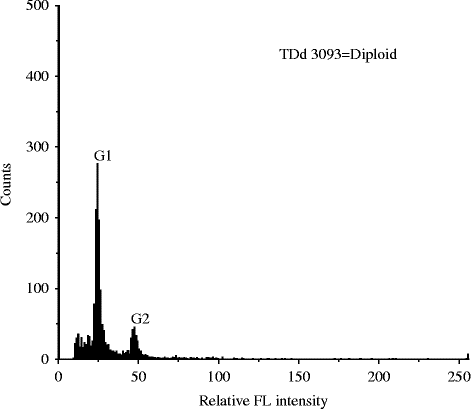
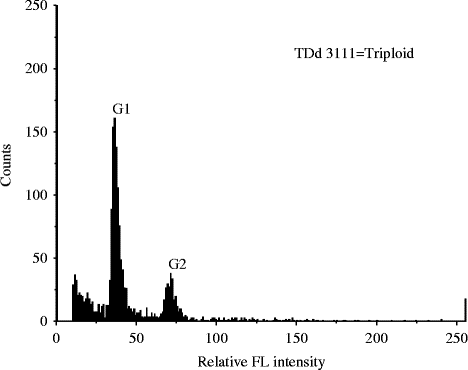
The analysis revealed that 32 (60%) accessions of D. dumetorum were diploid (2x) and 21 (40%) were triploid (3x) (Table 1). The comparison between the sex of the accessions and ploidy level revealed that the proportion of males was higher than that of females in both diploid and triploid accessions. Among the diploid clones, 81% were male, whereas 19% were female; for triploid clones, 57% were male, while 43% were female (Table 1). The histograms of the relative fluorescence intensity of the nuclei isolated from the accessions are shown in Figs. 1 and 2. Diploid peaks are shown as G1 and G2 peaks at channels 25 and 50, respectively, while triploid peaks are shown to have a G1 peak at channel 45 and G2 peak at channel 75.
Ploidy level, sex (M, male; F, female) and geographic origin of Dioscorea dumetorum clones

Histogram of the relative fluorescence (FL) intensity of the nuclei isolated from accession TDd 3093 of Dioscorea dumetorum with the diploid chromosome level. Peaks G1 and G2 corresponds to the nuclei at the G1 and G2 phases.

Histogram of the relative fluorescence (FL) intensity of the nuclei isolated from accession TDd 3111 of Dioscorea dumetorum with the triploid chromosome level. Peaks G1 and G2 corresponds to the nuclei at the G1 and G2 phases.

Phytochemical studies
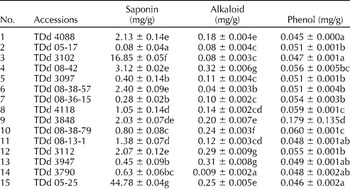
The findings from preliminary phytochemical screening (data not shown) indicated that the majority (53%) of the accessions contain steroids and nearly half of the population (49%) comprised terpenoids. Only four of the studied accessions did not contain these two compounds. The presence of saponins, alkaloids and flavonoids was confirmed using TLC, indicating that some of the spots on the plates had the same R f values as those of the reference compounds used (gallic acid and quercetin; see online supplementary Table S3). The quantitative phytochemical constituents of the various accessions of D. dumetorum tubers are shown in Table 2. The contents of saponins, alkaloids and phenols were highest in accessions TDd 05-25 (44.78 ± 0.07 mg/g), TDd 08-42 (0.32 ± 0.006 mg/g) and TDd 3848 (0.176 ± 0.14 mg/g), respectively.
Total saponin, alkaloid and phenol contents in the selected clones of Dioscorea dumetorum

Data represent mean ± SEM of three separate measurements (n= 3).
Different letters within the same column are significantly different (P= 0.05) as determined by the least significant difference test.
Morphological characterization
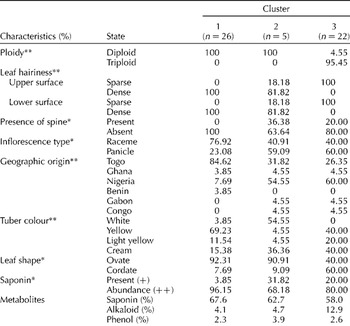
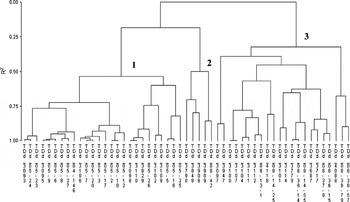
With regard to the morphological traits, it was found that some of the traits such as presence or absence of spines on the stem, leaf shape, tuber flesh colour, inflorescence type and hairiness of the upper and lower leaf surfaces significantly explained the differences among the populations (Table 3). Only a small proportion of the total variance R2 was associated with passing from ten to three clusters. At this level, there was a large separation among the three clusters (pseudo F= 11.9), but the separation between the last two clusters (CL4 and CL12) was modest (see online supplementary Table S4). At the two-cluster level, over 20% of the total variance was accumulated, while the separation among the two clusters remained high (pseudo F>12) and the separation between the last two clusters was much higher than that for the previous accumulation of the clusters (pseudo t 2>14), indicating no similarity between them. The resulting clusters were called cluster 1, cluster 2 and cluster 3 (Fig. 3). The agglomerative hierarchical clustering dendrogram showing the relationship among the accessions is presented in Fig. 3. At the R 2 value of 1.00, almost all the 53 accessions were distinct from each other, while at 0.75, almost half of the accessions were similar to each other. Only the characteristics that significantly explained cluster variability (likelihood-ratio χ2 P≤ 0.05) were used to characterize the clusters (see Table 3). A significant association was found among the several variables measured in the population (see online supplementary Table S5). Ploidy level (VR12) had a significant and negative correlation with the presence of spines on the main stem; however, the magnitude of the association was moderate ( − 0.35), indicating that triploid clones had few spines on the vine.
Cluster characterization using ploidy level, morphological traits, geographic precedence and metabolites assessed in the clones of Dioscorea dumetorum

n, number of clones by cluster.
The phytochemical characterization was based on the presence (+) or abundance (++) of saponin across the 53 accessions of D. dumetorum.
Significance as determined by the χ2/likelihood-ratio χ2 test of association: * P≤ 0.05, ** P≤ 0.01.
Agglomerative hierarchical dendrogram of Dioscorea dumetorum accessions based on ploidy levels, morphological traits, qualitative phytochemical screening and geographical origin. Numbers 1, 2 and 3 represent cluster groups.

Ploidy level had a significant and negative association ( − 0.33) with inflorescence type (VR9), indicating that diploid clones had a racemose inflorescence, while the clones with a panicle were triploid. Although the association between leaf arrangement (VR16) and ploidy level (VR12) was significant and positive, it was low (0.31). However, this could be interpreted as a trend for triploid clones to have alternated leaves and diploid clones to have opposite leaves. A strong, positive and highly significant association between tuber colour (VR21) and ploidy level (0.71) indicated that triploid clones had creamy and yellow bark, while diploid clones had white bark.
Discussion
In this study, the proportion of diploid and triploid levels reported for D. dumetorum is consistent with the findings of Obidiegwu et al. (Reference Obidiegwu, Rodriguez, Ene-obong, Loureiro, Muoneke, Santos, Kolesnikova-Allen and Asiedu2009), in which five of the six clones of D. dumetorum analysed were diploids while one individual was triploid. The determination of the association between sex and ploidy level may indicate a predominance of triploidy for male accessions; however, a more systematic sampling method that ensures an equal number of accessions per country may change this association. It was also found that ploidy levels among the accessions varied with geographic precedence with respect to percentage contribution from various countries. In Togo, the accessions were predominantly diploids (23 vs. 6 triploids), whereas in Nigeria, they were predominantly triploids (12 vs. 5 diploids). However, there was an east–west trend for triploids predominantly in Nigeria, Gabon and Congo, while the west had more of the diploids.
The occurrence of a diploid level in most of the accessions of D. dumetorum studied is noteworthy. However, this result does not rule out the possibility of higher ploidy levels, but could only support the hypothesis that polyploidization may have been limited in the accessions of D. dumetorum. The most likely hypothesis is autopolyploidy, in which triploid individuals in the accessions of D. dumetorum occurred by the fusion of reduced (n) and unreduced (2n) gametes. In similar events reported in other studies, an increase in ploidy levels has been correlated with growth vigour, higher and more stable tuber yield and increased tolerance to abiotic and biotic stresses (Malapa et al., Reference Malapa, Arnau, Noyer and Lebot2005; Lebot, Reference Lebot2009; Arnau et al., Reference Arnau, Abraham, Sheela, Sartie, Asiedu and Bradshaw2010). This is in line with the findings of the present study in which cluster 3, with mainly triploid accessions, showed some level of morphological structure. Accessions in this group were morphologically characterized by yellow and cream tuber flesh colour, absence of spines on the stem (in about 80% of the clones), cordate leaf shape and leaf colour ranging from green to deep green, and also 100% sparsely distributed hairiness on the upper and lower leaf surfaces. Flow cytometry is shown herein to be a useful tool for the determination of ploidy levels in D. dumetorum and can contribute towards the genomic understanding of this species. However, ploidy levels of D. dumetorum accessions are lower than the tetraploid, hexaploid and octoploid levels reported for other Dioscorea species (Ramachandran, Reference Ramachandran1968; Abraham, Reference Abraham1998; Dansi et al., Reference Dansi, Mignouna, Zoundjihekpon, Sangare, Asiedu and Ahoussou2000; Egesi et al., Reference Egesi, Pillay, Asiedu and Egunjobi2002).
The pruned dendrogram at the R 2 value ranging between 0.25 and 0.50 (R 2= 0.32) identified three main clusters. Cluster 1 had the highest number of accessions (26), which were all diploid and contained high levels of saponins. Of these accessions, 22 were from Togo, two from Nigeria, one from Benin and one from Ghana, representing the westernmost diploids. The detection of the majority of diploids in the accessions from Togo tentatively supports the suggestion that Togo may include the putative centre of origin of this species (Sonibare et al., Reference Sonibare, Asiedu and Albach2010), and the fact that most of the diploid accessions from Togo belong to cluster 1 suggests this to be the most ancestral group. Morphologically, this cluster composed mostly of male accessions, characterized by the absence of spines on the stem, shallow lobation, light-green leaf colour and yellow to cream tuber flesh colour but mostly yellow (69.2%). Moreover, hairiness on the upper and lower leaf surfaces was 100% dense. Cluster 2 had a total of five diploid male accessions mainly in the Western African countries: three from Nigeria and two from Benin. This cluster was characterized morphologically by green and light-green leaf coloration, white to cream tuber flesh colour, with the majority (81.8%) of the accessions having dense hairiness on both leaf surfaces. Cluster 3, which comprised 22 accessions, showed a wide geographic distribution of the accessions, similar to cluster 2. This group consisted of one diploid accession from Togo and all triploid accessions including TDd 3097 from Togo and TDd 3947 from Nigeria, both with abundant levels of saponins and a serrated undulation of the leaf margin. The inclusion of a single diploid accession from Togo could point to an origin of the triploids from diploids related to this accession and further strengthens the importance of Togo for the diversification of the species. Accessions from Nigeria and Togo were shown to be distributed across all clusters, as revealed in the genetic diversity study of this species (Sonibare et al., Reference Sonibare, Asiedu and Albach2010). This finding also indicates that accessions of the populations studied, although originating from the same geographic location and precedence, may be genetically different. Alternatively, accessions from different countries that agglomerated in the same clusters may have a similar parental background, or are a product of the normal practice of exchanging germplasm materials among communities. This is clearly shown in cluster 1 where accessions from neighbouring countries such as Nigeria, Benin, Togo and Ghana were grouped together.
It could be inferred from the clustering data that the population studied is diverse, and that there are clear associations between ploidy level and morphological traits, which may be useful in genotyping and phenotyping secondary metabolites to improve their selection efficiency in this species. This also indicates that the diversity among the accessions in the three clusters affects all the traits contributing significantly to explaining cluster variability, including those traits that need to be considered in designing a breeding strategy for this species. This suggests that yam farmers in Togo, with their continuous activity of selection–domestication–selection, have played a significant role in the enrichment and maintenance of genetic diversity.
The results reported for the association between morphological traits and ploidy level in banana are inconsistent with those reported for that in yam. Horry et al. (Reference Horry, Dolezl, Dolezelova and Lysak1998) and Pillay et al. (Reference Pillay, Ogundiwin, Tenkouano and Dolezel2006) suggested that considering only the morphological traits in banana would produce ambiguous results. Babil et al. (Reference Babil, Irie, Shiwachi, Tozohara and Fujimaki2010) reported that triploid clones of D. alata showed the largest leaves and rounded leaf base. They also found that the sizes of the stomata tended to enlarge as the ploidy level increased; in contrast, stomata density decreased as the ploidy level increased. They concluded that the intra-specific variation in the phenotypic traits of D. alata collections from Myanmar was mainly due to the variations in ploidy levels. Implementation of a breeding strategy will reveal how the morphological traits associated with ploidy levels could be used to develop a selection index for more precise phenotyping. It is of practical importance for yam breeders to determine the ploidy status of clones, especially new introductions, before they can be utilized in a breeding programme. This is also essential for the sexual breeding of yams, which will enable the matching of ploidy levels as well as enhance ploidy manipulations in intra-specific crosses.
Concerning the phytochemicals possessed by this yam species, the findings of this study indicated the presence of a source of important metabolites in the species. The level of saponins was abundant in the majority of the clones agglomerated in the three clusters. Alkaloids were present in less than 5% of the clones in clusters 1 and 2 and in about 13% of the clones in cluster 3. Saponin and alkaloid contents are considered to be important due to their toxicity in yams. These toxic metabolites occur in varying concentrations in yam tubers (Ogbuagu, Reference Ogbuagu2008; Nwosu et al., Reference Nwosu, Odimegwu, Ofoedu, Ibeabuchi, Olawuni and Ikeli2014). Phenols were present in low proportion in the accessions of each of the three clusters.
The present study is the first to report on ploidy data for D. dumetorum. The study shows the clustering of D. dumetorum accessions from West and Central African countries into three main cluster groups. The relationships between sex and ploidy level and between ploidy level and morphological traits were demonstrated by the data. Ploidy levels varied among the clones with respect to geographic precedence. One to three components were obtained for each of the metabolites: saponins; alkaloids; flavonoids. The data provided could be employed in improving the efficiency of the selection process of the crop for breeding programmes with respect to ploidy levels, morphological traits and secondary metabolites in D. dumetorum. Furthermore, the high level of saponins present in most of the yam accessions renders this metabolite as a chemotaxonomic marker for this species of Dioscorea, given that a detailed evaluation and characterization of saponin constituents is pursued. A more systematic phenotyping protocol for metabolite profiles using metabolomic tools will be implemented to discover genes associated with the synthesis of individual metabolites and to further develop genetic markers to improve selection efficiency in the breeding programme of this species.
Supplementary material
To view supplementary material for this article, please visit http://dx.doi.org/10.1017/S1479262114000975
Acknowledgements
The authors gratefully acknowledge the technical staff of the Yam Breeding Unit, Molecular Cytogenetics and Biotechnological Laboratory at IITA, Ibadan, and the Department of Pharmacognosy Laboratory at the University of Ibadan, Nigeria. This study was financially supported by the Georg Forster Research Fellowship of the Alexander von Humboldt Foundation (AvH) awarded to M. A. Sonibare and by IITA Research Fellowship awarded to T. F. Adaramola.