Achieving high rates of hand hygiene (HH) adherence within healthcare is a global challenge that has only been accentuated by the COVID-19 pandemic. 1,2 Efforts to improve HH adherence have been hampered by the inability to accurately measure performance due to inherent limitations of direct observation methods. Reference Dhar, Tansek and Toftey3–Reference Kovacs-Litman, Wong and Shojania6
New technology for more accurately measuring HH is a necessary first step in making significant improvements in acute-care hospitals. Reference Srigley, Gardam, Fernie, Lightfoot, Lebovic and Muller7,Reference Muller8 Group electronic hand hygiene monitoring systems (GEHHMSs) may provide a more accurate estimate of unit-based HH adherence. These systems work through continuous automated counting of alcohol and soap-based dispenser activations through a wireless sensor. Unit-level HH adherence is determined every 24 hours by dividing HH events by the expected numbers of hand hygiene opportunities per patient hour (HHO rate) multiplied by the hourly patient census. Reference Leis, Powis and McGeer9 One advantage of this approach is that it does not require individual HCWs to wear badges or bracelets with embedded sensors, which can be a barrier to implementation. Reference Levin, Razon and Schwartz10
An accurate estimate of the average HHO rate is required to implement a GEHHMS. This number has been validated for medical and surgical wards across several countries to allow successful implementation of GEHHMS, resulting in reductions in healthcare-associated transmission of methicillin-resistant Staphylococcus aureus. Reference Leis, Powis and McGeer9,Reference Nayyar, Moore and McCreight11–Reference Kelly, Blackhurst, McAtee and Steed14 However, the same data are lacking within critical care units where the burden of healthcare-associated infection is the greatest. Reference Mitchell, Taylor and Rudnick15
To enable wider adoption of GEHHMS within critical care, there is a need to better understand the predictors of the number of HHOs in this setting. We performed this multicenter study to describe the average HHO rate across different critical care units to broadly validate and implement a GEHHMS.
Methods
Study setting and patient population
Hand Hygiene–Improvement Preventing And Controlling Transmission (HH-IMPACT) is a quality improvement network in acute-care hospitals in Ontario, Canada. In total, 10 hospitals (20 critical care units) participated in the observational study of HHOs, including 5 academic and 5 community teaching hospitals. An additional 2 hospitals implemented GEHHMS using the derived predicted HHO rate, including 1 academic and 1 community-teaching hospital. In total, 26 critical care units were eligible to participate; 2 were excluded because they were physically relocated during the study period. At all 12 participating institutions, the study was either approved by the research ethics board or research ethics review was not required because the project met institutional criteria for exemption from such a review.
Observer training
All observers were trained in advance to identify HHOs in accordance with the Public Health Ontario “Four Moments for Hand Hygiene” methodology: Moment 1, before patient or patient environment contact; Moment 2, before an aseptic procedure; Moment 3, after body fluid exposure risk; Moment 4, after patient or patient environment contact. 16 This methodology is similar to the WHO “Five Moments for Hand Hygiene” except that it requires HH both prior to and after contact with the patient’s environment whereas WHO requires HH only after contact with the patient’s environment. Reference Nayyar, Moore and McCreight11 All observers completed a learning module on HH auditing followed by in-person training in a central study location in Toronto, Ontario, Canada.
Data collection
Between January 7, 2019, and June 30, 2019, observers were scheduled for day, evening, and night shifts, including weekdays and weekends, to observe HHOs. Observers were randomized to a bed location using a random number generator to determine unit and bed number. A standardized data collection form was used that included date, time, room type (private, shared or open pod), level of acuity of both unit and patients, infection control precautions, entry and exit times from the patient environment, and the type of healthcare worker (HCW) involved in the interaction. If a patient’s curtains were drawn, then the observer would ask the HCW to provide details of the interaction to determine the number and type of HHOs that occurred. Observers documented only HHOs; they did not audit HH adherence. Observers also recorded the acuity of the unit and patient, defined based on Critical Care Services Ontario definition as follows: Level 1 involves meeting the needs of the deteriorating patient; level 2 involves increased monitoring or support of single organ system failure without mechanical ventilation; and level 3 involves the highest level of service to meet the needs of the patient including mechanical ventilation and support for multi-organ system failure. This definition is aligned with that of the World Federation of Societies of Intensive and Critical Care Medicine. Reference Marshall, Bosco and Adhikari17 Some units were further classified as mixed level 2–3 if they involved a combination in which at least 20% of patients were in either category.
Derivation of HHOs rate
The data for HHO rate per patient hour were analyzed in a Poisson regression model adjusting for clustering of unit nested within hospital. The model included the following explanatory variables: time of day, hospital site, hospital type (community, university), critical care unit acuity, (level 2, level 3, or level 2–3), patient acuity (level 1, level 2, or level 3), patient population (medical-surgical, neurosurgical, cardiovascular, trauma, burns), accommodation (private room vs shared room vs open pod), isolation status (transmission-based precautions or not), and day of the week (weekday or weekend). The model adjusted for overdispersion and calculated incidence rate ratios (IRRs) with their associated 95% confidence intervals. All unit-level predictors that were significantly associated with HHO rate were used to derive a predicted average HHO rate based on their IRR. Because the HHO benchmark in GEHHMS is based on unit-level estimates of HHO rate, patient-level predictors were excluded from this derivation model. Analyses were carried out using SAS version 9.4 software (SAS Institute, Cary, NC).
Implementation of GEHHMS
The predicted HHO rate based on the derivation from the 10-hospital data set was used to implement GEHHMS (DebMed SC Johnson Professional) across all 24 critical care units starting November 1, 2019. Baseline HH adherence was recorded for 60 days during which no feedback of HH performance was provided to HCWs, followed by daily feedback to all units beginning the week of January 6, 2020. Between January and March 1, 2020, all units incorporated GEHHMS data into unit-based huddles and quality improvement meetings at least once weekly. There were no other cointerventions. The original study protocol was to continue iterative improvement until June 2021, but due to the COVID-19 pandemic, quality improvement efforts were halted in March 2020.
Results
In total, 2,812 hours of observation were collected that identified 25,417 HHOs within critical care units including 9,627 (38%) Moment 1 obervations, 3,148 (12%) Moment 2 obervations, 3,702 (15%) Moment 3 obervations, and 8,940 (35%) Moment 4 observations. Nursing staff accounted for 20,718 (82%) HHOs, physicians accounted for 596 (2%), and other HCWs made up the remaining 4,103 (16%).
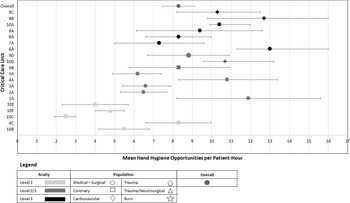
The aggregate mean HHO rate was 8.30 (95% CI, 7.46–9.13): 9.66 (95% CI, 8.79–10.52) during the day and 6.04 (95% CI, 5.04–7.04) at night. Table 1 shows the further breakdown of mean HHO rate by hospital and unit. Figure 1 depicts the mean HHO rates and 95% confidence intervals by unit showing the stepwise increase in HHOs with increasing acuity of patients in the included units.
Mean Hand Hygiene Opportunities per Patient Hour by Hospital and Critical Care Unit

Mean hand hygiene opportunities per patient hour and corresponding 95% confidence interval by study unit and organized by unit acuity and patient population.

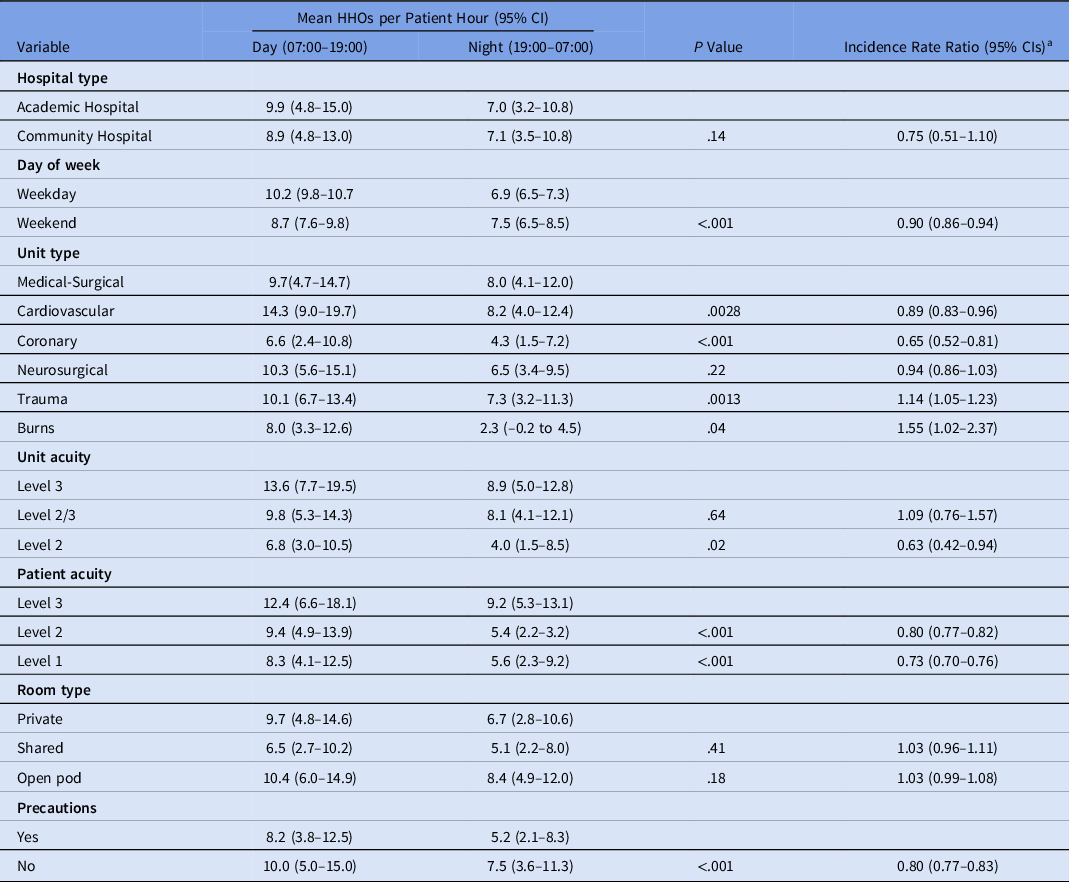
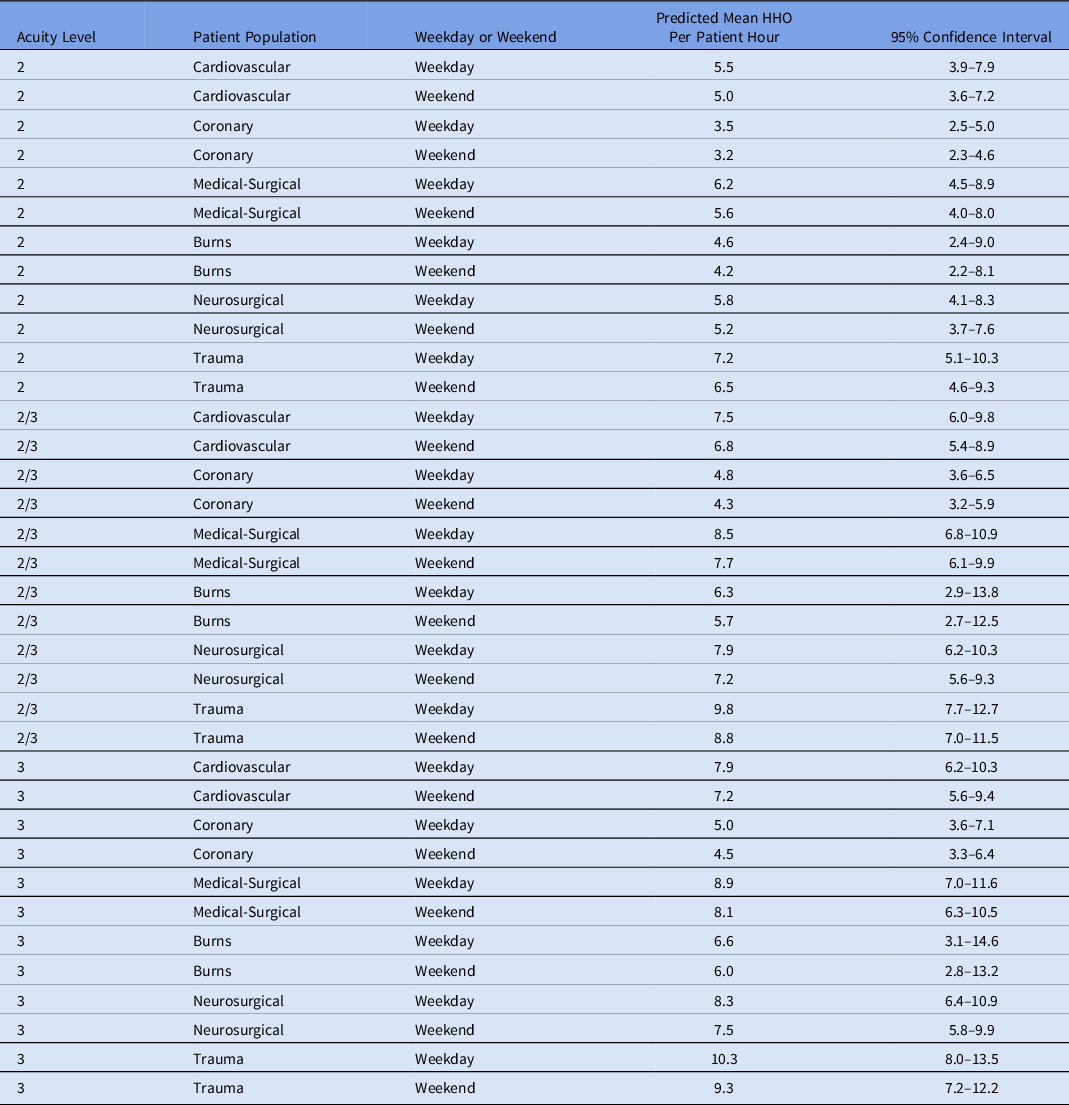
Table 2 describes the predictors of HHOs that were significant based on the Poisson regression model. Time, day of the week, unit acuity, patient acuity, patient population, and use of transmission-based precautions were significantly associated with the HHO rate. Among these variables, unit-level predictors, including acuity level on the unit, population, and day of the week, were included along with time of day, in a 4-variable Poisson model to derive predicted HHOs across 36 different permutations. Table 3 summarized the predicted HHO rate based on stable critical care unit characteristics.
Predictors of Mean Hand Hygiene Opportunities (HHO) Per Patient Hour Across 20 Canadian Critical Care Units

a Reference is first variable within each category. Model adjusted for clustering of unit nested within hospital and included the following covariates: time, hospital, day of week, unit acuity, patient acuity, patient population, room type and presence of precautions.
Predicted Hand Hygiene Opportunities (HHOs) Per Patient Hour Based on Stable Critical Care Unit Characteristics

Following implementation of GEHHMS using these predicted HHO rates, aggregate HH adherence was 30.0% (1,084,329 of 3,614,908) at baseline across 24 critical care units, with a range of 12.0%–68.8%. Following feedback to units, aggregate HH adherence improved to 33.5% (717,435 of 2,140,944) during the first month and up to 38.5% (740,660 of 1,921,656) during month 2 (P < .0001). All units improved HH adherence by the second month of the intervention (average improvement, 8.5%; range, 2.4%–18.6% between units).
Discussion
Our multicenter study describes the frequency of HHOs across critical care units and their associated predictors, which in turn was used to derive denominator benchmarks for the broad implementation of GEHHMS. The HH adherence measured using these benchmarks was similar to prior covert observational studies in critical care including 5 critical care units that measured HH adherence of 29%. Reference Eckmann, Behnke, Gastmeier and Ruden4 The expected improvements in the first months using this system were also consistent with prior experience on medical and surgical wards. Reference Leis, Powis and McGeer9
Concerns about the accuracy of automated HH measurement systems is a major barrier to implementation in critical care units. A prior study of an electronic HH monitoring system noted that the assessment of both HHOs and HH events was inaccurate, resulting in lack of acceptance by critical care staff. Reference Levin, Razon and Schwartz10 To validate GEHHMS, fewer studies have assessed HHOs in critical care units than medical and surgical wards. Using the Four Moments of HH methodology, Goodliffe et al Reference Goodliffe, Ragan and Larocque18 found an average hourly HHO rate of 6.8 (4.9–8.7) in an adult critical care unit but did not adjust for time of day and excluded weekends. Han et al Reference Han, Conway and Moore19 collected a large sample of HHOs and found an HHO rate per patient hour of 8.6 (7.4–9.8) when adjusting for time of day, but observations were also limited to a single critical care unit. Using the WHO methodology, 2 single-center studies measured HHO rates of 6.8 and 7.8 per patient hour in medical-surgical critical care units compared to 5.2 per patient hour in a neurosurgical intensive care unit. Reference Steed, Kelly and Blackhurst20,Reference Scheithauer, Haefner and Schwanz21
By studying 20 different critical care units in 10 hospitals, we identified additional predictors of HHOs that were used to derive average HHO rates based on specific critical care unit characteristics. These unit-specific HHO rate estimates seem consistent with prior studies. For example, the unit studied by Han et al, a level 3 medical-surgical critical care unit, was predicted based on our model to have 8.9 and 8.1 HHOs per patient hour during weekdays and weekends, respectively. Reference Goodliffe, Ragan and Larocque18 This predicted HHO rate is closely aligned with 8.6 HHO rate identified by these authors, and it was 12% higher than the finding of Steed et al, Reference Steed, Kelly and Blackhurst20 as expected based on the difference with the WHO Five Moment methodology. Our derived HHO rate for neurosurgical critical care units is also lower than that for medical-surgical units by 10%–40% depending on acuity, as previously reported by Scheithauer et al. Reference Scheithauer, Haefner and Schwanz21 We also report the HHO rate in a burn center which, to our knowledge, has not been described in the literature previously. However, given that only a single critical care unit involving burn, trauma, and a mixed neurosurgical population were included in our data set, further external validation of these populations is needed.
Our study provides a roadmap to institutions who are preparing to implement GEHHMS in critical care. Unlike medical-surgical wards where the HHO rate appears to be more stable across units, the larger variation in critical care requires a tailored approach based on known predictors of HHO rate. Reference Levin, Razon and Schwartz10–Reference Azim, Juergens and McLaws12 We believe that our model accounts for many of these differences within critical care units and that our derived average HHO rate accurately predicts benchmarks for hospitals using the Four Moments methodology. For countries using the WHO Five Moments methods, the expected HHO rate is ˜10%–20% lower than our derived estimates due to the absence of HHOs prior to contact with patient environment. Reference Han, Conway and Moore19–Reference Scheithauer, Haefner and Schwanz21
Our study has several limitations. First, the hospitals included were mainly larger community and university-affiliated academic hospitals and may not reflect practices in critical care units of smaller hospital centers where acuity may be lower. Second, our derived predicted HHO rate across different critical care units should not be directly applied to countries that use the WHO Five Moments without the appropriate adjustment. Third, our model was limited to unit-level predictors that were known in advance of implementing GEHHMS. Because patient-level predictors, such as individual patient acuity or presence of transmission-based precautions, were not included, average changes to these variables could have influenced these denominator benchmarks. Finally, due to the COVID-19 pandemic, the follow-up period following implementation of GEHHMS was limited. However, the available period allowed us to confirm that HH adherence measurements before and after implementation fell within the expected range. Continued use of GEHHMS is planned across our network as critical care units recover from the COVID-19 pandemic and are able to resume continuous quality improvement.
Unit-specific estimates based on known predictors of HHO rate enabled broad implementation of GEHHMS. Further longitudinal quality improvement efforts using this system are required to assess the impact of GEHHMS on both HH adherence and clinical outcomes within critically ill patient populations.
Acknowledgments
We thank the following individuals for their contributions in data collection and implementation of group electronic hand hygiene monitoring: Amber Linkenheld-Struk, Tanya Agnihotri, Sabrina Alonso, Sarah McBride, Sonya Mackay, Alice Newman, Sydney Baltazar, Saba Khan, Julie Gryn, Shara Junaid, Wendy Doda, Beata Mostowiak, Benjamin Rogers, Cassandra Perau, Srivani Seetharaman. We especially wish to thank Christine Moore for her work in training hand hygiene observers. The vendor of the group electronic monitoring system played no role in the development of the study protocol, data collection, analysis or interpretation of the results.
Financial support
This work was supported by the Innovation Fund of the Alternate Funding Plan from the Academic Health Sciences Centres of Ontario, at Sunnybrook Health Sciences Centre, St. Michael’s Hospital and University Health Network.
Conflicts of interest
None of the authors have any conflicts of interest to declare related to this article.