Faces and facial expressions of emotion have a critical role in human social interaction. Being able to extract socially relevant information from faces and to decode the meaning of facial expressions is crucial for a proper understanding of other´s feelings and intentions (e.g., Frith, Reference Frith2007). The importance of our ability to read into other´s faces is underscored by studies describing deficits in the ability to extract social and affective information from faces in conditions such as autism and schizophrenia, where poor social adjustment is a prominent characteristic (e.g., Adolphs, Sears, & Piven, Reference Adolphs, Sears and Piven2001; Kohler, Walker, Martin, Healey, & Moberg, Reference Kohler, Walker, Martin, Healey and Moberg2010; Pelphrey et al., Reference Pelphrey, Sasson, Reznick, Paul, Goldman and Piven2002).
It has been repeatedly shown that viewing faces that show emotional expressions induces in the observer specific patterns of facial activity. While perception of happy or smiling faces tends to produce a response pattern characterized by increased activity of the zygomaticus major (ZM) muscle and decreased activity of the corrugator supercilii (CS), perception of angry faces usually leads to increased corrugator activity (e.g., Dimberg, Reference Dimberg1982, Dimberg & Thunberg, Reference Dimberg and Thunberg1998; Dimberg & Ohman, Reference Dimberg and Ohman1996). These facial reactions are usually observed during the first second of exposure to an emotional expression and thus, have been called Rapid Facial Reactions (Moody, McIntosh, Mann, & Weisser, Reference Moody, McIntosh, Mann and Weisser2007). Although these reactions are usually sub-perceptual and are not visible to the naked eye, they can be detected by means of facial electromyography (EMG).
Characterization of the mechanism underlying these reactions to facial expressions has been a matter of considerable debate. Some researchers have interpreted them in terms of social mimicry (Chartrand & Bargh, Reference Chartrand and Bargh1999; Lakin, Jefferis, Cheng, & Chartrand, Reference Lakin, Jeffries, Cheng and Chartrand2003). By this account, perception of a specific facial expression automatically elicits a similar expression from the observer without any mediation by an emotional or evaluative process. For example, Chartrand and Bargh (Reference Chartrand and Bargh1999) have proposed a perception-behavior link mechanism, by which perception of another´s behavior facilitates similar behavior in oneself. An alternative account considers facial reactions in the presence of emotional expressions as part of an affective reaction to the expressions themselves (Hess, Philippot, & Blairy, Reference Hess, Philippot and Blairy1998; Moody et al., Reference Moody, McIntosh, Mann and Weisser2007). These reactions would thus be a consequence of a process involving affective evaluation and emotion recognition. Several pieces of evidence are consistent with this interpretation. Firstly, rapid facial reactions are not only evoked by facial expressions. Other affective stimuli, such as pictures or sounds of emotional content (e.g., Bradley, Codispoti, Cuthbert, & Lang, Reference Bradley, Codispoti, Cuthbert and Lang2001; Bradley & Lang, Reference Bradley and Lang2000), also evoke facial responses that are differentiated according to the valence of the stimulus, with increased ZM or CS activity to stimuli judged as pleasant or unpleasant, respectively. Second, in addition to facial emotional expressions, rapid facial reactions can also be elicited while viewing images of emotional body postures (Magnée, Stekelenburg, Kemner, & de Gelder, Reference Magnée, Stekelenburg, Kemner and de Gelder2007). Moreover, these reactions seem to be sensitive to the effects of emotional context. As an example, increased fear responses have been reported to angry faces after fear induction (Moody et al., Reference Moody, McIntosh, Mann and Weisser2007).
The interpretation of facial reactions to emotional expressions as affective responses is consistent with the more general idea that, in both humans and other mammals, there are differentiated patterns of facial movement that reflect the evaluation of a stimulus as pleasant or unpleasant (e.g., Armel, Pulido, Wixted, & Chiba, Reference Armel, Pulido, Wixted and Chiba2009; for a review, see Berridge, Reference Berridge2000). Several decades of research on animal and human conditioning have shown that motor and physiological responses elicited by biologically relevant events are easily transferred to stimuli with which they have been repeatedly paired (for a review see Ayers & Powell, Reference Ayers and Powell2002). From this it can be inferred that, as long as facial expressions of emotion are affective stimuli, repeated pairing of a neutral face with a positive or negative emotional expression should change the affective valence of that face through an associative learning mechanism and consequently modify the pattern of facial reactions it evokes in the observer. More specifically, the learned expectancy that the face of a specific individual will change to adopt a happy expression would give that face a positive valence and so evoke an appropriate facial response, that is, an increase in ZM activity. Conversely, the expectancy that a face will change to angry would give that face a negative valence and so evoke an increase in CS activity. However, the possibility that faces of different identities may acquire affective valence by their association with positive or negative emotional expressions and that this should be reflected in different patterns of facial reaction to them has not been previously explored. Previous studies have indeed measured EMG responses to faces associated with non-facial aversive stimuli (Bunce, Bernat, Wong, & Shevrin, Reference Bunce, Bernat, Wong and Shevrin1999; Dimberg, Reference Dimberg1987). In these studies, EMG activity at the Corrugator or Orbicularis Oculi regions was conditioned to angry faces signaling the delivery of aversive shock. Changes in facial reactivity revealing changes in affective valence can also be conditioned to non-facial stimuli, as reported in a study showing conditioning of facial EMG activity to abstract pictures associated with liked and disliked foods (Armel et al., 2009). This evidence shows that facial EMG activity is indeed sensitive to associative learning and that it can be used as an index of the changes in the affective value of a stimulus.
In the present experiment, the participants were exposed to repeated pairings of neutral (S1) and expressive (S2) faces. S1 were expressively neutral faces of different individuals and S2 were the faces of those same individuals showing a happy or an angry expression. A discrimination learning procedure was used, with some S1 faces always followed by a happy expression and others by an angry expression. The aim of this procedure was that the participants learned to identify some neutral faces as belonging to “friendly” individuals and others as belonging to “hostile” ones. Facial reactions in the presence of S1 and S2 faces were studied through EMG recording over the Zigomaticus Major (ZM) and Corrugator Supercilii (CS) muscle regions. The main objective of our study was, therefore, to test the possibility that stimuli repeatedly associated with positive or negative facial expressions of emotion can acquire the ability to elicit a pattern of facial reactions similar to the one elicited by the expressions themselves.
Although the elicitation of facial reactions in response to facial expressions of emotion is usually described as a well established finding that can be shown in most participants, it should be recognized that individual differences in facial reactivity exist, as shown in several studies that have reported positive correlations with relevant personality variables. Special attention has been given to the role of empathy and there is evidence of a positive correlation between questionnaire measures of empathy and facial reactivity or “mimicry” (Sonnby-Borgström, Reference Sonnby-Borgström2002; Sonnby-Borgström, Jönsson, & Svensson Reference Sonnby-Borgström, Jönsson and Svensson2003; see, however, Achaibou, Pourtois, Schwartz, & Vuilleumier, Reference Achaibou, Pourtois, Schwartz and Vuilleumier2008, for different results). Correlations with dysphoria levels (Sloan, Bradley, Dimoulas, & Lang, Reference Sloan, Bradley, Dimoulas and Lang2002) and differences related to responsivity to self-produced cues have also been reported (Laird et al., Reference Laird, Alibozak, Davainis, Deignan, Fontanella, Hong and Pacheco1994). Given the objectives of our study, we paid special attention to potential differences between participants in EMG responsivity. As our hypothesis was that the participants would show, in the presence of the S1 faces, a pattern of facial activity similar to that evoked by the associated emotional expression, it is clear that this result should only be observed in those participants who showed the expected pattern of increased ZM activity to happy faces and increased CS activity to angry faces in the first place.
EXPERIMENT 1 Method
Participants
57 students (9 males, 48 females, aged between 17 and 25, M = 18.7, SD = 3.2) from the Universidad Complutense de Madrid voluntarily took part in this experiment in exchange of course credits. All participants reported to have no history of any neurological or psychiatric disorders. Informed consent was obtained before starting the experiment.
Stimuli
Eight pictures from the Karolinska Directed Emotional Faces database (KDEF, Lundqvist & Litton, Reference Lundqvist and Litton1998) were used as stimuli. The faces corresponded to four different models, two males and two females. The neutral faces of these models were used as S1. The S2 were the same models showing a happy or an angry expression. One model of each sex showed the happy expression and the other model showed the angry expression (see Appendix 1 for list of the stimuli used and for associations for each model). These pictures were selected based on results from a pilot experiment (N = 38) where the participants evaluated a bigger set of KDEF pictures in terms of expressive intensity (from 1 = very angry, to 9 = very happy), valence (from 1 = very negative to 9 = very positive) and arousal (from 1 = very relaxing to 9 = very activating). For the evaluations obtained in the pilot study see the Appendix 2.
All pictures were converted to grey scale, cropped to conceal most of the hair and equated in contrast energy (cRMS = 0.2). The faces were presented centered on the screen of a 23” LCD monitor, inside a 512 x 512 pixels square with a 50% grey background, subtending an area of 13.5 × 13.5 degrees of visual angle (dva).
Procedure
The experimental session took place in a sound proof room. Stimulus presentation and response collection were programmed and controlled with stimulation software E-Prime 1.1(Psychology Software Tools, Pittsburgh, PA). Participants were seated at a distance of 50 cm from the computer screen.
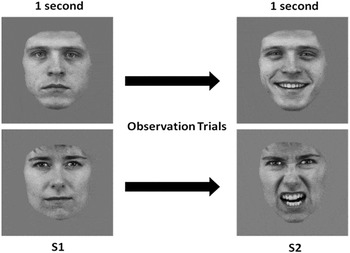
Participants were asked to imagine they had arrived in a new town and that they were going to meet new people. Their task was to identify each person they met as “friendly” or “hostile” based on their facial expression. The experimental task included two types of trials. On observation trials, the participants were presented with S1-S2 sequences where expressively neutral faces of different models (S1) were followed by the face of that same model showing either a happy or an angry (S2) expression. For two models, S1 was always paired with its corresponding angry expression (S2) and for the other two the S1 was paired with the corresponding happy expression (S2). Faces that smiled during the observation trials would be “friendly”, while faces that frowned during those trials would be “hostile”. Figure 1 shows examples of these pairings. On categorization trials, only the neutral S1 faces were presented and the participants had to decide if they belonged to friendly or to hostile models, based on the expression associated to that model in the S1-S2 sequences shown previously.
Stimulus sequence on observation trials.

The whole session consisted of twenty blocks. On each block, the four observation trials (one per model) were followed by the four categorization trials. Thus, each S1 (non-expressive) face was seen twenty times followed by the S2 face and twenty times alone. Each observation trial started with a fixation point, presented at the centre of the screen for 500 ms; this fixation point was then replaced by the onset of a non-expressive face (S1), during 1 second, followed by the face of the same individual showing the corresponding expression (S2), also with a duration of 1 second. Each categorization trial started with the 500 ms fixation point, followed by the response screen containing a S1 face and the two possible response options (“Friend” or “Enemy”) below. Participants were asked to indicate their response by clicking over the appropriate option with the mouse within a 1 second time limit. Presentation of the stimulus was finished by this response.
EMG Signal Acquisition and Analysis
The experimental environment was carefully prepared so as to ensure that no electronic devices could contaminate the EMG signal. EMG was recorded using a Powerlab system, from four active electrodes corresponding to two distinct bipolar montages. Miniature surface electrodes (4 mm, Ag/AgCl) filled with electrode gel were attached on the left side of the face over the zygomaticus major (ZM) and corrugator supercilii (SC) muscle regions, following Fridlund and Cacioppo’s (Reference Fridlund and Cacioppo1986) guidelines. An additional ground electrode was placed on the elbow. The participant’s skin had been previously cleansed with alcohol over the register sites. Simple motor and cognitive tasks (e.g., eyes closing and opening, counting backwards) were used during participant´s preparation in order to ascertain proper electrode functioning and mask the intention of the experiment.
The EMG was continuously recorded at 1K/s with an online 50–400 Hz band-pass digital filter, using the Powerlab software. Data were segmented into 3000 ms epochs, corresponding to the S1 and S2 stimulus duration and the previous 1000 ms period, full-wave rectified and smoothed over 200 ms periods. The values corresponding to the S1 and S2 periods were then baseline-corrected by subtracting the average baseline EMG activity from the activity corresponding to each time bin. Finally, statistical analysis was carried out on the average values corresponding to the ten 100 ms time bins during each the S1 and S2.
Results
For all repeated measures ANOVA analyses reported in the present paper, the Greenhouse-Geisser correction was applied when the sphericity assumption was violated. Post-hoc analyses were performed using the Bonferroni correction (significant when p ≤ .05).
Behavioral results
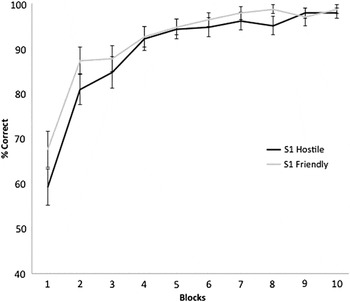
A 10 x 2, Blocks x Category (friendly or hostile) repeated measures ANOVA was performed on accuracy results (that is, correct identification of S1 faces as friendly or hostile) during the categorization phase. The analysis gave significant effects of Blocks, F(9, 504) = 49.759, p < .001, η2 = 0.470, and of Category, F(1, 56) = 4.151, p = .046, η2 = 0.069, reflecting increased accuracy over blocks with a slightly better performance in the case of friendly faces. Figure 2 represents the learning curves through the blocks, these results with accuracy on categorization trials. Post-hoc comparisons showed that accuracy in the four first blocks was lower than in the others blocks (p < .05). This result indicates that learning of the association between S1 and S2 reached asymptotic level only at the end of the first half of the session. Based on this finding, EMG results were split for analysis into two blocks corresponding to the first and second halves of the session.
Percentage of correct identifications on categorization trials for the two S1 categories (friendly, hostile). Each data point represents averages of two blocks.

EMG results
The crucial EMG results were those corresponding to the S1 faces. These were analyzed only for observation trials, where the S1–S2 faces sequences were presented. This decision was based on three considerations. First, it guarantees that responses in the presence of the S1 and S2 faces are compared against a common baseline (EMG activity in the presence of the S1 and S2 faces was corrected against the same pre-trial baseline activity). Second, only during the observation trials did the participants have the expectancy that the neutral faces would be followed by a positive or negative expression. Moreover, there is evidence suggesting that explicit instructions to evaluate an affective stimulus may dampen spontaneous, automatic affective responses (e.g., Lieberman, Reference Lieberman, Todorov, Fiske and Prentice2011) of which the EMG responses here studied are an example. In fact, a previous study by Aguado et al. (Reference Aguado, Valdés-Conroy, Rodriguez, Román, Diéguez-Risco and Fernández-Cahill2012) using a paradigm similar to that employed in the present experiment showed a different pattern of modulation of brain potentials to S1 neutral faces followed by emotional S2 faces and to those same S1 faces presented alone. Finally, S1 duration during the categorization trials was different for each participant and trial, as presentation of the stimulus was terminated by the categorization response.
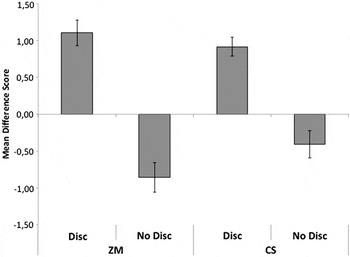
Before carrying the main analysis and in order to check for individual differences in facial reactivity, a difference score was computed for each participant and muscle (a similar index was used by Achaibou et al., Reference Achaibou, Pourtois, Schwartz and Vuilleumier2008). First, the average ZM and CS activity in response to each facial expression (S2) over the 20 observation trials was calculated. Then, ZM difference scores were calculated by substracting average ZM activity in the presence of angry faces from average ZM activity in the presence of happy faces. Those participants showing positive values were considered as ZM discriminators. Complementarily, CS difference scores were calculated by substracting the average CS activity in the presence of happy faces from the average CS activity in the presence of angry faces. Participants showing positive values were considered as CS discriminators. According to these difference scores, 33 participants (58% of the total sample) were ZM discriminators and 38 (66.7% of the total sample) were CS discriminators. Note that a particular participant might be discriminator for both expressions, for only one or for none of the expressions. Mean difference scores for discriminators and non discriminators are presented in Figure 3.
Mean EMG activity difference scores for ZM and CS discriminators and non discriminators.

With the aim of evaluating the effects of learning on EMG activity elicited by the S1 faces, results were analyzed separately for the first and second half of the session, that is, for two successive blocks of ten observation trials. Statistical analyses were carried out on the average values corresponding to the ten 100 ms time bins during the S1. Repeated measures, 10 x 2 x 2 ANOVA, with Time and Category (friendly or hostile) as within-subjects factors and Discriminator as the between-subjects factor, were performed separately for each muscle. No significant effects were obtained in the first block of trials on ZM activity in the presence of S1 faces. However, a small but significant Category x Discriminator interaction was obtained in the case of CS activity, F(1, 55) = 4.33, p = .042, η2 = .073. Analysis of this interaction revealed that CS discriminators showed significantly higher CS activity in the presence of hostile S1 faces than in the presence of friendly S1 faces.
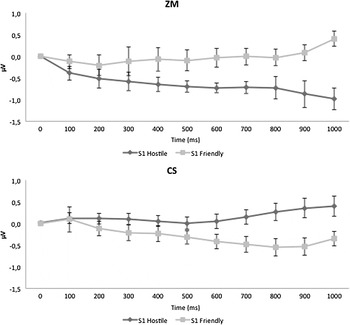
Figure 4 presents the EMG results corresponding to the S1 friendly and the S1 hostile faces, respectively, during the second block of trials. It can be observed that ZM discriminators showed higher ZM activity in the presence of friendly rather than in the presence of hostile faces, that is, a pattern similar to that observed when comparing ZM activity in the presence of the corresponding S2 happy and angry faces. A comparable result can be seen for CS activity, with discriminators showing higher activity over this muscle´s region in the presence of S1 hostile faces rather than in the presence of S1 friendly faces. Statistical analyses confirmed these impressions. A significant Category x Discriminator interaction was found for ZM activity, F(1, 55) = 14.91, p < .001, η2 = .213. Post-hoc analyses yielded significant between-category differences in both discriminators and non-discriminators. While discriminators showed higher ZM activity in the presence of S1 friendly faces, non discriminators showed higher ZM activity in the presence of S1 hostile faces. For CS activity, a significant Category x Discriminator interaction was also found, F(1, 55) = 10.1, p < .001, η2 = .155. Post-hoc analyses revealed between-category differences only in discriminators, who showed significantly higher CS activity in the presence of S1 hostile faces.
Mean EMG activity over Zygomaticus Major (ZM) and Corrugator Supercilii (CS) regions in the presence of S1 faces on the second block of trials.

Discussion
The results of Experiment 1 showed that repeatedly pairing neutral faces with positive or negative emotional expressions (happy and angry) is effective to change the pattern of facial reaction to those faces as measured by EMG activity. This change was in the direction of the pattern of facial activity evoked by the expressions themselves, that is, increased ZM activity in the presence of neutral faces associated with happy expressions (“friendly” individuals) and increased CS activity in the presence of those faces associated with angry expressions (“hostile” individuals). However, this was not a general result as it only appeared in discriminators, that is, those participants who also showed ZM or CS discrimination to the S2 expressive faces themselves. But at the same time, this very fact strongly suggests that the changes in facial activity evoked by the S1 faces were a consequence of an associative learning process by which each neutral face was associated with the corresponding facial expression. This is similar to the usual result in Pavlovian conditioning studies, where responses similar to those elicited by the unconditioned stimulus are conditioned to cues they have been repeatedly paired with (see Ayers & Powell, Reference Ayers and Powell2002, for a review). A question that remains to be answered is if the associative procedure used in the present experiment also changes the explicit evaluation of the S1 faces. In other words, if, as a consequence of learning, the faces associated with happy expressions are perceived as more positive and those associated with angry expression are perceived as more negative. This is what we would predict if the changes in EMG activity in response to the neutral faces would be due to the modification of the affective value of the faces as a result of associative learning.
EXPERIMENT 2
A shortcoming of the design of Experiment 1 was that it did not include explicit evaluation of the affective valence of the S1 faces by the participants. This is important if we want to attribute the observed changes in EMG activity in response to the S1 faces to the modification of their affective valence. Previous studies have shown that changes in explicit evaluation of neutral faces can be brought about by pairing them with positive or negative social information (e.g., Bliss-Moreau, Barrett, & Wright, Reference Bliss-Moreau, Barrett and Wright2008; Blessing, Keil, Linden, Heim, & Ray, Reference Blessing, Keil, Linden, Heim and Ray2006). These results can be considered in relation to the well-known phenomenon of evaluative conditioning that occurs when the affective evaluation, or the extent to which a stimulus is liked, is modified due to its pairing with other positive or negative stimuli (see De Houwer, Thomas, & Baeyens, Reference De Houwer, Thomas and Baeyens2001, for a review). In our study, the neutral S1 faces were paired with emotional expressions that are usually evaluated as affectively positive or negative and that are of high relevance in social interaction. Moreover, participants learned to categorize those faces in terms of two socially relevant categories (friendly or hostile). All this would lead us to predict that our associative learning procedure should produce changes in the explicit affective evaluation of the S1 faces.
Method
Participants
23 students (18 females, 5 males), aged between 18 and 39, M = 20.28, SD = 4.3) from the Universidad Complutense de Madrid voluntarily took part in this experiment in exchange of course credits. All participants reported to have no history of any neurological or psychiatric disorders. Informed consent was obtained before starting the experiment.
Procedure
The experimental procedure was identical to that of Experiment 1 with two exceptions. One was that no EMG measures were taken. Moreover, the participants were asked to evaluate explicitly the S1 faces before and after the observation phase. On each of these evaluations, S1 faces were presented and the participants were asked to rate them on two continuous scales of valence (from 1 = very negative to 9 = very positive) and arousal (from 1 = very relaxing to 9 = very arousing).
Results and Discussion
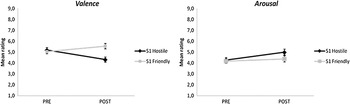
The results of valence and arousal evaluation are presented in Figure 5. A 2 x 2 Category (friendly vs. hostile) x Time (pre-learning vs. post-learning) repeated measures ANOVA was carried out on the results of each evaluation. In the case of valence, significant effects were found of Category, F(1, 22) = 5.10, p = .034, η2 = 0.19, and of the Category x Time interaction, F(1, 22) = 10.10, p = .004, η2 = 0.31, revealing that learning was effective to modify the valence of the faces. Post-hoc analyses showed significant differences on the second, post-learning evaluation test, with friendly faces being rated as significantly more positive than hostile faces (Means = 5.7 and 4.2, respectively, SEM = .26). As for arousal evaluations, significant effects were obtained only of the Time factor, F(1, 22) = 5.05, p = .035, η2 = 0.18, revealing an increase in evaluated arousal from Pre to Post-test for both the friendly and the hostile faces.
Valence and arousal ratings in Experiment 2.

The results of Experiment 2 showed that the associative procedure used in this and the previous experiment was effective to modify the explicit evaluation of neutral faces according to the valence of the emotional expression they had been paired with. An unexpected result was the significant increase of arousal ratings in the post-learning evaluation phase for both the S1 hostile and friendly faces. As can be seen in Appendix 2, S2 angry faces were evaluated by the participants of the pilot study as more arousing than S2 happy faces. Thus, a selective increase of arousal ratings for those S1 faces associated with angry expressions would be expected. At present we can only speculate that the observed increase in arousal ratings for both types of faces might reflect the acquisition of emotional meaning irrespective of the specific valence of the associated expression.
General discussion
The results of our Experiment 1 showed that rapid facial responses to faces paired with positive or negative emotional expressions can be modified through associative learning. Expressively neutral faces associated with happy or with angry expressions (that is, S1 “friendly” and “hostile” faces) acquired the ability to evoke in the observer a pattern of facial reactions similar to that evoked by the expressions themselves, that is, increased ZM activity in the presence of friendly faces and increased CS activity in the presence of hostile faces. However, this result was restricted to those participants who also showed the expected pattern of facial responses in the presence of the S2 expressive faces themselves. Though this fact might seem to limit the generality of our results, it, in fact, gives support to an interpretation in terms of associative learning. As is typical of classical conditioning, where the form of the conditioned response tends to replicate that of the unconditioned response to the unconditioned stimulus, the expected increase of ZM activity in the presence of S1 friendly faces and of CS activity in the presence of S1 hostile faces only appeared in those participants who showed the typical pattern of facial responses in the presence of the corresponding expressive faces. These results are consistent with previous evidence showing that facial muscle activity is sensitive to associative learning and can change in response to stimuli paired with positive or negative affective consequences (Armel et al., Reference Armel, Pulido, Wixted and Chiba2009; Bunce et al., Reference Bunce, Bernat, Wong and Shevrin1999; Dimberg, Reference Dimberg1987). Moreover, our results extend this evidence by showing that facial expressions of emotion are effective in producing changes in the response to the neutral face of the individual who shows them.
The results obtained in the present experiment have implications for the controversy over the meaning of rapid facial reactions generated upon exposure to facial expressions of emotion. As mentioned in the introductory section, these reactions have been alternatively interpreted as mimetic responses to the observed expression (Chartrand & Bargh, Reference Chartrand and Bargh1999) or as part of an affective reaction produced by the expression itself (Hess et al., Reference Hess, Philippot and Blairy1998; Moody et al., Reference Moody, McIntosh, Mann and Weisser2007). The results we obtained with the S1 faces associated with happy or with angry expressions seem more consistent with this last explanation and can be interpreted as reflecting a change in affective meaning, given that we observed changes in ZM and CS activity in response to faces that did not show any emotional expression. The mimicry hypothesis is consistent with the observation of increased CS activity to angry faces and of increased ZM activity in the presence of happy faces, because CS contraction produces the frown that is characteristic of angry faces and ZM contraction produces the smile component of happy faces. However, increased CS or ZM activity in the presence of a neutral face is difficult to interpret as a mimetic reaction because expressively neutral faces do not usually wear a frown or a smile. The most plausible interpretation of our results is that changes in facial activity to the S1 neutral faces reflect learning of an association with the corresponding positive or negative emotional expression and that this learning modifies the affective meaning of the neutral faces in the direction of the affective valence of the expression itself. However, we must recognize that this does not rule out the possibility that a mimicry mechanism might still be involved in facial responses to emotional faces.
The results of Experiment 2 showed that the procedure used in Experiment 1 was also effective to modify the explicit evaluation of the S1 faces. Although EMG and evaluation results were gathered in different experiments and with different samples, both measures are consistent in showing sensitivity to associative learning derived from pairing neutral faces with different emotional expressions. However, though changes in both measures can be attributed to learning, it is not at all clear what the relation between these changes might be. Whether they are interpreted as mimicry or as affective responses, rapid facial reactions evoked by emotional expressions are usually considered to be automatic and non-controllable, reflecting the operation of non-conscious processes (e.g., Chartrand & Bargh, Reference Chartrand and Bargh1999; Dimberg, Reference Dimberg1987), a view that is supported by studies showing differentiated facial reactions to emotional faces presented subliminally (e.g., Dimberg, Thumberg, & Elmehed, Reference Dimberg, Thunberg and Elmehed2000). Thus, it is most likely that changes in facial EMG and in explicit evaluation reflect different and independent processes related to implicit and explicit learning processes, respectively.
Finally, a word is in order in relation to the individual differences we observed in facial reactivity. As we have already mentioned, differences in EMG reactivity in the presence of facial expressions of emotion have been previously described and related to differences in personality and empathy level. For example, differences in facial reactivity to happy faces have been found in individuals with different levels of dysphoria or depression, possibly reflecting more basic differences in sensitivity to social reward (Sloan et al., Reference Sloan, Bradley, Dimoulas and Lang2002). It might be that the between-subject variation we observed in facial response to happy faces was partly due to individual differences in sensitivity to social reward in our sample. On the other hand, a subset of participants in our study showed higher ZM activity in the presence of angry faces than in the presence of happy faces. In fact, these ZM non discriminators also showed higher ZM activity in the presence of the S1 faces that had been associated with angry expressions. This inverse pattern has indeed been reported before and associated to some personality traits, such as low empathy or high dismissal/avoidance and explanations have been suggested in terms of regulation of negative affect or attentional strategies (Sonnby-Borgström, Reference Sonnby-Borgström2002; Sonnby-Borgström & Jônsson, Reference Sonnby-Borgström and Jönsson2004). Alternatively, increased ZM activity in the presence of angry and hostile faces might be interpreted as submissive smiles to the face of dominant individuals. This is a plausible interpretation given the composition of our sample, with a majority of females. However, simpler interpretations of apparently idiosyncratic patterns of facial response should not be dismissed. For example, given that the masseter muscle is often engaged in angry expressions and that electrode placement for recording ZM activity is close to it, it might be that increased ZM activity to angry faces was in fact caused by cross-talk from the masseter (Hess, Reference Hess, Harmon-Jones and Beer2008).
At the most general level, the results here reported show the operation of a learning mechanism based on emotional expression that may contribute to the acquisition of affective valence by the faces of our conspecifics and modify the way in which we automatically react to their sight. We have reported in a previous paper results that show that the associative learning procedure used in the present study is also effective to modulate early perceptual processing of individual faces as shown by event-related potentials (Aguado et al., Reference Aguado, Valdés-Conroy, Rodriguez, Román, Diéguez-Risco and Fernández-Cahill2012). Taken together, what these results suggest is that positive and negative emotional expressions have power enough to modify the affective value of human faces and that this change is manifest at both central (brain responses) and peripheral levels (facial reactions). This mechanism is of potential adaptive significance to the extent that it reflects the affective relevance of the outcome of previous encounters with specific individuals.
Appendix 1
KDEF stimuli used in the experiments

Appendix 2