The Optimality Theory (OT) mechanism Jones proposes is a universal account of the structure of kinship systems. Such OT accounts should relate to typology in two ways. First, they should be able to predict the attested range of variation in a domain using different rankings of a plausible (and, one hopes, restricted) set of constraints. Second, the markedness constraints employed should make predictions about the relative frequency of occurrence expected for the different patterns that can be generated. We explore here the quantitative distribution of kin systems and suggest that it is emphatically nonrandom in a statistically significant sense, and that at least some common patterns do not necessarily support the markedness scales proposed by Jones.
The notion of an evaluation metric that could select one from amongst a set of candidate grammars, so important for early work in generative grammar (see, e.g., Chomsky Reference Chomsky1965, pp. 34–47; Chomsky & Halle Reference Chomsky and Halle1968, ch. 9), has no relevance to the mechanism of OT. This model uses input values taken from a set of universal cognitive categories fed to a universal generative system to produce candidate output forms. The candidate forms are evaluated against a set of ranked constraints; again this is assumed to be a universal set: “The ranking in a particular language is, in theory, a total ordering of a set of universal constraints.” (McCarthy Reference McCarthy2001, p. 6) Different outputs result from varying the relative ranking of the constraints, but none of the resulting grammars is simpler or more economical than any other; the cognitive machinery is the same in each case. The relatively small range of variation observed in phonologies, the subfield of linguistics where OT originated and has been most explored, is attributed to the fact that markedness constraints are grounded in facts about the articulation, perception, and processing of speech (Gordon Reference Gordon2007).
All other things being equal, Jones's analysis would predict that no kinship system would be more economical to generate than any other; however, Jones does propose some markedness constraints which should restrict the variation. It is therefore an interesting question whether the observed distribution of different kinship systems across the cultures and languages of the world is random or not, and whether the distributional evidence supports the proposed markedness constraints.
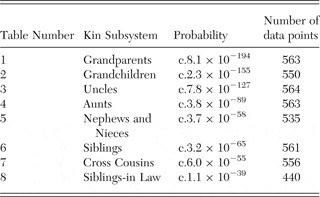
We take as a sample for analysis the kinship systems classified by Murdock (Reference Murdock1970). This sample is accepted by Jones (Reference Jones2003) as the best available source and provides up to 564 data points for eight subsystems of kinship. Given that this approaches being a sample of 10% of the world's languages, we take it as adequate for an initial exploration of the question. The results of our investigation of the data are presented in Table 1. These results were obtained using an analysis based on the Minimum Message Length (MML) principle, comparing a multinomial distribution with all classes equi-probable versus a model with probabilities inferred by MML with a uniform prior (α=1) (Wallace Reference Wallace2005, sect. 5.4.2, p. 248; Dowe Reference Dowe2008, fn. 151). By using only these two rival models, we are being generous with our probabilities reported in Table 1.
Table 1.
Probability of the frequency distributions reported by Murdock (Reference Murdock1970) occurring by chance (as estimated using MML techniques)
Table 1 shows that the probability of any of the patterns in the subsystems of kinship analysed by Murdock occurring by chance is vanishingly small. Although in one case (Murdock's Table 8) the probability is many orders of magnitude larger (undoubtedly largely a result of the smaller sample in this case), that result still represents a minute possibility. Therefore the possible variation in kinship systems is constrained.
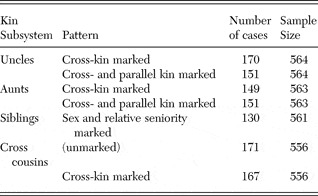
It is not possible to comment in all cases as to how these results relate to Jones's markedness scales, but in the cases where a direct relation can be made, the results are equivocal (see Table 2 for numerical data). For uncle and aunts (discussed in detail in Jones Reference Jones2003), two patterns are almost equally common. One treats cross-kin relations as marked, with father's brother and mother's sister collapsed with the parent terms, while the other pattern has special terms for both the parallel and the cross-relation. The first pattern treats cross-kin relations as more marked than parallel relations, in accord with Jones's markedness scale, but the second pattern does not. In the case of siblings, the most common pattern has four distinct terms coding both sex and seniority. In some cases, these terms may be in pairs, of which one is formally marked relative to the other; this could only be established by consulting the original sources. But it is not obvious that these data confirm Jones' view that junior kin are marked relative to senior kin. For cross cousins, one of the two common patterns does not distinguish this relation at all, while the other does. Again, only one possibility matches Jones's markedness scale. Overall, the match between Jones's markedness scales and these results is not strong.
Table 2.
Categories marked in the most common patterns for three kin subsystems
Jones's analysis of kinship terminology using OT is promising with respect to the first of the typological goals mentioned above. His (2003) discussion shows that it generates the common possibilities in at least one subsystem. However, the simple test reported here suggests that the analysis has some work to do still to meet the second goal.





 You have
Access
The Optimality Theory (OT) mechanism Jones proposes is a universal account of the structure of kinship systems. Such OT accounts should relate to typology in two ways. First, they should be able to predict the attested range of variation in a domain using different rankings of a plausible (and, one hopes, restricted) set of constraints. Second, the markedness constraints employed should make predictions about the relative frequency of occurrence expected for the different patterns that can be generated. We explore here the quantitative distribution of kin systems and suggest that it is emphatically nonrandom in a statistically significant sense, and that at least some common patterns do not necessarily support the markedness scales proposed by Jones.
The notion of an evaluation metric that could select one from amongst a set of candidate grammars, so important for early work in generative grammar (see, e.g., Chomsky Reference Chomsky1965, pp. 34–47; Chomsky & Halle Reference Chomsky and Halle1968, ch. 9), has no relevance to the mechanism of OT. This model uses input values taken from a set of universal cognitive categories fed to a universal generative system to produce candidate output forms. The candidate forms are evaluated against a set of ranked constraints; again this is assumed to be a universal set: “The ranking in a particular language is, in theory, a total ordering of a set of universal constraints.” (McCarthy Reference McCarthy2001, p. 6) Different outputs result from varying the relative ranking of the constraints, but none of the resulting grammars is simpler or more economical than any other; the cognitive machinery is the same in each case. The relatively small range of variation observed in phonologies, the subfield of linguistics where OT originated and has been most explored, is attributed to the fact that markedness constraints are grounded in facts about the articulation, perception, and processing of speech (Gordon Reference Gordon2007).
All other things being equal, Jones's analysis would predict that no kinship system would be more economical to generate than any other; however, Jones does propose some markedness constraints which should restrict the variation. It is therefore an interesting question whether the observed distribution of different kinship systems across the cultures and languages of the world is random or not, and whether the distributional evidence supports the proposed markedness constraints.
We take as a sample for analysis the kinship systems classified by Murdock (Reference Murdock1970). This sample is accepted by Jones (Reference Jones2003) as the best available source and provides up to 564 data points for eight subsystems of kinship. Given that this approaches being a sample of 10% of the world's languages, we take it as adequate for an initial exploration of the question. The results of our investigation of the data are presented in Table 1. These results were obtained using an analysis based on the Minimum Message Length (MML) principle, comparing a multinomial distribution with all classes equi-probable versus a model with probabilities inferred by MML with a uniform prior (α=1) (Wallace Reference Wallace2005, sect. 5.4.2, p. 248; Dowe Reference Dowe2008, fn. 151). By using only these two rival models, we are being generous with our probabilities reported in Table 1.
Probability of the frequency distributions reported by Murdock (Reference Murdock1970) occurring by chance (as estimated using MML techniques)
Table 1 shows that the probability of any of the patterns in the subsystems of kinship analysed by Murdock occurring by chance is vanishingly small. Although in one case (Murdock's Table 8) the probability is many orders of magnitude larger (undoubtedly largely a result of the smaller sample in this case), that result still represents a minute possibility. Therefore the possible variation in kinship systems is constrained.
It is not possible to comment in all cases as to how these results relate to Jones's markedness scales, but in the cases where a direct relation can be made, the results are equivocal (see Table 2 for numerical data). For uncle and aunts (discussed in detail in Jones Reference Jones2003), two patterns are almost equally common. One treats cross-kin relations as marked, with father's brother and mother's sister collapsed with the parent terms, while the other pattern has special terms for both the parallel and the cross-relation. The first pattern treats cross-kin relations as more marked than parallel relations, in accord with Jones's markedness scale, but the second pattern does not. In the case of siblings, the most common pattern has four distinct terms coding both sex and seniority. In some cases, these terms may be in pairs, of which one is formally marked relative to the other; this could only be established by consulting the original sources. But it is not obvious that these data confirm Jones' view that junior kin are marked relative to senior kin. For cross cousins, one of the two common patterns does not distinguish this relation at all, while the other does. Again, only one possibility matches Jones's markedness scale. Overall, the match between Jones's markedness scales and these results is not strong.
Categories marked in the most common patterns for three kin subsystems
Jones's analysis of kinship terminology using OT is promising with respect to the first of the typological goals mentioned above. His (2003) discussion shows that it generates the common possibilities in at least one subsystem. However, the simple test reported here suggests that the analysis has some work to do still to meet the second goal.