
I. INTRODUCTION
Compared with Mg and its alloys, particle reinforced Mg matrix composites (PMMCs) with the merits of high specific strength, high specific modulus, and low coefficient of thermal expansion, have attracted widespread attention in recent years.Reference Wang, Xu, Wu, Chen, Peng, Jin, Xin, Zhang, Liu, Cheng, Chen, Deng and Wang1–Reference Chen and Yan4 Besides fabrication and thermomechanical process, particle size was also an important factor on influencing the mechanical properties of PMMCs.Reference Deng, Wang, Wu, Hu, Wu and Gan5,Reference Shen, Wang, Ying, Wu and Song6 To give a full play to the merits of different particle sizes, the mixture of micron and submicron particle were thought to be an effective way.Reference Deng, Shi, Wang, Wang, Wu, Nie and Wu7,Reference Zhang, Qiu, Wang, Wang and Jiang8 In the previous work of Deng et al.,Reference Deng, Shi, Wang, Wang, Wu, Nie and Wu7 a (submicron + micron) SiCp/AZ91 composite was fabricated and followed by two-step deformation, which exhibited high yield strength than that of single-size particle reinforced composites. Based on the strengthening mechanism analysis, the grain refinement and dislocation strengthening mechanisms were found to play a major role in mechanical properties at room temperature.Reference Deng, Shi, Wang, Wang, Wu, Nie and Wu7
Nevertheless, the flow stress and deformation behavior of fine grained PMMCs at elevated temperature also need comprehensive investigation. The as-cast bimodal size SiCp/AZ91 composite was compressed at the temperature of 270–420 °C and 0.001–1 s−1 by Zhou et al.,Reference Zhou, Deng, Li, Nie, Xu, Zhou and Fan9 the deformation mechanism was revealed, and the processing map was also drawn. Nevertheless, the activation energy of deformation could be reduced obviously when the SiCp/AZ91 composite own finer grains according to the authors’ previous investigation.Reference Deng, Li, Nie, Xu and Wang10,Reference Deng, Li, Xu, Nie and Liang11 Thus, the deformation behavior of fine grained PMMCs is different from that with coarse grains; however, a little work has been focused on this aspect at present.
In fact, the hot deformation process related to the occurrence of recrystallization, and the recrystallization behavior of Mg influenced by SiCp had been recognized by investigators.Reference Deng, Wang, Zheng and Wu12,Reference Wang, Deng and Liang13 Based on Deng et al.’s investigation,Reference Deng, Wang, Zheng and Wu12 the influence of submicron SiCp on the dynamic recrystallization (DRX) behavior of Mg was different from that of micron SiCp. Nevertheless, Wang et al.’s researchReference Wang, Deng and Liang13 also found that the existence of a little amount of submicron SiCp had an obvious effect on the static recrystallization behavior of bimodal size PMMCs. So, it can be concluded that that effect of bimodal size SiCp on the recrystallization of the Mg matrix is different from that of single size SiCp, which may directly reflect on the flow stress and influence on the deformation behavior. Even though some research has been done on PMMCs, its flow stress and deformation behavior of the fine-grained Mg matrix influenced by bimodal size SiCp still lack investigation.
As a consequence, a fine-grained bimodal size SiCp/AZ91 composite is fabricated in the present work. After being subjected to compression at elevated temperatures, the flow stress and deformation behavior of the fine grained Mg matrix influenced by bimodal size SiCp are to be revealed, and the reasons are also given and analyzed.
II. EXPERIMENTAL PROCEDURES
The AZ91 alloy was selected as the matrix alloy. Two sizes (submicron and micron) of SiCp are used as reinforcement. The average particle size of submicron and micron SiCp is about 0.2 μm and 10 μm, respectively. In the present work, the bimodal size SiCp/AZ91 composite containing 1 vol% of 0.2 μm SiCp and 9 vol% of 10 μm SiCp (denote as “S-1 + M-9”) was fabricated by stir casting. The whole fabrication process was conducted in a protective atmosphere of CO2 and SF6 to avoid burning.Reference Deng, Shi, Wang, Wang, Wu, Nie and Wu7 First, the AZ91 alloy was molten at 720 °C, and then cooled to 590 °C which made the matrix alloy in the semisolid condition. As the 1 vol% submicron and 9 vol% micron SiCp were added into the molten AZ91 alloy, the melt was stirred for 30 min, and then was rapidly reheated to 720 °C for casting. The melt was poured into a preheated steel mold and solidified under 100 MPa pressure.
To eliminate the impact of the Mg17Al12 phase, the composite ingot was homogenized at 415 °C for 24 h before hot deformation. To refine the grain size of the S-1 + M-9 composite, the as-cast ingot with homogenization was forged at 420 °C with 50% reduction first, and then be extruded at 370 °C with the ratio of 16:1. For comparison, the monolithic AZ91 alloy, 0.2 μm 1 vol% (denoted as “S-1”) and 10 μm 10 vol% (denoted as “M-10”) SiCp/AZ91 composites were also developed by the same fabrication process.
Microstructure characterization was carried out using an optical microscope (OM), The OM samples cut perpendicular to the extrusion direction were etched in a solution of an oxalic acid (4 g oxalic acid +100 mL distilled water) to recognize grain boundaries, and the average grain size was measured by Image-Pro Plus software. Specimens of Φ 8 × 12 mm for the compression test were machined along the as-extruded rods. The hot compression test was carried out on a Gleeble 3500 thermal simulation machine (Data Sciences International, New Brighton, Minnesota). Detailed compression process was illustrated in Ref. Reference Deng, Li, Xu, Nie and Liang11.
III. RESULTS AND DISCUSSION
A. Compression stress–strain curves of fine grained Mg matrix composites
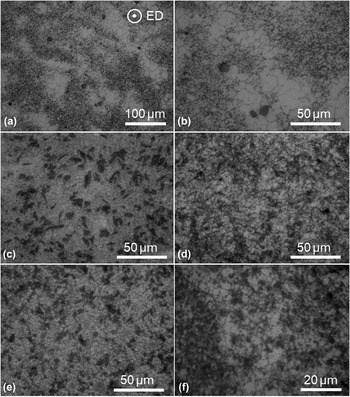
After the combination of forging and extrusion process, the optical microstructures of the AZ91 alloy and SiCp/AZ91 composites are given in Fig. 1. It shows that the grains of the AZ91 alloy, M-10, S-1, and S-1 + M-9 composites are refined obviously after extrusion. As given in Figs. 1(a) and 1(b), the grain size in the AZ91 alloy is nonuniform, and the regions in which contains both fine and coarse grains. As compared with the AZ91 alloy, the grains become much more uniform and finer in M-10, S-1, and S-1 + M-9 composites. The reasons should attribute to the addition of SiCp which can not only promote nucleation of DRX but also inhibit the growth of DRXed grains. The measured average grain size of as-extruded AZ91, S-1, M-10, and S-1 + M-9 composites are ∼6.3 μm, ∼2.4 μm, ∼1.4 μm, and ∼1.5 μm, respectively.
Optical microstructure of the AZ91 alloy and SiCp/AZ91 composites after the hot extrusion process. (a and b) AZ91 alloy, (c) M-10, (d) S-1, and (e and f) S-1 + M-9.

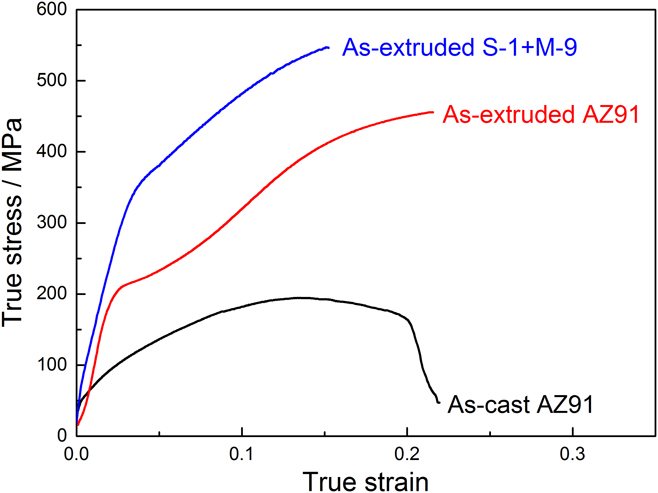
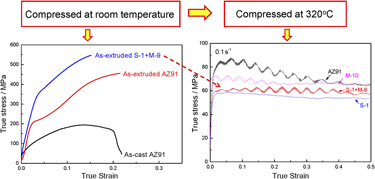
The compression stress–strain curves of the AZ91 alloy and SiCp/AZ91 composite at room temperature are given in Fig. 2. After being deformed by the combination of forging and extrusion process, the ultimate compression stress (UCS) of the as-extruded AZ91 alloy is ∼456 MPa, which is obviously higher than that of the as-cast AZ91 alloy (∼195 MPa). According to the author’s previous work, the average grain size of the as-cast AZ91 alloy was ∼120 μm,Reference Zhou, Deng, Li, Shang, Liang and Fan14 which was refined to ∼6.34 μm after forging followed by the extrusion process. So, the significant grain refinement of the as-extruded AZ91 alloy contributes to its high UCS. Nevertheless, the as-extruded S-1 + M-9 composite exhibits much higher UCS (∼546 MPa) as compared with the as-extruded AZ91 alloy. This means that the addition of bimodal size SiCp is propitious to improve the strength of the AZ91 matrix. Similar results had been proved by the tensile strength in the author’s previous work of Ref. Reference Deng, Shi, Wang, Wang, Wu, Nie and Wu7 The high UCS of the as-extruded S-1 + M-9 composite can also be attributed to grain refinement, dislocation strengthening, load transfer effect, and Orowan strengthening mechanisms.
Compression stress–strain curves of the AZ91 alloy and SiCp/AZ91 composite at room temperature.

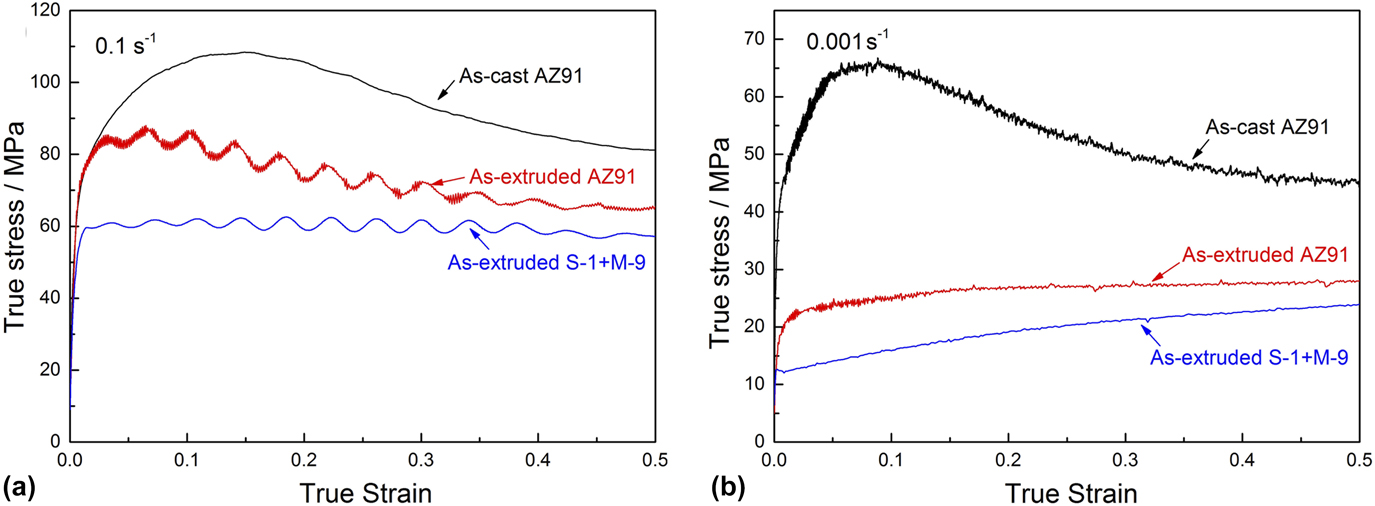
To evaluate the flow stress of bimodal size PMMC at elevated temperature, the AZ91 alloy and SiCp/AZ91 composite are compressed at 320 °C, and true stress–strain curves of which are given in Fig. 3. Unfortunately, the bimodal size PMMC (as-extruded S-1 + M-9) does not exhibit the desired strength. Unlike the compression properties in Fig. 2 at room temperature, the as-extruded S-1 + M-9 shows the lowest flow stress during the whole compression process at 320 °C. It seems that the strengthening mechanisms at room temperature are not applicable for the as-extruded S-1 + M-9 at elevated temperature.
True stress–strain curves of the AZ91 alloy and SiCp/AZ91 composite compressed at 320 °C with the strain rate of (a) 0.1 s−1 and (b) 0.001 s−1.

It is known that the addition of particles may result in the grain refinement of the Mg matrix. Thus, the influence of grain size on the flow stress of the Mg matrix should be clarified first to reveal the compression stress–strain curves of the fine grained Mg matrix influenced by SiCp.
1. Compression stress–strain curves influenced by grain size
It should be noted from Fig. 3 that the flow stress of the as-extruded AZ91 alloy is lower than that of as-cast conditions. As mentioned above, the grain size in the as-extruded AZ91 alloy is much finer than that of as-cast conditions, thus the fine grains in the as-extruded AZ91 alloy may be responsible for its lower flow stress at elevated temperature. On Barnett et al.’s investigation of the AZ31 alloy,Reference Barnett, Beer, Atwell and Oudin15 the influence of grain size on the high temperature flow stress was evaluated and the results indicated that the flow stress decreased with the decreasing grain size of the AZ31 alloy. The reason may attribute to the following two effects: on the one hand, the grain boundary sliding occurs much more easily at elevated temperatures with decreasing grain size, which may deteriorate the strengthening effect of grain refinement; on the other hand, the decreasing grain size is thought propitious to the occurrence of DRX, which may consume a large amount of dislocations and result in the low flow stress at elevated temperatures.
Nevertheless, multipeaks are found in the as-extruded AZ91 alloy at 0.1 s−1; however, only one peak appears in the as-casted AZ91 alloy, as shown in Fig. 3(a). Similar results had been found by Sakai et al.,Reference Sakai and Jonas16 who thought that the occurrence of multipeaks in stress–strain curves depended on the ratio between DRXed grain size (D d) and original grain size (D 0). Usually, only one peak appears when D d/D 0 < 2 and the multipeaks will occur once the D d/D 0 > 2. Sakai et al.’s recent work further revealed that the amount of peaks in stress–strain curves strongly depended on original grain sizeReference Sakai, Belyakov, Kaibyshev, Miura and Jonas17: only one peak appears in the material with coarse grains and multipeaks usually occur in the material with fine grains. During the hot compression process, the fine grains will grow up gradually until a steady grain size and lead to the disappearance of multipeaks in stress–strain curves.
As the strain rate decreases to 0.001 s−1, the multipeaks disappear in the as-extruded AZ91 alloy. Generally, the rate of dislocation multiplication decreases with decreasing strain rate, so the occurrence of DRX nucleation becomes much more difficult for the as-extruded AZ91 alloy with fine grain size, which is usually accompanied by the growth of grains during the compression process with low strain rate. This may be one reason for the above phenomenon. Detailed analysis about the influence of the strain rate on the flow stress of the fine grained Mg matrix is given in the following part.
2. Compression stress–strain curves influenced by SiCp
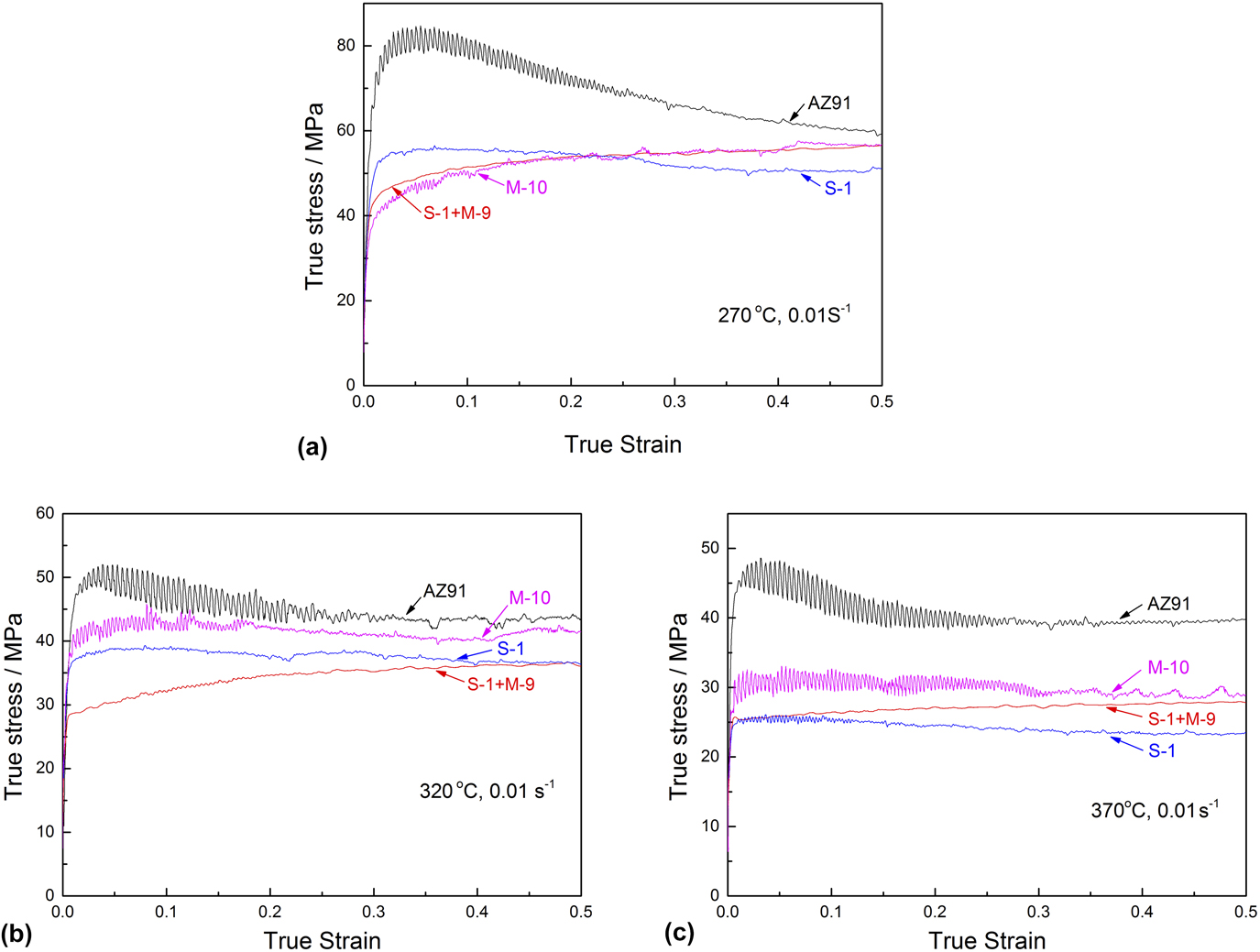
To verify the high temperature properties of the fine grained Mg matrix influenced by SiCp, the stress–strain curves of the as-extruded AZ91 alloy, S-1, M-10, and S-1 + M-9 composite compressed with 0.01 s−1 at different temperatures are given in Fig. 4. It reveals that the flow stress of the AZ91 alloy exhibit the maximum value among above materials at the given temperatures. As mentioned above, the average grain size of the as-extruded AZ91, S-1, M-10, and S-1 + M-9 composites are ∼6.3 μm, ∼2.4 μm, ∼1.4 μm, and ∼1.5 μm, respectively. As discussed in Sec. III.A.1, the material with coarse grain size usually exhibit the higher flow stress; this may account for the maximum flow stress of the AZ91 alloy. Nevertheless, it can also be noted from Fig. 4 that the flow stress of S-1, M-10, and S-1 + M-9 composites does not decrease systematically with decreasing initial grain size. This means that the initial grain size is not the only factor influencing the flow stress of the SiCp reinforced Mg matrix composite. The following part will give detailed analysis of the above phenomenon at different compression temperatures and strain rates.
Stress–strain curves of the AZ91 alloy and SiCp reinforced magnesium matrix composite compressed at 0.01 s−1 with the temperature of (a) 270 °C, (b) 320 °C, and (c) 370 °C.

As the compression temperature is 270 °C, the stress–strain curves are given in Fig. 4(a). During the initial stage of compression, the S-1 composite exhibits the maximum flow stress among SiCp reinforced Mg matrix composites, while the flow stress of the M-10 composite is the lowest. With the increasing compression strain, the compression stress–strain curves of S-1 + M-9 and M-10 composites become similar gradually, which are also accompanied by the increase of flow stress. When the strain is larger than 0.25, the flow stress of S-1 + M-9 and M-10 composites is higher than the S-1 composite. As mentioned above, the initial grain size of the S-1 + M-9 composite (∼1.5 μm) is slightly larger than that of the M-10 composite (∼1.4 μm), both of which are finer than that of the S-1 composite (∼2.4 μm). Owing to the lower compression temperature, the initial grain size grows up hardly at the initial stage of compression, thus the initial grain size is still the main factor that influence the flow stress of the SiCp reinforced Mg matrix composite. Besides, it should be noted that the content of the SiCp in S-1 composite is only ∼1 vol%; however, the content of which are ∼10 vol% in both S-1 + M-9 and M-10 composites. As compared with S-1 composite, the hinder effect of SiCp on dislocation movement is much stronger in S-1 + M-9 and M-10 composites, which lead to the increasing dislocation density and result in the improvement of flow stress with the proceeding of compression.
At the compression temperature increase to 320 °C, the stress–strain curves are given in Fig. 4(b). Different from Fig. 4(a), the flow stress of the M-10 composite exhibits the maximum flow stress among SiCp reinforced Mg matrix composites, while the flow stress of the S-1 + M-9 composite is the lowest. Based on the authors’ previous work, the recrystallization temperature of the M-10 composite is ∼300 °C,Reference Deng, Li, Nie, Wang and Fan18 which is lower than that of S-1 (∼340 °C)Reference Deng, Li, Nie, Wang and Fan18 and S-1 + M-9 (∼334 °C)Reference Wang, Deng and Liang13 composites. It means the recrystallization has occurred at 320 °C for the M-10 composite. Moreover, Ref. Reference Deng, Li, Nie, Wang and Fan18 also shows that the grain size around M-SiCp is finer than that in the regions among M-SiCp, which indicates not only recrystallization but also grain growth which occurs at 320 °C. After that, the average grain size of the M-10 composite is larger that of S-1 and S-1 + M-9 composites.Reference Li, Nie, Deng, Shang, Zhou, Xu and Fan19 Based on the above analysis, the growth of the grain is the reason for the high flow stress of the M-10 composite. As discussed by the authors’ previous work on Ref. Reference Li, Nie, Deng, Shang, Zhou, Xu and Fan19, the grain size of the S-1 + M-9 composite is finer than that of S-1 and M-10 composites owing to the combination effect of S-SiCp and M-SiCp, which results in its lower flow stress.
At the compression temperature increase to 370 °C, the stress–strain curves are given in Fig. 4(c). Similar to Fig. 4(b), the flow stress of the M-10 composite also exhibit the maximum flow stress among SiCp reinforced Mg matrix composites. The difference is that the flow stress of the S-1 + M-9 composite is higher than that of the S-1 composite, i.e., which locates between M-10 and S-1 composites. At the initial stage of compression, the stress–strain curve of the S-1 + M-9 composite is similar to that of the S-1 composite, which is close to M-10 composite gradually with the increasing compression strain. This means that the flow stress of the S-1 + M-9 composite is controlled by S-SiCp at the initial stage of compression, and then it is controlled gradually by M-SiCp with the proceeding of compression. As mentioned in Ref. Reference Li, Nie, Deng, Shang, Zhou, Xu and Fan19, the grains around M-SiCp grow up obviously in the M-10 composite at 370 °C; however, the grain size of both S-1 and S-1 + M-9 composites is finer than that of the M-10 composite, owing to the formation of submicron particle dense zones (SPDZs), which lead to the lower flow stress of S-1 and S-1 + M-9 composites. At the initial compression stage, the grains are mainly controlled by SPDZs, and the flow stress of the S-1 + M-9 composite is similar to that of the S-1 composite, which indicates that low stress of the S-1 + M-9 composite is controlled by S-SiCp in this stage. As compared with S-1 composite, 9 vol% M-SiCp still exist in the S-1 + M-9 composite which has obvious effect on hindering dislocation movement. As a consequence, the dislocation density in the S-1 + M-9 composite increases with the proceeding of compression, which results in the increase of flow stress. Moreover, the increased dislocation density can also contribute to the improvement of stored energy, which is propitious to the growth of grains and also contribute the enhancement of flow stress.
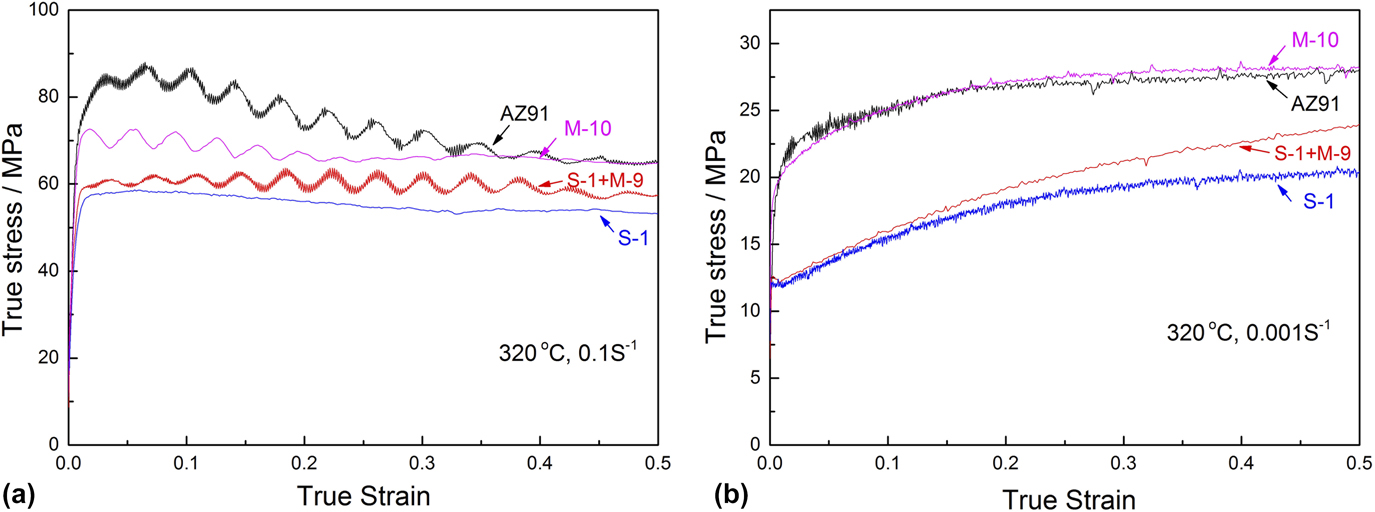
Besides temperature, the strain rate is also an important fact influencing the flow stress of SiCp reinforced Mg matrix composites. The stress–strain curves of the as-extruded AZ91 alloy, S-1, M-10, and S-1 + M-9 composites compressed at 320 °C with different strain rates are given in Fig. 5. As the strain rate is 0.1 s−1, multipeaks appear in M-10 and S-1 + M-9 composites; however, the stress–strain curve of the S-1 composite is flat. It seems that the stress–strain curve of the S-1 + M-9 composite at 0.1 s−1 is controlled by M-SiCp, as shown in Fig. 4(a). Nevertheless, the flow stresses of the AZ91 alloy, M-10, S-1 + M-9, and S-1 composites decrease in sequence during the compression process.
Stress–strain curves of the AZ91 alloy and SiCp reinforced magnesium matrix composite compressed at 320 °C with the strain rate of (a) 0.1 s−1 and (b) 0.001 s−1.

As mentioned above, the AZ91 alloy possesses the largest grain size and exhibits the maximum flow stress during compression. Even though the average grain size of S-1, S-1 + M-9, and M-10 composites decreases in sequence, the flow stress does not decrease as expected. This phenomenon further proves that the initial grain size is out of work on understanding the flow stress of the fine grained Mg matrix influenced by SiCp. In general, the dislocation density in the material depends on the multiplication rate (R 1) and annihilation rate (R 2) of dislocation. That is, the density of dislocation will increase when the R 1 is larger than R 2, and then result in the enhancement of flow stress. The content of SiCp in both S-1 + M-9 and M-10 composites is 10 vol%, which is larger than that in the S-1 composite (1 vol%). As compared with S-1 composite, the hinder effect of SiCp on dislocation movement is much stronger in S-1 + M-9 and M-10 composites during compression, which leads to the decrease of R 2 and conduce to the increase of the ratio between R 1 and R 2. As a consequence, the dislocation density in S-1 + M-9 and M-10 composites is higher than that of the S-1 composite during compression. This may account for the high flow stress of S-1 + M-9 and M-10 composites. Owing to the combination effect of S-SiCp and M-SiCp, the average grain size in the S-1 + M-9 composite is finer than the M-10 composite at 320 °C,Reference Li, Nie, Deng, Shang, Zhou, Xu and Fan19 which leads to the decrease of its flow stress.
Accompanied by the decrease of the strain rate, the multiplication rate of dislocation decreases and the effect of grain size on flow stress is weakened gradually. When the strain rate reduces to 0.001 s−1, the flow stress of the M-10 composite is similar to that of the AZ91 alloy, as shown in Fig. 5(b), while the flow stress of the S-1 + M-9 composite is similar to that of the S-1 composite initially and then increase gradually during compression. The above phenomenon reveals that the flow stress of the fine grained Mg matrix influenced by M-SiCp is negligible at extreme low strain rate. Moreover, it can also be noted from Fig. 5(b) that the flow stress of the S-1 + M-9 composite is controlled by S-SiCp at the initial stage of compression, and this effect is weakened gradually with the proceeding of compression.
The effect of particle on flow stress strongly depends on the strain rate. On Humphreys et al.’s investigation of the particle reinforced Al matrix composite,Reference Humphreys and Kalu20 no PDZ was formed around the particle and the particle was thought to have no effect on the matrix when the strain was lower than a critical value during hot compression, thus the flow stress of the composite is identical with the matrix alloy. Usually, the mobility of dislocation reduces obviously at such a low strain rate (0.001 s−1), which results in the decrease of both R 1 and R 2. Meanwhile, the promoting effect of micron particle on dislocation initiation is also weakened inevitable. As a consequence, the promoting effect of micron particle on DRX nucleation is weakened and the composite is mainly accompanied by the growth of grains at 0.001 s−1.Reference Sabirov, Barnett, Estrin and Hodgson21 This may account for the nearly coincident stress–strain curves of the M-10 composite and AZ91 alloy.
As compared with M-10 composite, 1 vol% S-SiCp exists in the S-1 + M-9 composite. Owing to the pinning effect of S-SiCp on grain boundary, the grains grow up hardly in the S-1 + M-9 composite so the flow stress of which is close to the S-1 composite and lower than the M-10 composite. With the proceeding of compression, both the grains grow up and the dislocation density increases in the S-1 + M-9 composite, thus results in the increase of flow stress.
As a consequence, the effect of the particle on the fine grained Mg matrix depends on grain size and dislocation density, both of which strongly depend on temperature and strain rate. For the given strain rate, the grains grow up with the increase of temperature; however, the formation of SPDZs in the S-1 + M-9 composite limits the growth of grains and leads to the finer grains and lower flow stress as compared with M-10 composite. For the given temperature, the multiplication rate of dislocation decreases with the decreasing strain rate. As a result, the pinning effect of S-SiCp on grain boundary and dislocation is strengthened. The flow stress of the S-1 + M-9 composite is controlled by S-SiCp at the initial stage of compression, and the flow stress of which is close to the S-1 composite. With the proceeding of compression, the density of dislocation increases which results in the increase of flow stress.
B. Deformation mechanism of fine grained Mg matrix influenced by SiCp
Generally, the deformation behavior of the material can be described by three kinds of constitutive equations (i.e., the power, the exponential, and the hyperbolic). Moreover, the hyperbolic sine law involves both power and exponential equations, which can be applied in a wider stress range successfully, and usually used to investigate the deformation behavior of PMMCs.Reference Tjong and Ma22 Thus, the activation energy Q of hot deformation can be calculated by using the following equation:
 $$Q = R{\left\{ {{{\partial \ln \dot{\varepsilon }} \over {\partial \ln \left[ {\sinh \left( {\alpha \sigma } \right)} \right]}}} \right\}_T}\left\{ {{{\partial \ln \left[ {\sinh \left( {\alpha \sigma } \right)} \right]} \over {\partial \left( {{1 / T}} \right)}}} \right\}\quad ,$$
where R is the gas constant [8.31 J/(mol K)],  $\dot{\varepsilon }$ is the strain rate, σ is the peak stress, T is the absolute temperature, and α is a material constant which can be calculated by using the following equation:
 $$\alpha = {\beta / n}\quad ,$$
where both n and β are material constants, which can be calculated by linear regression of  $\ln \dot{\varepsilon } - \ln \sigma$ and
 $\ln \dot{\varepsilon } - \sigma$, respectively. The relationships between
 $\ln \dot{\varepsilon }$ and ln σ of AZ91, S-1 + M-9, M-10, and S-1 composites are given in Fig. 6. Figure 7 shows the relationships between
 $\ln \dot{\varepsilon }$ and σ of AZ91, S-1 + M-9, M-10, and S-1 composites.
Relationships between  $\ln \dot{\varepsilon }$ and ln σ of the (a) as-cast AZ91 alloy, (b) as-extruded AZ91 alloy, (c) S-1 + M-9, (d) M-10, and (e) S-1 composites.

Relationships between  $\ln \dot{\varepsilon }$ and σ of the (a) as-cast AZ91 alloy, (b) as-extruded AZ91 alloy, (c) S-1 + M-9, (d) M-10, and (e) S-1 composites.

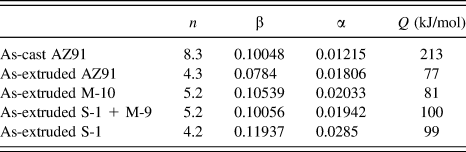
According to Fig. 6, the obtained n values of the as-cast AZ91 alloy, and as-extruded AZ91, S-1 + M-9, M-10, and S-1 composites are 8.3, 4.3, 5.2, 5.2, and 4.2, respectively. Based on Fig. 7, the obtained β values of the as-cast AZ91 alloy, as-extruded AZ91, S-1 + M-9, M-10, and S-1 are 0.10048, 0.0784, 0.10056, 0.10539, and 0.11937, respectively.
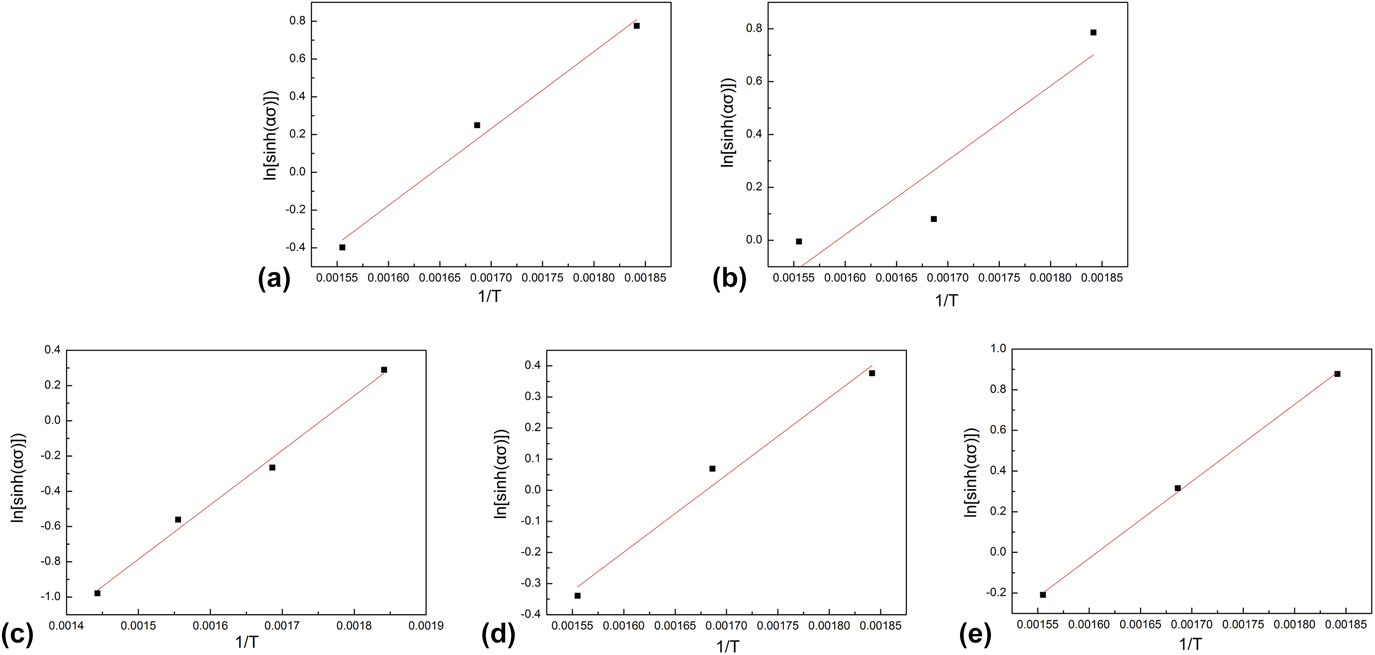
Thus, the calculated α values of the as-cast AZ91 alloy, as-extruded AZ91, S-1 + M-9, M-10, and S-1 are 0.01215, 0.01806, 0.01942, 0.020332, and 0.0285, respectively, according to Eq. (2). Then, the relationships between  $\ln \dot{\varepsilon }$ and ln[sinh(ασ)] of AZ91, S-1 + M-9, M-10, and S-1 composites can be seen in Fig. 8. Figure 9 exhibits the relationships between ln[sinh(ασ)] and 1/T of AZ91, S-1 + M-9, M-10, and S-1 composites. Based on the above analysis, the calculated Q values of the as-cast AZ91 alloy, as-extruded AZ91, S-1 + M-9, M-10, and S-1 are 213, 77, 100, 81, and 99 kJ/mol, respectively, according to Eq. (1). All the above values have been summarized in Table I.
Relationships between  $\ln \dot{\varepsilon }$ and ln[sinh(ασ)] of the (a) as-cast AZ91 alloy, (b) as-extruded AZ91 alloy, (c) S-1 + M-9, (d) M-10, and (e) S-1 composites.

Relationships between ln[sinh(ασ)] and 1/T of the (a) as-cast AZ91 alloy, (b) as-extruded AZ91 alloy, (c) S-1 + M-9, (d) M-10, and (e) S-1 composites.

The calculated n and Q values of the AZ91 alloy and SiCp/AZ91 composites.

Usually, the n values were 2, 3, 5, and 8, which represent grain boundary sliding, viscous glide of dislocation, climb of dislocation, and a constant substructure model.Reference Nieh, Wadsworth and Sherby23 The n of the as-cast AZ91 alloy is 8.3, so it closes to 8 and the deformation relates to a constant substructure model. After being extruded, the n is reduced to 4.3 and the deformation changes to dislocation climbing. The Q value of the as-cast AZ91 alloy is ∼213 kJ/mol, which is higher than the self-diffusion activated energy of pure Mg (135 kJ/mol).Reference Vagarali and Langdon24 However, the Q value is reduced to 77 kJ/mol after extrusion, which is lower than the grain boundary diffusion activation energy of pure Mg (82–105 kJ/mol).Reference Frost and Ashby25 The as-extruded AZ91 alloy possesses lower n and Q values as compared with the as-cast one, which indicates its better deformation ability. It is also the reason for the lower flow stress of the AZ91 alloy after extrusion.
As shown in Table I, the Q values for the as-extruded M-10, S-1 + M-9, and S-1 composites are 81, 100, and 99 kJ/mol, respectively, all of which are higher than that of the as-extruded AZ91 alloy (∼77 kJ/mol). It should be noted that the Q values of above three composites are close to the grain boundary diffusion activation energy of pure Mg. Hence, the deformation mechanisms of above three kinds of composites all refer to grain boundary diffusion. The n values of M-10, S-1 + 10-9, and S-1 composites are 5.2, 5.2, and 4.2, respectively, as shown in Table I, and all of them refer to the dislocations climbing during deformation.
IV. CONCLUSIONS
As a consequence, after investigating the flow stress and deformation behavior of the fine grained Mg matrix influenced by bimodal size SiCp at elevated temperature, the following conclusions can be drawn:
(1) The flow stress of the fine grained SiCp/AZ91 composite decreases with the elevating temperature and decreasing strain rate. Influence of SiCp on the flow stress of the fine grained Mg matrix depends on particle size. As compared with M-SiCp, the S-SiCp has more significant effect on reducing flow stress.
(2) The flow stress of the S-1 + M-9 composite locates between S-1 and M-10 composites. At the initial stage of compression, the flow stress of the S-1 + M-9 composite is controlled by S-SiCp. With the proceeding of compression, the role of M-SiCp on influencing the flow stress of the S-1 + M-9 composite becomes stronger gradually.
(3) The calculated activation energy of the S-1 + M-9 composite is higher than that of the M-10 composite, however, nearly the same as the S-1 composite, and the deformation of which is controlled by ∼1 vol% sub-micron SiCp.
ACKNOWLEDGMENTS
This work was supported by “National Natural Science Foundation of China” (Grant No. 51771128), Projects of International Cooperation in Shanxi (Grant No. 201703D421039), and the “Natural Science Foundation of Shanxi” (Grant No. 201601D011034).