Moyamoya disease is a chronic, progressive occlusive cerebrovascular disease characterised by steno-occlusive changes at the terminal portion of the internal carotid artery and an abnormal vascular network at the base of the brain. Reference Zhang, Zheng and Epidemiology1 Patent foramen ovale is a flap-like channel formed by incomplete fusion of atrial septum primum and secundum after birth. Reference Pristipino, Sievert and D’Ascenzo2 Both patent foramen ovale and moyamoya disease are possible causes of stroke, but there are few reports of their simultaneous occurrence in patients with cerebral stroke. Here, we report a case of ischaemic stroke with patent foramen ovale combined with moyamoya disease.
Case report
A 25-year-old man was admitted to our hospital because of headache and blurred vision for 2 months. There was no associated fever, neck rigidity, abnormal body movements, dizziness, auditory, speech, and gait abnormalities. He had a 4-year history of smoking, but no other significant history was identified. Neurological examination revealed homonymous visual field defect of right side. Other physical examinations were unremarkable. The Clinical Risk of Paradoxical Embolism score at admission was 9 points (total score: 10 points), and the National Institute of Health stroke scale score was 1 point.
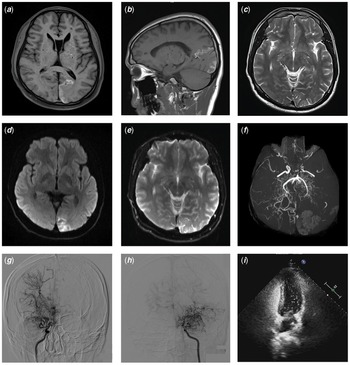
Brain MRI demonstrated an acute ischaemic lesion in the left occipital lobe (Fig 1a–e). Therefore, magnetic resonance angiography was performed which showed occlusion of the bilateral terminal internal carotid artery and abnormal vascular network at the skull base (Fig 1f). Further, cerebral angiography was done which revealed non-visualisation of the bilateral distal internal carotid arteries, anterior cerebral artery, and middle cerebral artery, with an abnormal vascular network at the base of the brain (Fig 1g–h). All the findings were suggestive of moyamoya disease.
Images of a patient with patent foramen ovale combined with moyamoya disease. ( a–e ) Brain MRI (T1, T1, T2, DWI, ADC) showed an ischaemic lesion in the left occipital lobe and cortical area. ( f–h ) Brain MRA and digital subtraction angiography showed moyamoya disease. ( i ) cTTE showed moderate right-to-left shunts after the Valsalva maneuver.

Additional diagnostic tests were performed to exclude other causes of ischaemic stroke. Transcranial Doppler examination detected numerous microembolic signals in the vertebrobasilar system after the Valsalva maneuver. Contrast transthoracic echocardiography showed moderate right-to-left shunts after Valsalva maneuver, demonstrating the existence of patent foramen ovale (Fig 1i). Lower extremities venous ultrasound, electrocardiogram, 24-hour Holter monitoring, and laboratory tests showed no remarkable findings. The patient was finally diagnosed with moyamoya disease, patent foramen ovale, and ischaemic stroke.
After a multidisciplinary discussion, the patient successfully underwent percutaneous patent foramen ovale closure to prevent re-occurrence of ischaemic stroke but refused recommended surgical revascularisation for moyamoya disease. Antiplatelet therapy with 100 mg/day of aspirin and 75 mg/day of clopidogrel for 6 months and aspirin 100 mg/day alone after 6 months was applied post-operatively.
Discussion
Moyamoya disease often causes acute neuromotor deficits. Ischaemic events are the most common initial presentation. Reference Zhang, Zheng and Epidemiology1 The anterior circulation is predominantly involved while posterior circulation stroke develops in the late stage of moyamoya disease. Reference Kim, Lee and Roh3
Haemodynamic compromise was the primary mechanism of ischaemic stroke in moyamoya disease Reference Kim, Lee and Roh3 , but recent studies proposed embolism may also play a role. Reference Chen, Duan and Xu4 Microembolic signals detected by transcranial Doppler ultrasonography are associated with ischaemic moyamoya disease. Reference Chen, Duan and Xu4 Indeed, both mechanisms have been assumed to coexist and be complementary in moyamoya disease with ischaemic stroke. Therefore, large artery steno-occlusion increases not only the risk of haemodynamic infarction but also the risk of embolic infarction. Reference Sedlaczek, Caplan and Hennerici5 Cerebral angiography is the gold standard for diagnosing moyamoya disease and evaluating its progression. Surgical revascularisation is effective for ischaemic-type moyamoya disease and antiplatelet agents are recommended as a conservative management, but the risk of bleeding remains. 6
Patent foramen ovale is the most common anatomical cause of right-to-left shunt. Previous studies have shown that patent foramen ovale is a risk factor for cryptogenic stroke, and paradoxical embolism is considered to be the main pathogenesis. Reference Thaler, Ruthazer and Weimar7 The brain lesions of patent foramen ovale-associated stroke patients mostly involve the posterior circulation and damage a single vascular area. Reference Sookyung Ryoo, Jong-Won Chung and Mi Ji Lee8 A study found that the vertebrobasilar system receives less adrenergic innervation, is less sensitive to sympathetic stimulation, and has weaker vascular regulation ability. Vertebrobasilar circulation receives less adrenergic innervation, when the sympathetic tone is increased by the Valsalva maneuver, vertebrobasilar circulation, which is less responsive to sympathetic stimuli, increases blood flow. Reference Bum Joon, Hoyon and Byung Joo9 Clinical Risk of Paradoxical Embolism score is commonly used to predict the correlation between cryptogenic stroke and patent foramen ovale. Patients in the high Risk of Paradoxical Embolism score strata are much more likely to have patent foramen ovale-related strokes. Reference Kent, Ruthazer and Weimar10 Among patients with cryptogenic stroke, patent foramen ovale prevalence increased from 23% in those with 0–3 points to 73% in those with 9–10 points, corresponding to the patent foramen ovale attributable fraction estimates of approximately 0–90%. Moreover, stroke recurrence rates after patent foramen ovale closure decrease as the Risk of Paradoxical Embolism score increases. Reference Kent, Ruthazer and Weimar10 Some studies advocate that a Risk of Paradoxical Embolism score > 6 is classified as patent foramen ovale-related strokes. Reference Thaler, Ruthazer and Weimar7 Since microemboli via patent foramen ovale increase the risk of cryptogenic stroke, relevant guidelines recommend patent foramen ovale closure combined with double antiplatelet therapy for secondary prevention of stroke. Reference Pristipino, Sievert and D’Ascenzo2 The brain imaging characteristics of ischaemic-type moyamoya disease and patent foramen ovale-associated stroke are summarised in Table 1. Reference Kim, Lee and Roh3,Reference Sookyung Ryoo, Jong-Won Chung and Mi Ji Lee8,Reference Bum Joon, Hoyon and Byung Joo9,Reference Zhao, Zhang and Wang11
The brain imaging characteristics between ischaemic-type moyamoya disease and patent foramen ovale-associated stroke

MMD=moyamoya disease, PFO=patent foramen ovale.
In our case, the patient presented with headache and his age of onset (25 years old) was not at the bimodal peak of moyamoya disease. MRI showed the cortical infarction of left occipital lobe but the posterior circulation was unobstructed, with low National Institute of Health stroke scale score. Therefore, the intracranial artery disease was difficult to explain this stroke. Contrast transthoracic echocardiography revealed a patent foramen ovale and the Risk of Paradoxical Embolism score was 9 (total score: 10 points). Moreover, the clinical manifestations and infarct location were in line with patent foramen ovale-related stroke (Table 1). Hence, we consider that patent foramen ovale is the main reason for this patient’s stroke. To prevent recurrence of ischaemic stroke, the patient successfully underwent percutaneous patent foramen ovale closure and received antiplatelet therapy. On subsequent follow-ups for 12 months after discharge, the patient’s headache continued to alleviate and did not complain of new focal neurological deficit. There was no right-to-left shunting detected in contrast transthoracic echocardiography, and a re-examination of brain MRI showed no additional stroke events.
Conclusion
Our case suggests the coexistence of moyamoya disease and patent foramen ovale, which increases the risk of potential embolism and may participate in the progress of moyamoya disease. Therefore, for moyamoya disease patients, we should strengthen the detection of microembolic signals and the screening of patent foramen ovale.
Acknowledgements
None.
Financial support
This work was supported by the Natural Science Foundation of Hunan Province (No.S2021JJMSXM1714).
Conflicts of interest
None.
Ethical standards
No specific ethical approval from Institutional Reviews Boards is necessary for this type of publication. The authors assure that all patient data provided in this case report are anonymised and informed consent was taken from the patient.