

Objectives
1. To develop a simple and concise data collection tool.
2. To collect accurate data relating to the post-operative complications in recovery. Ensuring that accurate data are collected for every patient who has recovered following general or spinal anaesthesia/block and sedation (patients receiving local or other forms of nerve blocks without sedation are routinely returned to the ward post-operatively, and therefore not incorporated into this audit).
3. To ensure that each anaesthetist receives formal feedback with regard to the complications their patients experience.
4. To improve anaesthetic practice and reduce the complications in recovery.
5. As a marker of quality of service.
Methodology
This audit was an original concept of Colin Lawrence (Consultant Anaesthetist) and Natalie Quine (then Clinical Specialist Recovery). The idea never really developed past initial thoughts and doodlings. However, Colin and Kerry Brislane (Anaesthetic Registrar) formulated the audit tool with input from Natalie (now Team Leader Recovery Services). The tool was piloted, and feedback was given by recovery staff completing the form and the auditors undertaking the data analysis. The initial pilot had a high return rate, but there was an obvious group of patients being missed. To combat this issue, the form was placed in the adult care plan, thus ensuring that every adult patient admitted to the department would have a form. The bigger issue was capture of paediatric data, which remains an issue as the paediatric care pathway originates from the paediatric ward – this patient group is predominantly day case work and therefore the observations and recovery care plans are generated at the time of admission to the ward. It is reliant on staff remembering to hand the form out, but this is noted to have improved with subsequent audit cycles. Two quarters’ worth of meaningful data to date have been collected.
Every post-operative patient going through recovery has a form completed. The form has been purposefully kept user friendly to increase compliance with completion. It is a very straightforward data collection form that incorporates basic patient details – including age, sex, surgery, surgeon, anaesthetist and speciality.
If the recovery is uncomplicated, the form is signed to state this; if it is complicated, there is a tick box system in place. The individual completing the form ticks the complications relevant to that patient. There is also space for comments to allow any further relevant information to be collected and a staff signature. The form is signed by staff to show that it is completed; when the anaesthetists get the feedback, there are no data stating which nurse/ODP completed each form, and so there is no opportunity for negative repercussions for staff. See Appendix 1 for Audit form.
Results
The audit results are interesting. There has been a consistent 90% return rate, and data capture was increased significantly with the audit tool being stored in the care plan. The auditors are still working on how to ensure that there is a 100% return rate.
Discussion
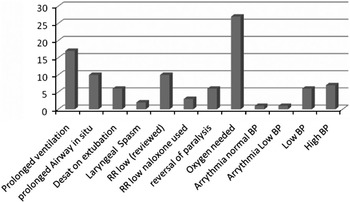
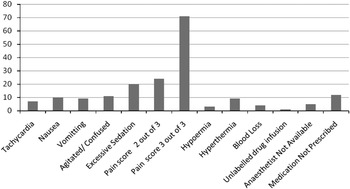
From graphs 1 and 2, it is obvious that the greatest clinical complication documented was related to pain. The pain score used within the hospital is a numerical rating score ranging from 0 to 3, with 0 indicating no pain and 3 indicating the worst possible pain. Merskey and Bogduk [Reference Merskey and Bogduk1994] cited in Macintyre et al [Reference Macintyre, Scott, Schupp, Visser and Walker2010] ‘emphasises that pain is not a directly observable or measurable phenomenon, but rather a subjective experience that bears a variable relationship with tissue damage’. This subjective experience is individual to each patient and can be related to previous experiences, pre-operative anxieties and expectations [Macintyre et al, Reference Macintyre, Scott, Schupp, Visser and Walker2010].
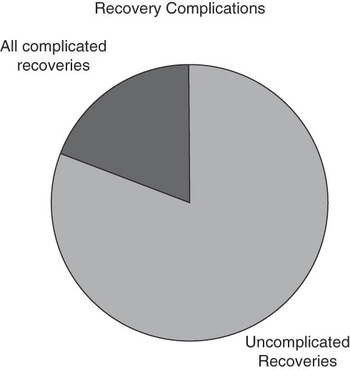
Number of complicated versus uncomplicated recoveries. The complication rate is 19%, but when administrative issues are sorted out, the complication rate is 16%.

The graph above shows the number of individual patients experiencing each clinical complication.

The graph above shows the number of individual patients experiencing each clinical and non-clinical complication.

Given the type of surgery undertaken within the hospital, a number of patients are ‘regular’ visitors, some since a few months old, some since their original injury or burn and their pain is very much multifactorial. It is sometimes very difficult to ensure effective analgesia for these patients, particularly when some of them relive the horrific nature of their initial injury each time they have more surgery. Some patients are on long-term, high-dose analgesia for traumatic injuries resulting in loss of limbs. It has been noted that some of these individuals self-medicate and manipulate their medications to manage their pain. Within the confines of hospital policies and procedures, it can be very difficult for these individuals to manage, particularly when they cannot take their usual doses of medication, which is often excessive to what they are actually prescribed. Those patients with a pain score of 2 or more are given intravenous opiate. Once IV opiate is administered, it automatically means that the patient is in recovery for 55 minutes worth of observations. This is as per the Trust Opiate Policy.
Clinical complications
When considering the other high-scoring clinical complications, these included delayed extubation (including nurse-led extubation of Nasal ET tubes, ET Tubes and LMAs) and prolonged periods of assisted ventilation (assisted short-term ventilation is common practice within the department); prolonged periods were described as more than 15 minutes in either case. The time factor was incorporated and based on factors that the lead anaesthetists felt were appropriate and that the anaesthetists were comfortable with. A prolonged period of ventilation and intubation was noted to have a direct and negative impact on discharge times.
Clinical complications also incorporate laryngospasm, which accounted for only 3 cases. All of these were related to paediatric patients and all were under 3 with an LMA that was removed in recovery, and each child was on the trauma list. Any child recovered in recovery will be spontaneously breathing with an LMA but certainly not an ET tube. It has been suggested that this age group has the LMA removed deep in an attempt to manage this complication. Incomplete reversal of muscle relaxants accounted for 5 patients. Contrary to popular belief, incomplete reversal of muscle relaxants is still a complication that is easily preventable. Pain requiring IV opiate analgesia, uncontrolled post-operative nausea and vomiting, excessive sedation and hyper/hypothermia are to name but a few.
Administrative complications
The administrative complications are related to surgeon and anaesthetist availability, lack of operation notes, lack of anaesthetic records being printed, delays in discharge to the ward either through prolonged recovery (greater than 60 minutes) or the ward staff being unable to collect or accept patients back to the ward and oxygen not being prescribed for return to the ward. The largest overall delay can be attributed to unavoidable, prolonged recovery. A prolonged recovery for this audit is classed as a recovery period longer than 60 minutes, which is noted due to the nature of recovery undertaken and the constraints of the opiate protocol.
The complications remained anonymous and each anaesthetist was given their own complication rate and how this related to the total number for each complication. I know, having spoken to one or two of the anaesthetists, that they were a little shocked by their results, but that they are looking at it as a positive thing and how they can best change their practice to rectify some of the issues. One anaesthetist feels that in order to solve the majority of the issues, it requires a very small change in his clinical practice. It is important to them that their patients receive the best possible anaesthetic experience. Some of the major highlighted themes from the audit are summarised below in recommendations made to the Anaesthetic Department.
1. The prescription of oxygen preemptively for any major case, or any case that might easily be predicted as needing oxygen (this audit had definitely under reported this issue).
2. Prescribing all post-operative medications.
3. Ensuring that patients are properly reversed.
4. A prolonged stay by the anaesthetist for children under 3 years of age and any known difficult airway.
5. To be more aware of overwarming small children by monitoring temperatures intraoperatively.
6. To consider the possibility of removing LMA deep before coming to recovery in children under 3 years of age. All the cases of laryngospasm were in this age group.
This audit is now continuous, and the results will be used as a basis for formulating the Anaesthetic Department’s Quality Accounts along with the retrospective questionnaires and patient interviews that have been undertaken to evaluate the patient experience.
So, what next?
The audit cycle will continue with quarterly reporting to individual anaesthetists and the general department with total combined figures. To ensure that this process continues and is less time- and labour-intensive, the idea of an electronic reporting format is being investigated, all data being entered at the bedside. This will also reduce the number of sheets of paper that are required – hopefully, reporting will be at the click of a button instead of one individual sorting the forms into complicated and uncomplicated types, then sorting the complications and working out which anaesthetist has which complications. There will be greater scope for the types of reporting and the anaesthetist’s individual complications will be even more meaningful as the system will then be rolled out to all recovery areas, ensuring maximum data collection, and will be on the total number of cases per anaesthetist through recovery areas instead of the complications as a percentage of total log book cases. This means that the percentages are artificially skewed dependent on the number of cases each anaesthetist handles, which is recovered in the inpatient recovery facility.
Appendix 1 – The Form