

INTRODUCTION
Maize is the most important cereal food crop in sub-Saharan Africa and its demand is predicted to double by 2050 (Anley et al., Reference Anley, Zeleke and Dessalegn2013). In Rwanda, maize has larger production volumes than any other grain crops, including pulses (NISR, 2014). In rural Ethiopia, maize is the most important staple food in terms of calorie intake (Abate et al., Reference Abate, Shiferaw, Menkir, Wegary, Kebede, Tesfaye, Kassie, Bogale, Tadesse and Keno2015). Maize is genetically diverse, with germplasm adapted to a wide range of growing conditions (Anley et al., Reference Anley, Zeleke and Dessalegn2013). However, while maize breeding has had great impact in sub-Saharan Africa (Smale and Jayne, Reference Smale and Jayne2003), little attention has been paid to developing germplasm specifically suited to complex environments such as agroforestry systems (Tiwari et al., Reference Tiwari, Virk and Sinclair2009). Almost all of the maize varieties have been bred and tested in open fields and may not be well adapted to agroforestry conditions (Desclaux et al., Reference Desclaux, Huang, Bernazeau and Lavene2016).
Due to the effect of heterosis (i.e., hybrid vigour), maize hybrids are generally expected to yield more and to provide greater quality – e.g., uniform grain colour and size – than open-pollinated varieties (OPVs) in open field conditions (van Heerwaarden et al., Reference van Heerwaarden, Hellin, Visser and Van Eeuwijk2009). In the United States of America, 50% of the yield gain since the 1930s is attributed to the introduction of hybrid maize and improved genetics (CIMMYT, 1997). In sub-Saharan Africa, an improvement in maize yield as a result of the adoption of hybrid maize was also reported (Smale and Mason, Reference Smale and Mason2014). However, the seed of maize hybrids is expensive for resource-poor farmers and cannot be recycled without severe yield penalty (Macharia et al., Reference Macharia, Njeru, Ombakho and Shiluli2010).
In developing countries where agroforestry is a common practice, farmers claim that local landraces are better adapted to shade than genotypes bred on experimental stations (Tiwari et al., Reference Tiwari, Brook, Wagstaff and Sinclair2012). Some smallholder farmers believe that hybrid maize can perform well, but only under high-input management practices, which poor farmers seldom achieve (Macharia et al., Reference Macharia, Njeru, Ombakho and Shiluli2010). So far, there is no literature empirically comparing maize hybrids to OPVs in agroforestry systems. The adoption of improved maize hybrids in developing countries has been constrained by the lack of selection experiments in complex on-farm environments in agroforestry systems (Tiwari et al., Reference Tiwari, Brook and Sinclair2004). Thus, there is a need to advise farmers whether hybrids have an advantage over OPVs in agroforestry systems, characterized by reduced light intensity due to shade, and competition for water and nutrients.
The objective of this study is to fill this knowledge gap and compare the performance of OPVs and hybrids under agroforestry systems. We hypothesized that OPVs outperform hybrids in such systems, assessing the effects of trees (Grevillea robusta and Senna spectabilis in Rwanda and Acacia tortilis in Ethiopia) on the performance of commonly used maize hybrids and OPVs.
MATERIAL AND METHODS
Experiments were conducted in two locations to evaluate the effects of trees on the performance of maize varieties (hybrids vs. OPVs): Bugesera, Rwanda, and Meki, Ethiopia. Both zones are classified as semi-arid in the national systems and as equatorial savannah with dry winter in the Köppen–Geiger system (Kottek et al., Reference Kottek, Grieser, Beck, Rudolf and Rubel2006). According to the Köppen climate classification, the savannah with dry winter climate has the driest month with precipitation lower than 60 mm and less than 4% of the total annual precipitation.
Experimental sites in Bugesera, Rwanda
In Rwanda, six farms were selected to host trials in Bugesera, located at 2°21'S, 30°15'E and 1397 m above sea level (a.s.l). The climate is characterized by a bimodal rainfall pattern with a major peak in April and a secondary peak in November. The ‘long rains’ (also known as ‘season B’) usually start around mid-February and last up to mid-July and the ‘short rains’ (also known as ‘season A’) start in September and last until January. The rainfall varies between 850 and 1000 mm per year with an average annual temperature of about 21°C. Soils in the Bugesera experiments are humic Ferralsols at lower elevations and haplic Ferralsols at higher elevations with depths of about 100–200 cm. The selected plots were cropped with maize or sorghum in rotation with bush beans in the previous seasons. The experiments in Bugesera were conducted in the 2014 B, 2015 A, 2015 B and 2016 A seasons.
Experimental sites in Meki, Ethiopia
In Ethiopia, three farms were selected to host trials in the lowlands of the Central Rift Valley in Meki, located at 8°11'N, 38°51'E and 1500 m a.s.l. The climate is characterized by a unimodal rainfall pattern peaking around July–August (Getachew and Tesfaye, Reference Getachew and Tesfaye2015). The rainy season or ‘Kiremt’ normally runs from June to September with the annual total rainfall ranging from 281 to 1131 mm with a long-term average of 729 mm per year (Getachew and Tesfaye, Reference Getachew and Tesfaye2015). The average annual temperature is 19.3 °C. Soils in Meki are deep Andosols with high organic matter and good water-holding capacity (Regional State of Oromia, 2003). The selected plots for the experiments were cropped with maize in the preceding seasons. The experiments in Meki were conducted in 2014 and 2015.
Experimental layout
Three tree species were used in the experiments: two in Bugesera and one in Meki. For each tree species, three farms were selected, each including two plots with almost identical trees in their centre and one open plot (without tree). This resulted in six on-farm experiments (with two tree species) in Bugesera and three experiments (with one tree species) in Meki. The size of each of the two plots with trees was 10 × 10 m to equal the size of open plots which was 10 × 20 m. Each of the plots with trees were divided into four subplots, while the open plots were divided into eight subplots each being 5 × 5 m (see supplementary Fig. S1, available online at https://doi.org/10.1017/S0014479718000297).
Two main factors were studied: (i) the presence or absence of tree and (ii) vigour (hybrids vs. OPVs as proxy). In Bugesera, Rwanda, the selected tree species were G. robusta and S. spectabilis since they are dominant in the landscape. The four selected maize (PAN4M21, PAN67, SC403 and SC513) hybrid cultivars were among the most popular cultivars in the area and the four selected OPVs were ISARM081, ISARM101, Pool32 and ZM607. In Meki, Ethiopia, the selected tree species was A. tortilis – the most frequent tree on farms in the area – and the four maize hybrids included MH138Q, MH140, BH540 and MH130, while OPVs were Melkassa-6Q, Gibe-2, Melkassa-4 and Melkassa-2. For each tree species, the eight varieties selected for the site (four hybrids and four OPVs) were randomly assigned each season to one of the eight subplots under one of the two trees and to one of the eight subplots of the open plot (Fig. S1).
In each season, fertilization rates followed general recommendations for both areas, that is, 100 kg di-ammonium phosphate per hectare (18 kg N ha−1 and 20 kg P ha−1) applied at planting, and 100 kg urea per hectare (46 kg N ha−1) applied as top-dressing six weeks after plant emergence. Maize was planted following local practice at a spacing of 0.4 m within rows and 0.8 m between rows with two plants per hole in Bugesera. In Meki, maize was planted at a spacing of 0.3 m within rows and 0.7 m between rows with one plant per hole left after thinning.
Measurements
Tree characteristics measured included tree height, diameter at breast height (DBH) around 1.5 m above ground, diameter at stump height (DSH) around 15 cm above ground, canopy radius and tree age. The tallest shoot was selected for height measurement of Senna spectabilis, which was the only species with many shoots. Trees in Rwanda (G. robusta and S. spectabilis) were planted by farmers and the age reported was assessed through farmer recall (the age of A. tortilis in Ethiopia was not captured in this study). In both Bugesera and Meki, daily rainfall and air temperature were measured using automatic weather stations (Vantage Pro2™, Davis Instruments Corp, USA) positioned at a maximum distance of 1 km from all plots. Weekly phenological measurements were taken from 20 days after sowing (DAS) to the end of the vegetative growing period, in all plots of the experiments in Rwanda. In Meki, phenological measurements were taken twice a month from 20 DAS but only in the 2014 season. The phenological parameters measured included the number of fully expanded leaves, the length and the width of the last fully expanded leaf and the plant height. Leaf area index (LAI) was calculated as follows:
 $$\begin{equation}
{\rm{LAI}} = (0.75 \times L \times B) \times {\rm{NL}} \times D
\end{equation}$$
where L represents the length from the leaf base to the tip of a leaf, B represents the maximum width of the leaf, NL represents the total number of leaves per plant and D represents the plant density (plants m−2). The value of 0.75 (Maddonni and Otegui, Reference Maddonni and Otegui1996) reflects the shape of the leaf in-between values for a triangle and a square.
Stover and grain yields were measured and dry weights of maize grain and total biomass were determined gravimetrically. Subsamples were oven dried at 60 °C for one week. Harvest index was calculated as grain yield (in dry matter basis) divided by total above ground biomass (in dry matter basis).
Statistical analysis
Means of tree characteristics were compared through an analysis of variance (ANOVA) using Fisher's F-test. Maize grain dry matter yield, total dry matter biomass, harvest index, LAI and plant height data were analysed with a linear mixed-effect model (LMM) with vigour – OPVs or hybrids – and tree presence/absence as fixed effects and farm and plot (with each tree and sole maize being separate plots) as random effects. A separate random season effect was modelled for each farm, with successive seasons coded as an ordered factor. For analyses within a single country, season was also included as a fixed effect, while this term was replaced by a country term in analyses across the two countries. The effect of tree species was evaluated for Rwanda (where two species were present) by adding species as a fixed effect to the single country model. Adding a random genotype (i.e., different cultivars) term did not result in a better model fit (based on Akaike's Information criterion) and then this factor was not included. Differences in genotypes were assessed using a similar model but with vigour – OPVs and hybrids – replaced by genotypes.
The significance of fixed effects was tested using a type-III ANOVA with the Satterthwaite approximation for the denominator degrees of freedom. Predictmeans functions from the lme4 library were used to test tree presence/absence, vigour and interaction effects on maize LAI, height and yields in each country separately. All analyses were carried out using R software (R Development Core Team, 2014).
RESULTS
Local climate and tree characteristics
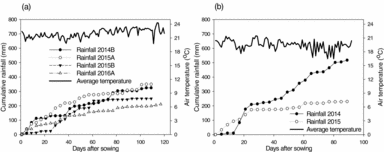
In Bugesera, rainfall was higher in the 2015 A season (350 mm) followed by 2014 B (325 mm), 2015 B (250 mm) and, finally, 2016 A (211 mm) (Figure 1a). Seasonal rainfall was very variable in Meki during the seasons under observation, with 536 mm rainfall received in 2014, more than double the amount received in 2015 (230 mm) (Figure 1b). In Bugesera, air temperature was higher than in Meki. The maximum, minimum and average air temperatures were, respectively, 26.7 °C, 19.6 °C and 22.3 °C in Bugesera, while the corresponding values in Meki were 21.5 °C, 16.5 °C and 19.5 °C.
Cumulative rainfall and average daily air temperature during growing seasons under observation at Bugesera, Rwanda (a) and Meki, Ethiopia (b).

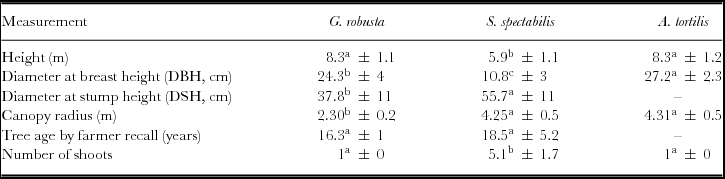
G. robusta and A. tortilis trees had about the same heights but were taller than S. spectabilis trees (Table 1). The latter had the largest DSH but the smallest DBH for individual shoots. S. spectabilis was the only tree species in the study to have many stems. S. spectabilis and A. tortilis had similar canopy radii, which were larger than the canopy radius of G. robusta. S. spectabilis trees were of about the same age as G. robusta based on farmer recall.
Characteristics of G. robusta, S. spectabilis and A. tortilus trees used in the experiment at the on-set of the trial (beginning of 2014). Standard deviations are given after the signs ‘±’. Means followed by the same letter in the same row do not differ significantly at α = 0.05.

Note: –: are characteristics not measured.
Grain yield, above-ground biomass and harvest index
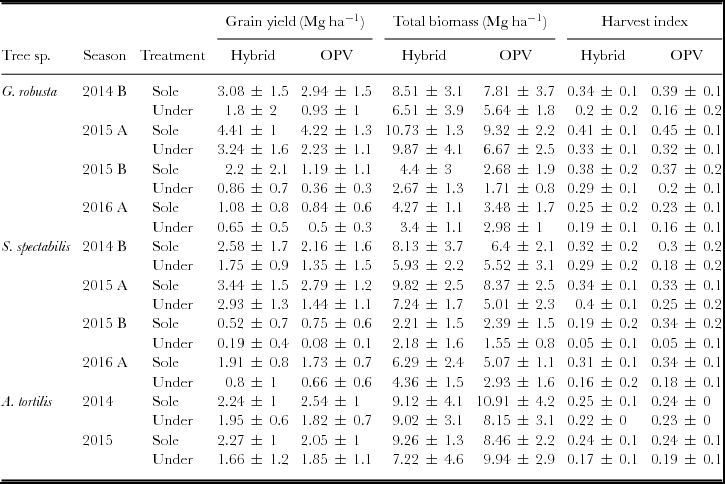
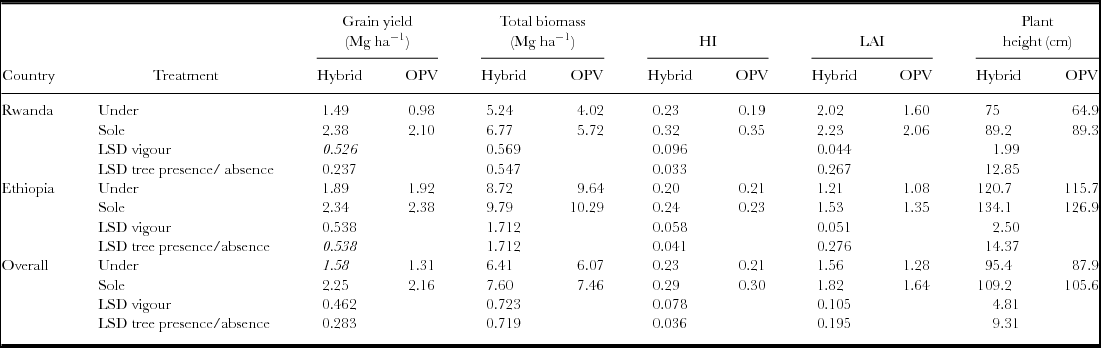
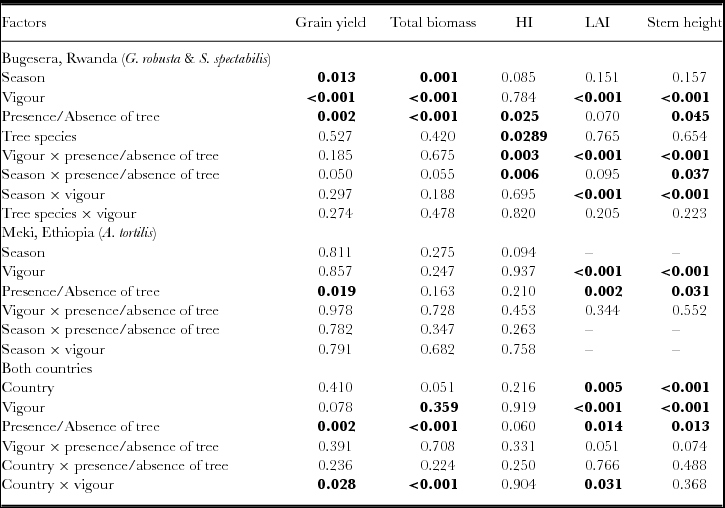
The observed grain yield was 2.06 Mg ha−1 in Meki and 1.76 Mg ha−1 in Bugesera, mean total biomass was 9.1 Mg ha−1 in Meki and 5.5 Mg ha−1 in Bugesera and mean harvest index was 0.22 in Meki and 0.27 in Bugesera (Table 2). These differences were not significant. In Bugesera, grain yields and total biomass differed significantly between hybrids and OPVs but harvest index was similar (Tables 4 and 5). In Meki, grain yield, total biomass and harvest index of hybrids did not differ from OPVs and there was no seasonal effect (Tables 4 and 5). In Bugesera, drought in seasons 2015 B and 2016 A affected both grain yield and total biomass but did not affect the harvest index. The presence of trees significantly reduced maize grain yield, total biomass and harvest index in Bugesera but only affected grain yield in Meki (Tables 2, 4 and 5).
Comparison of observed maize grain yield, total biomass and harvest index of hybrids and OPVs in sole crop and under G. robusta and S. spectabilis trees in Bugesera, Rwanda and under A. tortilis trees in Meki, Ethiopia. Standard deviations are given after the sign ‘±’.

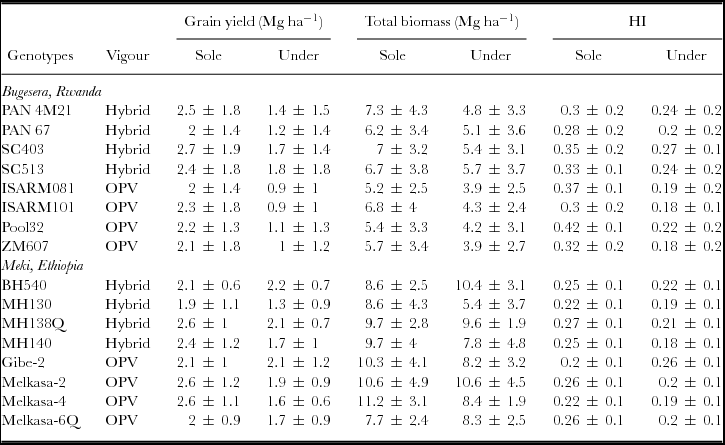
There was no evidence of significant differences between genotypes within vigour class, but in Bugesera, larger grain yields in both sole crop and under trees were observed for the hybrids SC403 (2.7 Mg ha−1 in sole crop vs. 1.7 Mg ha−1 under tree) and SC513 (2.4 Mg ha−1 in sole crop vs. 1.8 Mg ha−1 under tree), while the smallest grain yield was observed for the OPV genotype ISARM081 (2 Mg ha−1 in sole crop vs. 0.9 Mg ha−1 under tree) (Table 3). The genotypes SC403 and SC513 had the highest observed total biomass under trees, while ISARM081 had the least.
Comparison of mean grain yields, total biomass and harvest index (HI) of genotypes in sole crop and under trees in Bugesera, Rwanda and Meki, Ethiopia. Standard deviations are given after the sign ‘±’.

The presence of trees affected grain yield and total biomass of hybrids and OPVs in the same manner in both Bugesera and Meki. However, trees strongly decreased the harvest index of OPVs more than hybrids in Bugesera. In the latter site, estimated reduction in grain yield was 0.9 and 1.1 Mg ha−1 in hybrids and OPVs, respectively, while reduction in biomass was 1.5 and 1.7 Mg ha−1, respectively. In Meki, grain yield reduction was 0.5 Mg ha−1 for both vigour classes and the corresponding reduction in biomass was 1.1 and 0.6 Mg ha−1 for hybrids and OPVs, respectively. Across the two sites, there was no significant interaction between the presence of trees and vigour class, although the reduction in harvest index was stronger in OPVs than in hybrids in Bugesera (Tables 4 and 5). Harvest index decreased from 0.32 to 0.23 in hybrids and from 0.35 to 0.19 in OPVs, for example. Interaction of season and presence/absence of trees was only observed in Bugesera and was significant for grain yield (p = 0.05) and total biomass (p = 0.055). The effect of tree species in Rwanda was only significant on harvest index and Senna spectabilis reduced the maize harvest index more than G. robusta.
Comparison of the model predicted means for maize grain yield, total biomass and harvest index of hybrids and OPVs in sole crop and under G. robusta and S. spectabilis trees in Rwanda, under A. tortilis trees in Ethiopia and the overall predicted means for both countries.

p values results of the LMM model for the effects of fixed factors – vigour, tree species, presence/absence of tree and their interactions – on maize grain yield, total biomass, harvest index (HI), leaf area index (LAI) and plant height in the on-farm trials. Significant effects (p <0.05) are shown in bold.

Note: –: measurements were only taken for one season.
Crop leaf area index and stem height
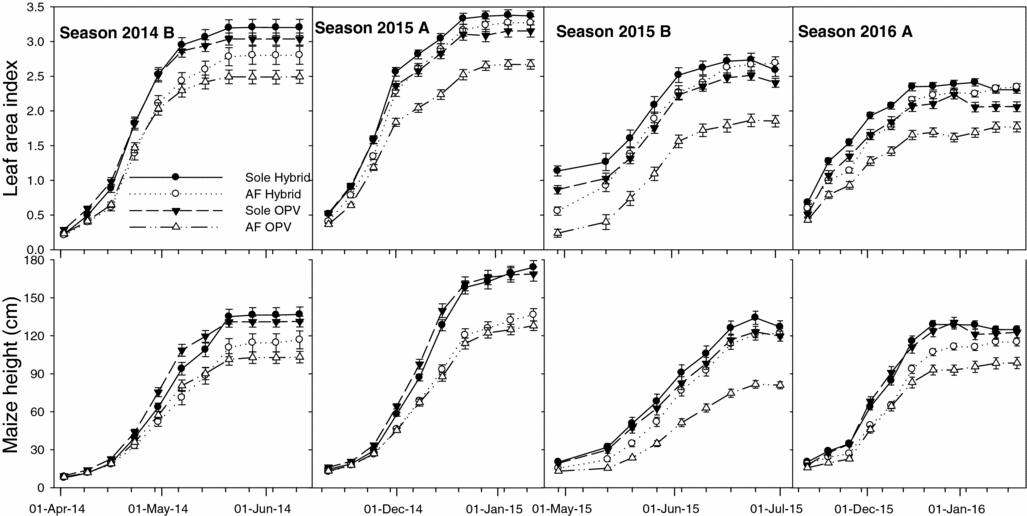
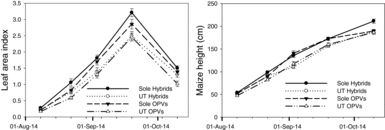
LAI was significantly larger and stem height was significantly shorter in Bugesera. In Bugesera and Meki, LAI and stem height were significantly higher in hybrids than in OPVs (Figures 2 and 3, and Table 5). In Bugesera, hybrids had an estimated LAI of 2.1, while it was 1.8 for OPVs. In Meki, estimated LAI for hybrids was 1.4 as compared with 1.2 for OPVs. Overall, the presence of trees decreased LAI and stem height in Meki but only plant height was reduced in Bugesera (Figures 2 and 3, and Table 5). In Bugesera, reduction in LAI was marginal (p = 0.07) but higher reduction was observed in OPVs than in hybrids (Tables 4 and 5). In this site, stem height reduction under trees was also stronger with OPVs than in hybrids. In Meki, there was no interaction between vigour and tree presence for both LAI and plant height. Hybrids in Bugesera had an average LAI of 2.2 in sole crop and 2.0 under trees, while the corresponding values of LAI for OPVs were 2.1 and 1.6. These differences were already present shortly after emergence (Figure 2).
Time courses for leaf area index and height of maize hybrids and OPVs growing under trees (AF: Agroforestry) or as sole maize during four consecutive seasons (2014 B, 2015 A, 2015 B and 2016 A) in the genotype experiment in Bugesera, Rwanda. Standard errors of the mean are shown.

Time courses for leaf area index and height of maize hybrids and OPVs growing under trees (UT) or as sole maize during the 2014 season in the genotype experiment in Meki, Ethiopia. Standard errors of the mean are shown.

DISCUSSION
Hybrids outperformed OPVs in agroforestry systems of Bugesera, but not Meki
Maize hybrids performed significantly better than OPVs under trees in Bugesera but this was not observed in Meki (Table 4). Presence of trees reduced yields of maize hybrids and OPVs in the same manner, but hybrids yielded significantly more than OPVs under trees in Bugesera. The interaction of season and the presence of trees in Bugesera was about significant for grain yield (p = 0.050) and for total biomass (p = 0.055) but highly significant for harvest index (Table 5). Thus, the larger yields of hybrids even in drier seasons suggest that they withstand water stress better than OPVs in Bugesera. This contrasts with the findings of Kamara et al. (Reference Kamara, Menkir, Badu-Apraku and Ibikunle2003), who reported that maize hybrids are more susceptible to drought than OPVs.
In Meki, hybrid yields did not significantly differ from OPV yields under trees. Probably, OPVs used in the experiment were genotypes produced after significant breeding efforts from the International Maize and Wheat Improvement Center (CIMMYT) and the Ethiopian Institute of Agricultural Research to include traits of stress resistance (e.g., drought resistance) – Melkassa-ns varieties (Beshir, Reference Beshir2011). There was severe early water stress in Meki during the 2014 season and terminal water stress during the 2015 season (Figure 1). The early water stress in 2014 season reduced maize emergence rate and negatively affected the yields despite the season's higher total rains when compared to the region's average annual rainfall. OPVs available in Ethiopia (e.g., Melkassa-2, Melkassa-4 and Melkassa-6Q) are higher yielding and likely better adapted to drought than OPVs available in Rwanda (Kidane et al., Reference Kidane, Yirga, Teklay, Teklay and Juhar2016). This better adaptation to water stress, a frequent constraint in agroforestry systems of equatorial savannahs (Ong and Leakey, Reference Ong and Leakey1999), may explain why these OPV cultivars yielded equally to hybrids.
In Bugesera, the ‘SEEDCO’ hybrids SC403 and SC513 performed better than the ‘PANNAR’ hybrids (PAN4M21 and PAN67) at p = 0.08, and much better than all the OPVs under trees. The selection of traits under optimal growing conditions may also improve performance under suboptimal conditions (Russel, Reference Russel1984). This appears to have been the case under agroforestry conditions in the equatorial savannahs of Rwanda, where best performing hybrids in sole crop also performed better under trees. All the varieties that were used in both Bugesera and Meki were officially released and among the most popular varieties in the region, but the presence of trees strongly reduced their grain yields. Tiwari et al. (Reference Tiwari, Virk and Sinclair2009) and Desclaux et al. (Reference Desclaux, Huang, Bernazeau and Lavene2016) proposed participatory plant breeding methods to breed for agroforestry conditions, targeting traits influencing agro-ecological structure and function rather than the classical breeding that targets higher yields in optimum conditions, and this is supported by our findings.
Our results showed that hybrids yielded more than OPVs in both sole crops and under trees in Bugesera (Table 4 and 5). In Meki, the yields of hybrids and OPVs were reduced in the same manner under trees when compared to open fields. In contrast to farmers in Meki, Ethiopia where the development of dryland OPVs is advanced (Abate et al., Reference Abate, Shiferaw, Menkir, Wegary, Kebede, Tesfaye, Kassie, Bogale, Tadesse and Keno2015), farmers in equatorial savannahs of Rwanda could benefit from cropping hybrids (e.g., SC403 and SC513) in agroforestry systems since their current OPVs are negatively impacted by agroforestry conditions.
LAI and plant height are reduced by tree presence for OPVs, but not for hybrids
Tree presence reduced LAI and maize stem height, more so for OPVs than for hybrids (Figure 2). This reduction explained lower maize grain yield and above-ground biomass under trees as compared to open fields in Bugesera. Desclaux et al. (Reference Desclaux, Huang, Bernazeau and Lavene2016) suggested that it is crucial to consider plant leaf shape and phenology while breeding for shade tolerance in agroforestry. We find that hybrids produce more total biomass than OPVs, which could provide more feed for livestock (Tiwari et al., Reference Tiwari, Brook and Sinclair2004). Based on the higher cost of hybrid seeds when compared to OPVs (Efa et al., Reference Efa, Gorman and Phelan2005), and the comparable yield and biomass production for OPVs and hybrids, we recommend farmers in Meki to grow OPVs rather than the more expensive hybrids in the stressed conditions (Alemu et al., Reference Alemu, Mwangi, Nigussie and Spielman2008).
CONCLUSION
We hypothesized that maize OPVs outperform hybrids under trees, which was not proven by our data. We found that the presence of trees reduced yields of both OPVs and hybrids when compared to the open field in both Bugesera (Rwanda) and Meki (Ethiopia). We conclude that in tropical savannah regions of Rwanda, agroforestry farmers could benefit from cropping hybrids, both under trees and in the open field. In contrast, for farmers practicing agroforestry in tropical savannah regions of Ethiopia, OPVs have similar yields as hybrids in low-input farming systems and decisions on seeds can simply be based on other factors such as seed costs and availability.
Acknowledgements
This study was implemented as part of the project ‘Trees for Food Security’ (FSC/2012/014), made possible by the generous support of the Australian Centre for International Agricultural Research (ACIAR) and CRP MAIZE (www.maize.org). Any opinions, findings, conclusion or recommendations expressed in this publication are those of the authors and do not necessarily reflect the view of ACIAR and CRP MAIZE.
SUPPLEMENTARY MATERIAL
To view supplementary material for this article, please visit https://doi.org/10.1017/S0014479718000297