INTRODUCTION
While in the past scholars of political science have generally thought democracy to die at the barrel of a gun – in coups and revolutions – the rise of populist politics has alerted the world to the possibility of democracy being strangled slowly in the name of ‘the people’. Populists consider society to be separated into two homogeneous but antagonistic groups – the ‘pure people’ and the ‘corrupt elite’. While there has been much research into populism in the West, scholarship on the particularities of the phenomenon within the African context is still emerging. The importance of a regional perspective becomes clear when one considers the contextual nature of populist politics and the different iteration it takes on the African continent. It tends to manifest as a populism of the left; more economically focused than in the West and more prone to Marxist-socialist ideological underpinnings; being reliant on a dual nexus of urban and ethnically based support; and as a response to post-liberation governments.
This article examines the phenomenon within the context of the current South African political climate, dominated by three political parties: the long-ruling African National Congress (ANC), the Democratic Alliance (DA) as the official opposition, and the Economic Freedom Fighters (EFF), a growing populist party. The broader rationale of the article is to contribute towards the understanding of oppositional populism on the African continent. More narrowly defined, the main research question guiding this analysis is: Could the EFF have led to a shift wherein the ANC and DA became more populist in their political rhetoric and discourse? If the EFF could shift the political rhetoric in South Africa, despite their inability to amass sufficient electoral support to attain the highest office in the land, what could this mean for South Africa's unconsolidated democracy?
The discourse-centred approach of this study allowed for populists to be identified by their political rhetoric, with speeches by political leaders forming the primary data used to analyse the level of populist discourse of a particular party. The coding rubric compiled by Hawkins (Reference Hawkins2009) was used to score 12 speeches from the 2014 and 2019 electoral periods. Surprisingly, the results indicated that, while the EFF's rhetoric was consistently populist, it did not appear to significantly influence populist political rhetoric in the other two parties. Even so, the populist party does pose a danger to the as yet unconsolidated South African democracy owing to its illiberal and anti-pluralist tendencies. In addition, there is the possibility that other parties, in order to sway voters to rather vote for them, may adopt some of the EFF's policies and behaviour (rather than rhetoric) if they perceive the EFF's tactics to work.
We proceed with a review of the different approaches towards studying populism, with a motivation for our choice of the ideational approach. We then provide an overview of populism in Africa, highlighting its challenges for liberal democracy. Thereafter, the contextual factors of the South African political sphere are briefly discussed, followed by a more in-depth explanation of the methodology applied in this study. Finally, the results are presented followed by a discussion.
DIFFERENT APPROACHES TO STUDYING POPULISM
Academic debates about populism's meaning have carried on for more than five decades ever since Ionescu & Gellner's (Reference Ionescu and Gellner1969) pioneering edited volume. Perhaps the only scholarly consensus has been conceptual disagreement about the term. Researchers have mentally laboured over its component parts for half a century, often trying to mould academic ontology to fit empirical reality. Within these scholarly battles, four approaches dominate the extant literature: structural, political-institutional, performative and ideational. Below we briefly review each definitional strategy and provide a justification for our use of the ideational approach.
Structural accounts, employed by scholars in the 1960s and 1970s, emphasised the support base of populist political actors. Examining Latin America, early accounts (Di Tella Reference Di Tella1965) illustrated that populist parties attracted voters from ‘incongruent’ social groups, cutting across the socioeconomic cleavage that structured many countries’ political systems. Other researchers (Germani Reference Germani1978; Cardoso Reference Cardoso1979; Drake Reference Drake1982) identified that marginalised citizens, living in destitute conditions, gravitated towards larger than life figures who campaigned on statist economic policies that they promised would serve as a panacea for the masses’ difficulties. As such, the structural conditions of the region gave rise to charismatic presidents who promised to serve as champions for their adoring masses.
As rich and fruitful as these seminal accounts of populism are, their conceptual approach suffers from a few weaknesses. Structural accounts’ utility is bound by time (1940s and 1950s) and place (Latin America), with their value sharply waning when later actors and other geographic regions are analysed. The conceptual requirement of a coalition of variegated classes should also be questioned as this is not unique to populism. Contemporary catch-all parties also aim to maximise their support across social strata (Singer Reference Singer2018). Lastly, past structural accounts posited populism as a regime type, and centred exclusively on electoral winners (Hawkins & Rovira Kaltwasser Reference Hawkins, Rovira Kaltwasser, Hawkins, Carlin, Littvay and Rovira Kaltwasser2019: 6). For the purposes of our study, with an examination of potential populist behaviour by both incumbent and opposition parties, the structural account offers very little.
Another dominant definitional approach is the political-institutional account that emphasises a leader's specific interactions with their followers. Leaders are usually charismatic and attempt to achieve and exercise political power through direct, unmediated backing from enthusiastic supporters (Weyland Reference Weyland2001, Reference Weyland, Ostiguy, Kaltwasser, Taggart and Espejo2017). Central to this approach is the interplay between leaders and followers, and the emphasis on top-down mobilisation (Barr Reference Barr2003; Roberts Reference Roberts2006). A major advantage of this strategy is that it leaves open to empirical examination the ideological nature of populist actors – left-wing or right-wing, with no focus on specific policies. Further, it allows the researcher to focus on both incumbent and challenger candidates.
As with other approaches, it also suffers from some weaknesses. The definition requires that populists’ political vehicles lack institutionalisation. As such, the approach is less amenable to country contexts with strong and institutionalised political parties like Western Europe, Australasia, and the USA (Mudde & Rovira Kaltwasser Reference Mudde and Rovira Kaltwasser2017; Hawkins et al. Reference Hawkins, Carlin, Littvay and Rovira Kaltwasser2019b), and may bias empirical scoring on the basis of actor features that are largely determined by the electoral system.Footnote 1 The importance of leader attributes (personality and political institutionalisation) also shifts the scholar's analytical gaze to the supply side of populism, while devaluing the demand side (Mudde & Rovira Kaltwasser Reference Mudde and Rovira Kaltwasser2018), inhibiting the examination of how or why populist ideas resonate with the general public.
The performative or sociocultural approach focuses on the public behaviours of political actors, with the main focus being the relational aspects between leader and follower. Ostiguy (Reference Ostiguy, Ostiguy, Kaltwasser, Taggart and Espejo2017: 73) posits that populist leaders engage in sociocultural performances aimed at fostering strong emotional bonds with potential followers, and they specifically do so through the ‘flaunting of the low’. The low refers to the use of slang, vernacular language, folksy expressions and metaphors, rude and brash behaviour, and even swearing (Moffitt & Tormey Reference Moffitt and Tormey2014). Populism, more than anything, is a public spectacle performed by a leader to generate a sense of sameness among her followers, that she is ‘one of us’ (Moffitt Reference Moffitt2015).
This strategy offers the advantage of considering what makes populist behaviour attractive to citizens and the interplay between leader and follower. For descriptive purposes this approach seems to be advantageous, yet when one tries to extend it to empirical analysis it suffers from three key shortcomings. First, scholars using this approach tend to describe non-populists as ‘stiff’, ‘boring’, ‘serious’ and ‘rigid’ (Moffitt & Tormey Reference Moffitt and Tormey2014; Ostiguy Reference Ostiguy, Ostiguy, Kaltwasser, Taggart and Espejo2017). These adjectives are rather subjective and a researcher's own implicit bias(es), conditioned by education and personality among other factors, likely affect how these labels would be applied to candidates. As such, any effort to systematically score cases would likely run into major problems with validity and inter-coder reliability.
Second, much of the performative approach relies on establishing that a connection was formed between leader and follower. It is nearly impossible for a researcher to accurately assess the feelings or emotions of audience members at political events without asking these citizens about their experiences. Short of surveying the public at campaign rallies and other events, the researcher is left to make certain assumptions without much of an empirical basis. Third, the behaviours and conduct identified by Ostiguy (Reference Ostiguy, Ostiguy, Kaltwasser, Taggart and Espejo2017) as ‘high’ – well-spoken, culturally sophisticated – apply to prototypical populists like Pim Fortuyn in the Netherlands and Pablo Iglesias in Spain (Mudde & Rovira Kaltwasser Reference Mudde and Rovira Kaltwasser2018: 1672).
The ideational approach treats populism, by and large, as a set of ideas. Central to this definitional strategy is a moralistic component, in which both leader and follower view politics as a fundamental struggle between the ‘virtuous and good people’, and the ‘evil elite’ (Mudde Reference Mudde2004; Hawkins Reference Hawkins2009; Müller Reference Müller2016; Hawkins et al. Reference Hawkins, Carlin, Littvay and Rovira Kaltwasser2019b). The former are conceived as ‘the pure people’, whilst the latter are presented as homogeneous, but pathological (Mudde & Rovira Kaltwasser Reference Mudde and Rovira Kaltwasser2013: 151). Adherents of this approach scoured global leaders considered to be populist by scholars to search for a common element across cases. The inductive nature of this approach paves the way for empirical analysis of potential cases of populism. Similar to the advantages of other strategies, the ideational definition places no requirement on any programmatic appeal, ideology or set of policies (Mudde & Rovira Kaltwasser Reference Mudde and Rovira Kaltwasser2018), and leaves open for empirical examination the degree to which ideas are present in leader's speeches or how widespread populist ideas may be among the populace.
Within the ideational approach, there are different strands. One perspective sees populism as a ‘thin-centred ideology’ (Mudde Reference Mudde2004: 543) that can easily incorporate other political beliefs such as nativism (Mudde & Kaltwasser Reference Mudde and Rovira Kaltwasser2017), as well as the left-right ideological spectrum. Utilising this methodological framework, adherents tend to analyse which ideologies complement populism, and in which contexts they may surface (Mudde & Rovira Kaltwasser Reference Mudde and Rovira Kaltwasser2018). Others (Laclau Reference Laclau2005) made important theoretical contributions by identifying the subjectivities of ‘the people’ and of the opposing power bloc of ‘the elite’ as ‘empty signifiers’, symbolic vessels filled with particular content depending upon the political context within which the would-be populist finds themselves. A further significant contribution (Mudde & Rovira Kaltwasser Reference Mudde and Rovira Kaltwasser2013: 151) was the recognition of the populists’ appeal to Rousseau's ‘general will’, thus presenting themselves as the voice of ‘the pure people’, who have a unified and identifiable will.
Another analytical pathway within this approach emphasises the need to collect data (either leader speeches or public opinion data with targeted questions) and investigate the prevalence and potential change in the levels of populism over time and across space (Akkerman et al. Reference Akkerman, Mudde and Zaslove2014; Van Hauwaert & Van Kessel 2018; Hawkins et al. Reference Hawkins, Carlin, Littvay and Rovira Kaltwasser2019b). It primarily focuses on empirical examination, positing that populist ideas can be operationalised, measured and scored. In this study we employ an empirical approach that examines the discourse of leaders. We do so for four reasons.
First, we seek to enrich the nascent body of literature on African populism. Specifically, we wish to go beyond descriptive accounts and present an empirical account of the prevalence of populism, and assess whether it is used by fringe and/or mainstream actors. Second, and related to the first, our study seeks to partly fill the geographic gap in the populism literature by offering an empirical contribution that puts the South African case in comparative perspective. For cross-national and cross-regional comparisons, the ideational approach is ideal, as it allows for ‘much-needed dialogue between scholars’ with different regional expertise (Mudde & Kaltwasser Reference Mudde and Rovira Kaltwasser2018: 1669). For these three objectives, we desire an approach that allows systematic data collection and valid and reliable scoring, increasing our inferential leverage and ability to speak more broadly on populism in a comparative sense.
Fourth, another objective for us is to consider the effects that populists have had on the democracy in South Africa, and whether they present a danger to a somewhat fragile democratic consolidation. Using the ideational approach, as others contend (Mudde & Kaltwasser Reference Mudde and Rovira Kaltwasser2018; Singer Reference Singer2018), we acknowledge that populists, at their core, seek to fundamentally shake up the system to amplify the voice of ‘the people’, while frequently removing restrictions on majority rule. Populists are not merely wishing to ‘kick the bums out’ at the ballot box; rather they seek a tectonic shift that rattles the foundation underpinning democratic institutions and rules. The ideational approach thus most closely aligns with our theoretical and empirical motivations of the study.
In selecting the ideational approach, we acknowledge that other definitional and theoretical viewpoints are also valid yet ultimately serve different purposes. Too often in academic studies, definitions and approaches are treated as a zero-sum game in itself, in which scholars make either-or decisions. Our goal here is to utilise the ideational approach for this specific study, but we acknowledge that other definitions also have validity and advantages for different research questions. Some scholars (Barr Reference Barr2009; Levitsky & Loxton Reference Levitsky and Loxton2013; Resnick Reference Resnick and Torre2018) have even combined the ideational and political-institutional accounts, and contributed greatly to the literature.
We are also aware of the weaknesses of the ideational approach and seek to overcome some of them. Often, critics of this strategy raise the issue that this approach reduces populism to ‘only rhetoric’ or words of leaders. As such, we offer that scoring speeches is but a first step in the careful, systematic analysis of leaders’ actions. We are mindful of this and extend our analysis in a later sub-section that details how the public rhetoric of leaders shapes their other political behaviours. Lastly, a different critique, offered by Weyland (Reference Weyland and Torre2018: 54), puts forth that this approach is too inclusive and generates ‘false positives’ in its scoring.Footnote 2 We acknowledge that our data set of speeches are just that, and caution against claiming too much from these limited data points. However, we contend that an initial understanding of how populists define ‘the people’ provides valuable insight into how they will behave politically and for whom they will try to offer enhanced representation. Müller (Reference Müller2016: 21) presciently notes that populists claim to represent the true people, who are actually only a slice of the entire population and portray them as the ‘real people’. Comprehension of this dynamic is crucial to understanding how populists will try to restructure politics, and the agendas they will pursue.
POPULISM IN AFRICA AND ITS IMPLICATIONS FOR DEMOCRATIC CONSOLIDATION
It is imperative to recognise the contextual factors, which distinguish populism in African countries from iterations of the phenomenon in Western contexts (Inglehart & Norris Reference Inglehart and Norris2016), while noting that the region shares similarities with other developing world contexts, like Latin America (Mudde & Kaltwasser Reference Mudde and Rovira Kaltwasser2013). These features include a reliance on the Marxist-socialist liberation backgrounds of many African states (Mangcu Reference Mangcu2012; Thomson Reference Thomson2016) and a ‘fusion of charismatic leadership with a message of social inclusion’ (Resnick Reference Resnick2014: 3). A further feature is a focus on a dual nexus of ethnic and urban support (Kimenyi Reference Kimenyi2006; Resnick Reference Resnick2014). The reliance on ethnic ‘home grounds’ together with economic have-nots for support, especially in the most urbanised areas, is also uniquely African (De la Torre Reference De la Torre2014; Resnick Reference Resnick2014), and is a programmatic focus of most African populists. So is a possible affinity for ‘second-wave’ populism, which constructs former liberation parties as the newly hateful elite which has failed to provide economic opportunities, rather than the focus on a cultural backlash common in the West (Resnick Reference Resnick2014; Hadiz & Chryssogelos Reference Hadiz and Chryssogelos2017). Interestingly, Melber (Reference Melber2018: 2) noted that the former liberation movements of Southern Africa tended to turn into populist governments using populism as a means to legitimise their long-term governance by ‘appealing to the continued struggle against foreign domination and thereby marketing oneself as the only true alternative and promise of a better future’. He also acknowledged that these populist appeals to ‘the people’ tended to be baseless, with little evidence of concern for their constituencies, while drawing much personal benefit from being the incumbents. It is thus unsurprising that the second wave of populism is directed against these liberation governments.
A common thread across African populists (liberationist and post-liberationist) is the tendency to make economic outcome variables the centre of their campaigns. The more instrumental understanding of democracy in many African states intensifies the danger that the illiberal nature of populist rhetoric poses to the continent's as-yet unconsolidated democracies, as support for the democratic system becomes conditional on materialist factors and may be withdrawn if socio-economic goods are not received or material inequalities are not rectified (De Jager Reference De Jager2015: 205). In unconsolidated democracies where a democratic political culture is still developing, poor governance (with its accompanying economic failings) can result in citizens attributing the poor performance to the democratic regime rather than the incumbents (De Jager & Steenekamp Reference De Jager, Steenekamp and Van Beek2018: 2), and populists are quick to use the opportunity of this societal disgruntlement. Unconsolidated democracies that suffer from poor governance thus become vulnerable to political actors who are indifferent to the intrinsic values of liberal democracy.
Populists pose a danger to democratising states when they reject three of the basic principles of liberal democracy: objecting to constitutional checks and balances, disdaining representative democracy, and opposing a pluralistic interpretation of ‘the people’. Zakaria (Reference Zakaria1997: 42–3) argues that ‘[d]emocracy without constitutional liberalism is not simply inadequate, but dangerous, bringing with it the erosion of liberty, the abuse of power, ethnic divisions, and even war’. Populism thus has the potential to polarise society, present pluralistic societies as binaries, and turn politics into zero-sum games. As Melber (Reference Melber2018: 2) observes, ‘[p]opulist forms of mobilisation take advantage of the understanding and practice of liberal democracy while being in their core utterly illiberal’. Thus, they may make use of the democratic structures, like elections, but their ultimate intent is not to necessarily support the continuation of the democratic system should they win at the polls.
THE SOUTH AFRICAN CONTEXT
With the theoretical groundwork having been lain for a deeper analysis of populist politics, and having established that populism is rooted in its contextual environment, it is important to briefly discuss the South African political landscape. The ambient conditions for the African iteration of the populist phenomenon are present in the South African context, including a history of Marxist ideologies among the country's liberation movements as well as being the ideological lens of the EFF; a particularly economically unequal society; and a former liberation party embroiled in various accusations of complacency, corruption and poor governance.
Since the 2014 election cycle, the South African political landscape has been dominated by three parties in particular – the ANC, the DA and the EFF. The ANC has governed nationally since the first democratic elections in 1994, but has recently been rocked by several high-profile corruption cases and the state capture saga under the Zuma administration, creating opportunities for the official opposition, the DA, and the much younger EFF to assert themselves. Since the ANC is structured as an alliance (with the South African Communist Party and the Congress of South African Trade Unions), ‘supporters of the ANC spanned a greater range of social groups and ideological positions than any other competing party or organisation’ (Dubow Reference Dubow2000: 109). However, the party currently seems torn between the constitutional values of those who founded and built it, the communist values of the SACP, and the predatory values of those who seek to use it as a platform for personal gain through access to state resources.
The DA is ‘the culmination of a long line of political parties splitting and coalescing’ (De Jager Reference De Jager2015: 155) and defines itself as ‘a party that believes in liberal values and principles’ (Grootes Reference Grootes2019). The party has been the official opposition for over a decade while also being a ‘party of government’ (De Jager Reference De Jager2015: 155) as the leader of the Western Cape provincial government. Despite having had leaders from various racial groups, it continues to struggle against hitting an ‘electoral ceiling’ of minority voters and a designation as a ‘white party’ by many black South Africans.
The EFF provides a prominent example of a populist party within the African context. It is not the first party to lay claim to those disaffected voters who have begun to see the ANC as the new ruling class of oppressors, but it is by far the most successful. Policy-wise, the EFF manifesto for 2014 had its roots in the ANC Youth League policies formulated when its so-called commander-in-chief, Julius Malema, was president of that body, but the EFF also appropriated ‘a smattering of ideology and rhetoric’ from Pan-Africanism, Fanonism and Marxism (Robinson Reference Robinson, Schulz-Herzenberg and Southall2014: 77). In its constitution, the EFF self-identifies as a ‘radical and militant economic emancipation movement that brings together revolutionary, fearless, radical, and militant activists’. The party eschews representative democracy, democratic procedures and the restraint needed in a pluralistic society. During a Pre-Election Talk in 2019, Nosipho Makamba-Botya (EFF Western Cape Provincial spokesperson) stated that the EFF's ‘aim is to have a one-party system’. The party undermines democratic institutions; disrupting State of the Nation Addresses (SONA) and failing to be present at formal parliamentary disciplinary hearings, calling them ‘kangaroo courts’ (Fisher Reference Fisher2014). It engages in hate speech, incites violence, and is intolerant of other political parties and the media. Former DA leader Mmusi Maimane reported Malema to the Equality Court for hate speech against a DA mayor. Malema had called the DA the ‘enemy of the people’ and threatened: ‘We are going to remove a mayor of PE … we are going for your white man in PE. We are going to cut the throat’ (quoted in Anderson Reference Anderson2018). Rather than using democratic procedures to address grievances, the party and its members turn to violence as evidenced in the vandalising of Clicks, H&M and Vodacom stores. The Daily Maverick tracked 11 instances of violence perpetrated by the EFF within a space of two years (Haffajee Reference Haffajee2020).
Thus in the South African case, the EFF, as a populist party of the left, has little intrinsic support for a liberal democratic form of government. This highlights the importance of understanding its influence on the two other major political parties.
THE EFF AS A POPULIST PARTY
It is clear that the EFF complies with every aspect of the definition for populism as set out in the previous section. It has emerged from a state of perceived crisis leadership in South Africa, which it uses to enforce a strictly Manichaean distinction between the ‘corrupted leadership elite’ and the ‘oppressed working-class people’. The EFF shows a strong opposition to the political establishment in the form of the ANC as well as the white minority, which it argues controls the economic establishment, and instead claims to represent the will of the people in its entirety, with a restrictive interpretation of ‘the pure people’.
The EFF's populist discourse is further shown to comply with the specificities of populism within the African context. It is firmly situated within a political landscape dominated by socio-economic inequality; it is based on a tradition of Marxist–Leninist ideology; it proclaims a message of social inclusion through the clever use of charismatic leadership, and it campaigns on ethnicity by re-racialising the South African society.
With the source of the populist danger in South Africa thusly identified, one might consider the consequences that anti-pluralist politics could have for the country's fledgling democracy. In a state that has not yet managed to fully entrench its relatively new democracy, the EFF's attempts to discredit some of the core pillars of political accountability is concerning, to say the least. The party's disdain for the independent judiciary and media and claim that there is no true neutrality in these institutions does irreparable damage to democracy-building. In a state as diverse as South Africa, the EFF's understanding of ‘the true people’ as a single, unified group poses obvious dangers to the concept of representative democracy and the value of pluralism upon which the state is built. The party also advocates the use of violence against those that oppose ‘the people’, even while being involved in corruption scandals which would place it firmly in the position of the ‘corrupt elite’ that it claims to oppose. As such, the EFF poses a clear danger to democratic consolidation in South Africa.
METHODOLOGY
As the aim of this case study is to analyse the shifts in political rhetoric in South African politics over two election cycles, a study of key texts presents the most relevant way to measure a change in tone and subject matter over this period.
This study implements a holistic grading method of textual analysis, as pioneered by Hawkins (Reference Hawkins2009). The holistic approach has been found to achieve high levels of inter-coder reliability and validity (Rooduijn & Pauwels 2011; Hawkins et al. Reference Hawkins, Aguilar, Castanho Silva, Jenne, Kocijan and Rovira Kaltwasser2019a). The analytical coding of speeches in this way allows for the allocation of a score to each text, which then allows for further inspection, interrogation and interpretation of the data (Richards Reference Richards2013: 95–6). This innovative grading method presents one of the most expansive and specific attempts to develop methodology aimed at understanding populism and expands the reliability of studies focused on the influence of political discourse.
Qualitative coding organises raw data into conceptual categories. The scoring of populism on a scale entails a tag or label for assigning units of meaning to the descriptive data provided in the texts. While codes are more usually ‘attached to “chunks” of varying size – words, phrases, sentences or whole paragraphs’ (Neuman Reference Neuman2011: 510–11), Hawkins's holistic grading method allows for coding which considers the entire text in a more all-inclusive way, measuring the tone, themes and ideas conveyed in the text rather than the frequency of key words or phrases, which may indicate only ideological leanings (Hawkins et al. Reference Hawkins, Aguilar, Castanho Silva, Jenne, Kocijan and Rovira Kaltwasser2019a).
This research method sees populism as a continuous variable, not simply binary; this in turn allows for closer examination of trends over time and small shifts in political discourse and style. The coding rubric was originally constructed by Hawkins (Reference Hawkins2009), utilised by Hawkins et al. (Reference Hawkins, Carlin, Littvay and Rovira Kaltwasser2019b) and provided for use by other researchers by the latter study.
The rubric contrasts possible populist rhetorical tactics and content with the pluralist perspective and allows for a score to be allocated on the basic of these oppositional forms of rhetoric, ranging from 0 – ‘not populist at all’ to 2 – ‘extremely populist’. For example, a discourse which frames everything in moral and dualistic terms – in other words, which espouses a Manichaean vision of the world, with the implication, or even the explicitly stated view, that there are no grey areas, would be termed populist. The pluralist antithesis would ‘not frame issues in moral terms or paint them in black-and-white’ but would instead tend to focus on particular issues or policy ideas. The pluralist discourse would emphasise (or at least not eliminate) ‘the possibility of natural, justifiable differences of opinion’ (Hawkins et al. Reference Hawkins, Carlin, Littvay and Rovira Kaltwasser2019b).
Speech selection
Hawkins et al. (Reference Hawkins, Carlin, Littvay and Rovira Kaltwasser2019b) found that four key speeches per term were enough to measure how populist a political leader was during that term. An average rating on the 0–2 scale is given for every speech, after which the average for all four speeches is found, thus equalling the average for that speaker for the term in office. For this study, a choice of four speeches per party were selected, and all speeches were delivered in English.Footnote 3
As a parliamentary system, South Africa's political system tends to give precedence to political parties, as opposed to presidential systems, which favour individual leaders. In order to adapt this research method to party politics in South Africa, party leaders’ speeches are used as proxies for party rhetoric. Electoral issues in national elections tend to be more wide-ranging and less localised, and speeches from these elections better preserved, than with local elections. The units of analysis are thus the three parties which captured the largest share of the vote in both the 2014 and 2019 national elections – the ANC, the DA and the EFF. All speeches were selected from the election campaigns of the respective parties. These speeches were expected to be the most reliable measure of populist discourse used by these political leaders, as they were delivered to their voters directly in an attempt to galvanise voters to show up for the relevant party on election day. While the exact dates of the speeches for each party differ somewhat, the goal and occasion of the six texts for each election cycle are the same, thus making them comparable within this coding system.
A manifesto speech and a final rally speech from each party was selected for each election cycle. A ‘manifesto speech’ is exactly that – a speech given by the most senior party member at the official launch of the manifesto for that election period. A ‘final rally speech’ is defined as a speech given during the party's final public convention in their campaign for office. All 12 speeches chosen for this study are from large public rallies where audiences numbered in their thousands and where the general public was invited to attend, not just party members.
Given the nature of national election campaigns in South Africa, all 12 speeches selected for this study were given by the party leader at the time, as they were also the party's candidate for president, making the gravitas of the speakers comparable.
This study relies purely on textual data, available in the public domain on the relevant parties’ web pages and through reliable online news sources. A key limitation was the lack of recordkeeping of important speeches in South African political coverage. As a result of the suspension of the ANC's website for non-payment to its service provider in 2018, transcripts of Zuma's 2014 manifesto speech were not publicly available and had to be obtained through correspondence with the ANC Department of Information and Publicity (DIP). Transcripts of EFF leader's speeches were more difficult to track down. For those speeches not publicly available, YouTube videos were transcribed.Footnote 4
Upon initiating this study, the researchers expected to find that only the EFF scores highly, or as ‘clearly populist’, in the 2014 election cycle, while the other two parties move further away from a 0 score on the scale in the ensuing years, indicating that they are becoming more populist as the EFF normalises populist political discourse in the South African political milieu. However, this assumption was proven wrong, as examined in the next section.
RESULTS
Having confirmed both the populist trademarks of the EFF, and its commander-in-chief Julius Malema, and the possible danger that this brand of political discourse poses to the as-yet unconsolidated democracy of South Africa, this article now turns to an analysis and comparison of the rhetoric used by the three main political parties.
For the 2014 electoral cycle, a speech by Julius Malema at the occasion of the party's election manifesto launch on 22 February 2014 was analysed. The second speech analysed for the 2014 election period is the launch of the party's manifesto in October 2013. For the 2019 election cycle, two speeches were examined: Malema's speech at the manifesto launch on 2 February, and his speech at the party's Tshela Thupa rally on 5 May.
The speeches of Jacob Zuma, then leader of the ANC, at the ANC's manifesto launch on 11 January 2014 and at the party's closing rally on 4 May of that year were analysed. His successor, Cyril Ramaphosa's speech at the ANC's manifesto launch for the 2019 election on 12 February, as well as his speech at the ANC's final rally, known as the Siyanqoba rally, on 5 May of the same year, were evaluated.
For the DA, the speeches by the then-party leader Helen Zille at the party's 2014 manifesto launch on 23 February and at the campaign's closing ‘Vote for Jobs’ rally on 3 May were scrutinised. For the 2019 election cycle, her successor, Mmusi Maimane's speeches at the DA manifesto launch on 23 January and at the DA's final Phetogo rally on 4 May of that year were examined. A discussion of observable shifts along the populist-pluralist spectrum for the two election cycles follows. Table I illustrates scores for each actor's campaign speech.
Populist scoring for South African politicians during the electoral campaigns.

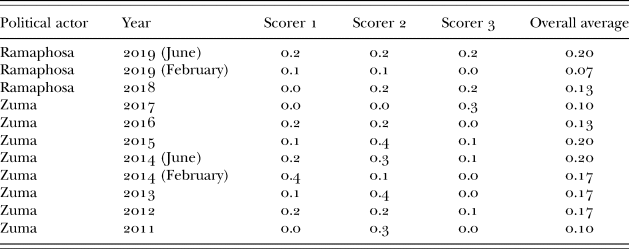
As a baseline for comparison of populist behaviour during the electoral campaigns, we have also scored annual (in election years they are bi-annual) State of the Nation Address (SONA) speeches for the ANC party leaders (Zuma and Ramaphosa). This gives us both a measure of the degree of populism in South Africa in non-electoral years, and a better sense of each actor's natural populist rhetorical tendency. The results appear in Table II.
Populist Scoring for SONA speeches over time.

ANALYSIS OF PARTY DISCOURSES AND TRENDS
2014 national elections
The EFF
At the EFF's launch, Malema states that his new party knows ‘the people’ and knows their struggle, and he clearly positions them as the only legitimate voice of the ‘masses’ of South Africans who are downtrodden and forgotten by the current administration. There is a clear narrative that the EFF is the people's voice, and anyone who disagrees is not one of ‘the people’. Malema constructs a revolutionary narrative in the speech, drawing on freedom fighting metaphors and a narrative of revolution. The EFF is simply spearheading a revolution which will be happening anyway – a continuation of the original fight for freedom – and the EFF is thus tied in with a storied version of history. Malema does not make mention of voting as a democratic process or show specific regard for the rule of law. In fact, where the law is unjust in his eyes, he encourages disobedience in decidedly anti-pluralist tones. This makes the speech deeply populist in nature, with a score of 1.78.
Similarly, the manifesto launch ranks as extremely populist, with a 1.80 score on the scale. It articulates nearly all the elements of the ‘ideal populist discourse’ and contains few elements that would be considered pluralist. Malema posits a Manichaean political field – the self-serving, corrupt government and their capitalist influences, and the ‘people's movement’ of the EFF. He constructs the former liberators of the country as an evil minority elite. The ANC government, revered for the critical role it played in the negotiated settlement that led to South Africa's first democratic elections, is named as the people's enemy, which has ‘sold out’. As a result, ‘the people’ ‘must stop relying on the elite’ and instead ‘must be [their] own liberators’, with the EFF as the only party which can change the system.
In both the above speeches, the ‘enemy of the people’ is clearly set out in the text as the ruling ANC and their supporters and partners in corporate South Africa. This brings the average for the EFF for the 2014 election cycle to 1.79, a decidedly populist score.
The ANC
Zuma's speech at the manifesto launch reads more like a policy overview of the ANC's past and future plans for South Africa than any kind of populist urging to abandon the system or rise up against a common enemy. Opposition parties are not mentioned, and the only real reference to an ‘enemy’ is in the mention of ‘certain destructive and opportunistic elements’. In general, Zuma avoids a conspiratorial tone and does not single out any evil ruling minority. He does sell his party through its connection to Nelson Mandela and conjures other struggle heroes in the hopes that this will further remind listeners of the party's almost mythologised past. He is also at pains to point out that the changes the party has made to its land restitution policy is based on specific areas of the Constitution, not on ‘the will of the people’. Instead, he focuses on the power of a democratic vote, a pluralist hallmark. Given the pluralistic aspects of his speech, we score it a 0.25.
At the party's closing rally, Zuma's speech focuses on the numerical and statistical results of the ANC's 20 years in office. The true enemies of the smooth running of the South African state are said to be individuals who commit corruption or other crimes in their own capacity, not as part of any conspiring minority. While Zuma mentions that companies involved in ‘bid rigging, price fixing and corruption’ will be punished, he does not make them out to be a powerful force of subversion. The system, he implies, does not need systemic change. While he often speaks of ‘our’ people of South Africa, Zuma's construction of ‘the people’ is as broad as his construction of the ‘enemy’ is vague, and his notion of citizenship is broad enough to be considered pluralist. Due to its general pluralist nature, and evident absence of populist discourse, the speech scores a 0.15 on the scale. This brings the party's average score for the 2014 election cycle to a 0.20, denoting Zuma's campaign as pluralist, contrary to expectations.
The DA
Zille's speech at her party's manifesto launch espouses strong pluralist values as the best form of opposition to the corrupted ANC. The overwhelming content of the speech is thus her party's policy proposals – she promotes the DA's tangible successes at governance and advertises the improvements the party will make when it comes into power nationally. Zille justifies the need for these policies by pointing out the ANC government's recent failures under Zuma. She seems to be stating that she used to respect the party in its early years, but that it was no longer the same party, and instead ‘[a] better life for all’ has become ‘a better life for some’. While Zuma is called out by name for using his office for personal gain, Zille highlights the need for competent political leadership and policymaking, thus keeping her speech within the confines of pluralism. The democratic system seems to be working, in Zille's eyes, if only voters would make the right choice. We rate her initial speech as distinctly pluralist with a 0.13.
At the DA's final rally, Zille incorporates some elements of populism. However, the speech remains a definitively pluralist text and scores a 0.23. Zille clearly represents the ANC as both a party of corrupt minority elites and the source of the troubles that South African citizens are facing. In contrast to the supposedly arrogant and detached perspective of the ANC, Zille uses Xhosa and South African slang in her speech in an attempt to associate herself and her party with South Africa's majority black working class. However, she does not construct an exclusive ‘people’, which may be said to form the base of her party. Zille further takes a distinctly pluralist view when she emphasises that democratic processes are the only way in which South Africa's ship may be righted. The DA's average score for the 2014 election cycle is 0.18, making it a decidedly pluralist campaign.
2019 national elections
The EFF
Malema's main thesis for this election manifesto speech is clear: In South Africa under the ANC, the rich are becoming richer and the poor are becoming poorer, and these two groups are largely divided along racial lines. Malema makes it clear that he is making this speech to ‘his people’ in Soshanguve, because they represent the millions of other poor black South Africans. He thus constructs the EFF as representing the will of the majority ‘people’ that is clearly predicated on both racial and class lines. Malema again posits the ANC as the ‘people's enemy’ and uses the metaphor of hunger to frame this situation as a crisis to which a robust response cannot be postponed. He argues that stronger actions are thus necessary, justifying his constant calls to change the system by changing the rules of engagement in South African politics, namely the Constitution. His speech is scored as highly populist at 1.93.
Malema constructs a Manichaean argument at the EFF's final rally, arguing that the DA is ‘racist’, and the ANC elite are both ‘criminals’ and ‘too old’ to be in government. Malema's language also shows a bellicosity towards the opposition that is incendiary and condescending, lacking the decorum that one shows a legitimate opponent in a pluralist democracy. The most populist aspect of this speech is the constant justification of extra-parliamentary responses to the current government's failures. While Malema both denies and denounces any EFF involvement in the threats made towards a journalist critical of the EFF, he also encourages some followers to ‘go to parliament … and shoot them randomly’. While he might argue that these are simply rhetorical devices, it is not reflective of a pluralist stance, which encourages voting as the answer to these issues. Overall, non-democratic means are openly justified, marking the speech as conclusively populist and scored at 1.83. The combination of the very populist scores gives the EFF an average of 1.88 for the 2019 electoral cycle.
The ANC
At the party's manifesto launch, President Ramaphosa carefully tempered appeals to the almost mythological legacy of the ANC and its history as the ‘people's party’ with broad-based, pluralist appeals to all South Africans, thus earning a score of 0.28. The speech contains an insinuation that the ANC is inextricably linked with the benefits that democracy has brought so far and with the will of the people. However, Ramaphosa does not allude to an unchanging essentialism to this will. He pays more than lip service to pluralist democratic institutions, noting that great strides have been made through the actions of these structures in the process of consolidating South Africa's democracy. He positions South Africa as a nation ‘founded on a democratic and progressive Constitution that guarantees equal rights to all people’.
Ramaphosa constructs a slightly more Manichaean worldview at the party's Siyanqoba rally, but avoids a conspiratorial tone, openly respects democratic institutions, and preaches a politics of differences, even if he does at the same time encourage unity. He emphasises the contact the party has had with ordinary South Africans and that the party has ‘heard them’ – the implication being that the ANC now speaks for them as well. However, his inclusive positioning of ‘the people’ of South Africa tempers the populist effect of this construction. He also emphasises the importance of democratic checks and balances on the power of the government. He does not claim that the ANC's majority should exempt the party from being held in check or accountable, and instead emphasises accountability for public servants. This marks the speech as pluralist, with a score of 0.03. This brings the ANC's average for the 2019 election campaign to 0.16 – decidedly pluralist.
The DA
At the party's manifesto launch, Maimane advances the idea that his dream for South Africa is a work in progress, but does so in a decidedly pluralist manner, earning a 0.03 score. He argues that the ANC has corrupted the system, but presents it as a moral degradation of a former liberation party rather than the decline of South Africa's democratic system in general. Accusatory or inflammatory language is directed at the ANC itself instead of the system, but Maimane makes it clear that judgement should take the form of a democratic vote. He promotes the protection of democratic institutions and praises the Constitution and South Africa's commitment to the rule of law.
In his speech at the DA's Phetogo rally, marking the end of his 2019 campaign, Maimane launched a more personal attack on the ANC in general and Ramaphosa in particular. Ramaphosa is named as a perpetuator of Zuma's crimes, and the ANC leadership presented as criminals, not statesmen who should be respected. No specific group of South Africans is said to make up ‘the people’. He also encourages voters to choose the DA by discouraging traditional measures of in-grouping: you cannot vote according to ‘your race, your language, your culture or your religion’. To Maimane, democracy is the calculation of votes rather than the creation of one unified whole, a distinctly pluralist sentiment, earning an overall 0.23 for this speech. Maimane's overall score for the 2019 campaign thus averages to a 0.13 – still decidedly pluralist, despite minor elements of populism.
DISCUSSION
It is clear from Figure 1 that there have been no major shifts in the level of populist rhetoric employed by the ANC or the DA. However, the qualitative coding system used in this study allows for an analysis of the texts within the parameters of their populist scores to inspect, interrogate and interpret (Richards Reference Richards2013: 95) within the context of the South African socio-economic and political climate. As such, the context of each of the parties’ positions may help to explain their placement on the populist spectrum. What is clear from the above analysis is that one party's success in employing populist discourse in their electoral campaigns has not encouraged the other two parties to venture further from more pluralist discourse.
Average populist scores by party over the two most recent national elections.
Note: 0 indicates no populism, while 2 indicates highly populist.

It is now possible to return to the research question: Has the EFF influenced the other major political parties to be more populist in their political rhetoric and discourse? This analysis leads us to answer in the negative, noting that while South Africa does evince the contextual factors that are conducive to the manifestation of populist politics, only the EFF has consistently taken advantage of this condition. The EFF scored near the ‘2’ (upper maximum limit) on all four speeches examined in this study, designating it firmly as a populist party for its evocation of a ‘people’ based on both race and class distinctions, and its lack of professional respect for the identified ‘enemy’ – the apparently corrupted and complacent ANC, and their so-called white capitalist collaborators. These speeches are extremely populist, come very close to the ‘ideal’ populist discourse, and have few elements that could be considered non-populist.
The ANC and the DA, while utilising selective instances of populist rhetoric in their political discourse, continually temper these populist statements with more pluralist statements, earning consistently low scores across the two election periods examined for their inclusive constructions of the ‘people’. Figure 2 illustrates the trend over time in populism content in SONA speeches, and Figure 3 indicates the placement of the campaign levels on that same trendline. What is most apparent is that ANC leaders do not deviate much in their pluralistic and (non)-populist behaviour. There may be some variation within campaign cycles and over time, but there are no longitudinal spikes or upward trends, nor any meaningful differences between their electoral and non-electoral behaviour.Footnote 5 Similarly, the DA's candidates (Zille and Maimane) largely eschew populism in their campaign speeches.Footnote 6
Populist content in SONA Speeches, 2011–2019.

Level of Populism in South African Politics, 2011–2019.

Populist content in South African elections, by speech type.

As such, we find no evidence in support of the expectation that these two parties would become more populist in their political rhetoric due to the EFF's entrance into the political game. Even so, we need to acknowledge there have been observable shifts in both policy and behaviour of the ANC and DA over the two national election periods, which are probably attributable to the EFF's electoral successes based on its populist antics. Furthermore, the EFF as a decidedly populist party with little democratic fervour, still poses a challenge to South Africa's as yet unconsolidated democracy.
While the ANC has not adopted more populist rhetoric, despite its failure to hold onto younger voters as the liberation struggle slowly fades into history, it has incorporated policy issues brought forward by the EFF, such as the Expropriation of Land Without Compensation – in direct violation of the Constitution and the enshrined protection of property rights – into its own policy stance. The DA, on the other hand, has adopted some of the younger party's regalia and image choices (The Citizen 2014). To a lesser extent, the DA has also adopted the EFF's focus on personality politics through its depiction of Maimane and other young DA leaders as ‘saviours’ of the struggling state. Admittedly, the findings also point to the possible limitations of a discourse analysis in measuring populism, and highlight the need for further research including analysing populism in terms of policy and behaviour.
The EFF's inflammatory discourse still poses a challenge to the country as a young democracy. The state has somewhat institutionalised its precepts of constitutionalism since 1994 but has not necessarily entrenched these values deeply in its political culture yet. A study by de Jager and Steenekamp (2018) using World Values Survey data showed that South Africans’ support for democracy has decreased (from 91% in 1995 to 72% in 2013), while their willingness to consider non-democratic regime types has increased (from 29% to 61%). Moreover, in South Africa it is clear that populism has seized on real rather than imagined tensions, leaving the EFF with the potential to disrupt the budding democracy with its anti-pluralist rhetoric.
CONCLUSION
While no distinct shift in populist rhetoric over the two election cycles can be seen in public and prominent speeches, one might also point to the shifts in policy and behaviour that the ANC and DA have undergone in the face of the entrance of a decidedly populist political party into the political playing field. Some critics point to the DA's release of blue berets, or the ANC's renewed policy proposals for expropriation without compensation, as examples of these shifts towards emulating the EFF's tactics. It does seem that the EFF's electoral successes have ushered in black leftist populist politics with relatively strong popular appeal (Gumede Reference Gumede2019), similar to trends on the continent where African populism has been the playground of leftists and Marxist-socialist parties.
Gumede (Reference Gumede2019) further argues that the EFF threat caused Ramaphosa to support policies pushed by the more populist wing of the ANC, led by Zuma supporters, ahead of the 2019 elections. If this is true, further electoral success for the younger party may lead to its policies, rather than its rhetoric, becoming its main influence in South African politics. Many ‘born-frees’, knowing only a post-1994 South Africa, have grown up in an ANC-controlled state but have seen only the consequences of poor governance by the once-lauded party. Many of these young people have instead turned to the EFF, meaning that Malema's party has the most growth potential in the current political context (Gumede Reference Gumede2019), with 49% of EFF supporters under the age of 25 (Harris Reference Harris2014). However, many young people have also simply rejected elections altogether, opting to rather not vote. If the EFF plans to increase its support base, it will need to mobilise the youth to vote. But this will also be tantamount to mixed messages – a call to vote, while disparaging the democratic system. The ANC's battle to attract new voters as the struggle generation ages may leave it inclined to look towards policies that are attracting young people to its rival.
The DA, on the other hand, cannot afford to lose its core supporters by endorsing more leftist policies and may thus turn to more surface-level behavioural shifts. The party's release of blue berets ahead of the 2014 national elections (The Citizen 2014) may provide one example; another might have been the party's conscious efforts to build up a cult of personality around the most recently departed party leader, Mmusi Maimane, ahead of the 2019 cycle (Msomi Reference Msomi2016). What is clear is that populist discourse will remain an important factor in South African politics for the foreseeable future.
However, the research also makes clear the possible shortcomings of a discourse-only approach when analysing shifts in populist politics. While the EFF's success may not have encouraged the DA or the ANC to change their political rhetoric, the success of the populist party at the polls seems to have made the other two parties more likely to adapt their policy offerings and even media presence to that of the EFF. Perhaps a more thorough approach would also analyse other forms of public relations, such as party-sponsored supporters’ wear, as well as shifts in policy.
While this analysis is by no means exhaustive, it does present a way of engaging with the growth in populist rhetoric in South Africa and may offer a glimpse into the motivations of those politicians who do employ this discourse with various levels of success. As such, this analysis is an attempt to gauge the rise in populism in South Africa's yet unconsolidated democracy, and reflect on who will ultimately make up ‘the people’ – based on either a narrowly conceived populist ‘ideal’ or a pluralist recognition of diversity.