


Introduction
Self-injury is defined as the deliberate and direct injuring of body tissue without suicidal intent for purposes not culturally sanctioned. This behavior has also been referred to by other names, including deliberate self-harm, self-mutilation, non-suicidal self-injury, and self-injurious behavior. Self-injury is a growing public health concern due to its disproportionate frequency in adolescents and young adults (Ross and Heath, Reference Ross and Heath2002; Whitlock, Eckenrode and Silverman, Reference Whitlock, Eckenrode and Silverman2006) and its strong association with psychopathology (Hawton, Rodham, Evans and Weatherall, Reference Hawton, Rodham, Evans and Weatherall2002; Klonsky, Oltmanns and Turkheimer, Reference Klonsky and Moyer2003).
Self-injury most often occurs in psychiatric populations. Rates of self-injury are estimated to be 21% among adult psychiatric populations (Briere and Gil, Reference Briere and Gil1998), and 40-61% among adolescent inpatient populations (Darche, Reference Darche1990; DiClemente, Ponton and Hartley, Reference DiClemente, Ponton and Hartley1991). Self-injury has also been reported to occur in 4% of adult community samples (Briere and Gil, Reference Briere and Gil1998; Klonsky et al., Reference Klonsky, Oltmanns and Turkheimer2003). Rates are particularly high in young populations, as 8% of children ages 12 to 14 (Hilt, Nock, Lloyd-Richardson and Prinstein, in press), 14-15% of adolescents (Laye-Gindhu and Schonert-Reichl, Reference Laye-Gindhu and Schonert-Reichl2005; Ross and Heath, Reference Ross and Heath2002), and 14-17% of college students (Favazza, DeRosear and Conterio, Reference Favazza, DeRosear and Conterio1989; Whitlock et al., Reference Whitlock, Eckenrode and Silverman2006) report having self-injured.
Self-injury typically begins between 13 and 16 years of age (Muehlenkamp and Gutierrez, Reference Muehlenkamp and Gutierrez2004; Rodham, Hawton and Evans, Reference Rodham, Hawton and Evans2004). There is some indication that self-injury is more common now than in the past. For example, in several studies lifetime rates are higher in younger than older participants (Briere and Gil, Reference Briere and Gil1998; Zlotnick, Mattia and Zimmerman, Reference Zlotnick, Mattia and Zimmerman1999). Regarding types of self-injury, many studies suggest that cutting is the most common form while less common forms include self-hitting, pinching, scratching, biting, and burning (Briere and Gil, Reference Briere and Gil1998; Laye-Gindhu and Schonert-Reichl, Reference Laye-Gindhu and Schonert-Reichl2005; Ross and Heath, Reference Ross and Heath2002). However, Whitlock et al. (Reference Whitlock, Eckenrode and Silverman2006) found that severe skin-scratching was the most common form in college students. Most self-injurers report having used multiple methods (Gratz, Reference Gratz2001; Herpetz, Reference Herpertz1995; Whitlock et al., Reference Whitlock, Eckenrode and Silverman2006). Studies on the functions of self-injury indicate that self-injury serves varied purposes, including reducing negative feelings, punishing oneself, and eliciting attention from others (Briere and Gil, Reference Briere and Gil1998; Brown, Comtois and Linehan, Reference Brown, Comtois and Linehan2002; Favazza et al., Reference Favazza, DeRosear and Conterio1989; Nock and Prinstein, Reference Nock and Prinstein2004; Rodham et al., Reference Rodham, Hawton and Evans2004). An empirical review suggests that the most common function of self-injury is the regulation of negative affect (Klonsky, Reference Klonsky2007), sometimes referred to as relieving tension or stopping bad feelings.
Self-injury is associated with many types of psychopathology. Self-injurers score higher than non self-injurers on measures of depression and anxiety (Andover, Pepper, Ryabchenko, Orrico and Gibb, Reference Andover, Pepper, Ryabchenko, Orrico and Gibb2005; Hawton et al., Reference Hawton, Rodham, Evans and Weatherall2002; Klonsky et al., Reference Klonsky, Oltmanns and Turkheimer2003). In addition, self-injury is correlated with many personality disorders, including the borderline, dependent, schizotypal, and avoidant personality disorders (Klonsky et al., Reference Klonsky, Oltmanns and Turkheimer2003). Although self-injurers exhibit considerable diagnostic heterogeneity (Klonsky & Olino, in press), self-injury exhibits a particularly large association with borderline personality disorder (Andover et al., Reference Andover, Pepper, Ryabchenko, Orrico and Gibb2005; Klonsky et al., Reference Klonsky, Oltmanns and Turkheimer2003; Stanley, Gameroff, Michalsen and Mann, Reference Stanley, Gameroff, Michalsen and Mann2001). Even though self-injury can be distinguished from suicide attempts on the basis of the behavior's intent and lethality, self-injurers are more likely to attempt suicide in comparison to non self-injurers (Brown et al., Reference Brown, Comtois and Linehan2002; Muehlenkamp and Gutierrez, Reference Muehlenkamp and Gutierrez2004).
The demographic correlates of self-injury are not clear. Some studies indicate higher rates in females (Muehlenkamp and Gutierrez, Reference Muehlenkamp and Gutierrez2004; Whitlock et al., Reference Whitlock, Eckenrode and Silverman2006), while others find no gender differences (Briere and Gil, Reference Briere and Gil1998; Klonsky et al., Reference Klonsky, Oltmanns and Turkheimer2003). There may be gender differences in the forms of self-injury used by males and females rather than differences in overall prevalence rates, as males report more self-hitting and females more cutting (Laye-Gindhu and Schonert-Reichl, Reference Laye-Gindhu and Schonert-Reichl2005). A recent study of psychiatric patients examined differences between male and female self-injurers (Claes, Vandereycken and Vertommen, Reference Claes, Vandereycken and Vertommen2007). In this study, males were found to engage in more burning, to experience more pain, and to use self-injury to get attention from others (socially-oriented functions). In comparison, females engaged in more cutting, reported more interpersonal complaints, and more sexual abuse. In addition, there appears to be some racial disparity. Higher rates of self-injury are found in Caucasian than non-Caucasian populations (Gratz, Reference Gratz2006; Ross and Heath, Reference Ross and Heath2002; Whitlock et al., Reference Whitlock, Eckenrode and Silverman2006).
Some suggest that child abuse (sexual, physical, and emotional) may contribute to the development of self-injury, but research in this area is mixed. Hawton et al. (Reference Hawton, Rodham, Evans and Weatherall2002) reported that 10% of sexually abused males and almost 30% of sexually abused females had self-injured. However, a recent meta-analysis found that childhood sexual abuse (CSA) accounts for less than 6% of the variance in the development of self-injurious behaviors and is therefore not likely to play an important etiological role (Klonsky and Moyer, in press). Childhood physical abuse may be more strongly related to self-injury than CSA (Carroll, Schaffer, Spensley and Abramowitz, Reference Carroll, Schaffer, Spensley and Abramowitz1980; Evren and Evren, Reference Evren and Evren2005; Zoroglu et al., Reference Zoroglu, Tuzun, Sar, Tutkun, Savas, Ozturk, Alyanak and Kora2003; Zweig-Frank, Paris and Guzder, Reference Zweig-Frank, Paris and Guzder1994); however, further research is needed.
Treatment of self-injury can be challenging. One therapy showing promise with self-injuring populations is Dialectical Behavioral Therapy (DBT), which focuses on cognitive-behavioral strategies to increase skills in mindfulness, effective communication, and emotion regulation (Linehan, Reference Linehan1993; Brown, Reference Brown1998). Research has documented DBT's success in reducing self-injury, but most of the samples were women diagnosed with Borderline Personality Disorder (Linehan, Armstrong, Suarez, Allmon and Heard, Reference Linehan, Armstrong, Suarez, Allmon and Heard1991; Linehan, Heard and Armstrong, Reference Linehan, Heard and Armstrong1993; Linehan et al., Reference Linehan, Comtois, Murray, Brown, Gallop, Heard, Korslund, Tutek, Reynolds and Lindenboim2006). Additionally, Acceptance-Based Emotion Regulation Group Intervention is a newer therapy that focuses on decreasing self-injury by teaching more adaptive ways of responding to emotions. Preliminary research shows positive effects on emotional dysregulation and self-injury (Gratz and Gunderson, Reference Gratz and Gunderson2006). However, these studies have only examined treatments for self-injury in borderline populations. Little research has addressed treatment of self-injury in community samples of adolescents and young adults, where between 8-15% self-injure (Hilt et al., in press; Laye-Gindhu and Schonert-Reichl, Reference Laye-Gindhu and Schonert-Reichl2005; Ross and Heath, Reference Ross and Heath2002). In addition, not much is known about the effects of treatment over the long term, and many people receiving treatment continue to self-injure, even if less frequently (Scheel, Reference Scheel2000; Koerner and Dimeff, Reference Koerner and Dimeff2000; Swenson, Torrey and Koerner, Reference Swenson, Torrey and Koerner2002). Therefore, efforts to enhance treatment for self-injury are ongoing.
One challenge for therapists is that many self-injurers spend less than a few minutes contemplating their behavior before engaging in a self-injurious episode (Nock and Prinstein, Reference Nock and Prinstein2005). Therefore, there may be little time to intervene between the urge to self-injure and the actual self-injury. Identifying ways of resisting urges to self-injure, including those that are most effective, could enhance the treatment of self-injury. Such knowledge would aid therapists working with these clients, as well as researchers interested in constructing effective treatments for these patients. Toward this aim, the present study examined the prevalence and perceived helpfulness of methods for resisting self-injurious urges in 39 young adults with a history of repeated self-injury.
Method
Participants
Participants were 39 young adults (30 women, 9 men) from a college sample who screened positive for non-suicidal, deliberate skin-cutting and completed an interview about their self-injury. Participants could choose between receiving course credit or $15 for their participation in the study. The mean age of the sample was 19.4 years (SD = 2.2). The racial composition of the sample was 89% Caucasian, 4% African American, 4% Asian, and 2% Hispanic.
Procedure
Undergraduates in low-level psychology courses were screened over the courses of two academic years (N = 2,776). For the purposes of the present study, a measure was included to assess history of non-suicidal, but deliberate self-injury. This was assessed using the following item: “About how many times in your life have you intentionally (i.e., on purpose) cut your wrists, arms, or other areas of your body (e.g., with a knife, scissors, razor blade, etc.) even though you weren't trying to commit suicide?” Fifty-three individuals who indicated a history of five or more instances of skin-cutting and who had not yet fulfilled their research requirement (or alternative assignment) were invited by e-mail to participate in a study on self-injury. The threshold of five or more cutting episodes was chosen to ensure a clinically relevant sample that could reasonably respond to questions about resisting urges to self-injure. Forty-eight agreed to participate. At the interview, the original screening questions were presented a second time to ensure participants met study criteria. Nine of the 48 participants were excluded at that point because they did not meet the central criteria for participation in the study (at least five skin-cutting episodes): five had fewer than five cutting episodes, two reported misunderstanding the screening measure, and the other two could not recall how they reported or responded to the screening measure. The protocol was administered to the remaining 39 students.
Measure
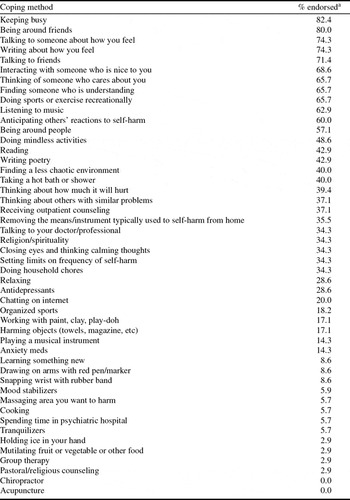
A structured interview was designed to assess efforts by self-injurers to resist harming themselves. Participants were presented with 48 methods that could be used to resist urges to self-injure that were drawn from websites by and for self-injurers (see Table 1 for a complete list of methods assessed). Participants were asked to make two judgments about each of the methods presented to them. First, they were asked to rate how often they had used a particular method on a 5-item scale, 1-Never, 2-Rarely, 3-Sometimes, 4-Usually, 5-Always. Second, for each method that participants had tried, they were asked to rate how helpful they found that method to be for resisting urges to self-injure on a 3-item scale, 1-very helpful, 2-somewhat helpful, 3-not at all helpful. Lastly, a subset of participants (n = 30) were asked what percentage of the time they were successful in resisting urges to self-injure. Specifically they were asked: “In those instances in which you had an urge to self-harm and tried a ‘very helpful’ method, approximately what percent of the time were you successful in avoiding self-harm?” and “Similarly, in those instances in which you had an urge to self-harm and tried a ‘somewhat helpful’ method, approximately what percent of the time were you successful in avoiding self-harm?”
Frequency with which methods for resisting urges to self-injure were used by participants

aThese figures indicate the percentage of participants who endorsed having used each method at least once for the purpose of resisting an urge to self-injure.
Results
Treatment history
Sixty-four percent of the participants reported having received some form of mental health treatment: 59% had participated in outpatient counseling, 39% had taken psychiatric medication, and 13% had received treatment in an inpatient psychiatric hospital.
History of self-injury
According to self-reported lifetime estimates, participants cut themselves a mean of 17 times (SD = 13; Range = 5–50). Ninety-two percent of participants reported that they had engaged in additional self-injurious behaviors as well, including banging body parts against something (endorsed by 51% of the sample), severe scratching (46%), burning (39%), sticking sharp objects into skin (28%), interfering with wound healing (26%), severe skin picking or pinching (23%), biting (21%), hitting (13%), and rubbing skin against rough surfaces (3%). The mean number of methods of self-injury endorsed was 4 (SD = 2). The mean age of onset of cutting was 14 (SD = 2) with a mean duration of 3 years (SD = 2). Seventy-two percent of participants reported that they had self-injured in the past year.
Most common and most helpful methods
Thirty-five of the 39 participants (89.7%) reported that they had tried to resist urges to self-injure. These 35 participants were presented with a list of 48 methods for resisting urges (see Table 1). For each method, participants indicated if they had used the method and, if so, whether the method was very helpful, somewhat helpful, or not helpful at all for resisting urges to self-injure. Forty-six of the 48 methods assessed had been utilized by more than one person, and the average person endorsed 16 methods (SD = 6). As indicated in Table 1, the most common methods were: “Keeping busy” (endorsed by 82.4% of participants), “Being around friends” (80.0%), “Talking to someone about how you feel” (74.3%), and “Writing about how you feel” (74.3%).
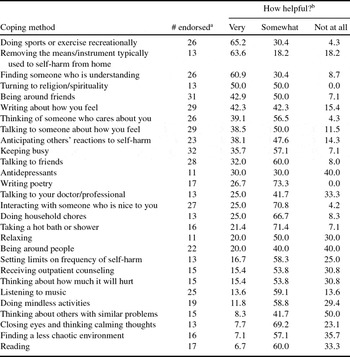
Table 2 presents the most helpful methods for resisting urges to self-injure. “Doing sports or exercise recreationally” was rated as “very helpful” by 65.2% of those who used this method. Other very helpful methods include: “Removing the means/instrument typically used to self-harm from home” (63.6%), “Finding someone who is understanding” (60.9%), and “Turning to religion/spirituality” (50.0%). Participants were also asked to indicate how often they were able to resist self-injurious urges. On average, participants reported successfully resisting urges to self-injure 85% of the time (SD = 14) when using a “very helpful” method, and 52% of the time (SD = 20) when using a “somewhat helpful” method.
Helpfulness ratings of methods for resisting urges to self-injure

aThese figures indicate the number of participants who endorsed having used each method at least once for the purpose of resisting an urge to self-injure.
bThis table presents helpfulness ratings for coping methods that were used by at least 10 participants. Participants could rate each method they had tried as being “Very helpful,” “Somewhat helpful,” or “Not at all helpful” for resisting urges to self-injure.
Discussion
The present study examined self-injurers' attempts to resist urges to harm themselves. Results indicate that most self-injurers strive to resist self-injurious urges. Results also suggest that individuals employ a range of methods to resist urges. In the present study, 46 methods were endorsed by multiple persons and the average person endorsed more than a dozen methods. The most common methods for resisting urges were: “Keeping busy”, “Being around friends”, and “Talking to someone about how you feel”. In general, participants reported being able to resist most of their self-injurious urges. For example, participants felt they could successfully resist urges about half the time when trying methods perceived as “Somewhat helpful”, and most of the time when trying methods perceived as “Very helpful”. Interestingly, methods identified as being the most helpful were not the ones employed most often. The most helpful methods were judged to be: “Doing sports or exercise recreationally,” “Removing the means/instrument typically used to self-harm from home” and “Finding someone who is understanding”.
It is interesting to note that the most helpful methods for resisting urges to self-injure are not also the most widely used. This discrepancy may occur for a couple of reasons. From a practical standpoint, the most widely used methods are perhaps the most convenient or accessible. Methods such as “Keeping busy” or “Being around friends” may be easier than “Doing sports or exercise recreationally” or “Removing the means/instrument typically used to self-injure from home”. In addition, the most helpful methods may not be used as often because they are not the most intuitive. “Talking to others about how you feel” may instinctively seem more effective in coping with feelings that prompt self-injury than engaging in physical exercise. That physical exercise may better help people calm down and avoid self-injury is not as readily apparent.
That the most common methods were not rated as the most helpful ones has treatment implications. It is useful for clinicians to know which methods are more or less successful in reducing urges to self-injure, and to distinguish these from methods that are simply more common or popular. Helpful methods can be emphasized and incorporated into treatment plans for self-injurers. For example, many psychologists encourage clients to minimize or eliminate access to the implement used to self-injure. The present study's results support this approach, and indicate that a majority of self-injurers may find this to be an effective and practical step for reducing self-injury. In addition, results suggest that exercise may provide an adaptive alternative to self-injury. This finding is consistent with recent research by Wallenstein and Nock (Reference Wallenstein and Nock2007). In their case study, physical exercise led to substantial reductions in self-injurious thoughts and behaviors. In light of results both from the present study and from Wallenstein and Nock, future research should examine physical exercise as a treatment for self-injury in a formal, randomized controlled trial.
The present study represents a preliminary look at methods used by self-injurers to resist self-injurious urges. One limitation of the current study is the nature of the sample, which consists of college students. Future research should assess attempts to resist urges to self-injure in diverse samples. In addition, future studies should assess psychopathology of participants both to ensure a well-defined sample and to determine if subgroups with different clinical profiles may experience and react to self-injurious urges in different ways. Further, the coping methods measure used in this study is new and currently lacks information about reliability and validity. Future research would benefit from an instrument with established psychometric properties. Lastly, the current study used retrospective self-report measures to assess the history of self-injury. Future research in this area should consider utilizing diary methods whereby real-time information about self-injurious urges and relevant contextual features can be obtained. It is hoped that findings from this study will help psychologists supplement and enhance treatment for clients who self-injure.
Acknowledgements
Preparation of this study was supported by grant MH67299 from the National Institute of Mental Health and by the Office of the Vice President of Research at Stony Brook University.



Comments
No Comments have been published for this article.