Research into psychopathic personality in childhood and adolescence has gained special relevance in the past decade. The importance of detecting and analyzing these traits at early developmental stages has been highlighted by a wide body of research evidencing their usefulness for predicting severe and persistent conduct problems (e.g., Rowe et al., Reference Rowe, Maughan, Moran, Ford, Briskman and Goodman2010), Attention Deficit Hyperactivity Disorder symptoms (ADHD; DeLisi et al., Reference DeLisi, Vaughn, Beaver, Wexler, Barth and Fletcher2011), aggression (e.g., Marsee & Frick, Reference Marsee, Frick, William and Elizabeth2010), future antisocial behavior and delinquency (e.g., McMahon, Witkiewitz, & Kotler, Reference McMahon, Witkiewitz and Kotler2010), a lack of prosocial behaviors, social competence skills and poor school adjustment (López-Romero, Romero, & Luengo, Reference López-Romero, Romero and Luengo2012), and adult psychopathy (e.g., Lynam, Caspi, Moffitt, Loeber, & Stouthmer-Loeber, Reference Lynam, Caspi, Moffitt, Loeber and Stouthamer-Loeber2007). One case in point has been the recent inclusion of a severity specifier (i.e., “with low prosocial emotions”), based on the Callous-unemotional (CU) conceptualization, for child and youth conduct disorder in the latest version of the Diagnostic and Statistical Manual of Mental Disorders (DMS-5; American Psychiatric Association, 2013).
Notwithstanding the evidences supporting the usefulness of psychopathic personality as a potential precursor of long-lasting conduct problems (Herpers, Rommelse, Bons, Buitelar, & Scheepers, Reference Herpers, Rommelse, Bons, Buitelaar and Scheepers2012), some concerns have also been raised around the construct on youth populations. Some authors have noted that many features traditionally associated with psychopathic personality are to some extent normative and temporary in childhood (Edens, Skeen, Cruise, & Cauffman, Reference Edens, Skeem, Cruise and Cauffman2001). However, other authors considered that the study of psychopathic-personality should be addressed, from a dimensional perspective, as a matter of grade, with those traits considered problematic at high levels (Salekin, Rosenbaum, & Lee, Reference Salekin, Rosenbaum and Lee2008). Moreover, it has been questioned whether psychopathic personality actually refers to the same phenomenon during different developmental stages (Seagrave & Grisso, Reference Seagrave and Grisso2002). Considering psychopathy as a developmental construct, and following the heterotypic continuity principle, it has been suggested that psychopathic personality may be expressed differently across different developmental stages, being these specific expressions a representation of the same underlying phenomenon. At this regard, the interest of examining the stability of psychopathic traits across different developmental periods has been extensively emphasized (Andershed, Reference Andershed, Salekin and Lynam2010).
As can be observed in prior research on general personality traits, the study of stability has been conducted from different ways, levels and perspectives that supplement each other in an open-mindedness approach to personality development (De Fruyt et al., Reference De Fruyt, Bartels, Van Leeuwen, De Clercq, Decuyper and Mervielde2006; Roberts, Wood, & Caspi, Reference Roberts, Wood, Caspi, Jonh, Robins and Pervin2008). Commonly, most studies on child and youth populations have focused on the relative stability of psychopathic traits (i.e., rank-order continuity), assessed by correlating scores obtained at two different points in time, which allows one to examine to what extent individuals maintain their position with respect to their peers over the analyzed period. As was observed with adult populations (e.g., Rutherford, Cacciola, Alterman, McKay, & Cook, Reference Rutherford, Cacciola, Alterman, McKay and Cook1999), existing data have revealed moderate to high levels of relative stability in psychopathic-like traits during childhood (e.g., Barry, Barry, Deming, & Locham, Reference Barry, Barry, Deming and Lochman2008; Frick, Kimonis, Dandreaux, & Farrel, Reference Frick, Kimonis, Dandreaux and Farell2003; Pardini, Lochman, & Powell, Reference Pardini, Lochman and Powell2007), adolescence (e.g., Muñoz & Frick, Reference Muñoz and Frick2007; Pardini & Loeber, Reference Pardini and Loeber2008), from childhood up to adolescence (e.g., Lynam et al., Reference Lynam, Charnigo, Moffitt, Raine, Loeber and Stouthamer-Loeber2009; Obradović, Pardini, Long, & Loeber, Reference Obradović, Pardini, Long and Loeber2007), and even in preschool samples (Waller et al., Reference Waller, Gardner, Hyde, Shaw, Dishion and Wilson2012; Willoughby, Waschbusch, Moore, & Propper, Reference Willoughby, Waschbusch, Moore and Propper2011).
Similar results were observed in terms of absolute continuity (i.e., mean-level), computed by comparing the mean score for each measurement in order to examine to what extent scores on psychopathic traits measures remain stable over time. Based on these results, psychopathic traits tend to remain fairly stable over both short and long intervals (Lynam et al., Reference Lynam, Charnigo, Moffitt, Raine, Loeber and Stouthamer-Loeber2009). However, some traits were also suggestive of a pattern of change involving a significant decrease (e.g., Muñoz & Frick, Reference Muñoz and Frick2007) or increase (e.g., Pardini & Loeber, Reference Pardini and Loeber2008) during the analyzed periods.
Given that overall patterns observed in the whole sample may mask differential patterns at the individual level (Roberts, Caspi, & Moffitt, Reference Roberts, Caspi and Moffitt2001), the need of examining developmental trajectories of psychopathic traits at the individual level has been also evidenced (e.g., Frick et al., Reference Frick, Kimonis, Dandreaux and Farell2003; Lynam et al., Reference Lynam, Charnigo, Moffitt, Raine, Loeber and Stouthamer-Loeber2009). Those results have led to identify specific patterns of stability and change, with most of participants showing levels of psychopathic traits essentially stable from childhood to adolescence, but with some individuals also exhibiting distinctive patterns of increase or decrease (e.g., Fontaine, Rijsdijk, McCrory, & Viding, Reference Fontaine, Rijsdijk, McCrory and Viding2010; Pardini & Loeber, Reference Pardini and Loeber2008). These studies have also allowed the identification of some relevant predictors of distinctive developmental patterns (e.g., genetic factors, early conduct problems or the quality of parenting; Fontaine et al., Reference Fontaine, Rijsdijk, McCrory and Viding2010; Frick et al., Reference Frick, Kimonis, Dandreaux and Farell2003; Pardini et al., Reference Pardini, Lochman and Powell2007), as well as related behavioral, emotional and psychosocial outcomes (e.g., Baardewijk, Vermeiren, Stegge, & Doreleijers, Reference Baardewijk, Vermeiren, Stegge and Doreleijers2011; Fontaine, McCrory, Boivin, Moffitt, & Viding, Reference Fontaine, McCrory, Boivin, Moffitt and Viding2011).
In spite of results observed in previous studies, longitudinal research specifically exploring the stability of psychopathic personality from early developmental stages has been quite scarce (Ribeiro da Silva, Rijo, & Salekin, Reference Ribeiro da Silva, Rijo and Salekin2012), with some studies examining this question as part of broader designs. This could be the reason why most of the available studies have just shown results in terms of relative stability, which has severely restricted the establishment of firm conclusions in this field (Roberts et al., Reference Roberts, Caspi and Moffitt2001). Also, most of the studies in this context have spanned around one to four years (e.g., Barry et al., Reference Barry, Barry, Deming and Lochman2008), with a few involving longer follow-up periods (Fontaine et al., Reference Fontaine, McCrory, Boivin, Moffitt and Viding2011; Obradović et al., Reference Obradović, Pardini, Long and Loeber2007). Furthermore, although we know that early psychopathic-like traits are related with a poor behavioral and psychosocial adjustment (López-Romero et al., Reference López-Romero, Romero and Luengo2012), there is a paucity of studies that explore longitudinal associations between distinctive stability/change patterns and future behavioral and psychosocial outcomes (Fontaine et al., Reference Fontaine, McCrory, Boivin, Moffitt and Viding2011). Finally, to our knowledge, most of the studies in this area have been conducted in US and North-European based samples, restricting the spread of their main conclusions to different contexts. Particularly, the study of youth psychopathic personality from a developmental perspective remains scarce in the Spanish context, which represents a culturally distinctive setting.
Based on the foregoing, this study aimed to go deeper into the development of psychopathic-like personality from childhood to adolescence, through two specific objectives. Firstly, by examining the stability of early manifested psychopathic traits in a Spanish sample and across a six-year period. The variety of methods for analyzing continuity and change in personality traits (De Fruyt et al., Reference De Fruyt, Bartels, Van Leeuwen, De Clercq, Decuyper and Mervielde2006), and the fact that the apparent continuity of an attribute at the group level may mask changes at the individual level (Roberts et al., Reference Roberts, Caspi and Moffitt2001) led us to analyze the stability by three different ways. Hence, we examined to what extent the position of a child with respect to their peers was maintained over time (i.e., rank-order or relative continuity). Also, we assessed how constant the scores in the psychopathic trait measures remained stable across the six-year period (i.e., mean-level or absolute continuity). In addition, we examined the stability and change patterns at the individual level via the Reliable Change Index (RCI; Christensen & Mendoza, Reference Christensen and Mendoza1986; Jacobson & Truax, Reference Jacobson and Truax1991), which provides a reliable measure of the increase or decrease in each psychopathic trait. The RCI has been extensively used to assess the clinical significance of change in therapeutic situations and in measures of personality factors (e.g., Robins, Fraley, Roberts, & Trzesniewski, Reference Robins, Fraley, Roberts and Trzesniewski2001), and proved highly accurate toward detecting individual changes (Maassen, Reference Maassen2001). Secondly, we aimed to analyze adolescent behavioral and psychosocial outcomes related with distinctive developmental patterns of psychopathic traits, identified over the analyzed period.
Method
Participants
Data was collected from an initial sample (T1) of 192 Spanish boys (72.4%) and girls (27.6%) aged 6–11 years (M = 8.05, SD = 1.49), from both urban and rural areas, and studying Elementary Education in 34 public schools in Galicia (NW Spain). The schools were located in predominantly working-class communities, and the academic level of participants’ principal caregiver was basically elementary (61.2%). Under Spanish criteria, a large proportion of the sample would fit in lower or lower-middle socio-economic status (87.9%). The information was supplied by 173 parents and 113 teachers.
A follow-up study was conducted six years later (T2) on 138 of the 192 initial participants, with 68.8% boys and 31.2% girls aged 12–17 years (M = 13.93, SD = 13.95), and with information provided by 138 parents and 102 teachers. The level of attrition among the two data collections was of 28%. Those participants who completed both assessments and those who only completed the first assessment were compared, with no significant differences in terms of age : t(176) = 0.40, p > .05, gender: χ² (1) = 2.16, p > .05, SES: t(161) = – 0.92, p > .05, and initial levels of conduct problems, both reported by parents (CBCL): t(170) = 1.12, p > .05, and teachers (TRF): t(107) = 1.30, p > .05.
Variables and Instruments
Psychopathic traits (T1–T2). Modified Child Psychopathy Scale (mCPS; Lynam, Reference Lynam1997; Lynam & Gudonis, Reference Lynam and Gudonis2005)
The parent version, consisting of 55 items in the form of Yes (1)–No (0) questions, was used. The items were classified into 14 dimensions that in turn were grouped into two global factors. Factor 1 (F1; α = .80 and .81, in T1 and T2 respectively) encompassed the affective and interpersonal traits (e.g., “Is he able to see how other people see?”). Factor 2 (F2; α = .81 and .84) encompassed traits from the behavioral dimensions (e.g., “Does he take a lot and not give much in return?”). Finally, a Global score (α = .87 and .88) was used as a general measure of child and youth psychopathic personality.
Antisocial Process Screening Device (APSD; Frick & Hare, Reference Frick and Hare2001; Spanish version from Romero, Reference Romero2001)
The teacher version of the instrument, which assesses psychopathic traits via 20 items scored from 0 (Not at all true) to 2 (Definitely true), was used. The Callous/Unemotional traits factor (CU; α = .76 and .69 in T1 and T2 respectively) assesses the most salient affective and interpersonal traits (e.g., “Emotions seem shallow”), whereas the Impulsivity/Conduct Problems factor (I/CP; α = .83 and .81) evaluates behavioral psychopathic traits (e.g., “Acts without thinking”).
Externalizing behavior (T2). Child Behavioral Checklist (CBCL; Achenbach, Reference Achenbach1991a)
The CBCL categories belonging to the externalizing dimension were used: Aggression (α = .92), which comprises 20 items assessing anti-normative behaviors (e.g. “Cruelty, bullying or meanness to others”); and Delinquency (α = .76), composed by 13 items assessing severe antisocial behaviors (e.g., “Sets fires”). All the items were scored on a scale 0 (Not true) to 2 (Very true or often true).
Attention Deficit/Hyperactivity Disorder (ADHD) symptoms (T2). Conners’ Parent Rating Scales-Revised (Conners, Reference Conners1997; Spanish translation by Villegas)
The short version of this instrument was used, consisting of 27 items (e.g., “He/she gets out of control, loses his/her patience, gets annoyed”) whereby Oppositional (α = .89), Distraction (α = .95), and Hyperactivity (α = .85) were assessed. Parents rated each item on a scale from 0 (Never or rarely) to 3 (Always).
Aggression patterns (T2). Parent Report of Reactive and Proactive Behaviors (Dodge & Coie, Reference Dodge and Coie1987)
Aggressive behaviors were assessed through six items, measuring both Reactive (α = .81; e.g., “Yells at others when they have annoyed him/her”), and Proactive aggression (α = .86; “Threatens and bullies someone”). Parents were asked to report the frequency of each behavior on a scale from 1 (Never true) to 5 (Almost always true).
Social competence (T2). Fast Track Social Competence Scale–Parent Version (Conduct Problems Prevention Research Group, 1995)
This scale comprising 12 items, included six items measuring Prosocial/Communication Skills (α = .87; e.g., “Listens to other points of view”) and the other six measuring Emotional Regulation Skills (α = .86; e.g., “Copes well with failure”). Parents were asked to score to what extent each statement was true on a scale from 0 (Not at all) to 4 (Very well).
Questionnaires without a previous Spanish version were adapted and translated according to guidelines widely accepted for successful translation (Brislin, Reference Brislin1970), and after obtain authors’ consent. Therefore, one bilingual translator, who was culturally informed, individual blindly translated the questionnaires from the original language (English) to the second language (Spanish). Another bilingual translated it back to the original language (Spanish to English). Differences in the original and the back-translated versions were discussed and solved by joint agreement of both translators.
All the measures have been used in previous studies, showing acceptable levels of internal consistency, and evidencing their validity in assessing the intended constructs (e.g., López-Romero et al., Reference López-Romero, Romero and Luengo2012; Romero, Luengo, Gómez-Fraguela, Sobral, & Villar, Reference Romero, Luengo, Gómez-Fraguela, Sobral and Villar2005).
Procedure
All procedures, assents/consents, and instruments were approved by the Bioethics Committee at the Universidad de Santiago de Compostela, Xunta de Galicia, and Ministerio de Ciencia y Tecnología.
The initial study (T1) was started by contact with the schools. After obtaining parental consent, case selection was facilitated by a teacher-reported questionnaire adapted from the Teacher’s Report Form (Achenbach, Reference Achenbach1991b), and expanded with a listing of various behaviors established in accordance with the DSM-IV-TR criteria (APA, 2000) for Attention-Deficit/Hyperactivity Disorder (ADHD), Oppositional Defiant Disorder and Conduct Disorder. Given the difficulties to access to large samples when teacher participation is required, this initial assessment was used as a screening procedure aimed to ensure that the sample included children representative of different levels of conduct problems, by using the 50th percentile as a cut-off point. Finally, 87% of families and 63% of teachers from the selected sample agreed, by written consent, to participate in the study. The questionnaires were administered by qualified psychologists trained in the use of the instruments, and completed by parents Footnote 1 and teachers at the participants’ schools.
The follow-up study (T2) started by telephone contacts with the families and schools to inform them of the objectives of this second assessment. Once permission was obtained, qualified staff was again sent to the schools to have the parents and teachers complete the corresponding questionnaires.
Statistical Analyses
The whole sample was firstly analyzed for relative stability (rank-order), using zero-order correlations between T1 and T2 scores. Secondly, stability was analyzed on the whole sample in absolute terms (mean-level), using Student’s t-test to compare the mean scores obtained in T1 and T2. The effect size of all statistically significant differences was assessed through Cohen’s d (Cohen, Reference Cohen1988). Finally, participants were classified as Decreased, Increased or Stable by using the Reliable Change Index (RCI; Christensen & Mendoza, Reference Christensen and Mendoza1986; Jacobson & Truax, Reference Jacobson and Truax1991). RCI = (X
2 – X
1)/ S
diff, where X
1 represents an individual’s score at Time 1, X
2 that same individual’s score at Time 2, and S
diff the standard error of the difference between the two scores, computed from the standard error of measurement:
 $\,{S_{diff}} = \sqrt 2 {({S_E})^2}\,\,$
. RCI scores less than –1.96 or greater than 1.96 are considered reliable because they are unlikely to occur without reliable change. The statistical test based on the chi-square distribution (χ²) was used in order to check the statistical significance of the differences. Given the wide age range of the participants, as well as the potential gender differences, the sample was divided by gender (boys and girls) and in two age groups (6–8 and 9–11). Correlations between T1 and T2 scores were repeated by age and gender groups, and then compared using Fisher’s Z to check for significant differences. As regards absolute stability analyses, the potential interaction of age and gender was examined through Analysis of Variance (Repeated measures). Finally, age and gender variables were also included in crosstabs to compare RCI groups using the chi-square distribution (χ²).
The second objective was addressed by examining specific developmental patterns of psychopathic-like traits, identified from scores above and below the 50 percentile on the Global score of mCPS. A set of Multivariate analysis of covariance (MANCOVA) was used to compare the trajectories on the external criteria. The strength of differences was assessed through the partial effect size statistic (ŋ²), interpreted in accordance with Cohen’s guidelines (Cohen, Reference Cohen1988). All the analyses were conducted on IBM SPSS Statistics 20.
Results
Preliminary Analyses
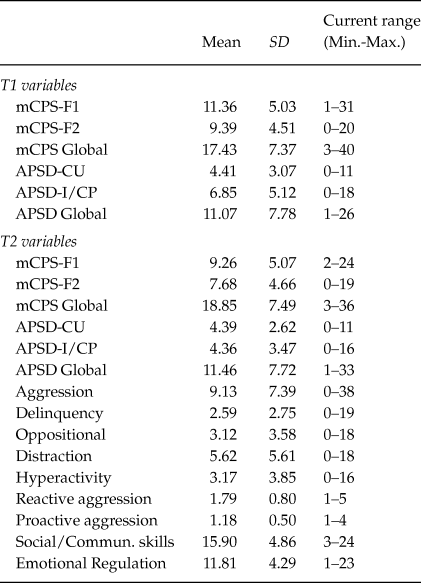
Descriptive statistics (mean, standard deviation and current range) of main study variables are displayed in Table 1.
Descriptive statistics of main study variables

Note: SD = Standard deviation; mCPS = Modified Child Psychopathic Scale; APSD = Antisocial Process Screening Device.
Stability of Psychopathic Traits from Childhood to Adolescence
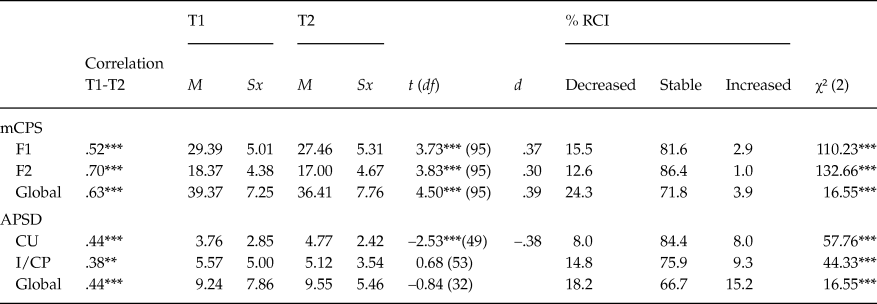
The first objective of this study was addressed by examining the stability of psychopathic traits as reported by parents (mCPS) and teachers (APSD). Results of those analyses are presented in Table 2.
Relative (rank-order), absolute (mean-level) and individual level (RCI) stability of psychopathic traits over a six-year interval

Note: mCPS = Modified Child Psychopathy Scale; F1 = Factor 1; F2 = Factor 2; Global = mCPS global score; APSD = Antisocial Process Screening Device. CU = Callous-Unemotional traits; I/CP = Impulsivity/Conduct problems; Global = APSD global score; M = sample mean; Sx = standard deviation; t = the simple value of the Student’s t-test statistic; df = degrees of freedom; d = Cohen’s measure of simple size for comparing two sample means; % = percentages of decrease, increase and stable levels based on the Reliable Change Index (RCI); χ² = the chi-square distribution.
* p < .05; **p < .01; ***p < .001.
Results of correlation analyses reflected moderate-to-high levels of relative stability in parent-reported psychopathic measures, with moderate levels observed on teacher-reported Footnote 2 . Table 2 also shows the results of absolute stability, with traits reported by parents exhibiting a statistically significant decrease and a moderate effect size (d = .30–.39) after six years. Regarding teachers’ reports, CU traits exhibited a significant increase, with a moderate effect size (d = .38), while I/CD and the Global score remained fairly stable across the analyzed period. Finally, Table 2 displays the proportions of stability and change at the individual level, in terms of RCI. Most of the participants remained at the same level in all the analyzed traits over the six-year period, with only a small minority exhibiting change. Based on the chi-squared statistic (χ²), the distribution of decreasers, nonchangers and increasers differed significantly from a random change pattern.
Previous analyses were replicated in both gender and age groups. No significant differences were observed either between gender groups or age groups, with only one exception: in terms of relative stability, mCPS-F2 showed significantly higher stability for girls than for boys (.62 and .84, p < .001, for boys and girls respectively; Z = –2.18, p = .03).
Developmental Patterns of Psychopathic Traits: Concomitant Outcomes
Considering that the RCI patterns did not distinguish youths who remained stable at the low level from those who stayed at the high level, new distinctive developmental groups were identified. The Global Score of the mCPS was used since it provided the most readily comparable scores given that the informants (i.e., parents) were the same at T1 and T2. Following an analytical scheme similar to one used in previous studies (e.g., Frick et al., Reference Frick, Kimonis, Dandreaux and Farell2003), the 50 percentile was used as the cutoff point. Then, two groups were established in both T1 and T2 from scores above and below the 50 percentile on the mCPS. All possible combinations between T1 and T2 groups were then considered in order to establish four distinctive developmental groups, namely: Stable Low (Low T1-Low T2; n = 42), Increasing (Low T1-High T2; n = 11), Decreasing (High T1-Low T2; n = 12), and Stable High (High T1-High T2; n = 38). Preliminary analyses of variance showed that the four identified patterns were homogeneous in terms of age on both T1, F(3, 99) = 1.08, p > .05, and T2, F(3, 97) = 0.82, p > .05. On the contrary, there were significant differences in terms of gender χ² (3) = 9.24, p = .026, with a significantly higher number of boys than girls in the Stable High group. Moreover, those groups were significantly different on the initial levels of externalizing conduct problems (CBCL) F(3, 98) = 27.67, p < .001, η2 = .46. These results led us to introduce both gender and the T1 global score CBCL as covariates in the subsequent analyses.
Those groups were then compared on T2 external criteria traditionally related with psychopathic-like personality. Variables used in the analyses were grouped by content, with variables underlying externalizing conduct problems, ADHD symptoms, aggression patterns, and social competence included in separate MANCOVA analyses.
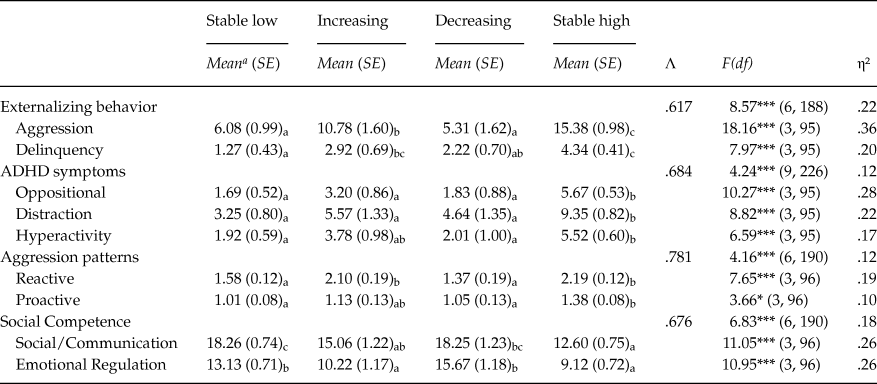
As Table 3 displays, there were significant differences in all the combined variables. When results of dependent variables were examined separately, differences between trajectories remained significant, even after controlling for initial conduct problems, and after including a Bonferroni adjusted alpha level (p ≤ .025). With respect to externalizing behavior, the Stable High group exhibited higher scores in aggression after six years, with the highest levels of delinquency manifested by both the Stable High and the Increasing groups. Similarly, the highest levels of ADHD symptoms were observed in the Stable High group, whereas the highest levels of reactive and proactive aggressive behavior were manifested by both the Stable High and the Increasing groups. However, in terms of proactive aggression the Increasing group did not show significant differences in relation to the Stable Low and the Decreased, although the expected tendencies, with higher levels of proactive aggression in the Increasing groups, were clearly observed. Finally, the Stable High and the Increasing groups showed the lowest levels of emotional regulation and social/communications skills, with no significant differences between the Increasing and Decreasing groups in social/communication skills. Based on η2 values and following Cohen’s guidelines (Cohen, Reference Cohen1988), all the differences between the analyzed developmental groups had a medium to large effect size.
Comparisons between developmental patterns of psychopathic traits on T2 behavioral and psychosocial outcomes

Note: SE = Standard error; Λ = Wilks’s Lambda distribution; F = F distribution; df = Degrees of freedom; p = Probability value; η² = Eta squared.
a Means reported are least squares means adjusted for the covariates (gender and T1 externalizing conduct problems).
Probability values (p) in bold are statistically significantly different after apply the Bonferroni adjustment. Means with different subscripts (a, b, c) were significantly different (p ≤ .05) in pairwise comparisons using Tukey LSD post-hoc test.
* p < .05; **p < .01; ***p < .001.
Discussion
Given that psychopathic traits refer to developmental constructs, the need to better understand their development and future implications has been raised as a relevant question in this field (Fontaine et al., Reference Fontaine, McCrory, Boivin, Moffitt and Viding2011). As was expected, results showed that psychopathic traits exhibited moderate-to-high levels of relative stability, particularly as assessed from parent-reported information, which has shown more consistency over time (Obradović et al., Reference Obradović, Pardini, Long and Loeber2007). This result is in line with those obtained in previous studies conducted in preschool and school-aged children (e.g., Barry et al., Reference Barry, Barry, Deming and Lochman2008; Waller et al., Reference Waller, Gardner, Hyde, Shaw, Dishion and Wilson2012; Willoughby et al., Reference Willoughby, Waschbusch, Moore and Propper2011), adolescent (e.g., Lynam et al., Reference Lynam, Charnigo, Moffitt, Raine, Loeber and Stouthamer-Loeber2009; Pardini & Loeber, Reference Pardini and Loeber2008), and adult populations (e.g., Rutherford et al., Reference Rutherford, Cacciola, Alterman, McKay and Cook1999). Moreover, this stability levels are comparable to broader results outlined regarding general personality traits (McCrae et al., Reference McCrae, Costa, Terracciano, Parker, Mills, De Fruyt and Mervielde2002; Roberts & DelVecchio, Reference Roberts and DelVecchio2000), as well as to results reported for other psychopathological constructs (e.g., ADHD; Willoughby et al., Reference Willoughby, Waschbusch, Moore and Propper2011). In addition, some variability patterns were also detected in terms of absolute stability and at the individual level (RCI), which strengthens the relevance of analyzing stability from different levels and perspectives that would complement each other in a broader analysis of personality development (Andershed, Reference Andershed, Salekin and Lynam2010). Thus, masked changes at the group level would be avoided, and a more realistic outlook about the development of psychopathic traits would be finally provided (De Fruyt et al., Reference De Fruyt, Bartels, Van Leeuwen, De Clercq, Decuyper and Mervielde2006; Fraley & Roberts, Reference Fraley and Roberts2005; Roberts et al., Reference Roberts, Caspi and Moffitt2001). At this regard, although psychopathic traits remained largely stable from childhood to adolescence, a small number of youths exhibited a significant reduction (Fontaine et al., Reference Fontaine, McCrory, Boivin, Moffitt and Viding2011), especially as judged from parent-reported data (Frick et al., Reference Frick, Kimonis, Dandreaux and Farell2003). From a life-course developmental perspective it could be suggested that a decreasing pattern may emerge as a response of a normal development process, with individuals growing toward increasing maturity and adaptation (e.g., Branje, van Lieshout, & Gerris, Reference Branje, van Lieshout and Gerris2007). In relation to teacher-reports, patterns of stability and change showed more variability, which is consistent with what was observed in previous multi-informant research, probably because most of the informants usually change on every assessment (Obradović et al., Reference Obradović, Pardini, Long and Loeber2007), and the contact with the youth tend to decrease as the students advance in school (Frick, Barry, & Kamphaus, Reference Frick, Barry and Kamphaus2010).
Even though the predictive power of psychopathic traits for future behavioral disorders has been supported by a number of studies (e.g., Marsee & Frick, Reference Marsee, Frick, William and Elizabeth2010; McMahon et al., Reference McMahon, Witkiewitz and Kotler2010; Rowe et al., Reference Rowe, Maughan, Moran, Ford, Briskman and Goodman2010), there is a need of longitudinal researches that examine the relationship between specific developmental trajectories and future behavioral outcomes (Fontaine et al., Reference Fontaine, McCrory, Boivin, Moffitt and Viding2011; Lynam et al., Reference Lynam, Charnigo, Moffitt, Raine, Loeber and Stouthamer-Loeber2009; Pardini & Loeber, Reference Pardini and Loeber2008). Overall, it was observed that stable high and increasing levels of psychopathic-like traits were related with a high-risk adolescent profile, showing severe behavioral and psychosocial problems. Specifically, youths who have shown high levels of psychopathic-traits in both T1 and T2, and those who have increased their levels during the analyzed period, manifested more externalizing problems during adolescence (Baardewijk et al., Reference Baardewijk, Vermeiren, Stegge and Doreleijers2011). They also showed more ADHD symptoms, reactive and proactive aggression, and lower levels of social competence skills (Fontaine et al., Reference Fontaine, McCrory, Boivin, Moffitt and Viding2011; López-Romero et al., Reference López-Romero, Romero and Luengo2012). No differences were observed between participants with stable low and decreasing levels of psychopathic-like traits, showing the most adaptive psychosocial profile. These results would support not only the predictive power of psychopathic traits, but also the distinctive association among specific developmental patterns and adolescent behavioral maladjustment (Baardewijk et al., Reference Baardewijk, Vermeiren, Stegge and Doreleijers2011; Fontaine et al., Reference Fontaine, McCrory, Boivin, Moffitt and Viding2011). We could expect them, especially as regards the stable high group, given the close relationship traditionally established between high levels of psychopathic-like traits and a wide range of adolescent problems (e.g., DeLisi et al., Reference DeLisi, Vaughn, Beaver, Wexler, Barth and Fletcher2011; López-Romero et al., Reference López-Romero, Romero and Luengo2012; Rowe et al., Reference Rowe, Maughan, Moran, Ford, Briskman and Goodman2010). With respect to the increasing group, results are to some extent promising, particularly considering that the initial level of conduct problems was controlled. Thus, a significant increase in psychopathic traits levels from childhood to adolescence can be related with a poor adolescent psychosocial adjustment (Fontaine et al., Reference Fontaine, McCrory, Boivin, Moffitt and Viding2011).
In sum, as occurs with general personality traits (Fraley & Roberts, Reference Fraley and Roberts2005; Moya et al., Reference Moya, Viruela, Mezquita, Villa, Ibáñez, Ortet, Morales-Vives and Blakie (Chairs)2013), psychopathic traits seem to remain essentially stable from childhood to adolescence. This would support the developmental conception of the construct (Salekin et al., Reference Salekin, Rosenbaum and Lee2008) and reinforce its usefulness in youth populations (Andershed, Reference Andershed, Salekin and Lynam2010). However, since psychopathic traits are developmental constructs, some patterns of change are also expected and, indeed, observed, raising the possibility of change across the life course (Branje et al., Reference Branje, van Lieshout and Gerris2007; Roberts et al, Reference Roberts, Caspi and Moffitt2001). Moreover, high levels of psychopathic traits designate a subgroup of youths at increased risk for severe behavioral and psychosocial disturbances. These results highlight the predictive value of the construct (Andershed, Reference Andershed, Salekin and Lynam2010; Lynam et al., Reference Lynam, Charnigo, Moffitt, Raine, Loeber and Stouthamer-Loeber2009), and would reinforce the evidences outlined with respect to diagnostic classification of severe and persistent conduct problems, as was noted by the inclusion of a severity specifier for CD based on the CU conceptualization (DSM-5; APA; 2013; Frick, Ray, Thornton, & Khan, Reference Frick, Ray, Thornton and Kahn2013). Overall, the current findings highlight the need of extending the study of psychopathic personality at early developmental stages (Salekin et al., Reference Salekin, Rosenbaum and Lee2008), when personality traits might be specially unstable and prone to change (McCrae et al., Reference McCrae, Costa, Terracciano, Parker, Mills, De Fruyt and Mervielde2002; Obradović et al., Reference Obradović, Pardini, Long and Loeber2007). This will contribute not only to identify relevant behavioral and psychosocial outcomes, but also to the better knowledge of potential early precursors involved in the development of psychopathic personality (Ribeiro da Silva et al., Reference Ribeiro da Silva, Rijo and Salekin2012). At this regard, some factors, such as specific genetic factors, the presence of early conduct problems, the quality of parenting or the influence of peer relationships, have been related with significant changes on psychopathic traits level (e.g., Barry et al., Reference Barry, Barry, Deming and Lochman2008; Fontaine et al., Reference Fontaine, Rijsdijk, McCrory and Viding2010; Frick et al., Reference Frick, Kimonis, Dandreaux and Farell2003; Waller et al., Reference Waller, Gardner, Hyde, Shaw, Dishion and Wilson2012). This may allow the development of more targeted and effective intervention and prevention programs for children with psychopathic traits. Even though psychopathic personality has been related with a difficult-to- treat condition and several poor treatment outcomes (e.g., Haas et al., Reference Haas, Waschbusch, Pelham, King, Andrade and Carrey2011; Harris & Rice, Reference Harris, Rice and Patrick2006), there is also evidence of some positive benefits in children with conduct problems and high levels of psychopathic traits (e.g., see Frick et al., Reference Frick, Ray, Thornton and Kahn2013; Salekin, Reference Salekin, Salekin and Lynam2010). Most of these studies have focused in the behavioral manifestation of psychopathic personality, reporting reductions in conduct problems, with very little research examining whether the affective and interpersonal features also respond to treatment. This fact has led to questioned whether the reduction in those behavioral disturbances was really due to change in the level of psychopathic traits (Caldwell, Skeem, Salekin, & Van Rybroek, Reference Caldwell, Skeem, Salekin and Van Rybroek2006). Notwithstanding this relevant concern, some recent studies revealed promising results suggesting that some intensive interventions can reduce the level of psychopathic traits, including the affective and interpersonal features of the construct (Caldwell, McCormick, Wolfe, & Umstead, Reference Caldwell, McCormick, Wolfe and Umstead2012; McDonald, Dodson, Rosenfield, & Jouriles, Reference McDonald, Dodson, Rosenfield and Jouriles2011; Somech & Elizur, Reference Somech and Elizur2012).
Taken together, the current findings contribute to justify the study of psychopathic-like personality in young populations, trying to overcome some of the controversies and limitations suggested in previous research (e.g., Edens et al., Reference Edens, Skeem, Cruise and Cauffman2001). As long as we know, this is one of the few studies that have examined the stability of psychopathic-like personality with a multi-method and multi-informant approach, spanning a six-year period from childhood to adolescence, and analyzing the longitudinal relationship among specific stability/change patterns and some relevant behavioral and psychosocial problems during adolescence. Moreover, this is also the first study that has examined the stability of psychopathic traits in a Spanish sample, a context where the longitudinal study of adolescent development has been scarce (Parra & Oliva, Reference Parra and Oliva2009). Hence, these results would reinforce the usefulness and predictive value of the construct in this specific and culturally distinctive context. Considering the relevance of social and cultural backgrounds in the development of personality traits (Herpers et al., Reference Herpers, Rommelse, Bons, Buitelaar and Scheepers2012), this study would then contribute to provide an international scope on the topic beyond the US and North-European based research.
Beyond these contributions, properly interpreting these results should also entail some limitations. Firstly, although we have used different procedures to examine stability in psychopathic traits, future studies involving larger samples should include new analysis methods, particularly at the individual level (e.g., longitudinal invariance, ipsative change; Andershed, Reference Andershed, Salekin and Lynam2010). Similarly, new perspectives might be also addressed, such as examining the stability of psychopathic traits using the chronological age instead of the assessment point as the primary metric of time. Moreover, it would be interesting to check how psychopathic traits develop in problematic children in contrast to their no-problematic counterparts. Secondly, the participants’ age at the first assessment time (T1) led us to use information reported by parents and teachers, who are optimal informants for psychological adjustment measures on pre-adolescent samples (Frick et al., Reference Frick, Barry and Kamphaus2010). However, future expanding studies might be facilitated by the use of self-reported measures that provide direct information from youths (Pardini & Loeber, Reference Pardini and Loeber2008). In line with this argument, we have used different psychopathic traits assessment tools for parents and teachers, increasing the expected informant discrepancies. Thirdly, specific developmental patterns of psychopathic traits and the external criteria were only based on parents’ reports, raising the possibility that the observed results were partly influenced by shared method variance. Finally, it would be necessary to analyze not only behavioral and psychosocial outcomes derived from specific developmental patterns, but also etiological factors underlying psychopathic-like personality (e.g., parenting, social relationships; Barry et al, Reference Barry, Barry, Deming and Lochman2008; Fontaine et al., Reference Fontaine, Rijsdijk, McCrory and Viding2010). Special emphasis should be provided to factors that slow down the development of psychopathic traits and facilitate their reduction over time (Salekin & Lochman, Reference Salekin and Lochman2008).
In conclusion, the study of psychopathic-like personality during early developmental stages seems to be justified, as well as their role as a major risk factor for negative behavioral outcomes. Considering that personality traits are usually less stable during childhood and adolescence, results in this field have allowed the identification of developmental periods where psychopathic traits are especially prone to change. From a developmental psychopathology approach, and given the high-risk profile of children with high levels of psychopathic traits, these results raise the need of early prevention and treatment programs, which would also contribute to restrain the development of severe and persistent adolescent problems.
This research was supported by the Spanish Ministries of Health (National Plan on Drugs), and Education (grant BS02003–10340; and the Teacher Training University Program - Programa de Formación de Profesorado Universitario, FPU; grant number AP2009–0714).