

Introduction
The New Zealand government's ambitious ‘Smokefree 2025’ goal (to reduce tobacco smoking prevalence across all population groups to 5% or lower by 2025) (Ministry of Health, 2009) is at risk because of the markedly higher smoking prevalence in Māori (indigenous New Zealanders) and Pacific people than European New Zealanders (34%, 27%, and 17%, in men and 42%, 23%, 13%, in women, respectively) (Ministry of Health, 2014). Smoking prevalence varies considerably by specific Pacific group, sex, and age (Statistics New Zealand, 2015). In 2007, a nationally representative survey reported that Pacific high school students were twice as likely to be regular smokers compared with their European counterparts (Helu, Robinson, Grant, Herd, & Denny, Reference Helu, Robinson, Grant, Herd and Denny2009). Of Pacific adult smokers in the survey, many had started smoking in their younger years. Pacific smokers aged 18–25 years should, therefore, be prioritised when promoting smoking cessation services (Helu et al., Reference Helu, Robinson, Grant, Herd and Denny2009).
However, while Pacific people who smoke tobacco are highly motivated to quit, (Karalus, Binoka, & Karalus, Reference Karalus, Binoka and Karalus2010) they have a relatively lower engagement with community smoking cessation programmes, despite similar rates to Māori of referral (40% in Māori; 34% in Pacific) (Pasifika, 2010). They are also under-represented among callers to Quitline (a nationwide toll-free confidential service for people stopping smoking): in 2010 only 4% of new callers were Pacific compared to 20%, who were Māori (Pasifika, 2010).
One approach may be to promote smoking cessation services via online advertising. Traditional media, such as television and radio, have been effective at increasing use of quit services, but are limited by the prohibitive cost (Grilli, Ramsay, & Minozzi, Reference Grilli, Ramsay and Minozzi2002; Hopkins et al., Reference Hopkins, Briss, Ricard, Husten, Carande-Kulis and Fielding2001). Online advertising aimed at increasing demand for smoking cessation services is more cost-effective than traditional recruitment strategies (Graham, Miler, Saul, & Pfaff, Reference Graham, Milner, Saul and Pfaff2008). Technological advances have enabled greater and more targeted reach of online advertisements, with access beyond computers and laptops, to internet-capable tablets and smartphones. However, the success of advertisements is contingent on placement on websites, eye-catching appeal of the advertisement, (Ministry of Health, 2009), and re-targeting of intended audiences who have been to a website (by sending similar adverts across multiple sites they may use) (Graham et al., Reference Graham, Fang, Moreno, Streiff, Villegas and Muñoz2012; Lambrecht & Tucker, Reference Lambrecht and Tucker2013).
Studies have indicated the effectiveness of health behaviour change strategies using the online medium (Statistics New Zealand, 2013) but little has been published regarding the use of online advertising for smoking cessation (Cobb, Graham, Byron, & Abrams, Reference Cobb, Graham, Byron and Abrams2011). In 2008, a feasibility study in the United States involving smokers from ethnic minorities, of lower socioeconomic position and higher tobacco dependence, suggested this group was more likely to access phone-based or website-based cessation support than traditional media (Graham et al., Reference Graham, Papandonatos, Bock, Cobb, Baskin-Sommers and Niaura2006). Ramo et al. (Reference Ramo, Thrul, Delucchi, Ling, Hall and Prochaska2015) published the protocol for a current randomised trial of a Facebook-hosted smoking cessation intervention comprising daily support, live counselling and cognitive behavioural therapy versus an internet programme. Haines-Saah, Kelly, Oliffe and Bottorff (Reference Haines-Saah, Kelly, Oliffe and Bottorff2015) tested the feasibility of using Facebook to engage young adults in a programme of youth-led online for peer support for past quitters and critical reflection among current smokers, finding high acceptability. Most recently, in a quasi-experimental study that compared callers to a telephone helpline with those using a multicomponent social media approach familiar to most young smokers (online information and video uploads, a support app and sharing the experience of quitting on Facebook) Baskerville, Azagba, Norman, McKeown, and Brown (Reference Baskerville, Azagba, Norman, McKeown and Brown2016) found that the social media approach showed more than twice the cessation efficacy than the traditional approach at 3 months.
However, this is a relatively new field and there has been no research exploring the acceptability, feasibility, and therefore the potential effectiveness, of online smoking cessation services advertising for young people who smoke tobacco. There is a unique opportunity for this medium to reach Pacific young people, who are high users of online services and report some of the highest levels of individual use of the internet for leisure activities, including downloading or listening to music, watching video content, and engaging in gaming (Statistics New Zealand, 2013). On this basis, we embarked on a research project to scope the potential of the online medium for smoking cessation support among this population group.
Aims and objectives
The aim of this study was to explore the views that 18–25 year old Pacific smokers in New Zealand have towards online smoking cessation advertising. The objectives were as follows:
(1) To assess how Pacific youth connect with social media.
(2) To understand device use (type) and social media use by Pacific youth.
(3) To explore their opinions about the design elements of an online advertising campaign to promote smoking cessation, including aesthetics and message framing.
This information was used to aid the development of an online advertising campaign to increase demand for evidence-based smoking support in this group.
Methods
A total of 20 Pacific participants, aged 18–25 years were recruited through a purposive method of indirect snowballing method (Biernacki & Waldorf, Reference Biernacki and Waldorf1981). The fieldwork was led by a Pacific female researcher who held consultations with Pacific community groups and individuals. Information about the focus groups was disseminated across church groups, associations, organisations, kava clubs, and youth groups across Auckland. Information was shared through social networking sites such as Facebook, Instagram, through word of mouth, phone, text, face-to-face communication to reach a widespread cohort of Pacific communities, and to ensure that all avenues of contact were exhausted for this research.
Individuals who were interested in participating were given the contact details of the researcher. Meetings with individuals and groups were conducted to provide an opportunity for potential participants to ask questions to the researcher, voice any concerns, and to gain most clarify and information regarding the research. In order to take part in this study, participants needed to meet the following criteria: aged 18–25 years, self-identified as a Pacific Islander, a regular user of online information, residing in Auckland New Zealand and a current, daily, or ex-smoker. According to the New Zealand Health Survey current smokers are defined as adults aged 15 years or older who have smoked at least monthly (more than 100 cigarettes in their whole life). Daily smokers are defined as those aged 15 and older and smoked everyday with more than 100 cigarettes in their whole life. Ex-smokers are defined as those 15 and over who have smoked more than 100 cigarettes in their whole life and stopped smoking more than one month ago. The 100-cigarette threshold limits the indicator to people with established tobacco use.
Eligibility was verified at the time of consent. If participants did not fulfil all the criteria, they were unable to participate in the study. The recruitment was completed using indirect snowballing methods and all participants who volunteered and provided informed consent remained in the study, with no drop-out participants.
Participants were divided into two groups (18–20 years and 21–25 years) facilitated by a female Pacific researcher. The focus groups took place at the University of Auckland's School of Population Health, which participants agreed would be a suitable place, and agreed upon a time through email, phone, or text message. The focus groups were conducted over 90–110 minutes.
The open-ended focus group questions covered themes identified from our literature review: (1) the devices used to connect with social media, (2) popular social websites, (3) banner and advertisement placement on websites, (4) preferences for advertisements, (5) positive or negative framing about smoking messages, and (6) key cultural cues and motivations for quitting smoking.
All discussions and comments were audio recorded, transcribed verbatim, then analysed using the general inductive method to yield the key themes and central findings (Thomas, Reference Thomas2006). The general inductive approach was applied through manual readings of the transcript and using NVivo qualitative data analysis software (QSR International). First, the key themes from the focus groups raw data were arranged in various categories, frameworks, and theories. The categories from coding emerged from labelling for categories where words and key phrases were identified. Second, each category was described in terms of key characteristics and limitations. Third, text associated with category occurred where categories were coded according to meanings and perspectives. Fourth, links and relationships between categories were established and arranged in a hierarchical category system to indicate central, sub-central, and parallel categories. The researcher read the transcript numerous times to identify key themes. A discussion on the findings was carried out between the researcher and principal investigator, creating a coding frame that was applied to the transcript and text segments. New codes emerged from the raw data and themes were analysed horizontally, which involved grouping sections of texts into themes. No new themes emerged by the end of this process, suggesting that all major themes were developed (Marshal, Reference Marshall1996). Data saturation – when there is enough information to replicate the study (O'Reilly & Parker, Reference O'Reilly and Parker2013; Walker, Reference Walker2012), when the ability to obtain additional new information has been attained (Guest et al., Reference Guest, Bunce and Johnson2006), and when further coding is no longer feasible (Guest et al., Reference Guest, Bunce and Johnson2006) – was achieved rapidly as the facilitator and researchers identified that the data from the two focus groups highlighted central overriding themes.
Results
Twenty participants, men (n = 8) and women (n = 12), aged 18–25 years participated in two focus groups. There was a range of ethnic-specific Pacific smokers represented: Tongan (5), Samoan (5), Niuean (3%), Cook Island Maori (3), Fijian (2), Tuvaluan (1), and Tahitian (1).
Devices and Social Media
Devices used by Pacific Young Adults
The key informants reported that the main devices they used to accessing the internet were laptops, tablets, and smartphones. For social media or recreational uses of websites, smartphones, and iPod touch were the preferred devices. Desktop computers were mostly used for work, business, or school purposes. Smartphones were preferred for social media due to their portability, accessibility, convenience of installed applications, and being in-sync with personal accounts:
From the teens up, it's mainly smartphones. Everyone has a phone to use for the Internet and social media. Its portable, you carry it everywhere, work, and school, just to go to the store. The phone can be used wherever and whenever. (Focus group 1)
Phones: everything is practically synched in and you have the FB or twitter application there, just a tap away (Focus group 2)
You carry it with you everywhere anyways and it has easy access to the net (Focus group 2)
Reasons for Social Media Use
The primary purpose of using social media was communication, specifically, to remain connected with family and friends. In particular, Informants emphasised that social media was a means to establish, re-establish, and strengthen relationships with peers. Most participants stated that social media provided a fast, efficient, and affordable way to remain connected with people overseas. Its affordability was the greatest incentive for ongoing use.
I personally use social media to connect and stay connected with family and friends. In New Zealand and even overseas, through Facebook and messages on there, it would be the main way I stay connected, keep tabs, and just know what is going on in the lives of family and friends who I care for but I can't actually just drive to and hang with (Focus group 1)
Yeah, communication, that is the biggest reason. You don't need credit too, just Wi-Fi, and boom; you can hit a mate up and catch up through social media (Focus group 2)
Among the younger participants age group (18–20 years), social media were used to remain aware of upcoming events, milestones in the lives of peers, and for gaming purposes. They used social media if they could not afford other forms of communication (such as text messages or voice calls via carriers) and to relieve boredom. The older participants (21–25 years) stated that Facebook had additional benefits, such as the community pages and ‘like’ pages that united people with similar interests.
There are also communities on FB, community pages or like pages that is another reason I use it. (Focus group 2)
For a lot of the youth in their teens, if they don't have phones or texts recur than they can just engage through Facey or tweet or even Instagram. It is all-free to use the sites and that's why most people would use it. With the younger ones as well, if we have nothing else to do, that's kind of it, jump online and just start killing time (Focus group 1)
Main Social Media Websites Used
Participants identified Facebook, followed by Twitter and Instagram as the top social media websites they used on their device. Other commonly visited websites, included YouTube, Tumblr, and BlogSpot. All participants reported they accessed Facebook at least once a day. They agreed that because social media are frequently used by Pacific people, including smokers, they were an ideal platform to promote various health messages, including smoking cessation.
I would say that social media is used a lot by Pacific people for the reasons of communicating and remaining in touch with whanau and friends so it's a good idea to have smoking warnings or quit smoking messaging on there, I reckon, (Focus group 2)
For the youth, yes the social media would be a powerful tool especially because smokers and non-smokers alike use it daily, at the least (Focus group 1)
Twitter was not believed to be as effective as Facebook to engage with others. Participants stated that users would update their tweet and then exit the application, whereas Facebook was more engaging and interactive.
I personally will be on FB for longer and scrolling through the feed then on twitter, I tweet and then I'm out of there and that's what most of peers do to (Focus group 1)
Further, participants reported that they spent more time on Facebook and used it more frequently than Twitter. Facebook pages such as ‘Keeping up with the Sola's’ (99,329 followers as at November 2016), ‘Laughing with Samoans’ (246,545 followers), ‘Proud to Be a Tongan’ (181,428 followers), ‘Proud to Be a Samoan’ (77,717 followers), and ‘The Cougar Boys’ (351,822 followers) were listed as ideal pages for Pacific young people to share links, banners, and pictures.
Advertisements – Key Features and Preferences
Size and Location
Participants indicated that banners on the sidebars were generally overlooked, because they knew it was a space occupied with ‘meaningless’ or ‘timewasting’ promotions. Sidebar banners were also not featured on the Facebook phone application. Most participants indicated that clear, bold, and large fonts were crucial to gaining attention but recommended avoiding overwhelming the banner with too much ‘noise’.
All participants indicated that banners and ads needed to be larger if located on the sidebars of Facebook (where ads are conventionally placed) or in the newsfeed timeline, central to the page. Informants recommended creating a community page on Facebook, whereby users could click on images in order to be directed to a page, for information and service details on cessation support.
Website Links
Once engaged with an advertisement (specifically smoking cessation messages), participants voiced that they wanted to connect with linked websites and registrations that were straightforwards and simple to follow, with the majority of the information on a single page or web address (thus, avoiding having to navigate multiple website links). Participants agreed it was essential that links worked effectively as any disruption would lead to suspicion of links being a ‘scam’ disruptive links were also considered too much effort to pursue further.
I don't want a million questions, just one site and I can go through there, and it's a good way to avoid scam because when you have all these pop-ups and links, I get suspect like is it spam or are my parents trying to find out I smoke? (Focus group 2)
Celebrities and Role Models
Both focus groups stated that Pacific Island celebrities, role models, and public figures often gained their interest and attention. Seeing a familiar face spurred curiosity about the purpose of the ad. The younger participants shared that a recognisable Pacific Island celebrity would gain attention because they were role models with influence.
Seeing a brown face always grabs my attention, if it's a sports star like Malakai or Maria (Tutaia) and even some of the Pacific actors. (Focus group 1)
If it's like . . .figures that we as youth look up to, of course it will grab our attention. They have so many followers on Facebook, Instagram, and twitter. They have an influence too on what we become interested in because they are idolized. Not everyone will take it on board, but it gets our attention (Focus group 2).
Informants added that even unknown Pacific individuals would gain their attention as they would be more personable or relatable, compared to celebrities. More than half of the informants suggested that using unknown people would get attention with greater efficacy in terms of carrying messages across from a relatable source. This approach was deemed as less intimidating and encouraged the message that everyday people too, had the capacity to quit smoking.
For myself, unknown Pacific people draw me in. There is a mystery to that, you see the sports stars and celebrities in most things, so it makes you question even more who this person is? Why are they here? What are they saying? And celebrities can be intimidating, they are celebs for a reason, they do better than normal and average people. If I can have a relatable real person say something across the screen, I would probably think I could do it as well. Whereas, for celebs, I sink back and think, it's so and so, of course they can do that (Focus group 1).
Colours and Patterns
Flashing advertisements and motion GIFs present on Google, Tumblr, Twitter, and Facebook were considered to be simple ways to gain attention. Given that most images on social media were motionless, flashing, or motioned GIFs stood out for the informants. However, a few participants noted that flashing images could be irritating or cause headaches.
. . .most GIFs or flashing pictures are attention grabbing, I reckon (Focus group 2)
The participants recommended avoiding neutral, pastel, and various greys that would be washed out against white FB backdrops; whereas black and white static images were described as ‘bold’ with a tendency to stand out from a screen. The informants provided examples of the All Black (NZ rugby football team) campaigns, ads to lower alcohol consumption, and Saatchi & Saatchi's Facebook page that exposed the impacts of domestic violence. These images set a ‘sobering’ undertone, encouraging the user to meaningfully consider the content. These colours were not distracting and shapes or images could be contrasted to give focus to dominant features and phrases. Other informants stated that black and white images looked ‘classic’ or ‘old-school’, adding to their appeal.
Phrases, Words & Visuals
Both of the focus groups recommended using simple language and various catch phrases that would be effective. Examples included the following:
Be smart, don't start
Yeah, Nah
Smoko breaks’ [this phrase is used commonly by Pacific smokers to represent a smoke break].
It's an addiction that can take your life, don't let it.
Each puff is another blow to your lungs.
One of the focus groups strongly believed that dramatic or intense phrases would gain attention and provoke thought, and capture the severity and the magnitude of how toxic and adverse tobacco smoking is for health. The given examples included the following:
Smoking has killed, smoking kills, smoking is killing
Deadly addiction
Cancer
However, one participant cautioned that emotive language might generate guilt or stigma among current users, and may transcend into victim-blaming and disempowerment. There was consensus that well thought out phrases would be highly effective, but only if such messages were able to appeal to the audience's reason, rather than attacking smokers.
It is important to not emotionally bully or sabotage their self-confidence through the message, because obviously you will need some confidence to decide and then carry out the journey of quitting. If you come for me, like you are attacking me, I won't want to stop; I'll just get defensive over my smoking. (Focus group 1)
One focus group commented that applying visuals may be a powerful approach. It was stated to be thought-provoking in allowing the respective viewer to discern their own personal perspectives about the message. In relation to smoking cessation advertisements, participants described that adverts which included vivid imagery of the physical effects of smoking, and campaigns with children, as the most effective approaches that encouraged them personally to consider cessation.
Pictures paint words, millions, thousands and so for me that's usually powerful. Especially if there's this message or something that gets you thinking, and it's always open for interpretation (Focus group 2)
Messaging and Framing
The focus groups indicated that advert messages would be effective if there were; testimonials, appropriate framing of messages, reverse psychology, cultural cues, and addressing central motivations (dispelling myths).
Testimonials
The use of personal testimonials was considered persuasive. Both focus groups highlighted a recent New Zealand campaign by the Heart Foundation in which two well-known Pacific men shared testimonials of hardship, and perseverance to quit smoking. These testimonials portrayed cessation as achievable, whilst acknowledging its difficulty. Most informants strongly voiced that the process of cessation was often ‘side-tracked if they gave into a smoke’. However, testimonies that were honest about the difficulties, and overcoming these, were potent and relatable to real-life experiences. Participants stated that while ample scientific and medical facts on cigarettes were worthwhile, personal stories were equally important.
Testimonies or stories are always a soft spot for Pacific. We are by family people so it's interesting and inspiring when we see a Pacific person do something successful, like saying no to smoking. The most effective testimonies will probably be real, raw and just honest about quitting. (Focus group 2).
Participants emphasised that there were ample scientific and medical facts on cigarettes and while facts were worthwhile, experiences and journeys were just as important.
Negatively Framed Messaging
The majority of the participants agreed that current adverts were not effective in encouraging a desire to quit smoking, though they did credit some of the advertisements for being thought-provoking. The respondents indicated that negatively framed messages perpetuated defensive responses, such as: ‘That hasn't happened to me’. The frequent use of negative framing has led to informants feeling ‘untouchable’ or being the ‘exception’.
When I see all these dramatic photos and visuals, I don't see that happening to me and it's been a few years of smoking so I just think that either I'm an exception and it doesn't harm me the way it does the person in the pic or they're the exception so they experience way worse harm than me and the people I know that smoke (Focus group 1).
The participants argued that if their smoking habits were as harmful as publicised, they would have experienced health conditions as dramatic as those advertised. For many of the participants, the negatively framed imagery and messaging were regarded as ‘photo-shopped’ and ‘over-exaggerated’. The older informants added that negative framing could create stigma, victim-blaming, emotional or psychological harm, was a form of bullying, and significantly ‘disempowering’.
I have tried so many times. It hasn't worked, obviously, but when all these negative messages come at me, I almost feel useless, then I don't even want to give it a shot, I'll just be disappointed after 2 days of giving up then getting back on it. Maybe something that will keep my spirits high so at least I think I have a chance (Focus group 1).
You have to be careful with the negative way of messaging or expressing it because I can tell you struggling with addiction to it, no one wants to harm their family and so you kind of feel like you're letting everyone down and its disempowering and I think mentally it can do things to people, like actually discourage it because you feel so low so when you're stressed you're going to turn to what eases you and yes, it's a smoke for me every time (Focus group 2)
Though most of the informants were against negative framing, a few reasoned that Pacific people are more fearful, thus generally responsive, of ‘bad things’ happening than being influenced through benefits and ‘good things’. Focusing on high costs of smoking was considered more of an annoyance than an incentive to quit. The participants who had children suggested that if advertisements had images of what the money could alternatively be used for, such as diapers, bills, or basic needs, this could be more effective.
There was this funny video of a son telling his dad that if he had saved all the money he used to smoke in two years, He could afford a Mercedes. The dad looked to the son, a non-smoker and said, where's yours then? That went viral in the Pacific community, because it's true. All these what if I didn't spend on this then I would on that, but it's just funny now (Focus group 2).
Younger participants reported that some of the negatively framed pictures were effective because youth valued their self-image and external features. Exposure to the effects that smoking has on teeth, eyes, skin, and general appearance did influence younger Pacific people who strongly wished to preserve their youth and aesthetic beauty. However, one focus group commented that they were soon desensitised to graphic visuals and ‘threats’.
Some of the images are gross as, and that's a put off for a lot to make you want to give up or not even to start Focus group 2)
When you have a non-smoker stand next to a smoker and pick on the differences because of smoking. Wow. Next level, that would hit me (Focus group 2)
Positively Framed Messaging
The majority of participants showed a preference for positively framed messages that were empowering, encouraging, and inspiring. Most agreed it was preferable to propose ‘a cause to live’ rather than ‘threats of death’
I would have to say that positive messages would encourage people to get power over the habit. They will want to if you encourage not discourage. Give them hope to live longer and with health (Focus group 2)
Stop and you will live, keep going and die. One is more appealing because it gives the benefit, not the negative. People enjoy good news not bad news (Focus group 1)
The younger age group noted that positively framed messages needed to show short-term benefits to appearance or health consequent to cessation, as well as long-term benefits. They elaborated that this approach would allow the audience (themselves included) to visualise the short-term benefits, making smoking cessation seem more realistic and attainable, therefore, providing a stronger motivation to quit. Further, the younger focus group explained that short-term benefits were crucial for younger cohorts who ‘want to see gains, now or as soon as possible’.
We see old people and how their bodies have or haven't taken the toll of smoking and non-smoking. It would be different to see what it can do to me in five years and ten year, so what happens sooner and not just later or down the line or else ill think, oh keep smoking and stop when it comes to the ages where things get bad (Focus group 2).
The use of positively framed testimonials of real and relatable people that had successfully quit was regarded as important. Participants stated that they could trust testimonies of lived experiences, as opposed to just facts (which can be dispelled by subjective experiences, observations, opinions, or caused defensive responses). It was crucial to enforce the idea that if he or she could do it, then so could the present smoker. Such strategies reinforced a strength based, not a deficit based ‘I don't have what it takes’ minds-set.
The participants shared that the testimonies shown needed to portray that cessation was not an overnight, instant success, rather a ‘process’ or a ‘journey’. A ‘normal’ person who had tried quitting many times before succeeding reflects realistic cessation. Testimonies were suggested to include common struggles faced and how to overcome them. Older participants cautioned against being over-zealous or undermining the difficulty in cessation. Although a ‘can do’ attitude was important for many, smokers needed to be accurately informed that cessation was a unique and difficult process to each smoker.
Participants in both focus groups supported the view that merging positively and negatively framed messages would be effective, as it would provide a balance and give individuals the opportunity to identify the effects of continuing or stopping, providing a parallel and comparison. One group felt that the framing strategy needed to ‘reveal two pathways’. One pathway leading down a path of deterioration and the other a path to health and wellbeing. Participants felt it was crucial to include this strategy, and give the individual the autonomy to choose their own path.
Positive and negative are both true. If I stop I will live longer and more healthily. If I go, I may die from it. Both are true. Not one is false. So balancing out these ideas gives the person the rare but honest reality. It's catch 22, every time you see the message, you have to re-decide, and hopefully one day there is a decision to just throw it away (Focus group 1)
Reverse Psychology
An informant posited using reverse psychology to gain attention. For example: ‘Keep smoking’ in bold lettering, and then a visual on what ongoing smoking might do. The informant's thinking was to catch the attention of the audience with an unexpected statement, followed by clear communication on the negative effects of smoking. However, other informants stated using reverse psychology could easily send mixed messages, and for some, such messaging would be regarded as tantamount to permission to continue smoking.
If there was an ad that said keep smoking, that would get my attention hands down and then it will show all the bad stuff that comes with smoking, I would be shocked like is it telling me to smoke? What? (Focus group 2).
The only problem with telling people to smoke to get their attention and reverse psychology is that it might be permission for them to and we don't want to give mixed messages, well that's my thinking anyway. But I do get that its clever if you say keep smoking and right under you can show the consequences like if you do, there's a chance you can get cancer or have bad teeth (Focus group 2)
Cultural Cues
Both of the focus groups discussed the notion that smoking goes against the Pacific concept of the ‘body as a temple’. Participants noted that Pacific people are collective so an effective strategy would utilise a family-based approach. One group felt that parents could be encouraged to quit for the betterment of their children, as well as vitality and longevity. The other group voiced that parents still have authoritative influence over their children and youth, and thus a maternal figure could be effective in promoting the message.
For youth, mum's still have a hold and it could be that one stare and we would stop whatever it is she was mad about. If we can channel that in than it might help because youth do still place importance on what the parents think (Focus group 2).
Participants asserted that messages for older age groups needed to be primarily ‘intervention based’. They believed that smoking in the Pacific culture had become normalised. Further, participants expressed that that younger cohorts required ‘prevention based’ and ‘intervention based’ messages, as youth were at an age where they were ‘impressionable’ and ‘easily influenced’.
For the older people it would have to be messages to help us quit. Prevention is for the younger guys. Growing up, seeing all the aunts, uncles and parents smoke, it was normal, and that needs to be changed, but you can only change it by getting these role models of parents and stuff to give it up. (Focus group 1)
When asked, if there were particular groups or cultures that needed to be considered, participants suggested certain people that were more susceptible to becoming smokers
it's part of the rugby culture, grab a beer and a smoke, even if you don't smoke. (Focus group 1)
Factory smokers, chain smokers. On break, before and after, it's smoking. (Focus group 2)
Among the Tongan groups this also included Kava clubs:
Cloud of smoking at the kava sessions and some of them give it to the younger ones. (Focus group 2)
The participants explored the benefits of working with churches and also accessing younger Pacific smokers by creating messages for the party-goers:
Alcohol and other drugs are a no at church. The only thing that is normal and you see all the men doing straight after church is smoking. (Focus group 1)
Addressing Central Motivations
A primary finding was dispelling the myths or countering the very motivations that perpetuated smoking behaviour or dependency. All participants agreed that advertisements that addressed these myths or concepts of smoking would be ‘extremely helpful’ as it would engage with core reasons where behaviours or decisions stemmed. Participants commented that reasons for continuing to smoke included the perception it helps with weight loss, for stress relief, as a cultural ritual (for instance among rugby teams or various workplaces), and as a social lubricant. Therefore, addressing these ‘perceived’ truths would help smokers reconsider why they smoke.
If you can get the motivation or the reason behind quitting and prove that smoking does jack (nothing) you would have so many people quit. Like it took me maybe a year of trying to lose weight and de-stress to realise that it didn't work in terms of weight loss or stress relief and it was just expensive so as soon as I kind of had that thought or reality swayed, it was way easier to give up (Focus group 2)
Why did I start? To be honest, it was the rugby culture at the club that I was at and I would before and after a game, but it makes, well it made me unfit and when I could tie that into my smoking, I thought about stopping (Focus group 2)
I began because I wanted to fit in, maybe for youth, if they know there's way better ways to fit in, they'd reconsider, you know? (Focus group 1).
Discussion
A major advantage of social media is its reach. Others have found this to be the case when trying to recruit participants into research studies. For example, Rait, Prochaska and Rubinstein (Reference Rait, Prochaska and Rubinstein2015) sought to recruit participants into smoking studies using Facebook advertisements compared with traditional strategies, finding Facebook to be convenient and with wide reach but expensive and less effective than interpersonal referrals. Our study participants also identified Facebook as the preferred website to reach the target audience.
While social media has the potential to reach young people who smoke, engagement, and motivation towards action (in this case, smoking cessation) is dependent on a range of other factors that may be quite specific to the target audience. Our findings align with those from other research that has identified the importance of design, placement, and content embedded in smoking cessation messages to either encourage or discourage consideration or motivation to quit smoking (for example, Cobb et al., Reference Cobb, Graham, Byron and Abrams2011; Graham et al., Reference Graham, Papandonatos, Bock, Cobb, Baskin-Sommers and Niaura2006).
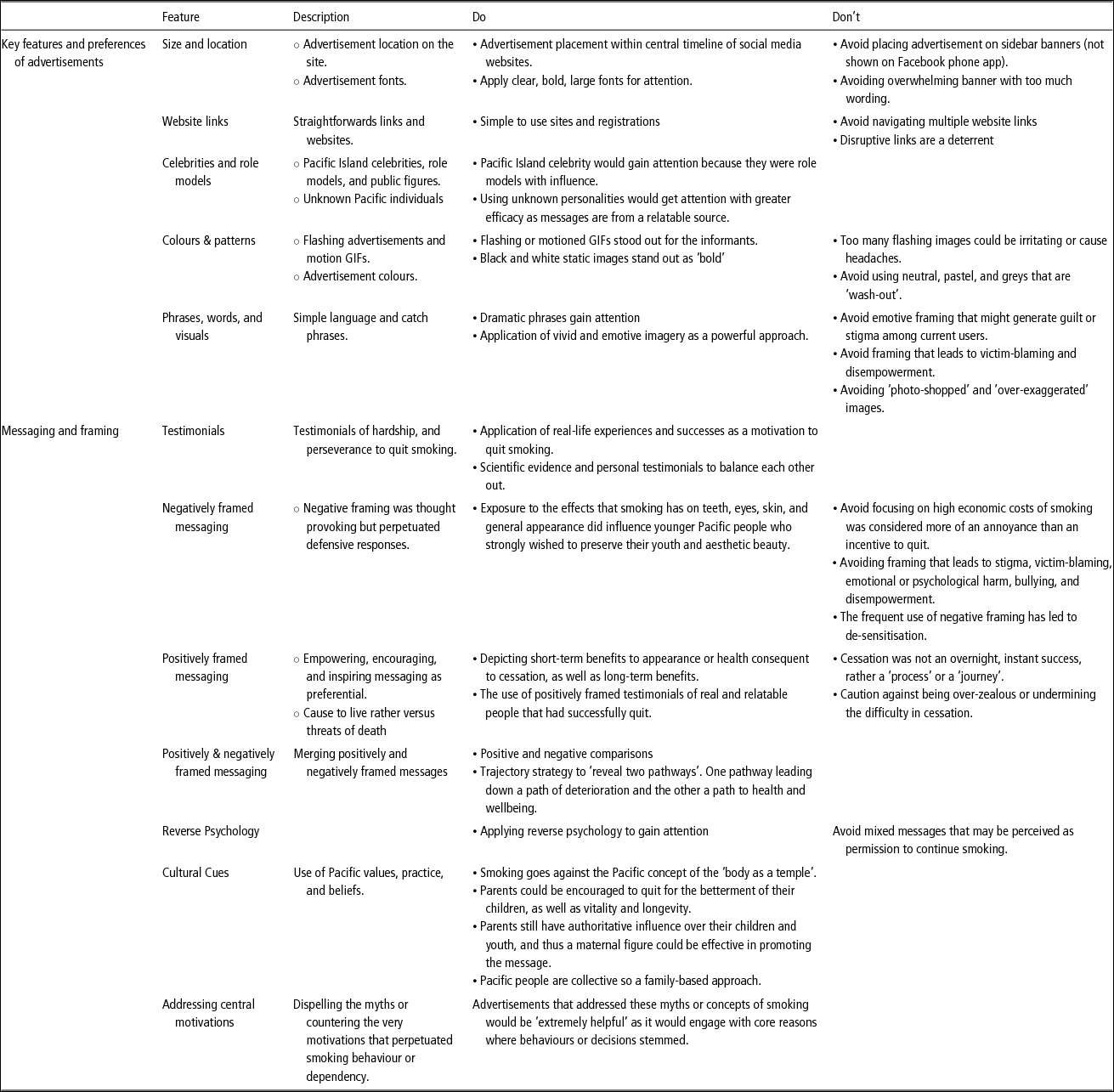
Our study revealed a number of other factors important to consider when designing an online smoking cessation campaign for Pacific youth. We have summarised these in Box One as ‘dos and don'ts’. One very practical but nevertheless important factor was the need for messaging to be readable on smartphones, as this was the preferred device for Pacific young people to access social media. There was broad agreement on the importance of featuring Pacific people, whether famous or ‘people like me’, and their personal testimonials. A risk with using sports or music ‘heroes’ as role models in such campaigns is that they can rapidly fall from favour. It was intriguing, therefore, to find that some participants had a preference for having ‘ordinary people’ tell their stories, and by doing so, making change seem within reach. Message framing also emerged as an important factor. Participants favoured a balance of negative and positive framing.
Dos and Don'ts of Tobacco Online Smoking Cessation Adverts for Pacific youth.

There were a number of limitations with our study. First, some participants knew either the facilitator or each other. While this could have constrained their responses, given the non-sensitive nature of the topic we think it more likely it facilitated more open discussion. Second, participants in the focus groups could not possibly represent all diverse Pacific youth perspectives. However, data saturation occurred rapidly so we would be surprised if new ideas emerged with a larger group.
Further research in this population, comparing a variety of messages, banners, and advertisements, using positive versus negative and merged (positive and negative) framing, would be informative prior to developing and testing interventions. The application of our findings to Pacific youth in Pacific Islands settings is unknown. Considering the very high rates of smoking among young people in some Pacific nations – as high as 52% among males in one survey (Kessaram et al., Reference Kessaram, McKenzie, Girin, Roth, Vivili and Williams2015) – further investigation is warranted.
Acknowledgements
We would like to acknowledge the individuals that took part in this study for their time and contribution.
Financial Support
This study was supported by the Tobacco Control Research Tūranga. The Tūranga is supported through funding from the Reducing Tobacco-related Harm Research Partnership co-funded by the Health Research Council of New Zealand and the Ministry of Health of New Zealand (HRC grant 11/818). The University of Auckland Human Participants Ethics Committee did not require formal application for this research, but we obtained informed consent from the participants regardless.
Conflict of Interest
None.
Ethical Standards
The authors assert that all procedures contributing to this work comply with the ethical standards of the University of Auckland Human Participants Ethics Committee.