What explains the course of Uyghur unrest in the 1990s and 2000s? In this article, after discussing the literature on Uyghur unrest, I look at the factors that have influenced the locations of Uyghur-related violent incidents, the forms that those incidents have taken, and the changes in location and form since 1990 over three phases defined by the nature of Chinese government policy towards Uyghur “separatism.” The first began with the spectacular uprising in Baren in April 1990. During this time, there was a low level of logistically sophisticated violence in Xinjiang itself. The Chinese government certainly dealt harshly with actual attackers, but largely depended on social and economic policies to dampen unrest. In the second phase, beginning with the 1996 Strike Hard campaign, the Chinese government cracked down hard, rounding up thousands and executing hundreds of Uyghurs suspected of violence and “separatist” activities, in addition to imposing draconian controls of Uyghur social and religious life. Violent incidents initially increased inside Xinjiang, but had subsided by 2000. Less complex targeted killings and arson predominated. Several incidents apparently tied to Uyghurs also occurred in Central Asian countries adjacent to Xinjiang before Uyghurs suffered the wrath of regional governments with increasingly friendly security relations with China. The third phase began in 2001, when, following the 9/11 terrorist attacks in the United States, China publicly aligned itself with the US as a country that also suffered from “terrorism.” The incentives of the Chinese government to portray Uyghur unrest as externally instigated, terroristic in nature and specifically tied to al-Qaeda, increased. Significant violent incidents in Xinjiang became rare until 2008 and 2009, when there were several creative, even bizarre, incidents that required minimal planning or materials inside Xinjiang itself.
These shifts in the nature and location of incidents over time can only partly be explained by Chinese government policy. There is another factor: the political and economic geography of the border areas between China and the countries of Central AsiaFootnote 1 – not only the physical terrain but also the transportation infrastructure and political conditions on either side of the border. This geography, when combined with repression, channels and constrains both the legitimate and illicit movement of people and goods across the borders, making both the command and control, and logistical functions of Uyghur-related violence more difficult. The relatively small number of land links between Central Asia and China decrease the options that Uyghurs have for moving weapons and people into Xinjiang along legitimate routes, while the difficult physical terrain limits the ability of rebels to smuggle supplies in illicitly. Both legitimate and illicit movements occur in the context of Chinese and Central Asian governments' policies towards Uyghur separatism, policies that have varied in hostility over the years.
Filling in the Gap
Authors writing on the rise of Uyghur-related violence (or its periodic reappearance despite government suppression) tend to focus on grievances as the drivers of the unrest, either rooted in historical memory or in more proximate factors.Footnote 2 And Uyghurs do indeed have many legitimate grievances, not all of which can be covered here.
The Chinese government has long argued that Xinjiang has been controlled continuously by the central government for hundreds of years,Footnote 3 but the idea of a Uyghur state free of Han Chinese control is not new, based as it is on memories of two breakaway republics during the tumultuous 1930s and 1940s.Footnote 4 The often violent and disruptive means by which the Chinese Communist Party has consolidated economic and political control over Xinjiang have also been contentious. Since 1954, the Xinjiang Production and Construction Corps (Xinjiang shengchan jianshe bingtuan 新疆生产建设兵团) has brought in millions of Han Chinese soldiers and civilians to build cities and engage in mining and agricultural development in less populated areas of the region.Footnote 5 The Communist Party apparatus remains under the control of Han Chinese, and there is little chance of the advancement of Uyghur Party cadres to high levels, even though Xinjiang is technically a Uyghur autonomous region.Footnote 6 Economic development in Xinjiang has also been associated with natural resource exploitation that has not benefited Uyghurs, and environmental degradation, particularly of the Tarim River. Advances in standards of living have been uneven, with continued Han in-migration and Uyghurs facing higher poverty rates than Han Chinese, as well as discrimination in the labour market.Footnote 7 Even China's Open Up the West Campaign, begun in 2000, which was ostensibly aimed at mitigating many of these problems, was designed to consolidate gains made in assimilating Xinjiang in the 1980s and 1990s.Footnote 8
Economic and political control of the region and the influx of Han Chinese are not the only grievances. While Islam is in theory allowed in Xinjiang, in reality the Chinese government controls it tightly: limiting the number of Uyghurs allowed to go on hajj, requiring training of imams to take place in the state-run school in Urumqi 乌鲁木齐Footnote 9 and prohibiting non-state-led cultural events (mäshräp).Footnote 10 If the Chinese government does not support the practice of Islam,Footnote 11 identity as Muslims, in addition to shared language, ethnicity, history and cultural practices, can serve to bind Uyghurs to each other and separate them from Han Chinese, leading to the possibility of violence and escalation in tense situations.Footnote 12
Arguments about Uyghur unrest based on grievances can perhaps explain why certain targets are attacked, but are less helpful in explaining the long-term trajectory of the violence, or why certain types of attacks – bombings instead of assassinations – take place, given that long-standing grievances tend to be fairly constant over time. This article is therefore not about the grievances that cause the incidents. Instead it focuses on explaining the course of Uyghur unrest by looking at two of its aspects that are well documented but understudied: the types of violent incidents and their locations, whether in Xinjiang or elsewhere. While a great deal of attention is focused on the security threat Uyghur violence may (or may not) pose,Footnote 13 this article is also not about the formal organizations, such as the East Turkestan Islamic Movement, which may or may not be behind them (or even exist),Footnote 14 or about those organizations' connection to external groups such as al-Qaeda.Footnote 15 Rather, I am interested in what it takes, from a logistical and planning point of view, to produce different kinds of violent incidents, and how the hostility of different governments and the geography of Xinjiang and Central Asia have combined to constrain the ability of rebels to carry out logistically sophisticated attacks, forcing violence, when it does arise, into incidents that require little or no logistical support or planning.
Data
The innate lack of transparency within the Chinese state, combined with political sensitivity about what goes on in Xinjiang, makes it impossible to collect satisfactory data on Uyghur separatist activities or specific violent incidents. Given the paucity of information, some of the discussion in this article is necessarily speculative. The incidents about which we do have information either come from Western observers who have done in-depth research,Footnote 16 the Chinese government itself (largely published in a 2002 white paper on Uyghur separatism and a 2004 yearbook on public security in Xinjiang),Footnote 17 or are big enough that the Chinese government has had a difficult time covering them up. For the purposes of this article, data on violent incidents in China and Central Asia are taken from START's Global Terrorism Database,Footnote 18 Chinese government white papers and security almanacs (anquan tongzhi 安全通志) and contemporaneous English- and Chinese-language newspaper and wire service reports.Footnote 19
All these data sources are biased: the Chinese government has incentives to represent the nature of Uyghur unrest in the harshest possible light, picks and chooses which incidents to report, and often attributes separatist motives to seemingly unrelated violence.Footnote 20 Databases of terrorist incidents, meanwhile, are almost entirely drawn from Western sources. This poses a problem for incidents that take place in non-Western countries, especially in those, such as in Central Asia, that are largely off the radar of the Western media.Footnote 21
Despite these problems, Chinese government reports are one of the few primary sources with anything approaching a systematic, year-on-year description of public security incidents in Xinjiang. Uyghur sources, particularly websites, are understandably more concerned with cataloguing instances of government repression than recording the details of possible separatist incidents, making it difficult to use them as sources for an article with a focus on changes in patterns of Uyghur unrest. More generally, Uyghur sources are not necessarily any less biased than Chinese ones. One of the most extensive internet collections of Uyghur-related news, for instance, in September 2010 showed on its front page several videos of the 2009 Urumqi riots accompanied by the headline “Uyghur people will remember the massacre in Urumqi, July 5th 2009 for ever!”Footnote 22
Chinese reports on incidents of Uyghur unrest are likely to be biased along three dimensions. First, the Chinese government could wrongly attribute an incident to Uyghurs, or could wrongly attribute separatist intent to acts of violence committed by Uyghurs, leading to miscategorization (and thus an inflation in the number) of supposed incidents, and the impression that the Uyghur experience in Xinjiang is dominated by violence. Second, Chinese sources often lump together all Uyghur “separatist” incidents, whether violent or not. This leads to cases where government reports consider distributing leaflets in the same breath as violent acts.Footnote 23 Third, the Chinese government could attribute a given separatist incident to the wrong group; in its official documents, it often conflates the names of different groups, or refers to them generically (such as, for example, “East Turkestan terrorist organization” (DongTu kongbu zuzhi 东突恐怖组织).Footnote 24
I attempt to resolve problems with quality and bias of the data in several ways. First, primarily using Chinese government sources runs the risk of unconsciously adopting the attitudes and the terminology of the Chinese government. I have thus striven to use politically neutral terminology where possible. In particular, I refer to specific violent incidents as “separatist” in nature only when there is explicit evidence that they are. Second, by focusing exclusively on the number and type of violent incidents in Xinjiang and Central Asia without regard for which Uyghur group was responsible, I navigate away from the more unreliable aspects of Chinese government data, and sidestep debates about Uyghur grievances and the security threat (or lack thereof) posed by Uyghur separatists. This article is thus about the possible external constraints on the “production” of violent incidents in Xinjiang rather than why the perpetrators are producing that violence. Even acts of resistance grounded in legitimate grievances (such as those committed by the French Resistance in the Second World War) are still subject to limits on what they are able to do. Third, I look at patterns of violence in specific significant incidents rather than solely in the aggregate, allowing for greater detail about incidents for which there is less uncertainty as to provenance. Fourth, where possible, I compare the hard data provided by the Chinese government with its claims about the overall nature of Uyghur unrest. Particularly in Phase III, using the government's own information, Uyghur rebels have been surprisingly ill equipped given the threat they supposedly presented.
Finally, concentrating on acts of violence gives us some measure of analytical clarity. As discrete incidents, they are more easily quantified than other types of resistance such as subversive discourse. Violent incidents are also more likely to result in reporting (and thus data) by both Chinese and Western sources than non-violent acts. Care is taken in this article, however, not to assume that violent incidents are the sum total of Uyghur resistance to Chinese rule; given the relatively small number of incidents even at the height of the unrest in the mid-1990s, violence is almost certainly not even the main outlet.Footnote 25 It would thus be a mistake to characterize the Uyghur relationship with the Chinese government as predominantly violent. It would also be a mistake to deny that China's policies towards Uyghurs in Xinjiang, inasmuch as they include mass arrests, summary trials and executions, are not themselves acts of violence.
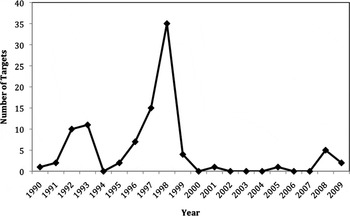
Figure 1 shows the number of different targets in violent incidents publicly reported in Xinjiang from 1990 to 2009. I take logistically complex incidents to be those that require a long or involved planning process, acquisition of quantities of professional-grade explosives or manufactured bombs, or relatively high degrees of command and control because of the co-ordinated movements and attacks required. Such incidents, in short, require either time or materials, or both. For the purposes of coding the incidents, I include insurrections (such as the 1990 Baren 巴仁 incident), bombings and co-ordinated attacks (large numbers of people attacking a target with multiple types of weapons by surprise) in this category. I take logistically simple incidents to be those that require fewer manufactured materials (either guns or explosives), little command and control, and only short periods of time for planning. Into this category fall riots, assassinations, and “creative” attacks such as arson and poisoning or attacks with homemade explosives (although this is a more subjective category), neither of which require the acquisition of guns or manufactured explosives. I consider a single apparent incident to have multiple targets if different sites attacked are far enough apart in time or physical distance to have required, in my judgment, significant additional planning and/or materials over and above what is required for attacking a single target. Targets are a preferable measure of violent activity since the primary sources often talk of waves of incidents spread over several months rather than individual attacks, making it easier to quantify total targets rather than total incidents. These are almost certainly not all the incidents that took place (the Chinese government claims there were over 200 separatist attacks from 1990 to 2001, far higher than the numbers shown),Footnote 26 but it is probably safe to assume that there was a surge in incidents from 1996 to 1998 and a lull after 2000, even if we do not know the exact numbers.
Number of Targets in Violent Incidents in Xinjiang, 1990–2009

Phase I (1990–1996)
Although there had been periodic outbreaks for several years beforehand, notably in a protest against nuclear testing in Lop Nur in 1986, the current unrest began with the Baren incident in April 1990, when hundreds of armed Uyghurs invaded Baren, attacked local government offices and for several days fought off the Chinese military sent to stop them. Chinese sources are vague about where the Uyghurs' weapons came from, although they make clear that the Uyghurs bought them, and in some sense were forced to move more quickly than they intended because their plot was on the verge of being discovered.Footnote 27
The Baren incident was the most spectacular Uyghur attack up to that point – or for some time since – and was logistically complex. According to Chinese records, the rebels established an “East Turkestan Islamic Party” in 1989, months before the Baren incident; their plan was to secure Baren as a strategic beachhead and from there build an “East Turkestan Republic.” They held at least four major planning meetings leading up to the insurrection, one of which was devoted to the question of procuring supplies, both weapons and (white) uniforms. Several rebels were tasked with procuring guns, explosives and ammunition. Towards the end of March 1990, the rebels also ran a training camp to prepare people for the fight ahead. Fundraising consisted of levies on conspirators and robbing cadres in the weeks leading up to the insurrection. The stolen money was then used to buy weapons and vehicles.Footnote 28
The main part of the rebels' plan was to send several hundred people to besiege the government offices in Baren. This they did, quite successfully, for a number of hours starting on 5 April, and in the process netted five guns. A large group of rebels also attacked and burned a bus carrying policemen to Baren, killing the policemen with knives, and seizing their guns and ammunition. At the government offices, the besiegers claimed to have enough weapons to carry out a massive attack, and backed this up with an armed assault that used guns and explosives. When the People Liberation Army units finally arrived and began restoring order, most of the groups of rebels they subdued and captured (after sometimes violent shootouts) were armed, although not excessively so. One group of 19 rebels was found to have to have over 1,000 yuan in cash, one knife, three homemade bombs, 30 bullets and two horses, but only one pistol.Footnote 29
This pattern of depending largely on weapons seized from Chinese government police and militias, and on homemade weapons, especially explosives, rather than professionally manufactured guns seems to have held throughout the rebellion. Rebels seized 14 guns from police, as well as four police vehicles, among other things, while hundreds of homemade bombs were made in a blacksmith shop in Kashgar 喀什 and transported to Baren for use before the rebellion.Footnote 30
The Baren incident was followed by a series of bombings in various cities around Xinjiang – a standard, if low-level violent campaign. The danger that the Chinese government was facing should not be exaggerated: both the 2002 white paper and the START database only log one multi-location bombing attack in 1991 and another in 1992 in Urumqi. The bombs' targets were not exceptional: the 1991 explosions took place at a Kuqa 库车 county government office and an XPCC unit, while the 1992 bombings targeted buses in Urumqi.Footnote 31 Less explosive incidents also took place: between June 1991 and March 1992 there were six attacks with firearms on Han residents of Hotan 和田 prefecture, south of Xinjiang.Footnote 32
There was apparently some level of organization and long-term planning in the attacks during this period. Chinese government sources claim that 17 rebel cells (of uncertain nature) were broken up in 1992, including six in Aksu 阿克苏 prefecture alone.Footnote 33 The rebels needed money to buy materials for the bombs, and there was thus a robbery in Shayar 沙雅 county in November 1991 where the money taken (500,000 yuan) was apparently used in 1992 for rebel activities.Footnote 34 These included two bus bombings in Urumqi on 5 February, which seemed to have an unusual level of planning and organization behind them. Five months after the attacks, police in Yecheng 叶城 county, Kashgar prefecture claimed to have uncovered a training site connected with the attacks, while in October, handguns, detonators and other objects related to the bombings were also confiscated in Kashgar. Altogether, in 1992 the police detected 47 plots and confiscated 20 guns, 415 rounds of ammunition, 87.75 kilograms of explosives and 12 explosive devices. They also arrested 535 people on suspicion of separatist activities.Footnote 35
The following year saw a continuation of the government's efforts. Throughout the province there were 76 separatist incidents, with 191 people arrested and 21 rebel cells (in possession of guns and explosives) uncovered. In southern Xinjiang, there were seven bombings, four assassinations and 12 cases of pro-independence propaganda leafleting.Footnote 36 The most spectacular of the attacks was a series of 20 bombings, assassinations and leafletings in Kashgar prefecture, which began on 17 June with a bomb attack against a Kashgar agricultural company office and continued for the next three months in Yengisar 英吉沙, Shache 莎车 and Yecheng counties, and Kashgar city. The 2002 white paper claims that there were ten separate explosions during this time, suggesting that half the attacks used explosives.Footnote 37 Government sources allege that the primary perpetrators were the “Islamic Revolutionary Party,” although seven groups were identified in the aftermath of the bombing campaign.Footnote 38
The year after that, 1994, was relatively quiet, with 30 reported incidents, but qualitative evidence suggests that the Chinese government perceived Uyghur unrest as escalating dramatically from 1995, when 32 “counter-revolutionary groups” were uncovered, the most since the 1980s.Footnote 39 Attacks marked a return to form in 1995, with an explosion in Urumqi in January (and the arrest of three Uyghurs with three more pre-assembled bombs), a riot in Hotan in July and protests in Yining 伊寧 in August to protest against a crackdown on mäshräp.Footnote 40 This does not mean that all the groups were in fact violent, organized Uyghur separatist groups. Chinese governments classified 54.1 per cent of those uncovered between 1990 and 1995 as violent “typical” groups, which seems to mean that they persisted organizationally across a number of incidents, and had a recognizable name and some sort of command and control structure. Non-violent cultural groups made up 11.9 per cent of the organizations broken up – not all of which may have been separatist in nature, given the Chinese government's attitude towards Uyghur groups – with more ad hoc violent cells making up the remaining 34 per cent.Footnote 41
What is interesting is the relatively small stock of weapons that armed Uyghur rebels apparently had during this period. From 1990 to 1995, “incomplete” statistics revealed that Chinese police captured 83 small arms, of which 15 had been imported from other countries. They also captured 10,000 rounds of ammunition, more than two tons of explosives and 248 small bombs (of which 200 were homemade), as well as weapons-making tools.Footnote 42 In the aggregate, some of the materials were clearly available in large quantities – two tons of explosives is enough to create problems for a long time – but even if the numbers were doubled, averaging them across the dozen or more cells that were discovered every year, among hundreds of people and over a five-year period, any given rebel cell appears considerably less well supplied. By contrast, the US Central Intelligence Agency airdropped over 1,000 pallets of guns, ammunition and other supplies into Tibet to support guerrilla fighters there between 1959 and 1961, and the Tibetans were still outgunned by the PLA.Footnote 43
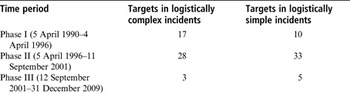
The profusion of explosives and blasting caps, and the relatively small number of professionally manufactured guns or explosive devices, suggest that local mines may have been valuable sources of some materials, but rebels had difficulty acquiring firearms within Xinjiang itself and so had to resort to foreign sources. In this first stage of the unrest, Uyghurs were able to launch standard, sophisticated attacks – bombs that targeted transportation, government officials and buildings – with a fair amount of planning, including multiple meetings, co-ordination of hundreds of people and training camps. Indeed, in Phase I, the number of targets hit in logistically complex incidents exceeded the targets hit in logistically simple incidents (see Table 1). Already in this phase, however, rebels' material resources were stretched and constrained. If some Uyghurs wanted to start a large-scale rebellion, they would have to get manufactured guns and bombs from somewhere.
Number of Targets in Major Violent Incidents in Xinjiang by Phase and Logistical Complexity

Notes:
Logistically complex incidents include bombings, co-ordinated attacks and insurrections; logistically simple incidents include riots, arson, assassinations and poisonings.
Phase II (1996–2001)
Chinese authorities became increasingly concerned with the unrest in Xinjiang in early 1996. Jiang Zemin chaired a Politburo meeting on 19 March 1996 that discussed the problem. The resulting “Minutes of the Central Politburo Committee Meeting concerning safeguarding Xinjiang's stability” designated illegal religious activities and ethnic separatism as the two greatest threats to Xinjiang's stability. The often violent implementation of the Politburo's pronouncement quickly followed on 5 April; it was the beginning of Xinjiang's most comprehensive Strike Hard campaign to date.Footnote 44
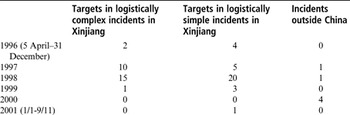
The months after the beginning of the Strike Hard campaign actually saw a rise in logistically sophisticated incidents in Xinjiang (see Table 2). This is not surprising. The literature on insurgencies has found that the crackdown itself can create new grievances, and violence might actually increase as elements within the newly angered population turn to violence.Footnote 45 Not only are more disaffected people available for recruitment, but the separatists themselves can frame state repression as depriving their entire constituent population of rights. Some insurgencies, in fact, will pursue a strategy of provocation in their violent campaigns as a means of causing the state to overreact.
Phase II Targets by Year, Location and Logistical Complexity

Note:
Contact author for data.
By the middle of 1998, significant incidents declined to almost nil, the last major incident of 1998 being a series of arson attacks in Hotan in May.Footnote 46 Organizing and planning apparently continued, as the Chinese government claimed to break up 195 cells of some sort in 1998, and 76 cells in 1999, including two particularly “violent” organizations based in Kashgar and Hotan.Footnote 47 Two trends are of interest. First, the onset of the Strike Hard campaign was almost immediately followed by a rise in logistically simple incidents, particularly assassinations; these incidents outpaced complex attacks in terms of the number of targets hit in every year between 1996 and 2001, with the exception of 1997. Second, 1997 saw the emergence of violent incidents outside Xinjiang. These continued until the end of Phase II at a low level in Turkey, Kyrgyzstan and Kazakhstan, and included arson, gun attacks and assassinations. While some incidents were probably separatist in nature, such as the 2000 killing of a moderate Uyghur leader in Kyrgyzstan, analysts are sceptical about these violent incidents being tied to Uyghur separatism.Footnote 48 They do suggest, however, that Uyghurs were able to procure weapons in Central Asia.
Although the Strike Hard campaign did seem to be correlated at first with a rise in violence, by mid-1998 the Chinese government's measures began to work, and violence declined precipitously. An effective crackdown, by increasing fear, reduces the political space and time in which rebels can plan sophisticated operations, inasmuch as the chance of being detected by the Public Security Bureau rises, especially with more people involved in the operations. And the Chinese government is able to bring massive resources to bear. The PLA's Lanzhou Military Region, which contains Xinjiang, fields approximately 220,000 troops and several radar stations for border defence.Footnote 49 Nationwide, there are approximately 400,000 internal security force personnel and 260,000 border defence force personnel.Footnote 50 Moreover, the hukou 戶口 household registration system allows the government to track down Uyghur suspects fairly easily.Footnote 51 Every crackdown since 1996 has been accompanied by reports of human right violations: mass roundups of Uyghur suspects, quick trials (followed by quick executions), and, more importantly, the breakup of dozens of organized cells and the seizure of their weapons, usually a combination of guns, homemade explosives, knives and peripheral materials.Footnote 52 Every seizure decreases the materials available to rebels as a whole (although, since the rebels have never appeared to be particularly united, the effect of one seizure on another group is probably low), requiring that groups replenish their supplies. The increased state repression in Xinjiang decreases opportunities for new weapons procurement, so that a logical next step would be to import weapons from the countries bordering Xinjiang to the west and south, all of which are weaker states than China.
This logic applies to Uyghur rebels (or more generally, refugees) as well: people who would otherwise be subject to repression move to neighbouring countries with lower levels of state hostility. The insurgency literature has generally found that rebel groups under attack often take refuge in neighbouring countries, thus prolonging and intensifying rebellions: out of reach of the target country, the groups can regroup and plan attacks, acquire weapons more easily, and raise funds in a politically open environment.Footnote 53 Unlike many other rebel movements, however, the transnationalization of Uyghur unrest did not result in a prolongation of the violence. The reason for this is simple: there must be some way for rebels to move people, weapons and information from the refuge country to the target country, and Xinjiang's physical geography and cross-border transportation infrastructure are such that smuggling is very difficult in the face of concerted, competent state hostility. Xinjiang borders seven countries: Mongolia, Russia, Kazakhstan, Kyrgyzstan, Tajikistan, Afghanistan and Pakistan. In theory, the large number of adjacent countries should provide many opportunities for rebels to find refuge, and to move people, weapons and information back into Xinjiang from abroad. It is astonishing, therefore, that Uyghur rebels seem to have been unable to take advantage of the fantastically long border between Xinjiang and the outside world, the varying degrees of disintegration of the bordering countries – Afghanistan is suffering from its own large-scale insurgency, while Tajikistan and Pakistan are weak states – and the mountainous terrain that should be difficult for China to police.
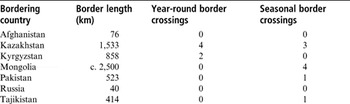
Here the geography is important (see Table 3). Russia and Mongolia have borders with Xinjiang that are either short and economically insignificant (in the case of the Russian border) or far from the lands traditionally occupied by Uyghurs in western and southern Xinjiang, thus mitigating their usefulness for smugglers (in the case of both the Russian and Mongolian borders). The Afghan border with Xinjiang forms the eastern tip of the Wakhan Salient, which is nearly impenetrable even for foot traffic, and has not had a legal border crossing for over 100 years.
Countries Bordering Xinjiang with Length and Number of Legal Border Crossings

Sources:
Central Intelligence Agency, World Factbook (Langley, VA: Central Intelligence Agency, 2008); “Doing business in Xinjiang” (Beijing: Ministry of Commerce, 2006); “Xinjiang's land ports and border trade,” China.org.cn, 15 December 2004. See http://www.china.org.cn/english/features/Xinjiang/114820.htm.
Tajikistan had no legal overland connection with China until June 2004 (that is, long after the end of Phase II), when a road at Kulma Pass 阔勒买 opened for approximately half of each year (and then for only 15 days per month, although this was extended to the entire six-month period in 2008).Footnote 54 The rest of the Tajik–Chinese border is mountainous, although there are some passes that can be traversed on foot (and as a result are of the greatest concern for analysts who are worried about drugs being smuggled into China from Tajikistan). The Tajik side in the southern part of the border with China, Gorno-Badakshan, is itself cut off from the rest of Tajikistan by snow three months of the year.Footnote 55 The illicit transportation of weapons, explosives and the like by foot across the Tajikistan–China border is thus possible, but the sustained transportation of large quantities is questionable.
Kyrgyzstan's border with Xinjiang is nearly as mountainous as Tajikistan, but features two fairly heavily used crossings through passes (Irkeshtam 伊尔克什坦 and Torugart 图噜噶尔特). The border between Xinjiang and Pakistan is traversed by the Karakorum Highway, which is closed much of the year due to snow, and is the highest (and most expensively constructed) international paved highway in the world.
Kazakhstan is the only Central Asian Republic with large expanses of flat terrain along its border with Xinjiang, and as a result the majority of trade between China and Central Asia flows through the Kazakhstan–Xinjiang border checkpoints. This is especially true of the Qorghas 霍尔果斯 border checkpoint, where, in June 2007, 1,300 people per day were crossing into China from Kazakhstan. The checkpoint itself sees 340,000 tons of goods moved every year, and the bazaar at the border employs hundreds of people directly, while many more provide services to border crossers.Footnote 56 Kazakhstan also contains the only rail connection between China and Central Asia.
Uyghur rebels (or even non-politically motivated smugglers) are stuck with two options when moving themselves or weapons into Xinjiang from Central or South Asia, both of which have significant disadvantages. First, they can cross the borders outside the legal checkpoints, thereby avoiding concentrations of Chinese state power. The terrain along the vast majority of the border, however, is quite difficult to cross, which is why there are so few legitimate highways in the first place. Xinjiang's borders with Pakistan, Afghanistan, Tajikistan and Kyrgyzstan are entirely mountainous, raising the costs in terms of time, money and support structures needed for illegal movement to very high, perhaps even impossible, levels.
Second, smugglers can attempt to move illicit goods along the highways that pass through Chinese immigration and customs officials at legitimate border checkpoints. For all the optimism about the skyrocketing trade between China and Central Asia, there are surprisingly few legal border crossing points between Xinjiang and other countries – just six, in fact, are open all year. The result is that smugglers trying to move goods into Xinjiang along legal routes are limited in how much they can carry, for fear of being discovered, and are channelled into a few chokepoints around which the Chinese government can concentrate scrutiny and personnel. In 2005, for example, what was apparently one of the largest gun-running rings ever discovered in China (although seemingly unrelated to Uyghur separatism), consisted of smugglers moving guns one or two at a time in the linings of bags and suitcases in vehicles that used the Karakoram Highway to travel from Pakistan to Xinjiang and on to Qinghai.Footnote 57
Although data on Uyghur weapons smuggling are almost entirely unavailable, the relatively small number of attacks, especially logistically sophisticated incidents, suggests that any smuggling attempts from the outside into Xinjiang were either not successful or did not move large quantities of weapons into the region. The best-known smuggling case between 1996 and 2001 was an incident in April 1998 where border police found a stash of weapons hidden in containers of wool coming across the border from Kazakhstan at the Qorghas border checkpoint. The Chinese government proclaimed it to be the biggest Uyghur smuggling event ever uncovered, and announced that the same smugglers had moved weapons into China 17 times before.Footnote 58 What is interesting about this “huge” smuggling incident is the small number of weapons involved. The smugglers were attempting to bring in 19,000 rounds of ammunition, which is certainly a lot, but only six pistols and one folding submachine gun. Even multiplied by 17, this is not a particularly large arsenal, certainly not enough to start a large or even medium-scale rebellion, particularly given the effectiveness of Chinese police in confiscating weapons whenever they broke up cells. The 2004 Xinjiang security yearbook notes that during crackdowns in 1998, security forces captured 30 people who had been smuggled back into Xinjiang from abroad, along with 29 automatic weapons from abroad. In 2000, likewise, police in Kashgar prefecture broke up a cell containing ten people who had come in from abroad. Interestingly, the emphasis in the description of the material seizures in 2000 is on propaganda materials rather than weapons.Footnote 59
Clearly rebels were trying to move weapons and people back into Xinjiang, and were sometimes successful, but were unable to do so in large enough numbers to maintain a traditional guerrilla campaign. The rebels were thus left with a situation where they were both prevented from organizing sophisticated violent incidents inside Xinjiang and denied the ability to bring in weapons from outside, resulting in an increase in logistically unsophisticated incidents in Xinjiang, and the appearance of incidents outside the region.
Phase III (2001–2009)
Almost concurrently with the Strike Hard campaign in 1996, China began encouraging security co-operation with Central Asian countries with the formation of the Shanghai Five and its focus on “separatism, fundamentalism and terrorism,”Footnote 60 and resolving border disputes in the region.Footnote 61 After 11 September 2001 and China's declaration that its fight against Uyghur separatism was part of the global war on terror, Central Asian governments' policies towards Uyghur separatism turned nearly as hostile as those of China itself. In 2002, the Shanghai Five's successor, the Shanghai Co-operation Organization (SCO), announced the creation of a regional anti-terrorism agency, and China conducted its first military manoeuvres with another country. Notably, these were joint border security exercises with Kyrgyzstan, exercises that could only have been targeted at stopping the illicit movement of Uyghur rebels (and drug traffickers) between the two countries.Footnote 62 In 2003 and 2006, China conducted further military exercises with SCO members, emphasizing border security and attacks on mock terrorist training camps, in an apparent bid to build political support for cracking down on Uyghur rebels.Footnote 63
The effect of the heightened hostility after 2001 in both Central Asia and China was twofold. First, the exodus of Uyghurs continued: a number of Uyghurs were captured in Afghanistan and sent to Guantanamo Bay during the United States' Operation Enduring Freedom (although many of them claimed they were not in Afghanistan for military training), and Hasan Mahsum, the purported leader of the East Turkestan Islamic Movement, was killed in a firefight with the Pakistani military in 2003 in Pakistan's Northwest Frontier Province.Footnote 64 In both cases, the Uyghurs in Afghanistan and Pakistan clearly had access to sufficient weaponry and time to participate in an insurgency there. They did not, however, seem to have the ability to move those weapons back to Xinjiang. While it is possible, even probable, that Uyghurs are better at moving themselves and goods through the mountainous borders between Xinjiang and Central Asia than the Chinese government thinks, from long experience travelling throughout the region, the political space to plan these smuggling operations needs to exist as well. Through their own crackdowns, Central Asian governments thus reduced the time and space Uyghurs had for applying their cultural knowledge to smuggling operations from Central Asian countries into Xinjiang.Footnote 65
Second, within Xinjiang itself Uyghur-related violent incidents seemed to die down for the next six years. Uyghurs in Xinjiang were subjected to the same harsh, even violent, conditions that had existed since the start of the 1996 Strike Hard campaign, combined with little breathing room in the countries adjacent to Xinjiang, as well as the post-9/11 Chinese government's attempt to connect them to international terrorism. Some analysts claim the lack of violence in Xinjiang after 2001 shows that China was attempting to demonize what was never a large or threatening movement in the first place.Footnote 66 It is certainly true that China hopped on the Islamic terrorism bandwagon, although it is also probable it would have continued with its crackdown even if 9/11 had never occurred.
When the Uyghur-related violence did start up again, it was constrained by the ongoing crackdowns in both China and Central Asia that deprived those who wanted to engage in violent acts of easy opportunities to acquire weapons and explosives and move them to targets in Xinjiang. The result was the appearance of incidents that were more “creative” in how they maximized violent impact. Three incidents in 2007 and 2008, which may or may not have been connected to each other, illustrate this new creativity.
In 5 January 2007, Chinese police raided what they called a “terrorist camp” in a mountainous location called Kushirap 库斯拉甫 in Akto 阿克陶 county near Kashgar, killing or capturing 35 people and confiscating homemade explosives. Later investigations called the initial report into question. According to a Spanish journalist, local Uyghurs claimed that the “terrorist camp” raid was actually the result of a mining dispute. Uyghurs near the village of Kushirap had been running a coal mine when a Han Chinese businessman arrived and ordered them to stop because he had purchased the mine. This led to a standoff and then protests that soon attracted 150 Uyghurs from other districts, and took on Uyghur nationalist overtones by focusing on grievances surrounding Han Chinese exploitation of Xinjiang's natural resources. In the process, they turned violent, and a Han Chinese policeman was killed. Afraid of the consequences of the policeman's death, dozens of Uyghurs fled into the countryside, where they were hunted down by the Chinese authorities.Footnote 67 This version of events conforms well with how other Uyghur protests and riots have started, but also explains why the police found homemade explosives: they could simply have been used for mining. Even if Uyghur nationalists took advantage of the situation to create a protest, they evidently did not have sophisticated weapons at their disposal.
In the run-up to the Beijing Olympics, the Chinese government expressed great concern about Uyghur rebels plotting attacks against foreign visitors and government officials during the Olympics, and otherwise disrupting the games. In April 2008, it claimed to have broken up a number of plots in the previous four months. In January 2008, for example, government forces raided several “terrorist nests,” captured ten suspects and found equipment necessary for making explosives from commercially available compounds, as well as four kilograms of yellow sulphur and 100 kilograms of nine other types of chemicals, computer equipment and disks, “holy war” materials and 18 completed devices. Police claimed that the suspects were planning on attacking the Olympics as well as government and military sites in Beijing and Shanghai. Later, in March and April, police claimed to have raided another organization and rounded up 35 suspects in Urumqi, along with 9.51 kilograms of explosive precursors and eight blasting caps. The organization had apparently been recruiting in a number of cities around Xinjiang.Footnote 68
Crucially, however, there did not appear to be any professional-quality explosives such as TNT or C4, which are often used as accelerants in terrorist bombs, or any professionally made guns. Assuming the Chinese government reported the weapons seizures accurately and completely, it is surprising how ill-equipped the Uyghur groups were, particularly given their apparently grand plans. The chemicals captured would have been enough to make a large number of homemade grenade-type devices, and perhaps a medium-sized bomb, but certainly nothing approaching truck bomb size. Here the Chinese government's own data contradict its claims about well-armed Uyghur separatists.
Two definitely violent incidents in 2008 that were actually successful were both “creative” in nature. On 4 August, two Uyghurs stole a truck and ran it into a group of soldiers in Kashgar, killing 16 of them and wounding 16 others. They then threw homemade explosives and stabbed the victims. Nine homemade explosive devices, one homemade gun, two machetes and “holy war” materials were found to be in the suspects' possession.Footnote 69 Then, early on the morning of 10 August, a group of Uyghurs commandeered a taxi (or taxis) in Kuqa 库车, Aksu prefecture, and apparently threw homemade explosives at police cars, the Public Security Bureau building, the industry and commerce administration building, and possibly several other buildings, killing several police and injuring civilians. In the ensuing fight, eight Uyghurs were killed, two were captured, two blew themselves up and three escaped.Footnote 70
Despite talk of the resurgence of Uyghur-related violence on the eve of the Beijing Olympics, what is remarkable about the two attacks is how unsophisticated they were, from a planning and logistics viewpoint. In both cases, the attackers' means of transport was commandeered vehicles, while the primary weapons used were the vehicles themselves (requiring no prior planning or material preparation), knives and small grenade-like homemade explosives. The attacks were not co-ordinated simultaneously across different cities (although the 4 and 10 August attacks may have been connected) as the unsuccessful rebels had apparently intended, and no professional-grade explosive is mentioned as having been used. By “creative” approaches that minimized logistical footprints and operational sophistication, the rebels were able to cause damage in excess of what others had been able to do with more sophisticated plots, given the political and geographic constraints under which they were labouring.
The incident of post-9/11 Uyghur-related unrest most widely reported in Western media – the riots between Uyghurs and Han Chinese in Urumqi that began on 5 July 2009 and continued into 8 July – was not necessarily “planned” at all. The immediate cause of the protests that culminated in violence appears to have been Uyghur dissatisfaction at the handling of an incident on 25–26 June at a factory in Shaoguan 韶关, Guangdong, in which rumours of Uyghur workers sexually assaulting a Han woman led to riots between Han Chinese and Uyghurs that resulted in the deaths of two Uyghurs. The July riots were followed by further riots on 3 September over Han Chinese dissatisfaction with the government's handling of the July riots and a wave of syringe attacks that were supposed to have targeted primarily Han Chinese, although their actual provenance is uncertain.Footnote 71 Chinese police claimed that agitators from Uyghur advocacy organizations outside China, especially Rebiya Kadeer in the United States, spread information about the Shaoguan incident and encouraged violence through the internet and mobile phones.Footnote 72 The Chinese government subsequently cut off internet access to Xinjiang and instituted another Strike Hard campaign, in which trials were shortened and evidence needed for conviction lowered to ensure speedy reprisals.Footnote 73 There is no external evidence that this is true, but both the riots themselves and the Chinese government's claims about their immediate cause illustrate the path that unrest in Xinjiang has taken since 2001: riots, inasmuch as they are not purposive or organized, require no planning or logistics. Even if, for the sake of argument, expatriate Uyghur groups did instigate the July 2009 protests in Urumqi via the internet and online chat fora, as with the “successful” 2008 attacks, this suggests that violence is developing in the direction of incidents that do not require overcoming Xinjiang's difficult geography and moving physical weapons across borders.
As long as China is able to maintain an atmosphere of fear, keep even marginally effective control of the territory of Xinjiang itself and convince Central Asian countries to crack down on any Uyghur rebels in their midst, any violent groups will have difficulty planning or procuring supplies for sophisticated acts of rebellion, although the opening of an increasing number of land routes between Central Asia and China may make it more difficult for China to police the legitimate ports of entry into Xinjiang.Footnote 74 The future of Uyghur unrest may lie in “creative” incidents that require little planning or materials, and against these China has proven less effective.