1. Introduction
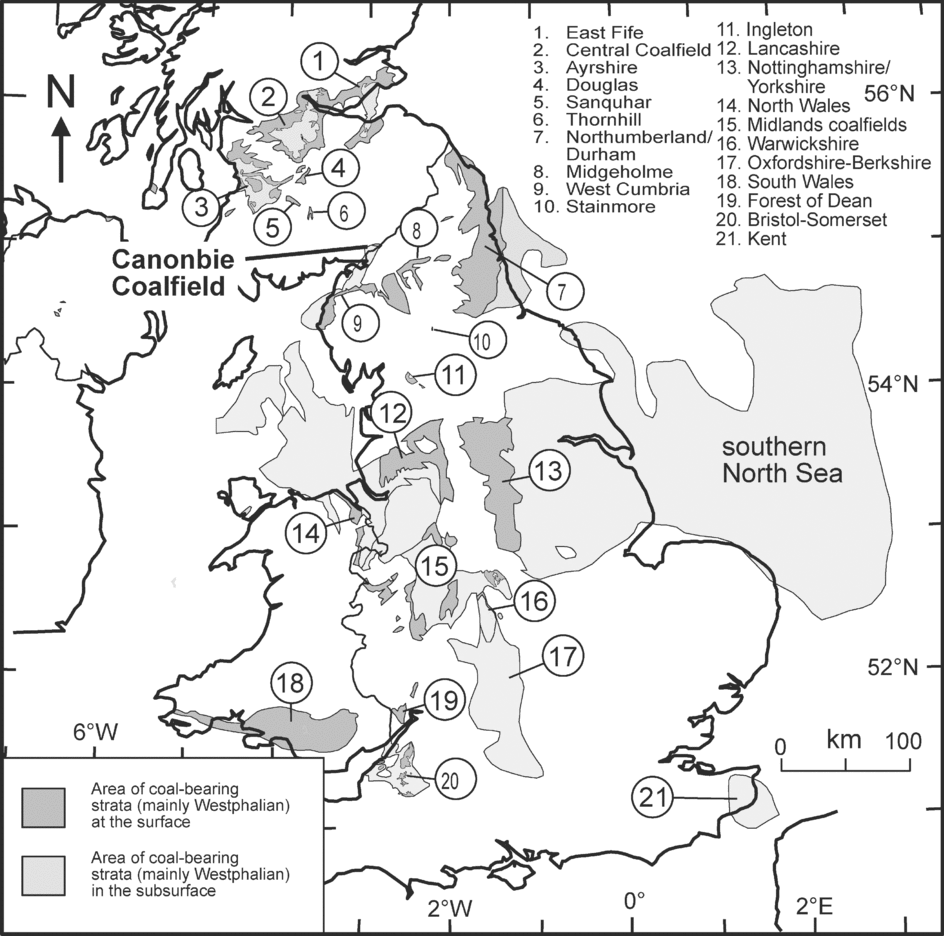
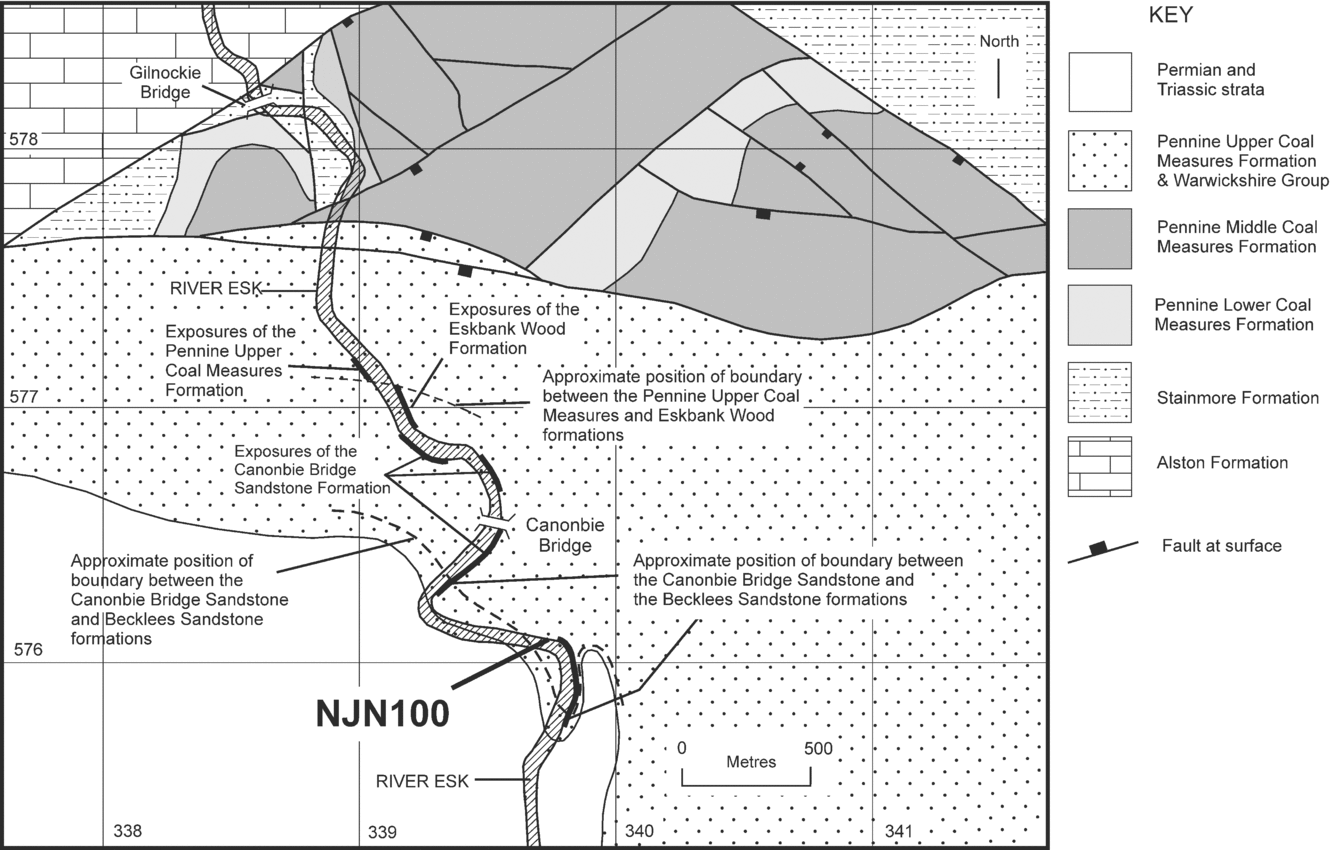
The Canonbie area of southwest Scotland (Fig. 1) is one of the few areas in the UK outside of the English Midlands where uppermost Carboniferous (Bolsovian–Asturian) strata can be directly examined at outcrop. The presence of red strata (including both primary and secondary red beds) in the ‘Upper Coal Measures’ of the Canonbie area was noted by Peach & Horne (Reference Peach and Horne1903), Simpson & Richey (Reference Simpson and Richey1936), Barrett & Richey (Reference Barrett and Richey1945), Trotter (Reference Trotter1953), Lumsden et al. (Reference Lumsden, Tulloch, Howells and Davies1967), Day (Reference Day1970) and Picken (Reference Picken1988). Recent work by Jones, Holliday & McKervey (Reference Jones, Holliday and McKervey2010) on outcrops along the River Esk (Fig. 2) has shown that these strata can be assigned to the Warwickshire Group because the red-bed facies show evidence for early oxidation (primary reddening). The type area of the Warwickshire Group is the Warwickshire Coalfield in central England (Fig. 1), where the succession attains its fullest thickness of 1225 m (Powell et al. Reference Powell, Chisholm, Bridge, Rees, Glover and Besly2000) and typically comprises red mudstones and sandstones, with varying amounts of pebbly sandstone, conglomerate, grey mudstone, thin coals, lacustrine limestone (‘Spirorbis limestone’) and calcrete palaeosols. The Warwickshire Group ranges in age from late Bolsovian to Autunian, although the degree of biostratigraphical control is reduced compared with the Pennine Coal Measures Group because of the effects of reddening (Besly & Cleal, Reference Besly and Cleal1997; Powell et al. Reference Powell, Chisholm, Bridge, Rees, Glover and Besly2000).
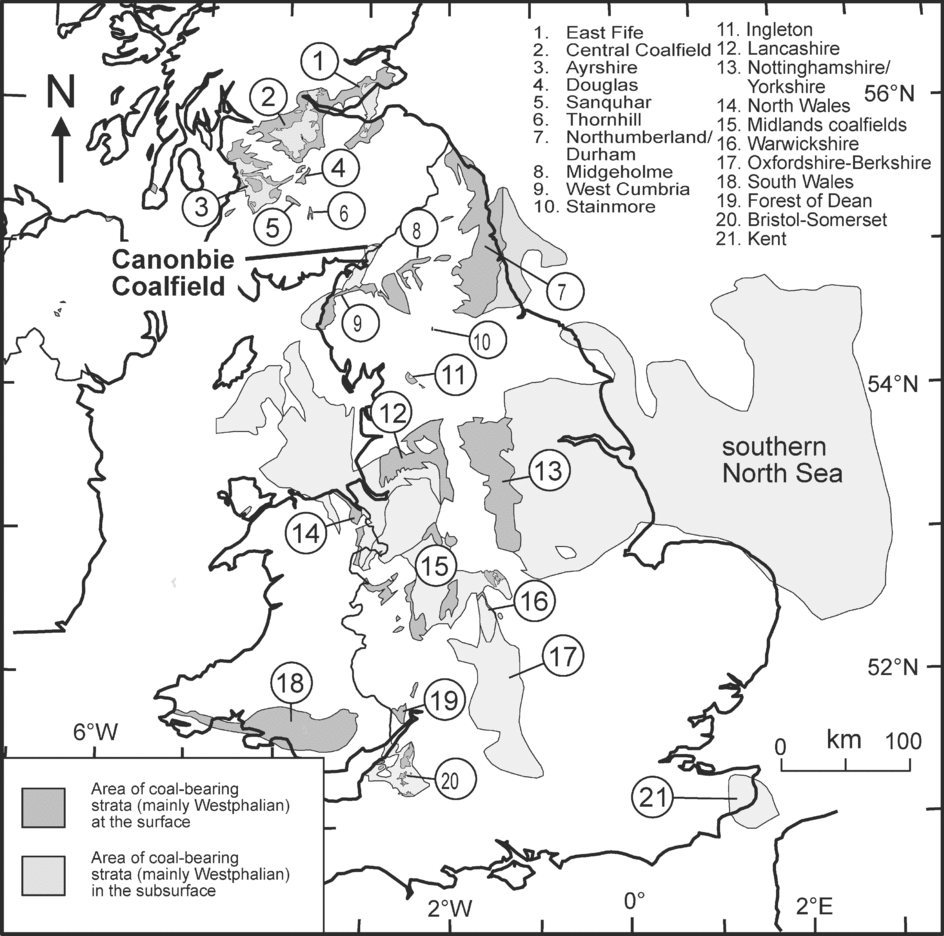
Location map showing the Canonbie Coalfield in relation to other UK coalfields (modified from British Geological Survey, 1999).
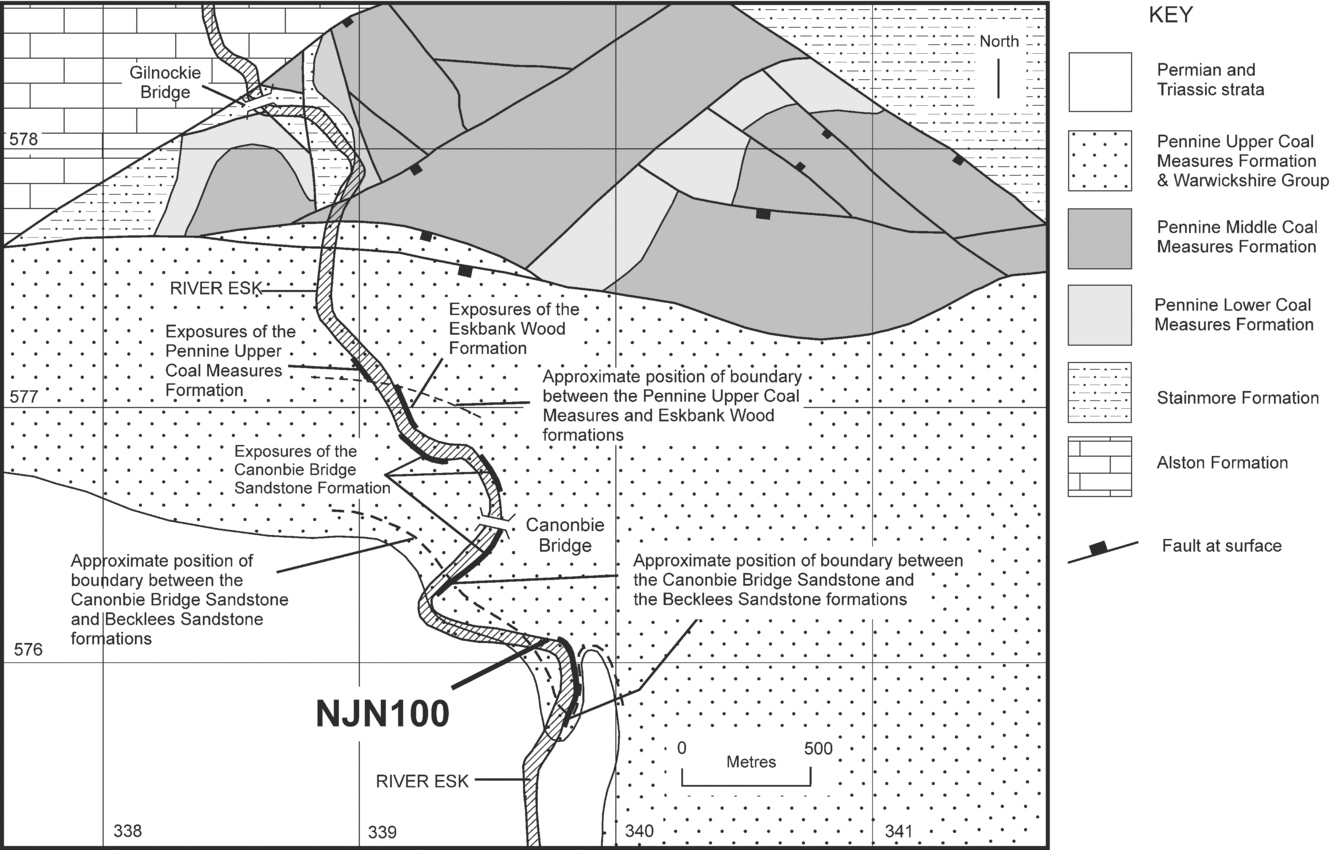
Geological map of the outcrops along the River Esk, Canonbie area, southern Scotland, showing the location of sample NJN100 (modified from Jones, Holliday & McKervey, Reference Jones, Holliday and McKervey2010).
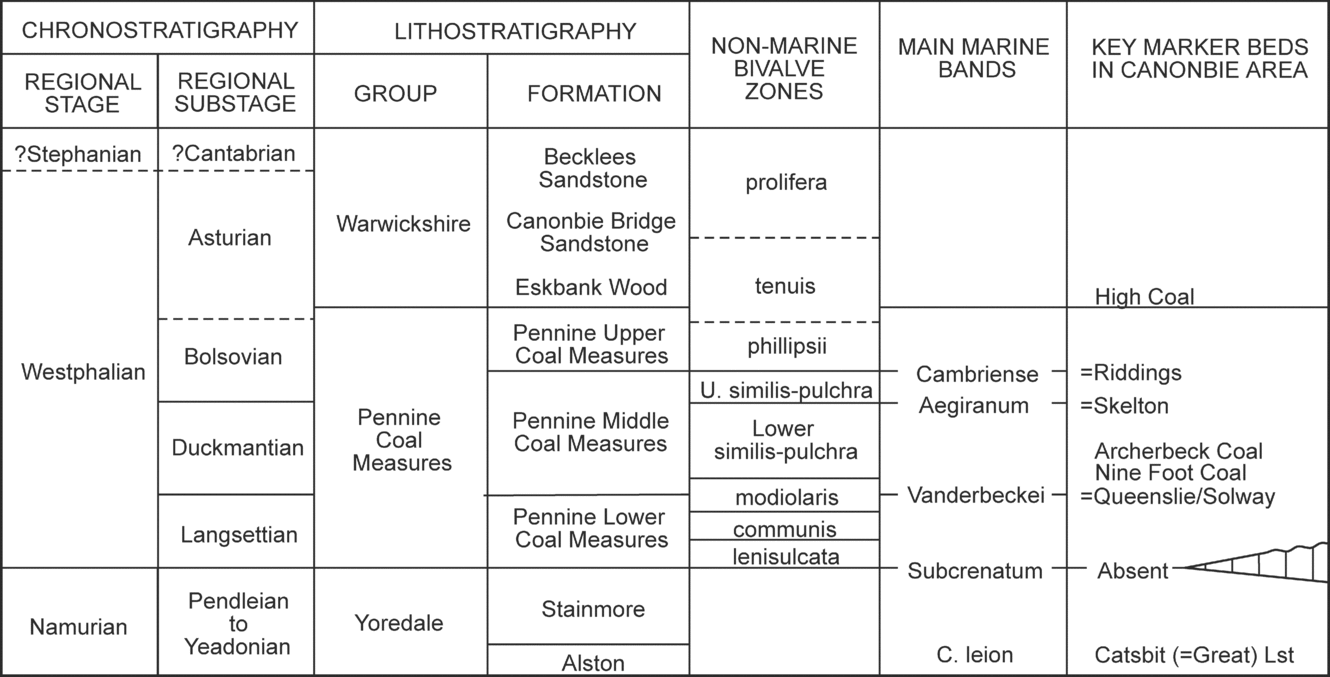
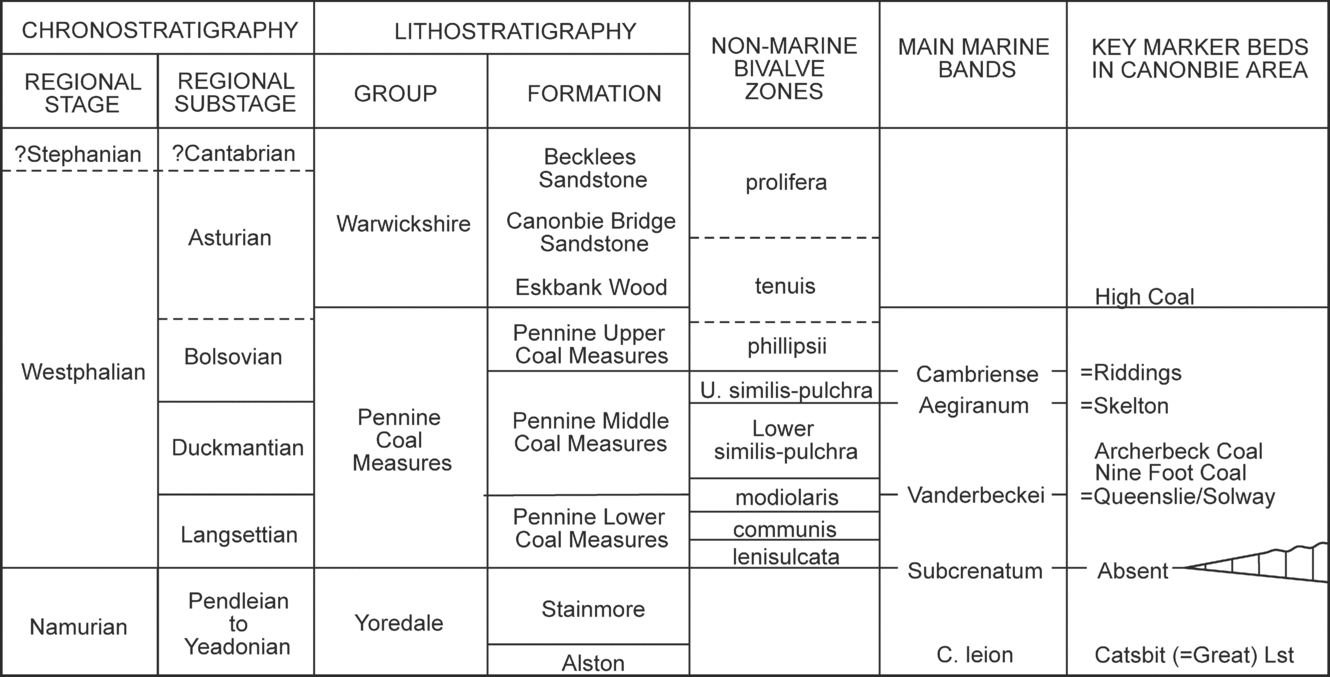
The Warwickshire Group in the Canonbie area has been subdivided into three formations (Jones, Holliday & McKervey, Reference Jones, Holliday and McKervey2010): the Eskbank Wood at the base, the Canonbie Bridge Sandstone, and the Becklees Sandstone at the top (Fig. 3). The Canonbie Bridge Sandstone Formation is noteworthy because of the occurrence of thick units of medium- and coarse-grained cross-bedded channel sandstones deposited by a series of northward-flowing braided river systems. The sandstones in the Canonbie Bridge Sandstone Formation are commonly micaceous and contain abundant lithic grains, thereby resembling the Halesowen Formation of central England and the Pennant Sandstone Formation of South Wales and southern England (Jones, Holliday & McKervey, Reference Jones, Holliday and McKervey2010), which are known from isotopic studies to represent detritus sourced from the Variscan orogenic belt to the south (Hallsworth et al. Reference Hallsworth, Morton, Claoué-Long and Fanning2000; Sherlock, Jones & Jones, Reference Sherlock, Jones and Jones2000). The similarity between the Canonbie Bridge Sandstone Formation and the Halesowen Formation is substantiated by heavy mineral and garnet geochemical data (Jones, Holliday & McKervey, Reference Jones, Holliday and McKervey2010). The similarities in petrographical and heavy mineral characteristics between the Canonbie Bridge Sandstone Formation, the Halesowen Formation and the Pennant Sandstone Formation, together with evidence for northerly directed palaeocurrents, led Jones, Holliday & McKervey (Reference Cope, Guion, Sevastopulo, Swan, Cope, Ingham and Rawson2010) to propose that the Canonbie Bridge sandstones represent the products of a river system that drained the Variscides several hundreds of kilometres to the south. If so, this would extend the known northward distribution of Variscan-derived Upper Carboniferous sediment, the previous record being the Dalton Rock (Bolsovian) near Sheffield, Yorkshire (Hallsworth et al. Reference Hallsworth, Morton, Claoué-Long and Fanning2000).
Lithostratigraphy of the Carboniferous in the Canonbie area, based on Trueman & Weir (Reference Trueman and Weir1946), Ramsbottom et al. (Reference Ramsbottom, Calver, Eager, Hodson, Holliday, Stubblefield and Wilson1978) and Waters et al. (Reference Waters, Browne, Dean and Powell2007).
Although the evidence is compelling, the similarity in petrographical and mineralogical characteristics between the Canonbie Bridge Sandstone Formation and known Variscan-sourced sandstones in central and southern England is not absolute proof that these sandstones have a common provenance. In this paper, we report U–Pb isotopic age dates of detrital zircons from a Canonbie Bridge Sandstone Formation sample, analysed in order to test the possibility that Variscan-sourced sediment reached the Canonbie area during Late Carboniferous times.
2. Geological background
Sedimentological and stratigraphical studies of the Warwickshire Group crop out along the River Esk (Fig. 2), together with borehole records from the Canonbie area, led Jones, Holliday & McKervey (Reference Cope, Guion, Sevastopulo, Swan, Cope, Ingham and Rawson2010) to subdivide the group into three units: the Eskbank Wood, Canonbie Bridge Sandstone and Becklees Sandstone formations (Fig. 4).
Composite sedimentological log of the Warwickshire Group succession exposed along the River Esk, Canonbie between [3917 7705] and [3930 6726], showing approximate stratigraphical position of sample NJN100 within the Canonbie Bridge Sandstone Formation (modified from Jones, Holliday & McKervey, Reference Cope, Guion, Sevastopulo, Swan, Cope, Ingham and Rawson2010).
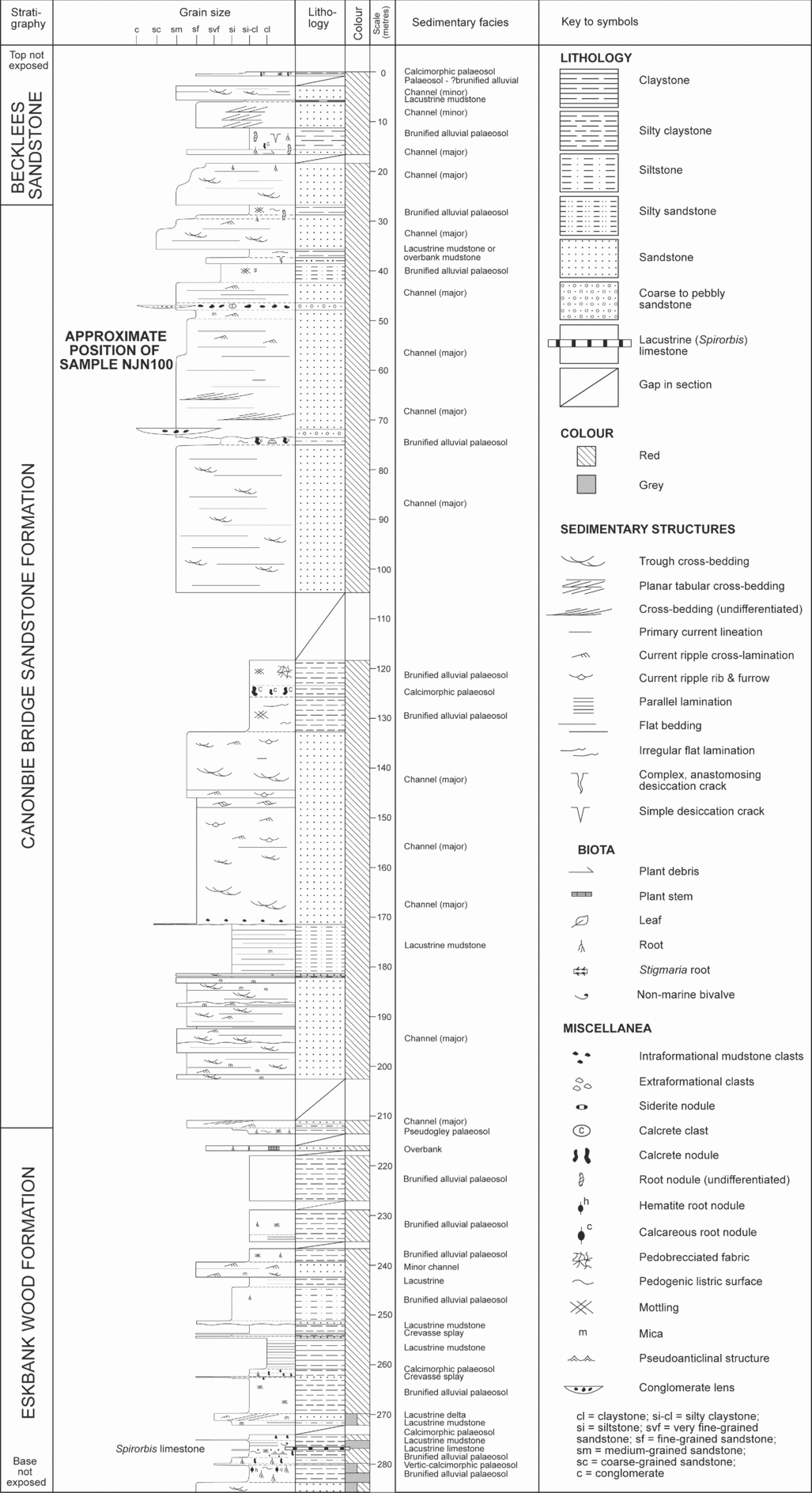
The Eskbank Wood Formation consists mostly of red mudstones, interbedded with fine- to medium-grained sandstones, calcrete palaeosols, thin beds of Spirorbis limestone and Estheria-bearing mudstones. Sparse thin coals (some of which have been oxidized and altered to limestone) and grey mudstones are present in the lower part of the formation. The outcrop includes mudstones that contain a fauna believed to diagnose the A. tenuis or A. prolifera non-marine bivalve zones of Trueman & Weir (Reference Trueman and Weir1946), indicative of an Asturian age (Fig. 3). The outcrop section along the River Esk (Fig. 2) proves up to 75 m of the formation, but borehole records suggest that the thickness of the formation ranges between 145 and 175 m. The base of the formation, which is not exposed at outcrop and has therefore been defined in boreholes, is taken at the first major primary red-bed strata overlying the grey mudstones that dominate the Pennine Upper Coal Measures Formation (Fig. 3).
The overlying Canonbie Bridge Sandstone Formation is dominated by reddish brown to greenish grey, moderately to poorly sorted, fine- to coarse-grained sandstones with a lithic arenite composition, interbedded with reddish brown mudstones and reddish brown mudstone palaeosols (including calcretes). The sandstones occur as sharp to erosively based, cross-bedded channel bodies, 10–30 m thick, in multi-storey successions. In hand specimen, the sandstones are commonly micaceous and contain a noticeable component of greenish grey grains. Thin-section petrography reveals that the greenish grey grains are lithic clasts, mainly comprising fine foliated or schistose low-grade metapelitic and metapsammitic fragments. The formation is well exposed along the River Esk between ~ 250 m south and ~ 600 m north of Canonbie Bridge (Fig. 2). Borehole records show that the formation ranges in thickness from 131 to 168 m. The sample reported in this paper (NJN100) was taken at [339789 576088] (Fig. 2).
The Becklees Sandstone Formation comprises sandstones with a subfeldspathic arenite composition, interbedded with reddish brown mudstones and reddish brown mudstone palaeosols (including calcretes). The sandstones are generally cross-bedded and occur as erosively based channel bodies, 10–30 m thick, in multi-storey units. In hand specimen, the sandstones are fine- to medium-grained, orange brown to bright reddish brown and pinkish brown, moderately to well sorted, typically lack mica, and contain low proportions of lithic clasts. At outcrop along the River Esk, the change in lithology between the Canonbie Bridge Sandstone Formation and the Becklees Sandstone Formation is abrupt, and is associated with sand-filled polygonal cracks penetrating the top of the Canonbie Bridge Sandstone Formation. The change in composition, accompanied by a change in palaeocurrent direction from northward-directed in the Canonbie Bridge Sandstone Formation to southerly directed in the Becklees Sandstone Formation, indicates a change in sediment provenance across the boundary. The top of the Becklees Sandstone Formation is truncated at the sub-Permian unconformity and its full thickness is therefore not known, but up to 200 m was proved in the Becklees Borehole (Jones, Holliday & McKervey, Reference Cope, Guion, Sevastopulo, Swan, Cope, Ingham and Rawson2010).
3. Analytical methods
Zircon grains were separated from sample NJN100 using standard crushing, washing, heavy liquid (Sp. Gr. 2.96 and 3.3), and paramagnetic procedures. The zircon-rich heavy mineral concentrate was poured onto double-sided adhesive tape, mounted in epoxy together with chips of the reference zircons (TEMORA and SL13), sectioned approximately in half, and polished. Reflected light photomicrographs, transmitted light photomicrographs and cathodoluminescence (CL) scanning electron microscope (SEM) images were prepared for all zircon grains. The CL images were used to decipher the internal structures of the sectioned grains and to ensure that the ~ 20 μm SHRIMP spot was wholly within a single age component within the sectioned grains.
The U–Th–Pb analyses were made using SHRIMP RG at the Research School of Earth Sciences, The Australian National University, Canberra, Australia. The zircons on the mount were analysed sequentially and randomly until a total of 70 grains was reached. Each analysis consisted of five scans through the mass range, with a reference zircon analysed for every five unknown zircon analyses, following the SHRIMP analytical method recommended by Williams (Reference Williams, McKibben, Shanks III and Ridley1998 and references therein). The data have been reduced using the SQUID Excel Macro of Ludwig (Reference Ludwig2001).
The U/Pb ratios have been normalized relative to a value of 0.0668 for the TEMORA reference zircon, equivalent to an age of 417 Ma (Black et al. Reference Black, Kamo, Allen, Aleinikoff, Davis, Korsch and Foudoulis2003). Uncertainties given for individual analyses (ratios and ages) are at the one sigma level (Table A1, in online Appendix at http://multimediafluids.uam.elogim.com/journals/geo). Correction for common Pb was made using the measured 204Pb/206Pb ratio in the normal manner, except for grains younger than c. 800 Ma and for grains with low U and, therefore, low radiogenic Pb, in which case the 207Pb correction method was used (Williams, Reference Williams, McKibben, Shanks III and Ridley1998). When the 207Pb correction is applied, it is not possible to determine radiogenic 207Pb/206Pb ratios or ages. In general, for areas younger than c. 800 Ma, and for areas that are low in U and therefore low in radiogenic Pb, the radiogenic 206Pb/238U age has been used for the histogram and probability density plots. The 207Pb/206Pb age is used for grains older than 800 Ma, or for younger grains enriched in U.
4. Zircon age population in the Canonbie Bridge Sandstone Formation
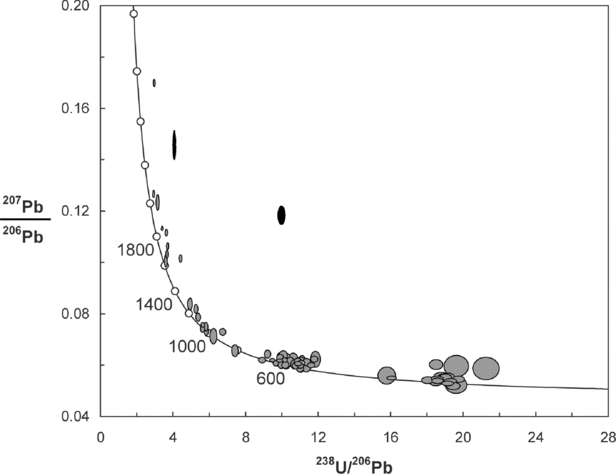
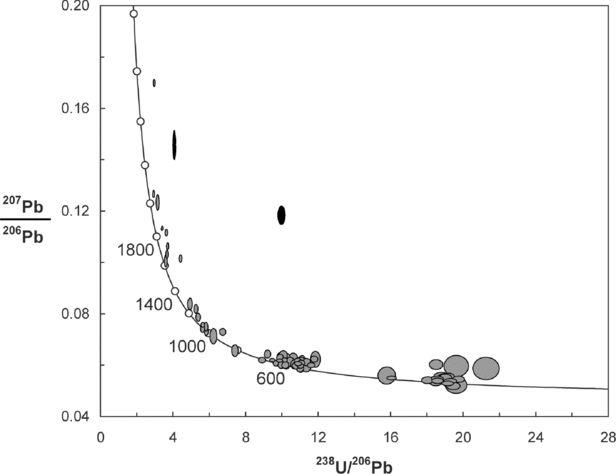
The zircon age data from sample NJN100 are displayed on a Tera & Wasserburg (Reference Tera and Wasserburg1972) concordia plot (Fig. 5) generated using Isoplot/Ex (Ludwig, Reference Ludwig2003) and on a combined relative probability density–stacked histogram plot (Fig. 6), generated using AgeDisplay (Sircombe, Reference Sircombe2004).
Tera-Wasserburg concordia diagram displaying zircon compositions from Canonbie Bridge Sandstone Formation sample NJN100 (n = 70). Data ellipses are 1σ. Zircons that are > 20 % discordant or have otherwise unreliable apparent ages are shown in black.
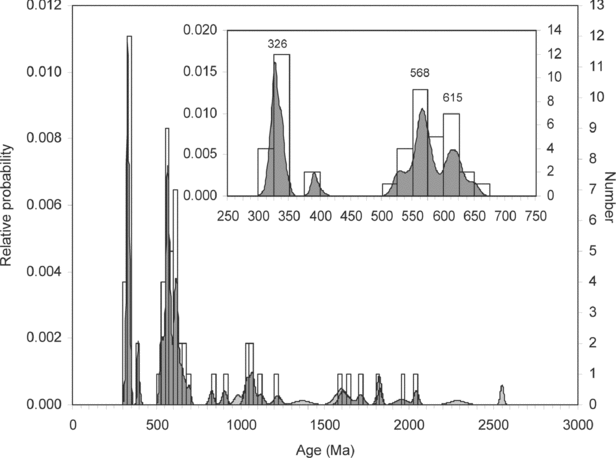
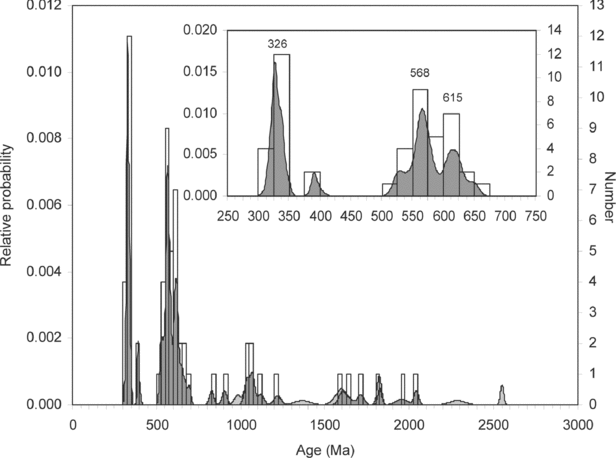
Combined histogram–relative probability plot of zircons from Canonbie Bridge Sandstone Formation sample NJN100 (n = 69 of which 63 are > 90 % concordant), generated using the AgeDisplay program (Sircombe, Reference Sircombe2004). Inset shows detail of the 250–750 Ma age range and the approximate ages of the main peaks.
The concordia plot shows that the majority of the zircons analysed are concordant or near-concordant. The most obvious exceptions are grains 16.1 and 31.1, which are > 20 % discordant (Table A1, in online Appendix at http://multimediafluids.uam.elogim.com/journals/geo), and grain 14.1, which lies slightly above concordia, is slightly enriched in common Pb, and yielded a 206Pb/238U age close to the Carboniferous–Permian boundary (294 ± 7 Ma, ± 1σ). The Canonbie Bridge Sandstone Formation is believed to be Asturian (equivalent to the Moscovian: Heckel & Clayton, Reference Heckel and Clayton2006) in age (Jones, Holliday & McKervey, Reference Cope, Guion, Sevastopulo, Swan, Cope, Ingham and Rawson2010), and should therefore be no younger than c. 306.5 Ma, according to Gradstein, Ogg & Smith (Reference Gradstein, Ogg and Smith2004). Grain 14.1 has an apparent age c. 24 Ma younger than the main Carboniferous group of zircons (Table A1), the youngest of which is 318 Ma (Namurian). This age is therefore considered suspect, and was not plotted on the relative probability density–histogram plot (Fig. 6). It should be noted, however, that it does fall within error of the youngest of the main group of zircons if the appropriate 2σ error (± 14 Ma) is applied. The grain is probably a Carboniferous zircon that has lost a small amount of radiogenic Pb from the crystal lattice, causing 238U/206Pb to increase, thereby yielding an anomalously young apparent age.
The zircon age spectrum (Fig. 6) shows the presence of two major groups, together with a number of smaller peaks. The two main groups are late Neoproterozoic to early Cambrian (693–523 Ma) and Early Carboniferous (348–318 Ma). The late Neoproterozoic to early Cambrian peak comprises 31 of the 67 concordant or near-concordant grains (46 % of the population), and appears to consist of two main groups, the larger one peaking at c. 568 Ma and the smaller one at c. 615 Ma. The Early Carboniferous group is represented by 16 zircons (24 % of the population), peaking at c. 326 Ma. In addition, eight zircons (12 % of the population) are late Mesoproterozoic to early Neoproterozoic in age (1119–827 Ma), four (6 %) are late Palaeoproterozoic to early Mesoproterozoic (1712–1566 Ma), and four (6 %) are mid-Palaeoproterozoic (2042–1818 Ma). Finally, there are two zircons dated at 390–396 Ma, one at 1218 Ma, and one at 1365 Ma.
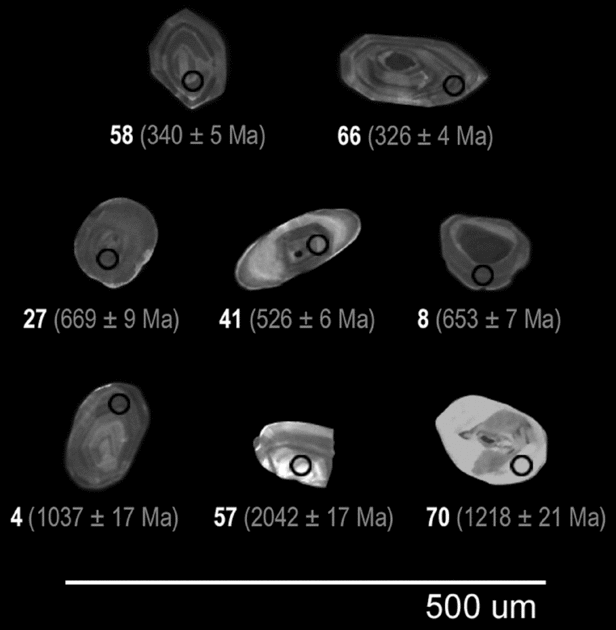
Most of the Early Carboniferous zircons are euhedral or subhedral, with simple igneous oscillatory zoning under CL (Fig. 7). Rare grains show more homogeneous CL that may reflect a metamorphic paragenesis. Grains with recognizable cores and overgrowths are scarce. Their habit and zonation patterns suggest that most of the Early Carboniferous zircon grains represent first-cycle derivation from granitoids, which accords with the relatively short time gap between crystallization and sedimentation.
CL images of selected zircon grains from sample NJN100, including: (top row) Early Carboniferous zircons (grains 58 and 66) showing euhedral or near-euhedral habit and intricate igneous zoning; (middle row) late Neoproterozoic to early Cambrian zircons, ranging from rounded grains with diffuse zoning (grain 27), near-euhedral grains with intricate zoning (grain 41), and grains with unzoned cores and intricately zoned igneous overgrowths (grain 8), and (bottom row) Palaeoproterozoic to late Mesoproterozoic zircons, including subrounded grains with intricate zoning (grain 4) and subrounded grains with diffuse zoning (grain 57). Grain 70 has an intricately zoned igneous core and bright, apparently unzoned (possibly metamorphic) overgrowth.
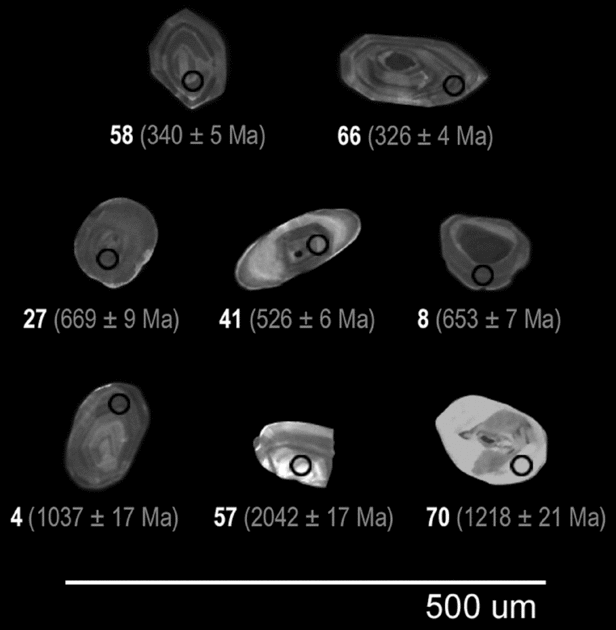
The late Neoproterozoic–early Cambrian zircons show a wider range of habit, from euhedral to rounded. CL images of most grains show zoned igneous internal structures (Fig. 7). A small proportion of late Neoproterozoic–early Cambrian zircons display cores and overgrowths, such as grain 8 (Fig. 7), which CL shows to have a dark homogeneous core and a weakly zoned igneous overgrowth (the latter dated as 653 ± 7 Ma).
The older (Palaeoproterozoic to early Neoproterozoic) zircon population has few euhedral or near-euhedral grains, most being subrounded, rounded or subangular. It seems likely that many of these older zircons are recycled. Most have igneous zonation patterns (Fig. 7). Some of the Palaeoproterozoic to early Neoproterozoic zircons display cores and overgrowths. One zircon (grain 70) has an irregular intricately zoned igneous core that has been partially resorbed and/or replaced by a bright CL, homogeneous overgrowth (Fig. 7). The overgrowth has comparatively low U (47 ppm) and very low Th (Table A1). The Th/U ratio of ≤ 0.01, in conjunction with the habit, suggests that the overgrowth may be of metamorphic origin.
5. Discussion
The zircon population in sample NJN100 from the Canonbie Bridge Sandstone Formation unequivocally indicates that the sediment was derived from south of the Variscan Front. This is diagnosed by the presence of the two major age groups, Early Carboniferous (348–318 Ma) and late Neoproterozoic to early Cambrian (693–523 Ma). The Early Carboniferous group corresponds to granitoid magmatism and associated metamorphism in Brittany, dated as 345–300 Ma (Brown & Dallmeyer, Reference Brown and Dallmeyer1996), and in the Saxo-Thuringian Zone of the central European Variscides, which ranges from 352 to 290 Ma (Tischendorf et al. Reference Tischendorf, Förster, Frischbutter, Kramer, Schmidt, Werner, Dallmeyer, Franke and Weber1995). The late Neoproterozoic to early Cambrian group corresponds to the Cadomian of Armorica (Guerrot & Peucat, Reference Guerrot, Peucat, D'Lemos, Strachan and Topley1990; Strachan, D'Lemos & Dallmeyer, Reference Strachan, D'Lemos, Dallmeyer, Nance and Thompson1996) and the central European Variscides, such as the Saxo-Thuringian Zone (Tischendorf et al. Reference Tischendorf, Förster, Frischbutter, Kramer, Schmidt, Werner, Dallmeyer, Franke and Weber1995). Derivation from the north or west can be categorically ruled out, since the zircon age structure in sample NJN100 contrasts strongly with that seen in northerly or westerly derived Carboniferous sandstones in the Pennine Basin. The zircon populations in northerly or westerly derived sandstones have Archaean, mid-Proterozoic and Silurian–Devonian elements, indicating that their source regions lay in parts of Laurentia–Baltica that were affected by the Caledonian orogeny (Hallsworth et al. Reference Hallsworth, Morton, Claoué-Long and Fanning2000).
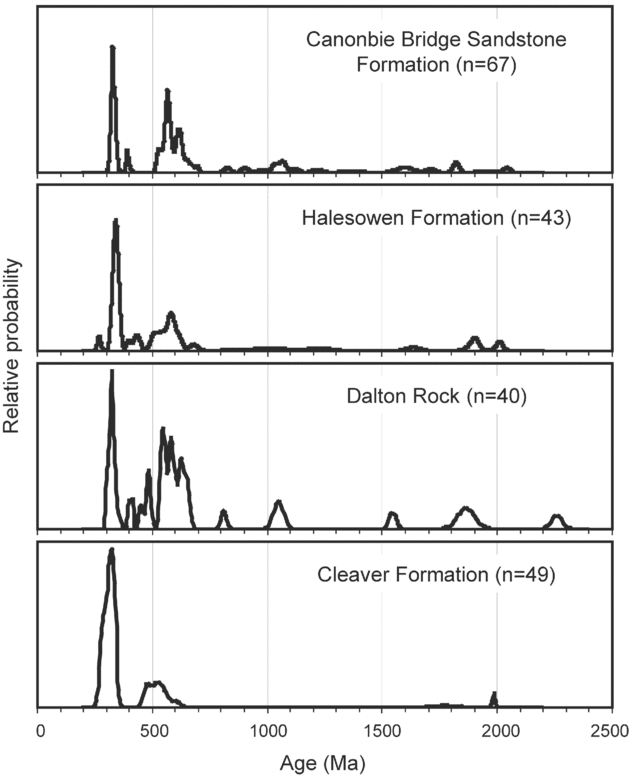
The zircon data therefore indicate that the Canonbie Bridge sandstones represent the products of a river system that drained the Variscan orogenic belt several hundreds of kilometres to the south or southeast, providing strong support for the suggestion made on the basis of petrographical, heavy mineral and palaeocurrent evidence (Jones, Holliday & McKervey, Reference Cope, Guion, Sevastopulo, Swan, Cope, Ingham and Rawson2010). The zircon age structure of the Halesowen Formation of the English Midlands, which has similar petrographical and heavy mineral characteristics (Jones, Holliday & McKervey, Reference Cope, Guion, Sevastopulo, Swan, Cope, Ingham and Rawson2010), is closely comparable to that seen in sample NJN100 (Fig. 8). The Halesowen zircon age spectrum contains two main groups (357–323 Ma and 651–534 Ma), comprising 38 % and 33 % of the population, respectively. These peaks directly match the two main peaks in the Canonbie Bridge Sandstone Formation, although the relative abundance of zircons in the two groups is somewhat different. The other components of the Halesowen spectrum also correspond to those present in the Canonbie Bridge Sandstone Formation (Fig. 8). There is little doubt that the Halesowen Formation and the Canonbie Bridge Sandstone Formation share a common provenance, and that their source area lay within the Variscides of western or central Europe.
Comparison of detrital zircon age spectra from the Canonbie Bridge Sandstone Formation compared with other Carboniferous sandstones derived from the Variscides, adapted from Hallsworth et al. (Reference Hallsworth, Morton, Claoué-Long and Fanning2000) and Morton et al. (Reference Morton, Hallsworth and Claoué-Long2001, Reference Morton, Hallsworth, Moscariello, Collinson, Evans, Holliday and Jones2005).
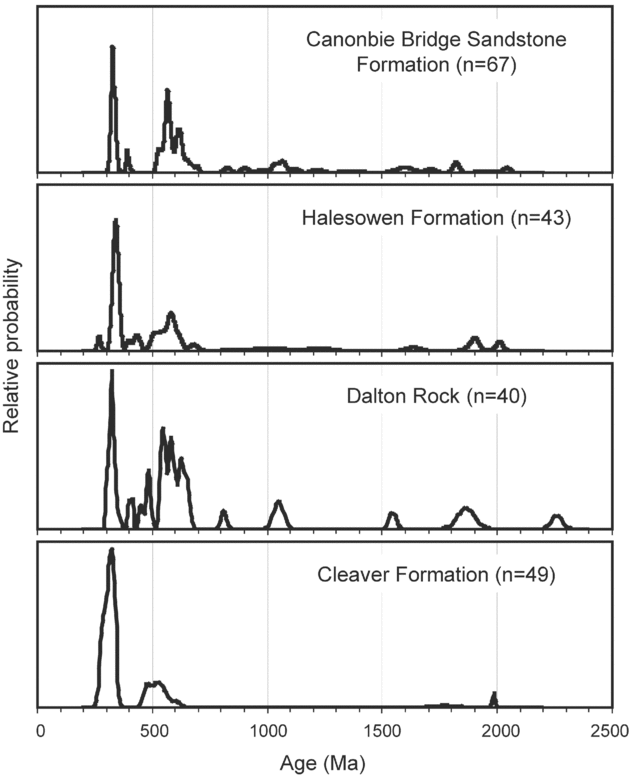
The Dalton Rock (Bolsovian) near Sheffield, Yorkshire, and the Cleaver Formation (Duckmantian) of the southern North Sea also have zircon age populations diagnosing derivation from the Variscides (Hallsworth et al. Reference Hallsworth, Morton, Claoué-Long and Fanning2000; Morton, Hallsworth & Claoué-Long, Reference Morton, Hallsworth and Claoué-Long2001; Morton, Hallsworth & Moscariello, Reference Morton, Hallsworth, Moscariello, Collinson, Evans, Holliday and Jones2005). These sandstones have bimodal zircon populations similar to those in the Canonbie Bridge Sandstone and Halesowen formations (Fig. 8), with Carboniferous and late Neoproterozoic to early Cambrian peaks.
There are two likely sources for these Variscan-derived sandstones: the Saxo-Thuringian Zone of central Europe and the Armorican Massif of Brittany. As discussed above, both of these areas have Early Carboniferous granitoids intruding Cadomian crust. It is unlikely that Armorican-derived sediment could have reached the Pennine Basin and southern North Sea areas during the Duckmantian–Bolsovian, since the Wales-Brabant High was an area of positive relief at that time (Besly, Reference Besly, Besly and Kelling1988; Cope et al. Reference Cope, Guion, Sevastopulo, Swan, Cope, Ingham and Rawson1992). Consequently, the Cleaver Formation and Dalton Rock are believed to have been derived from the Saxo-Thuringian Zone to the southeast (Morton, Hallsworth & Claoué-Long, Reference Morton, Hallsworth and Claoué-Long2001; Morton, Hallsworth & Moscariello, Reference Morton, Hallsworth, Moscariello, Collinson, Evans, Holliday and Jones2005). However, during the Asturian, there is evidence that the Wales-Brabant High was breached (Besly, Reference Besly, Besly and Kelling1988), a view supported by the similarity between the petrographical character of the Halesowen and Canonbie Bridge Sandstone formations (north of the Wales-Brabant High) and the Pennant Sandstone Formation (south of the high), which suggests a common provenance for these sandstones. Hence, it is possible that sediment could have been introduced to the English Midlands and the Canonbie area from the Armorican Massif through the breached Wales-Brabant High at this time (Hallsworth et al. Reference Hallsworth, Morton, Claoué-Long and Fanning2000). However, Sherlock, Jones & Jones (Reference Sherlock, Jones and Jones2000) argued that Bolsovian–Asturian lithic arenites in the Forest of Dean Basin (south of the Wales-Brabant High) were derived from the central European Variscides.
There is heavy mineral evidence indicating that the Dalton Rock and similar ‘Mexborough-type’ sandstones had a different provenance to the Halesowen Formation, the former having higher monazite:zircon (Hallsworth et al. Reference Hallsworth, Morton, Claoué-Long and Fanning2000). It could be argued, therefore, that the Dalton Rock was derived from a different source to the Halesowen and Canonbie Bridge Sandstone formations (Saxo-Thuringian as opposed to Armorican). However, it can equally well be argued that the difference in mineralogy represents a change in the nature of the lithologies available for erosion, for example, through uplift. This question therefore remains to be resolved.
The origin of the older Proterozoic zircons in the Canonbie Bridge Sandstone Formation remains somewhat equivocal. They could either represent older crustal components within the Variscides, or be derived from sources outwith the Variscan belt. Most of the peri-Gondwanan terranes in central and western Europe have a Palaeoproterozoic (c. 2.2–2.0 Ga) protolith (Armorica, Saxo-Thuringia, Moldanubia), with only the Moravian–Silesian area having younger (c. 1.3–1.0 Ga) crust (Calvez & Vidal, Reference Calvez and Vidal1978; Nance et al. Reference Nance, Murphy, Strachan, Keppie, Gutierrez-Alonso, Fernandez-Suarez, Quesada, Linnemann, D'Lemos, Pisarevsky, Ennih and Liégeois2008). Hence, the older Palaeoproterozoic zircons in the Canonbie Bridge Sandstone and Halesowen formations, which extend back to > 2.0 Ga, could have been derived from the western or central European Variscides. The late Mesoproterozoic to early Neoproterozoic group in the Canonbie Bridge Sandstone Formation is approximately coeval with the so-called ‘Pentevrian’ event (c. 900–1100 Ma), formerly believed to be the age of the Penthièvre massif in Brittany (Bishop, Roach & Adams, Reference Bishop, Roach, Adams, Harris, Shackleton, Watson, Downie, Harland and Moorbath1975), but the significance of this event was subsequently called into question by Roach, Lees & Shufflebotham (Reference Roach, Lees, Shufflebotham, D'Lemos, Strachan and Topley1990). High-grade paragneisses in the Mid-German Crystalline Rise (adjacent to the Saxo-Thuringian Zone) contain small numbers of c. 1.0 Ga zircons in association with dominant c. 550 Ma and c. 2.06 Ga zircons (Zeh et al. Reference Zeh, Brätz, Miller and Williams2001). In the Massif Central of France, Visean volcanic rocks contain xenocrystic zircons dated as Mesoproterozoic, > 1.0 Ga (Bruguier et al. Reference Bruguier, Becq-Giraudon, Bosch and Lancelot1998), approximately coeval with the late Mesoproterozoic to early Neoproterozoic group in the Canonbie Bridge Sandstone Formation. Therefore, there is evidence to indicate that late Mesoproterozoic to early Neoproterozoic zircons could have been derived from basement rocks in the Variscides. It is also possible that early Neoproterozoic to Palaeoproterozoic zircons could have been recycled from sandstones within the Variscides. For example, Gerdes & Zeh (Reference Gerdes and Zeh2006) and Linnemann et al. (Reference Linnemann, Pereira, Jeffries, Drost and Gerdes2008) have established that early Neoproterozoic (c. 850 to 1000 Ma) and Palaeoproterozoic (c. 1700 to 2250 Ma) zircon age populations are present as detrital components within sandstones of the central European Variscides. Therefore, the only Proterozoic component of the zircon age spectrum that cannot be readily matched with a source in the Variscides is that found at c. 1600 Ma. It is also possible to find a Variscan source for the zircons dated as 390–396 Ma, since this corresponds to the subduction–obduction cycle of the Rheic and Galicia-Massif Central Palaeozoic oceans (Matte, Reference Matte1986); furthermore, grains of this age have been found in the Visean of the Massif Central (Bruguier et al. Reference Bruguier, Becq-Giraudon, Bosch and Lancelot1998).
For the most part, therefore, the zircon population in the Canonbie Bridge Sandstone Formation can be matched with sources in the Variscides. However, it is also possible that some detritus was supplied from non-Variscan sources traversed by the river system en route to the Canonbie area. Incorporation of a small amount of older northerly derived Carboniferous (Namurian) sediment is one possibility, since these sandstones contain a wide range of mid-Proterozoic grains in conjunction with Silurian–Devonian (Caledonian-age) zircons (Hallsworth et al. Reference Hallsworth, Morton, Claoué-Long and Fanning2000). However, this mechanism should also introduce a small number of Archaean zircons, which does not appear to be the case, the only possible exception being grain 15.1, which yielded an age of 2551 ± 10 Ma but is 24 % discordant. Recycling of northerly derived Old Red Sandstone is another possibility, but cannot be tested owing to the absence of zircon age data from the Old Red Sandstone.
6. Conclusions
The zircon population in the Late Carboniferous Canonbie Bridge Sandstone Formation comprises two main peaks, one of Early Carboniferous age (348–318 Ma), corresponding to the age of igneous activity during the Variscan Orogeny, and one of late Neoproterozoic to early Cambrian age (693–523 Ma), corresponding to the Cadomian. Together, these two groups comprise 70 % of the zircon population. These data show unequivocally that most of the sediment was derived from the Variscides of western or central Europe. The assemblage also contains a range of older Proterozoic zircons, including a late Mesoproterozoic to early Neoproterozoic group (1119–827 Ma), a late Palaeoproterozoic to early Mesoproterozoic group (1712–1566 Ma), and a mid-Palaeoproterozoic group (2042–1818 Ma), together with two Devonian grains. Most of these zircons can also be attributed to Variscan sourcing, the only exception being the c. 1600 Ma group. However, it is also possible that some of the late Mesoproterozoic to Palaeoproterozoic and Devonian zircons were locally derived through recycling of northerly derived sandstones of Devonian–Carboniferous age.
The Canonbie Bridge Sandstone Formation zircon population is closely comparable to those found in other Variscan-sourced sandstones from the UK Carboniferous, the coeval (Asturian) Halesowen Formation of the English Midlands, the older Bolsovian Dalton Rock of Yorkshire, and the Duckmantian Cleaver Formation of the southern North Sea, as described by Hallsworth et al. (Reference Hallsworth, Morton, Claoué-Long and Fanning2000), Morton, Hallsworth & Claoué-Long (Reference Morton, Hallsworth and Claoué-Long2001) and Morton, Hallsworth & Moscariello (Reference Morton, Hallsworth, Moscariello, Collinson, Evans, Holliday and Jones2005).
The zircon age data confirm previous suggestions of a Variscan source for the Canonbie Bridge Sandstone Formation, made on the basis of petrographical, heavy mineral and palaeocurrent evidence (Jones, Holliday & McKervey, Reference Cope, Guion, Sevastopulo, Swan, Cope, Ingham and Rawson2010). This is the most northerly record to date of Variscan-derived sediment in the UK, the previous being the Bolsovian Dalton Rock of Yorkshire. However, the sandstones at Canonbie are thick (channels 2–10 m thick in multi-storey units up to 50 m thick) and are believed to represent fairly extensive northerly flowing fluvial systems. Given their size, it is thought likely that they would extend to at least the Midland Valley of Scotland, and probably beyond. Similar-aged successions are known locally from the Midland Valley (e.g. the Ayrshire Coalfield) and it is interesting to speculate about the provenance of sandstones in this area.
Possible sources for the Canonbie Bridge Sandstone Formation and coeval Halesowen Formation are the Armorican Massif of Brittany and the Saxo-Thuringian Zone of the central European Variscides. Derivation from the former would require transport across the Wales-Brabant High, which is believed to have been breached by this time (Besly, Reference Besly, Besly and Kelling1988). The Saxo-Thuringian Zone is believed to have supplied the earlier Westphalian Variscan-sourced sandstones (Morton, Hallsworth & Claoué-Long, Reference Morton, Hallsworth and Claoué-Long2001; Morton, Hallsworth & Moscariello, Reference Morton, Hallsworth, Moscariello, Collinson, Evans, Holliday and Jones2005), but these have different heavy mineral characteristics to the Asturian (Hallsworth et al. Reference Hallsworth, Morton, Claoué-Long and Fanning2000), implying they had a different provenance. However, this could either reflect a geographical shift in source or evolution of the lithological characteristics within the same source area, and cannot be taken as proof of Armorican versus central European sourcing.
Acknowledgements
We are grateful to Doug Holliday for his help and encouragement with this study, to John McKervey for providing the heavy mineral separate, and to Dirk Frei for his helpful comments on a previous version of the manuscript.