Although the descriptive representation of women has substantially improved during the past several decades (IPU 2020), political institutions are often still criticized for being gendered—that is, for maintaining problematic inequalities between male and female officeholders (Erikson and Verge Reference Erikson and Verge2020; Lowndes Reference Lowndes2020). While these persistent inequalities may be overlooked when narrowly focusing on the numeric presence of women, they become clear when scrutinizing the functioning of representative institutions and their officeholders’ behavior more intensively (Bäck and Debus Reference Bäck and Debus2019; Taylor-Robinson Reference Taylor-Robinson, Martin, Saalfeld and Strom2014).
This article contributes to our understanding of how political institutions may uphold gendered differences. Looking at parliamentary behavior, research has shown that female and male members of parliament (MPs) emphasize different topics in their legislative agendas (Schwindt-Bayer 2006; Taylor-Robinson and Heath Reference Taylor-Robinson and Heath2003), and that women MPs get to take the floor less often than their male counterparts, especially during “hard” policy debates covering topics that are commonly linked to men's stereotypical strengths and interests (e.g., Bäck and Debus Reference Bäck and Debus2019; Bäck, Debus, and Müller Reference Bäck, Debus and Müller2014). Still, much remains unknown about the role that political parties play in fostering behavioral differences between male and female MPs. Since parties are powerful gatekeepers of parliamentary work (Saalfeld and Strøm Reference Saalfeld, Strøm, Martin, Saalfeld and Strøm2014), such studies would provide deeper insights into the causes of these persistent disparities.
This article examines whether the degrees of party control and intraparty competition associated with different types of parliamentary instruments have gendered effects on the use of those instruments. We focus on parliamentary questions (PQs), which are used extensively by MPs to scrutinize the executive, represent citizens’ concerns, and gain personal publicity. PQs have been praised as rather “sincere” manifestations of individual parliamentary behavior (Rozenberg and Martin Reference Rozenberg and Martin2011, 398). Compared to other types of parliamentary activity, such as the sponsorship or initiation of bill proposals, motions, or resolutions that may be followed by a vote and thus could reveal intraparty disunity, PQs are typically less subject to monitoring and control by political parties (Rozenberg and Martin Reference Rozenberg and Martin2011). However, formal rules on PQs (and their different types) typically vary (Rasch Reference Rasch2011; Russo and Wiberg Reference Russo and Wiberg2010). While MPs in some cases do enjoy a lot of leeway to autonomously draft and table PQs (e.g., written PQs), in other cases (e.g., plenary PQs), their use is more subject to the formal control of (party) gatekeepers. Moreover, the scarcer and more visible character of some PQs (e.g., plenary PQs) might lead to an increase in (intraparty) competition among MPs. After all, as the debates that follow from PQs often receive considerable press coverage, they are an important source of information for voters, providing MPs with opportunities to highlight their personal expertise and elucidate their policy positions (Bäck, Debus, and Müller Reference Bäck, Debus and Müller2014; Pearson and Dancey Reference Pearson and Dancey2011; Proksch and Slapin 2012). Hence, if the possibility to table particular PQs is influenced by gender, this hampers not only female MPs’ visibility to voters, but potentially the substantive articulation of their policy interests and even the overall legitimacy of parliamentary procedures.
Drawing on a new data set on the use of PQs (N = 180,783) in the Belgian Chamber of Representatives between 1995 and 2019, this article examines how often and on which topics female and male MPs ask PQs. More specifically, we are interested in whether potential gender differences in the questioning behavior of MPs are contingent upon the degree of party control and intraparty competition associated with particular types of PQs. We hypothesize that gender differences, in terms of women asking fewer PQs on “hard” topics and more PQs on “soft” topics, are larger with regard to questions on which party control is strong and intraparty competition large (e.g., oral plenary PQs, particularly in larger party groups) compared to questions that result from MPs’ individual prerogatives and thus are associated with less competition and party control (e.g., written PQs).
Multivariate regression analyses reveal that in Belgium, gendered differences in the policy issue concentration of MPs exist. These differences, moreover, are more visible in PQs that are associated with a greater degree of party control (i.e., oral plenary PQs) compared to PQs that MPs may draft and table relatively unrestrictedly and autonomously (i.e., written PQs). These findings both bring new insights into the gendered and behavioral side effects of parliamentary procedure and shed some light on the “free choice versus coercion” controversy with regard to women's substantive focus of parliamentary work.
THEORY AND HYPOTHESES
Although a basic feature of contemporary parliaments is that all members are nominally equal (Strøm Reference Strøm and Döring1995), a number of inegalitarian differences appear when looking at empirical research on women MPs. Whereas women's numeric presence in parliament steadily increased because of the introduction of electoral gender quotas, among other things (e.g., Dahlerup Reference Dahlerup2007; Matland Reference Matland, Ballington and Karam2005), women still encounter restricted access to positions higher up the political hierarchy (e.g., Krook and O'Brien Reference Krook and O'Brien2012) or to particular (often “prestigious”) committees (e.g., Bækgaard and Kjaer Reference Bækgaard and Kjaer2012; Carroll Reference Carroll and Reingold2008). Focusing specifically on parliamentary behavior, studies have found that female MPs take the floor less frequently to deliver speeches compared with male MPs (Bäck and Debus Reference Bäck and Debus2019; Bäck, Debus, and Müller Reference Bäck, Debus and Müller2014; Kathlene Reference Kathlene1994). However, these studies have been met with some countervailing empirical evidence, as a number of case studies in other settings (e.g., Pearson and Dancey Reference Pearson and Dancey2011) have found that women are as equally active participants in debates as are their male colleagues (Taylor-Robinson Reference Taylor-Robinson, Martin, Saalfeld and Strom2014).
More unambiguous findings result from studies focusing on the substantive dimension of female MPs’ work. This literature points to a “horizontal division of labor,” whereby female MPs specialize in a distinct range of policy domains. Bäck, Debus, and Müller's (Reference Bäck, Debus and Müller2014) study of the Swedish Riksdag shows that female MPs deliver significantly fewer speeches and that the only policy domains in which the differences between male and female MPs are smaller are soft policy areas, such as health or welfare policy. These findings are corroborated in a comparative study covering seven European legislatures (Bäck and Debus Reference Bäck and Debus2019). In addition, Clayton, Josefsson, and Wang (Reference Clayton, Josefsson and Wang2017), focusing on Ugandan plenary debates, conclude that women and men MPs emphasize different policy agendas.
These differences can be explained not only by general theories of women's substantive representation, but also by theories of gender stereotypes and gender role incongruity (Bäck and Debus Reference Bäck and Debus2019; Eagly and Karau Reference Eagly and Karau2002). The former literature highlights that women MPs see themselves as acting for women and empathize with them in particular. Parliamentary activities, such as introducing legislation, debating, and voting, are some of the ways in which women MPs can act for women. Women MPs, therefore, may have a greater interest in speaking during debates on issues that they view as disproportionately affecting women. Mackay (Reference Mackay2001), for example, finds that elected women believe they have a responsibility to act for women by raising issues such as child care and equal opportunity in policy debates. The latter literature argues that voters, party selectorates, and media actors unconsciously associate politicians’ gender with particular capacities and opinions (Huddy and Terkildsen Reference Huddy and Terkildsen1993). Women are believed to have more attributes of the “communal dimension,” which describes a sense of empathy and concern with the welfare of other people (e.g., affectionate, helpful, kind, nurturing, and sensitive). Men are supposed to have more attributes of the “agentic dimension,” which refers to an assertive and controlling tendency (e.g., ambitious, dominant, independent and self-confident) (Eagly Reference Eagly1987). These assumptions about candidates’ personalities result in a number of stereotypical patterns in which female candidates are more likely to be perceived as competent in soft issues linked to the traditional domain of the family, such as education, health care, and helping the poor. Men, on the other hand, would do a better job with hard issues, such as the military, foreign trade, and taxes (see, e.g., Dolan Reference Dolan2014; Huddy and Terkildsen Reference Huddy and Terkildsen1993). Following this reasoning, female MPs would deliver fewer speeches in debates focusing on policy areas that can be characterized as hard, since they reflect men's stereotypical strengths (Escobar-Lemmon and Taylor-Robinson Reference Escobar-Lemmon and Taylor-Robinson2008; Lawless Reference Lawless2004).Footnote 1
Multiple mechanisms may drive gendered differences in parliamentary activity. From a pessimistic point of view, behavioral differences between male and female MPs may result from actual discrimination in the legislature and gendered informal institutional norms. Men, who still make up the majority of parliaments and are overrepresented in leadership positions, may guard their traditional policy domains in the legislature. Alternatively, party leaders might strategically appoint male and female spokespersons on particular topics when they believe that the party will be assessed as more competent on those topics when they do so (Bäck, Debus, and Müller Reference Bäck, Debus and Müller2014, 514), even though there is limited evidence for such competence stereotypes among voters (Devroe and Wauters Reference Devroe and Wauters2018). As a result, women might involuntarily find themselves “pushed” toward soft topics (Bækgaard and Kjaer Reference Bækgaard and Kjaer2012; Carroll Reference Carroll and Reingold2008). The push mechanism might be more indirect and subtle, however; for instance, women may refrain from addressing prestigious hard policy domains when they feel they are not really expected to do so (Pratto et al. Reference Pratto, Stallworth, Sidanius and Siers1997) or when they simply do not desire to compete with male legislators over popular and politically important policy domains (Niederle and Vesterlund Reference Niederle and Vesterlund2007). From a more optimistic perspective, women MPs might also self-select into specific policy areas because of common interests and shared social identities (Carroll Reference Carroll and Reingold2008). Following Phillips's (Reference Phillips1995) idea of a “politics of presence,” female MPs might have a distinct set of priorities, resulting in a stronger desire than men to actively engage in particular topics in the legislative process. Consequently, female MPs might be deliberately “pulled” toward soft policy topics.
In light of this discussion, a more profound understanding of the role that political parties play in creating gender gaps in parliamentary activity is highly relevant. This article examines the substantive focus of female MPs’ parliamentary activity and the influence of parties on that activity by connecting gendered perspectives on parliamentary behavior to the surging number of studies examining MPs’ use of parliamentary questions (PQs). PQs make up a large part of the day-to-day parliamentary work of MPs and serve many purposes. First and perhaps foremost, MPs use them to hold the executive accountable, scrutinize cabinet members, extract information, and steer government policy in the desired direction (Otjes and Louwerse Reference Otjes and Louwerse2018). Beyond that, PQs also serve more individual political purposes. MPs may use PQs to substantively represent constituents’ interests and show concern for the needs of particular social groups (e.g., Bird Reference Bird2005; Saalfeld Reference Saalfeld2011) or geographical entities (e.g., Russo Reference Russo2011). Particularly when PQs take place during plenary sessions (e.g., “Question Time”), they provide backbenchers with much-desired opportunities to gain publicity, showcase expertise, articulate policy preferences, and build up a personal reputation.
Importantly, the formal rules surrounding different types of PQs typically vary (Russo and Wiberg Reference Russo and Wiberg2010). Although PQs (particularly written ones) have been praised as rather “sincere” manifestations of individual parliamentary behavior, as legislators may draft and table them relatively autonomously (Rozenberg and Martin Reference Rozenberg and Martin2011, 398), some PQs are distinctly subject to more party control (Rasch Reference Rasch2011). Particularly during plenary sessions, time is scarce and a fixed window dedicated to PQs is often delineated. As the possibility to direct PQs to the executive in front of a full house comes both with prestige and media attention, MPs typically queue up for the occasion, resulting in high levels of intraparty competition. This can have negative effects for female MPs, who are generally more likely to exhibit competition-averse behavior (Niederle and Vesterlund Reference Niederle and Vesterlund2007). Furthermore, under such circumstances, the allocation of PQs is typically left to the informal judgment of party group leaders, whose primary concern might not be to outline a perfectly fair distribution of opportunities for self-promotion among group members, but rather to strategically select speakers who can most convincingly articulate the party position on a particular topic (Proksch and Slapin 2012; Rasch Reference Rasch2011). Because MPs typically have incentives not only to cultivate a personal vote (e.g., by taking the floor and gaining personal publicity) (Carey and Shugart Reference Carey and Shugart1995), but also to please party selectorates, they might be inclined to abide by party leaders’ judgments and not interfere during these particular debates.
Hence, we argue that it is crucial to take into account the role of political parties when studying gendered differences. When parties and their leaders are struck by the idea that voters have specific norms of whether certain policy issues are considered soft or hard, these norms might also become internalized by the political party (Bäck, Debus, and Müller Reference Bäck, Debus and Müller2014). Electoral considerations could incentivize parties to select male speakers in general, and on hard policy topics in particular, when they believe that doing do would allow the party to bring a message more convincingly.
We examine the impact of parties on female MPs’ questioning behavior by differentiating between several types of PQs and hypothesizing that gendered differences are contingent upon the degree of party control associated with particular types of PQs. In line with previous studies, we hypothesize the following:
H1: Female MPs will ask more PQs on soft policy topics and fewer PQs on hard policy topics compared to male MPs.
However, in light of the foregoing, and notwithstanding any more or less formalized a priori horizontal division of labor in specialized committees, we expect that female MPs more often intervene on hard policy domains (and less often on soft policy domains) when they may freely and autonomously table PQs, compared to PQs on which access is more restricted and the gatekeeping role of political parties is larger, as typically is the case during plenary sessions:
H2: Female MPs will ask more PQs on soft policy topics and fewer PQs on hard policy topics than male MPs when the degree of party control associated with particular types of PQs is larger.
In addition, PQs (particularly plenary ones) are a scarce good, and MPs have good reason to want to showcase their expertise on particular topics during (plenary) debates. In the case of actual competition-averse behavior by female MPs (Niederle and Vesterlund Reference Niederle and Vesterlund2007), it can be expected that gendered differences further increase when the degree of intraparty competition to be able to ask PQs increases—that is, when a relatively smaller number of PQs are to be divided among a larger number of MPs, as might be the case in larger party groups when a fixed number of PQs per party group is delineated (the allocation of plenary PQs in Belgium will be discussed later in this article).
H3: Gendered differences, in terms of female MPs asking more PQs on soft policy topics and fewer PQs on hard policy topics than male MPs, further increase when the level of intraparty competition associated with PQs increases.
DATA AND METHODS
The Belgian Case
We test these hypotheses using a novel data set on MPs’ questioning activity in the federal Chamber of Representatives of Belgium. The Belgian case is interesting for three reasons. First, from an international perspective, Belgium has a comparatively high share of female legislators: more than 40 percent in the last decade (IPU 2020). Second, research has shown that Belgium's electorate, at least that of the Flemish region,Footnote 2 hold very limited political gender stereotypes based on the issue competence of male and female politicians (Devroe and Wauters Reference Devroe and Wauters2018). Third, during consecutive constitutional reforms that have transformed the country into a federal state since 1970, many competences that can be described as soft (e.g., education, culture, elderly and child care) were transferred to the subnational level. Consequently, many of the remaining competences at the federal level are hard (e.g., defense, foreign affairs, justice), albeit with a few exceptions (e.g., social security, health care). Therefore, the Belgian Chamber of Representatives can be seen as a crucial confirmatory (least-likely) case. Because of the high level of gender equality and the nature of federal competences, one could expect a normalization of female MPs engaging in hard policy domains.
Variables and Statistical Models
Our raw data set contains detailed information on every single PQ (N = 180,783) that was tabled in the Chamber of Representatives between 1995 and 2019. These data cover six consecutive legislative terms and 1,121 individual legislators. Belgian federal MPs are entitled to ask three types of PQs. Written PQs (N = 101,965) are submitted on an individual basis and require a written answer from the targeted minister within 20 working days. Oral committee PQs (N = 65,836) are tabled at least one day in advance of a committee meeting. In that meeting, the MP reads out the question, the involved minister gives an oral answer, and the MP makes a brief concluding statement. Although they are also submitted on an individual basis and MPs may formally table PQs in any committee meeting, party groups have an indirect effect through the allocation of committee seats at the beginning of the term.Footnote 3
Oral plenary PQs (N = 12,982) follow a similar procedure as oral committee PQs, but the right to ask plenary PQs is much more subject to party group control. Prior to the weekly plenary session, the party group leaders communicate to the Speaker of the House who will ask a plenary PQ on the party groups’ behalf. They typically do so after consulting the MPs in the party group meeting preceding the weekly plenary session. Although individual MPs can make individual proposals, party group leaders play an important role in leading these discussions and deciding in case of disagreement, thereby considering what is collectively and strategically the most interesting option for the party (de Vet Reference de Vet2019). This can be a hard choice, particularly in large party groups, because the number of PQs that a party group is entitled to ask per weekly plenary session is not determined proportionally based on their seat numbers. Instead, each recognized party group—no matter the size—is entitled to ask only two PQs,Footnote 4 which in practice means that an MP who belongs to a party group of 30 members has a much smaller chance of taking the plenary floor that week than an MP who belongs to a party group of 5 members. This leads to an increase in intraparty competition among MPs in large groups to be allotted these highly visible oversight instruments. The following analyses primarily focus on MPs’ use of written and oral plenary questions, since contrasting these individual instruments (characterized by a lot of autonomy) and group-based instruments (strongly controlled by party groups) provides us with a good opportunity to test our theoretical hypotheses.
Besides collecting basic information on each PQ, such as their author, title, type, date, meeting, and the targeted minister, we gathered up to 10 standardized EuroVoc descriptors per PQ from the Chamber's official online repository.Footnote 5 These descriptors are assigned by the Chamber's administrative clerks and provide a detailed indication of the content of each PQ. The multilingual EuroVoc thesaurus (www.eurovoc.eu) consists of 7,243 unique, hierarchically structured lemmas. Similar to other studies (e.g., Vliegenthart and Walgrave Reference Vliegenthart and Walgrave2011), we reduced the number of issue codes in a first step by reclassing them into the 127 inbuilt aggregate categories (i.e., the “microthesauri”). The number of categories was further reduced by recoding them into the 21 major policy areas outlined by the Comparative Agendas Project (CAP),Footnote 6 which fosters the cross-national comparability of our results (e.g., Bäck and Debus Reference Bäck and Debus2019). Our issue codebook can be found in Appendix A1 in the supplementary material online.
Because PQs typically have multiple EuroVoc descriptors (mean = 3.61, standard deviation = 1.49), and because the Chamber does not systematically assign primary descriptors, we use a fine-grained operationalization of PQs’ policy content. This circumvents the potential loss of crucial nuances when relying on rudimentary or single-issue coding.Footnote 7 If a single PQ has 4 descriptors on “social affairs” and 1 on “macroeconomics,” that PQ is weighted by a factor of 0.8 and 0.2, respectively, as a PQ on these policy domains. When aggregating the number of (weighted) PQs per MP per policy domain, we obtain a total N close to (but not identical because of rounding errors) the actual total number of PQs posed.
In order to model both the amount and substantial focus of MPs’ PQs, we constructed a dyadic data set containing each possible combination of MPs and policy domains as the basic unit of analysis (N = 23,541) (see also Bäck and Debus Reference Bäck and Debus2019; Proksch and Slapin 2011). Our central dependent variables measure how many (written and oral plenary) PQs MPs pose in a specific policy domain. Because these are overdispersed integer count variables (see Appendix A2), we fitted negative binomial regression models that regress the number of PQs posed by MPs per domain against a range of independent and control variables.Footnote 8
The central independent variable is a dummy variable indicating the gender of MPs (1 = female). A categorial variable indicates whether a policy domain is hard, soft, or neutral. Following Krook and O'Brien (Reference Krook and O'Brien2012), macroeconomics, labor, defense, transport, immigration, foreign affairs, domestic trade, foreign trade, law and crime, technology, and agriculture are coded as hard policy domains. Social affairs, health, education, and arts and culture are identified as soft, and the remaining policy domains are coded as neutral.Footnote 9 Party group size, which is expected to increase intraparty competition on specific types of (hard, plenary) PQs, is operationalized as the seat share (percent) of a party in the legislature.
A number of additional variables potentially affect legislators’ activity and substantive focus and therefore should be taken into account. At the individual level, we control for differences in activity that result from premature seat changes by coding the relative time the MP served during that term (1 = full term). Furthermore, we control for the parliamentary tenure of MPs (coded as the number of years since the MPs first entered a federal or regional parliament) or whether MPs hold a position as extraparliamentary party president or parliamentary party group (PPG) leader (dummy, 1 = leadership role). The electoral vulnerability of MPs is computed as a measure that theoretically ranges from 0 (safe seat) to 1 (insecure seat) and is obtained by dividing the order in which an MP was elected on a district list by the total number of seats his or her party won in that district in the previous elections (e.g., André, Depauw, and Martin Reference André, Depauw and Martin2015).Footnote 10 The basic idea behind these controls is that inexperienced or electorally insecure MPs have more incentives to showcase activity (to party selectorates or voters) compared to those with more experience, electoral security, or leadership functions who might employ instruments more selectively (Strøm Reference Strøm, Blomgren and Rozenberg2012). Because MPs’ membership of particular committees might interfere with the results, we additionally add a dummy variable that indicates whether an MP is a permanent member of the standing committee that is in charge of the corresponding policy domain.Footnote 11
At the party level, a dummy variable distinguishes between opposition and majority party groups (1 = governing party), as opposition MPs are expected to be more active with regard to oversight activities. Since leftist party groups might be more sensitive to both soft issues and gender equality (Krook Reference Krook2010), we add a variable based on Chapel Hill Expert Survey data (Bakker et al. Reference Bakker, Hooghe, Jolly, Marks, Polk, Rovny, Steenbergen and Vachudova2020) indicating a party's ideological position on a general left-right scale (0 = left, 10 = right). Lastly, and mainly to account for the fact that MPs have progressively become more active in tabling PQs in recent years (Rozenberg and Martin Reference Rozenberg and Martin2011), a categorical variable distinguishes between the six legislative terms.
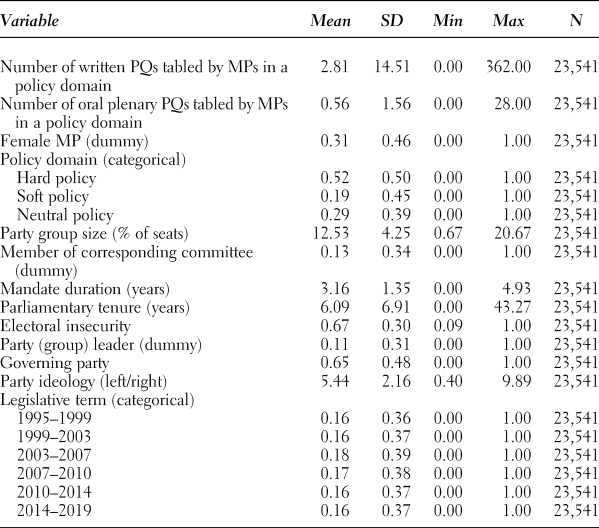
Table 1 provides descriptive statistics of all variables. All multivariate models are estimated using robust standard errors, clustered at the level of the MP.
Descriptive statistics

RESULTS
Bivariate Analyses
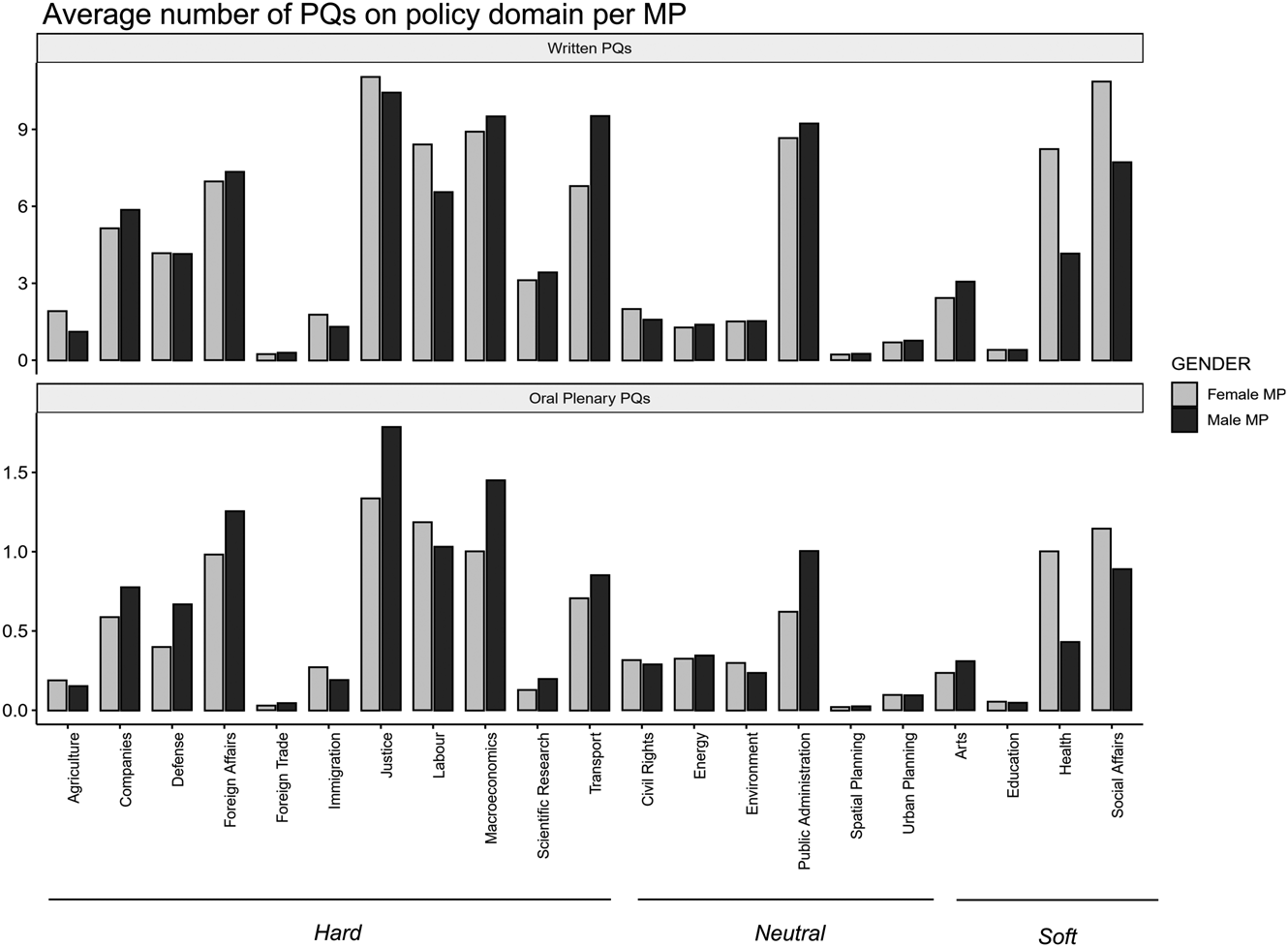
Before analyzing the substantive focus of male and female MPs’ PQs using multivariate analyses, we take a look at some descriptive results. Figure 1 presents a bivariate comparison of the average number of PQs asked by male and female legislators per policy domain.
Bivariate differences between male and female MPs’ questioning activity.

Immediately, a number of interesting observations strike the eye. First of all, Figure 1 neatly shows how some policy domains simply attract more attention than others in the Belgian Chamber. A lot of PQs focus on domains like foreign affairs, justice, labor, or macroeconomics, while only a minority deal with topics such as arts and culture, education, foreign trade, or spatial and urban planning. As discussed earlier, to some extent, this can be explained by the fact that many of those (less popular) competences are (fully or partially) devolved to the subnational regions and communities. Still, although many of the remaining federal competences could be described as hard, soft domains like social affairs or health remain (largely) federal and do instigate a lot of PQs.
Second, Figure 1 already hints at distinct differences between male and female MPs. When looking at the average number of written PQs posed by legislators, these differences appear particularly large on policy domains such as social affairs and health. As hypothesized (H1), women appear more active in these soft policy domains. Conversely, men are more active on hard policies such as transport, foreign affairs, macroeconomics, and companies and domestic trade. It should be noted that—at least when looking at written PQs—these differences on hard topics are often very small (transport being an exception) and sometimes go against the expected direction (e.g., labor and justice).
Interestingly, however, a third observation is that many differences between male and female legislators on hard policy topics seem to increase during plenary sessions. Particularly in areas such as justice, macroeconomics, defense, and foreign affairs, gendered differences that are rather small at first (in terms of MPs’ use of written questions) become larger when analyzing plenary PQs. These bivariate findings seem to provide some preliminary support for H2: although women MPs do address hard topics when they may do so autonomously and unrestrictedly, male MPs appear considerably more active in these domains when access to the floor is more restricted and party control is greater. However, as intervening factors might be at play (e.g., female MPs typically occupy fewer leadership positions or have less electoral security), we turn toward the multivariate analyses.
Multivariate Analyses
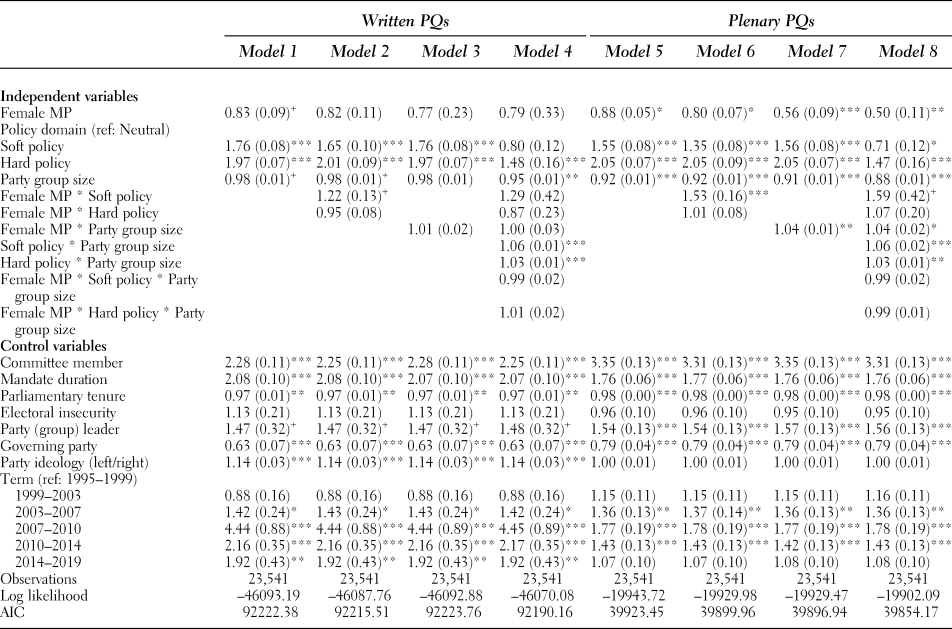
Table 2 shows a series of negative binomial regression analyses that model the number of PQs posed by MPs on specific policy domains. We fitted the same models twice, once for the number of written PQs and once for the number of oral plenary PQs as the dependent variable.Footnote 12 The former are characterized by relative individual autonomy for MPs and nonrestricted use, while the latter are group-based and party-controlled instruments.Footnote 13 To enhance the interpretability of the results, the regression estimates are presented as incidence rate ratios. Scores above 1 indicate a positive effect, scores below 1 the opposite.
Negative binomial models explaining the number of PQs tabled by MPs in a policy domain

Note: Coefficients are incidence rate ratios (cluster-robust standard errors between parentheses).
*** p < .001; ** p < .01; * p < .05; + p < .1.
We first look at the negative binomial regression models (1–4) that explain the number of written PQs tabled by MPs. The baseline Model 1 shows that, controlling for other factors, female MPs in the Belgian Chamber are slightly less active in drafting written PQs, although this effect is only statistically significant at the p < .1 level. In addition, soft and hard policy domains attract more written PQs compared to neutral policy areas. Party group size has a very small negative effect on the number of written PQs tabled, and most of the control variables go in the expected direction: legislators who are permanent members of the standing committee dealing with a policy domain and members who served a full term logically ask more PQs (in a policy domain). Having a lot of parliamentary experience and belonging to a governing or leftist party, on the contrary, have negative effects.
More central to the research purposes of this article are the interaction effects in Models 2–4. Model 2 shows a positive effect of female MPs asking more written PQs on soft policy topics. Although some prudence is appropriate, as the effect is quite small and only significant at the p < .1 level, this finding suggests that women also mostly address soft topics when they enjoy relative autonomy to unrestrictedly do so. Further three-way interaction terms with PPG size (about which we did not hypothesize regarding written PQs) show no significant effects.
More interesting effects emerge, however, when contrasting these models with the models explaining the use of more party-controlled oral plenary PQs. Baseline Model 5 shows how women less often than men are able to make use of scarce plenary time to ask PQs. This is true even when controlling for variables like holding a party leadership position, electoral insecurity or parliamentary experience. What also becomes clear is that particularly hard and, to a lesser extent, soft policy domains are more popular topics than neutral policy domains during plenary sessions. Moreover, we see a negative and significant effect for PPG size on the number of plenary PQs. This was expected, as larger PPGs in the Belgian Chamber, like small PPGs, are entitled to only two oral plenary PQs per week, increasing the degree of intraparty competition in the allocation of these resources.
When further exploring the interaction effects in Models 6–8, we first of all see that female MPs appear much more likely than men to address soft topics in the (fewer) plenary PQs that are allotted to them. This effect on oral plenary PQs (Model 6) is, moreover, more clear and sizable than the effect on written PQs (Model 2). Although the models thus confirm the presence of a significant interaction effect between policy domains and MPs’ gender, these interaction terms and their substantial effect remain somewhat difficult to interpret, the more so because policy domain is a multinomial categorical variable, which means that the coefficients should be interpreted as relative differences to the reference category (i.e., neutral policy domains).
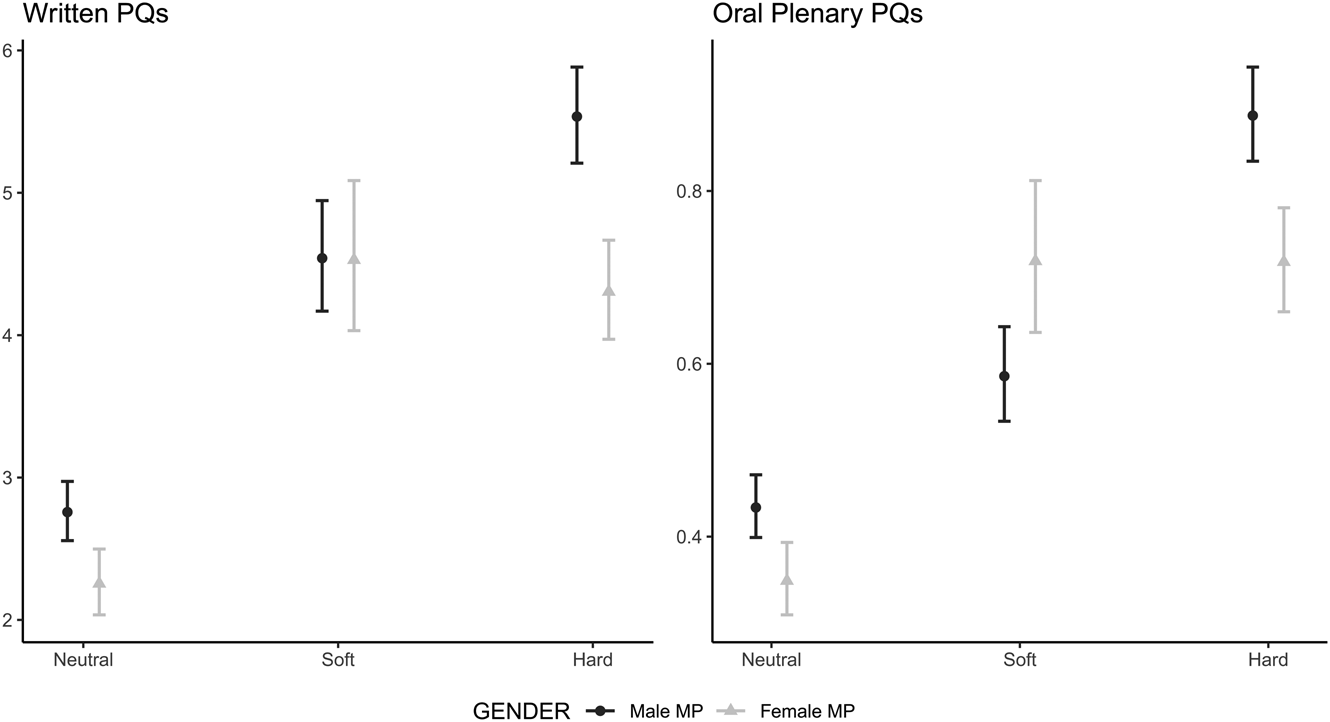
Therefore, we refer to Figure 2, which plots the predicted number of hard, soft, and neutral policy PQs posed by male and female MPs based on Models 2 and 6 in Table 2. This immediately makes a number of things clear. First of all, Figure 2 shows that male MPs ask more PQs in hard but also in neutral policy domains compared to female MPs. This is true not only for oral plenary PQs but also for written PQs. Instead, what seems to drive the more substantial and clear significant interaction effect between MPs’ gender and their PQs’ policy focus in Model 6 (compared to Model 2) is the fact that women more often address soft policy domains than men in their oral plenary PQs (i.e., where party gatekeepers play a large role in deciding who takes the floor) but not in their written PQs (i.e., which MPs may draft and table relatively autonomously).
Predicted number of hard, soft, and neutral policy PQs tabled by male and female MPs. Marginal effects computed based on Model 2 and Model 6 (Table 2), respectively. All covariates are held constant at their mean. 95% confidence intervals.

It should be noted, however, that these effects seem driven not by female MPs emphasizing soft policy domains over hard policy domains (they seem to address the topics to an equal degree), but by male MPs deemphasizing soft policy domains and focusing on hard PQs during plenary sessions (which constitute the majority of plenary PQs). These findings thus provide partial support for both H1 and H2: although female legislators less often ask hard policy (written and oral plenary) PQs than men, they only address soft topics more often than men in their oral plenary PQs, which are associated with a higher degree of party coordination and control.
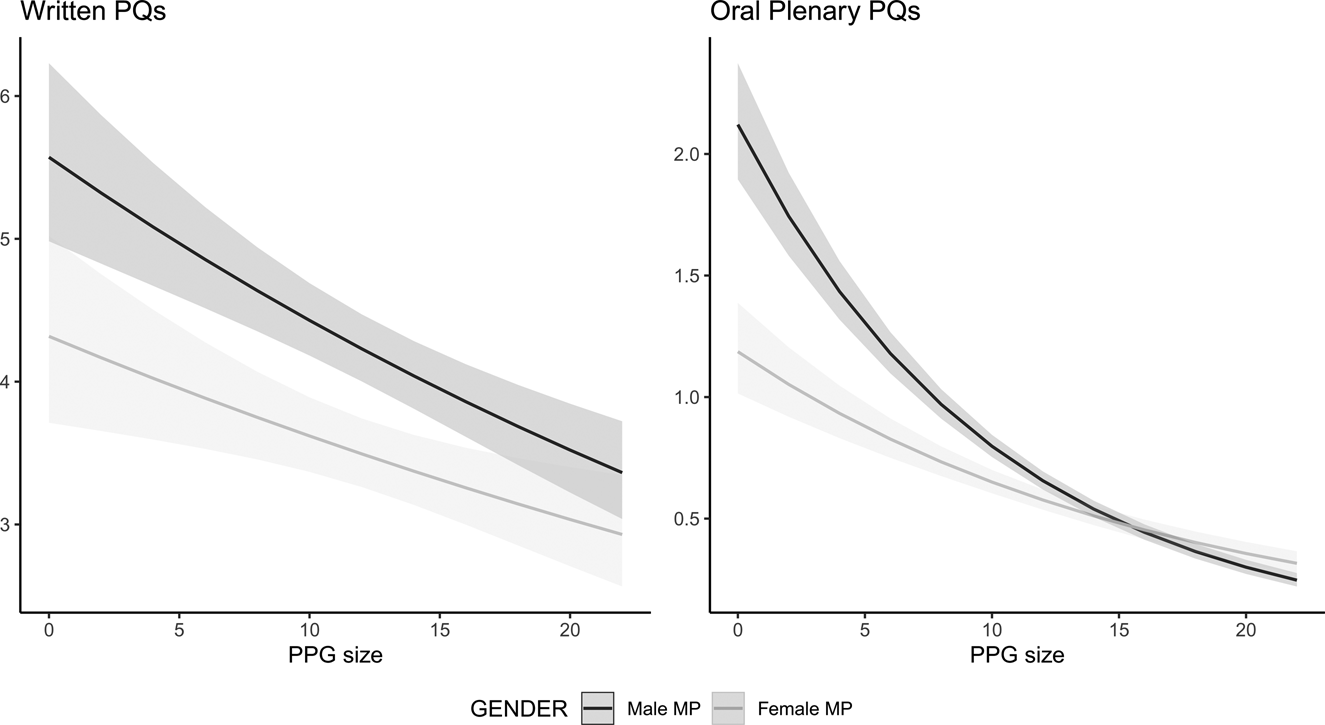
However, as the three-way interaction term in Model 8 indicates, we do not find an additional effect on the activity of female on hard/soft policy domains when the intraparty competition to be able to ask plenary PQs increases with PPG size. Thus, H3 is rejected. Lastly, we point out a rather interesting finding in Model 7. Although female MPs in general take up less plenary speaking time than male MPs, this model shows a positive interaction effect for female MPs asking more plenary PQs in larger party groups. This goes against our expectations, as the intraparty competition to be able to ask one of the party group's much-desired PQs during plenary “Question Time” is higher in large party groups. Figure 3 clearly shows that particularly in smaller party groups men ask more oral plenary PQs than women. As a party group's size increases, however, the opportunities for MPs to ask plenary PQs decrease but at a faster rate for men, closing this “gender gap” in MPs’ plenary questioning behavior.
Effect of PPG size on the predicted number of PQs tabled by male and female MP (95% confidence intervals). Marginal effects computed based on Model 3 and Model 7 (Table 2), respectively. All covariates are held constant at their mean. 95% confidence intervals.

Why this is the case remains somewhat unclear. Of course, larger PPGs might have more women to select as plenary speakers in the first place. Additional exploratory analyses indeed suggest that replacing the party group size variable with the absolute share of women in a PPG yields very similar coefficient sizes as in Model 7, while the relative share of women in a PPG does not. Leaving the very small, nonrecognized PPGs (fewer than five members) out of the analyses, moreover, does not alter the results. Moreover, it could be that party groups and their leaders are more sensitive to a gender balance and fair division of plenary PQs when such opportunities for self-promotion are more scarce (i.e., in larger party groups) (de Vet Reference de Vet2019, 210–12). Future research could look further into this.
CONCLUSIONS
This article empirically investigated whether the degree of party control and intraparty competition associated with different types of PQs has a gendered effect on the use such questions. Our results demonstrate that in Belgium, male and female MPs differ in the substantive focus of their parliamentary work. However, whereas male MPs are generally more active on hard (but also neutral) policy domains than women (both in their written and oral plenary PQs), female MPs only address soft policy domains more than men during more party-controlled plenary sessions and not in their individual written PQs. This seems to indicate that gendered differences are smaller when MPs may relatively autonomously draft and table PQs and increase when access to the floor is more restricted and party control is greater. Yet, contrary to what we hypothesized, these differences do not further intensify when the intraparty competition to be able to ask plenary PQs increases with party group size.
These results shed some light on the “choice versus coercion” controversy with regard to women's substantive focus of parliamentary work. Although our results point to a rather limited gender gap over soft policy issues in written PQs, this gender gap becomes substantially larger in the use of plenary PQs, when political parties’ gatekeeping control over PQs increases. This might indicate that women not only have a natural preference toward these issues (choice), but that they are also somewhat pushed—either directly or indirectly—toward these soft policy domains by parties that may strategically select women as the most convincing speakers on these topics. This highlights the important role of political parties in driving MPs’ activity and in shaping women's position in the legislature.
Our findings also have a number of important implications from a societal perspective. First, our study suggests that there is no level playing field for male and female MPs as male MPs have more chances for self-promotion during more visible plenary sessions, and particularly when plenary PQs address hard political issues (i.e., the majority of issues). This might hamper not only female MPs’ visibility to voters, but also the substantive articulation of their policy interests on particular domains and the overall legitimacy of parliamentary procedure (Bäck, Debus, and Müller Reference Bäck, Debus and Müller2014; Pearson and Dancey Reference Pearson and Dancey2011; Proksch and Slapin 2012).
Second, parliaments across Europe have been adapting their procedures and standing orders in recent decades, which contributed to what Heidar and Koole (Reference Heidar, Koole, Heidar and Koole2000) called the rise of the “parliamentary party group complex.” This denotes the tendency to shift away from the individual rights of MPs to enhancing the role of parliamentary party groups in controlling the resources needed by MPs to pursue their goals. Although such shifts may be driven by efficiency reasons, an important side effect that should be taken into account when designing procedural change is that their effects may not be gender-equal. As our study shows, a reinforced gatekeeping function for parties might lead to larger gender stereotypical patterns in the legislature.
Although this study illustrates that the degree of party control plays an important role in gender differences, complementary interview data could further lay bare whether party gatekeepers actually favor male spokespersons on hard topics, thereby directly pushing women to soft issues, or whether there is a more indirect abidance to perceived institutional norms. Future research could also focus on the factors that do cause more gender equality in plenary access or MPs’ substantial focus. The (critical) share of female party group members not only is important from this point of view (e.g., Bäck and Debus Reference Bäck and Debus2019), but also would prove useful to further investigate the effect(s) of a female party group leader or the appointment of female ministers to hard policy departments, who could function as role models and counter the paradigm that parties would lose credibility when they actively bring women to the forefront in these areas.
Supplementary Material
To view supplementary material for this article, please visit [https://doi.org/10.1017/S1743923X21000490]