Introduction
Heritage speakers are early bilinguals whose first language (heritage language) is different from the majority language of the society they live in. Existing research has demonstrated that they typically show patterns in their heritage language (HL) that differ from those shown by age-matched monolinguals (Benmamoun, Montrul, & Polinsky, Reference Benmamoun, Montrul and Polinsky2013; Kupish & Rothman, Reference Kupisch and Rothman2018; Montrul, Reference Montrul2008, Reference Montrul2015; Polinsky & Kagan, Reference Polinsky and Kagan2007; Rothman, Reference Rothman2009b; Scontras, Fuchs, & Polinsky, Reference Scontras, Fuchs and Polinsky2015). Various, non-mutually exclusive factors have been argued to contribute to the observed differences between the two populations, including cross-linguistic influence from the majority language (e.g., Argyri & Sorace, Reference Argyri and Sorace2007; Cuza, Reference Cuza2012, Reference Cuza2016), heritage input quantity (e.g., Daskalaki, Chondrogianni, Blom, Argyri, & Paradis, Reference Daskalaki, Chondrogianni, Blom, Argyri and Paradis2019; Flores, Santos, Jesus, & Marques, Reference Flores, Santos, Jesus and Marques2017; Gathercole & Thomas, Reference Gathercole and Thomas2009), and heritage input quality. Input quantity and quality have received various definitions in the literature (Paradis, Reference Paradis2011a; Unsworth, Reference Unsworth, Schmid and Köpke2019). In the present study, input quantity will be taken to refer to the daily amount of heritage language input that children receive at home from their parents and siblings (Paradis, Reference Paradis2011b). Input quality, on the other hand, will be taken to refer to the variation that might be present in the heritage input, whereby a certain linguistic property (such as subject placement or subject realization) might not always be used in a monolingual-like manner (Paradis & Navarro, Reference Paradis and Navarro2003; Pascual y Cabo, Reference Pascual y Cabo2018; Pires & Rothman, Reference Pires and Rothman2009).
To illustrate the effect of these factors, we may consider subject placement among heritage speakers (HSs) of free word order languages residing in English-majority communities. A recurring observation in the literature is that these speakers tend to overextend the use of preverbal subjects in contexts where postverbal subjects are preferred or required (for Greek, see Argyri & Sorace, Reference Argyri and Sorace2007; and Daskalaki et al., Reference Daskalaki, Chondrogianni, Blom, Argyri and Paradis2019; for Spanish, see Cuza, Reference Cuza2012, Reference Cuza2016). While it is possible that these patterns are the result of cross-linguistic influence from English, which is a rigid subject–verb–object (SVO) language (Argyri & Sorace, Reference Argyri and Sorace2007; Cuza, Reference Cuza2012, Reference Cuza2016), it is also possible that they are further modulated by the daily amount of heritage language use (Daskalaki et al., Reference Daskalaki, Chondrogianni, Blom, Argyri and Paradis2019) and/or by the differential properties of subject placement attested in the heritage input.
To date, the evidence that the differences in the performance displayed by heritage speakers are related to the qualitative properties of the heritage input is mostly indirect. Most of the existing studies have attempted to reconstruct the input heritage speakers receive by testing a group of first-generation immigrants, whose language is taken to be representative of the input received by second or later generations of heritage speakers (Montrul, Bhatt, & Girju, Reference Montrul, Bhatt and Girju2015; Montrul & Sánchez-Walker, Reference Montrul and Sánchez-Walker2013; Pascual y Cabo, Reference Pascual y Cabo2018). Very few studies have explored the quality of the input heritage speakers received in childhood from their actual heritage input providers (i.e., from their parents) (Paradis & Navarro, Reference Paradis and Navarro2003), and no study, to our knowledge, has examined the impact of heritage input quality on the language acquisition and development of heritage speakers. The present study aims to complement the existing literature by exploring whether the parental input in Greek immigrant families in Western Canada differs with respect to subject placement from the parental input in Greek monolingual families, and whether there is an association between parental input and children's output in the placement of subjects.
The nature of the heritage input
It is becoming increasingly acknowledged that the experience of HSs with their HL might not only be quantitatively, but also qualitatively different from the experience of age-matched monolinguals (Kupisch & Rothman, Reference Kupisch and Rothman2018; Paradis, Reference Paradis2011b; Pascual y Cabo & Rothman, Reference Pascual y Cabo and Rothman2012; Polinsky, Reference Polinsky2018; Rothman, Reference Rothman2009a; Sorace, Reference Sorace2004, Reference Sorace2011). Qualitative differences could be due to two main reasons: first, heritage speakers are children of first- and second-generation immigrants, who might have undergone attrition themselves, or of L2 speakers who might have different levels of proficiency. As a result, they might be exposed to a contact variety of their language that diverges from the monolingual variety in the form and use of certain structures (Paradis, Reference Paradis2011b; Paradis & Navarro, Reference Paradis and Navarro2003; Sorace, Reference Sorace2004, Reference Sorace2011). Alternatively, they could be children of immigrants who speak a regional and/or informal variety. Because the heritage language is typically used in informal settings, these heritage speakers would only be exposed to the regional/informal variety that possibly differs in its properties from the monolingual standard (Pires & Rothman, Reference Pires and Rothman2009; Rothman Reference Rothman2007). In either case, differences in the heritage input could affect the outcome of heritage language acquisition, especially in instances of limited access to HL schooling that would expose them to the properties of the monolingual standard (Bayram et al., Reference Bayram, Rothman, Iverson, Kupisch, Miller, Puig-Mayenco and Westergaard2019; Kupisch & Rothman, Reference Kupisch and Rothman2018).
The very few studies that have explored the qualitative properties of the heritage input have provided preliminary support to the hypothesis that input quality might indeed be different in heritage contexts. In an early study, Paradis and Navarro (Reference Paradis and Navarro2003) compared spontaneous production data from two Spanish monolingual children (ages: 1;8–2;7 and 1;8–1;11), one Spanish–English bilingual child learning Spanish in a heritage context (age 1;9–2;6), and their parental interlocutors. They focused on subject realization in Spanish, a domain that was predicted to be challenging for Spanish–English bilingual children due to the systematic differences between the two languages: Whereas in English, pronominal subjects are generally phonologically expressed (they are overt), in Spanish they can be omitted (they can be null). Their results indicated that the bilingual child produced a higher percentage of overt subjects (35%) than her monolingual peers (at or below 20%) a result that could be due, at least partially, to cross-linguistic influence from English. Crucially, though, a similar pattern was replicated in the parental input. Thus, the parents of the bilingual child (a native Cuban Spanish-speaking father and an L1 English / L2 Spanish-speaking mother) produced more overt subjects in Spanish than the parents of the monolingual children. In view of these results, the researchers concluded that the type of Spanish input could contribute to the increased number of overt subjects found in the bilingual child's output, in addition to and/or instead of cross-linguistic influence from English.
More recently, a number of studies (Montrul et al., Reference Montrul, Bhatt and Girju2015; Montrul & Sánchez-Walker, Reference Montrul and Sánchez-Walker2013; Pascual y Cabo, Reference Pascual y Cabo2018) explored the nature of HL input by employing a three-way comparison between monolingual, first-, and second-generation adult immigrants – the latter being heritage speakers. For example, Montrul and Sánchez-Walker (Reference Montrul and Sánchez-Walker2013) focused on Differential Object Marking (DOM), that is the overt marker a that obligatorily precedes [ +animate, +specific] direct objects in Spanish. Using a story retelling task and a picture description task, they collected data from five Spanish-speaking groups: 39 child heritage speakers (ages 6;0 to 17;0), 20 child monolingual speakers (ages 6;0 to 17;0), 64 adult heritage speakers (ages 18–25), 23 first-generation adult immigrants (ages 40–60), and 40 adult native speakers (ages 18–60). The bilingual groups resided in the US at the time of testing, whereas the monolingual groups resided in Mexico. Results from the adult groups showed that, unlike the native speakers from Mexico, who performed at ceiling, both the heritage speakers and the first-generation immigrants showed significant rates of omission of DOM in obligatory contexts. More precisely, heritage speakers were less accurate (accuracy–story retelling: around 80%; accuracy–picture description: around 77%) than both first-generation (accuracy–story retelling: 87%; accuracy–picture description: 81%) and monolingual speakers (accuracy–story retelling: 96.7%; accuracy–picture description: 95.4%). Given that the heritage speakers were children of first-generation immigrants, the authors concluded that they were likely exposed to a type of Spanish input that contained a higher DOM omission rate than those of their age-matched monolinguals.
Accordingly, Pascual y Cabo (Reference Pascual y Cabo2018) focused on the domain of Spanish dative experiencer verbs such as gustar ‘to like’, whose experiencer argument, when realized, needs to be preceded by the dative marker a. Using a scalar grammaticality judgment task and an elicited production task, he collected data from 67 heritage speakers of Spanish residing in the US (49 adults, ages 18–24 and 18 children, ages 6;6–11;1), 29 monolingual speakers of Spanish (16 adults, ages 18–24 and 13 children, ages 6;6–11;1) residing in Cuba, and, finally, 17 first-generation adult immigrants who had come to the US between the ages of 15 and 41 and had resided in the US for at least 10 years. The findings from the elicited production task revealed that monolingual adults were more accurate with the dative marker a (86.69%) than both first-generation immigrants (76.83%) and adult heritage speakers. Furthermore, heritage speakers’ performance appeared to be modulated by their proficiency, since advanced speakers performed better than intermediate speakers (advanced heritage speakers: 70.79%; intermediate heritage speakers: 51.63%). Based on these results, Pascual y Cabo concluded that, at least in the case of experiencer verbs, the heritage speakers’ linguistic outcomes could be traced back to the variability found in the language of first-generation immigrants, who are the main source of their Spanish input.
The results of these studies are particularly significant, as they provide preliminary support for the hypothesis that there might be incipient structural changes in the heritage input that get quantitatively amplified in the language of the next generation of heritage speakers. However, the evidence for this hypothesis is still not fully established, because most of the existing studies (Montrul et al., Reference Montrul, Bhatt and Girju2015; Montrul & Sánchez-Walker, Reference Montrul and Sánchez-Walker2013; Pascual y Cabo, Reference Pascual y Cabo2018) provide us with an approximation of the type of input heritage speakers receive, as adults at the moment of testing. The type of input heritage speakers received from their parents in their school years and the impact it had on their heritage language development is still largely unexplored. In the present study, we addressed this gap by examining subject placement among heritage speakers of Greek in Western Canada (parents and school-aged children) and monolingual speakers of Greek in Greece (parents and school-aged children). In addition, to better understand the effect of input quality, we took into consideration the parental generation, as well as the children's general proficiency and input quantity in the heritage language. Before moving on to the specifics of our study, we briefly review subject placement in Greek and English, which is the phenomenon that will serve as the domain of comparison between the two languages.
Subject placement in Greek
The syntactic literature
Subject placement in declaratives
Greek is a language with free word order, a fact that has been related to the availability of overt case marking and rich subject–verb agreement (Alexiadou & Anagnostopoulou, Reference Alexiadou and Anagnostopoulou2000). According to the predominant view, VSO is the basic word order in Greek declaratives, in that it is felicitous in neutral/all new contexts, as illustrated with the dialogue in (1) (Alexiadou & Anagnostopoulou, Reference Alexiadou and Anagnostopoulou1998; Philippaki-Warburton Reference Philippaki-Warburton1987, Reference Philippaki-Warburton1989):

Deviations from the canonical word order either follow from grammatical factors, such as the transitivity and the lexical semantics of the verbal predicate (Roussou & Tsimpli, Reference Roussou and Tsimpli2006; Spyropoulos & Revithiadou, Reference Spyropoulos, Revithiadou, Halpert, Hartman and Hill2009), or depend on the information structure of the overall discourse (Alexopoulou, Reference Alexopoulou1999; Skopeteas, Reference Skopeteas, Féry and Ishihara2016). Thus, preverbal subjects (of transitive/eventive predicates) can be associated with a topic (Alexiadou & Anagnostopoulou Reference Alexiadou and Anagnostopoulou1998; Kotzoglou Reference Kotzoglou2006; Philippaki-Warburton Reference Philippaki-Warburton1987, Reference Philippaki-Warburton1989; Spyropoulos & Philippaki-Warburton Reference Spyropoulos and Philippaki-Warburton2002; Tsimpli Reference Tsimpli1990) or a narrow/contrastive focus reading (Roussou & Tsimpli, Reference Roussou and Tsimpli2006; Tsimpli, Reference Tsimpli and Kiss1995), unlike postverbal subjects that are non-felicitous in the same contexts. Illustrations are provided with the dialogues in (2) and (3), respectively:

Conversely, postverbal subjects obtain higher felicity judgments than preverbal ones, in wide focus contexts, where the SV sequence is the perceived focus domain (Alexopoulou, Reference Alexopoulou1999):

Greek, therefore, differs from English, where subjects are typically preverbal independently of whether they are attested in topic continuity (5), narrow/contrastive focus (6), or wide focus (7) contexts.
(5) Topic reading
a. What did Peter do?
b. Peter/He broke the lamp.
(6) Narrow/Contrastive focus
a. Who broke the lamp? Peter or Nikos?
b. PETER broke the lamp.
(7) Wide focus
a. What happened with the lamp?
b. Peter broke the lamp.
Subject placement in interrogatives
Differently from declaratives, interrogative clauses in Greek, matrix and embedded alike, do not allow word order variation. In these contexts, postverbal subjects are obligatory, rather than merely preferred, and dissociated from information structure considerations (Kotzoglou, Reference Kotzoglou2006; Panagiotidis & Tsiplakou, Reference Panagiotidis, Tsiplakou, Catsimali, Kalokairinos, Anagnostopoulou and Kappa2004; Tsimpli, Reference Tsimpli1990). Illustrations are provided in (8) with matrix and in (9) with embedded interrogatives.

Once again, Greek differs from English, where postverbal subjects are required in matrix (10) but not in embedded interrogatives (11):
(10) Matrix interrogatives
a. What did Maria break?
b. *What Maria broke?
(11) Embedded interrogatives
a. *I don't know what broke Maria.
b. I don't know what Maria broke.
Acquisition studies
The acquisition of word order alternations in Greek has received little attention in the L1 literature. The few studies that have been carried out suggest that monolingual children produce both preverbal and postverbal subjects at a very early age. Kapetangianni (Reference Kapetangianni, Caunt-Nulton, Kulatilake and Woo2007) examined production data samples of three monolingual Greek-speaking children drawn from the Stephany Corpus of the CHILDES database (MacWhinney & Snow Reference MacWhinney and Snow1985; Stephany Reference Stephany and Slobin1995) and reported that these three Greek children used preverbal and postverbal subjects at the earliest two-word production stages and before they reached the age of two. Tsimpli (Reference Tsimpli, Stavrou and Terzi2005) concluded the same based on the analysis of spontaneous data collected from two Greek-speaking children at regular monthly intervals. Significantly, for our purposes, neither of the two researchers reported any non-felicitous uses of preverbal subjects in contexts where postverbal subjects are preferred/required.
A different picture emerges once we consider studies examining the developmental trajectories of Greek–English bilingual children. This population has been shown to systematically overextend the use of preverbal subjects (which is the overlapping option between Greek and English) into contexts, where postverbal subjects would be the preferred and, in some cases, the grammatical option (Argyri & Sorace, Reference Argyri and Sorace2007; Daskalaki et al., Reference Daskalaki, Chondrogianni, Blom, Argyri and Paradis2019).
For instance, Argyri and Sorace (Reference Argyri and Sorace2007) examined subject placement in wide focus contexts, where subjects are preferably postverbal and in embedded interrogatives, where subjects are obligatorily postverbal. To this end, they analyzed comprehension and production data from two Greek–English bilingual populations: (i) Greek–English bilingual children born and raised in the UK and (ii) Greek–English bilingual children born and raised in Greece. Their results pointed to an effect of input quantity, since the bilinguals living in the UK (who had more exposure to English) produced more erroneous preverbal subjects than the bilinguals living in Greece (who had more exposure to Greek). Furthermore, errors were observed in both the Wide Focus (WF) context (i.e, the context in which subject placement depended on the integration of syntactic and discourse knowledge) and, to a lesser degree, in the Embedded Interrogative (EI) context (i.e., the context in which subject placement was conditioned solely by syntactic constraints).
More recently, Daskalaki et al. (Reference Daskalaki, Chondrogianni, Blom, Argyri and Paradis2019) replicated Argyri and Sorace's (Reference Argyri and Sorace2007) production task with a different population: bilingual children learning Greek as a heritage language in North America (Western Canada and New York City). Whereas Argyri and Sorace examined the role of input through a between-groups comparison, Daskalaki et al. studied the role of language use (measured as the mean proportion of Greek received and produced by the children in the home environment) as a continuous variable. This allowed them to directly determine the impact of language use among children who belonged in the same group of bilinguals. In line with Argyri and Sorace, they found that, under limited Greek language use, subject placement is affected in both structures, in different degrees. Namely, Greek heritage children produced more preverbal subjects in the WF context than in the EI context.
To sum up, the evidence from the acquisition studies supports the conclusions that the production of preverbal subjects in WF and EI by Greek–English bilingual children is most likely a pattern due to cross-linguistic influence (since it appears in the language of Greek–English bilingual children but not in the language of young monolingual children) that is further modulated by the amount of Greek language use. Whether qualitative aspects (in addition to quantitative aspects) of the Greek input are associated with the type and rate of preverbal subjects produced by bilingual learners is a possibility that is not yet determined, and is examined in the present study.
The present study
Research questions
The present study had two inter-related goals: to explore whether the parental input in Greek immigrant families differs with respect to subject placement from the parental input in Greek monolingual families, and to examine whether there is an association between parental input and children's output in the placement of subjects. To this end, we revisited Daskalaki et al.'s (Reference Daskalaki, Chondrogianni, Blom, Argyri and Paradis2019) study on the acquisition of Greek as a heritage language in North America (New York and Western Canada). Using the same sentence completion task that was designed to trigger subject placement in WF and EI (two contexts where postverbal subjects are preferred (WF) or required (EI) in the monolingual variety), we analyzed data not only from heritage and monolingual children, but also from the parents of these two groups. The child data were drawn from the Canadian subsample tested in Daskalaki et al. and were re-analyzed against an age-matched monolingual control group.Footnote 1 The parental data (for the Canadian subsample) were collected during the same period, but were only analyzed later on for the purposes of the present study. Three research questions were addressed:
1. Do Greek heritage children differ from Greek monolingual children in their choices of subject placement? Are these differences modulated by the generation of the heritage children?
2. Do the parents of Greek heritage children differ from the parents of Greek monolingual children in their choices of subject placement? Are these differences modulated by the generation of the immigrant parents?
3. Is there an association between the mothers’ and the children's choices of subjects? Is this association independent of the children's general proficiency in Greek and the amount of heritage input they receive from their mothers?
For questions 1 and 2, differences in subject placement in the heritage and monolingual parental input was taken to signify differences in the parental input quality received by the heritage and the monolingual children, respectively. For question 3, maternal input quality was chosen over the paternal input quality, for practical reasons (fewer fathers participated in our study), but also because the existing literature suggests that mothers are more likely to behave in ‘child-centered’ ways, such as to talk more and to use supportive rather than directive language with their children (for an overview, see Pierce & Genesee, Reference Pierce, Genesee, Grüter and Paradis2014). Finally, the children's general proficiency and the mothers’ heritage input quantity were treated as potentially contributing variables, in view of studies showing that they can both be associated with the outcome of heritage language acquisition (on the role of general proficiency in the HL, see Montrul & Rodríguez-Louro, Reference Montrul, Rodríguez-Louro, Torrens and Escobar2006; Pascual y Cabo, Reference Pascual y Cabo2018; and Rothman Reference Rothman2009b; on the role of parental input quantity in the HL, see Daskalaki et al., Reference Daskalaki, Chondrogianni, Blom, Argyri and Paradis2019; and Gathercole & Thomas, Reference Gathercole and Thomas2009; for an overview of the role of input in minority contexts, see Unsworth, Reference Unsworth, Schmid and Köpke2019).
Predictions
With respect to the first two questions, we predicted that the bilingual heritage groups would produce more preverbal subjects than the monolingual groups. This is in line with existing studies showing that bilingual populations speaking a free and a rigid SVO word order language combination tend to extend the use of preverbal subjects in ungrammatical or pragmatically non-felicitous contexts (for Greek–English bilinguals, see Argyri & Sorace, Reference Argyri and Sorace2007 and Daskalaki et al., Reference Daskalaki, Chondrogianni, Blom, Argyri and Paradis2019; for Spanish–English bilinguals, see Cuza Reference Cuza2012, Reference Cuza2016). Furthermore, we predicted an effect of generation for both children and parents, in view of the studies suggesting that accuracy decreases with generation (Montrul et al., Reference Montrul, Bhatt and Girju2015; Montrul & Sánchez-Walker, Reference Montrul and Sánchez-Walker2013; Pascual y Cabo, Reference Pascual y Cabo2018; Silva-Corvalán, Reference Silva-Corvalán, Seliger and Vago1991).
With respect to the third question, we predicted that if there is an effect of maternal input quality, then there should be an association between mothers’ and children's choices with respect to subject placement in the two conditions. Furthermore, we predicted that this association would remain, even when the children's general proficiency and quantity of maternal HL input were partialled out.
Methods
Participants
To compare the quality of parental input and children's output in heritage and monolingual contexts (questions 1 and 2), we collected data from 29 Greek–English bilingual families residing in Western Canada and 20 Greek-speaking monolingual families, residing in Greece. Participants were then classified into four groups of Greek speakers: There were 33 heritage children from Western Canada (mean age: 11 years and 8 months; range: 6–18;10, SD: 37.72), 27 Greek-speaking monolingual children from Greece (mean age: 12; range: 9–14;9; SD: 17.07), 33 Greek–English bilingual parents residing in Western Canada (mean age: 43;3; range: 36;8–58; SD: 54.63), and 30 monolingual parents residing in Greece (mean age: 46;7; range: 39–57; SD: 54.50). Heritage children matched monolingual children in socioeconomic background (t(44.1) = –0.76, p = .4), as measured through years of maternal education. They also matched monolingual children in terms of age (t(48) = –0.48, p = .63), even though the range was wider in the heritage group. Note that the youngest child in the monolingual group was nine years old, whereas in the heritage child group there were also a few younger children. In order to exclude the possibility that lower performance in the heritage group is driven by these younger children, we performed between-group analyses with and without the heritage children below age nine years. Bilingual parents were older than monolingual parents (t(60.5) = –2.86, p = .006, d = 0.06), but given that the target structures are acquired by monolingual speakers in childhood and given that it's the bilingual parents who are older and not the reverse, the age difference between the parents’ groups was not expected to be a factor of influence.
To obtain information about the language background of our bilingual families (parents and children), we used Daskalaki et al.'s (Reference Daskalaki, Chondrogianni, Blom, Argyri and Paradis2019) adaptation of the Alberta Language Environment Questionnaire (Paradis, Reference Paradis2011a). Heritage children were either born in Canada (n = 32) or in Greece (n = 2), but had started consistent exposure to English in a daycare, or a preschool programme by the age of 5;0. Furthermore, children attended Greek (Saturday) schools and received Greek input by their parents (in varied degrees) from birth. In our sample, the mean proportion of Greek parental input (on a scale from 0 to 1, with 0 as only English being spoken and 1 as only Greek being spoken), was 0.84 in early childhood (range: 0.13–1; SD: 0.27), and 0.5 at the time of testing (range: 0.13–1; SD: 0.24) (Table 1).
Participant characteristics: full sample

Notes. HC = Heritage Children; MC = Monolingual Children; BP = Bilingual Parents; MP = Monolingual Parents; Gen = Generation; Age = chronological age; SES = socioeconomic status as measured by years of maternal education; AoO = age of systematic exposure to English; LoE = length of exposure to English, months of consistent exposure to English; GR parental input Early childhood = the proportion of Greek spoken to the child by his/her parents in early childhood (0 to 36 months). It is calculated between 0 and 1, with 0 as only English being spoken and 1 as only Greek being spoken; GR parental input Current = the proportion of Greek spoken to the child by his/her parents at the time of testing (same scale as above); GR Expr. Vocab. = Greek expressive vocabulary (Vogindroukas et al., Reference Vogindroukas, Protopapas and Sideridis2009); RS = Raw scores; ENGL Recept. Vocab. = English receptive vocabulary measured with PPVT-4 (Dunn & Dunn, Reference Dunn and Dunn2007); SS = Standard scores (mean = 100; range = 85–115).
The parents of the heritage children were all native speakers of Greek. More precisely, there were twenty-four second-generation Greek immigrant parents (nineteen mothers / five fathers) born and raised in Canada and exposed to Greek in early childhood and nine first-generation Greek immigrant parents (five mothers / four fathers) who had immigrated to Canada in adulthood (mean age of arrival: 27;5; range: 21;9–41; SD: 75.412) and had resided in Canada for an average of 16;1 years (range: 4;3–33;6; SD: 109.179). Accordingly, there was one second-generation child (both parents first generation), 14 2.5-generation children (one parent first / other parent second) and eighteen third-generation children (both parents second generation).
If the parents did not use Greek with their children at home, if they used a third language in addition to English, or if the children were unable to complete the tasks in Greek, the family was excluded from the study. Descriptives for the background variables of relevance (age, age of onset to English, Greek parental input in early childhood, Greek parental input at the time of testing) are provided in Table 1, for both parents and children. Because there was only one second-generation child, we merged second- and 2.5-generation children into a single group.
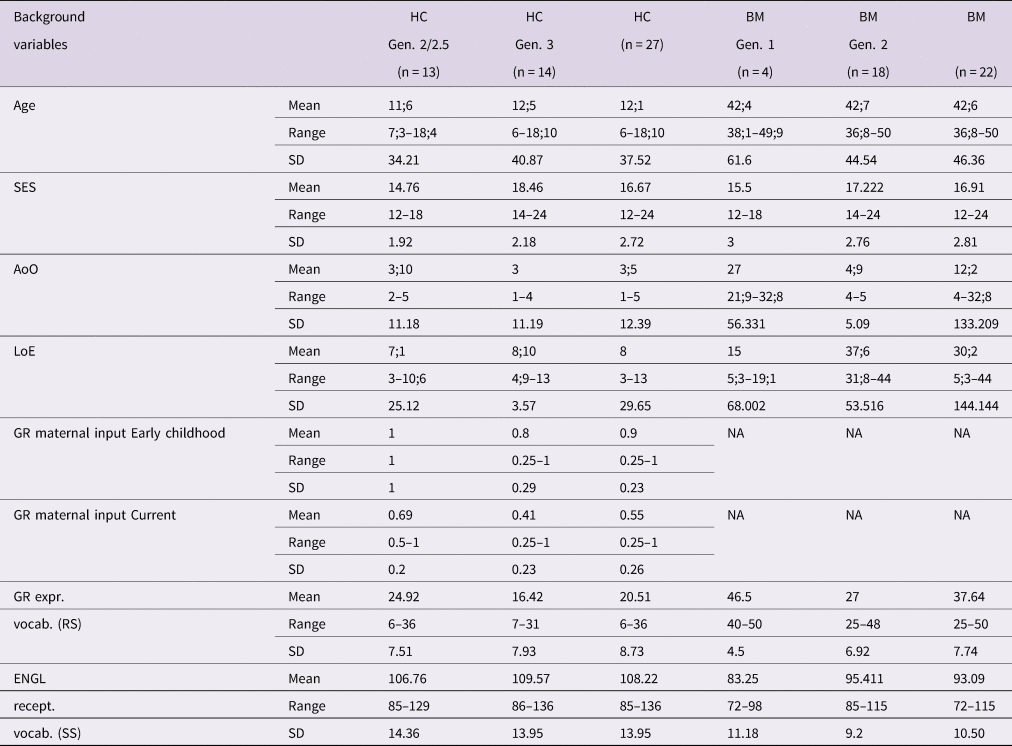
To determine if there is an association between the accuracy of heritage children and the accuracy of their parents (question 3), we focused on the bilingual group and extracted a subsample consisting of mother–child dyads. From this subsample, one dyad was excluded because the mother did not speak Greek to the child. This resulted in 27 mother–child dyads: one with a second-generation child, 12 with a mixed/2.5-generation child (one parent first / other parent second), and 14 with a third-generation child. Of the 27 dyads, there were five cases (including one twin) that involved two children from the same family. Descriptives for the subsample are provided in Table 2. As can been seen, the mean proportion of maternal input in Greek was 0.9 in early childhood (range: 0.25–1; SD: 0.23), and 0.55 at the time of testing (range: 0.25–1; SD: 0.26).
Participant characteristics: subsample

Notes. HC = Heritage Children; BM = Bilingual Mothers; Gen.= Generation; Age = chronological age; SES = socioeconomic status as measured by years of maternal education; AoO = age of systematic exposure to English; LoE = length of exposure to English, months of consistent exposure to English; GR Maternal Input Early Childhood = the proportion of Greek spoken to the child by his/her mother in early childhood (0 to 36 months). It is calculated between 0 and 1, with 0 as only English being spoken and 1 as only Greek being spoken; GR Maternal Input Current = the proportion of Greek spoken to the child by his/her mother at the time of testing (same scale as above); GR expr. vocab. = Greek expressive vocabulary (Vogindroukas et al., Reference Vogindroukas, Protopapas and Sideridis2009); RS = Raw scores; ENGL recept. vocab. = English receptive vocabulary measured with PPVT-4 (Dunn & Dunn, Reference Dunn and Dunn2007); SS = standard scores (mean = 100; range = 85–115).
Materials
Parental questionnaire
Daskalaki et al.'s (Reference Daskalaki, Chondrogianni, Blom, Argyri and Paradis2019) adaptation of the Alberta Language Environment Questionnaire (ALEQ; Paradis, Reference Paradis2011a) was administered to the parents, through face-to-face interviews. The questionnaire included questions on various variables that might have affected the child's language experience, including parental input at home, both at the time of testing and in early childhood (before the age of three), socioeconomic status (SES), Age of Onset to English (AoO), and Length of Exposure to English (LoE).
The parental input at the time of testing was measured using questions about how often the parents spoke Greek to the child on a scale from 0 (Greek almost never / English almost always) to 4 (Greek almost always / English almost never). The overall amount of Greek parental input was then calculated as the mean proportion of input that the child received from the mother and the father. Additionally, we calculated the amount of Greek parental input in early childhood, by using the same questions and scale as above. Information about the SES of the family was calculated based on years of maternal education. The child's AoO and LoE to English coincided with the child's age of exposure and length of exposure to English in school.
Other information gathered from the ALEQ targeted the parents themselves. Parents provided information about their date and place of birth and their year of immigration to Canada (if applicable). In the case of second-generation immigrants, AoO and LoE coincided with their age of exposure and length of exposure to English in school. In the case of first-generation immigrants AoO and LoE coincided with the year of immigration and years of residence to Canada.
English vocabulary
To assess participants’ proficiency in English, we used the Peabody Picture Vocabulary Task (4th edition) (PPVT-IV; Dunn & Dunn, Reference Dunn and Dunn2007), which is a receptive vocabulary task standardized with monolingual speakers of English in North America. In this task, participants were shown a four-picture panel and asked to point to the picture that best matched the word spoken by the experimenter. Raw scores were converted to standard scores and descriptives are given in Table 1 for the full sample and in Table 2 for the subsample of our participants. All bilingual heritage children met monolingual age-appropriate norms. Bilingual adults also met age-appropriate norms, except for four first-generation immigrants who received a score below the normal range.
Greek vocabulary
To assess participants’ proficiency in Greek, we used an expressive vocabulary task, which was standardized for Greek school-aged children (Vogindroukas, Protopapas, & Sideridis, Reference Vogindroukas, Protopapas and Sideridis2009). In this task, which at the time of testing was the only available vocabulary task standardized for monolingual speakers of Greek, participants were presented with a total of 50 black-and-white flashcards and were asked to name the object depicted on the flashcard. Bilingual groups had a statistically significant lower accuracy than their monolingual controls. This was true for both the child (t(39.7) = –16.29, p < .001, d = 3.99) and the adult groups (t(36.3) = –5.33, p < .001, d = 1.32).
Experimental task
To test subject placement in the two target structures (i.e., in the Wide Focus and Embedded Interrogative structure), we used Daskalaki et al.'s (Reference Daskalaki, Chondrogianni, Blom, Argyri and Paradis2019) elicited production task, which is an adaptation of Argyri and Sorace (Reference Argyri and Sorace2007). In this task, participants were shown a number of pictures on a computer screen and were subsequently asked a question that prompted the structures under consideration.
In the WF condition, participants were presented with pictures that depicted an activity between two animated characters (e.g., a little girl playing with a toy boat and a little boy, Janis, who was looking at the girl, clearly upset). They were then asked a wide focus question that was meant to prompt the production of a postverbal subject, as in (12):

In the EI condition, participants were presented with a picture depicting a grandparent, who complained about not remembering his/her grandchild's activities. After each picture, participants were prompted to complete a sentence of the sort i jaja / o papus den thimate ‘Grandmother / grandpa doesn't remember …’, which in Greek requires a postverbal subject:

There were eight items per condition, which resulted in sixteen items. For a detailed description of the task, see Daskalaki et al. (Reference Daskalaki, Chondrogianni, Blom, Argyri and Paradis2019). All responses with postverbal subjects were coded as correct and were given a value of ‘1’ and responses with preverbal subjects as incorrect and were given a value of ‘0’. Responses containing inter-sentential code-switching, responses with missing verbs or null responses were excluded from the calculation.
Procedures
Parents and children were tested in their homes or at the Greek school of the community by a Greek–English bilingual researcher. Each family member participated in an hourly session that consisted of a battery of tasks including: a video-recorded elicited production task (used to test subject placement in Greek), and two vocabulary tasks (used to assess participants’ proficiency in English and Greek). Children were tested first, followed by their mother, and/or father. At the end of the session, parents were administered a questionnaire that was used to gather information for the inclusion criteria.
Results
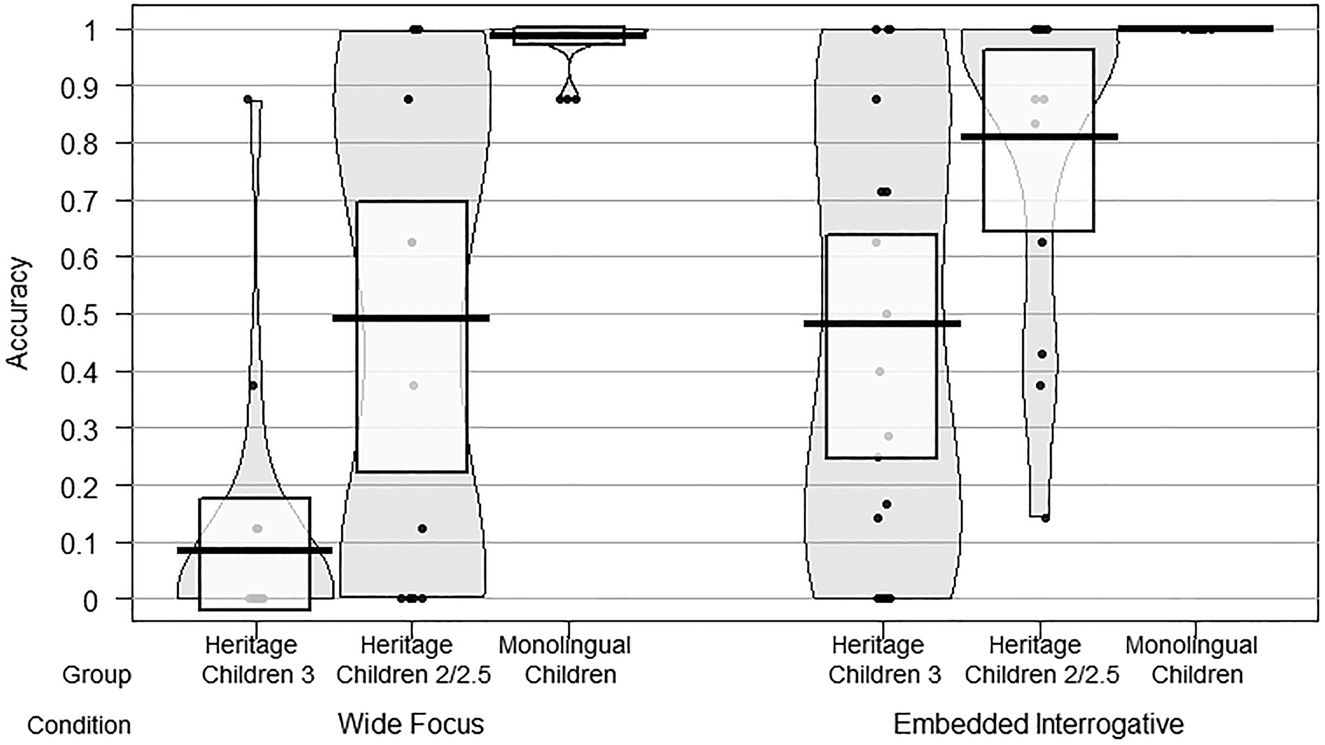
In order to answer the first research question, we analyzed the data from the Greek heritage children in Western Canada and compared these to the data from the monolingual children living in Greece. Results indicated that heritage children showed an overall lower accuracy (.45) than monolingual children (.99). Accurate responses (i.e., VS responses) per experimental condition are visualized in Figure 1, where the heritage children are merged into a single group independently of their generation, and in Figure 2, where the heritage children are divided into two subgroups: (i) the heritage children generation 3 group (HC 3), which includes 18 third-generation children (both parents second generation) and (ii) the heritage children generation 2/2.5 group (HC 2/2.5), which includes one second-generation child (both parents third generation) and 14 2.5-generation children (one parent first / other parent second generation). The pirate plots were created using the yarrr package in R and provide information on the raw data (points), the full data distribution (density curve), the mean (line), and the Confidence Interval (band) (Philips, Reference Philips2017).
Children's accuracy with subject placement in the heritage and the monolingual children on the Wide Focus and the Embedded Interrogative conditions.

Children's accuracy with subject placement in the heritage generation 3 group, heritage generation 2/2.5 group, and the monolingual group on the Wide Focus and the Embedded Interrogative conditions.

To investigate statistical differences between groups and conditions, we analyzed the data using mixed-effects modelling with a logistic link function (R version 3.3.3). To the extent that this was possible, we included maximal random effects structure with by-subject and by-item random incepts as well as slopes (Barr, Levy, Scheepers, & Tily, Reference Barr, Levy, Scheepers and Tily2013). In case the models did not converge, random-incepts-only models were run. The first model included by-subject and by-item random intercepts and slopes. Orthogonal sum-to-zero contrast coding was applied to the fixed-effects factors Group and Condition (Baguley, Reference Baguley2012). Children's accuracy was the binary outcome variable (correct, incorrect).
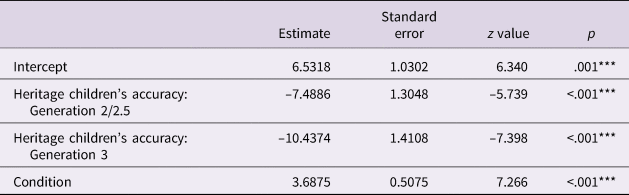
To investigate the modulating effect of group, we ran two models. The first model included a two-level factor Group (monolingual children, heritage children), in addition to Condition (Wide Focus, Embedded Interrogative). The second model included a three-level factor Group (monolingual children, heritage children generation 2/2.5, heritage children generation 3), in addition to Condition (Wide Focus, Embedded Interrogative). Subsequently, the two models were compared using a likelihood-ratio test to determine whether the second model was preferred over the first model and distinguishing between heritage children generation 2/2.5 versus generation 3 improved the model fit. Both models showed main effects of Group and Condition; the model comparison showed that the second model, which distinguished between two heritage groups based on generation, was preferred (χ 2(1) = 6.92, p < .01**). The estimates from the optimal model are presented in Table 3. Both generations of heritage children were outperformed by the monolinguals on subject placement. Changing the reference level demonstrated that the heritage children generation 2/2.5 were more accurate than the heritage children generation 3 (Estimate = –2.95, SE= 1.11, z value = –2.65, p < .01**). The main effect of Condition showed that children were more accurate in the Embedded Interrogative than in the Wide Focus condition. Excluding the children in the heritage group who were younger than nine years old (four children in total) did not change the significance of the effects of Group and Condition.
Mixed-effects regression model predicting children's accuracy with subject placement as a function of Group (reference level = monolinguals) and Condition (reference level = Wide Focus)

In order to answer the second research question, we compared the data from the Greek bilingual parents in Western Canada with data from the monolingual parents living in Greece. The results indicated that the bilingual parents had a lower overall accuracy (Mean Accuracy: .91) than monolingual parents (Mean Accuracy: 1.00). Accuracy per experimental condition is visualized in Figure 3, with bilingual parents merged into a single group, independently of their generation, and Figure 4, with bilingual parents divided into two subgroups: (i) the bilingual parents generation 1 group, which includes nine first-generation parents and (ii) the bilingual parents generation 2 group, which includes 24 second-generation parents.
Parents’ accuracy with subject placement in the bilingual and the monolingual parents on the Wide Focus and the Embedded Interrogative conditions.

Parents’ accuracy with subject placement in the bilingual generation 2 group, bilingual generation 1 group, and the monolingual group on the Wide Focus and the Embedded Interrogative conditions.

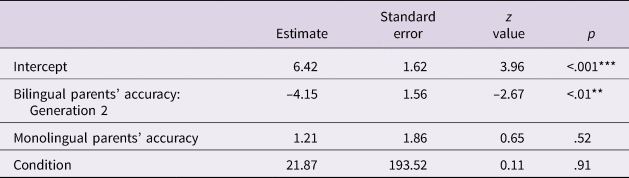
For the statistical analysis of the parents’ data, the same procedure was followed as for the heritage children. The first model included a two-level factor Group (monolingual parents, bilingual parents), in addition to Condition (Wide Focus, Embedded Interrogative). The second model included a three-level factor Group (monolingual parents, bilingual parents generation 1, bilingual parents generation 2), in addition to Condition (Wide Focus, Embedded Interrogative). Subsequently, the two models were compared using a likelihood-ratio test. Both models showed a main effect of Group but not of Condition; the model comparison showed that the second model, which distinguished between two bilingual groups based on generation, was preferred (χ 2(1) = 9.38, p < .01**). The estimates from the optimal model are presented in Table 4.Footnote 2 There was no difference between the monolingual and bilingual generation 1 parents; the bilingual parents generation 1 were more accurate than the bilingual parents generation 2. Changing the reference level to bilingual parents generation 2 demonstrated that the monolingual parents were more accurate than the bilingual parents generation 2 (Estimate = 5.36, SE = 1.38, z value = 3.89, p < .001***).
Mixed-effects regression model predicting parents’ accuracy with subject placement as a function of Group (reference level = bilingual parents generation 1) and Condition (reference level = Wide Focus)

Having established that not only heritage children (generation 2/2.5 and 3), but also the second-generation bilingual parents residing in Western Canada produce a higher rate of preverbal subjects in the Wide Focus condition than monolinguals, we moved on to explore whether there is an association between children's and parents’ choices (with respect to subject placement), and if so, whether the observed association is independent of the children's general proficiency and the parents’ amount of Greek input (question 3).
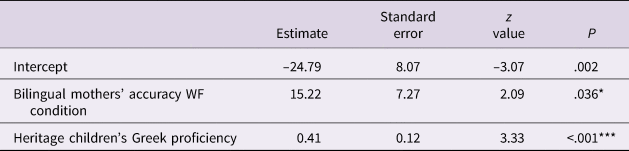
Accuracy on the two conditions in the subsample resembled that of the entire group. Maternal accuracy (n = 22) on the Embedded Interrogative condition was 1 and .81 (SD = .25, Range = .15–1) on the Wide Focus condition, and the heritage children (n = 27) had an accuracy of .68% (SD = .38, Range 0–1) and .32 (SD = .41, Range = 0–1), respectively. Two mixed-effects models were run. The first model included by-subject and by-item random intercepts, and mothers’ accuracy and children's Greek proficiency as fixed-effects predictors (both mean-centered). Children's accuracy was the binary outcome variable (correct, incorrect). The predictive effect of mothers’ accuracy could only be explored for the Wide Focus condition, as maternal performance in the Embedded Interrogative condition was at ceiling. The model returned significant effects for both mothers’ accuracy in the Wide Focus condition and children's Greek proficiency, showing that children who produced fewer preverbal subjects in the Wide Focus condition had mothers with higher accuracies in this condition, thereby controlling for children's proficiency in Greek. Children who had a higher level of Greek were more accurate in the Wide Focus condition. In order to account for the heterogeneity in the sample of parents, we added parental generation to the model. However, likelihood-ratio tests indicated that the model without parental generation was preferred (χ 2(1) = 0.53, p = .46). Table 5 summarizes the outcomes of this model.
Mixed-effects regression model predicting heritage children's accuracy in the Wide Focus condition with bilingual mothers’ accuracy and heritage children's Greek proficiency as predictors

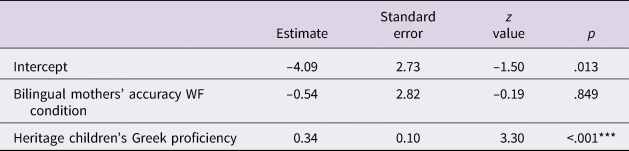
To test if mothers’ accuracy in the Wide Focus uniquely predicted children's accuracy in the same condition, we also ran a follow-up model in which it was tested whether or not mothers’ accuracy in the Wide Focus condition and children's Greek proficiency predicted children's accuracy in the Embedded Interrogative condition. The results, summarized in Table 6, show that while children's Greek proficiency emerged as a significant predictor, mothers’ accuracy in the Wide Focus condition did not predict children's accuracy in the Embedded Interrogative condition. The differential effect of maternal accuracy on child accuracy is visualized in Figure 5.
Interaction effect of Condition and Maternal Accuracy on Child Accuracy.

Mixed-effects regression model predicting heritage children's accuracy in the Embedded Interrogative condition with bilingual mothers’ accuracy and heritage children's Greek proficiency as predictors

The second model, which had mothers’ accuracy and maternal input quantity as fixed-effect predictors failed to converge. Figure 6 demonstrates that maternal accuracy (which is an ordinal variable with four levels) is related to maternal input quality and that (with one exception) the mothers who use Greek relatively infrequently, that is 25% of the time, are the ones who use SV structures in the Wide Focus condition.
Maternal input quality (accuracy) and maternal input quantity.

Discussion
The goal of the present study was twofold: (1) to test the hypothesis that the parental input received by heritage children is qualitatively different from the parental input received by monolingual children; and (2) to explore whether these differences affect the outcome of heritage language acquisition. To this end, we revisited Daskalaki et al.'s (Reference Daskalaki, Chondrogianni, Blom, Argyri and Paradis2019) study on subject placement in two different contexts: the Wide Focus context, where postverbal subjects are preferred due to discourse-related conditions, and the Embedded Interrogative context, where postverbal subjects are required due to syntactic constraints. In addition to analyzing the heritage children's language in relation to age-matched monolinguals, we analyzed it in relation to the parental input they received. More precisely, our research questions were sought to determine: (1) differences between monolingual and bilingual/heritage children (2/2.5- and third-generation); (2) differences between monolingual and bilingual parents (first- and second-generation immigrants); and (3) the association, if any, between mothers’ and children's choices in this domain.
Bilingual speakers vs. monolingual speakers
Regarding the bilingual–monolingual differences (questions 1 and 2), the bilingual groups produced a higher rate of preverbal subjects in contexts where postverbal subjects would be the preferred or required option in the monolingual variety. More precisely, bilingual/heritage children produced fewer postverbal subjects (.45, overall accuracy) than monolingual children (.99, overall accuracy). Accordingly, bilingual parents produced fewer postverbal subjects (.91, overall accuracy) than monolingual parents (1.00, overall accuracy), though the overall performance of the bilingual group was almost at ceiling.
Further analyses revealed an effect of generation and condition. An effect of generation was found in the case of both bilingual groups (heritage children, bilingual parents), a finding that is consistent with existing literature reporting that the heritage language of immigrants becomes less monolingual-like across generations (Silva-Corvalán, Reference Silva-Corvalán, Seliger and Vago1991). More precisely, even though both third- and 2/2.5-generation heritage children were significantly different from monolingual children in subject placement, third-generation children produced significantly fewer postverbal subjects than 2/2.5-generation children. A similar pattern was observed in the parents’ group, with second-generation parents producing significantly fewer postverbal subjects than first-generation parents. The latter ones performed at ceiling on a par with monolingual parents (1.00, overall accuracy). The discrepancy between the ceiling performance of first-generation immigrants tested in the present study and the variable performance of first-generation immigrants tested in the US studies discussed in previous sections (Montrul & Sánchez-Walker, Reference Montrul and Sánchez-Walker2013, and Pascual y Cabo, Reference Pascual y Cabo2018) could be due to the biographical characteristics of the respective groups. Specifically, the US-based immigrants had an earlier and longer exposure to English, which could explain their variable performance.
In addition, the type of sentence (Wide Focus vs. Embedded Interrogative) was found to modulate the performance of both bilingual groups. More precisely, bilingual/heritage children produced more preverbal subjects in Wide Focus than in Embedded Interrogatives. As to the bilingual parents, they produced preverbal subjects solely in the Wide Focus condition. The differential vulnerability of the two contexts is in line with findings reported in Argyri and Sorace (Reference Argyri and Sorace2007) and in Daskalaki et al. (Reference Daskalaki, Chondrogianni, Blom, Argyri and Paradis2019), and could either be due to the syntax–discourse interface status of Wide Focus subjects or to the fact that, even in the monolingual variety, preverbal subjects have a more variable distribution in declaratives than in interrogatives. Thus, whereas interrogatives only accept postverbal subjects, declaratives accept both preverbal and postverbal subjects depending on the discourse context. Both the interface status and the less consistent distribution of subjects in declaratives could facilitate the effect of cross-linguistic influence from English, which is a rigid SVO language (for detailed discussion, see Argyri & Sorace, Reference Argyri and Sorace2007, and Daskalaki et al., Reference Daskalaki, Chondrogianni, Blom, Argyri and Paradis2019).
To sum up, our study confirmed the hypothesis that the parental input in heritage contexts can be qualitatively different from the parental input in monolingual contexts. Furthermore, it showed that the observed differences can be modulated by individual-level variables (such as the generation of the parents) and language-level variables (such as the structure under consideration). In this regard, it complemented previous studies which, based on smaller participant samples (Paradis & Navarro, Reference Paradis and Navarro2003) or on a reconstructed heritage input (Montrul et al., Reference Montrul, Bhatt and Girju2015; Montrul & Sánchez-Walker, Reference Montrul and Sánchez-Walker2013; Pascual y Cabo, Reference Pascual y Cabo2018), had reached similar conclusions.
Parent–child accuracy
Having provided evidence that the parental input received by the heritage children might be qualitatively different from the parental input received by the monolingual children, we moved on to determine whether the maternal choices with respect to subject placement had an impact on their children's choices (question 3). To this end, we focused on mother–child dyads and ran two models: one with maternal accuracy / input quality and child general proficiency as predictors, and a second one with maternal accuracy / input quality and maternal input quantity as predictors.
The first model revealed that children's general proficiency was positively associated with children's accuracy in both the Wide Focus and Embedded Interrogative conditions. This is consistent with existing studies showing that proficiency is a predictor of speakers’ performance in their heritage language (Montrul & Rodríguez-Louro, Reference Montrul, Rodríguez-Louro, Torrens and Escobar2006; Pascual y Cabo, Reference Pascual y Cabo2018; Rothman Reference Rothman2009b). As to the role of maternal accuracy / input quality, the model gave rise to mixed results: in the Wide Focus context, a significant association was established between maternal and child accuracy, confirming the impact of input quality on the outcome of heritage language acquisition. More precisely, a maternal accuracy of 75% was associated with a child accuracy of 5%, whereas a higher maternal accuracy of 90% was associated with a higher child accuracy of 15%. In the Embedded Interrogative context, on the other hand, children's accuracy was predicted neither by their mother's ceiling accuracy in Embedded Interrogative, nor by their mother's accuracy in Wide Focus. It may be that, in the case of Embedded Interrogative, which is a structure of higher complexity, more distal qualitative factors explored in the literature, such as level of literacy (Bayram et al., Reference Bayram, Rothman, Iverson, Kupisch, Miller, Puig-Mayenco and Westergaard2019; Kupisch & Rothman, Reference Kupisch and Rothman2018) and access to HL books and TV programs (Jia & Paradis, Reference Jia and Paradis2015), may account for the observed variance. It may also be that a composite quality measure, comprising the accuracy of both parents and siblings, would be a better predictor since, based on our results, speakers belonging to the children's generation are more likely to use preverbal subjects in both conditions.
The second model, with maternal accuracy / input quality and maternal input quantity as predictors, did not converge, most likely due to the low variance in the amount of HL input provided by the mothers of our sample. Further analyses revealed that mothers using a higher rate of preverbal subjects were mothers using Greek less often with their children. The observed relationship is interesting in its own right as it shows that the different patterns observed in the children's heritage language, most commonly taken to be the result of reduced input quantity, could also be the result of divergent input quality. This explanation is consistent with studies in the L2 literature that found that not only quantitative but also qualitative aspects of the (parental) input might be relevant for the children's L2 development (Chondrogianni & Marinis, Reference Chondrogianni and Marinis2011; Paradis Reference Paradis2011a; Paradis & Jia, Reference Paradis and Jia2017; Sorenson Duncan & Paradis, Reference Sorenson Duncan and Paradis2018). Future research with a greater sample of participants showing more variation in the amount of heritage input will enable us to determine with certainty whether the effects of input quality remain even when the effects of input quantity are partialled out.
Conclusions
The results of this study taken together give rise to two main conclusions: first, the parental input received by heritage children can be qualitatively different from the parental input received by monolingual children, in that it may contain preverbal subjects in contexts where monolinguals would prefer postverbal subjects. These differences are modulated by the generation of the input providers (with first-generation immigrants being more monolingual-like than second-generation immigrants), as well as by the structure under consideration (with structures having a more variable distribution in the monolingual variety being more vulnerable to change than structures with a more consistent distribution). Second, parental input quality in addition to parental input quantity may affect the outcome of heritage language acquisition, in that children producing a higher rate of preverbal subjects have parents whose Greek input is not only quantitatively reduced, but also richer in preverbal subjects. These two findings, in turn, highlight the methodological advantage of cross-generational comparisons in heritage contexts and suggest that the different patterns often observed in the language of heritage speakers could be due in part to the heterogeneity of the input they are exposed to.
Limitations and future directions
At the same time, it has to be acknowledged that our conclusions are based primarily on how second-generation mothers and their children performed concurrently on a sentence completion task (recall that, of the 27 mother–child dyads, only four included a first-generation mother). Further research is needed to determine whether the observed association between the qualitative properties of the parental input and the children's output is also true for first-generation mothers and their children, whether it is maintained over time, and/or once we examine naturalistic rather than elicited data. These are questions that we intend to address in a follow-up study.
Acknowledgements
We would like to thank EFF-SAS Research Fund (University of Alberta) for funding this project. We would also like to thank the Greek schools that made our research possible: the St. George's Hellenic School of Edmonton, the Hellenic Community of Edmonton, the St. Paul's Greek Orthodox Community of Regina, the Hellenic Community of Calgary, and the Greek Orthodox Community of East Vancouver. Finally, we are grateful to all the children and their parents for their participation and enthusiasm, and to Eliana Kavgadoulis for assisting with the data collection.