Affectionately called Fat Baby and Hamburger, Antonio loved to make other people laugh, his family members said…The fourth-grader was on the honor roll at Hinton Elementary School and was so smart he could “sell water to a whale,” according to an obituary written by Antonio’s family and distributed at the funeral, held at the church where he was baptized and sang in choir. His framed Washington Park peewee football No. 84 jersey stood to the left of his small White casket.
—Chicago Tribune, Sept. 20, 2014, on the death of 9-year-old Antonio SmithINTRODUCTION
Every year, more than 30,000 Americans are killed by guns (Casselman et al., Reference Casselman, Conlen and Fischer-Baumundated). To put that number in context, between 2004 and 2015 guns accounted for more deaths than did AIDS, and for roughly the same number as hypertension, liver disease, and motor vehicle accidents (Kodjak Reference Kodjak2017). Such excessive numbers prompted the American Medical Association (AMA) to declare gun violence in the United States a public health crisis, characterizing the scale of the problem by writing that, “Since 1968, more individuals in the United States have died from gun violence than in battle during all the wars the country has fought since its inception” (Bauchner et al., Reference Bauchner, Rivara, Bonow, Bressler, (Nora) Disis, Heckers, Josephson, Kibbe, Piccirillo, Redberg, Rhee and Robinson2017). Moreover, the AMA argues, understanding the problem requires focusing not on instances of mass shootings, but instead on the routine nature of gun fatalities, noting that, “on average almost 100 people die each day in the United States from gun violence” (Bauchner et al., Reference Bauchner, Rivara, Bonow, Bressler, (Nora) Disis, Heckers, Josephson, Kibbe, Piccirillo, Redberg, Rhee and Robinson2017). Other factors likewise responsible for fatalities have generated popular outcry, prompting action from public officials. The opioid epidemic, responsible for fewer deaths in 2016 (approximately 25,000) than firearms, provides an example (NIH National Institute on Drug Abuse 2019).
Yet, legal barriers prevent the systematic collection of data on gun deaths, elected officials define the problem largely in terms of mental health, and high levels of gun deaths have not led to sustained public attention—all of which stand in the way of meeting the health crisis with appropriate regulation.Footnote 1 However, research demonstrates that under certain conditions mass shootings elicit at least short term attitudinal shifts towards greater gun control (McGinty et al., Reference McGinty, Webster and Barry2013; Newman and Hartman, Reference Newman and Hartman2017). This raises the question: Why don’t much more frequent, everyday instances of gun violence likewise trigger greater public support for gun control?
We offer a racialized theory of public opinion surrounding “everyday” gun death.Footnote 2 Gun homicides are not evenly distributed across the population, and Black Americans are at greater risk of experiencing gun violence than are Whites and other racial groups. Despite comprising roughly 12% of the population, more than 50% of those killed by guns are Black (Fingerhut et al., Reference Fingerhut, Ingram and Feldman1998).Footnote 3 In 2016, Black men were more than ten times more likely to die by homicide than were White men, and more than eighty percent of homicides involved firearms (Riddell et al., Reference Riddell, Harper, Cerdá and Kaufman2018). Black and White Americans hold very different views towards gun control. While 54% of White Americans think it is more important to support gun rights than to control gun ownership, only 30% of Black Americans think the same (Gun Rights and Gun Control 2010). Moreover, media portrayals of gun homicide draw on racialized scripts that may tap implicit or explicit racial biases held by Whites, who are otherwise unlikely to come by new information about gun violence in the cities where they live. Whites, therefore, may attribute Black gun death to stereotypes about the moral failings of the Black community and thus fail to demand an institutional response.
Past research explains attitudes towards gun control primarily in terms of ideology and varying levels of principled commitment to protect the Second Amendment (Braman et al., Reference Braman, Kahan and Grimmelmann2005; Celinska Reference Celinska2007; Joslyn et al., Reference Joslyn, Haider-Markel, Baggs and Bilbo2017; Kleck et al., Reference Kleck, Gertz and Bratton2009; Pearson-Merkowitz and Dyck, Reference Pearson-Merkowitz and Dyck2017). When shifts in attitudes towards gun control do occur, research finds, they result from crime victimization (Filindra and Kaplan, Reference Filindra and Kaplan2017) or living in close proximity to a mass shooting (Newman and Hartman, Reference Newman and Hartman2017). Very little research examines how victim race shapes gun control policy preferences. Emerging scholarship, however, finds that racial resentment predicts support for gun rights among Whites (Filindra and Kaplan, Reference Filindra and Kaplan2016). We argue that this racial bias in turn influences White attitudes towards gun homicide and by extension attitudes towards potential policy responses. Both more explicit forms, such as symbolically racial attitudes, and implicit biases that may impact attitudes when viewers are uncritical of media portrayals of gun violence, shape White responses to day-to-day gun violence. Implicit and explicit racial biases among Whites may lead either to declining support for gun control or to indifference in the face of routinized Black gun death.
We assess our theory by triangulating multiple data sources. First, relying on a survey dataset of Chicago respondents fielded in 2014, we examine how Whites respond to Black gun death. By combining survey date of interview and the highly salient death of a 9-year-old Black child, via a regression discontinuity design (RDD), we show that Whites become less supportive of gun control as a function of the death. Next, in order to assess whether this is particular to Black death or extends to exposure to death more generally, we employ an MTurk experiment. We find that relative to a control condition Whites become more supportive of gun control in response to White gun death than when exposed to Black gun death.
In sum, we show that: 1) Whites respond to Black gun death by decreasing support for gun control, and 2) Whites may be more likely to support gun control when victims are White as opposed to Black. Our findings offer important insight into why White opinion on gun control remains relatively unchanged in response to routine gun death, despite the fact that gun violence in the United States has risen to the level of a public health crisis.
BACKGROUND AND LITERATURE
In this section, we develop an argument to explain White indifference to Black gun death, even in the face of a growing epidemic. Building on a nascent line of research establishing the association between symbolic racism and gun ownership, we argue that White attitudinal responses to Black gun death are shaped by latent racial biases. Even among Whites who may not hold explicitly racist attitudes, typical depictions of Black Americans who are victims of gun violence in the media employ racialized frames that locate the source of violence in the personal failings of the victim, which may in turn promote attitudinal indifference among White viewers. In order to develop this argument, we begin with a brief overview of the historically racialized roots of the gun debate in order to demonstrate the connection between White identity and attitudes towards gun regulation, as well as findings from existing research that show an association between symbolic racism and gun ownership. We then review the means by which race may indirectly shape responses to gun death, given differential handling by the media of Black gun death and other types of gun violence. We then turn to an empirical assessment of the role of race after developing our central hypothesis that exposure to Black gun death will not impact or will negatively impact White support for gun regulation.
The Historical Racialization of Gun Control
Debates around gun regulation are historically racialized. At the founding of the United States and during the Reconstruction era, laws governing access to guns were designed to arm Whites in defense against the threat of Native American tribes and slave insurrections and likewise disarm these threatening populations (Burkett Reference Burkett2008). As a marker of citizenship, the right to own a gun expanded with emancipation, defended by Black elites concerned with self-defense against extra-legal violence, and Black ownership was in turn legally curtailed in particular in southern locales (Halbrook Reference Halbrook1995).
Gun ownership as a site of contested citizenship manifested again during the Civil Rights Movement, when radical Black activism inspired Republican lawmakers to spearhead extensive regulation (Burkett Reference Burkett2008; Filindra and Kaplan, Reference Filindra and Kaplan2016; Murakawa Reference Murakawa2014; Weaver Reference Weaver2007). Perhaps most famously, Ronald Reagan championed gun restrictions in the face of armed activists protesting a ban on open-carry laws in the California state house, but squared gun ownership with White identity when he argued that openly carrying guns was an inappropriate way to address civil rights (Burkett Reference Burkett2008; Filindra and Kaplan, Reference Filindra and Kaplan2016). Following from this logic, White gun activists positioned ownership as a symbol of individual liberty, building coalitions with the ultra-conservative “White resistance” movement that developed under George Wallace (Filindra and Kaplan, Reference Filindra and Kaplan2016).
Unsurprisingly, attitudes towards gun control diverged along the lines of race following the grafting of gun ownership to White identity. According to the General Social Survey (undated) in the early 1970s roughly equal percentages of Black and White respondents favored policies that require individuals to obtain a permit before purchasing a gun (about 75%). By 1977, 82% of Blacks favored gun permits compared to only 69% of Whites, a gap which persists today. At the same time, Whites experience the threat of gun violence, which regulation promises to address, at much lower rates than their Black counterparts. Instead, they learn about instances of gun violence in their cities and communities through the media. The historically racialized roots of gun rights, where the contest over ownership was a vehicle for contests over citizenship, infuses contemporary gun debates. For White Americans, support for permissive gun regulation may be a marker of racial identity, and for White racial progressives, racialized portrayals of gun death via the media may nevertheless tap implicit biases leading to attitudinal indifference.
White Identity and the Politics of Gun Control
Despite the racialized history of debates of gun ownership, little research examines the role of race in shaping public opinion towards gun control. Instead, existing research on this topic identifies the importance of ideology, cultural predispositions, and partisanship (Braman et al., Reference Braman, Kahan and Grimmelmann2005; Celinska Reference Celinska2007; Joslyn et al., Reference Joslyn, Haider-Markel, Baggs and Bilbo2017; Kleck et al., Reference Kleck, Gertz and Bratton2009; Pearson-Merkowitz and Dyck, Reference Pearson-Merkowitz and Dyck2017).Footnote 4 Work by Alexandra Filindra and Noah J. Kaplan (Reference Filindra and Kaplan2016, Reference Filindra and Kaplan2017) and Kerry O’Brien and colleagues (Reference O’Brien, Forrest, Lynott and Daly2013) are important exceptions, and this research supports the claim that racial biases among Whites inform attitudes towards guns. Drawing on the 2012 American National Election Survey, O’Brien et al. (Reference O’Brien, Forrest, Lynott and Daly2013) find that among Whites holding symbolically racist attitudes is positively associated with gun ownership and negatively associated with support for gun control. Building on this, in their foundational work connecting symbolically racist attitudes to gun ownership, Filindra and Kaplan (Reference Filindra and Kaplan2016) employ a priming experiment exposing respondents to pictures of people who are Black and people who are White drawn from the Implicit Association Test (IAT). They find that exposure to the prime diminished support for gun control, and that this effect operates via racial resentment. Confirming this, observational data suggests that racial resentment and the belief that Black Americans are more violent than Whites are associated with lower levels of support for gun control (Filindra and Kaplan, Reference Filindra and Kaplan2017).
The association of anti-Black attitudes with lower levels of support for gun control among Whites suggests that contemporary attitudes towards gun control are highly raced. At the same time, White Americans are at comparatively low risk of experiencing gun violence in their daily lives. A related line of inquiry examines the impact of exposure to gun violence on attitudes towards gun control when that exposure takes the form of mass shootings. Drawing on the 2010 Cooperative Congressional Election Study (CCES) together with a unique dataset of all known mass shootings, researchers find that living in close proximity to this kind of violent event is associated with increased support for gun control (Newman and Hartman, 2017, Reference Newman and Hartman2019). Researchers likewise find that anxiety resulting from close proximity to a mass shooting can moderate the role of ideology (Rogowski and Tucker, Reference Rogowski and Tucker2019), which is a primary factor shaping attitudes towards gun control (Braman et al., Reference Braman, Kahan and Grimmelmann2005; Joslyn et al., Reference Joslyn, Haider-Markel, Baggs and Bilbo2017; Kleck et al., Reference Kleck, Gertz and Bratton2009; Pearson-Merkowitz and Dyck, Reference Pearson-Merkowitz and Dyck2017). Thus, it may also be that exposure to violence impacts attitudes towards the regulation of firearms insofar as it changes the risk calculation Whites employ with respect to gun violence.
However, our key variable of interest that may impact White attitudes towards gun control is exposure to everyday instances gun violence leading to the death of Black people, which occur with greater frequency than mass shootings. Black Americans are ten times more likely than are White Americans to die by gun homicide (Giffords Law Center undated). Thus, Whites are relatively more likely to come by information regarding firearm fatalities in their cities and communities via the news, without the contemporaneous risk of the victimization of themselves or a loved one. This has implications for their attitudes towards gun control because of the particular way in which the media portrays Black gun death specifically. While news outlets and journalists prioritize novelty, this preference is tempered by the competing need to package stories in easily digestible scripts in concert with “typifications that reflect existing social structures” (Lundman Reference Lundman2003, p. 360). As such, stories that feature White victim-Black perpetrator pairings, for example, might be favored over stories with more unique circumstances for the extent to which they speak to viewers’ underlying stereotypes (Chiricos and Eschholz, Reference Chiricos and Eschholz2002; Haider-Markel and Joslyn, Reference Haider-Markel and Joslyn2001; Lundman Reference Lundman2003). Viewers’ stereotypes are then reinforced by bias in the selection of newsworthy homicides.
Consequently, Blacks are over-represented in the media as criminals and underrepresented as victims relative to Whites, and to their distribution in the population (Chiricos and Eschholz, Reference Chiricos and Eschholz2002). When Black homicide is covered in the media, portrayals are couched in descriptions that attribute blame to the victim, confirming stereotypes around the moral failings of the urban poor (Haider-Markel and Joslyn, Reference Haider-Markel and Joslyn2001; Parham-Payne Reference Parham-Payne2014). Coverage of Black gun death less frequently includes the name of the victim alongside their picture and description, further contributing to their dehumanization (Leonard Reference Leonard2017). While an instance of violence where at least four people lose their lives as the result of a single shooter is technically considered a mass shooting, the media frequently fail to characterize such instances that take place in urban communities accordingly (Leonard Reference Leonard2017). Instead, they are portrayed as routinized daily risks, highlighting their connection to gangs, and thereby locating their source in the breakdown of their community’s ability to self-regulate (Duxbury et al., Reference Duxbury, Frizzell and Lindsay2018; Leonard Reference Leonard2017).
In contrast, scripts that accompany death that occurs as a consequence of mass shootings, exposure to which can moderate underlying predispositions that inform attitudes towards guns, suggest an alternative set of solutions. Very often, discussions of mass shootings are accompanied by references to mental illness. While researchers find that reports of shootings framed around mental illness yield heightened support for gun control among the public (McGinty et al., Reference McGinty, Webster and Barry2013), the mental illness script to describe instances of mass violence is most often used when the perpetrator is White (Duxbury et al., Reference Duxbury, Frizzell and Lindsay2018). The moniker of mass shooting is reserved for those incidents that take place in comparatively White and wealthy spaces and are often painted as anomalous to the shooter’s character, thereby locating the source of the violence in the breakdown of social institutions (Duxbury et al., Reference Duxbury, Frizzell and Lindsay2018; Leonard Reference Leonard2017). Thus, it may be that exposure to mass shootings moderate the relationship between predispositions and gun attitudes because on the one hand, they alter the way individuals think about the risk of experiencing gun violence, and on the other hand, they are scripted in popular discourse in ways that suggest institutional solutions (McGinty et al., Reference McGinty, Webster and Barry2013). In contrast, more routine instances of gun violence and, in particular Black gun death, are scripted by the media in ways that have the potential to cue latent racial biases even among those who do not hold explicitly racist attitudes.
ARGUMENT
Our goal here is not to assess why mass shootings elicit attitudinal shifts in favor of gun regulation, but instead to understand why everyday instances of Black gun death do not elicit commensurate attitudinal shifts, especially when Whites are exposed to them directly. By and large, public opinion research on attitudes towards gun control does not have much to say about racially differential attitudes towards gun regulation. Instead it largely focuses on the role of ideology and beliefs in individuality and collectivism (Braman et al., Reference Braman, Kahan and Grimmelmann2005; Celinska Reference Celinska2007; Joslyn et al., Reference Joslyn, Haider-Markel, Baggs and Bilbo2017; Kleck et al., Reference Kleck, Gertz and Bratton2009; Pearson-Merkowitz and Dyck, Reference Pearson-Merkowitz and Dyck2017). Work that does focus on race examines differences across racial groups. We build on this work to examine, among Whites in particular, attitudinal responses to Black gun death, where scholars have not examined the role of race of the victim. In keeping with the small collection of articles that do address race, we posit that racialized perceptions of gun homicide shape attitudinal responses to it, though for those White Americans who do not hold racially resentful views, the effect may be indirect. When violence is portrayed as a community’s moral failure, as it so often is with respect to Black gun death, the solution lies with the community (Muhammad Reference Muhammad2011). When it is portrayed as a failure of societal institutions, as it very often is with respect to mass shootings, the solution lies in changing the institutions (Muhammad Reference Muhammad2011). Portrayals by the media of daily instances of Black gun death function to dehumanize Black Americans, positioning them more often as perpetrators than as victims, and often employing scripts that attribute death to the breakdown of the community’s ability to regulate itself. All of this serves to support indifference among White Americans toward Black gun fatalities, irrespective of level of racial animus. In this instance, racialized perceptions of death are an indirect result of media framing. For racial conservatives, effects may be more direct insofar as Black gun death cues racial biases.
This generates our primary hypothesis: Exposure to instances of Black gun death will either decrease or have no impact on support for gun control among Whites.
STUDY 1: OBSERVATIONAL EVIDENCE, CHICAGO AREA STUDY 2014
We begin by assessing White responses to a real-world instance of gun violence that results in Black death. Very few publicly available surveys: 1) include gun policy batteries, 2) are in the field during a highly salient racialized gun death, and 3) make interview date available. We managed to locate a dataset with all of these qualities: the 2014 Chicago Area Study (CAS). Importantly, this survey includes gun policy and attitude items, racial identification items, a host of relevant controls, interview date, and a salient racialized (Black) gun homicide occurring during its fielding. Our expectation is that Whites in the CAS will either be unmoved or will become less supportive of gun control immediately following the shooting death of a Black victim. The next section reviews this study’s methods, before moving on to discuss the findings.
Data and Methods
The observational data come from the 2014 Chicago Area Study (CAS) developed by scholars at University of Illinois Chicago and fielded by the research firm Gfk (formerly Knowledge Networks) from August 15 to September 16, 2014, although the Chicago metropolitan area portion concluded on September 8, 2014. The survey includes 500 respondents from across the state of Illinois, and 1274 from the city of Chicago and the surrounding suburbs.Footnote 5 To construct a representative sample, the data collection firm first samples households from its probability-based web panel, then augments the data with respondents in their opt-in web panels. The data are then weighted to representative racial and geographic benchmarks. For the probability-panel, 1568 respondents were invited to participate, with 946 completed the questionnaire (response rate: 60%). The non-probability panel included invites to 23,463 respondents, and 848 completes (response rate: 4%).
Due to our specific hypotheses and treatment, we focus on the subsample of White respondents in the Chicago metropolitan area (n = 679). The data are ideal for our purposes because there are extensive questions about gun policy and racial attitudes. We opt for a regression discontinuity analytical approach as opposed to a linear regression because interest in the death (which serves as our treatment) peaks immediately following the death then diminishes with time (see Figures 3 and 4). The White public’s considerations of how Black death shapes attitudes towards gun control are therefore most likely primed the days immediately following the death. Because there’s little reason to expect respondents’ survey date completion to systematically relate to random real-world events, this design lets us treat the death (and its media coverage) as a quasi-experiment where we estimate the treatment effect of the shooting on gun attitudes at the temporal cutoff (August 20). More precisely, we take advantage of the fact that respondents whose running variable (time) values reside in a small window around the cutoff enabling us to conceptualize the observational data as a randomly assigned experiment.
Our dependent variable is a scale of the three-gun policy preferences that were asked on the survey. An alpha reliability statistic reports a score of 0.71. This score is not extremely high; therefore, we include two additional items that address gun control attitudes, which raise the standardized alpha reliability statistic to 0.81. We normalize all variables then combine them into an additive scale; the distribution is presented in Figure 1. Lower scale scores are associated with opposition to gun control whereas high scores are associated with support for gun control. A correlation matrix in Appendix A Table 1 reveals relatively high covariance across the indicators. Further these individual measures reveal convergent and divergent validity, correlating with Democrat at around 0.3 and Republican at -0.2 to -0.3. These items read:
-
• What do you think is more important: to protect the right of Americans to own guns (0) OR to control gun ownership (1)?
-
• There should be a federal database of all gun sales. Strongly support (4), Somewhat support (3), Somewhat oppose (2), Strongly oppose (1).
-
• There should be a ban on all handguns. Strongly support (4), Somewhat support (3), Somewhat oppose (2), Strongly oppose (1).
-
• People should be allowed to carry concealed weapons with a permit. Strongly support (1), Somewhat support (2), Somewhat oppose (3), Strongly oppose (4).
-
• Some people say that stricter gun laws would give more power to government over average people. How strongly do you agree or disagree with this statement? Strongly agree (1), Somewhat agree (2), Somewhat disagree (3), Strongly disagree (4)?
Gun policy and attitudes normalized and scaled dependent variable

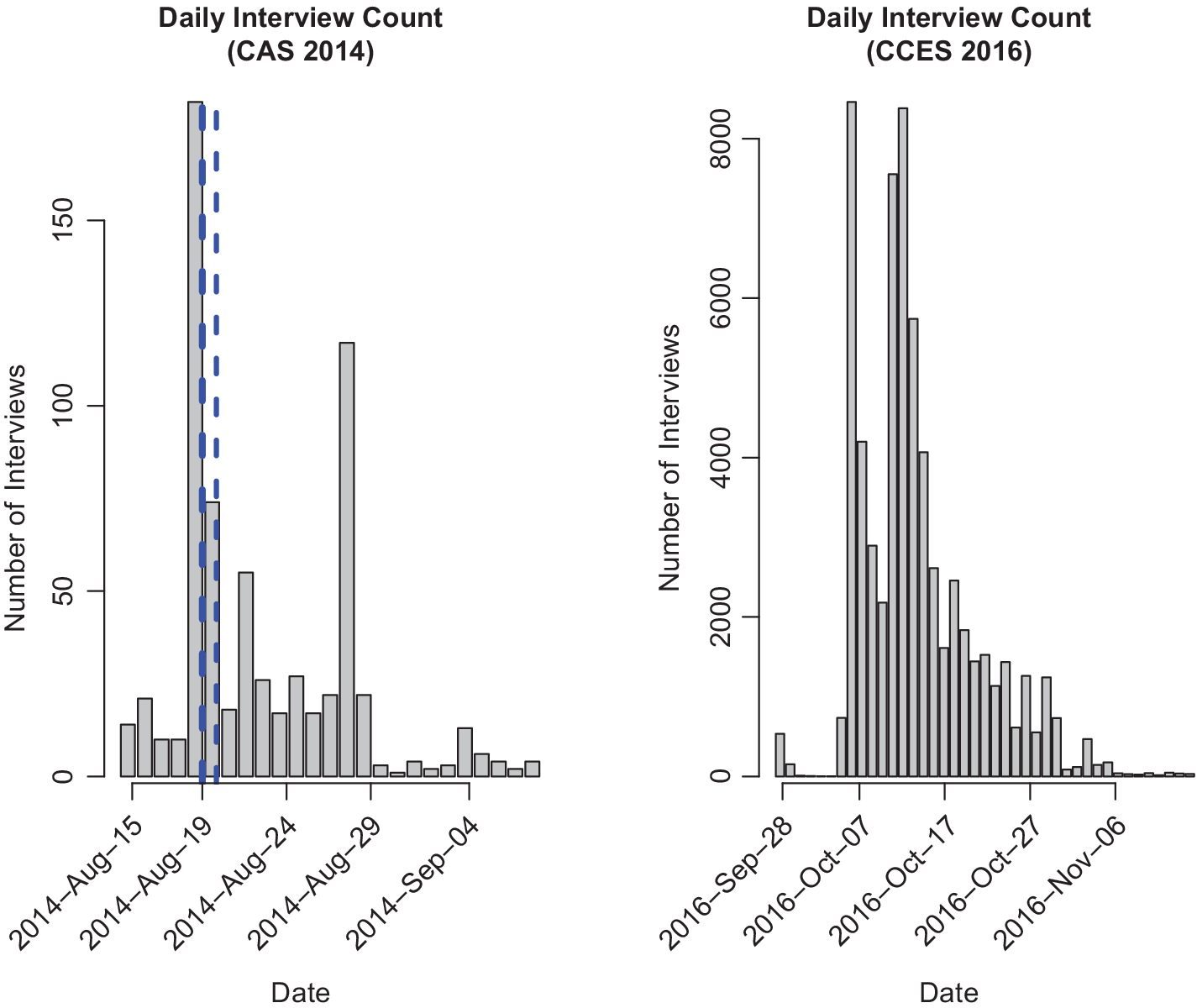
Importantly, the survey includes the interview date, which we treat as our running or score variable in the standard regression discontinuity framework (Calonico et al., Reference Calonico, Cattaneo and Titiunik2014; Hahn et al., Reference Hahn, Todd and Van der Klaauw2001). Appendix A Table 2 displays the interview date distribution. The interviews were disproportionately weighted towards the front half of the data collection period. Furthermore, as displayed in the RD density plot in the left panel of Figure 2, the distribution around the cutoff for Antonio Smith’s death is uneven (t =-9.013, p-value <0.001) with more interviews coming the day before the death relative to the day after the death. However, as displayed in the right panel of the figure (CCES 2016 interview date distribution), interview dates for web-based surveys tend to be front loaded and can demonstrate a significant fluctuation by date. There is little reason to believe that survey companies change incentive structures throughout the survey in response to real-world local events—especially when those companies are headquartered in areas different from the sample frame. Thus, the daily survey distribution response should not be correlated with the treatment or the outcome variable.Footnote 6
Date of interview and sample size; with Chicago Area Study (CAS) on the left and Cooperative Congressional Election Study (CCES) on the right

Our treatment now becomes a highly salient incident of gun homicide that occurred during the survey fielding period. An event that generates enough media coverage to momentarily draw residents’ attention to the issue of gun homicide can serve as a discontinuity. People on either side of the discontinuity are, assuming random sampling, essentially the same insofar as time is concerned, although we do estimate the RD effect with covariates as a robustness check. Respondents to the left of the running variable are absolutely in the control condition, whereas respondents to the right are in the treatment condition although we cannot say for sure that they are treated (i.e., were aware of the death). This makes this regression discontinuity design a hard test of our thesis because not everyone will have received the treatment so almost surely, we are underestimating our treatment effects.
To develop a treatment measure, we systematically evaluated Chicago homicides and their level of media salience during the survey’s fielding. First, we gathered homicide data for the city of Chicago, inclusive of victim name, location, race, and cause of death. These data were compiled and made available to the public by the Chicago Tribune. The data were then subset to only homicides occurring between August 15 and September 8. In total forty-five deaths occurred, 72% Black, 22% Hispanic, 4% Asian, and just 2% White. Furthermore, 87% of the deaths are a result of gunshots. The single White death was actually a stabbing, which falls outside the questions asked by the study. Therefore, we restrict our treatment to non-White homicide victims.
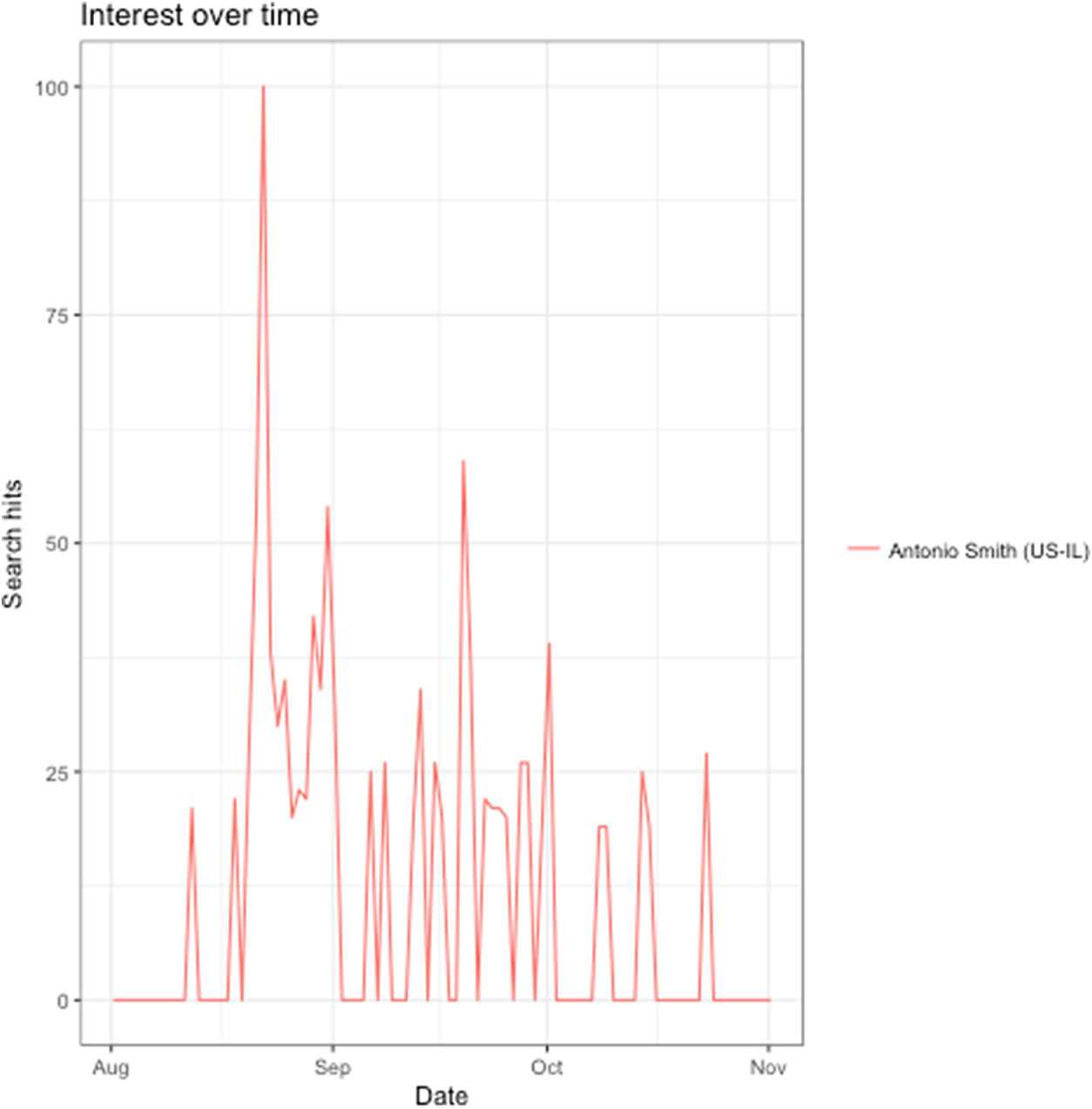
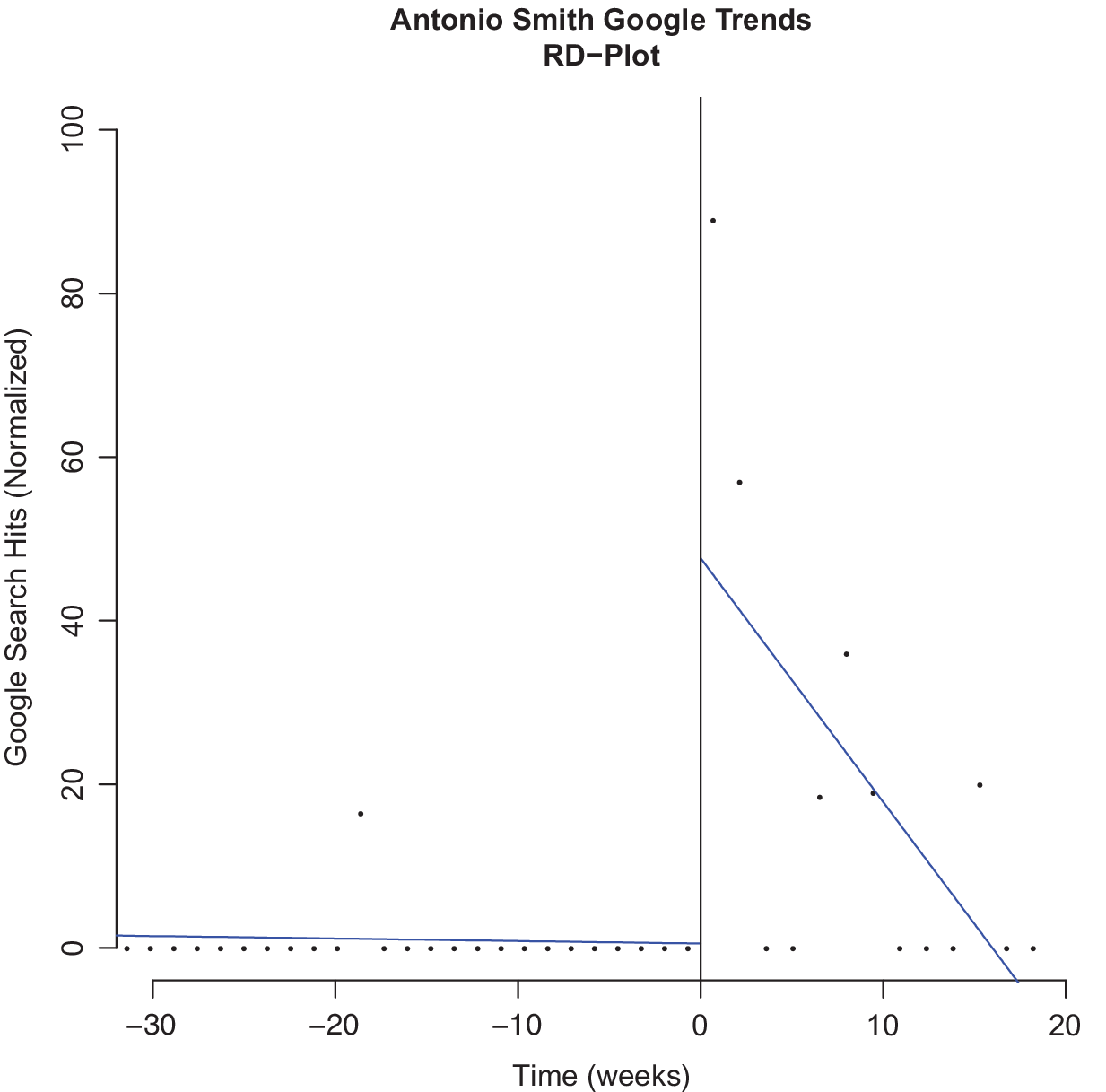
We wanted to identify the homicide that garnered the most media attention such that it might approach a real-world treatment. We therefore collected media reports about these deaths, ordering each transcript chronologically for each media outlet, which included all major television stations (CBS2 WBBM, NBC 5 WMAQ, ABC 7 WLS, and Fox Chicago WFLD) and newspapers (the Chicago Tribune, the Chicago Sun Times, and the Chicago Defender) in the local area. We identified the death of Antonio Smith as the most covered death in the dataset. Every single outlet in our dataset covered Smith, while other deaths garnered coverage from an average of two outlets. To further strengthen our argument that Smith’s death yielded high levels of coverage and approaches a real-world treatment, we conducted a daily Google Analytics search for “Antonio Smith,” an increasingly common way to detect salient public issues (Collingwood et al., Reference Collingwood, Lajevardi and Oskooii2018; Stephens-Davidowitz Reference Stephens-Davidowitz2014). Essentially, Google Analytics measures the quantity of searches on specific topics during specific time frames, then normalizes these searches between 0 (no interest) and 100 (maximum interest). We examined searches for “Antonio Smith Chicago” between the dates August 1 and November 1, 2014. Figure 3 clearly shows Smith’s death provoked intense Google searching from people whose ISP’s are located within Illinois. Figure 4 further confirms that searches peaked the day following Antonio’s death. Thus, we can be very confident that Antonio Smith’s death generated widespread public interest.Footnote 7 We replicated Figure 3 for all forty-five homicides; just nine deaths received any attention whatsoever on Google.Footnote 8 See Appendix A for a detailed discussion of Smith’s death.Footnote 9
Google Analytics searches for “Antonio Smith Chicago”, August 1–November 1, 2014, subset to Illinois. The spike in interest clearly occurs on the date of his death. Google Analytics normalizes interest from 0–100 where 0 is no interest and 100 is maximum interest

Regression Discontinuity plot of “Antonio Smith Chicago” where the running variable is the date of his death reveals a strong discontinuity effect indicating a large media treatment effect

Results
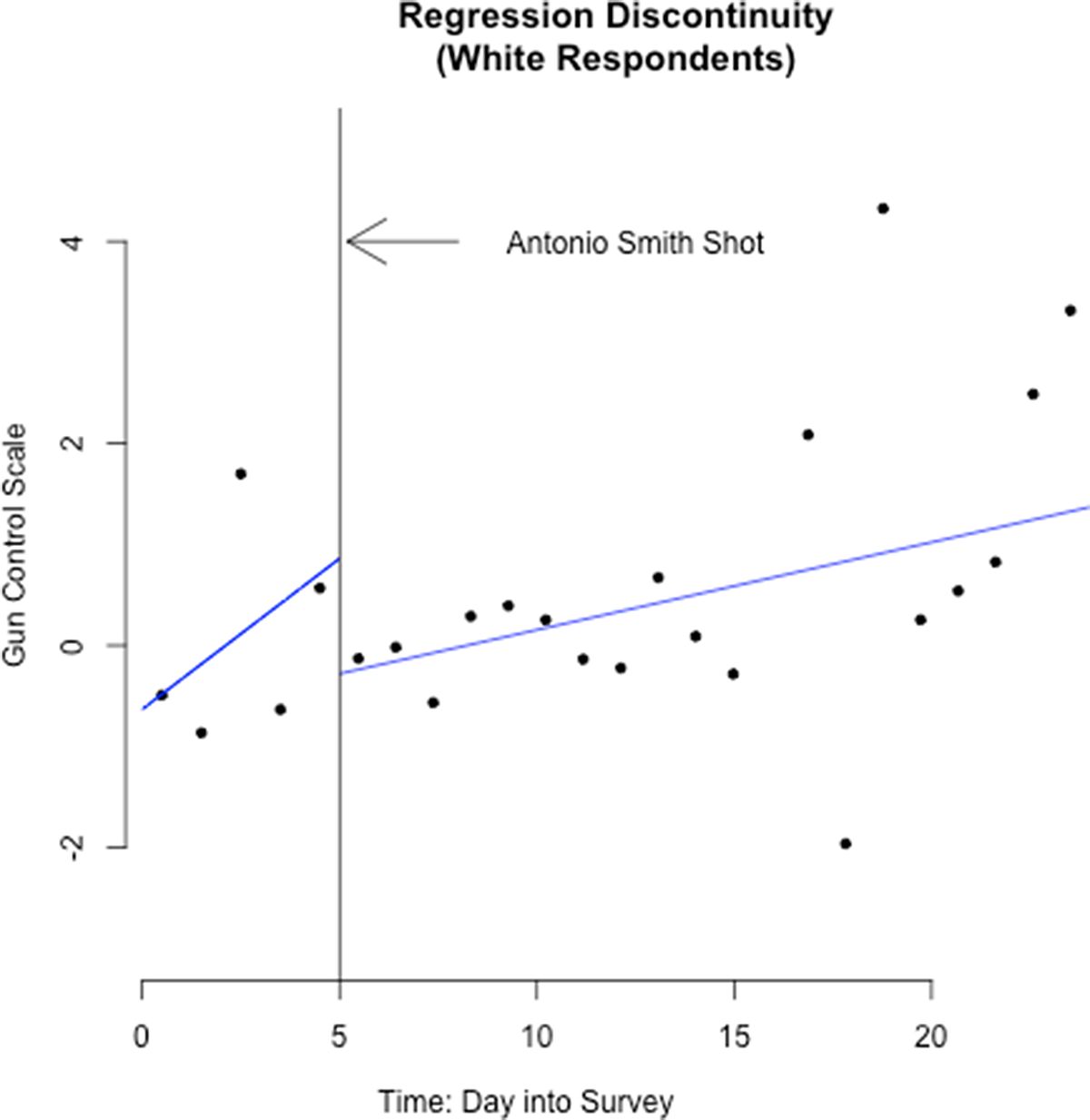
To evaluate this study’s primary hypothesis, we examine whether Antonio Smith’s death influenced White opinions towards gun control. Antonio Smith is a highly sympathetic victim, and one might ex ante expect Whites to respond to his death by increasing support for gun control. However, the coverage of the death embedded his murder within the broader context of Chicago gang violence. News stories included information that he was killed by a stray bullet in a dispute between rival gangs, and four gang members were charged in his death. Further, the logic underlying our hypothesis maintains that Black gun death will cue racial biases held by Whites, who will attribute death to failings of the Black community; they will thus seek to protect their gun rights. This is particularly true when media coverage of Black death invokes racial stereotypes, as the association of Antonio Smith’s death with gang violence does. Figure 5 presents the regression discontinuity plot (RD Plot) among White respondents with the sharp discontinuity occurring on August 20 (day 5 on the x axis), the day Antonio was shot and killed in the afternoon. The RDD is a quasi-experimental pretest-posttest design, where we elicit the treatment effect at the intervention’s cutoff. The effect is expected to diminish with time as the treatment (the death and coverage thereof) diminishes in salience. As hypothesized, Whites become less supportive of gun control, relatively speaking, as a function of Antonio Smith’s death. Visually, the drop in support for gun control is about 1 on the gun scale, which is about 0.25 of a standard deviation on the gun attitudes scale.
Regression Discontinuity plot reveals a clear break when treating August 20, Antonio Smith’s homicide, as a sharp discontinuity. White respondents become less pro-gun control as a function of the death

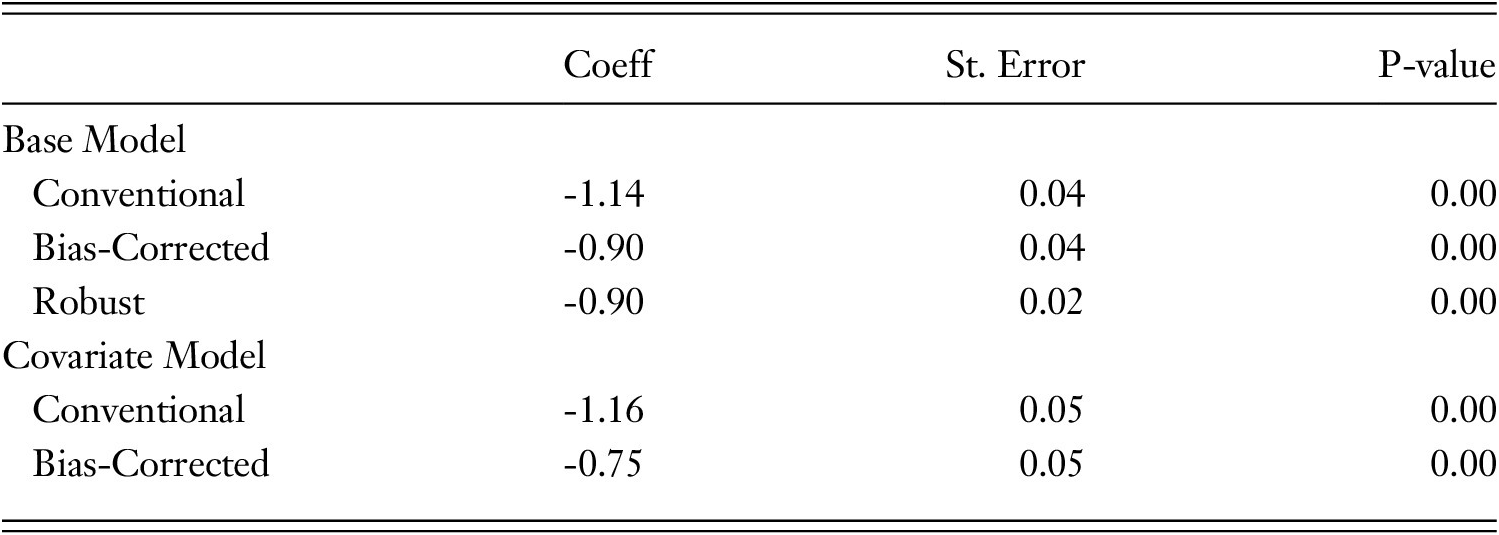
Next, we estimate two local regression discontinuity models, presented in Table 1, with and without covariates (party identification, age, sex, education, local news consumption, crime worry, opinions about whether Blacks and Whites are respectively violent, racial resentment, and gun ownership.)Footnote 10 While our balance tests in Appendix A (Table 3) show that covariate selection into the control (pre-shooting) or treatment (post-shooting) is effectively random, we nevertheless estimate our models with and without covariates. Covariates can help reduce the sampling variability without increasing bias (Cattaneo et al., Reference Cattaneo, Idrobo and Titiunik2017). For each regression, we present the conventional local estimate, the bias-corrected estimate, and the robust estimate. As recommended by Matias D. Cattaneo and colleagues (Reference Cattaneo, Idrobo and Titiunik2017) we focus our interpretation on the robust estimate—although the interpretations are substantively similar for all three estimates. Fitting with the plots, the base RDD robust model receives a coefficient of -0.90 (0.23 standard deviation), suggesting the gun homicide moved respondents into a more “pro-gun” direction. Substantively, relative to the control, the death treatment reduces White support for gun control by approximately 6.5% (Appendix A Table 4). That is, respondents interviewed a day after the shooting compared to a day before the shooting are about 6.5% less supportive of gun control on the outcome measure’s scale ranging from negative eight to positive six. While the covariate model drops the treatment coefficient 0.15 points, the substantive effects remain. This finding is consistent with the theory that exposure to Black gun death has the potential to cue underlying racial biases, which in turn lessen support for gun control, relatively speaking.
Regression Discontinuity, Dependent variable: Gun policy preferences and attitudes scale

Second model controls for the following covariates: Party identification, age, sex, education, local news consumption, crime worry, Blacks violent, Whites violent, racial resentment scale, and gun ownership.
This conjecture is supported by further analysis which examines more directly role of racial bias. To examine this, we draw on two questions included in the survey that query respondents about whether they think Blacks are violent, and whether they think Whites are violent. We then split respondents into two groups: 1) respondents who agree that Blacks are more violent than Whites; and 2) respondents who do not think that Blacks are more violent than Whites. We then estimate discrete RDD regressions among the two subsamples. With the first group, we find a statistically significant coefficient of -2.2 [-2.24, -2.17] at the 95% confidence level. Among the latter group, the discontinuity coefficient is 0.54 [-0.09, 1.17] and is not statistically significant. We find the same pattern when we split the sample by high/low racial resentment then estimate two discrete RDD models: -1.35 [-1.46, -1.24] among high resentment Whites, and -0.004 [-0.49, 0.48] among low resentment Whites.
While our assessment of the media environment surrounding Antonio Smith’s death strongly suggests that the death as treatment is empirically verifiable, we also estimated the above results subset to respondents who report they primarily watch local news.Footnote 11 Theoretically, local news viewers should have more exposure to salient local news events—like Smith’s murder—and so exposure to the treatment here should be more likely to occur. If this is true and the effect is real, then we should expect a greater treatment within this subset. Table 2 in Appendix B confirms our initial results, strengthening our findings. Here, the robust discontinuity coefficient is -1.42 (0.365 standard deviation), a notable improvement. Further, our results are not driven by people disproportionately self-selecting into the treatment via watching local news. A difference of means t-test reveals that respondents in the control and treatment groups watch local news at the same rates (μ = 0.0045, t = 0.115, p = 0.909).
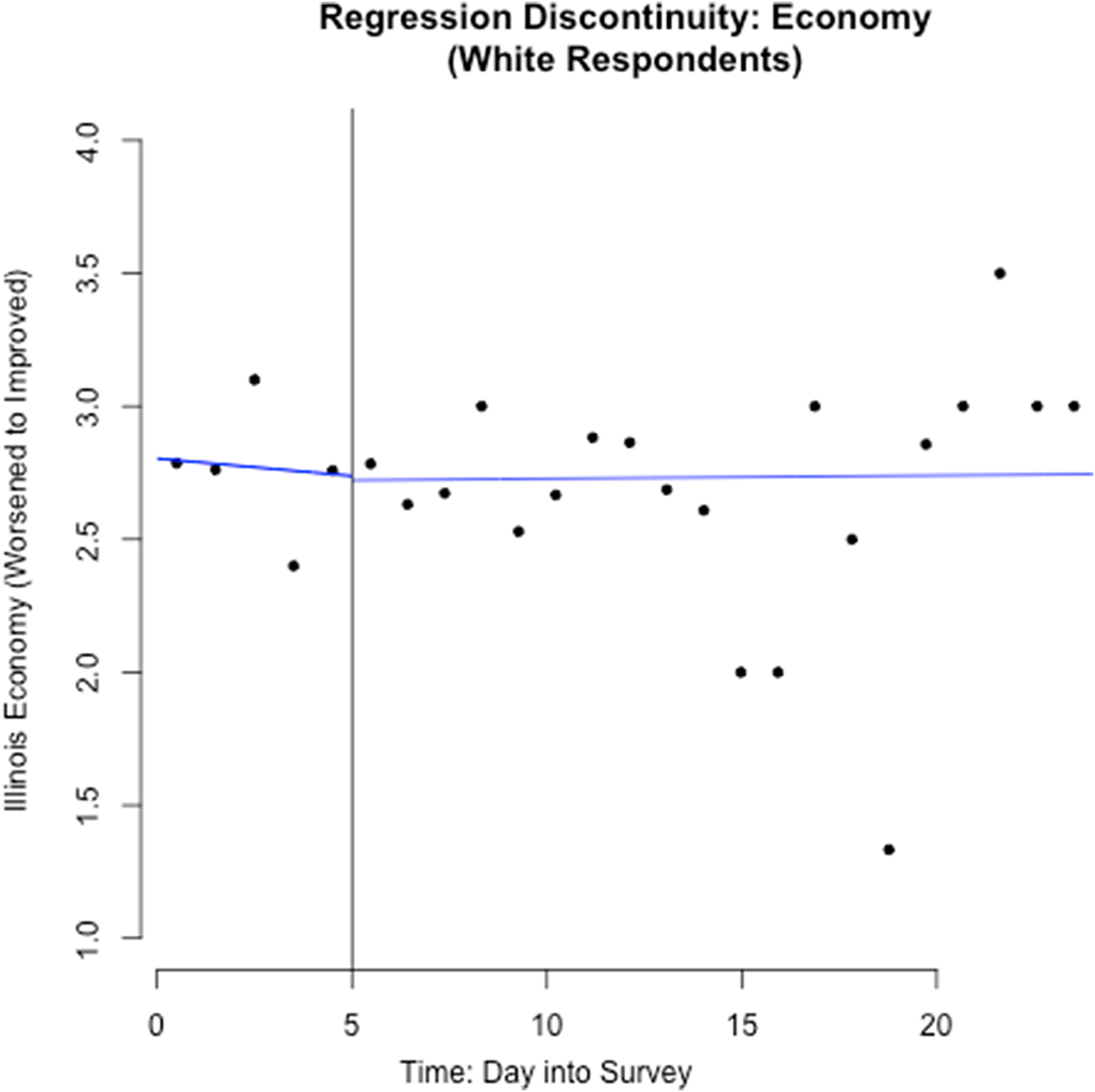
To further assess the robustness of these findings, we conducted two additional placebo tests. First, the survey asked a policy question about the economy: “Compared to last year, how would you rate the economy in Illinois? Would you say it has Improved a lot (5), Improved some (4), Stayed the same (3), Worsened some (2), Worsened a lot (1)?” There is no reason to believe Smith’s death should influence Whites’ attitudes towards the economy. Therefore, if the discontinuity produces a substantively significant result in the vein of that observed for gun control, then our design may be questionable. Figure 6 presents an RD plot indicating essentially no observable movement at the discontinuity. This enhances the robustness of our findings.
Regression Discontinuity plot reveals no clear break when treating August 20, Antonio Smith’s homicide, as a sharp discontinuity for attitudes about the economy. White respondents don’t change their attitudes about whether the Illinois economy is doing worse or better as a function of the death

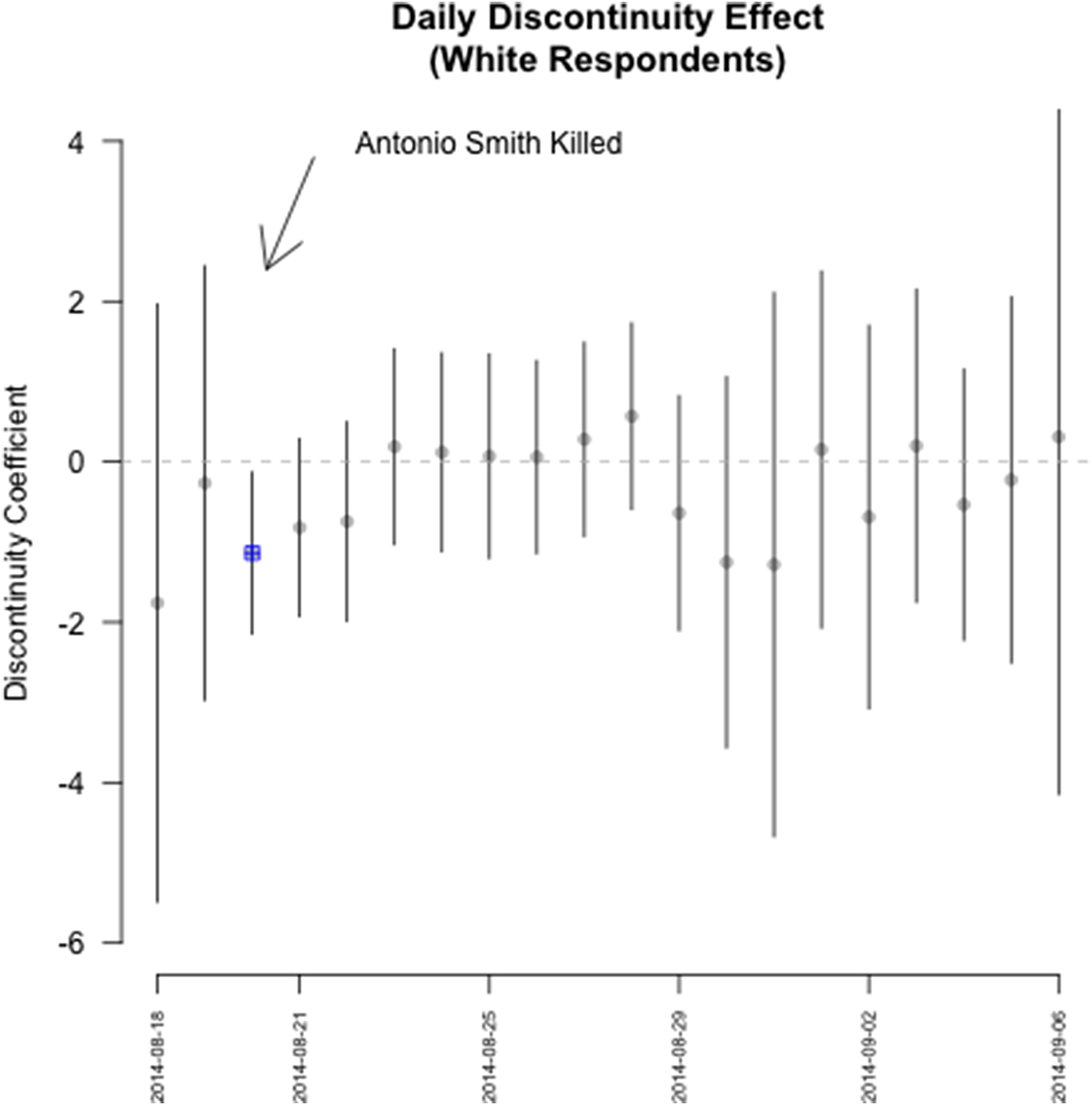
Finally, to strengthen our argument that Smith’s death is a critical social discontinuity, we can estimate RD models with arbitrary daily cutoffs. If we find statistically significant discontinuity effects (on gun control attitudes) on other survey dates, we might feel suspicious that our finding is a random fluke. Figure 7 plots this placebo check—daily estimated discontinuity coefficients with 95% confidence intervals. The figure demonstrates that August 20 is the only date producing a statistically significant treatment effect. That is, the 95% confidence bands overlap the 0 line on the y-axis every other day. This further supports our discontinuity findings. While there are some other dates that visually display a rise or drop relative to the previous day (like the drop between point 11 and point 12 on the plot), none of these drops produce statistically reliable changes and are more likely a feature of random sampling. For instance, no death occurred on August 28 that would have led to the drop between point 11 and 12.
Daily discontinuity effect only witnesses at the Smith cut-off. Other daily placebo cut-offs fail to achieve statistically significant effects

STUDY 2: EXPERIMENTAL EVIDENCE AMONG WHITE RESPONDENTS
Our observational findings suggest that Whites become more anti-gun control as a result the gun homicide of 9-year-old Black boy. Moreover, additional analysis reveals that this finding holds primarily among those who believe that Blacks are more violent than Whites. In contrast, Whites who do not subscribe to racial stereotypes about propensity for violence are indifferent to Black gun death. Study 2 sought to replicate and assess these findings further with a controlled experimental design. Since almost no other research exists examining White responses to racialized Black death, we were hesitant to draw firm conclusions based on one observational study. The main questions Study 2 attempts to answer, then, are: 1) Do Whites’ opinions about gun control change as a result of exposure to “everyday” gun death? If so, 2) Do Whites condition responses based on the race of the victim (as we suspect they do), demonstrating greater support for gun control when gun death victims are White? Our expectations are therefore: 1) Whites exposed to the death of a Black 13-year old boy will NOT become more pro-gun control relative to a control condition, and 2) Whites exposed to the death of a White 13-year old boy will become more pro-gun control relative to a control condition. Due to the specific facts around Antonio Smith’s death, where he was portrayed as an innocent bystander to gang violence, we wanted to evaluate whether White attitudes further shifted when the victim is themselves portrayed as a gang-member, where we might expect individuals to further double down on support for gun rights. However, race is our primary point of inquiry: If Whites respond to White death (in the form of greater support for gun control) but not Black death, this is further evidence in support for our racialized theory of gun attitudes.
Data
We conducted a two-wave panel sample of White MTurk respondents in early winter, 2017–2018. It is important to note that we are not making generalizable claims with these data, given that our data come from a convenience sample. Table 1 in Appendix B presents key demographic information from our sample and the 2016 CCES, for the same universe (White adults over the age of eighteen). Consistent with Adam J. Berinsky et al. (Reference Berinsky, Huber and Lenz2012) and Kevin E. Levay et al. (Reference Levay, Freese and Druckman2016), relative to a more representative sample, our convenience sample is disproportionately younger, has less income, but is better educated. Notably, we see no differences on party identification. However, due to experimental manipulation, we can make causal claims about treatment effects, which is the motivation of the current investigation (Coppock Reference Coppock2018; Mullinix et al., Reference Mullinix, Leeper, Druckman and Freese2015).
In wave one, we gathered demographic information, (e.g. respondent gender, race—on which we screened—income, education, and partisanship), as well as gun ownership and racial attitudes measures. This wave was collected December 22–26, 2017, with 98% of the respondents completing their surveys by December 24. We employ these variables to ensure the balance of our treatment groups. From December 26, 2017 to January 1, 2018, we fielded a second wave among the same respondents, administering our experiment followed by several post-treatment questions. All wave one respondents had at least two days (including Christmas) between waves and were encouraged to take the second wave. We collected the data in two waves to reduce the chances of pretreatment bias and other question-order effects (Sudman et al., Reference Sudman, Bradburn and Schwarz1996). Our results are reported only among respondents who passed a general attention check in wave one and two (fourteen respondents were excluded from wave one due to failing the attention check; all wave two respondents passed the attention check).
Wave one includes n = 186 respondents, who were incentivized to participate with $.50. Following the same interview procedure as wave one, wave two includes n = 148 of the same respondents, who were incentivized to participate with an additional $1, resulting in a 20% attrition rate. Table 4 in Appendix B indicates that no statistically significant differences emerge across demographic indicators between the two samples. In other words, attrition from wave one to wave two is random and so should not bias our results.
Experimental Manipulation
To assess our hypotheses, we randomly divided respondents into four treatment groups and one control condition.Footnote 12 Each group read a different story (two stories), coupled with a different image (two images). The stories are designed to mirror sympathetic and unsympathetic victims encountered in our media content analysis referenced earlier in the paper and are presented in Appendix B. We directly lift language from these stories so as to appear as realistic as possible. The two images are presented in Appendix B, in Figures 1 (White) and 2 (Black), which picture an early-teens Black or White child. We do not specify the race of the murderer, as that would introduce another factor into the experiment. Clearly, the treatment images are different boys (i.e., beyond skin color), so we pre-tested both among n = 60 m-Turk White respondents on several attributes.Footnote 13 For each picture, we asked respondents to rate the child on a 0–10 scale where 0 does not describe the person at all and 10 describes the person very well. The six attributes are: trustworthy, honest, attends school regularly, likely to get into trouble, gets good grades, and from a good family. We also asked them to guess the boy’s age.
Table 3 in Appendix B reports difference of means t-test comparisons for the two kids. On each attribute, respondents rate the two kids about the same, where sometimes the Black child is rated a bit higher, and other times the converse. While the White child is rated a bit older by these respondents, the mean of 13.68 to 12.98 falls easily within cohort and school-grade levels (e.g., kids in the same grade might be 9 months apart in age). Thus, we are confident that respondents assess these two kids about evenly, race notwithstanding.
The experiment implements a 2x2 factorial design, where the race of the victim differs (as indicated by the image shown to respondents (Black/White)), as does the type of person who was shot and killed (bystander/gang-involved). However, in both stories the victim is a thirteen-year old boy. Thus, treatment 1 is a Black bystander and treatment 2 is a White bystander, where the only difference between the two conditions is the image of a Black versus White boy. Treatment 3 is Black and gang-involved, and treatment 4 is White and gang-involved. The only difference between these two conditions is the race of the boy in the image. Finally, the control group read a story about recycling. Wave two thus begins with respondents exposed to one of these five conditions.
Following exposure to our treatment, respondents were asked about their gun attitudes as measured on a ten-item battery of gun policy proposals. Our dependent variable is therefore a scaled measure of gun policy preference items, following those developed by Filindra and Kaplan (Reference Filindra and Kaplan2017) (see Appendix B for wording). We coded items such that low numbers are the pro-gun position, and high numbers are the pro-gun control position. A reliability test on the combined measure indicates an alpha statistic of 0.9. The scale thus ranges from 4 to 40.
Results
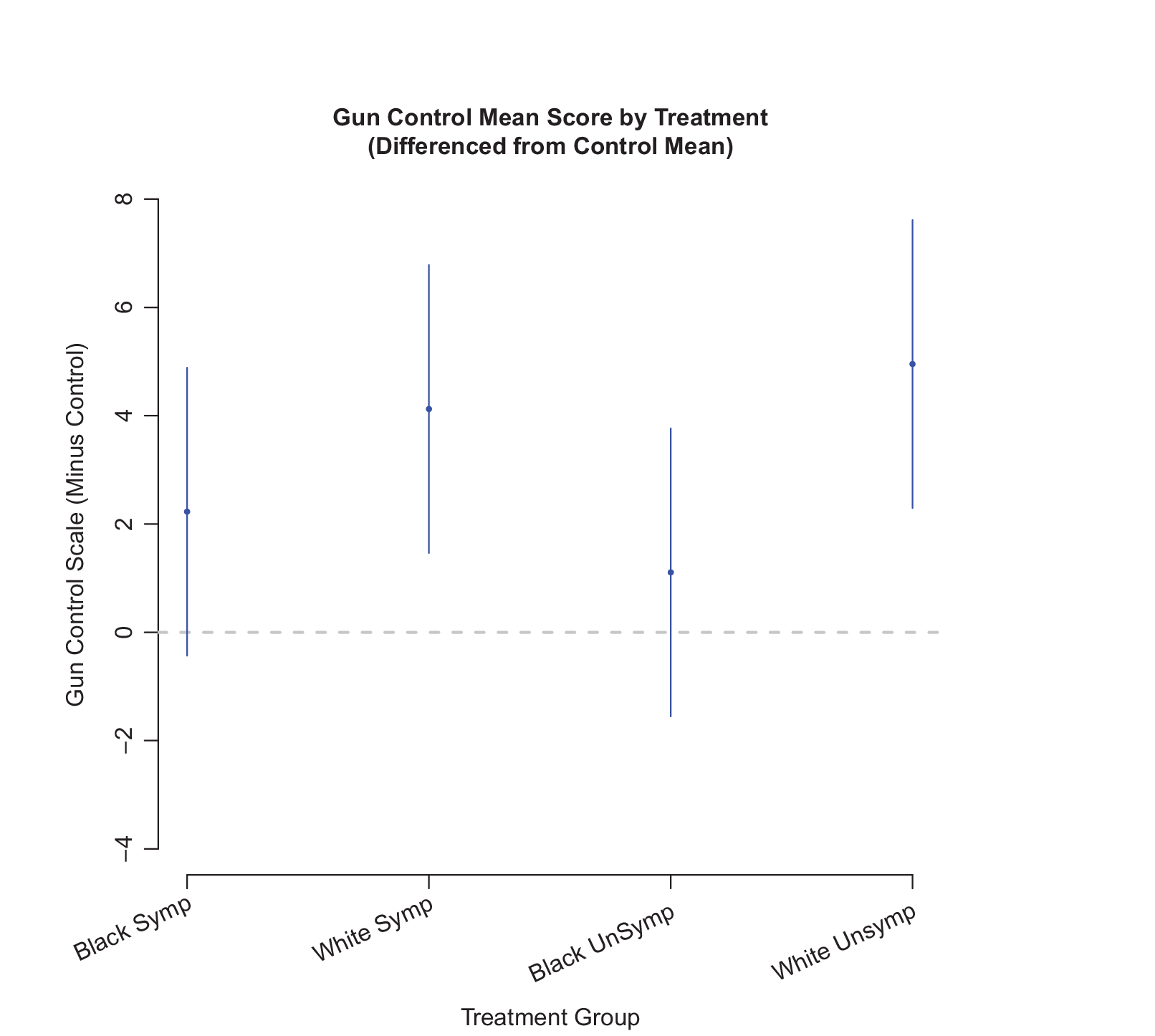
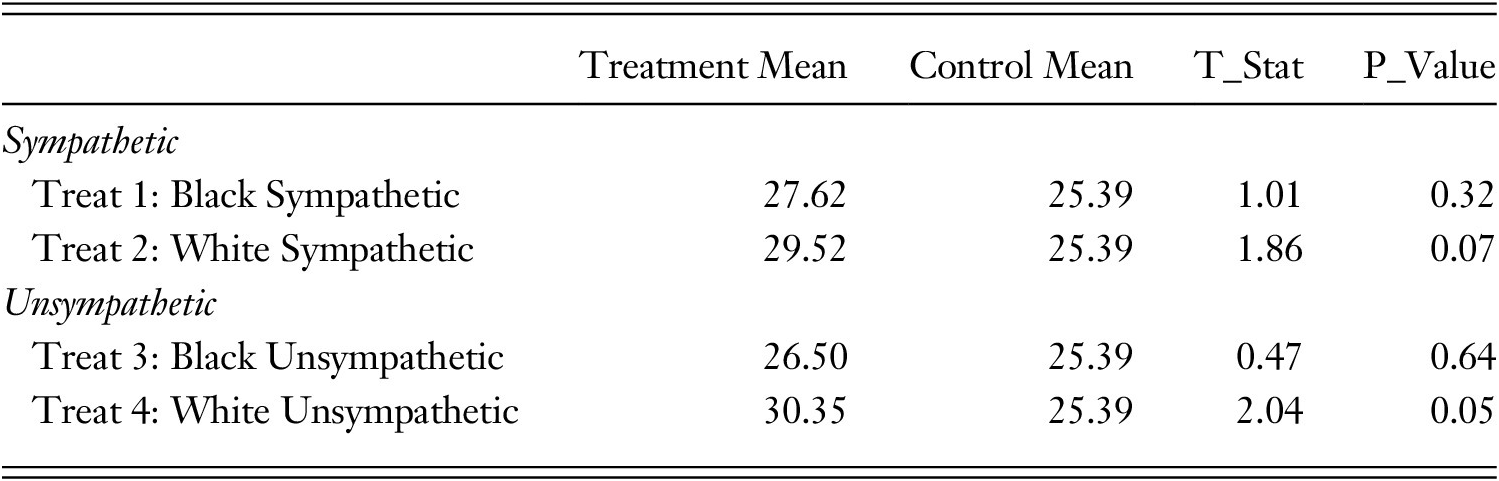
Figure 8 displays the mean gun control policy scores (minus control mean) by group among White respondents. Table 2 reports the appropriate statistical test values. The average gun policy score among respondents in the control group is 25.39. Respondents in the Black bystander condition report a mean score of 27.62, a score statistically indistinguishable from that in the control group. However, respondents in the White bystander condition report a score of 29.51, which is statistically significantly different from responses in the control group (mean= 29.51, p < 0.10). This pattern is replicated in the gang-involved condition: respondents report statistically significant mean differences (from the control) when the victim is White (30.35) but not when the victim is Black (26.5).
Mean gun policy scale treatment values by treatment condition differenced from mean gun control attitudes in the control group), study 2: Control: Recycling; Tr1: Black sympathetic gun death; Tr2: White sympathetic gun death; Tr3: Black unsympathetic gun death; Tr4: White unsympathetic gun death

Differences of Means t-test results between treatment condition and control condition among White respondents

Relative to the control condition, Whites exposed to newspaper stories about gun deaths reveal more pro gun-control attitudes, but this relationship is only statistically significant when the victim is White.
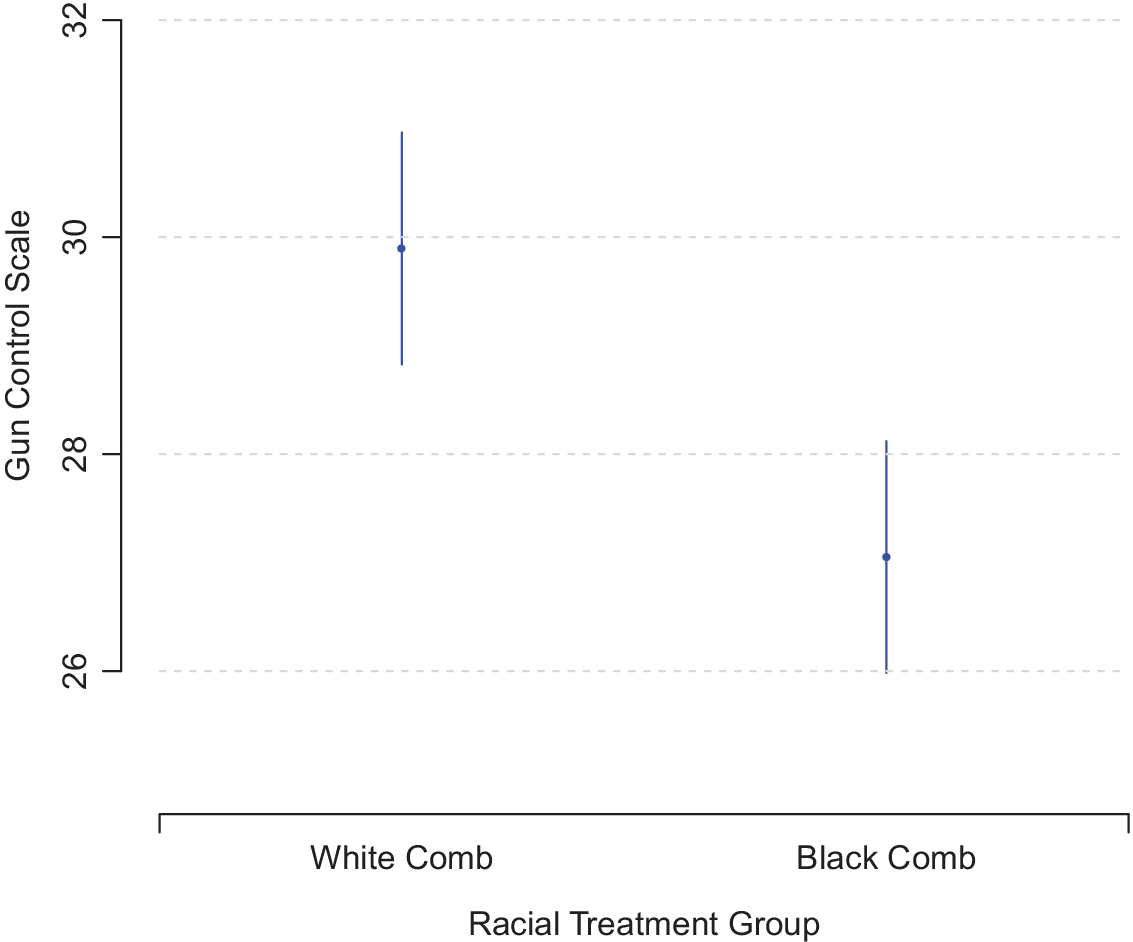
Next, because the type of death—bystander versus gang-involved—is not statistically distinct, we also collapse the two Black (bystander versus gang-involved) and two White (bystander versus gang-involved) conditions to assess the total effect across racial conditions.Footnote 14 Here, we obtain a result consistent with findings in Table 2: Gun attitudes among respondents in the Black death conditions are not statistically different from the control group (mean diff = 1.658, t-stat=-0.827, p-value = 0.412); whereas respondents in the White death conditions are statistically more pro gun-control relative to control group respondents (mean diff = 4.502, t-stat = 2.228, p-value <.05). Finally, we compare gun scale attitudes between the collapsed Black treatments and the collapsed White treatments (Figure 9). The mean gun control score among respondents in the White death condition is 29.89, whereas the mean score among respondents in the Black death condition is 27.05. The difference of 2.843 is statistically significant (t = 1.84, p < 0.10). In terms of effect size, this 2.84-point difference equates to roughly 0.34 standard deviations (on the gun scale). Taken together, these findings are broadly consistent with the Chicago analysis and supportive of our argument that racial biases underlie White attitudinal responses to gun violence.
Mean gun policy scale treatment values by combined racial treatment condition (Black Comb = Black sympathetic gun death; Black unsympathetic gun death. White Comb = White sympathetic gun death; White unsympathetic gun death.)

DISCUSSION AND CONCLUSION
We offer two key findings regarding White attitudinal responses to routinized Black gun death. First, using a regression discontinuity design evaluating responses to a real-world instance of Black death, we demonstrate that Whites do not respond to Black gun death by significantly altering their views in favor of gun control. Without our theoretical framework, we might have expected Whites to become more supportive of gun control, particularly given that the victim was a young boy whose death was hailed as a tragedy. This death was particularly striking, too, in that the victim is in no way responsible (i.e., drug dealer) for his own death. Often, media coverage of gun homicide associates victims with illicit activity, which reinforces stereotypes about Black criminality and potentially triggers latent racial biases. However, the fact that we still find White opposition to gun-control in response to this death suggests that in the minds of Whites, Black death is associated with moral or cultural deficiencies in the Black community, rather than as a social problem subject to public redress. Instead, the policy solution that follows from logic that locates the problem of gun violence in the moral failure of Black communities is to do nothing, or to regulate the moral behavior of the Black community through policing (Muhammad Reference Muhammad2011; Weaver Reference Weaver2007).
One may object that references to gang violence in accounts of Smith’s death are primarily to blame for White reactions, rather than Smith’s race. We answer this by following our regression discontinuity analysis with an experimental evaluation of White responses to treatments of Black gun death compared to treatments of White gun death. Using a two-wave Mturk survey, we found that while White attitudes were unmoved by Black gun death, they become more supportive of gun control when confronted with White gun death. This is true even when the White victim is portrayed as gang-involved. Thus, rather than references to gang violence, it is the race of the individual themselves that accounts for disparity in responsiveness of opinion to gun death among Whites. We tested these findings against a control and then against one another. The results from Study 2, then, are generally supportive of our overall argument that exposure to Black gun death—especially relative to White gun death—is likely to either not change gun attitudes one way or the other or to generate opposition to gun control. Our findings illuminate a key factor to understanding continued White opposition to gun control. Following from the racialized history of the gun debate, access to firearms is implicitly associated with White rights. Whites need not hold explicit racial animus nor directly oppose policies that would improve the lives of their Black counterparts—they simply need not be moved when presented with the degradation of Black life.
This research is important because it offers insight into the underlying reasons why Whites often do not respond to Black gun death in ways commensurate with their perceived responses to high profile instances of violence like the Parkland mass school shooting. Parkland provoked a “March for Our Lives” in a way that routinized gun death—Black gun death—has not. This, in turn, highlights some of the barriers to meaningful gun reform legislation facing activists. Activists and advocates should therefore focus their efforts on highlighting the individualized experiences of people of color and on mobilizing those already likely to support their cause. The thrust of what we are arguing is that underlying opposition to gun control are deep seated racial biases. Thus, the policy prescriptions that follow from it require making explicit the connection between race and gun rights. It is necessary to reframe the debate in terms of human dignity and civil rights instead of constitutional ones. Rather than discussing the conflict around access to guns as one of cultural values, it should be recognized that these, “competing values have, at their core, an often-unrecognized racial conflict that extends back to the very founding of the nation” (Burkett Reference Burkett2008, p. 58).
We offer this analysis with several caveats. While our findings offer insight into how Black death shapes White attitudes, the findings are not necessarily generalizable due to the fact that we drew on a convenience sample (experiment) in the one case and selected a potentially unrepresentative death in the other (RDD). However, this is why our research design triangulated data sources. Still, future research should seek to replicate the findings presented here, but in a variety of vignette scenarios. If our theory about routinized gun death is true, we should expect similar results. However, it may be the case that a more routinized description would not generate a lot of interest in the real world and so therefore would have no effect on attitude change. Thus, further work is needed to detail the scope conditions of how Whites respond to Black gun death.
In addition, future research should investigate heterogeneous treatment effects among Whites. It may be that Whites with particular baseline racial attitudes (i.e., racial resentment or racial empathy) respond differently to Black gun death. Moreover, it may be that in the second experiment Whites respond to the death of a White child out of in-group favoritism, where being presented with a White victim makes the threat of gun violence more salient. Even so, emerging research around White identity suggests that in-group favoritism among Whites is associated with underlying racial biases (Jardina Reference Jardina2019). However, this is an area for future research. We primarily focused on White responses to Black death, without attention to Black responses to Black and White death. Part of the reason for this is the relatively small Black sample in the Chicago data. It could be that Blacks are also self-interested, their attitudes not responding to White death. However, given Blacks’ lower levels of reported social dominance orientation (Pratto et al., Reference Pratto, Sidanius, Stallworth and Malle1994; Sidanius and Pratto, Reference Sidanius and Pratto2001), we find this possibility unlikely and atheoretical. Nevertheless, questions remain regarding the underlying causes of racially divergent attitudes towards gun control on which an inter-racial analysis may shed light. We hope this article sparks greater research in this area.
Supplementary Materials
To view supplementary material for this article, please visit http://dx.doi.org/10.1017/S1742058X20000156.