Introduction
Paragangliomas are uncommon neuroendocrine tumours arising from neural crest tissue found in various locations around the body.Reference Terracol and Guerrier1 Sympathetic-associated paragangliomas arise from the adrenal medulla or from the sympathetic ganglia and are generally functionally active, as indicated by excess catecholamine production. Parasympathetic-associated paragangliomas arising in the head and neck are usually non-functioning. In the head and neck, paraganglioma of the larynx is rare,Reference Terracol and Guerrier1, Reference Guerrier, Makeieff, Louche, Mouketou and Crampette2 with only 79 reported cases in the English language literature.Reference Ferlito, Devaney and Rinaldo3 Recently, paraganglioma syndromes have been described which are related to succinate dehydrogenase gene mutations.Reference Baysal, Ferrell, Willett-Brozick, Lawrence, Myssiorek and Bosch4 We report a case of a laryngeal paraganglioma and discuss its genetic origin.
Case report
A 38-year-old woman was referred with a laryngeal mass discovered incidentally during ultrasonography for a solitary thyroid nodule. The patient had no children and no related significant personal or familial medical history. She was asymptomatic, with neither dysphonia nor dyspnoea.
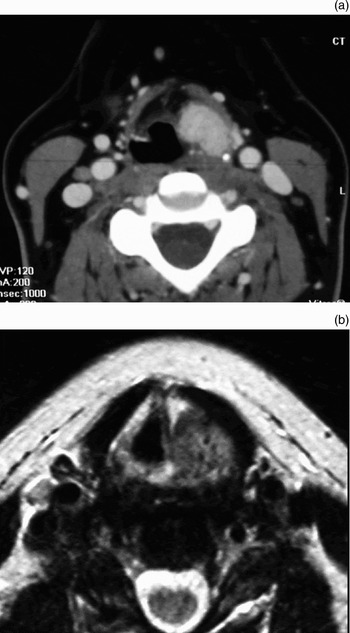
Fibre-optic laryngoscopy revealed a swelling in the area of the left laryngeal ventricle. Computed tomography and magnetic resonance imaging of the area showed a hypervascular laryngeal mass with the typical appearance of a paraganglioma, located in the left pre-epiglottic space (Figure 1). The plasma calcitonin level was normal (<10 µmol/ml), excluding a medullary thyroid carcinoma.Reference Rieu, Lame, Richard, Lissak, Sambort and Vuong-Ngoc5 Surgical removal of the paraganglioma was planned, and fine needle aspiration biopsy of the thyroid gland nodule was decided against as the nodule was to be excised during the same procedure.
Axial imaging views taken at the supraglottic level. (a) Iodine-enhanced computed tomography scan; (b) T2-weighted magnetic resonance imaging scan (note ‘salt and pepper’ appearance).

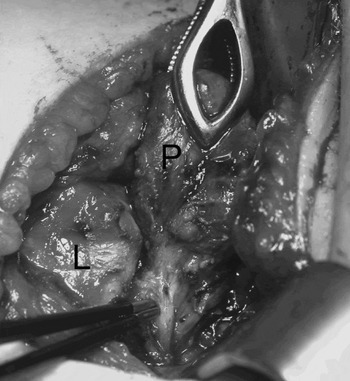
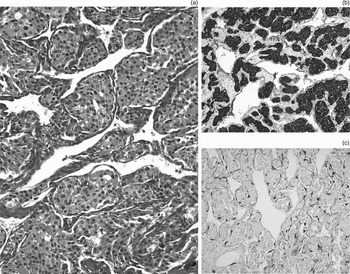
A neck incision at the level of the thyroid cartilage revealed an extremely vascular mass arising from the left superior laryngeal nerve and involving the lateral part of the pre-epiglottic space (Figure 2), with a blood supply derived from the superior laryngeal artery. The entire excision was performed without breaching the laryngeal mucosa. The thyroid cartilage was not removed. The frozen section histopathological appearance was consistent with a paraganglioma; this was confirmed from formol-fixed, paraffin-embedded sections and immunostaining (Figure 3), excluding, notably, neuroendocrine carcinoma. Paraffin-embedded sections of the thyroid nodule revealed a papillary carcinoma.
Surgical extra-mucosal removal of the laryngeal paraganglioma (P). The superior laryngeal nerve is indicated. L = left thyroid ala of the larynx

Microscopic view of the paraganglioma. (a) H&E staining showing uniform round or polygonal chief cells forming compact cell nests (‘zellballen’) surrounded by a delicate capillary network (×400). (b) Immunohistochemical staining for chromogranin A, with positive cell reactivity (×400). (c) Staining for S-100 protein, demonstrating the sustentacular cells, an important feature in the differentiation from other endocrine neoplasms (×400).

A post-operative octreoscan did not show any other paraganglioma. Plasma-free metanephrine analysis was negative, indicating no concomitant secreting pheochromocytoma.
A total thyroidectomy and right modified neck dissection were performed two months later. There were no post-operative complications. Formal histopathological analysis showed a 15 mm papillary carcinoma in the right thyroid lobe associated with a 2 mm microcarcinoma in the contralateral lobe. Subsequently, the patient went on to receive radioiodine treatment.
The coding exons of the succinate dehydrogenase gene B, C and D, including their intron–exon junctions, were analysed by denaturing high performance liquid chromatography. Total human genomic deoxyribonucleic acid (DNA) was obtained from peripheral blood lymphocytes. Genomic DNA was extracted by standard methods. Amplicons with abnormal enhanced mismatch mutation analysis denaturing high performance liquid chromatography profiles were sequenced on both strands (primer sequences are available on request). No deleterious mutation was found in the succinate dehydrogenase B and succinate dehydrogenase D genes. A deleterious in exon 4 of succinate dehydrogenase mutation C was identified. This mutation was a non-sense mutation: c.183G>A leading to p.Trp61X.
Discussion
Although paragangliomas have been described since the late 1940s,Reference Terracol and Guerrier1, Reference Fuller6 their genetic basis has only started to become clearer within the last few years.Reference Baysal, Ferrell, Willett-Brozick, Lawrence, Myssiorek and Bosch4 Hereditary paragangliomas are caused by germline mutation in the genes coding for the mitochondrial complex II, which is part of an enzyme complex found in the mitochondrial protein membrane involved in the Kreb cycle and the mitochondrial respiratory chain. This complex is composed of four sub-units, components of succinate dehydrogenase A, B, C and D. Germline succinate dehydrogenase mutations B, C and D give rise to paraganglioma syndromes four, three and one, respectively. The method of transmission of paraganglioma syndromes four, three and two is autosomal dominant, with maternal imprint for succinate dehydrogenase mutation D.Reference Hensen, Jordanova, van Minderhout, Hogendoorn, Taschner and van der Mey7 Succinate dehydrogenase mutation A has not yet been associated with paraganglioma, and the gene for paraganglioma two syndrome is still unidentified.Reference Neumann, Pawlu, Peczkowska, Bausch, McWhinney and Muresan8, Reference Schiavi, Boedeker, Bausch, Peczkowska, Gomez and Strassburg9
The three paraganglioma syndromes have different clinical presentations;Reference Schiavi, Boedeker, Bausch, Peczkowska, Gomez and Strassburg9 paraganglioma one and four are associated with pheochromocytoma, paraganglioma one with multiple tumours, and paraganglioma four with malignant tumours.Reference Neumann, Pawlu, Peczkowska, Bausch, McWhinney and Muresan8 Recently, Benn et al. reported data on genotype and phenotype associations in a cohort of 116 patients with pheochromocytoma–paraganglioma syndromes and succinate dehydrogenase mutations B and D. Succinate dehydrogenase mutation B carriers were more likely than mutation D carriers to develop extra-adrenal pheochromocytomas and malignant disease, whereas mutation D carriers had a greater propensity to develop head and neck paragangliomas and multiple tumours.Reference Benn, Gimenez-Roqueplo, Reilly, Bertherat, Burgess and Byth10 Paraganglioma three (succinate dehydrogenase mutation C) has been linked to carotid body tumours in young patients.Reference Schiavi, Boedeker, Bausch, Peczkowska, Gomez and Strassburg9 The mutation identified in our patient, c.183G>A (p.Trp61X), is clearly a disease-causing mutation. Not all the succinate dehydrogenase C-type mutations are deleterious; indeed, missense mutations exist, the significance of which is not clear.Reference Bayley, van Minderhout, Weiss, Jansen, Oomen and Menko11
• Paragangliomas are uncommon neuroendocrine tumours arising from neural crest tissue found in various locations around the body
• Hereditary paragangliomas are caused by germline mutation in the genes coding for mitochondrial complex II
• This paper describes a rare case of a laryngeal paraganglioma related to succinate dehydrogenase gene mutation C
• Every patient with paraganglioma should be tested for succinate dehydrogenase genetic mutations, even if a family history of paraganglioma is absent, in order to allow appropriate clinical management and to improve our knowledge of familial paraganglioma
Papillary thyroid cancer has been reported previously in one case of paraganglioma one and in one case of paraganglioma four,Reference Neumann, Pawlu, Peczkowska, Bausch, McWhinney and Muresan8 without inferring a similar genetic origin for the thyroid cancer. In the same way, we report such an association that has probably been caused purely by chance, since papillary thyroid carcinoma is a highly prevalent malignancy. However, the succinate dehydrogenase mutation C identified in our patient is extremely rare, with only 22 reported cases in the English language literature.Reference Schiavi, Boedeker, Bausch, Peczkowska, Gomez and Strassburg9 Such an association with malignancy should be reported, in order to improve our knowledge of familial paraganglioma.
The case presented here underlines the fact that the genetic investigation of paraganglioma is still in its early stages, and that every patient with paraganglioma should therefore be tested for succinate dehydrogenase genetic mutations, even if a family history of paraganglioma is absent, to allow appropriate clinical management and to improve our knowledge of familiar paraganglioma.
Acknowledgements
The authors wish to thank Dr Sophie Giraud from the Unité de Génétique Moléculaire, Hôpital Edouard Herriot, Lyon, France, for the genetic analysis.