

Rural economies have always depended upon credit, especially at times when there was either not enough currency in circulation to satisfy demand or not enough coinage in small denominations to make minor transactions feasible.Footnote 1 It is only in the last thirty years, however, that this situation has been seen by historians as normal and benign rather than as an insidious and degrading necessity.Footnote 2 This article aims to illustrate the extent and normality of credit in seventeenth-century Cheshire as well as to illustrate questions of who lent to whom and for what purposes. The inquiry involves communities that were largely rural and not particularly rich. In this it contrasts with the social environment explored by Craig Muldrew, a study ‘based upon a more complex model of exchange and interaction than other authors have suggested’, as Catherine Frances put it, although it is not surprising that there are many similarities in the behaviour found.Footnote 3
Cheshire did not exist in isolation, in either time or space, and apart from Muldrew's monumental work there are many studies of particular aspects. Of very recent articles, there are contributions on rural credit by Chris Briggs and by Phillipp Schofield, both for an earlier period, reminding us that the seventeenth century was a period of development from earlier practice and not one of total innovation, while Judith Spicksley's study of contemporary female investors does much to illuminate this study.Footnote 4 Closer to Cheshire, Bob Mather has examined Manchester inventories and accounts in the very late seventeenth century.Footnote 5 There is B. A. Holderness' article cited above, to which we can add his study of the place of credit in probate inventories, ‘Credit in a rural community, 1660–1800’, and Margaret Spufford has pointed to the limitations of inventories, whilst probate accounts were used by Anthony Poole in his study of Cranbrook in Kent.Footnote 6
The areas covered by this survey are Hale and Bowdon, in the north-east of Cheshire'; the ‘four parishes’ of Christleton, Tarvin, Tattenhall and Waverton in the west; Malpas, with thirteen adjacent townships, to the south-west; and the budding town of Congleton to the south-east, with about 2,500–3,400 people.Footnote 7 Of these, only Congleton approached an urban character, though not on the scale of Chester, with its population of around 7,000 in our period. Whilst by the seventeenth century Congleton was still dependent upon its rural surroundings, and agriculture was the predominant activity, it was beginning to have the character of a small industrial centre, the base for mercers and leather-workers, notably shoe-makers and glovers. W. B. Stephens and Norah Fuidge have described the development of the town in late Stuart times and they highlight many of the people and trades featured in my analysis of the inventories.Footnote 8 With trade went innkeeping and brewing but it was not until the next century that industrialization came, with the first silk mills. Less can be said of the other areas: Malpas was a small agricultural centre, centred (like Bowdon) upon a fine church and a large parish; Hale and the ‘four parishes’ were rural, although the former contained an active community of tanners. Waverton and Christleton, two of the four parishes, probably benefited economically from their proximity to Chester.
By ‘money supply’ I mean the availability of coin, excluding bullion or artefacts that could be converted into coin, even though the two were sometimes aggregated by appraisers when preparing an inventory. The terms ‘credit’ and ‘moneylending’ require definition. They fall, broadly, into two types: trade credit, which is the easing of a retail transaction by allowing time for payment; and deliberate acts of lending, not always in cash, for a longer-term purpose. The advance, of either kind, might not be in cash but the agreed non-payment of a particular transaction between traders as a way of using each other's credit-rating to protect their assets. Thus, at the unlikely risk of anachronism, Thomas Turner of Sussex (of whom more below) maintained a running account with his haberdashery suppliers in Southwark, the firm of Margesson and Collinson. At the simplest level these advances may be typified, on the one hand, by the borrowing of money long-term to buy a business, and on the other by the allowing of time to pay for a horse or other chattels – in Congleton, frequently boots and shoes. To the modern mind, the term ‘moneylending’ has overtones of interest being charged on the loan, something that became clearer during the period under review. In earlier times it raised problems of accusations of usury and I will touch upon that later.
A man's credit in the seventeenth century was built upon very different criteria from ours in the twenty-first. It was not based upon an assessment of his net worth, largely regardless of his willingness to meet an obligation, as now, but on an assessment of his utter reliability to meet every obligation, unsupported by anything more than a superficial valuation of his wealth. One constant worry for a long-term creditor was that if he pressed too hard – took court action perhaps – for a small amount, he might cause the collapse of the whole edifice and bring about total failure.
I. THE EVIDENTIAL BASE
Many studies of credit and lending have relied upon the evidence of court actions, recorded in royal, ecclesiastical and local courts. This can distort our understanding, for court action primarily records arrangements that have gone wrong. Frances' work was based upon probate accounts in the ‘disputed wills’ collection in the Cheshire Record Office,Footnote 9 and in her Table 4.1 she set out the reasons for disputes. Loans made and repaid amicably and without failure seldom appear in that sort of record. Not only that but, as Briggs had to explain in a recent and penetrating study, reliance upon the manorial courts depended upon a perception that they would be effective, and that belief seems to have declined in the second half of the fifteenth century, leading either to action in church courts or alternative methods of resolution.Footnote 10 The material used in this study is not affected by these problems. Death comes to us all, and I have used debts revealed in the inventories made after it as a source, supplemented by probate accounts and depositions, when available. This study is based upon five archives of wills and inventories prepared by researchers whose interest lay in other aspects of their contents, notably herd sizes and types. My referencing to the original sources outlined in the Appendix to this article – mostly to the Cheshire Wills and Inventories Archive held at the Cheshire Record Office – therefore follows the conventions that the individual researchers adopted.
There are relatively few probate accounts and it may well be that, whatever the legal requirement, these were only actually prepared when there was a difficulty or dispute.Footnote 11 They record transactions in progress, something which limits our view to that of a snapshot. We know from them what the position was when someone died but we do not know what he had been doing before, so that we cannot trace the career of a lender over a period of time, except by inference. It might be possible to trace the career of a serial borrower, if we could assemble enough inventories that recorded his debts over the years, but that task has not been attempted here.Footnote 12
As Spufford has pointed out, an inventory by itself is a seriously misleading document.Footnote 13 It does not purport to list all the deceased's wealth nor his liabilities, and whilst the lack of information on, say, real estate is not a hindrance for this study, the omission of debts owed by the deceased undoubtedly is and we have to be grateful for the occasions when they are listed, either in the will itself or in accounts. That information is best obtained from probate accounts, but there are fewer of those and the purpose of this article is to establish the frequency of debt holding and the occasions when cash was held at death. Cash presents its own problems, to which we will return.
The main advantage of inventory-based evidence is that, whilst it is dependent upon the hazard of the death of one party, that is a random event and it does not require the arrangement to have soured with recourse to law. Some of the debts recorded here might have ended up before the courts and there are suggestions that some had already been subject to such action, but others would have run their term amicably: on balance we should obtain a fairer idea of the extent and nature of credit arrangements by looking at wills and inventories.
The appraisers who compiled the inventories seem to have interpreted their duties in different ways: in the extent to which debts were specified, the recording of cash held on death and even the need to calculate the total value of the estate. All these will appear again, but first we must look more closely at the evidence. The material upon which this article is based relates to just over 600 deaths of both men and women, including widows and spinsters. It includes wills with inventory, wills without inventory and inventories without a will. A few have revealed accounts and depositions lodged at Chester Consistory Court, while mention is made of proceedings taken for recovery of debt in local courts: Altrincham Court Leet and Ashley [Manorial] Court. These rarely tell us much for our purpose and have generally been disregarded. Usually the information sought here lies in the inventories, because references in wills to the ‘payment of [my] debts’ are usually formal and rarely go into detail. Occasionally, a testator listed debts owed to him or her in the body of the will, presumably to make sure that they were all identified and collected. This applied not only to money simply ‘lent’ but to debts secured by bond, a double-safe approach which might indicate that the testator doubted the capabilities of the appraisers when it came to listing intangible rather than tangible assets.
Inventories by themselves cannot provide all the answers to economic questions of this magnitude, any more than court records can, and I have included information from other sources where it clarifies or amplifies particular issues. That still leaves us short of a review of the whole fiscal mechanism of the countryside.
The period chosen for review has been selected to cover legislative and social changes before and after the passing of the 1624 Act against Usury and to reflect the effects of the Civil War and its aftermath. The starting point has been taken as 1600, although some record collections started before then, but (as we shall see) there was a major legislative change in 1571, and the nearer one draws back to that point, the greater the extent to which traditional ideas have to be taken into account.
A note on method
The narrative below is supported by a number of tables; these must be treated with caution, however, for the hazards of survival ensure that we can never be certain that we are dealing with all the evidence that existed; not only that, but many surviving documents have been damaged or simply faded so that interpretation is difficult. Entries in inventories may reveal that there was a debt or a cash holding, but not the amount, and where this happens I have had to include or omit the entry as seems most useful. What has not been done is to ‘complete’ the entry with a guess, tempting though that sometimes is. Most tempting is to try to disentangle components of a composite sum, as when – quite often – the value of the deceased's clothing and the money in his purse were all lumped together. Where clothing is shown separately the values vary so much that any such guess is useless. The tables, then, should not be taken literally to the decimal point, without bearing in mind the deficiencies in the source material: they indicate trends, not precision.
II. BACKGROUND
The legislative background
As implied above, the long century from 1570 to 1680 saw major legislative changes which we must examine first in order to understand the legal and financial constraints within which money circulated and debts were created. We must first distinguish bare credit from credit with interest. Not all loans or credit arrangements carried interest. Short-term credit might well, then as now, be built into the price of an object sold, and inventories from Congleton in particular show this in operation when shoe-makers were owed for boots and shoes made earlier but not paid for by the time of the shoe-maker's death. We will return to these. It is unreasonable to expect that long-term arrangements could be made without some recompense for the lender, and before 1571 borrowers and lenders had either to comply with the laws on usury or find a way round them by artificial devices. The traditional medieval requirement had been that to avoid the charge of usury the risk had somehow to be shared between borrower and lender: one could not make a profit out of money itself. Various devices were adopted to get round this limitation, such as parallel payments or repayments greater than the sum advanced, but we do not need to go into this in great detail here as it was a dead issue by the time of this survey. There had been major changes to the laws on usury in the Act against Usury of 1571, which had the effect of defining and legalizing much that had previously been banned as well as generally reducing interest rates.Footnote 14 Another Act of 1624 made greater changes.Footnote 15 Even so, not all recompense was made in money and there must have been reciprocal services that could be set against money due. With this background it is not surprising that lending became more overt, though probably no more common.Footnote 16 The fundamental change in social and legislative attitude introduced by the 1624 legislation was summed up by Jones:
Where once all usury, ‘forbidden by the Lawe of God’, had been defined as ‘synne and detestable’, lending at interest was now [1624] considered to be a necessary and normal part of life, to be regulated by the state in the interest of the nation's economic welfare.Footnote 17
The argument over whether lending was oppressive or charitable and whether the aim was to help or hurt the borrower was consigned to the lender's conscience: in Parliament at least the new-found economists had won the day. How far such reforming attitudes had penetrated rural Cheshire was another matter, and it may be that appraisers and surviving relatives felt that it might be prudent not to publicize the terms of a loan too openly. This could apply not only to well-known ‘professional’ lenders but also to those whose lending was more limited. That raises the question of the extent to which the parties were still resorting to old-fashioned techniques of disguising an interest charge to look like something else. There was the curious arrangement in the mid-seventeenth century by which John Hardy lent Richard Dichfield £5, not to be repaid until Dichfield himself died. Was this an attempt to avoid a charge of usury, similar to the case of Bedingfield v Ashley (c.1575), which depended upon the borrower's daughters being alive at the end of a ten-year period?Footnote 18 If so, it was anachronistic and unnecessary. Another reason for the relative silence on interest rates is that one of the inadvertent results of the Act of 1571 was to set an interest norm of 10 per cent. If that was expected by both parties there would be no need to spell it out, whereas later, in the new century, rates varied and fell, so that overt statement was necessary. In Jones' words,
As the years passed the usury statute of 1571 set the expected benchmark for loans at interest. Even though loans at less than ten per cent were condemned no one paid any attention to their proscriptions, since no one lent at under ten per cent. Nevertheless, ten per cent came to be seen as a natural rate of interest.Footnote 19
The evidence presented here indicates that by mid-century interest rates were very much higher, possibly reflecting a shortage of money after the Civil War.
In the inventories, some appraisers carefully distinguished each debt, naming the other parties and specifying the nature of each debt – by ‘book’ (a term seemingly used to denote loans simply written down in a book without legal documentation), by bond or simply ‘lent’, with presumably little other formal evidence.Footnote 20 Some specified the charging of interest but many others avoided mentioning it, perhaps still feeling that it was a practice better left concealed, although some recompense for the loan must have been obtained. Other appraisers lumped them all together. The amount of cash held at death was another variant which will be examined below.
There are other variations. Whilst not directly relevant some may be noted, simply to demonstrate that we cannot expect scrupulous conformity in the treatment of money and debt. In Congleton there are several inventory entries for ‘glass in the windows’. Although this must have been fixed in situ, appraisers seem to have regarded it as an extra fitting that could be removed or negotiated for separately, not part of the building and accordingly it had its own value. It must be a measure of growing comfort and prosperity. In Hale, many appraisers identified the item selected to be taken as heriot, a tax levied by the landlord to enable the succeeding tenant to take possession. This does not occur elsewhere and may reflect local estate practice: what it does show is that the payment had not been commuted to a money payment, a reflection perhaps of the shortage of coin.
Money supply
In Congleton cash appears constantly in the inventories, in Hale and Bowdon commonly enough, but in the ‘four parishes’ and Malpas rarely. As discussed below, there probably were significant differences in the amount of money available but the variation may in part be either because some appraisers felt that it should not be included or, probably, that surviving spouses had taken care of any loose cash as being the most likely asset simply to disappear.
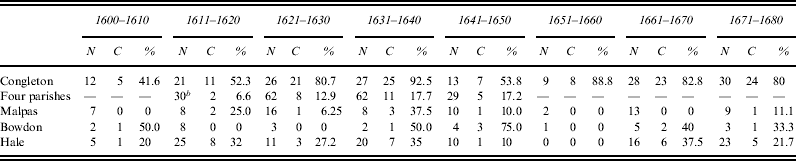
It is immediately clear that the incidence of cash holdings in the inventories – and by inference the amount of cash in circulation – varied greatly according to time and area. This can be seen in Table 1. It is hard to draw too firm a conclusion from the figures but certain assumptions have to be made, the most basic of which is that behaviour patterns remain constant unless something dramatic happens to alter them, and in this the drop in cash holdings reported in the decade 1641–1650 is significant.
Comparison of cash holdings in inventories in the Cheshire recordsFootnote a

a The figures include all references to cash being held, even when included with other assets such as apparel. N=number of inventories; C=cash holdings; %=percentage of cash holdings in the inventories; —=figures not available.
b From 1617.
Source: Derived from the transcribed/published inventories as listed in the Appendix to this article.
What the decade 1641–1650 does show is a dramatic fall in the number of cash holdings: in Congleton, down from 92.5 per cent of inventories in 1631–1640 to 53.8 per cent, a level comparable with the early decades of the century. Throughout, the percentage of inventories recording cash at death in Congleton greatly exceeded those in the other areas, which is a clear indication of the contrast between the workings of a rural and a more urban economy. In his introduction to Wilson's A discourse upon usury, R. H. Tawney observed that in the uncertain and cyclical world of agriculture ‘the need for advances was not the invention of man; it was inherent in the nature of things’.Footnote 21 This was true two centuries later, as was to be observed, à propos the Cotton Famine: in industry the process of profit-making is continuous through the year, while in agriculture it is a once-yearly cycle.Footnote 22 The various small trades in Congleton required cash to operate satisfactorily, while the rhythmic cycle of agricultural settlement allowed for annual set-off and barter. That said, the amounts of cash held even in Congleton were generally small and insufficient to allow total payment of debts had it been necessary. Boot- and shoe-makers seem to have found it particularly hard to obtain payment and several of their inventories list debtors for goods supplied; we will return to these when we consider debts.
The attitude of appraisers towards cash varied. In Congleton especially there was a greater tendency to include cash with the value of the deceased's clothes, thus disguising the value of each, while this was never done in Bowdon. Sometimes plate and coin were valued together and this draws attention to the constant use of the phrase ‘ready money’, with its implication that silver plate could if necessary be converted into usable form either as bullion or more slowly by reminting.
The amounts of cash held on death varied, though in general they were small. A few large sums were reported, such as the £160 held by John Torkinton of Tarvin in 1637 or the £123 held by George Goulden of Hale, tanner, in 1661, described as ‘ready money’ in his chest. The latter was all the more remarkable for it came at a time when the incidence of cash holdings was declining. No other Hale holding came near that amount, the next largest being less than half. In Congleton, the sums were more modest, though more widespread, the largest being that of Roger Kent, inn-keeper, who had £50 in 1665. In the earlier decades the largest was that of John Meeke, saddler, who had £77 14s 0d in 1636. Those in Malpas ranged from £35 15s 0d held in 1680by Richard Foxley, yeoman, who dealt in cheese, to only £12 2s 0d held by John Brindley in the more central decades, in 1639. Bowdon, finally, was almost cash-free, with John Sorocold's £6 being the largest (he died in 1649), until Robert Tipping died in 1662, holding £32 3s 0d.
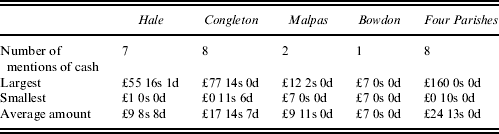
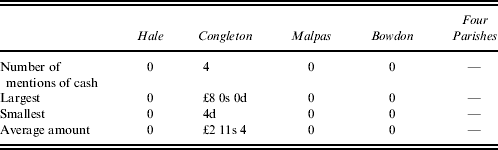
It is worth comparing cash holdings as a whole, for two decades 1631–1640, just before the Civil War, and 1651–1660, just after the disruption of the War and during the Interregnum. (See Tables 2 and 3.) If Torkinton's large holding in 1637 is excluded from Table 2 the average in the Four Parishes drops to £4 12s 0d, more in line with though lower than in the other areas. The value of clothes when shown separately varied so much that no safe generalization can be made.
Cash holdings in the Cheshire inventories, 1631–1640Footnote a

a The figures include only entries where there was cash alone, excluding sums included with other assets.
Source: As in Table 1.
Cash holdings in the Cheshire inventories, 1651–1660Footnote a

a —=figures not available.
Source: As in Table 1.
The greater incidence of cash holdings in pre-war Congleton (see Table 1) draws attention to Tawney's thesis: was it an example of the Protestant trade ethic triumphing over older values? There is every temptation to suggest this, but in reality the Civil War divisions in the town followed no obvious pattern. Initially the local Establishment tended towards the King, but later the Parliamentary faction was dominant: neither faction showed distinct economic differences – agriculture versus trade or one trade grouping against another – rather, one suspects, there was the common working out of long-standing jealousies and oppositions whose origins are now lost to us.Footnote 23 Towns were the foci of conflict whereas the countryside was less immediately affected. Table 1 shows the marked reduction in the incidence of coin-holding in the Civil War decade: Table 3 indicates that not only the incidence but also the reduced value of such holdings continued for some time thereafter. It may be that the supply was indeed greatly reduced or it may be that civil disruption and increased levels of taxation led people to hold less cash or not to admit that they had any. Either way, cash vanishes from this record and it is not until 1680 that we find another cash holding in Malpas, after which they become common.
What cannot be established is how much cash literally went underground during or after the Civil War. Inventories show that in earlier decades people seem not to have been too bothered about keeping cash in their houses. Entries commonly refer to money in purses, chests, desks and suchlike, suggesting little interest in concealment. These references may, of course, be only the tip of the iceberg and more cash was buried, but if so it was hidden from the appraisers and surviving spouses were either concealing it, or ignorant, in which case it would be lost. That could well happen: there is the instructive case of the large Congleton coin hoard thought to relate to John Walker (†1675), a skinner and prominent Royalist who was fined by the Commonwealth authorities.Footnote 24 One of the four burials involved, of 1,144 silver coins, can be dated to shortly after 1649, which would accord with a desire to hide wealth at a critical time. Coins in others were later, though, up to 1670, which testifies to a continuing caution arising from adversity. It was not bred of size alone, for the total value was £172 8s, large but no larger than other amounts which had been kept in houses. A feature of this hoard is the low total value relative to the number of coins: 3,409, many in small denominations and well-used. Walker's inventory gives no sign of significant cash holdings, for although he was owed £240 8d, his apparel and money with a saddle and bridle were lumped together at only £20. How many others buried their wealth in those troubled times? One aspect worth further thought is that the last coins in the hoard were deposited after 1670, even though a few years before the Royal Mint had recalled and replaced small coinage.Footnote 25 Why did Walker, or whoever the depositor was, not recover his hoard and turn it into new and valid coin instead of leaving it to become useless? It may be that over the preceding troubled years old enmities had accumulated that might have been resurrected if it were known that he had ready money. Taking the figures as they are, cash became a scarce commodity from before the Civil War until the Restoration, when it returned to its earlier level.
III. LENDING AND BORROWING
Who lent?
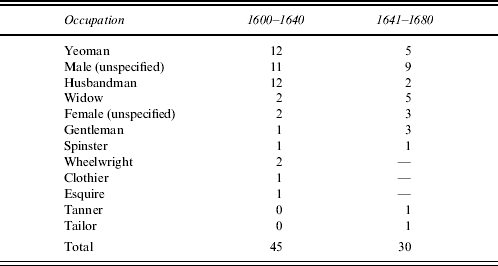
The crudest generalization in answer to this question is ‘anyone who had spare money’, and here we must return to my initial distinction between loans proper and short-term credit intended to facilitate a business transaction. The second group of lenders is more specialized and we will return to it. It is tempting to try to analyse lenders by social class but the task is made more difficult by the looseness of the definitions given in the records. Thus, for instance, ‘yeoman’ and ‘husbandman’ are used pretty well without discernible meaning. In Congleton and Hale industrial or commercial titles are more common and reliable, and Table 4 shows an analysis of debts from a list prepared by Jill Groves for Hale.
Occupations of lenders in Hale, 1600–1680Footnote a

a —=figures not available.
Source: Hale records as prepared by Jill Groves; See the Appendix to this article for details.
The debts themselves varied in both size and number. Before the Civil War, the average value of debts in Hale was around £95 10s 0d. The largest lender there was a tailor, John Hollinpriest (†1626) who had lent out £1,111 16s 7d but only had £40 in ready money. He was a true moneylender, for his other assets, excluding cash, amounted to only £23, and his name appears in many inventories. Even on his large scale of operation, he appears to have owed nothing and to have financed his lending from his own resources. The smallest lender owed 8 shillings (William Partington (†1619), whose total assets came to £98 16s 2d and whose principal asset was threshed corn worth £38).Footnote 26 These figures show not only the tremendous disparity in wealth but differing uses of cash and debt between different people. We have to remember – yet again – the hazards of documentary survival which undermine all statistical comparisons but, subject to that, the pattern after 1641 (shown in Table 4) is different. There were a third fewer inventories for a start, and the proportions in each group changed: yeomen and husbandmen were proportionately fewer, falling from 26 per cent of total to respectively 16 and 6 per cent. Women rose from 11 to 30 per cent among lenders, although the amounts that they lent did not significantly rise. Spicksley has traced the change (in Lincoln) from fathers leaving livestock and household goods to their daughters in the late sixteenth century towards bequests of cash by the end of the century and into the seventeenth. The purpose was to preserve the family estate but if replicated elsewhere this will have increased the number of spinsters able to lend money to obtain an income.Footnote 27 The largest lender here was William Vawdrey (†1665), gentleman, whose loans of £346 represented half his total assets, while the smallest was Richard Leather (†1672), who was owed 4d out of total assets of £29 18s 4d. Significantly, the value of the average debt holding had fallen to just over £62, well down on the pre-war average. This provides another indication of economic decline as a result of the war and subsequent disruption and taxation. There was still no particular group that lent the largest amounts: the three largest lenders were Vawdrey, a gentleman, with £346; Edmund Newton (†1669), yeoman, with £243 9s 5d, with £8 10s in ready money; and finally George Goulden (†1661), tanner, with £213 11s 0d. These sums represented for Vawdrey and Newton half of their total assets and for Goulden a third. Some lent higher proportions. Alice Royle (†1646) and Ellen Brundrett (†1669), both widows, lent 80 per cent of their assets; Henry Hardy (†1646), husbandman, had lent 75 per cent, but most lent less and the amounts were smaller. It is not surprising that women should lend proportionately more, as the interest from loans would represent more of their livelihood.Footnote 28
There is a marked contrast with nearby, though smaller, Bowdon. The existence of only seven debt-showing inventories for 1600–1640 there makes social analysis of little value but other comparisons can be valid. The largest holding was £27 for a member of the extended Janney family (†1637), which represented 65 per cent of his total assets, while the smallest was £1 owed to one of the ubiquitous Vawdreys (†1634), though this was less than 1 per cent of his total wealth of £162, itself the second-largest estate in value. Average debts were only £12 5s while debts as a whole represented 13 per cent of total assets. For 1641–1680 the same modest levels continued. The largest creditor was Samuel Saunders (†1665), whose £124 lent out represented 61 per cent of his total estate. The smallest was William Aldcroft (†1664), who was owed just £4, out of a modest estate worth £48 8s 2d. Saunders' holding increased the average debt holding to £27 12s but if that exceptional amount is excluded the level drops to £7 18s. Debt as a whole had risen to 32 per cent of assets, though the total estate value was lower than in the first four decades (£678, down from £742). What is striking is that two adjacent areas should show such a contrast.Footnote 29
The incidence of debt holding
In contrast to cash holding, where coin appears often to have been in short supply, especially in rural areas, debt was common. In Hale, at one extreme, debts appeared in 80 per cent of the inventories for the decade 1631–1640 (16 out of 20). Sometimes the testator owed money as well, though that was less common. Sample figures for the same years from Malpas and the Four Parishes show a lower incidence. In the former, five out of eight inventories showed debts to be paid (62.5 per cent), with one testator also owing rather more than he was owed. In the latter, 31 out of 61 held them (49.1 per cent).Footnote 30 We have seen that Congleton had the most active economy and we may see this against debt holding, set out in Table 5.
Incidence of debt holding in Congleton, 1611–1680Footnote a

a N=total number of inventories; D=inventories mentioning debts, including cases of debt owed to testator; %=percentage of cases of debts mentioned compared with inventories. Note that the total numbers of inventories may not correspond to the totals given in Table 1 because of variations in the information provided.
Source: As in Table 1.
The amounts lent varied greatly as a percentage of the total value of estates. Many were small lenders, such as Alexander Vawdrey (†1674), of Hale, whose debtors of £1 10s 0d amounted to 1 per cent of his total assets. At the other end of the scale, the £21 14s 0d owed to George Hardy (†1674), also of Hale, represented 80 per cent of his assets. Of larger amounts, Lawrence Leicester (†1616), gentleman of Hale, was owed just over £450 out of total assets of £486, 92.5 per cent. Most serious lenders spread their risks by lending to many people. The inventory of William Bosson (†1618), of Congleton, showed good debts ‘with specialty’ of £102 2s 0d; desperate debts ‘with specialty’ of £19 6s 8d and debts ‘without specialty’ of £35 8s 10d.Footnote 31 The last were listed, revealing 60 names over a range of places, as far afield as Radnor (25s).Footnote 32 Some of the loans had been advanced by his wife. Another high-percentage lender, at over 90 per cent, was Richard Higginson, will be referred to later on.Footnote 33
We cannot establish the extent of debts owed by deceased individuals with any confidence. Out of 20 records from Bowdon where the deceased were creditors, 5 reveal them as debtors also, either because there are accounts or because they were listed in either wills or, quite wrongly, in inventories. In all five cases money was both owed and owing. All but two were simple debts and those were in relation to a quarter's wages owed to servants. The accounts show the difficulties faced by executors: Sibell Eaton, widow of John Barrington (†1625), lodged accounts in 1628 which revealed the need for two lawsuits to recover debts, one of which displayed the weakness of enforcement identified by Briggs (see above, page 247, and reference). Mr Janney, the Vicar of Bowdon, owed £3 (probably: the inventory is damaged), but after going to court Sibell was advised to compromise for 10s, of which she ruefully noted in her statement that only 3s was paid. Her largest cost was the maintenance of ‘the deceadent's child’ for nearly three years for which she appealed to the court for an allowance. There were clearly great difficulties in obtaining settlement from Janney, even after court judgement had been obtained in her favour. The other question, now insoluble, was whose child the minor was. Was it from a previous marriage of his? Was it theirs? She referred to the child as ‘the decedent's’ but that need not necessarily be the full truth. With the exception of Barrington, debts owed to other deceased exceeded those owed by them, and even in Barrington's case the inventory is too damaged to establish the totals with confidence.Footnote 34
Debts owed by a testator appear occasionally in the Hale records. John Bradley (†1604), of Ringway, was clearly insolvent. His assets, with nothing owed to him, amounted to £35 1s 2d, but he owed 20 debts (including £9 11s 0d to the ubiquitous Hollinpriest), amounting to £38 17s 5d. These were listed as an adjunct to the inventory. William Ashley (†1611), also of Ringway, recorded in his will that he owed Hollinpriest (who was also one of the appraisers) £37 6s 0d, with another £1 owing to Edmund Newton, whilst debts owing to him amounted to £5 4s. 0d. Since the value of his inventory came to £48 3s 6d, Hollinpriest must have been watching his own interest with a little relief. Ashley's list of debts contains a curious phrase, indicative of the complexities of rural arrangements:
John Burges of Hale to be paid within several dayes next after the date of this p[rese]nte £1 13 4.
And if the same be not paid by then accordinge as the same is here sett downe, then the Barg[ain] agreed upon betweene the said Burges and William Ashley to stand good in lawe.Footnote 35
There was plainly some side arrangement intended to guarantee recompense in lieu of repayment, presumably involving some physical assets that could be seized.
Trade credit
We now turn to short-term debt or trade credit arising from unpaid sales. As noted above, boot- and shoe-makers seem to have found it particularly hard to obtain payment and several of their inventories list debtors for goods supplied. One such was John Horden (†1616) whose inventory recorded five small debtors for either boots or shoes or shoes and ‘lent money’, and another for leather. There were another 16 debtors purely for money, including his brother William, who owed 38s and 4d, ‘whereof I have received of my said brother Will[ia]m one barrel of cream and a quarter of hempe’. The most long-suffering, or patient, of tradesmen must have been the woollen-draper James Hall (†1641) whose inventory not only listed 213 ‘debts owing to the testator’ but an earlier list of 158 names, of whom only 53 are described as ‘hoopful’. The distinction between the two lists is not clear, but the implication is that the first were regarded as current trade debts while the latter had a degree of permanence. All the amounts were small, ranging from 1d to 19s 8d in the first and 2d to £10 1s 5d in the second, although the last is exceptional, for only three other debts exceed £1 and then only slightly. The list of 213 names is totalled into £62 4s 1d ‘hopeful’ and £67 10s 11d ‘in desperate debts that is like not to bee’. These two lists, which between them must include members of almost every family in the area, are a startling testimony to the vigour of trade on the eve of the Civil War and to the quality of Hall's record-keeping.Footnote 36
Other tradesmen had difficulties: the inventory of Henry Wilkinson (†1631), of Congleton, probably a currier, had an entry for 7s 1d left unpaid ‘of oulde’ by Thomas Sochel: it was probably ‘desperate’ though not described as such. He was owed money by a range of tradesmen: three butchers, two people for wool, a hatter, a weaver, a glove-maker, a purse-maker, two pointers,Footnote 37 a carpenter, a leather-worker, as well as a few others unspecified. He would have echoed Thomas Turner's lament: ‘Oh, melancholy work! The long credit that I am obliged to give must greatly hurt my trade’, though both would have had to remember that without credit there might be no sale.Footnote 38 In Bowdon Jon Paulden (†1672) was perhaps more canny, for he was owed for ‘one paire of bound wheels bought but not payd for’. He had sensibly retained possession until paid.Footnote 39
By their nature, some transactions took time and an outstanding debt was not a cause for concern. Cheese seems to have been a commodity supplied on credit, so that the inventory of Vivian Yeavenson (†1605), husbandman of Edge, records two debts: Robert Johnson of Boughton owed the ‘remainder of a great debt for cheeses, 23s.’, while Yeavenson himself owed Richard Ashbrook of Tattenhall £6 for cheeses. It would seem that even if he made his own cheese he also acted as a factor or middleman. His connections were wider than many, for he was also owed 2s by William Thomas of Chester, glover. At the end of our survey period, William Overton (†1681), yeoman of Oldcastle, was owed £19 8s 6d by John Carter for cheese. This was probably his own product as at death he had 39 kine, 8 rearing calves, 7 two-year-old heifers and 2 one-year-old calves, a sizeable herd. His stock of cheese came to £52. His debts owed, including Carter's, came to £130 8s 6d out of total assets of £454 6s 10d.Footnote 40
Sometimes death interrupted an otherwise normal transaction. The second item of Jill Groves' Bowdon collection (John Williamson, †1607), which includes neither will nor inventory but only legal depositions, refers to the sale of a horse interrupted by the death of the purchaser. According to the evidence given, time to pay had been allowed but within that the purchaser had been ‘slaine’. Richard Craddock testified to the Chester Court that within ten days of the death and before the estate was appraised, he had returned the mare to the vendor, who had accepted it back in lieu of payment of the £2 6s. The time for payment was not specified in evidence but in further evidence Ralph Williamson stated that the price was to be paid ‘within a while after’ which suggests a casual verbal arrangement. Other assets had also been omitted from the inventory (which no longer exists) and had to be explained by further evidence. Another horse featured in the inventory of William Stockton (†1645), yeoman of Overton, who was owed £4 for one that he had sold. The implication is, again, that the purchaser had been given time to pay.Footnote 41
As implied above, not all transactions would have led to an amicable conclusion, as we shall see below.
Last, a business might continue in spite of death under either the executors or a surviving spouse. This was less likely if the trade depended upon the deceased's manual skill but trade stock was still there to be sold, as is clear in the inventory of George Ford (†1646), liquor salesman and Alderman of Congleton, whose appraisers noted that ‘the goods sold out of the shop between the time of [th]e said decedent his apprais[al] and the time of his death did amount as appeareth to us to … £21 18s 10d’ – another example of respectable book-keeping.Footnote 42
How executors enforced payment is another matter. The contrast between the various rural areas is less clear and the smaller numbers are likely to create misleading comparisons. What is clear is that they had less need of ready cash.
Proportions of good and bad debts
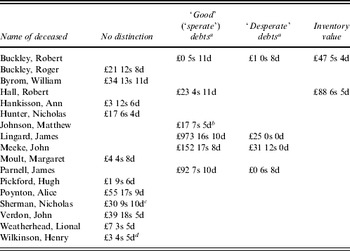
This, like many other issues, is confused by the differing attitudes of appraisers. There was always a measure of subjectivity in their approach, not only in what was included in an inventory but in the judgement that they had to make about the realistic value of debts. Some may have chosen the easy way out and simply recorded what they knew, without assessment, such that none of the Bowdon inventories makes a distinction between good and bad debts, while only two of the Malpas ones do in a meaningful way. These are, however, quite informative (see Table 6). John Carter's doubtful debts amounted to nearly a quarter of his estate of £1.006 13s 2d, while Hopley's were a little less, at 20 per cent of £183 3s 10d. Unless recovered, these were serious losses from the estates. Once more, the Congleton inventories provide more detail, though even so the picture is far from complete. The decade 1631–1640 will serve as an example (see Table 7).
Good and bad debts in Malpas, 1615 and 1664Footnote a

a —=figures not available.
Source: See the Appendix to this article.
Good and bad debts in Congleton, 1631–1640

a ‘Sperate’ debts were those where recovery was expected; ‘desperate’ debts, more obviously, were those where recovery was felt to be unlikely.
b By implication.
c Described as some ‘sperate’ and some ‘desperate’.
d £0 7s 1d was probably ‘desperate’.
Source: As in Table 1.
Lenders seem either to have exercised good judgement in the first place or to have been able to remedy their mistakes, for with one exception ‘sperate’ debts greatly outnumber the ‘desperate’ in value. The biggest lender of all, James Lingard, must have known exactly what he was doing, for the £25 in ‘desperate’ debts was minute in comparison with the whole. Wilkinson was more unfortunate than the figures suggest.
Malpas does provide one interesting example of how a testator tried to ensure that his debts were paid. Thomas Wilbraham (†1665), yeoman of Malpas, owed Lord Brereton for some land that he had bought and whose possession he wanted to ensure. In his will he therefore set out that ‘It is further my mind and will that as fast as money can be raised of the land and also money gotten in that is owing it shall be paid to the Lord Brereton for the last fourscore pounds that is to be paid for the land.’Footnote 43 He was in total owed £40 14s 0d which, if recovered, would go some way to pay the debt, but there were no physical assets to sell as his total estate amounted to only £174 13s 6d, all in current agricultural produce. Presumably the land had been bought on easy and loosely defined terms.Footnote 44
Recovery of debts
There is little indication in any of the records of how executors intended to enforce recovery, other (one may assume) than by pressure and recourse to law, if thought worthwhile, but a hint appears in a cryptic phrase in the inventory of Raphe Broster (†1644), of Tattenhall, where among the debts listed as due by bond, the appraiser noted £9 0s 0d ‘owing by Mr Bostocke layde down for him to the Sherriffe’. The threat of legal action was always an option.Footnote 45
Reference will later be made to two bonds, from Robert Woodall of Handforth (£4 10s) and John Royle of Etchells (15s 1d), that were reckoned worthless because they had been neither dated, sealed nor acknowledged. Other debts also had caused or would cause trouble. Edmund Simpson (†1611), yeoman of Bowdon, seems to have fallen out with his sister, Jane Sherman, or perhaps with his brother-in-law acting in her name. The inventory records:
First by Jane Sherman sister to the decedent a debt alledged by him and suite her upon commensad by the decedent and now in question, and reserved to order of two men … £3 6s 8d.
Jill Groves speculated about the exact details of what the two men were to do, either to make a judgement or to enforce payment, but for our purpose neither matters, for the phrase must mean that some court action had been started.Footnote 46
Who borrowed and why?
Just as those who had money lent it, so too those who needed it borrowed. It is not surprising that in small and closed communities it was usually only the debtor's name that was given. There are two exceptions to this: one is family members and the other is the relatively few people who were most distant, in another county or, in one case, another country.
Most borrowers lived locally and would be well known to all of the executors, the appraisers and the community at large. There was no need to identify them more clearly, and one wonders why family members, who would be even better known, were identified by their relationship. Various studies have suggested that it was a demonstration of family solidarity – the willingness of one member to help another and so strengthen kinship groups – but, for whatever reason, both wills and inventories spell it out. One example will suffice: Roger Lloyd (†1665), of Wigland (near Malpas), was owed £6 by his son, also Roger Lloyd. Those living further afield needed better identification, even if they lived within Cheshire. So the inventory of Randle Brown (†1608), yeoman of Cuddington, identified two of the three: Randle Moyle of Shocklach, £10; Roger Dayes of Bangor (? on Dee), £20; and presumably a local man, Randle Batha the younger, £10. Given the closeness of the county border it is not surprising that some Malpas debtors lived in Shropshire, like John Baker of Whicksall in Shropshire who owed £1 7s 8d to John Baker of Oldcastle (†1629). These are understandable but why did William Hopley (†1615), yeoman of Malpas, lend £10 to a Mr Astery, a Bedfordshire man? Hopley features in Table 6 above, where the debt was included in the ‘hopeful and good’ category, so the connection must have been sound. Lenders in Hale also mostly dealt with neighbours but there was a smattering of debtors from further away. One who was either unfortunate or had poor judgement was William Bradley (†1639), whose appraisers reported debts ‘which ought to be discharged [because there are] not hopes of recovering any of them’. These included three bonds from Edward Simpson of Timperley (£5 19s 3d) and one bond for £1 10s 0d from Edward Kelsall of Cheadle. Another two bonds from Robert Woodall of Handforth (£4 10s) and John Royle of Etchells (15s 1d) were reckoned worthless because they had not been dated, sealed or acknowledged (see above).Footnote 47
What were the terms of lending?
Interest
Although the legislative changes since 1571 had permitted the charging of interest, the paucity of references to it suggests that it took some time for it to become respectable in rural areas. Bowdon inventories do not explicitly mention interest until 1658 when Margery Harding's listed four amounts of interest due. The entries are curious for, whilst specifying the amount of the debt and the interest, only the latter was included in the total. So the entry for one debtor reads, in Jill Groves' transcription,
Also Ralph Strettell of ye parish ofAshton upon Merseybank 1 Martij 1657 bound in iiijli with condicion for paym[en]t w[i]th Intereste of . . . . . ijli [£2]Footnote 48
It is not clear from the entries whether the £2 interest was included in the £4 bond, or whether it was an extra charge but, whichever was the case, it is odd that the appraisers only included £2 rather than £4 or £6 in the total estate. The other three entries were treated in the same way. Interest was not apparently universal for the fifth debtor, Joshua Person, who seems simply to have owed £1 10s without interest. But it may be that he was subject to an older custom and may have actually been lent a smaller amount.
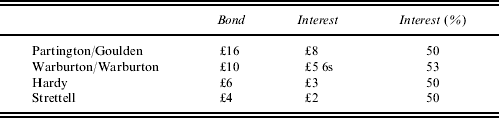
None of Widow Harding's Bowdon debts makes clear when the money was advanced, only when it was due, but if we assume them to be loans for a year, the interest rate was high. The calculation depends upon how the figures are interpreted but Table 8 was prepared on the assumption that in her four entries the interest was an extra charge and not included in the amount stated in the bond: in other words Strettell would have to repay £6, not £4. The alternative would have vastly increased the interest rate. This looks like a formidable rate but there are indications that the widow was not necessarily charging interest upon an annual basis but was regarding it more as a fee for the use of the money, irrespective of the length of the loan. We may infer this from the fact that the Warburton and Hardy loans were not due for repayment until June 1658 (inventory dated March 1658), but that Strettell's had been due for repayment in March 1657 yet the interest, and therefore the rate, remained the same. If this was the thought process, it suggests that the legislative changes had not yet entered mainstream thought, in Bowdon at least.
Widow Harding's interest rates, in her inventory of 1658

Source: See the Appendix to this article: Groves ed., Bowdon wills, part 2, p. 12.
Inventories from other areas indicate that some lenders had more rigorous attitudes. Richard Higginson (†1663), of Altrincham, a small market town not included in this survey, clearly intended to enforce due payment. At his death he was owed 37 debts by bond and 3 without specialty, amounting to £320 15s 3d of his total assets of £337 10s 7d, or 94.9 per cent. His other assets were cash of £16, his clothes worth 13 s 4d and a Bible worth 2s. His appraisers seem to have included the interest and the capital together in the total, but there was an additional element, as we see in one typical entry.Footnote 49
William Bradley of Hale (see also above) set out formidable conditions. The appraisers set out the terms:
Edward Simpson of Timperley in the county of Chester, husbandman, and Thomas Simpson his father, a debt due to the said deceased by bond, in the penaltie of five poundes for the payment of lijs viijd att a day past … £2 12s 7d
By the said Edward Simpson of Timperley debt[or] stand bound in the sum of four pounds for the payment of xls … [£2].Footnote 50
… and so on for the other debts listed. Despite the association of Simpson's father with the debt and the penalties attached of double the sum loaned, all the debts were deemed irrecoverable. The appraiser felt so strongly about the inadequately completed loans that he attached a note to the effect that they ought to be excluded from the ‘desperate debts mencioned in the said inventory w[i]th w[h]ich this accomptant cannot charge himself with’.Footnote 51
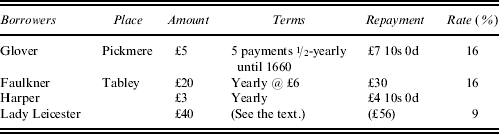
Charles Foster revealed some rare evidence from the Tabley estate, where the solicitor Thomas Jackson was the manager in mid-century at £4 a year. His papers have enabled Foster to trace the family over three generations, including details of Jackson's lending.Footnote 52 Four loans were described in his Memorandum Book. Unlike many of those we have looked at, these were all long-term, as summarised in Table 9. Lady Leicester defaulted and Jackson had to pay on her behalf, whereupon he secured a bond from her for the payment of £8 a year for seven years. The book records other occasions when Jackson was bound for or with other people, which was a common arrangement but was subject to a penalty of customarily double the value of the loan.
Thomas Jackson's loans at his death in 1655

Source: Charles Foster, Seven households: life in Cheshire and Lancashire, 1582–1774 (Northwich, 2002).
In a later passage Foster gives details of the activities of Sarah Fell, towards the end of our period. She received money as well as lending it, for Susannah Fletcher deposited £100 with her in 1673 at 5¾ per cent. She made a number of small trade loans, one to William Benson, a cloth merchant who borrowed 10s in 1677 for a week. No interest was charged but Foster suggests that ‘he no doubt recompensed [her] some way’, instancing as a parallel her purchase of 150 needles for her tailor, Matthew Fell, at a cost of 1s 8d.Footnote 53 Such mutual services must have commonly eased the formalities of trade but they are all too often lost to us.
Ralph Kelsall (†1619), of Hale, had widespread connections. He lent money separately to Anne and Joan Nuall (Newall?) of Chapel-in-le-Frith, once to Stockport, five times to Didsbury, five times to Ashton-on-Mersey and once in Gorton. These amounted altogether to £12 3s. It is from Hale that we have the most distant loan. Ellen Brundrett (†1669) was owed money by 15 people, among whom was Robert Brundrett of Dublin, for £10. He was presumably the Robert Brundrett named in her will as her son but it is not clear whether he was resident in Dublin and trying to invest borrowed money to advantage, or whether he was on an extended business trip. The former seems more likely.Footnote 54
Debts were seen as a form of asset that could be bequeathed by the testator to, usually, another family member. In 1662 Thomas Goulden, inn-keeper of Bowdon, specified in his will that ‘I doe hereby give and bequeath the sum of seaven pounds due to me by bond from the above named James Neild and William Arstall of Dunham Innkeeper, unto my wife Elizabeth Goulden.’ This was in addition to another debt of £5 from Neild alone, also bequeathed to her. Other debts were specifically allocated and the implication is that they were not due for repayment and the recipients would have to wait their turn.Footnote 55
Was the term specified?
This is a difficult subject. My initial generalization was that anyone who had money lent it, but the apparent shortage of coin raises the question of whether, when and how repayment was expected. Trade debts seem to have had no specified terms but merely an expectation that they would be settled as and when convenient, serving (as noted above) as a form of saving in the meantime. The life of more formal loans was rarely specified in wills or inventories, though due dates for payment were usually specified. It may be that this is a misleading impression arising from the nature of the evidence, for the appraisers were not interested in the terms of any loans, only their existence and whether they should be included in the inventory. Other studies that have been based upon loan documents themselves show that terms were clear, and the scattered evidence in the next paragraph indicates that the same was true of Cheshire.
In many cases there seems to have been little expectation that payment would be made. It may be that the system was remarkably modern, with a parallel in the rolling credit provided by credit cards. The inventory of Samuel Saunders (†1665), of Bowdon, starts with ‘inprimis, in debts owing by yearly payment, £124-10-0’, though unfortunately it does not itemize the debts nor whether the terms had been kept. John Baker (†1629), yeoman of Oldcastle, seems also to have envisaged an annual cycle, for although the starting dates were not given the nine debts listed, worth £58 13s 0d, were all ‘Due at the feast of the Annunciation of the Blessed Virgin Mary, 1630’. It is to be noted that in spite of the doctrinal changes and anti-saintly sentiments following the Reformation, Baker was not alone in using the old saints' days as his calendar.Footnote 56
In many cases repayment may not have been not intended until death or some other major event intervened, with those who relied upon penalty clauses being the minority who did require payment at a specified time. Thomas Phytheon (†1609), of Congleton, seems to have been relaxed about payment as his inventory noted ‘It[e]m mony due for the last yeare owinge …. xjL vs’.Footnote 57
Although he lived a century later and in Sussex, we see that Thomas Turner (cited above) kept running accounts, reconciled between the parties at the start of each year, though his entries for early 1756 suggest that settlement was complicated by the inebriation of his fellows. Significantly, once the balance was struck, money rarely changed hands but the balance was simply carried forward. Such an arrangement could last for many years: in 1763 Turner noted that he had by chance struck an equal balance with a neighbour after eleven years.Footnote 58
IV. Conclusion
The evidence indicates that the money economy of rural Cheshire in the seventeenth century was sophisticated and diverse. It depended upon credit both for long term finance and for the easing of current transactions when immediate settlement in coin might have been difficult. Outside Congleton few people kept substantial amounts of cash: if the inventories are to be taken at face value, in the countryside it was a rare commodity indeed – although we cannot accept this without some reservation – and, putting aside the opportunity for interference by surviving relatives, cash in the house was potentially at risk whereas cash invested in someone else's business was physically safer. The Civil War reduced the visible supply of cash in Congleton but had less effect in the countryside – there was of course less effect there to be made – but once that was over the supply seems quickly to have been restored. Both the terms of lending and the duration of loans show wide variation, from due dates reinforced by harsh penalty provisions to seemingly endless periods of credit. Interest rates are hard to detect but they do not appear to match the expectation of 10 per cent suggested by Jones. All this variation suggests a loose and individual adaptation to the new ethic reflected in the legislation but an altogether more ragged response to individuals' needs and circumstances, for the system was essentially pragmatic and not doctrinaire. Finally, these figures and locations demonstrate that the early modern world was not one of closed, exclusively inward-looking communities but that family and business connections enabled business – even in intangibles like debt – to be conducted over wide areas and that not only the lenders but the appraisers, when their time came, were able to make judgements, accurate or not, of their quality of debts and the chances of recovery from a distance.
Acknowledgements
I owe much to critical comments made by Dr Chris Briggs, Professor Peter Gaunt and Charles Foster who read an earlier version. Phillipp Schofield has been a great support in preparing the final text. Wills and inventories from Bowdon have been transcribed and published by Jill Groves and for the ‘four parishes’ by a research group headed by Tony Bland as editor in Wills and inventories with related documents for Christleton, Tarvin, Tattenhall and Waverton, for the period 1545–1650 (five vols., Tattenhall, 2003–2006). Unpublished material for Hale, Congleton and Malpas has been transcribed and generously made available to the author by, respectively, Jill Groves, David Jackson and David Hayns, to each of whom I am extremely grateful. This analysis would not have been possible without their labours and generosity. Any remaining faults are mine.
APPENDIX
The referencing system
The on-line catalogue of wills and inventories in the Cheshire Record Office, Chester (CRO) [http://www.cheshire.gov.uk/Recordoffice/Wills/] is not referenced here: any particular document is accessed by individual name, place and year, so to obtain the will/inventory of, say, John Brindley, the ordering entry would be, ‘John Brindley: Malpas: 1639: WS’. Inevitably each of the researchers whose work I refer to has adopted a different scheme, and I have provided a reference to their work, as identified below, rather than to the original source. To avoid including innumerable textual references, each will/inventory has been given an individual number, set out in the table below. The explanation is:
BOWDON – from Bowdon wills and inventories wills and probate inventories from a Cheshire township, part 1: 1600–50 and part 2: 1651–1689 (Sale, 1997 and 1998, respectively), transcribed and edited by Jill Groves: BW1=Bowdon wills, pt 1; BW2=Bowdon Wills, pt 2, thus, for instance, ‘Sorocold, John, BW1, p. 57’.
HALE – Hale entries in the transcript provided to me by Jill Groves have been numbered sequentially and this has been preserved in the listing below, thus, for example, ‘Partington, William, H [=Hale] 29’.
CONGLETON – Each will/inventory is referenced direct to the CRO [Cheshire Record Office] (WS) [Wills Supra] archive number, thus ‘Kent, William, C [=Congleton], WS40200’.
FOUR PARISHES – Wills and inventories with related documents for Christleton, Tarvin, Tattenhall and Waverton, for the period 1545–1650, ed. Tony Bland (five vols.; Tattenhall, 2003–2006): transcripts are not referenced but can be identified by a table of cross-references to the CRO (WS) provided at the end of each volume. This has been adopted here, thus ‘Broster, Raphe, 4P5 [=vol. 5], p. 784 (WS1646)’.
MALPAS – The inventory has been linked to the CRO (WS) archive by the year involved, thus ‘Hopley, William, M [for Malpas], WS1615’.
Wills/inventories references