


INTRODUCTION
Where a government gets its revenue from is widely believed to affect whether it is accountable to citizens. Natural resources and other types of windfall revenue hold out the prospect of better welfare for citizens, yet all too often they are associated with a host of bad governance outcomes, including authoritarianism and weak accountability in democracies.
Windfalls cause concern because they generate “rents,” or income that can be substantial in scale, is paid by external actors (rather than derives from domestic economic production), and accrues directly to government without necessitating bureaucratic capacity or interaction with citizens (Beblawi Reference Beblawi1987; Mahdavi Reference Mahdavi and Cook1970; Ross Reference Ross2012). While much of the focus has been on rents from oil and other natural resources, there is growing recognition that they can arise from other types of “unearned” revenue, including discretionary foreign aid (Moore Reference Moore, Robinson and White1998; Morrison Reference Morrison2009; Smith Reference Smith2008) and, for many poor subnational governments, central transfers (Brollo et al. Reference Brollo, Nannicini, Perotti and Tabellini2012; Gervasoni Reference Gervasoni2010).
The literature on the resource curse presents myriad causal mechanisms by which rents from such windfalls might undermine accountability.Footnote 1 Political science explanations originated with scholars of the rentier states of the Middle East who sought to explain the link between oil and persistent authoritarianism (Beblawi and Luciani Reference Beblawi and Luciani1987; Mahdavi Reference Mahdavi and Cook1970). Building on this literature, recent political economy research has focused on how windfalls affect the political behavior of leaders by increasing the value of holding office, thereby incentivizing them to invest in internal security (a repression mechanism) or to buy support through spending on goods or patronage (a spending mechanism) (Caselli and Cunningham Reference Caselli and Cunningham2009; Robinson, Torvik, and Verdier Reference Robinson, Torvik and Verdier2006; Ross Reference Ross2001).
The focus of this article is on another enduring explanation for the resource curse in the rentier state literature: That windfalls free politicians from the need to finance government through taxation, relieving social pressure for greater accountability (Beblawi and Luciani Reference Beblawi and Luciani1987; Mahdavi Reference Mahdavi and Cook1970). The so-called “tax mechanism” propounds that windfalls create a social contract in which leaders provide goods to citizens for free (or at low cost in terms of taxes paid) in exchange for political quiescence (Chaudhry Reference Chaudhry1997; Waterbury Reference Waterbury and Entelis1997). In making this claim, scholars contrasted rentier states to early modern European states where monarchs who needed tax revenue often confronted populations bent on rebellion or evasion and ultimately ceded political control in exchange for compliance (North and Weingast Reference North and Weingast1989; Tilly Reference Tilly1992).Footnote 2
Importantly, the tax mechanism rests on a clear microfoundational proposition: That windfalls undermine—and taxes strengthen—citizen demand for good government. In contrast to explanations that emphasize how different sources of revenue shape leaders’ actions, this claim focuses attention on how taxes and windfalls directly affect the political behavior of citizens. As such, it offers a citizen-centered explanation for the resource curse. By now it is almost a truism in political science that the “lower the level of taxation, the less reason for the public to demand representation” (Huntington Reference Huntington1991, 65). Similarly, Ross (Reference Ross2001, 332) states, “When governments derive sufficient revenues from the sale of oil, they are likely to tax their populations less heavily or not at all, and the public in turn will be less likely to demand accountability from—and representation in—their government.” Karl (Reference Karl, Humphreys, Sachs and Stiglitz2007, 265) also refers to a “participation deficit” in windfall economies, where low taxation means “there is a lack of connection between subjects and the state, which breaks any sense of ownership of public resources or consequent citizen engagement.”
Yet, there is still good reason to treat this claim as a hypothesis. For one, there is conflicting empirical evidence. While the majority of studies find that windfalls are harmful for accountability (Ross Reference Ross2001; Jensen and Wantchekon Reference Jensen and Wantchekon2004; Morrison Reference Morrison2009; Ramsay Reference Ramsay2011; Brollo et al. Reference Brollo, Nannicini, Perotti and Tabellini2012), others challenge these findings (Haber and Menaldo Reference Haber and Menaldo2011; Herb Reference Herb2005). Regarding the tax mechanism, it is possible that citizens care deeply about receiving their share of the windfall wealth and are far from unmotivated (Ross Reference Ross2012). A notable challenge for much of the empirical literature is that it relies on observational data, which presents formidable obstacles for identifying the causal impact of windfall revenue on engagement and accountability.
There also exists a compelling alternative microfoundational story: That windfalls do not undermine citizen will to act but rather their ability to do so by exacerbating government's information advantage (Brollo et al. Reference Brollo, Nannicini, Perotti and Tabellini2012; Gadenne Reference Gadenne2011; Ross Reference Ross2012). Accordingly, if taxation mobilizes more political action than windfalls, it must be because it reduces uncertainty about the budget, facilitates comprehension of public finances, or otherwise provides citizens with better information on the budget (Sandbu Reference Sandbu2006). An important implication of this approach is that enhancing citizen access to information is a more direct way to improve accountability in windfall environments than strengthening taxation.
The main goal of this article is to provide the first test of the claim that windfalls undermine—and taxes strengthen—citizen motivation to hold government accountable. Doing so requires an empirical strategy that causally identifies a behavioral mechanism at the individual level. I accomplish this by embedding a novel revenue experiment with tax and windfall treatments into a public awareness campaign conducted in a windfall-dependent district in Indonesia.
The tax treatment primed participants to think about the district government as managing “their” tax contributions using an exercise in which participants both paid a simulated tax and were encouraged to think about the share of locally generated taxes in the district budget. The windfall treatment, in contrast, did not involve a simulated tax payment and emphasized the role of both natural resource and central transfer revenue in the budget.Footnote 3 An important advantage of the design is that it minimized the possible information benefits of the tax treatment in order to isolate and test the claim that taxes produce stronger incentives than windfalls to take political action. Moverover, by varying different aspects of revenue in known ways, the experiment aims to shed light not only on whether taxation motivates political action vis-á-vis windfalls but also why.
The second goal of the article is to consider how, if taxation motivates citizens to care more about the budget, it might also affect how citizens become politically informed. In doing so, it aims to clarify the microfoundations by exploring the relationship between the motivational and informational effects of taxation. I investigate the possibility that taxation affects whether people acquire information by motivating citizens to become politically informed or demand transparency. Another possibility is that revenue conditions how people process information on government performance. Revelations of misused funds could provoke more political action when citizens pay taxes (Ross Reference Ross2004; Sandbu Reference Sandbu2006). To test this latter possibility, I embedded an overlapping information experiment into the public awareness campaign in which the treatment group obtained new information on actual government spending while the control group received placebo information.
The campaign was conducted with 1,863 randomly sampled adults from 93 villages around Blora district in Indonesia. Since Indonesia's “big bang” decentralization in 2001, districts like Blora have acquired both significant resources and authority to manage local development, making concerns about accountability at the local level highly relevant. The campaign itself was conducted in partnership with Indonesian NGOs and implemented by trained canvassers in the three months preceding district head elections in 2010.Footnote 4 The main outcomes of interest—measured through both a survey and actual participation in a postcard campaign—are the effects of the treatments on monitoring government, political participation, and incumbent support.
The results show that participants in the tax treatment were more willing to monitor the budget and take action against the incumbent than individuals in the windfall treatment. I interpret these findings to suggest that citizens have greater incentives to take action when government depends on their taxes rather than on windfalls. Specifically, the tax treatment caused a five percentage point increase in the share of participants willing to monitor the budget. Those in the tax treatment in the low information environment were also six percentage points more likely than those in the windfall treatment to use the postcard to pressure the incumbent for better performance. Interestingly, the tax treatment did not cause more political participation as measured both by turnout in the postcard campaign and in the survey, however. It is likely that the effect of the tax treatment was too weak to elevate the perceived benefits of taking action above the costs. This is consistent with previous studies that have suggested that taxation only induces mobilization when it is excessive (Bowler and Donovan Reference Bowler and Donovan1995; Scott Reference Scott1976).
To investigate why the tax treatment motivated more monitoring and sanctioning than the windfall treatment, I use the fact that the experiment varied three distinct aspects of revenue: the tax burden, the perceived share of taxes (relative to windfalls) in total revenue, and the perceived ratio of taxes (relative to windfalls) to spending. The tax treatment primarily increased the perceived share of taxes relative to windfalls in total revenue, which in turn caused greater feelings of ownership over the budget and a deeper appreciation for the relevance of the budget to daily life.
These findings provide the first, albeit qualified, microlevel support for the tax mechanism as an explanation for the resource curse. In doing so, they also contribute to a related literature on taxation and accountability (Bates and Lien Reference Bates and Lien1985; Brennan and Buchanan Reference Brennan and Buchanan1978; Ross Reference Ross2004). Central to this literature is the idea that being taxed engages citizens politically and induces a bargaining process between state and society over the terms of the fiscal contract (Levi Reference Levi1988). While this engagement on the part of individuals, interest groups, or firms could be a strategic response to secure lower taxation or more benefits (Easter Reference Easter2002; Lieberman Reference Lieberman2003), the behavioral story that paying taxes makes citizens care more about governance is also prominent in the literature (Moore Reference Moore2007). The results contribute to this literature and suggest avenues for future research by providing the first microlevel evidence of a link between taxes and political engagement; generating insights into why taxes motivate citizens; and raising questions about the conditions under which taxes yield political participation.
The findings also confirm that a government's source of revenue could affect how citizens become politically informed. By showing that the tax treatment increased the willingness to monitor government, these results take a step towards explaining how demand for information rises. Yet, once in possession of better information on government spending, the windfall group was just as intolerant of misuse. The information treatment caused a 44 percentage point increase in the share of participants who felt that government performed worse than initially believed, but the magnitude of the effect was the same in both the tax and windfall groups. Moreover, revelations of misused funds did not induce more monitoring, participation, or incumbent sanctioning in the tax than the windfall treatment; if anything, the effect of information on political action was as great, if not greater, in the windall treatment.
This last finding has important implications for a growing empirical literature on how information affects accountability. Recent studies have demonstrated that exogenously improving access to information—through the efforts of government, the media or civil society—affects whether and how citizens vote (Humphreys and Weinstein Reference Humphreys and Weinstein2010; Chong et al. Reference Chong, O, Karlan and Wanthekron2011; Banerjee et al. Reference Banerjee, Kumar, Pande and Su2011; Ferraz and Finan Reference Ferraz and Finan2008). Yet, it is also true that transparency “is a necessary, but not sufficient, condition to reduce corruption. In addition to access to information, [people] need an ability to process the information and the ability and incentives to act on the processed information” (Kolstad and Wiig Reference Kolstad and Wiig2008, 524). This article speaks to this literature by investigating whether the impact of providing citizens with information is weaker in windfall contexts because lower taxation creates fewer incentives to utilize that information to hold government accountable. In finding no support for this possibility, the results point instead to the potential benefits of using expenditure transparency to combat the detrimental effects of revenue windfalls.
THEORY AND HYPOTHESES
The main goal of this article is to investigate the microfoundational claim in the rentier state literature that windfalls and taxes give citizens different incentives to hold leaders accountable. I follow on Przeworski, Stokes, and Manin (Reference Przeworski, Stokes and Manin1999, 10) in defining a government as accountable if citizens can reward or sanction leaders for their behavior, “retaining in office those incumbents who perform well and ousting from office those who do not.” Consequently, the focus of the article is on identifying how windfalls and taxes affect individual action or individual participation in collective action aimed at restraining opportunistic politicians and pressuring them for better governance.Footnote 5
Windfalls and taxes are likely to produce variation in at least three types of citizen political behavior. The first is monitoring, which presents an important way to constrain leader misbehavior (Bjorkman and Svensson Reference Bjorkman and Svensson2010; Miller Reference Miller2005; Olken Reference Olken2007). It is often asserted that taxation motivates citizens to engage in more public scrutiny of government than windfalls (Collier and Hoeffler Reference Collier and Hoeffler2005; Devarajan et al. Reference Devarajan, Ehrhart, Le and Raballand2011). The second is political mobilization, ranging from low cost participation, like signing a petition or voting, to high cost participation, like joining a protest. While a common claim in the rentier state literature is that windfalls make citizens more quiescent, taxation has long been credited with fueling individual and collective action (Moore and Rakner Reference Moore and Rakner2002; Webber and Wildavsky Reference Webber and Wildavsky1986). Moreover, taxation is associated not just with higher levels of participation in general but with mobilization against the incumbent. Morrison (Reference Morrison2009), for instance, argues that windfalls stabilize both democratic and authoritarian regimes by reducing taxation and increasing the capacity to spend. Overall, it is suggested that higher taxes (even holding spending constant) is associated with a decline in public support for the incumbent (Niemi, Stanley, and Vogel Reference Niemi, Stanley and Vogel1995). Following the literature, I thus test the predictions that (holding spending constant) taxes are more likely than windfalls to motivate citizens to:
H1: . . .monitor government;
H2: . . .participate in politics;
H3: . . .withdraw support for the incumbent (incumbent sanctioning).
Why do Taxes and not Windfalls Motivate Political Action?
While the microfoundational proposition underpinning the tax mechanism suggests that taxes give citizens stronger incentives than windfalls to monitor, participate, and sanction, we still know little about why this would be the case. Implicit in the literature are three distinct aspects of revenue that might drive motivation at the individual level: the tax burden, the share of taxes (relative to windfalls) in total revenue, and the level of taxes (relative to windfalls) vis-á-vis spending.
Whereas windfalls are often described as “manna from heaven,” taxes could motivate political action because they require a contribution on the part of citizens. One reason why taxes provoke more political action than windfalls might simply be a distaste for higher tax burdens (taxes as a share of income) in the absolute (Ross Reference Ross2004). Another possibility is that paying taxes makes citizens care more about $1 of misspent tax revenue than $1 of misspent windfall revenue. Research on the endowment effect in psychology and behavioral economics shows that people are more averse to out-of-pocket losses than to foregone gains of an equivalent value (Kahneman, Knetsch, and Thaler Reference Kahneman, Knetsch and Thaler1991). As Sandbu (Reference Sandbu2006) explains,
Tax payments are generally perceived as a cost that people have to pay out of their earnings, and so people have an incentive to hold the government accountable for how it spends their money. Natural resource wealth that is wasted or stolen, in contrast, is more likely to be perceived as a foregone gain, since it has never passed through the hands of the population and therefore has never been ‘earned’ or ‘possessed.’ The endowment effect implies that the motivation to hold the government accountable is less strong in the case of natural resource revenue than in the case of taxes.
While the tax burden could mobilize citizens by provoking anger or ownership over the budget, citizens could alternatively be motivated by the share of total government revenue that comes from taxes relative to windfalls. The share of taxes in total revenue has traditionally been regarded as an indicator of the state's fiscal dependence on society, and “the higher that dependency, the more likely it is that governments will have to listen to their citizens” (Waterbury Reference Waterbury and Entelis1997, 157). In contrast, rentier states are characterized by a large share of budget revenue from windfalls and a low degree of fiscal dependence on society. If citizens are more likely to succeed in eliciting better governance as fiscal dependence increases, then this could be reflected in feelings of efficacy and empowerment.
Finally, as noted in the Introduction, it is widely believed that windfalls give leaders the resources to buy political support through patronage or goods at little or no cost to citizens. The corollary claim is that citizens are motivated to take action not by higher taxes in the absolute but by the “price” of public goods. As Ross (2004) states: “High taxes would not produce greater demand for representative government if the taxes were offset by greater benefits. Nor would a small tax bill necessarily lead to political quiescence. Both the size of the tax burden, and the quality and quantity of government spending matter; citizens ultimately care about the ‘price’ they pay for the government services they receive.” As the ratio of taxes to spending rises—and perhaps especially when taxes exceed the benefits provided in return—taxation becomes increasingly perceived as unfair. This could motivate action in a way that windfalls—which keep the price of public goods low—could not.
Revenue and the Link between Information and Action
Predictions on why different sources of revenue affect political action also have important implications for understanding the relationship between information and accountability. To clarify how the motivation and information microfoundation stories relate, I consider how different sources of government revenue could affect the ways in which citizens become politically informed.
One possibility, captured in H1 on monitoring, is that taxation motivates citizens to acquire more information, either by seeking it out or by demanding transparency concessions from government. For many—especially in developing countries where access to information is low—the costs of information are high and contribute to political ignorance (Downs Reference Downs1957). If paying taxes increases the perceived benefits of acquiring information, then taxation could help to explain when a better information environment emerges and why windfall-dependent governments tend to be so opaque (Ross Reference Ross2012). This is important because few studies have identified the origins of fiscal transparency.Footnote 6 Another implication is that, if taxation mitigates the resource curse by motivating information acquisition, transparency could be an alternative to taxation.
Another possibility is that revenue conditions how individuals process information on government performance. If taxation induces an endowment effect and makes citizens care more about waste, then learning about misspent revenue should provoke a stronger political reaction in a tax environment. Or, if citizens are sensitive to the “price” of public goods, then information revealing that citizens get less for their taxes should motivate political action. In other words, information that reveals bad spending should be more likely to provoke political action in a tax than a windfall environment.Footnote 7 If this were true, then where a government gets its revenue from could determine the extent to which information is effective at getting citizens to hold politicians accountable. Importantly, this would suggest that improving access to information would not be a substitute for taxation in combatting the detrimental effects of windfalls on political action. To test whether revenue conditions how citizens evaluate information on government spending, I add the final hypothesis:
H4: The misuse of public funds provokes more monitoring, participation, and sanctioning when citizens pay taxes.
For a graphical summary of the four main hypotheses, see Appendix A online.Footnote 8
THE INDONESIA CONTEXT
As one of the world's most populous and newly decentralized democracies, Indonesia presents a highly relevant context for testing these hypotheses. Indonesia's “big bang” decentralization in 2001 devolved the authority to manage local development in key areas—including health, education, water sanitation and infrastructure—to the district level. This made districts the second most important level of government in Indonesia after the national level. District governments now receive more than 40 percent of total public funds to manage development locally (World Bank 2007).
Yet democracy and accountability, while vibrant in post-Suharto Indonesia, are imperfect. Indonesians now directly elect both the executive branch and legislative branch at both national and local levels. Electoral participation is relatively high; voter turnout in the 2009 parliamentary elections was estimated at 71 percent and average turnout in local elections was estimated at 69 percent (Meitzner Reference Meitzner2009). Yet, Indonesians often express resignation in the face of corruption and poor governance. One explanation for this (on Java at least) might be a culture of nrimo, a concept which loosely translates into “acceptance of everything without protest” (Irawaty Reference Irawaty2011).
One potentially important obstacle to political engagement in Indonesia stems from the fact that these elected district governments are still fiscally dependent on revenue windfalls. The main source of funding for districts are central government transfers through general allocation funds (Dana Alokasi Umum, DAU), which on average finances more than 80 percent of district government expenditures (World Bank 2007, 23). Additionally, about 10 percent of regional governments receive income from natural resources, with producing districts receiving 6 percent of the oil revenues and 12 percent of the gas revenues that accrue to the center (World Bank 2007). For some well-endowed districts, this has resulted in substantial windfalls and, anecdotally, high levels of corruption and mismanagement (Evaquarta Reference Evaquarta2010).
Moreover, Indonesia's tax system is both highly centralized and relatively weak overall. The central government is responsible for setting tax rates and collecting revenue. District governments receive shares of their natural resource, income, and property taxes but have limited authority to raise additional revenue through formal taxation (Fane Reference Fane2003).Footnote 9 On the expenditure side, many districts in Indonesia are plagued by poor budgetary capacity, corruption and rent-seeking in the budget-making process, large allocations for routine expenditures, poor reflection of policy priorities, and little legislative oversight.
These features of fiscal and political life in Indonesia are evident in Blora district. While Blora is a relatively poor agricultural district, it anticipates substantial windfalls from the Cepu oil and gas block in addition to the transfers it already receives from the government. Concerns about the conditions for a local resource curse are compounded by a history of mismanagement. Allegations of corruption were particularly rife under the legislative chairman in power from 1999 to 2009, who also ran for district head in the 2010 elections.Footnote 10 Overall levels of political awareness in Blora are also low; pretreatment survey data shows that only nine percent of participants had heard something about the work of the district government in the previous 12 months.
RESEARCH DESIGN
The Experiments
To test the hypotheses, revenue and information experiments were overlapped in a cross-cutting design and embedded in a public awareness campaign conducted one-on-one by canvassers in participants’ homes. The basic campaign, which all participants received, was designed to familiarize citizens in Blora with the concept of the district budget and the role of elected officials in managing it. The campaign began with illustrations reminding participants that they vote for their representatives, that their representatives make decisions about public services, and that they should think about the future of the district when making political decisions (see the complete campaign script and illustrations in Appendix B online).
All participants then took part in a household budgeting exercise. Upon giving consent, participants earned a small income in exchange for their time, equivalent to about a half a day's wage for an agricultural laborer. Specifically, the windfall group earned 10,000 rupiah (about $1) and the tax group earned 14,000 rupiah (about $1.40). The canvasser then asked participants to take part in an exercise in which they used this income and a household budget game-board to show how they planned to allocate their income across different common household expenditures. This exercise helped to familiarize participants with the concept of a budget while setting the stage for the revenue experiment that followed.
Revenue Experiment
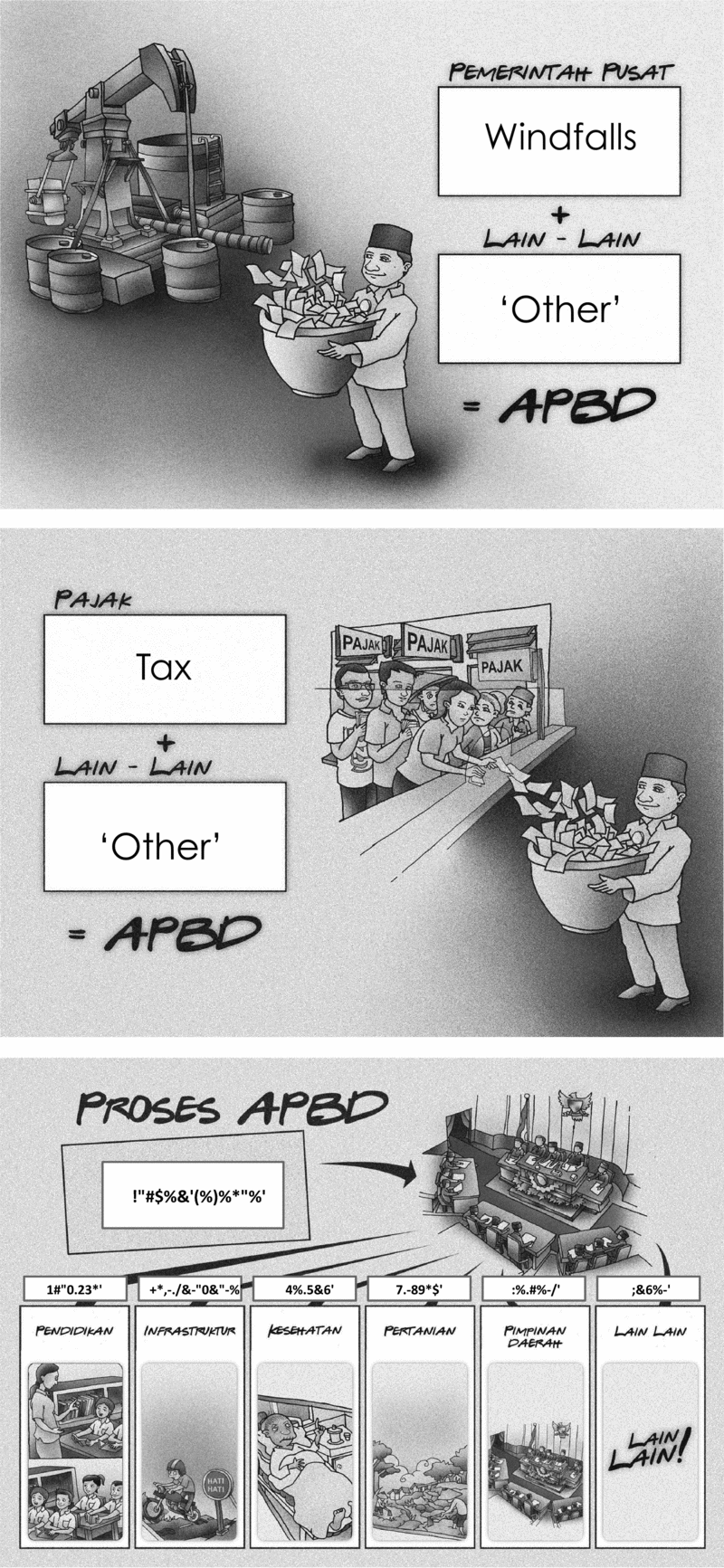
The canvasser next introduced the district government budget, explaining that just as households get income that they allocate across expenditures, so does the government. In the windfall treatment, participants were asked to return their 10,000 rupiah in income to their pockets and the canvasser took out a separate 10,000 rupiah representing district government income per capita. Using the windfall board to denote district government revenue (Figure 1, top), the canvasser divided the amount into 8,000 rupiah representing windfall revenue, primarily from central transfers and natural resources, and 2,000 rupiah representing revenue from other, unspecified sources.
Experiment Game-Boards
Note: The windfall game board (top); the tax game board (center); and the information experiment spending game board (bottom).

In the tax treatment, rather than asking participants to return their income to their pockets, the canvasser reminded them that they (or citizens like them) often have to pay taxes that go to the district government. To represent these tax obligations, the canvasser permanently transferred 4,000 of the 14,000 rupiah income from the participant's household budget game-board to the tax board representing district government revenue (Figure 1, middle). The canvasser then added 6,000 rupiah to the tax board from a separate pot, representing government income from other sources. Both windfall and tax groups thus ended with the equivalent of 10,000 rupiah on the board representing government income per capita.Footnote 11
Information Experiment
Following the revenue experiment, the canvasser conducted the information experiment using the 10,000 rupiah from the windfall or tax game-board. The treatment group received better information on actual government spending based on an analysis of the 2008 budget.Footnote 12 The control group received placebo information in the form of a list of facts and figures taken from the 2008 Blora statistical yearbook (Blora dalam Angka).
To provide the spending information in a comprehensible way, the canvasser used a district budget game-board with boxes for key spending categories, including education, infrastructure, health, agriculture, politicians, and “other” (Figure 1, bottom). The canvasser used the 10,000 rupiah—representing district government income per capita—first to illustrate the share of the total budget spent on each category. Second, the canvasser showed the budget share spent on programs for citizens versus routine administration within each category. Third, to highlight the fact that corruption further erodes spending on programs for citizens, the campaign mentioned two recent cases of alleged corruption and removed two cents from the board.Footnote 13 Finally, the canvasser disaggregated spending in the “politicians” category, breaking out the share that went to running the legislative and executive offices from the share that Blora's 46 elected representatives allocate to themselves for salaries and other private benefits. Overall, participants learned that about 30 percent of the total budget was spent on direct programs and services for citizens.
A Note on Design
The design merits some discussion as one of the first attempts to use an experiment to compare the effects of windfalls and taxes on citizen political behavior.Footnote 14 Importantly, the experiment aims to test whether political behavior varies depending on whether citizens view government as managing “their taxes,” defined as tax revenue from citizens living within the jurisdiction, or “windfalls,” defined as natural resource revenue and external revenue in central transfers. In defining transfers as windfalls, I follow on Gervasoni (Reference Gervasoni2010), who argues that central transfers are windfalls for poor subnational governments because they are far bigger than what they could obtain through their own taxing efforts. In other words, transfers produce “fiscal rents” when they contain a substantial amount of tax or nontax revenue that originates outside the jurisdiction. This is consistent with discourse in Indonesia, which suggests that district governments exhibit poor spending performance and accountability because they rely on “other people's money” in transfers rather than on locally generated tax revenue (Auracher and Sitepu Reference Auracher and Sitepu2011). Since this indicates that Indonesians plausibly view transfers as windfalls, the experiment was designed to test whether citizens are more motivated to take action when district revenue comes from “their” taxes rather than from natural resources and external revenue in central transfers.Footnote 15
In doing so, the experimental design sought to employ the strengths of a “lab-in-the-field” study by marrying a high degree of researcher control with a more naturalistic context than a pure lab experiment would provide (Morton and Williams Reference Morton and Williams2010). One main advantage of the revenue experiment is that it isolated taxation's hypothesized incentive effect from its possible information effect by equalizing the information held by both the windfall and tax groups. Both the windfall and tax treatments presented public finances in per capita terms and discussed revenue and spending as proportions of the total budget, not in terms of magnitudes, which are difficult to comprehend. Both treatments also minimized fiscal illusion by establishing clear linkages between revenue, spending, and the district government. These design features should increase confidence that any effect from the tax treatment derives from stronger incentives, not better information.
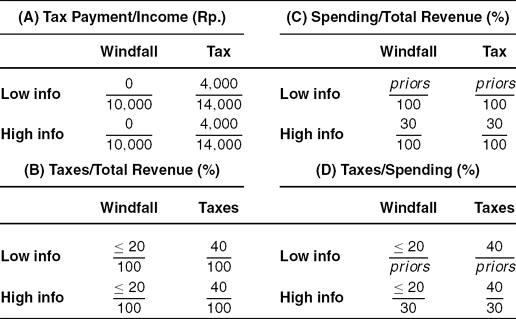
Another important feature of the design is that it varied the three distinct and theoretically motivated aspects of revenue discussed in the section on theory. Table 1 illustrates how the revenue and information experiments altered the tax burden, the perceived share of local taxes (relative to windfalls) in total revenue, and the perceived ratio of local taxes (relative to windfalls) to spending. By shifting these in a controlled way, the design gains purchase not only on whether taxes motivate more action than windfalls, but also why. While it was not feasible to vary each aspect independently, I present survey evidence below to shed light on which drives results.
Detailed Summary of the Treatments
Notes: The panels present details of the three aspects of revenue varied exogenously by the experiments. Panel A shows the tax burden (the ratio of taxes paid to income earned in the experiment). Panel B depicts the shift in the perceived share of taxes in total revenue. The assumption (later verified) is that the windfall treatment caused participants to believe that locally generated revenue constituted ≤20 percent of the district budget. Panel C shows the effect of the shift in priors induced by the information treatment, which revealed that the government spent 30 percent of total revenue on citizens. Panel D captures the “price” of public goods, obtained by putting the numerator in Panel B over the numerator in Panel C.
The tax treatment primed participants to think of the district government as managing “their” money by simulating a 4,000 rupiah tax payment (panel A of Table 1). The design strove for realism in imitating the core components of an actual income tax, conceptualized as a mandated transfer from an individuals’ earned income to the government at at an exogenous rate.Footnote 16 To underscore that the simulated tax was on earned income, canvassers emphasized at the outset that the payment was in exchange for the participants’ time and effort and the household budget exercise was designed to deepen perceived ownership over the income. The role of the canvasser can be seen as akin to that of an employer withholding income. Reassuringly, when participants were asked during the pilot how they felt about paying the simulated tax, a common response was, “biasa saja,” implying “same as [I] always feel” (when [I] pay taxes). Such a response is consistent with the fact that many citizens in Blora have experience paying taxes.Footnote 17
Second, the revenue experiment primed participants to think of the share of “their” taxes or of windfalls in the district budget. In particular, the tax group was primed on the share of taxes in total revenue that came from citizens in Blora and was shown a revenue composition in which 40 percent of total revenue came from taxes originating in the district. In contrast, the windfall group was shown that 80 percent of local government income came from central transfers and natural resources (see panel B of Table 1).Footnote 18 To prime but not deceive, participants in both groups were informed that this revenue composition of the budget was hypothetical and illustrative only.
Finally, the revenue and information experiments jointly affected the perceived “price” of public goods, defined here as the ratio of local tax revenue to spending on direct programs and services for citizens in the budget. As Ross (Reference Ross2004, 247) notes, “A rise in the price of government services can either take the form of a rise in taxes for a constant set of government services, or a constant level of taxes with a cut in government services.” While the tax experiment altered the numerator of that ratio as just described, the information experiment altered the denominator. Specifically, the spending experiment informed participants that 30 percent of the budget was spent on citizens, whereas beliefs in the low information group are participants’ priors (panel C). Panel D shows how the “price” of public goods changes across the experimental conditions. When taxes increase (relative to windfalls) and true spending decreases vis-á-vis prior beliefs on average, it is straightforward to see how the price of public goods rises across experimental conditions.Footnote 19
Sampling and Randomization
Participants in the campaign were randomly sampled using multistage cluster sampling from the adult population in Blora. The target population was all individuals between the ages of 17 (the voter eligibility age) and 65 who had resided in Blora for at least six months. First, 93 of 295 villages were randomly sampled within strata formed by subdistrict and urban-rural status. Within each village, one subvillage unit (dusun) was randomly sampled, followed by the random selection of 20 households from an updated list of all households in the dusun. Canvassers then sampled one participant in each household on arrival using simple random sampling from a full list of eligible household members made in consultation with a head of household. Random assignment was blocked at the village level so that, of the 20 participants per village, five were randomly assigned to each of the four experimental conditions. A number of steps were also taken to minimize design, canvasser, and timing effects, including blocking treatment assignment by canvassar and randomizing the order in which villages were visited. Evidence from a one-way anova of baseline survey data shows that, as expected, randomization produced a balance in pretreatment covariates across the four experimental conditions (see Appendix E online).
Data
Data come from two sources: Participation in a postcard campaign and an original survey. Survey data were collected by canvassers during the same visit. Upon consent, canvassers implemented a pretreatment module that inquired into individual and household characteristics, such as demographics, public goods usage, political participation, and experience with taxation. Post-treatment modules were implemented following both the revenue and information experiments to provide measures of the main outcomes as well as of underlying attitudinal change. The survey was identical for all participants. The sequencing for the campaign and survey is available in Appendix C online.
The concern with surveys is that they do not provide reliable measures of political behavior because responses are costless and subject to social desirability bias. I therefore use participation in a postcard campaign as a revealed preference measure of political behavior. At the end of the campaign, canvassers gave all participants the opportunity to return postcards. The postcard asked participants to indicate whether they were “satisfied with the district government in Blora and don't want to change anything about how it works” (a reward for good performance) or whether they “want the district government in Blora to do a better job” (a sanction for bad performance) (The postcard can be seen in Appendix D online). Participants were informed that the results of the postcard campaign would be shared with candidates in the lead up to the district head elections to encourage them to respond to public opinion.Footnote 20
Returning the postcard intentionally entailed a small cost. On average, participants lived about a 10-minute walk from a specially designated mailbox located in their community and they had up to 24 hours to deposit their postcards. This small cost is akin to various types of low cost political action, like signing a petition or contacting an official. The postcard campaign also resembles the voting decision in that participants had to decide both whether to turn out and whether to use their postcards to reward or punish the incumbent government. Descriptive statistics for the main outcome measures are available in Appendix F online.
MAIN RESULTS
Estimation and Hypothesis Testing
An unbiased estimate of the average treatment effect (ATE) can be obtained using the difference in mean outcomes for the tax and windfall groups as well as for the information treatment and control groups. To estimate the interaction between taxes and information, I take the difference-in-difference effect of the revenue and information treatments. The estimate of the ATE is based on treatment assignment rather than actual treatment status.Footnote 21
For the variance of the estimate of the ATE, I use standard errors developed by Neyman (Reference Neyman1923). This approach is conservative (produces bigger standard errors) because it assumes the (unobserved) covariance between potential outcomes at the individual level is zero.Footnote 22 For the main tests of the hypotheses, I use randomization inference p values from a Fisher exact test.Footnote 23 Randomization inference p values require no modelling assumptions.
Additionally, because I have several outcomes and measures of each outcome, I employ a multiple inference correction for all tests of the main effects of taxes versus windfalls. I use the two-step procedure for correcting the false discovery rate (FDR), or the proportion of null hypotheses that are falsely rejected (Anderson Reference Anderson2008). Analogous to p values, FDR q values are the smallest ratio of falsely rejected null hypotheses to total rejected null hypotheses at which the hypothesis would be rejected. Additional robustness tests and validity checks for all results are available in Appendixes G–K online.
Does Revenue Motivate Political Action?
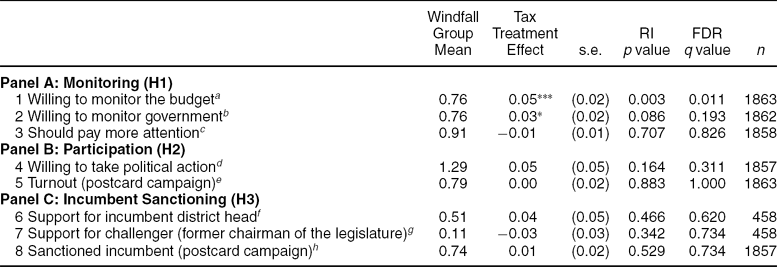
I begin by evaluating the effects of the windfall and tax treatments on the three main outcomes of interest: monitoring (H1), participation (H2), and incumbent sanctioning (H3). Table 2 reports the effects of the tax treatment for the full sample using the main measures for each outcome from both the survey and postcard campaign.
The Effect of the Windfall and Tax Treatments on Political Action (H1–H3)
Notes: Table reports (i) the mean in the windfall group, (ii) the average effect of the tax treatment, (iii) Neyman standard errors, (iv) the randomization inference p value, (v) FDR q values adjusting for multiple inference, (vi) sample size. Significance levels are denoted by *p < 0.10, **p < 0.05, and ***p < 0.01.
aHow interested are you in learning more about how the district government spends money in the budget? (Interested = 1.)
bHow interested are you in learning more about what the government of Blora is doing? (Interested = 1.)
cYou should pay more attention to what the district government does. (Agree = 1.)
dRegarding a problem or issue that was affecting your daily life or your community, would you in the future: contact a village or subdistrict official, contact the district head, contact a local legislator, contact the media or an NGO, take part in a demonstration? (Average of 5.)
eReturned postcard (1), abstained (0).
fWhich [candidate] would you say has your strongest support at present [in the upcoming district head elections]? (Incumbent = 1.)
gWhich [candidate] would you say has your strongest support at present [in the upcoming district head elections]? (Challenger and former legislative chairman = 1).
hReturned postcard and sanctioned incumbent (1), returned postcard and rewarded incumbent (−1), abstained from returning postcard (0).
I look first at how the revenue treatments affected participant willingness to monitor politicians, proxied by three survey questions reported in panel A of Table 2. The first question inquires into the willingness to learn more in the future about how the district government manages public funds. The tax group was five percentage points more willing to monitor the budget than the windfall group. This result is significant at the 99 percent confidence level (p = 0.003) and is robust to controlling for multiple inference. I also confirm that the finding is driven by a shift upward in the tax group rather than a shift downward of the windfall group. In the pretreatment survey, 71 percent of all participants wanted to learn more about the budget; the revenue experiment increased willingness to monitor in both the windfall and tax groups but more so in the latter. Substantively, the magnitude of the treatment effect is about half the size of having a primary school education; those who had completed primary school were 11 percentage points more willing to monitor the budget.
The following two questions in panel A ask about interest in monitoring government more broadly. There is weak evidence that the tax treatment caused a three percentage point increase in the proportion of partipants willing to monitor government more generally (row 2), although the more abstract question on whether participants agree they should “pay more attention” to what the district government is doing reveals no effect (row 3). Overall, the fact that the tax treatment had a positive effect on demand for information on the budget, if not government more broadly, supports H1.
There is no indication that the tax treatment increased willingness to engage in other forms of political participation, however. I evaluate the effect of the tax treatment on political participation (H2) using data from both the survey and the postcard campaign. To assess whether the treatments made participants more willing to take action to address issues affecting their lives or their communities, the survey asked about five types of nonelectoral political behavior. These included contacting a village or subdistrict official, the district head, a local legislator, and the media or an NGO. Participants were also asked if they would be likely to take part in a demonstration. The results, reported in panel B of Table 2, show no difference between windfall and tax groups in the mean number of types of political action participants were willing to take.Footnote 24
Participation in the postcard campaign, as a revealed preference, provides a better measure of actual willingness to take political action. As can be seen in row 5 of panel B, however, the tax treatment did not cause higher levels of participation in the postcard campaign. While 78 percent of all participants returned their postcards, there is no detectable variation in return rates across experimental conditions.
The third outcome of interest is whether the tax treatment reduced support for the incumbent government (H3). Panel C of Table 2 presents survey data on self-reported vote choice as well as the overall sanctioning effect of the postcard campaign. The public awareness campaign took place in the three months leading up to district head elections. The three candidates for district head included the incumbent, the former chairman of the district legislature, and a third challenger with ties to the bureaucracy and a popular Muslim organization. As described earlier, the former legislative chairman was widely suspected of corruption at the time. Participants were asked which candidate they most supported at the time the survey was conducted.
While low statistical power makes it difficult to detect significant differences across groups, the signs on the treatment effects in Table 2 suggest that the tax treatment produced higher support for the incumbent district head and lower support for the former legislative chairman.Footnote 25 One plausible explanation is that the tax treatment caused participants to prefer the incumbent district head relative to the challenger given the latter was viewed as more corrupt.Footnote 26
The postcard campaign again provides the main revealed preference measure of willingness to take action to demand better performance from government. Whereas the previous measures capture support for the incumbent district head relative to a challenger, the postcard more closely resembles a referendum on incumbent performance. To provide a composite “net sanctioning effect” measure, I code all those who returned their postcard and signaled that they want government to do better as 1, those who returned their postcard and said they were satisfied with the status quo as −1, and those who abstained from participating as 0. The final row of Table 2 provides little evidence that the tax treatment produced a greater impetus to sanction the incumbent than windfalls. Yet, as will be shown in the next section, while the tax treatment had no effect in the high information environment, it caused a six percentage point increase in the use of the postcard to sanction the incumbent in the low information environment. The results below provide evidence for H3 while also pointing to an unanticipated relationship between revenue and information.
Does Revenue Condition the Impact of Information?
The results presented so far suggest that the tax treatment increased demand for information on the budget, consistent with the notion that taxation promotes information-seeking. Hypothesis 4 predicts another way in which revenue affects information: by conditioning how people evaluate information on government spending. To investigate whether citizens care more about misspent public funds when they pay taxes, I focus on whether the impact of the information treatment depends on whether participants were in the windfall or tax treatment groups.
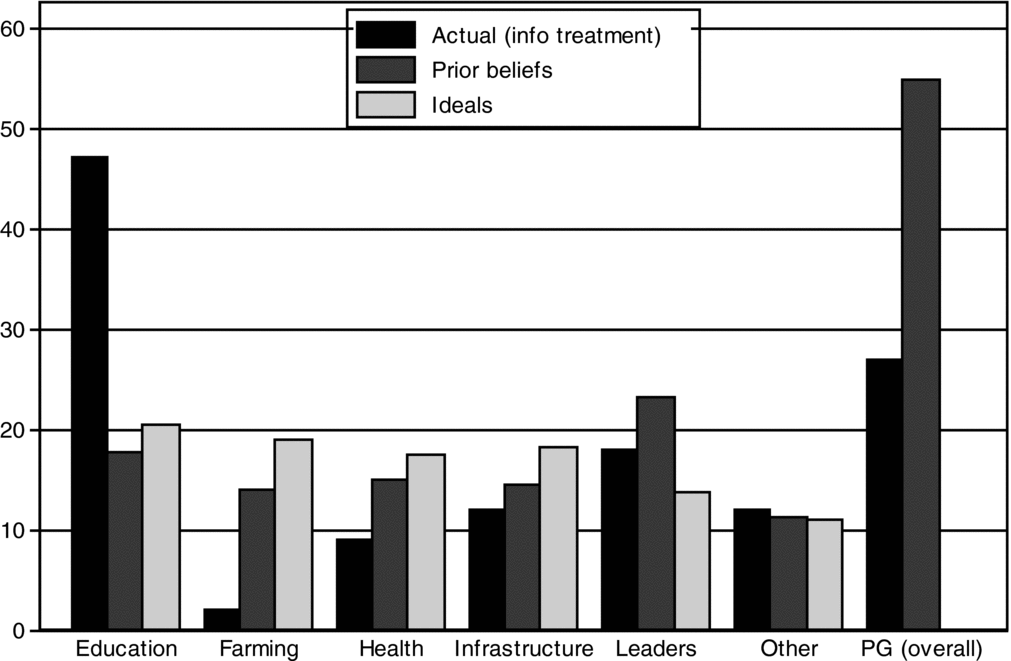
In order to study the effect of information, the information treatment had to shift participant beliefs about government spending. To check first that this occurred, I use data from a district budget exercise conducted with participants just prior to the information experiment to measure participants’ initial ideals and beliefs about public spending. All participants were asked to the use the 10,000 rupiah from the revenue experiment (and the district budget game-board) to illustrate how they would spend the funds if they were the decision-maker (ideals) and how they think government actually spends the funds (beliefs). As can be seen in Figure 2, while actual spending on education was far greater than what participants wanted or expected, spending was lower than desired or expected for health, infrastructure, and farming. In general, participants estimated that government spent about 55 percent of its revenue on public services and direct programs for them; the campaign revealed the true amount in 2008 to be 30 percent.
Spending Priors
Notes: Figure compares actual spending (as revealed by the treatment) to prior ideals and beliefs about government spending across the six categories highlighted in the information campaign. The two columns at the far right show the initial beliefs and the truth about the total share of the budget that government spent on all direct goods and services for citizens.
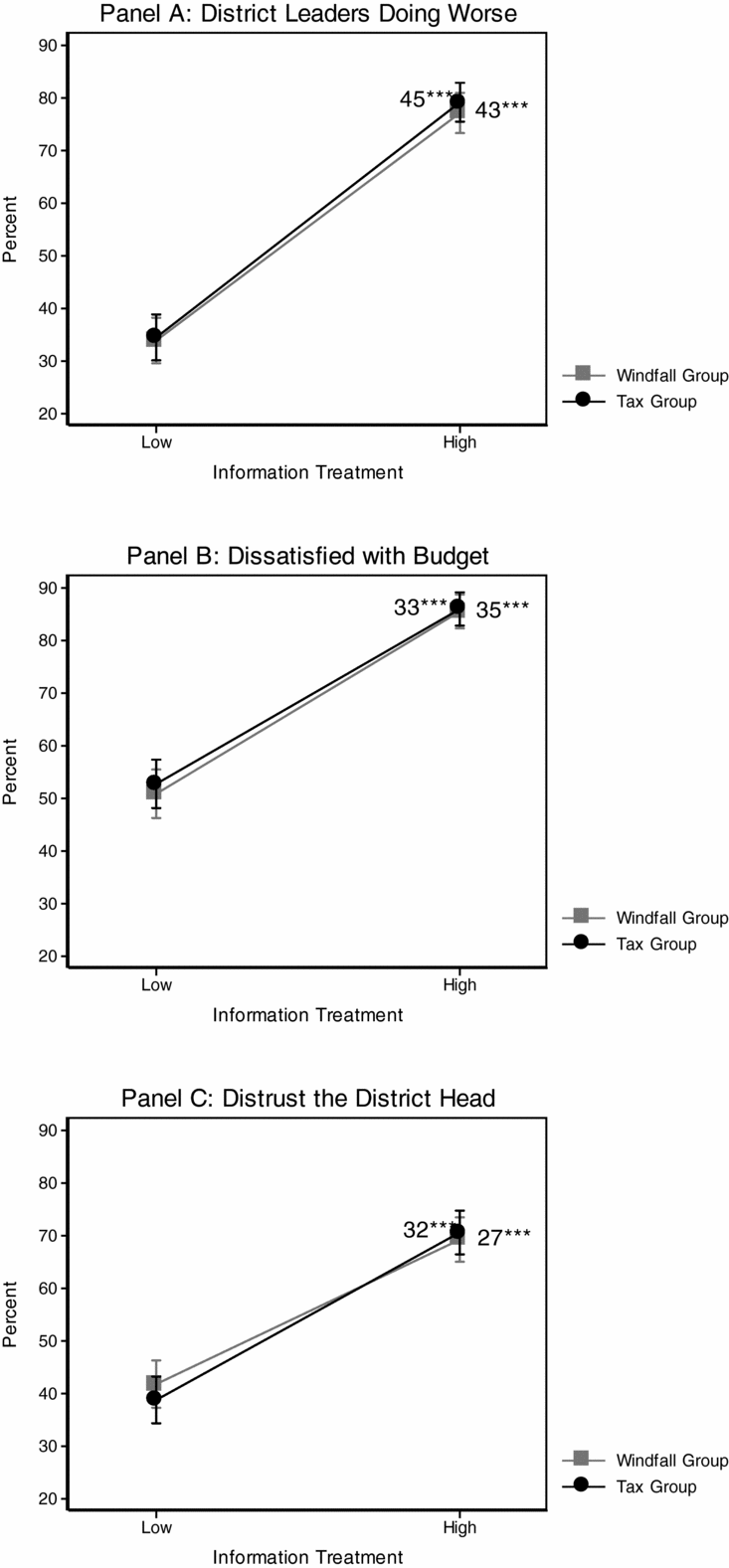
What participants learned made them view district government performance in a substantially worse light. Figure 3 presents results for three survey measures of attitudes towards government. The information treatment caused a 43 percentage point increase in the share of participants who felt government was doing worse than expected in the windfall group and a 45 percentage point increase in the tax group. Both of these effects are strongly significant. Yet, contrary to expectations, there is no evidence that the tax group reacted more strongly to the negative information. Questions on dissatisfaction with budget management (panel B) and distrust in the district head (panel C) reveal similar results; the pattern also holds for additional measures on dissatisfaction with district government overall and distrust in legislators (for tables of all results, see Appendix G online). These findings suggest that, while the information was indeed negative and caused participants to update beliefs, citizens in the tax treatment did not care more about misspent revenue.
How the Revenue Treatments Condition the Impact of Information on Attitudes Towards Government
Notes: Panel A shows the proportion who believe that “elected leaders in the district government are doing a worse job than [you] thought they were”; panel B is the proportion dissatisfied “with the way the district government manages the budget” (panel B); and panel C is the proportion that distrusts “the district head to do the right thing for the people of Blora” as a result of the treatments. Significance is denoted by *p < 0.10, **p < 0.05, and ***p < 0.01 based on randomization inference p values.
I proceed to assess the main evidence for H4: That information provokes more monitoring, participation, and sanctioning when citizens pay taxes. To do this, I revisit the main outcomes presented above but now with attention to whether there was an interaction effect in the revenue and information experiments. I focus here on the main measure of each outcome.
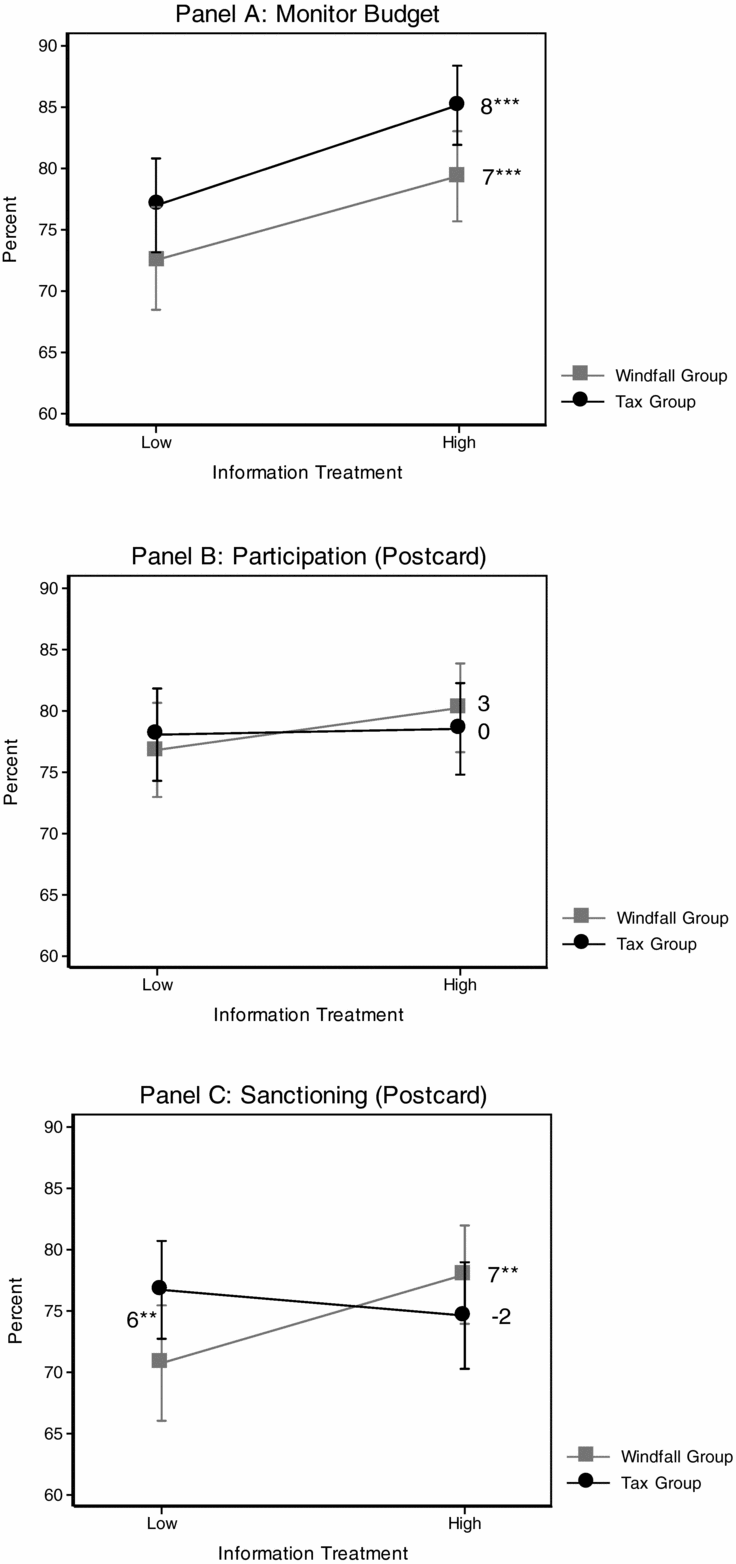
I begin by examining whether the impact of the information treatment on willingness to monitor the budget was greater for the tax than the windfall treatment group. The results, shown in panel A of Figure 4, indicate that the information produced a seven percentage point increase in willingness to monitor the budget in the windfall group (p = 0.006) and an eight percentage point increase in the tax group (p = 0.001). Similar to the findings above, however, since the magnitudes of these effects are approximately the same, there is no support for the prediction that revelations of misspent funds provokes a stronger desire among taxpayers to monitor government in the future.
How the Revenue Treatments Condition the Impact of Information on Political Action (H4)
Notes: Panel A is the proportion willing to monitor the budget; panel B is the proportion that participated in the postcard campaign; and panel C is the proportion that used the postcard to sanction the incumbent as a result of the treatments. All measures are defined in Table 2. Significance is denoted by *p < 0.10, **p < 0.05, and ***p < 0.01 based on randomization inference p values.
Next, I evaluate whether the effects of the information treatment on more overt types of political participation vary across windfall and tax groups. Notably, while we know that the information caused participants to take a more negative view towards government, panel B of Figure 4 indicates that this change in beliefs did not translate into higher participation in the postcard campaign for either the windfall or tax groups. This result further undermines support for H4.
Finally, I consider whether participants in the tax treatment were more likely than citizens in the windfall treatment to punish the incumbent. Panel C of Figure 4 presents the results for the net sanctioning effect of the postcard campaign. Whereas H4 predicts a significant positive interaction between the tax and information treatments, there is actually an unanticipated and significant negative interaction (p = 0.023). This occurs because the tax treatment caused a six percentage point increase in the willingness to use the postcard to sanction the incumbent but only in the low information environment (p = 0.041). Moreover, the information treatment caused a seven percentage point increase in incumbent sanctioning but only in the windfall environment (p = 0.014).Footnote 27 The information treatment, however, had no significant effect on subjects in the tax treatment.
Two notable implications arise from these findings. First, they provide support for H3 in that the tax treatment clearly produced more incumbent sanctioning than the windfall treatment in a low information environment. Second, they suggest that participants sanctioned the incumbent either because of the tax treatment or information treatment but the benefit of receiving both was limited; this could be interpreted to mean that there is possibly a ceiling in the effect of the treatments on political action.Footnote 28 All in all, while the data show three different patterns in how revenue and information relate, there is little evidence to support the idea that information provokes more political action when people pay taxes.
Summary of Main Results
In showing that the tax treatment caused a greater willingness to monitor the budget compared to the windfall treatment, the main results can be interpreted as support for H1. Evidence for H3 is also provided in showing that the tax treatment motivated participants in the low information environment to use their postcards to sanction the incumbent. There is less support for the hypothesis that different sources of government revenue create a differential willingness to participate in politics, as predicted by H2. One possible explanation for this pattern of results is that the tax treatment increased the perceived benefits of restraining government for participants but not sufficiently to exceed the perceived costs of action. This is consistent with the notion that citizens are most likely to protest taxes only when they become excessive (Scott Reference Scott1976). Interestingly, the fact that the tax treatment had a positive effect on monitoring but not on more overt types of political mobilization suggests a variation in how individuals assess the costs and benefits of different types of political engagement.
The findings also shed light on the possible relationship between taxation and information. In showing that the tax treatment made participants more willing to learn about the budget, it supports the notion that taxation enhances the demand for information. As such, the results provide microlevel corollary evidence for cross-national findings that governments that depend on windfall revenue tend to be less transparent (Ross Reference Ross2012). With respect to the effect of revenue on information processing, both the tax and windfall groups proved equally intolerant of revelations that public funds were not spent as well as expected. Contrary to H4, the results point to the effects of information on political action being as great, if not greater, in the windfall treatment.
WHY MIGHT TAXES MOTIVATE ACTION?
The tax treatment increased both the willingness to monitor the budget and to use the postcard to sanction the incumbent government (in the low information environment). As discussed previously, the revenue and information experiments exogenously varied three distinct aspects of taxation: The tax burden, the share of taxes (relative to windfalls) in total revenue, and the ratio of taxes (relative to windfalls) to spending (the “price” of public goods). I use the survey to investigate whether results were driven by the tax burden or the perceived share of taxes in total revenue; the lack of evidence for H4 rules out the possibility that participants were motivated by the price of public goods.Footnote 29
Panel A in Table 3 presents a measure designed to capture whether participants felt the out-of-pocket loss of their earned income associated with the simulated tax payment. The survey employed a question adapted from the Becker, DeGroot, and Marshcak (Reference Becker, DeGroot and Marschak1964) procedure to elicit risk tolerance for monetary gambles, where the tax group is expected to be more willing to take a risky gamble.Footnote 30 The results show, however, that those in the windfall and tax treatments display no difference in willingness to take a risk to win additional funds. The results were similarly inconclusive for a measure of willingness to gamble to avoid a loss (available on request).
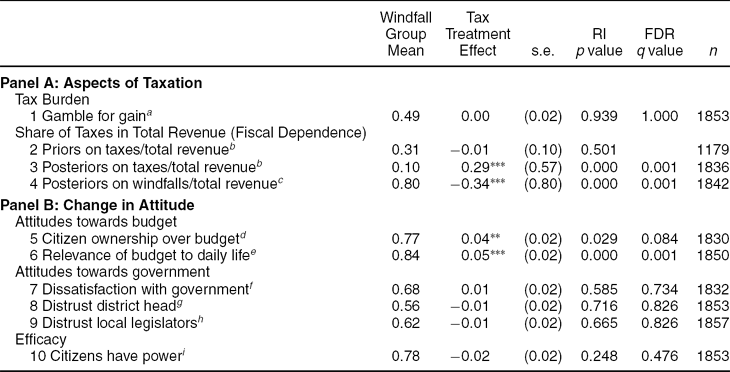
Why the Tax Treatment Motivated Political Action
Notes: Table reports (i) the mean in the windfall group, (ii) the average effect of the tax treatment, (iii) Neyman standard errors, (iv) the randomization inference p value, (v) FDR q values adjusting for multiple inference, and (vi) the sample size. Significance levels are denoted by *p < 0.10, **p < 0.05, and ***p < 0.01. All data come from survey measures taken immediately following the revenue experiment, except for the measures of attitudes towards the government, which were taken following the information experiment.
aImagine there are two envelopes—inside one envelope there is 0 rupiah and inside the other envelope there is 4,000 rupiah. . .Would you rather receive [. . .] for certain or would you rather take the risk between obtaining 0 or 4,000 rupiah? (Recorded amount for certain as a percentage of Rp. 4,000.)
bFor every 10,000 rupiah the district government gets in income, how much do you think comes from taxpayers in Blora?
cFor every 10,000 rupiah the district government gets in income, how much do you think comes from the central government and oil and gas?
dArg A: The money in the budget belongs to citizens in Blora vs Arg B: The money in the budget belongs to the district government. (Agree with A = 1.)
eThe budget is relevant to your daily life. (Agree = 1.)
fHow satisfied are you with how the district government manages the budget? (Dissatisfied = 1.)
gHow much do you trust the district head to do the right thing for people in Blora? (Distrust = 1.)
hHow much do you trust local legislators to do the right thing for people in Blora? (Distrust = 1.)
iPeople have power to get the district government to do what they want (Agree = 1.)
There is strong evidence, however, that the revenue experiment shifted the perceived share of taxes (relative to windfalls) in total revenue in the district budget, as can be seen in rows 2 through 4 of Table 3. The second row shows that, at the outset, participants on average estimated that 30 percent of total revenue comes from their taxes and, as expected, there was no difference between the tax and windfall groups. As can be seen in row 3, however, following the revenue experiment treatments, the windfall group believed that 10 percent of the budget came from their taxes compared to 39 percent in the tax group—a significant 29 percentage point difference.Footnote 31 Conversely, row 4 shows that the treatments reduced the perceived share of windfalls in the budget for the tax group relative to the windfall group.Footnote 32 Compared to the windfall group, which thought that 80 percent of the budget came from natural resources and external revenue in central transfers, the tax group believed that only 46 percent of the budget came from windfall sources (a significant 34 percentage point difference).Footnote 33
This evidence that the revenue treatments caused the tax group to believe that there was more tax, and less windfall, revenue in the budget (relative to the windfall group) is reflected in a clear change in attitudes towards the budget, as proxied by two survey questions presented in panel B of Table 3. To measure feelings of ownership over the district budget, one question asked participants whether they thought the money in the budget “belongs to citizens in Blora” or “belongs to the district government” (row 5). The tax group was four percentage points more likely to claim ownership for citizens. Similarly, to measure affinity to the district budget, another question asked participants whether they agreed with the statement that “the budget is relevant to your daily life” (row 6). The difference between the tax and windfall groups is a positive and significant five percentage points for this measure.
There is no evidence, however, for other types of attitudinal change suggested in the section on theory. Rows 7 through 9 present measures of dissatisfaction and distrust in the district government, but there is no evidence of a significant difference between the windfall and tax groups. I also investigate whether the tax treatment made citizens feel more empowered vis-á-vis local government. While the tax treatment did not bring about an objective change in citizens’ leverage over government, it nonetheless might have primed a stronger sense of government's fiscal dependence on society. To assess this possibility, the survey asked participants whether they think citizens “have power to get the district government to do what they want.” Row 10 of panel B shows no evidence of any difference in feelings of empowerment between the windfall and tax groups.
In sum, the data suggest that participants were motivated not by the tax payment itself but rather by a shift in beliefs about the share of taxes paid by citizens living in the district in total revenue. This in turn resulted in a greater sense of perceived ownership over district government funds and an appreciation of the relevance of the budget to daily life. There is no support for the possibility that the tax treatment evoked more negative feelings towards the government or that citizens felt more empowered vis-á-vis government as a result of the perceived increase in its fiscal dependence on society.
EXTERNAL VALIDITY
Blora is similar to many other districts in Indonesia as a windfall-dependent district with low levels of political awareness and known problems with corruption and budget mismanagement. Similarly, as a large, diverse developing democracy with a weak tax system and endemic corruption, Indonesia has much in common with other developing countries. By just one metric it shares the rank of 100 (out of 182 countries) with countries such as Mexico and Benin on Transparency International's 2011 Corruption Perceptions Index. Yet, to what extent are the results from this study externally valid in the sense that they generalize beyond Blora and Indonesia?
Answering such a question is difficult in that it requires conjecture on how the results would differ had this study been implemented in other populations or contexts. We can, however, use theory to consider how the findings might change if other parameters, particularly those that affect the perceived costs and benefits of taking action, varied. For instance, we might expect that the tax treatment would have a smaller (or null) effect on all three main outcomes in an authoritarian setting where the costs of taking political action are likely higher. Alternatively, the tax treatment might have a bigger effect in a more urban setting if access to infrastructure, public goods, and the media facilitate political action.Footnote 34
Another way to think about external validity is to question how making minor variations to the treatment might affect results (Duflo, Glennerster, and Kremer Reference Duflo, Glennerster and Kremer2006). For instance, it is possible that the windfall treatment would have motivated more political action (reducing the difference between the tax and windfall groups) if it had primed other sources of windfall revenue that resonate more strongly with citizens. Similarly, the tax treatment might have had a bigger effect had the experiment employed a heavier burden, higher share of taxes in total revenue, or higher price of public goods. Additionally, while this article simulated a personal income tax, the effect on political behavior of other types of direct and indirect taxes—including value-added taxation, a leading source of tax revenue in developing countries—would plausibly vary from the estimates provided here. Finally, the experiment did not give participants the option of noncompliance with their tax payment; it is possible that the effect of the tax treatment would be smaller had participants been allowed an exit option.
Another central aspect of the design that would affect the point estimates presented here is the focus on a partial rather than a general equilibrium relationship (Duflo, Glennerster, and Kremer Reference Duflo, Glennerster and Kremer2006). To test a mechanism by which windfalls, taxes, and information affect citizen political action, the experiment (intentionally) did not allow for a strategic response by politicians. In a general equilibrium, politicians would anticipate the impact of higher taxes or better information and modify their performance accordingly, which would in turn alter citizens’ observed political behavior. The results presented here are thus most immediately valid for settings in which politicians do not have the opportunity in the short run to adjust their performance in response to higher taxes or improved citizen access to information.
While there are numerous variations in context or treatment design that could change the point estimates presented here, the results nonetheless speak to a more general phenomenon. Critically, they suggest that taxes compared to windfalls can motivate more citizen political action. As such, the article employs a particular context and design to provide a proof of concept for a plausibly general phenomenon. Importantly, the notion that windfalls and taxes produce differences in citizen demand for good government is often stated as a general (not context specific) proposition; the findings presented here are also consistent with existing national and cross-national empirical evidence (Ross Reference Ross2001, Reference Ross2012). While the null effect on participation is surprising, there is good reason to believe—in light of the other favorable evidence—that the tax treatment would have motivated more participation had the effect on the perceived benefits of doing so been stronger. This null result does not undermine the other findings but rather points to the need for more inquiry into the conditions under which taxation yields more participation.
CONCLUSION
Understanding when and why windfall revenue undermines development remains a central focus of political economy research. While a number of compelling explanations for the resource curse exist, knowledge of which mechanisms have explanatory power, under what conditions, and how they relate to one another remains elusive. This article contributes to the resource curse literature by providing the first microlevel, causal evidence for the enduring proposition that windfalls undermine—and taxes strengthen—citizen motivation to hold leaders accountable. The experimental results suggest that, compared to windfalls, taxes indeed create stronger incentives for citizens to monitor the budget and sanction the incumbent (in a low information environment). There is no support for the hypothesis that different sources of government revenue create a differential willingness to participate in politics, however. This is likely because the tax treatment did not succeed in elevating the perceived benefits of action above the costs in this context.
The article also provides insights into why taxes and not windfalls might motivate political action. Both the rentier state and the tax-and-accountability literatures have variously suggested—but offered little evidence to substantiate—that citizens are motivated to take action by their tax burdens, by the share of taxes relative to windfalls in total revenue, or by the price of public goods. The results indicate that participants were motivated to monitor and sanction the incumbent by an increase in the perceived share of taxes relative to windfalls in total revenue, which fostered a greater sense of ownership over district public funds. These results suggest the need for more research into the extent to which citizens’ feelings of ownership vary for different types of windfall revenue—whether oil and natural resources, foreign aid, or central transfers—and the implications for political action. Moreover, the findings call more research on how different aspects of taxation affect political engagement and accountability. This is especially important in light of the finding that the tax treatment did not yield more participation than windfalls, which highlights the need for a better understanding of the conditions under which taxation motivates more costly political action.
A further contribution of this article is to shed light on the role played by revenue in the relationship between information and accountability. The evidence suggests that taxation motivates citizens to become politically informed or to demand better transparency from government. There is no indication, however, that citizens simply care less about misused revenue when government is financed by windfalls than by taxes—the impact of providing participants with negative information on government spending was as great, if not greater, in the windfall than in the tax treatment. This finding suggests that transparency and improving citizen access to information could be an effective alternative to strengthening taxation as a strategy for mitigating the resource curse.
Finally, the focus of this article is on how revenue affects citizen decisions to take political action, but not on the strategic interaction between politicians and citizens. While the findings suggest that taxation gives citizens stronger incentives to restrain government, evidence that it likewise gives politicians the incentives to make government more transparent, responsive, and efficient is still needed. Only through such future research will the impact of windfalls and taxes on how citizens become more vocal and active keepers of the public purse be understood.
Supplementary materials
To view supplementary material for this article, please visit http://dx.doi.org/10.1017/S0003055413000415




Comments
No Comments have been published for this article.