Introduction
Time has long been a major subject of study in philosophy, religion and the natural sciences. Time is not just a physical phenomenon, but also a psychological one (James Reference James1890/1950). Humans regulate and schedule activities by objective, chronological ‘calendar time’ but also experience time in subjective terms. For example, sometimes we feel that ‘time flies’, but other times moments seem to last forever. Ageing adds a new dimension to the experience of time. By definition, ageing involves moving across lived time. At some points in the lifespan, the future seems like an endless road stretching out before us, and at other times it feels that we are coming close to ‘the end of the road’. Generally, as individuals grow older, their past grows larger and their future shortens. Their interpretation of the present may be influenced by these changes in time perspective (de Beauvoir Reference de Beauvoir1972). Particularly, individuals' sense of future time perspective at different points in the lifespan may affect their level of wellbeing.
The current study examines time perception, specifically future time perspective from a psychological viewpoint. This study investigates young and middle-aged adults' psychological wellbeing in terms of two time-related variables: chronological age (i.e. time since birth) and future time perspective (i.e. perceived time left to live). Chronological age is a widely used variable in developmental research, but is conceptually clumsy (e.g. Helson, Soto and Cate Reference Helson, Soto, Cate, Mroczek and Little2006; Marshall Reference Marshall1975). When time is conceptualised not only as chronological age, but also perceived time left in life, an interesting picture emerges. Though one could suggest that chronological age and time left to live are simply ‘opposite sides of the same coin’, we argue that they have unique effects on psychological wellbeing. That is, psychological wellbeing is expected to be generally higher with chronological age (i.e. in midlife compared to young adulthood), but it is also higher with a more open-ended future time perspective. Thus, time since birth and perceived time left to live are argued to be opposing forces in the construction of psychological wellbeing.
Given that future time perspective has been theorised as an important developmental variable in various fields such as sociology and philosophy (e.g. de Beauvoir Reference de Beauvoir1972; Neugarten Reference Neugarten and Neugarten1996), there has been surprisingly little research on its effects on psychological wellbeing. Despite classic conceptions of midlife as an important time for examining one's future (Jung Reference Jung1933), research on midlife samples is particularly sparse (Staudinger and Bluck Reference Staudinger, Bluck and Lachman2001). To address this gap, the current research investigates the relation of chronological age and future time perspective to psychological wellbeing, with a focus on two adult age groups: individuals in young adulthood and in midlife. Our argument depends on three theoretical tenets: individuals in midlife have a less open-ended future time perspective than young adults; psychological wellbeing is generally higher in midlife; and a more open-ended future time perspective is related to greater psychological wellbeing. Each is discussed below.
Time perspective: midlife is pivotal
Midlife involves challenge and stress due to multiple roles and responsibilities, but is also a time of achievement and generativity (Freund and Ritter Reference Freund and Ritter2009; Helson and Soto Reference Helson and Soto2005). The psychological complexity and the flexibility of age boundaries in midlife (Baltes, Staudinger and Lindenberger Reference Baltes, Staudinger and Lindenberger1999) render it difficult to define using only a numerical indicator, chronological age (Lachman and Bertrand Reference Lachman, Bertrand and Lachman2001). This highlights the importance of using variables such as future time perspective for conceptualising midlife (Helson, Soto and Cate Reference Helson, Soto, Cate, Mroczek and Little2006). As individuals grow older, they accept the future as more limited with higher awareness of potential age-related declines (Fung and Carstensen Reference Fung and Carstensen2006). Socio-emotional selectivity theory (SST; Carstensen Reference Carstensen1991) focuses on the changing perceptions of time in late adulthood (i.e. when time is perceived as very short and ‘endings’ are in sight), but classic theories suggest that future time perspective is important across adulthood (not just in late life), particularly in midlife. For example, famous sociologist Neugarten (Reference Neugarten and Neugarten1996) theorises that midlife is governed by an internal social clock that shifts over time, reminding individuals that they are in the middle (Erikson Reference Erikson1959; Jung Reference Jung1933). Similarly, renowned philosopher de Beauvoir (Reference de Beauvoir1972) describes middle-aged adults' experiential sense of the future: one exchanges an indefinite, even infinite future for one that is finite. With the awareness of time as finite (Marshall Reference Marshall1975), adults start restructuring life in terms of time left to live rather than time lived (Neugarten Reference Neugarten and Neugarten1996).
Despite rich theory, little research has examined the sense of future time perspective in midlife. In one study, Cate and John (Reference Cate and John2007) compared women in their twenties, forties and fifties in terms of their future focus. Women in their forties and fifties saw fewer opportunities than younger women, and those in their fifties focused more on limitations than young women (Cate and John Reference Cate and John2007). Similarly, Kooij and Van de Voorde (Reference Kooij and Van de Voorde2011) showed that although young adults' future time perspective had no impact on their long-term subjective health or motives, middle-aged individuals' limited future perspective was associated with decreased subjective health. In another study, women in the final phase of midlife (specifically, at age 61) reported that their consciousness of time shifted to a greater awareness of ageing and death (Helson and Soto Reference Helson and Soto2005). As such, based on lifespan developmental theory (Erikson Reference Erikson1959; Staudinger and Bluck Reference Staudinger, Bluck and Lachman2001) and classic theories of midlife development grounded in psychoanalytic (Jung Reference Jung1933) and sociological perspectives (Neugarten Reference Neugarten, Eisdorfer and Lawton1973), the current study examines the relation of future time perspective to psychological wellbeing in midlife (compared to young adulthood).
Psychological wellbeing in young and middle adulthood
It is a mistake to regard age as a downhill grade toward dissolution. The reverse is true. As one grows older, one climbs with surprising strides. (George Sand, 1804–76)
Based on lifespan developmental psychology (Baltes Reference Baltes1997), Ryff (Reference Ryff1989a) posits six dimensions of psychological wellbeing that may change in multiple directions across the lifespan (Ryff and Singer Reference Ryff and Singer2006). Self-acceptance is a component of optimal functioning (Rogers Reference Rogers1961) and those with high levels are able to accept both positive and negative self-characteristics. Positive relations with others refers to feeling love and affection for other people (Maslow Reference Maslow1968) and forming deep friendships (Erikson Reference Erikson1959). Autonomy refers to making decisions independently and self-regulating behaviour. Environmental mastery is the ability to choose or create environments compatible with one's physical and psychological needs. Purpose in life refers to having goals and a sense of direction. Finally, personal growth is the need for continued development of one's potential (e.g. Clarke et al. Reference Clarke, Marshall, Ryff and Wheaton2001).
Individuals in midlife often show higher levels of psychological wellbeing. For example, in a series of studies (Ryff Reference Ryff1989b, Reference Ryff1991; Ryff and Keyes Reference Ryff and Keyes1995), middle-aged adults (30–64 years) reported higher environmental mastery and greater autonomy than young adults (18–29 years), and had similar levels of personal growth and purpose in life. On the dimensions of positive relations and self-acceptance, some studies find no age differences (Ryff Reference Ryff1989b), but others find that older adults (over 64 years) report more positive relations (Ryff and Keyes Reference Ryff and Keyes1995) and self-acceptance (Ryff Reference Ryff1991) than young and middle-aged adults (who report similar levels). This may be due to the different age ranges of different midlife samples: those closer to their sixties may be more likely to show the older adult profile of better positive relations and greater self-acceptance.
In sum, considering all six dimensions, midlife is a time when psychological wellbeing is the same or higher than in young adulthood (e.g. Helson, Soto and Cate Reference Helson, Soto, Cate, Mroczek and Little2006). This may be due to maturational changes and life experience over decades (e.g. Clark-Plaskie and Lachman Reference Clark-Plaskie, Lachman, Willis and Reid1999). In addition, it might be related to the fact that middle-aged adults have faced challenges in multiple domains, but often attained their highest status level occupationally. They have gained greater financial as well as psychological resources such as showing high levels of control beliefs and primary control strategies (e.g. Wrosch, Heckhausen and Lachman Reference Wrosch, Heckhausen and Lachman2000), and peak levels of affect complexity (e.g. Helson and Soto Reference Helson and Soto2005).
Relation of future time perspective to psychological wellbeing
The future belongs to those who believe in the beauty of their dreams. (Eleanor Roosevelt, 1884–1962)
Interest in future time perspective has increased recently, particularly in relation to ageing and health (Coudin and Lima Reference Coudin and Lima2011). SST (Carstensen Reference Carstensen1991) is an established adult developmental theory using future time perspective as the core variable affecting socio-emotional processes in ageing. SST does not specifically address psychological wellbeing. It uses ‘anticipated endings’ (whether assessed through chronological age or experimental manipulation) to predict socio-emotional preferences (i.e. choice of socio-emotional over knowledge-oriented goals, social network preferences; e.g. Hoppmann and Blanchard-Fields Reference Hoppmann and Blanchard-Fields2010). Findings support the theory (e.g. Hicks et al. Reference Hicks, Trent, Davis and King2012; Kooij and Van de Voorde Reference Kooij and Van de Voorde2011), suggesting that a shorter future time perspective creates a positivity effect (e.g. Mather and Carstensen Reference Mather and Carstensen2005; i.e. fewer negative emotions, greater attention to positive information). In short, SST suggests that reductions in future time perspective have positive socio-emotional outcomes.
Some research, however, has not found this link. For example, Kessler and Staudinger (Reference Kessler and Staudinger2009) found, in contrast to SST, that open-ended (not limited) future time perspective was related to better regulation of negative affect. When moving outside the realm of socio-emotional processes, the relation of limited future time perspective to positive outcomes finds little support. Instead, a variety of studies on psychological wellbeing, regardless of measurement technique (see Sejits 1998 for a review) show that reduced future time perspective is related to negative outcomes (i.e. lower wellbeing). For example, those with more open-ended views or who are planning for the future have lower levels of anxiety and depression (Coudin and Lima Reference Coudin and Lima2011; Zimbardo and Boyd Reference Zimbardo and Boyd1999). Having an open-ended future perspective is also associated with positive affect, life satisfaction and optimism (Allemand et al. Reference Allemand, Hill, Ghaemmaghami and Martin2012), and with greater reports of positive life events (Leist, Ferring and Filipp Reference Leist, Ferring and Filipp2010).
Most previous research, including that reviewed above, focuses on young adults. Fewer studies examine adult development or ageing. Some developmental research, however, shows similarities across age groups. For example, regardless of age, men and women with an expansive future time perspective experience higher levels of happiness (Yeung, Fung and Lang Reference Yeung, Fung and Lang2007) and greater levels of life satisfaction (Fingerman and Perlmutter Reference Fingerman and Perlmutter1995). An examination of older adults only showed that future orientation (i.e. having plans for next month, next year) predicts wellbeing (Kotter-Grühn and Smith Reference Kotter-Grühn and Smith2011): specifically, a decrease in future orientation or decrease in optimism about the future is longitudinally related to a decrease in wellbeing. Another study, however, suggests age differences (Kooij and Van de Voorde Reference Kooij and Van de Voorde2011). These authors showed that while young adults' future time perspective had no impact on their subjective health, middle-aged individuals' limited future perspective was associated with decreased subjective health. In sum, research specifically on psychological wellbeing (i.e. not on socio-emotional processes) demonstrates higher levels of wellbeing in relation to a more open-ended future time perspective (Drake et al. Reference Drake, Duncan, Sutherland, Abernethy and Henry2008). Further research is necessary to better understand lifespan developmental processes in the relation between future time perspective and psychological wellbeing. To our knowledge, this study is the first to examine the relation between future time perspective and multidimensional psychological wellbeing (Ryff Reference Ryff1989a) across adult age groups.
Age and future time perspective: opposing forces on psychological wellbeing
As argued thus far, being in midlife (i.e. higher chronological age) and greater future time perspective are both related to more positive psychological wellbeing. Of course, however, people generally have shorter future time perspectives as chronological age increases. That is, they do not naturally maximise both of these predictors of psychological wellbeing at once. Instead, we have argued that age and future time perspective act as opposing forces that simultaneously influence psychological wellbeing.
The current study
The goal of the study is to examine the argument that chronological age and future time perspective act as opposing forces in constructing psychological wellbeing in adulthood. As such, relations between age, future time perspective and psychological wellbeing (Hypotheses 1–3) must first be tested. These hypotheses were developed based on the reviewed theory and research:
• Hypothesis 1: Middle-aged adults are expected to have a less open-ended, positive future time perspective than young adults.
• Hypothesis 2: Middle-aged adults are expected to generally show higher levels of psychological wellbeing. They should maintain high levels of functioning on dimensions evident in young adulthood (i.e. personal growth, purpose in life), and show higher levels than the young on environmental mastery and autonomy. We also expect that the current sample of middle-aged adults (mean age = 56 years) will show higher levels than young adults on dimensions that have been inconsistent in past studies, but tend to be higher in older adults (i.e. positive relations, self-acceptance).
• Hypothesis 3: Independent of age, adults who have a more open-ended, positive future time perspective are expected to report higher levels of all dimensions of psychological wellbeing.
• Hypothesis 4: Age group and future time perspective are expected to have opposing effects on all dimensions of psychological wellbeing. Based on findings from Hypotheses 1–3, a mediation model will reveal that future time perspective acts as a suppressor (i.e. an opposing force), in the path between age group and psychological wellbeing. Note that differential relations between future time perspective and psychological wellbeing are not expected by age group (i.e. age group is not a moderator). A multiple-measures approach is taken for assessing future time perspective, and differential roles of the two measures is explored.
Method
Participants
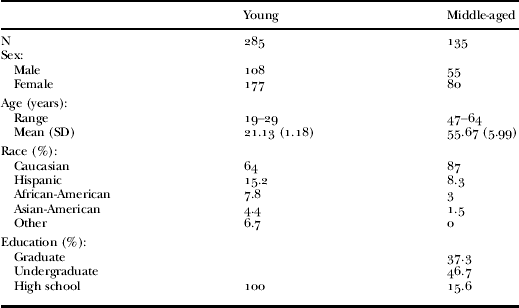
Invitations to complete two online surveys were sent to 398 young and 501 middle-aged adults. Among those, 346 young adults (87%) and 212 middle-aged adults (42%) started the survey, and 309 young adults (89%, ages 19–29) and 148 middle-aged adults (70%, ages 47–64) completed it. To ensure data quality, participants who dropped out in the second session, those who did not follow instructions and those who spent less than ten minutes or more than one hour on the survey were excluded.Footnote 1Table 1 presents demographic information for the final sample (N = 420).
Demographic composition of the sample by age group
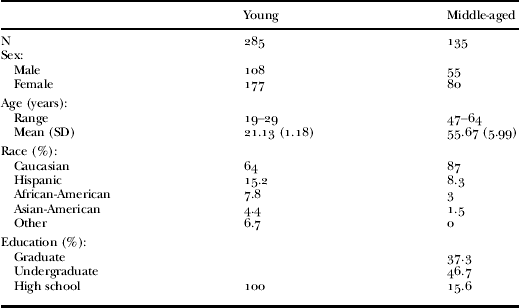
Notes: N = 420. SD: standard deviation.
The young adult sample was recruited from the Psychology Department's participant pool and received course credit. The middle-aged participants were compensated with a research-based handout on midlife development, and a small donation to one of two charities (their choice) was made on their behalf. They were accessed through the young adults who were invited to provide the researcher with names of up to two middle-aged individuals. Middle-aged participants were also invited to refer other middle-aged individuals. Given these procedures, we conducted analyses to demonstrate the independence of several groups in the sample, and found no dependency issues: to ensure that young adults who referred middle-aged adults were not different from those who did not refer, they were compared on major variables. Analyses of variance (ANOVAs) showed no differences, F ranges from 0.13 to 2.21, all p > 0.05. Similarly, middle-aged adults who referred others were not different from those who did not refer, F ranges from 0.22 to 2.01, all p > 0.05. Some young adults were related to some middle-aged adults, and some middle-aged adults were related to other middle-aged adults. ANOVAs examined whether pairs of related individuals were different from single individuals. A dummy variable for ‘group’ was created (entered as random factor) so that each group had a distinct code, as did single individuals. Groups did not differ on any variables, F ranges from 0.62 to 1.26, all p > 0.05.
Procedure
This research was approved by the Institutional Review Board at the university where it was conducted to ensure ethical treatment of participants. Participants were sent an e-mail including the link to the first survey (Surveymonkey.com) and were instructed to complete it within one week. When this was completed, they were sent the link to the second survey within 48–72 hours. Participants were asked to complete the surveys in a quiet location and told that they needed to complete each survey in one sitting. The choice to split the survey into two sessions was deliberate so that measures of psychological wellbeing and future time perspective did not influence one another. The first session included, in order of administration, the informed consent, the Psychological Well-Being Scale (Ryff Reference Ryff1989a) and the demographic items. In the second session, individuals completed two future time perspective measures. Administering measures across two sessions also helped prevent participants from becoming bored or tired while completing the survey.
In order to ensure data quality in this online survey format, participants were instructed to report technical problems such as a program error to the experimenter (e.g. Nosek, Banaji and Greenwald Reference Nosek, Banaji and Greenwald2002). Scales were broken into multiple short pages to prevent technical problems such as pages not loading due to length. To ensure that individuals were reading all the items and responding to each, foil items were embedded in the survey (e.g. items that give instructions such as “Answer ‘Strongly agree’ for this item”). Those who incorrectly answered more than two foils were excluded.
Measures
Psychological Well-Being Scale
This 54-item scale (Ryff Reference Ryff1989a) consists of six dimensions of psychological wellbeing: self-acceptance, positive relations with others, autonomy, environmental mastery, purpose in life and personal growth. Participants rated all items on a Likert-type scale ranging from 1 (‘strongly disagree’) to 8 (‘strongly agree’) (six subscales' Cronbach's alphas = 0.75–0.90).
Future time perspective measures
Two measures were used: the Rappaport Time Line is a straightforward measure of time perspective that represents one's subjective sense of time lived and time left to live. The Future Time Perspective Scale (FTPS; Carstensen and Lang 1996) also assesses subjective time left, but additionally includes one's feelings about the future. The correlation between the two measures was moderate, as they assess somewhat different aspects of future time perspective, r(417) = 0.53, p < 0.05.
For the Rappaport Time Line (Rappaport, Enrich and Wilson Reference Rappaport, Enrich and Wilson1985), participants receive a horizontal line representing their life. At the beginning of the line is the word ‘birth’ and at the end of the line is the word ‘death’. Participants respond by clicking a ‘where I am now’ point on the line to indicate their place in the lifespan. On Carstensen and Lang's (Reference Carstensen and Lang1996) FTPS, participants provide ratings from 1 (‘very untrue’) to 7 (‘very true’) for ten items such as ‘Many opportunities await me in the future’ (Cronbach's alpha = 0.89). In both measures, higher scores indicate a more open-ended sense of the future.
Background measures
These measures include demographics and a current perceived health status question rated on a six-point scale ranging from 1 (‘very poor’) to 6 (‘very good’): ‘Compared to other people my age, I consider my health to be …’ (Maddox Reference Maddox1962).
Results
Preliminary analyses
A preliminary multivariate analysis of variance (MANOVA) was run with race and sex entered as the independent variables, and the six psychological wellbeing dimensions as the dependent variables. Results showed that race had no effect on the dependent variables, F(24, 1372) = 1.5, p > 0.05. In contrast, sex had a main effect on psychological wellbeing, F(6, 340) = 2.30, p < 0.05, ηp2 = 0.04. Women had higher levels of positive relations and purpose in life than men, t = 2.06 and 2.13, respectively, all p < 0.05. Thus, sex was entered as a covariate in all major analyses. The interaction between sex and race was non-significant, F(24, 1372) = 0.72, p > 0.05.
A 2 × 2 ANOVA showed no age group or sex differences in self-reported health, F ranges from 0.86 to 2.44, all p > 0.05. Pearson's correlations were conducted between health and the two future time perspective variables. Results showed that self-reported health was significantly related to only the Future Time Perspective Scale, r(415) = 0.20, p < 0.001 (for Rappaport Time Line, r = − 0.05, p = 0.32). Pearson's correlations between health and the six psychological wellbeing dimensions were all positive and significant, r ranges between 0.18 and 0.37, all p < 0.001. Thus, self-reported health was also entered as a control variable in all major analyses. Finally, we did not expect age group to moderate the relation between future time perspective and psychological wellbeing, and conducted analyses that showed no moderation effects.Footnote 2
Rationale for major analyses
Hypotheses were tested using mediation analyses that detect suppression, rather than using multiple regression analyses. We expected chronological age and future time perspective to have opposing effects on psychological wellbeing (opposite signs of the direct and the indirect effects of age group). Using regression analyses would merely examine the impact of chronological age and future time perspective on psychological wellbeing. It would not capture their effects as opposing forces on psychological wellbeing. Suppression is indicated when the direct and the indirect effects of an independent variable (IV) on a dependent variable (DV) have opposite signs (Shrout and Bolger Reference Shrout and Bolger2002). Since this is exactly the scenario we conceptualised for the relation of age group, future time perspective and psychological wellbeing, this analysis was chosen as most appropriate for testing the study aims. Thus, Preacher and Hayes' (Reference Preacher and Hayes2004) innovative, non-parametric bootstrapping method of mediation analysis for detecting suppression/mediation was used. Specifically, analyses employed Hayes' (Reference Hayes2012) latest computational tool (i.e. PROCESS, freely available for SPSS) that integrates many statistical tools for mediation/suppression analysis.
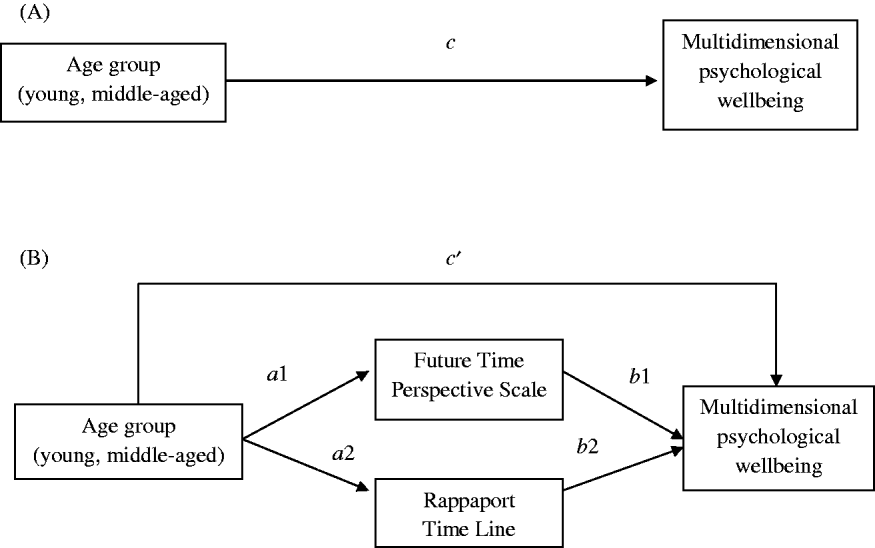
Figure 1 depicts the general model used in all analyses, illustrating the hypothetical paths through age group, the two measures of future time perspective and psychological wellbeing. The model specifies the relations between the IV, DV and the intervening variables (MacKinnon Reference MacKinnon2008). It can reveal suppression, mediation or no relation between variables in specified models (Shrout and Bolger Reference Shrout and Bolger2002). As mentioned before, suppression is indicated when the direct and the indirect effects of an IV on a DV have opposite signs. It also occurs when the magnitude of the direct effect becomes larger than the total effect after the addition of the mediating variable(s) (Davis Reference Davis1985; MacKinnon, Krull and Lockwood Reference MacKinnon, Krull and Lockwood2000). Suppressors are not often the focus of investigation, but in fact are extremely informative: they suppress the variance in the IV that is irrelevant to the prediction of the DV, thereby enhancing the predictive power of the IV (Tabachnick and Fidell Reference Tabachnick and Fidell2001).
(A) Direct effect of an independent variable (IV) on a dependent variable (DV); (B) indirect effect of IV on DV through mediators/suppressors.

Findings
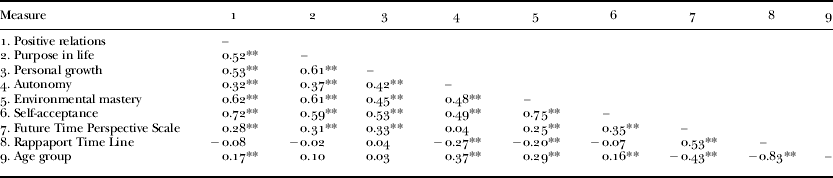
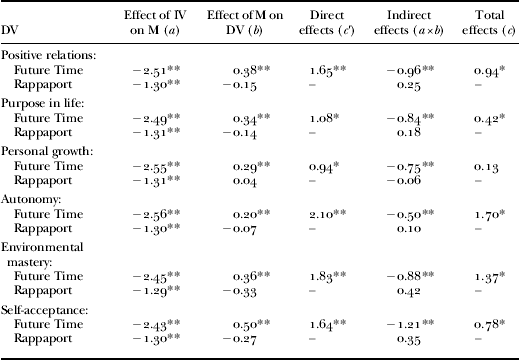
Separate models for each dimension of psychological wellbeing were run in which the FTPS and the Rappaport Time Line were entered simultaneously as multiple suppressors (see Table 3). The estimates are based on 5,000 bootstrap re-samples. Bias-corrected 95 per cent confidence intervals were computed.Footnote 3 Point estimates of indirect effects were considered significant when zero was not contained in their confidence intervals (Hayes Reference Hayes2012). Pearson's correlations are reported in Table 2 for all variables included in analyses.
Pearson correlation coefficients between dimensions of psychological wellbeing, the Future Time Perspective Scale, the Rappaport Time Line and age group
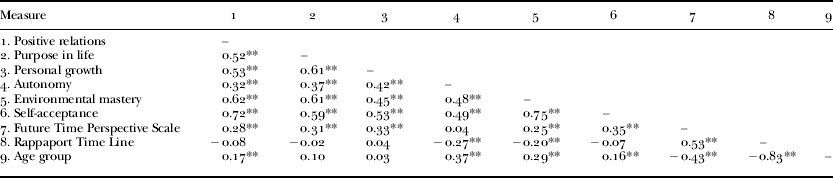
Note: Age group is a categorical variable with levels: 1 = young, 2 = middle-aged.
Significance level: **p < 0.001.
Future Time Perspective Scale and Rappaport Time Line as multiple mediating variables between age group and dimensions of psychological wellbeing
Notes: Based on 5,000 bootstrap samples. DV: dependent variable. IV: independent variable (i.e. age group). M: mediating variable (i.e. Future Time Perspective Scale, Rappaport Time Line). Sex and perceived health were entered as covariates in all models. For the six models, R 2 values range between 0.18 and 0.31, all p < 0.001.
Significance levels: * p < 0.05, ** p < 0.001.
Supporting Hypothesis 1, age group was negatively associated with the FTPS and the Rappaport Time Line (a weights in Table 3). Largely supporting Hypothesis 2, being in midlife was positively associated with five of the six dimensions of psychological wellbeing: self-acceptance, sense of positive relations, autonomy, environmental mastery and (predicted to be similar across age groups) purpose in life (c weights in Table 3). As expected, young and middle-aged adults showed similar levels of personal growth. For descriptive purposes, Table 4 presents means and standard deviations for the future time perspective measures and dimensions of psychological wellbeing by age group.
Descriptive statistics for the two future time perspective measures and psychological wellbeing in young and middle-aged adults
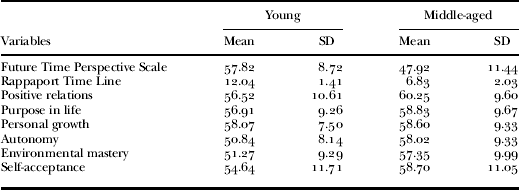
Notes: SD: standard deviation. Maximum score for the Future Time Perspective Scale = 70. Maximum score for Rappaport Time Line = 15. Maximum score for psychological wellbeing subscale = 72 (nine items per subscale on eight-point scales).
Independent of age group, a more open-ended future time perspective was expected to be related to positive psychological wellbeing on all dimensions (Hypothesis 3). Results showed that only the FTPS predicted all six psychological wellbeing dimensions, whereas the Rappaport Time Line (b weights in Table 3) predicted none of them.Footnote 4 This suggests that FTPS attenuates the effect of the Time Line, as it is a broader measure that encompasses sense of position in the lifespan (also assessed by the Time Line), but additionally measures one's sense of opportunities in the future. In sum, the third hypothesis was supported.
The final hypothesis was built on the first three, predicting that increased chronological age and decreased future time perspective would have simultaneous, opposing effects on psychological wellbeing. That is, future time perspective was expected to be a significant suppressor in the path between age group and psychological wellbeing. The suppression effect was tested by examining whether the direct effect of age group on psychological wellbeing (weight c′) and the indirect effect of age group through the two future time perspective variables (weights a×b) had opposite signs.
The model revealed specific indirect effects separately for the two future time perspective variables, and a total indirect effect for these variables as a set. In terms of specific indirect effects, when the FTPS and the Rappaport Time Line were analysed simultaneously, only the indirect effects through the FTPS were significant (weights a×b in Table 3): confidence intervals for the point estimates of these indirect effects (through FTPS) on the six dimensions of psychological wellbeing did not contain zero. In addition, the model conducted normal theory tests (i.e. Sobel tests; Sobel Reference Sobel and Leinhardt1982) for the specific indirect effects and showed that only the indirect effects through the FTPS were significant, z ranges between −3.79 and −6.45, all p < 0.001. Finally, for all dimensions of psychological wellbeing, the indirect effects and direct effects had opposite signs indicating suppression, and representing the hypothesised opposing forces of age group and future time perspective on psychological wellbeing. FTPS was a suppressor in the effect of age group on all six dimensions.Footnote 5
In addition, the total indirect effect of age group on psychological wellbeing through the two future time measures (i.e. the specific indirect effect through the FTPS plus the specific indirect effect through the Time Line) was also calculated separately for the six wellbeing dimensions. While the specific indirect effects of age group were significant through the FTPS (not the Time Line) for all dimensions of psychological wellbeing, the total indirect effect of age group through the two measures was significant for only personal growth. The total indirect effect of age group on personal growth through the two measures was significant with a point estimate of −0.81, and a 95 per cent bias-corrected bootstrap confidence interval of −1.4781 to −0.1416 (point estimates of indirect effects are considered significant when zero was not contained in their confidence intervals; Hayes Reference Hayes2012). Thus, while the FTPS alone played the suppressor role in the path between age group and five dimensions of psychological wellbeing, the two time measures worked together as suppressors in the relation between age group and personal growth.
Finally, as expected with a suppression effect, after the addition of future time perspective into the model, the direct effect of age group on psychological wellbeing (weight c′) has a larger magnitude than its total effect (weight c in Table 3) for all six dimensions. That is, FTPS suppressed criterion-irrelevant variance in age group allowing age group to emerge as an even stronger predictor of psychological wellbeing than before. In sum, the fourth hypothesis was supported.
Discussion
The study examined the effect of perceived time left to live in relation to the widely studied effect of time since birth on psychological wellbeing in young and middle-aged adults. Based on previous empirical research and classic theories (e.g. Erikson Reference Erikson1959; Jung Reference Jung1933; Neugarten Reference Neugarten, Eisdorfer and Lawton1973), future time perspective was conceptualised as developmentally relevant to psychological wellbeing. The findings support our argument concerning the opposing roles of age group and future time perspective in the construction of psychological wellbeing. The results are discussed in more detail below.
Age findings concerning future time perspective were as predicted (Hypothesis 1). Individuals in midlife have a less open-ended future time perspective than young adults. The findings support theoretical claims that in midlife, individuals realise that there is now more life lived than left to live (Erikson Reference Erikson1959; Heckhausen Reference Heckhausen and Lachman2001; Neugarten Reference Neugarten and Neugarten1996); with age one realises that the future is limited (Fredrickson and Carstensen Reference Fredrickson and Carstensen1990; Helson and Soto Reference Helson and Soto2005) and holds fewer opportunities (Cate and John Reference Cate and John2007). This finding is important in showing that shifts in future time perspective occur as early as in midlife (current sample, mean age = 56) rather than only in late life (as emphasised theoretically and empirically in SST; Carstensen Reference Carstensen1995). Future research in this area might examine shifts in time across more fine-grained adult age groups (i.e. early versus late midlife, and into young-old, old-old and oldest-old phases). Given classic theory citing midlife as pivotal in the shifting of time perspective, future research might also provide in-depth analyses of individuals changing perceptions as they enter, live through and exit midlife (i.e. through longitudinal research across midlife).
The current findings also supported our expectation of midlife as a period of high psychological wellbeing (Hypothesis 2). Midlife appears to optimally combine the strengths that have been empirically associated with several adulthood life phases in previous work. That is, middle-aged adults show high levels of autonomy and environmental mastery, as well as maintaining high levels of characteristics associated with young adulthood (e.g. personal growth, purpose in life) and gaining and developing characteristics most commonly associated with late adulthood (i.e. positive relations with others, self-acceptance). The finding of higher reports of autonomy and environmental mastery in midlife than in young adulthood is consistent with previous research suggesting that middle-aged adults have the necessary autonomy and mastery skills to handle the stress, multiple tasks (e.g. sandwich generation; Riley and Bowen Reference Riley and Bowen2005), productivity demands and social responsibility requirements of this life phase (e.g. Heckhausen Reference Heckhausen and Lachman2001; Helson and Soto Reference Helson and Soto2005; Lachman, Ziff and Spiro Reference Lachman, Ziff, Spiro, Abeles, Gift and Ory1994). Beyond that, however, the current sample of middle-aged adults also provided ratings similar to young adults in terms of personal growth (e.g. Helson and Soto Reference Helson and Soto2005), and higher ratings than the young on purpose in life. Finally, the middle-aged group showed a pattern similar to those over 65 in previous studies, that is, higher levels of positive relations and self-acceptance than young adults. The self-acceptance findings are in line with research showing that discrepancies between the actual and the ideal self are greater for young adults than for middle-aged individuals (Okun, Dittburner and Huff Reference Okun, Dittburner and Huff2006). The finding of greater positive relations with others is consistent with research showing that middle-aged adults are more likely to focus on emotionally meaningful social goals (Fung, Carstensen and Lang Reference Fung, Carstensen and Lang2001). In sum, much ageing-related literature has focused on overall declines in biological and sensory-cognitive resources beginning in the second half of life (Baltes Reference Baltes1987, Reference Baltes1997; Staudinger, Marsiske and Baltes Reference Staudinger, Marsiske, Baltes, Cicchetti and Cohen1995). Note, however, that psychological wellbeing is a domain that does not seem subject to loss. Instead, midlife appears to be a time in which individuals are thriving.
The study findings also confirmed the expectation that having a longer perceived time left to live is associated with positive, not negative, psychological wellbeing (Hypothesis 3). Previous research has focused on different aspects of wellbeing such as life satisfaction, positive affect or lack of depression (Drake et al. Reference Drake, Duncan, Sutherland, Abernethy and Henry2008). We focused on multidimensional psychological wellbeing (Ryff Reference Ryff1989a) to expand this literature, but in particular to include a developmentally sensitive wellbeing measure in relation to a developmentally relevant construct, future time perspective. Note that the relation between the psychological wellbeing measure used in this study (Ryff Reference Ryff1989a) and traditional measures of wellbeing used in previous work is as would be expected. For example, Ryff (Reference Ryff1989b) has shown that the six dimensions of psychological wellbeing are positively related to life satisfaction, affect balance, internal locus of control and morale (i.e. sense of satisfaction with oneself), and are negatively associated with depression and external locus of control. Similarly, two other studies show that prominent indicators of wellbeing (i.e. happiness, life satisfaction, lack of depression) are linked with all dimensions of Ryff's psychological wellbeing scale (Ryff and Keyes Reference Ryff and Keyes1995; Ryff et al. Reference Ryff, Lee, Essex and Schmutte1994). These findings suggest that the psychological wellbeing measure used in the current research is a valid indicator of wellbeing as also assessed by other measures.
Our results showed that regardless of current age, positive psychological wellbeing is related to perceiving the future as open-ended and full of opportunity. In line with non-developmental research showing a positive association between future time perspective and a variety of general wellbeing measures (e.g. Yeung, Fung and Lang Reference Yeung, Fung and Lang2007), the current study shows that both young and middle-aged adults who have an open-ended, positive future time perspective experience higher levels of psychological wellbeing. Note that this is a different pattern than has been found for socio-emotional outcomes in later life using the SST framework (e.g. Carstensen Reference Carstensen1995). It is unclear why having an open-ended future time perspective should be positively related to psychological wellbeing, but negatively related to socio-emotional processes. Clearly, there are a variety of mechanisms, not a single mechanism, linking time perspective to psychological outcomes. The current findings, in tandem with future research, may help to further develop and refine theory in this area. For example, having an open-ended future time perspective may generally be related to positive psychological wellbeing, but when individuals are reminded that endings are in sight (as per manipulations based on SST research), they may try to improve emotion regulation through focusing on meaningful social interactions or goals in the face of this threat to their psychological wellbeing. To delineate these relations, future research might examine whether socio-emotional variables (e.g. emotion-oriented goals) act as mediators between future time perspective and psychological wellbeing at different points in the lifespan.
The current findings only demonstrate the relation of open future time perspective to positive psychological wellbeing in middle-aged and young adults. Related findings, however, suggest that the association between an open-ended future time perspective and enhanced psychological wellbeing should also be evident in older adults: decreases in future orientation or in optimism about the future has been longitudinally related to decreases in wellbeing in older adults (Kotter-Grühn and Smith Reference Kotter-Grühn and Smith2011). Another study (Kooij and Van de Voorde Reference Kooij and Van de Voorde2011) showed that, in older individuals, having a shorter future perspective was associated with decreased subjective health. In sum, middle-aged and younger individuals in the current sample, as well as older adults in previous literature, experience greater psychological wellbeing with more open-ended and optimistic future time perspective.
Opposing forces on psychological wellbeing: age and future time perspective
The major aim of the study was to demonstrate the opposing roles of time since birth and time left to live on psychological wellbeing (Hypothesis 4). As expected, based on our conceptualisation and on predicted findings from the first three hypotheses, findings show that increasing age and decreasing future time perspective (as occurs with age) have opposing effects on all dimensions of psychological wellbeing. While psychological wellbeing is higher in midlife, future time perspective (associated with psychological wellbeing) is higher in young adulthood. Thus, time lived and perceived time left to live act in opposition to create psychological wellbeing across adulthood.
Note that the FTPS (Carstensen and Lang Reference Carstensen and Lang1996), assessing feelings that the future is open-ended and offers opportunities, best demonstrated this effect. That is, the FTPS attenuated the effect of the Rappaport Time Line (Rappaport, Enrich and Wilson Reference Rappaport, Enrich and Wilson1985) and acted as the only suppressor for all six dimensions of psychological wellbeing. Subjective location in the lifespan by itself, as measured by the Rappaport Time Line, does shape several dimensions of psychological wellbeing (i.e. self-acceptance, personal growth, positive relations). An open-ended sense of the future in combination with optimistic feelings about the future (as assessed by the FTPS) is consistently related to all six dimensions of psychological wellbeing. In sum, these two aspects of perceived time left (i.e. an open-ended sense of the future in combination with optimistic feelings about it) are important factors, along with chronological age, in the construction of psychological wellbeing in adulthood.
Chronological age does play a unique role, however. The statistical models demonstrate that when optimistic future orientation is accounted for, the relative benefit of time since birth (i.e. chronological age) emerges even more strongly. That is, being in midlife is an advantage to psychological wellbeing, but middle-aged adults' less open-ended future time perspective works against them, reducing the positive effects of age. Potentially, then, middle-aged adults who are able to maintain an open-ended view of the future, regardless of the objective reality that their time left to live is becoming shorter, will maintain the highest levels of psychological wellbeing. This interpretation is in line with researchers who suggest that future time perspective can be considered one form of self-regulation, and that even very old adults can use an open and positive future perspective as a buffer to maintain wellbeing (e.g. Kotter-Grühn and Smith Reference Kotter-Grühn and Smith2011).
In comparison with middle-aged adults, young adults have lower psychological wellbeing across five dimensions. For young adults, the same opposing forces of age and future time perspective are evident (i.e. age is not a moderator of the relation between future time perspective and psychological wellbeing), but these forces manifest differently due to young adults' actual place in the lifespan. Young adults gain from having a more open-ended, positive view of the future, but lack the psychological wellbeing associated with a more advanced age. While those in midlife can change their subjective perceptions about the future (e.g. through self-regulation, Kotter-Grühn and Smith Reference Kotter-Grühn and Smith2011; subjective appraisal of available resources, Martin and Westerhof Reference Martin and Westerhof2003; secondary control, Schulz and Heckhausen Reference Schulz and Heckhausen1996), young adults cannot change their chronological age. Instead, as previous research has shown (Ryff Reference Ryff1989a, Reference Ryff1991), it is growing older and growing up, potentially through gaining life experience (Clark-Plaskie and Lachman Reference Clark-Plaskie, Lachman, Willis and Reid1999) that bolsters one's positive relations with others, self-acceptance, sense of autonomy (Clarke et al. Reference Clarke, Marshall, Ryff and Rosenthal2000), environmental mastery and purpose in life (Staudinger and Kunzmann Reference Staudinger and Kunzmann2005).
Limitations
The current study had several limitations. First, recruiting individuals in midlife to participate in research is notoriously difficult (Nosek, Banaji and Greenwald Reference Nosek, Banaji and Greenwald2002). It is impossible to know if the obtained sample, though relatively large, is different from those who were invited but did not participate, or how representative they are of the middle-aged population. Also, though it is possible that those who did not participate were hindered by computer literacy, it is unlikely that a large percentage of middle-aged individuals are computer illiterate given current rates of computer ownership and literacy (e.g. the Pew Internet and American Life Project 2012 shows that 77 per cent of adults between ages 50 and 64 are actively using the internet). Note, however, that individuals not contacted to participate include those without e-mail addresses and such people may be unemployed or have lower socio-economic status, with concomitant effects on psychological wellbeing or future time perspective. For example, college-educated adults in midlife score higher on nearly every dimension of psychological wellbeing than high school-educated middle-aged adults (Markus et al. Reference Markus, Ryff, Curhan, Palmersheim, Brim, Ryff and Kessler2004). Our midlife sample was relatively highly educated and may have had higher wellbeing and a more open sense of future than the general middle-aged population. Obtained age differences are, however, in comparison with young adults who are attending university. Thus, education level might partially account for absolute levels of psychological wellbeing in midlife, but would not account for obtained age differences in time perspective or wellbeing.
The study employed a cross-sectional, correlational design (Schaie Reference Schaie1993). Effectively the study compares ‘baby boomers’ to ‘echo boomers’ (born approximately 1980–90). It is unclear whether or how cohort might be responsible for age group differences in reports of psychological wellbeing (echo boomers were lower on all dimensions) or in future time perspective (echo boomers were higher on both measures). Most crucial to the current research, however, both age groups/cohorts showed the same relations between these two central constructs. The obtained relationships need, however, to be investigated with a longitudinal design and a full adult lifespan sample (e.g. emerging adulthood, young adulthood, early midlife, late midlife, late life) to understand fully changes in the effects of time lived and time left to live across the adult lifespan. The current young adult sample is biased as it is a convenience sample (i.e. Psychology Department participant pool), and may not be representative of the non-college young adult population. Middle-aged and older adults who participate in research are also often college-educated. As such, future research should examine whether these effects hold in more heterogeneous young and middle-aged samples.
Future research might also manipulate future time perspective (e.g. Fung, Carstensen and Lutz Reference Fung, Carstensen and Lutz1999) to examine causal effects on psychological wellbeing. Some researchers discuss potential biases in testing mediation/suppression in correlational studies (e.g. Bullock, Green and Ha Reference Bullock, Green and Ha2010). As such, experimental designs could be used to test the suppression effects found in the current study through manipulating individuals' sense of future time perspective.
Finally, as self-reported health was not a major conceptual construct in the current research, it was measured with only a single item (Maddox Reference Maddox1962). With that measure, no effect of perceived health was evident in the models. Previous research, however, suggests that future time perspective may be influenced more by health status than by chronological age, such that age group differences in future time perspective disappear in chronically ill samples (e.g. Carstensen and Fredrickson Reference Carstensen and Fredrickson1998). For example, Stahl and Patrick (Reference Stahl and Patrick2011) also showed that older age was associated with a limited future time perspective (as measured by FTPS), but that perceiving greater functional limitations was also directly related to perceiving the remaining lifetime as limited. Future research, especially studies examining adult lifespan samples (e.g. including older adults) should more fully assess the role of both objective and subjective health status, and examine the moderating effect of health on the relations between age, time perspective and wellbeing outcomes.
Conclusions
Examining time in terms of both time lived and time left to live has provided a clearer picture of the construction of psychological wellbeing. The simultaneous, opposing forces of increased age and diminishing sense of the future as positive and open-ended are clearly at work in the construction of psychological wellbeing. One's age is both a fixed and a powerful predictor of psychological wellbeing. The extent to which individuals perceive their future as open-ended and offering opportunities is also, however, related to psychological wellbeing and is variable. Those in midlife have relatively high psychological wellbeing, but may need to work to construct and maintain an open-ended, positive sense of their future so as to optimise their high wellbeing levels as they enter late life. For young adults, the sense that an open-ended future full of opportunity lies ahead helps to boost psychological wellbeing during a developmental phase when it is relatively low. In sum, the way humans perceive, monitor or identify with time is a powerful and universal characteristic of the human experience. Time does not exist independently of the person, therefore this experience varies according to where one is in the lifespan and affects one's functioning accordingly.
Acknowledgements
This research was subject to the appropriate level of ethical review by the Institutional Review Board Office at the University of Florida (reference number UF IRB # 2009-U-911). There is no conflict of interest with any other parties. This research was supported in part by a Graduate Dissertation Award and a Jacquelin Goldman Fellowship from the Department of Psychology awarded to the first author.