Introduction
Personality disorders (PDs) are prevalent in the general population, with estimates ranging from 4% to 15% (Grant et al. Reference Grant, Hasin, Stinson, Dawson, Chou, Ruan and Pickering2004a; Coid et al. Reference Coid, Yang, Tyrer, Roberts and Ullrich2006; Lenzenweger et al. Reference Lenzenweger, Lane, Loranger and Kessler2007). The impact of PDs on public health is substantial (Tyrer et al. Reference Tyrer, Mulder, Crawford, Newton-Howes, Simonsen, Ndetei, Koldobsky, Fossati, Mbatia and Barrett2010). Individuals with a PD have higher rates of co-existing somatic health problems (Jackson & Burgess, Reference Jackson and Burgess2004; Moran et al. Reference Moran, Stewart, Brugha, Bebbington, Bhugra, Jenkins and Coid2007) and there is also high co-morbidity between PDs and the common mental disorders (CMDs) anxiety and depression (Jackson & Burgess, Reference Jackson and Burgess2000, Reference Jackson and Burgess2004; Coid et al. Reference Coid, Yang, Tyrer, Roberts and Ullrich2006; Lenzenweger et al. Reference Lenzenweger, Lane, Loranger and Kessler2007) and with substance use disorders (Grant et al. Reference Grant, Stinson, Dawson, Chou, Ruan and Pickering2004b; Moran et al. Reference Moran, Coffey, Mann, Carlin and Patton2006). The presence of co-morbid PD also seems to predict poorer treatment response for CMDs (Gorwood et al. Reference Gorwood, Rouillon, Even, Falissard, Corruble and Moran2010). The role of co-morbid CMD in relation to distress and functional impairment in PD is, however, unclear. Some studies have found independent effects of PDs on impairment at work, leisure and in social relationships, even after controlling for co-morbid CMD (Jackson & Burgess, Reference Jackson and Burgess2002; Skodol et al. Reference Skodol, Gunderson, McGlashan, Dyck, Stout, Bender, Grilo, Shea, Zanarini, Morey, Sanislow and Oldham2002). By contrast, one study found that, when controlling for CMD, the associations between PDs and functional impairment disappeared (Lenzenweger et al. Reference Lenzenweger, Lane, Loranger and Kessler2007) whereas others have concluded that the economic burden associated with PD is intimately affected by co-morbid CMD (Rendu et al. Reference Rendu, Moran, Patel, Knapp and Mann2002).
During the past 20 years, the rate of disability benefits (DBs) awarded for mental disorders has increased across the western world, and mental disorders are now the most common cause for DB claim in Great Britain (Cattrell et al. Reference Cattrell, Harris, Palmer, Kim, Aylward and Coggon2011). As there is very little reverse flow from receipt of DB into employment (OECD, 2010), being awarded a DB usually represents a permanent cessation of paid work. Although CMDs are increasingly recognized risk factors for work disability (Knudsen et al. Reference Knudsen, Øverland, Aakvaag, Harvey, Hotopf and Mykletun2010b), little is known about the effect of PDs on DBs. The prevalence of PDs in the population, the high co-morbidity between PD and somatic and other mental health problems, and the relative stability of functional impairments in PDs (Skodol et al. Reference Skodol, Pagano, Bender, Shea, Gunderson, Yen, Stout, Morey, Sanislow, Grilo, Zanarini and McGlashan2005), should make PDs particularly relevant with regard to occupational impairment and the receipt of DBs. Occupational impairment in PD has, however, usually been examined with a focus on employment status. More unemployment or part-time employment has been found among those with PD (Skodol et al. Reference Skodol, Gunderson, McGlashan, Dyck, Stout, Bender, Grilo, Shea, Zanarini, Morey, Sanislow and Oldham2002; Coid et al. Reference Coid, Yang, Tyrer, Roberts and Ullrich2006; Yang et al. Reference Yang, Cold and Tyrer2010), along with higher rates of ‘economic inactivity’ (Coid et al. Reference Coid, Yang, Tyrer, Roberts and Ullrich2006; Yang et al. Reference Yang, Cold and Tyrer2010). To our knowledge, only one study has specifically examined the effect of PDs on receipt of DBs (Korkeila et al. Reference Korkeila, Oksanen, Virtanen, Salo, Nabi, Pentti, Vahtera and Kivimaki2011), indicating that PD is a stronger risk factor for DBs than CMDs. This study was, however, based on a clinical population and knowledge about the relationship between PDs and the receipt of DBs in the general population is limited.
In the current study, using data from the British National Survey of Psychiatric Morbidity carried out in 2000, we set out to examine the cross-sectional associations between PD and DB receipt. Specifically, we aimed to investigate whether the potential association between PD and DB was influenced by co-morbid CMDs. Finally, we wanted to examine whether the strengths in the associations with DBs differed between PD alone, CMDs alone and co-morbid PD and CMDs.
Method
Study sample
The second British National Survey of Psychiatric Morbidity was carried out by the Office for National Statistics (ONS) in 2000 and assessed people aged 16 to 74 years living in private households in England, Scotland and Wales (Singleton et al. Reference Singleton, Bumpstead, O'Brien, Lee and Meltzer2000). The sample was drawn in a two-stage process using the Royal Mail's small-user postcode addresses. Postcode sectors were initially stratified according to socio-economic profiles within region, giving 438 sectors selected with a probability proportional to size. Thirty-six addresses within each region were then randomly selected for inclusion in the survey. Interviewers visited each address, and one member of the household aged 16 to 74 years was randomly selected for interview using the Kish grid method (Kish, Reference Kish1965). A more detailed description of the sampling procedure is provided in the survey's technical report (Singleton et al. Reference Singleton, Lee and Meltzer2002). Computer-assisted structured interviews, lasting on average 1.5 h, were conducted by the ONS interviewers. A total of 8850 adults completed the interview, representing a response rate of 67%.
Exposures: probable PD
Probable cases of PD according to DSM-IV criteria were identified using the screening questionnaire of the Structured Clinical Interview for DSM-IV Personality Disorders (SCID-II; First et al. Reference First, Gibbon, Spitzer, Williams and Benjamin1997). The participants gave ‘yes’ or ‘no’ responses to 116 questions measuring lifetime experiences of PD symptoms. Individual categories of DSM-IV PDs and the aggregation of the individual PD categories into three commonly used clusters were generated using algorithms developed in a previous survey (Singleton et al. Reference Singleton, Meltzer, Gatward, Coid and Deasy1998; Ullrich et al. Reference Ullrich, Deasy, Smith, Johnson, Clarke, Broughton and Coid2008). The algorithms developed in the previous survey used thresholds developed to reduce the number of false positives in the identification of a ‘probable’ PD case. The thresholds were thus manipulated to identify the best possible agreement between the SCID-II screening questionnaire and the SCID-II diagnostic interview, with a final model showing moderate sensitivity and specificity (Singleton et al. Reference Singleton, Meltzer, Gatward, Coid and Deasy1998; Ullrich et al. Reference Ullrich, Deasy, Smith, Johnson, Clarke, Broughton and Coid2008). This was considered adequate for the purpose of identifying a probable PD case (Singleton et al. Reference Singleton, Meltzer, Gatward, Coid and Deasy1998). Sensitivity and specificity between the SCID-II screening questionnaire and the SCID-II diagnostic interview based on these algorithms have previously been calculated for the individuals participating in the current study, and showed the following values (sensitivity/specificity): paranoid PD: 0.71/0.86; schizoid PD: 1.00/0.83; schizotypal PD: 1.00/0.93; histrionic PD: −/1.00; narcissistic PD: −/1.00; borderline PD: 0.62/0.94; antisocial PD: 0.80/0.88; avoidant PD: 0.79/0.93; dependent PD: 0.67/0.97; and obsessive–compulsive PD: 0.83/0.88 (Coid et al. Reference Coid, Yang, Bebbington, Moran, Brugha, Jenkins, Farrell, Singleton and Ullrich2009). Subjects with 10 or more PD criteria who did not fulfil the criteria for any of the individual PD categories were included in the reference groups.
The grouping of the individual categories of PDs into three clusters was carried out in accordance with DSM-IV (APA, 1994): Cluster A consisted of the Paranoid, Schizoid and Schizotypal categories, Cluster B consisted of the Histrionic, Narcissistic, Borderline and Antisocial categories, and Cluster C included the Avoidant, Dependent and Obsessive-Compulsive categories. An individual could score above threshold on several individual PD categories, and neither the individual PD categories nor the three clusters were treated as mutually exclusive groups. Co-morbidity between multiple PDs was not examined specifically in the current study.
Outcome: DBs
In this study, receipt of DBs was assessed by self-reported positive response on question of receipt of any of the following types of DBs: Incapacity Benefit, Severe Disability Allowance and related allowances, and Industrial Disablement Benefit. In the UK, DBs can be granted to individuals within working age, 16 to 64 years. Incapacity Benefit and Severe Disablement Allowance can be awarded to people under retirement pension age who are incapable of work due to illness or disability (Directgov, 2011a, c). Industrial Disablement Benefit is granted if the individual was employed in a job that caused the disability or disease (Directgov, 2011b).
Potential covariates
Covariates in the current study were selected a priori, based on associations with the exposure (PD) and outcome (DBs) shown in previous literature. Sociodemographic variables (age, gender, ethnic group, marital status and educational qualifications) were based on self-reported information from the participants. Participants were asked about which ethnic group they considered themselves to belong in, and because cell sizes were small for non-white individuals we dichotomized this variable into ‘white’ and ‘non-white’ categories. Marital status was dichotomized as ‘married’ versus ‘non-married’, and information about highest educational qualification achieved was divided into ‘no qualifications’ and ‘GCSE levels or above’ (GCSE is General Certificate of Secondary Education). The variable ‘living area’ was based on interviewer observations, in this study coded as ‘semi-rural or rural’ and ‘urban’.
The revised version of the Clinical Interview Schedule (CIS-R; Lewis et al. Reference Lewis, Pelosi, Araya and Dunn1992) was administered to all participants and standard procedures were used to derive the presence of any CMD. The CIS-R is composed of 14 sections that correspond to 14 symptoms usually experienced with CMD. Specific combinations of these sections can provide data on presence of ICD-10 disorders within the mental disorder categories Mood (Affective) Disorders and Neurotic Disorders. Finally, the score of the individual sections can be summarized, giving an indication of symptom severity (Singleton et al. Reference Singleton, Lee and Meltzer2002). A CMD case in CIS-R is defined as a total score of ⩾12. Previous studies have demonstrated a dose–response association between CMDs and DBs (Knudsen et al. Reference Knudsen, Øverland, Aakvaag, Harvey, Hotopf and Mykletun2010b); therefore, three symptom-level categories based on the total CIS-R score were defined in the current study: no case (0–11), case (12–17) and high symptom case (⩾18) (McManus et al. Reference McManus, Meltzer, Brugha, Bebbington and Jenkins2009).
In addition to CMDs, two clinical variables were included. The ‘number of long-standing illnesses’ reported by the participants was categorized into an ordinal variable ranging from 0 to 6, with more than six long-standing illnesses truncated into the last category. Substance use was defined by ‘hazardous drinking’ and was assessed using the Alcohol Use Disorder Identification Test (AUDIT) and applying the standard case-definition of a score of 8 or above (Babor et al. Reference Babor, de la Fuente, Saunders and Grant1992) and self-reported ‘lifetime use of illegal drugs’ (Yes/No).
Ethical approval
Ethical approval was given by the London Multi-Centre Research Ethics Committee and all relevant local ethics committees were informed. Written informed consent was obtained from all participants in the survey. Additional ethical approval was not required for this secondary data analysis.
Statistical analyses
Prior to the analyses, individuals not responding to the SCID-II questionnaire (n = 206) and individuals with missing responses on other included covariates (n = 49) were excluded. Furthermore, we aimed to include only individuals who were truly at risk for DBs, defined as those likely to have completed their education and not being age retired. Thus individuals below age 25 (n = 783) or above age 64 (n = 1201) were excluded. The final study sample consisted of 6341 individuals, 73.9% of all survey participants.
Standard weighting procedures were used in all analyses to account for the stratified, clustered sample and survey non-response to ensure that the results were nationally representative (Singleton et al. Reference Singleton, Lee and Meltzer2002). The distribution of the different sociodemographic, clinical characteristics and PDs among the total sample and the group of DB recipients are presented as unweighted numbers (n) and as weighted proportions (%) with 95% confidence intervals (CIs), and means with 95% CI where appropriate. The differences in characteristics among recipients and non-recipients of DBs are presented with p values derived from χ2 tests and independent t tests. The difference in number of PD symptoms, defined as the sum of PD criteria in SCID-II, between recipients and non-recipients of DBs were examined using the gender- and age-adjusted linear regression coefficient.
Analyses of association between probable PD and DBs were conducted on three levels: individual PD categories (e.g. Paranoid PD), the three PD clusters, and any PD (defined as scoring above threshold on at least one individual PD category). The reference groups were participants screening negative for the PD level being examined. Analyses of individual PD categories and PD clusters were conducted using simple logistic regression with the results presented as odds ratios (ORs). Logistic regression models were then used to examine the association between any PD (age and gender adjusted) and DBs, with cumulative block-wise adjustments for the potential covariates. The adjustment order of the blocks was determined a priori, with the blocks consisting of (i) sociodemographic characteristics (ethnic group, living area, marital status and educational qualifications), (ii) number of long-standing illnesses, (iii) CMD and (iv) substance use (hazardous alcohol consumption and ever used any illegal drug). The proportion of reduced effect size when adjusting for the potential covariates was calculated using the following formula:
 $${\rm Percentage\ reduced\ effect\ size\ } \equals 1 \minus {{\ln \lpar {\rm adjusted\ OR}\rpar } \over {\ln \lpar {\rm unadjusted\ OR}\rpar.}}$$
When comparing the relative strengths of the associations between PD, CMDs and DBs, four groups were created: neither PD nor CMD (reference group), PD only, CMD only, and co-morbid PD and CMD. CMD was defined as a score of ⩾12 on CIS-R. Logistic regression analyses with block-wise cumulative adjustment for sociodemographic factors, number of long-standing illnesses and substance use were then used and proportions of reduced effect size were calculated for all blocks. Finally, we tested for interaction between PD and CMD on the receipt of DBs using the Likelihood Ratio Test. All analyses were carried out using Stata for Windows, version 11.0 (StataCorp, 2009).
Results
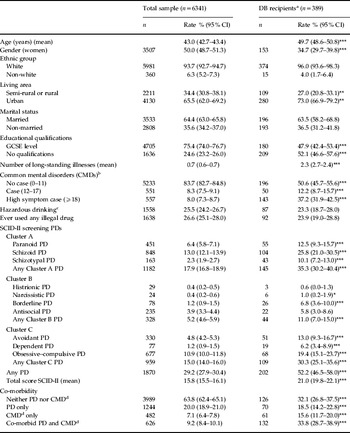
Of the total sample, 389 (weighted prevalence 5.6%) were receiving DBs at the time of the survey. The sociodemographic and clinical characteristics of the total sample and of DB recipients are presented in Table 1. In the total sample, the prevalence of any probable PD was 29.2% (95% CI 27.9–30.4) (Table 1), with Cluster A (17.9%) being the most common cluster. The commonest individual PD categories were Schizoid PD (13.0%), followed by Obsessive–Compulsive PD (10.9%) and Paranoid PD (6.4%).
Unweighted numbers (n) and weighted rates and means of sociodemographic and health characteristics, and prevalence of personality disorders (PDs) in the total population sample and among disability benefit (DB) recipients (5.6%). Age span 25–64 years

CI, Confidence interval.
a Test of difference between recipients and non-recipients of DBs.
b Total score on the Clinical Interview Schedule – Revised (CIS-R).
c Alcohol Use Disorder Identification Test (AUDIT) score >8.
d Total score ⩾12 on the CIS-R.
* p < 0.05, ** p < 0.01, *** p < 0.001.
The prevalence of PD among DB recipients was significantly higher than among non-recipients, except for the individual categories Histrionic PD and Antisocial PD (Table 1). More than half of the DB recipients (52.2%) screened positive for at least one PD. Cluster A was the most common cluster (35.3%), and the three commonest individual PD categories were: Schizoid PD (25.8%), Obsessive–Compulsive PD (19.4%) and Avoidant PD (13.0%). There were also significantly more PD symptoms among those receiving DBs (mean score 21.0, 95% CI 19.8–22.1, p < 0.001). The presence of CMD alone (15.6%) was also higher among DB recipients than non-recipients, as was co-morbid PD and CMD (33.8%), both p < 0.001 (Table 1). Those receiving DBs were also significantly older, more often men, living in urban areas, had lower education, and had a higher number of long-standing illnesses (all p < 0.01) (Table 1). Ethnic origin, marital status and substance use were not associated with DB status (all p > 0.05) (Table 1).
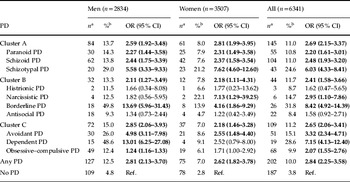
The unadjusted associations between the individual PD categories, the PD clusters and any PD and DB status, both gender stratified and for the total sample, are summarized in Table 2. The prevalence of DBs in the individual PD categories ranged from 8.4% to 31.8% and the prevalence in the PD clusters was 11%. In total, 10.0% of individuals with a PD were receiving DBs compared to 3.8% among individuals screening negative for PD (Table 2), yielding an unadjusted OR of 2.84 (95% CI 2.25–3.58). All of the clusters were significantly associated with DBs, with ORs ranging from 2.41 to 2.69 and little difference between effect sizes. For both genders, all of the individual PD categories were significantly associated with DBs, with the exception of Histrionic PD and Antisocial PD. In addition there were no associations between Dependent PD and Obsessive–Compulsive PD and DB among women and Narcissistic PD among men (Table 2). For many of the non-significant associations the cell sizes were small and CIs very wide. The strongest associations between individual PD categories and DBs were found for Borderline PD (OR 8.42, 95% CI 4.92–14.39), followed by Dependent PD (OR 7.15, 95% CI 4.13–12.40) and Schizotypal PD (OR 6.03, 95% CI 4.33–8.41).
Weighted proportions of disability benefit (DB) within each personality disorder (PD) category, and clusters, and unadjusted weighted associations between PD and DB in men, women and total sample. Associations estimated by logistic regression

OR, Odds ratio; CI, confidence interval; Ref., reference.
a Unweighted number of individuals within PD group receiving DBs.
b Weighted proportions of DBs within PD group.
Significant associations highlighted in bold.
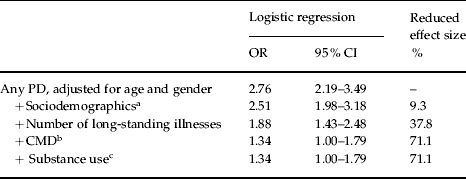
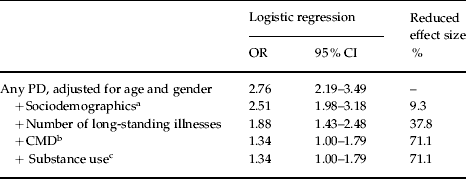
Adjusting for sociodemographic factors had little effect on the association between any PD and DBs (Table 3). However, further cumulative adjustments for the number of long-standing illnesses reduced the association from OR 2.51 to 1.88, equivalent to a 37.8% reduction of effect size. The association was further reduced to OR 1.34 when adding CMDs, reducing 71.1% of the initial effect size (Table 3). Adding substance use to the model did not alter the association, leaving a final fully adjusted OR of 1.34 (95% CI 1.00–1.79).
Weighted associations between any personality disorder (PD) and disability benefits (DBs), with cumulative adjustments for potential covariates and proportions of reduced effect size. Associations estimated by logistic regression analyses
CMD, Common mental disorder; OR, odds ratio; CI, confidence interval.
a Ethnic group, living area, marital status, educational qualifications.
b Grouped using the Clinical Interview Schedule – Revised (CIS-R) as no case (0–11 ), case (12–17 ) and high symptom case (⩾18).
c Alcohol Use Disorder Identification Test (AUDIT) score >8 and ever used any illegal drug.
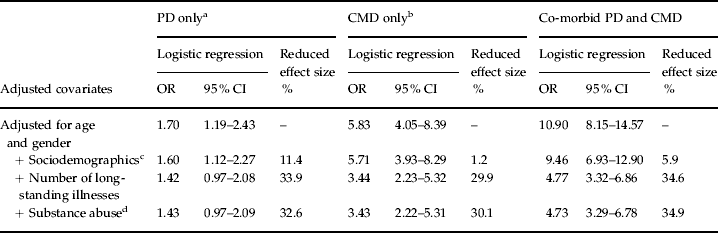
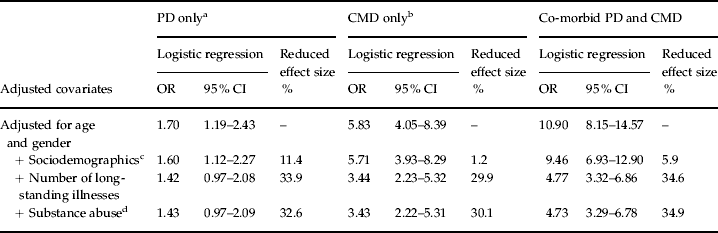
When stratifying the analysis according to presence or absence of PD and CMD, PD without co-morbid CMD was not significantly associated with DBs after adjusting for long-standing illnesses (Table 4). By contrast, CMDs without PD showed significant associations with DBs also when fully adjusted (OR 3.43, 95% CI 2.22–5.31). The strongest effect on DBs was found among the individuals with co-morbid PD and CMDs, with an unadjusted OR of 10.90 (95% CI 8.15–14.57) (Table 4). Fully adjusted, there was no significant difference between co-morbid PD and CMD (OR 4.73, 95% CI 3.29–6.78) and CMD only (OR 3.43, 95% CI 2.22–5.31). There was no evidence for an interaction effect between PD and CMD on the association with DBs (p = 0.97).
Weighted associations between personality disorder (PD) only, common mental disorder (CMD) only and co-morbid PD and CMD and disability benefits (DBs). Cumulative adjustments for potential covariates and proportions of reduced effect size. Individuals with neither PD nor CMD used as reference group. Associations estimated by logistic regression analyses
a Case-level on any PD in SCID-II screening questionnaire.
b Case-level CMD defined as score ⩾12 on the Clinical Interview Schedule – Revised (CIS-R).
c Ethnic group, living area, marital status, educational qualifications.
d Alcohol Use Disorder Identification Test (AUDIT) score >8 and ever used any illegal drug.
No interaction found between PD and CMD (p = 0.97).
Discussion
In this large, nationally representative sample, we found that presence of any probable PD, all three PD clusters and the majority of the individual PD categories were associated with receipt of DB. Adjusting for sociodemographic factors had little impact on the association between PD and DBs. The association was, however, substantially weakened when adjusting for CMD. In addition, we found that compared to PD only, CMD only and co-morbid PD and CMD showed significantly stronger associations with DBs.
To the best of our knowledge this is the first population-based study examining the association between PD and DBs, and investigating the impact of CMD. The study has several strengths. The population-based approach allowed us to study the association of interest with less risk of selection bias and greater generalizability than clinical studies. The large sample provided sufficient statistical power to examine exposures and outcomes that are relatively rare in the community. The use of standard weighting procedures increased the representativeness to households in Great Britain (Singleton et al. Reference Singleton, Lee and Meltzer2002). The wealth of information gathered in the survey allowed us to control for several sociodemographic and health-related variables that could be potential confounders or mediators in the association between exposure and outcome. Finally, the SCID-II screening questionnaire is a well-established instrument for assessing personality pathology in the population, with good psychometric properties (First et al. Reference First, Spitzer, Gibbon and Williams2002).
The findings also need to be considered in the light of certain limitations. First, despite the properties of the SCID-II screening questionnaire being considered adequate for the purpose of detecting probable cases of PD (Singleton et al. Reference Singleton, Meltzer, Gatward, Coid and Deasy1998), it is not a diagnostic instrument. PD questionnaires in general are susceptible to over-reporting personality pathology (Zimmerman, Reference Zimmerman1994). Although second-stage SCID-II interviews were used in the survey, these were only carried out on a fraction of PD screen-positive and screen-negative cases to inform prevalence estimates, and the numbers were too small to analyse for our purposes here. Notwithstanding these considerations, the screening version of SCID-II has been used in other publications based on the same dataset (Moran et al. Reference Moran, Stewart, Brugha, Bebbington, Bhugra, Jenkins and Coid2007; Yang et al. Reference Yang, Cold and Tyrer2010) and screening questionnaires of PD have also been used in other population-based studies (Jackson & Burgess, Reference Jackson and Burgess2000). Second, there may be some criterion overlap between the exposure of PD and the outcome, DBs, as some questions in the SCID-II addresses work function directly. For example, DSM Avoidant PD includes the criterion ‘Have you avoided jobs or tasks having to deal with a lot of people?’ and Obsessive–Compulsive PD includes the criterion ‘Do you have trouble finishing jobs because you spend so much time trying to get things exactly right?’ These are, however, only two of the 116 questions asked, and we do not believe they would have unduly influenced the general findings in this study. Third, as the study used cross-sectional data, causality cannot be inferred. However, based on the assumption of PDs having their onset in adolescence or in early adulthood, it is likely that the PD preceded the receipt of DB and not vice versa. The direction of causality relating to CMD is more difficult to establish. Although CMD has been found to precede DBs (Knudsen et al. Reference Knudsen, Øverland, Aakvaag, Harvey, Hotopf and Mykletun2010b), long-standing illness and work-life exit are also likely to increase the level of mental health problems. Hence, inclusion of CMD in regression models may represent overadjustment. Finally, higher rates of non-participation in population-based health surveys among individuals most severely affected by a PD (Knudsen et al. Reference Knudsen, Hotopf, Skogen, Overland and Mykletun2010a) may lead to an underestimation of the true association between PD and DBs, as these individuals may be more prone to claim DBs.
The results from this study are in line with previous studies showing higher rates of individuals with a PD being non-employed. Although CIs were wide, the findings that borderline and schizotypal PD were those most strongly associated with DBs concurs with studies showing high functional impairment in these patient groups (Skodol et al. Reference Skodol, Gunderson, McGlashan, Dyck, Stout, Bender, Grilo, Shea, Zanarini, Morey, Sanislow and Oldham2002, Reference Skodol, Pagano, Bender, Shea, Gunderson, Yen, Stout, Morey, Sanislow, Grilo, Zanarini and McGlashan2005). The finding that antisocial PD was not associated with DBs was not anticipated, as previous studies have indicated high functional impairment among individuals with antisocial PD. Only 22 persons of the total sample of 6314 screened positive for antisocial PD, and therefore it is possible that we failed to detect an association as a result of not having sufficient statistical power. Other explanations for this finding include the fact that individuals with antisocial PD are less likely to participate in health surveys (selection bias), that they may have more difficulties in gaining and staying in long-term employment and are therefore less likely to earn DB rights, and that they are less likely to receive ongoing treatment by the health service and are therefore less likely to receive medical recommendations for the receipt of benefits.
Only one previous study has specifically examined associations between PD and DBs, and found that PD was a stronger risk factor for DBs than CMD (Korkeila et al. Reference Korkeila, Oksanen, Virtanen, Salo, Nabi, Pentti, Vahtera and Kivimaki2011). However, in that study, individuals with co-morbid anxiety or depression were included in the PD group, and hence their findings may be more comparable with the association we detected in individuals with co-morbid PD and CMD.
There may be several explanations for the finding that the effect of PD alone was substantially weaker than when PD was co-morbid with CMD. The most straightforward explanation is that the association between PD and disability is heavily confounded by CMD and that CMD is the real cause for exiting work. It is, however, more likely that CMD lies on a causal pathway between PD and the receipt of DBs. Application for DBs is dependent on contact with health professionals and individuals rarely consult their general practitioner (their main medical signatories for DBs) for problems relating primarily to their personality (Moran et al. Reference Moran, Rendu, Jenkins, Tylee and Mann2001). They do, however, consult frequently with symptoms of CMD (Moran et al. Reference Moran, Rendu, Jenkins, Tylee and Mann2001). Moreover, early personality pathology makes individuals more susceptible to developing later CMD (Tyrer et al. Reference Tyrer, Seivewright, Ferguson and Tyrer1992). It is therefore plausible that the reduction in effect size reflects a mediating effect from CMD in the causal pathway between PD and DB.
Historically, the categorization of PDs has attracted fierce criticism because they are heterogeneous and potentially stigmatizing constructs that co-occur extensively with other mental disorders, and personality pathology would probably be better represented dimensionally (Tyrer et al. Reference Tyrer, Crawford and Mulder2011). Certainly many of the features of CMDs overlap with those of the commonest PDs seen in clinical practice, and therefore it has been argued that CMDs could be ‘lumped’ together with abnormal personality (Tyrer, Reference Tyrer1985). Our findings suggest that PD has limited impact on occupational impairment in the absence of concurrent CMD and this adds weight to the argument that the classification of PDs needs reform.
The observed strong association between co-morbid PD and CMD and DBs suggests that personality dysfunction as measured by a screening questionnaire adds some value to the prediction of the association between CMD and occupational impairment. As CMDs are usually episodic rather than chronic conditions, we might speculate that when CMDs are associated with a long-lasting functional outcome such as work disability, this may be attributable to more pervasive difficulties, such as underlying personality pathology, rather than the level of distress itself. However, whether there is a difference in effects between CMD alone and co-morbid CMD and PD on DBs is difficult to examine in cross-sectional studies. Longitudinal studies with measures of both personality dysfunction and CMD are needed to establish the direction of causality and whether the joint effects of PD and CMD change over time.
Acknowledgements
R.S., S.B.H. and M.H. are funded by the National Institute for Health Research (NIHR) Specialist Biomedical Research Centre for Mental Health at the South London and Maudsley National Health Service (NHS) Foundation Trust and Institute of Psychiatry, King's College London.
Declaration of Interest
None.