Across nations and over time, scholars have consistently demonstrated that the state of the economy remains one of the most salient factors in elections (Singer Reference Singer2011). As a result, a large literature has focused on modeling the influence of economic factors on support for competing teams of political elites (for recent reviews of the literature on economic voting, see Hibbs Reference Hibbs2006; Anderson Reference Anderson2007; Stegmaier and Lewis-Beck Reference Stegmaier and Lewis-Beck2013). Although we now have a much better understanding of how the economy influences election outcomes, one key component of this theoretical picture that has been missing is the role of political elites in attempting to shape economic voting. Researchers of economic voting have assumed that political elites are either passive actors or actors whose efforts to shape economic voting cancel each other out and can thus be safely relegated to the error term in empirical models of voting behavior. In this paper, we relax and test this assumption by developing a model of elite emphasis on the economy during election campaigns.
We begin with a simple question: “what determines how much political parties talk about the economy during campaigns?” We develop a theoretical model of how economic conditions, government status, and ideological competition shape the emphasis on economic issues during campaigns. As economic conditions worsen, the economy eclipses other issues as the most important issue facing the nation at that time. As economic performance is closely tied to voters’ valence assessments of parties as well as electoral fortunes in general, all parties have an incentive to shift their focus to emphasizing the economy. The degree of party responsiveness to economic performance, however, depends on the party’s role in government and the strategies chosen by ideologically similar parties.
We first provide a brief overview of the relevant literatures, focusing on how they connect the salience of an issue to elite strategies of campaign emphasis. On a sample of 22 advanced democracies from 1957 to 2006, we test these theoretical expectations and present empirical findings that demonstrate the influence of economic conditions, government status, and spatial competition on party campaign strategies in advanced democracies. We then conclude with a discussion of the broader implications of our findings for theories of economic and valence voting, as well as a set of promising areas for future research.
Literature
There is a wealth of literature that addresses why parties emphasize certain issues at the expense of others (e.g., Carmines and Stimson Reference Carmines and Stimson1989; Petrocik Reference Petrocik1996). Prominent theories of issue saliency (Budge and Farlie Reference Budge and Farlie1983) and issue ownership (Petrocik Reference Petrocik1996) suggest that certain issues are “owned” by specific parties—meaning that the party is able to handle that issue better than other parties—and that parties will attempt to elevate these issues on the agenda through emphasis during campaigns. Other parties recognize that competing on these dimensions is a losing strategy, so they emphasize an entirely different issue where they perceive an electoral advantage. For these scholars, party competition can be characterized as one of “avoidance” rather than “engagement” (Sigelman and Buell Reference Sigelman and Buell2004).
Recent theories have questioned the prevalence of avoidance techniques and have provided evidence that parties often directly engage other parties on the same issues (e.g., Sigelman and Buell Reference Sigelman and Buell2004). As economic conditions worsen, they become more salient in the political landscape: “Either a slowdown of growth or an increase in unemployment results in more citizens saying that the economy is important. Volatile economies also seem to heighten voter uncertainty and increase their attention to economic issues” (Singer Reference Singer2011, 301; see also Singer Reference Singer2013). For those issues with a high degree of salience, such as a poorly performing economy, parties feel pressure from mass media and their own supporters to face these issues head on (Green-Pedersen and Mortensen Reference Green-Pedersen and Mortensen2010). Even if an issue might be “owned” by another party (e.g., Petrocik Reference Petrocik1996), “the actual state of the world may make certain issues unavoidable” (Budge and Farlie Reference Budge and Farlie1983, 129). Thus, vote-maximizing parties cannot afford to ignore these salient economic issues: “to try to do so is to risk failing to make an appeal to new voters and to dishearten older supporters by displaying the party’s irrelevance to modern developments” (Klingemann, Hofferbert and Budge Reference Klingemann, Hofferbert and Budge1994, 29).
These studies suggest that elites have a wide range of potential strategies available when confronting issues of limited salience to the electorate (e.g., Green and Hobolt Reference Green and Hobolt2008). Economic performance is likely unique in this respect. When economic performance is poor, avoiding the issue seems like a risky strategy for two reasons. First, “it is virtually a universal belief among politicians, political commentators, and even voters that elections are referenda on the economy” (Duch and Stevenson Reference Duch and Stevenson2008, 1). Without directly engaging the opponent on matters of high salience, the party gives up the ability to prime the issue in voters’ minds (Lenz Reference Lenz2012) and structure the debate in a favorable way (Jerit Reference Jerit2008). Given the clear connection between economic performance and electoral fortunes (Powell and Whitten Reference Powell and Whitten1993; Anderson Reference Anderson1995; Duch and Stevenson Reference Duch and Stevenson2008), we would expect that both opposition and government parties would increase their emphasis of economic issues during instances of poor performance; whereas opposition parties would want to blame the government for the problems, the government parties would want to shift blame to other actors (e.g., Weaver Reference Weaver1986).
Second, economic performance can offer one of many basic heuristics that voters can use to decide how to vote (Stokes Reference Stokes1963), by influencing one’s perceptions of the party that “can best deliver economic ‘good times’” (Clarke et al. 2009, 31; see also Whiteley Reference Whiteley1984). As economic performance worsens and the economy becomes more salient, it becomes easier for voters to evaluate parties based on performance (Krosnick Reference Krosnick1990) and increases the effects of evaluations on vote choice (Fournier et al. Reference Fournier, Blais, Nadeau, Gidengil and Nevitte2003; Green and Hobolt Reference Green and Hobolt2008). Indeed, there is evidence that parties respond to the shifting salience of issues to voters by emphasizing those issues during a campaign (Hobolt and Klemmensen Reference Hobolt and Klemmensen2008; Spoon, Hobolt and De Vries Reference Spoon, Hobolt and De Vries2013).
Thus, when we think about how the relative salience of an issue influences emphasis, we arrive at the expectation that parties should emphasize the economy more in order to establish their credentials as the party best able to deal with the problems going forward, to shore up their leadership credentials, and to hold on to their core voters or party identifiers. When facing the electorate during times of relative economic prosperity, when less of the electorate is likely to see the economy as the most important issue facing the nation, governing elites are likely to emphasize whatever other issues are more salient for voters and thus put less emphasis on economic issues. If we think about the incentives facing opposition politicians, we have expectations that mirror those for governing politicians—they should emphasize the economy more when it is doing poorly and less when economic conditions are better. As opposed to government parties, opposition parties have more flexibility in terms of emphasizing issues that are not necessarily on the party-system agenda (Green-Pedersen and Mortensen Reference Green-Pedersen and Mortensen2010).
From the preceding discussion, we have the expectation that all parties should increase their campaign emphasis on the economy when economic performance has been poor and voter attention is likely to be focused on selecting the best parties to deal with the salient issue. We expect this tendency to be especially strong among governing parties and, in particular, those governing parties with a larger role in economic policymaking (such as the Finance Minister and Prime Minister). As these are the parties that the economic voting literature has shown us are most likely to be punished for poor economic performances, they have the most explaining to do in order to convince the electorate that they will be the best managers of the economy moving forward. Furthermore, Green-Pedersen and Mortensen (Reference Green-Pedersen and Mortensen2010) show that government parties are more constrained than opposition parties by having to respond to the salient issues of the day, such as subpar economic performance. In addition to economic performance and government status, another relevant concern for competing elites is the campaign emphasis of their ideological neighbors.
Unlike economic voting and valence voting models, spatial models of party competition (Downs Reference Downs1957; Grofman Reference Grofman1985; Rabinowitz and Macdonald Reference Rabinowitz and Macdonald1989) explicitly recognize that party strategies are the result of careful planning by elites. In spatial models of voting, scholars portray party and voter ideological placements as the main drivers of vote choice, and economic and other valence issues, if they include them, are usually seen as mere sideshows (e.g., Adams Reference Adams2001; Schofield and Sened Reference Schofield and Sened2006). Although the literature on spatial party competition suggests that some parties may be slow to respond to shifts in public opinion or changing economic conditions (e.g., Adams, Haupt and Stoll Reference Adams, Haupt and Stoll2009), the economic voting literature highlights the incentives that parties have to respond quickly to economic concerns. Leaders are strategic and carefully craft their messages to maximize votes; this means staying within their “ideologically delimited” space (Adams Reference Adams2001; see also Budge Reference Budge1994), but modifying their position enough to appeal to non-partisans. At the same time, there is convincing evidence that parties respond to shifts by rival parties (Adams and Somer-Topcu Reference Adams and Somer-Topcu2009), alter their strategies based on concerns of electoral vulnerability triggered by issues owned by more extreme parties (e.g., Meguid Reference Meguid2005; Spoon, Hobolt and De Vries Reference Spoon, Hobolt and De Vries2013), and emphasize similar issues as ideologically proximate parties (Vliegenthart, Walgrave and Meppelink Reference Vliegenthart, Walgrave and Meppelink2011). Indeed, Williams and Whitten’s (Reference Williams and Whitten2015) theory of spatial contagion effects argues that voters hold ideologically similar parties accountable for poor economic performance.
Spatial models typically assume that any crafting of strategy will be reflected in movement of the parties’ positions on a left–right scale. However, this does not have to be the case, especially when dealing with more specific issues like the economy. In addition to the option of parties shifting to the left or right (e.g., Tavits Reference Tavits2007; Hellwig Reference Hellwig2012), there is the possibility of turning up the volume of the message that they are delivering. Regardless of whether we are thinking about a strategy of changing position or changing the degree of emphasis of a particular issue area, spatial models of party competition focus on the movement of cut points between ideologically proximate parties and the resulting shifts in party support. Thus, the main expectation derived from the literature on spatial competition is that parties will craft their messages to voters based on what the other parties in their ideological neighborhood are doing.Footnote 1
A Model of Party Campaign Emphasis on the Economy
Pulling together the insights from the literature on issue competition discussed in the previous section, we derive the following theoretical propositions about how economic performance, government status, and ideological positioning come together to influence campaign emphasis:
PROPOSITION 1: All parties, opposition and government, will emphasize the economy more when conditions are poor and less when conditions are good.
PROPOSITION 2: These effects will be stronger for government parties with a larger role in economic policymaking.
PROPOSITION 3: The economic emphasis of spatially proximate parties will be positively correlated.
Although fairly standard linear model specifications can test the expectations from Propositions 1 and 2, they cannot test the expectations from Proposition 3. As outlined above, this expectation is that in a given election, each party’s level of campaign emphasis on the economy will be influenced by what the other parties in their ideological neighborhood are doing. This type of theoretical expectation is best tested in a spatial autoregressive (SAR from here on) model (Franzese and Hays Reference Franzese and Hays2007; Plumper and Neumayer Reference Plumper and Neumayer2010 provide overviews of the application of this class of models to political science data).
We specify an empirical model to test our theoretical propositions as follows:
 $$Y_{{ijt}} =\rho {\bf W}Y{\plus}\phi Y_{{ijt{\minus}1}} {\plus}\beta _{0} {\plus}\beta _{1} E_{{jt}} {\plus}\beta _{2} (E_{{jt}} {\times}G_{{ijt}} ){\plus}{\bf c}_{{ijt}} \gamma {\plus}\epsilon _{{ijt}} ,$$
where Y ijt is the economic campaign emphasis by party i in nation j during election t; W a weights matrix containing the ideological distances between each pair of parties in each nation in each election; E jt a measure of economic performance in nation j at time t; G ijt a measure of whether or not party i is a part of the government of nation j at the time of election t (Seki and Williams Reference Seki and Williams2014);Footnote 2cijt a vector of control variables measuring other relevant characteristics of party i in nation j at time t; ρ the spatial parameter that connects different predicted values of Y ijt,  $$\hat{Y}_{{ijt}} $$
, across observations based on W; ϕ, β 0, β 1, β 2, and γ are parameters, or in the case of γ vectors of parameters, that connect independent variable values to predicted values of Y ijt, also known as pre-spatial predicted values of the dependent variable; and
 $$\epsilon _{{ijt}} $$
a stochastic disturbance term.
Although this model specification is fairly complex, it is worth noting that it glosses over a number of additional measurement issues that we discuss in the following section; however, for now, we can summarize the theoretical claims that we have using this model. As the discussion above emphasizes, our expectations about the impact of economic performance on campaign emphasis are pretty straightforward. If we think of E jt as being an economic performance measure for which higher values indicate worse performance, our expectation is that increases in E jt will lead to increase in economic emphasis for all parties (β 1>0). Given the strong expectations that voters will punish governing parties for poor economic performances, governing parties may emphasize the economy even more when the economy is doing poorly to convince voters that, despite the current conditions, they are still the best choice for handling the problems facing their nation (β 2>0).
The expectation of a spatial voting effect (theoretical Proposition 3) works through the expected emphasis of other political parties, depending on their ideological proximities (as measured in the W matrix). This type of expectation—that the level of economic emphasis by ideologically proximate parties will influence their neighbors—is known as an expectation of positive spatial autocorrelation (ρ>0). What this means is that for each pair of parties competing in the election in nation j at time t, holding all other factors constant, we expect economic emphasis to be positively and more strongly correlated when the two parties are ideologically closer to each other. As ideological distance increases, this correlation should approach 0.
Research Design
In order to test the model presented in the previous section, we needed to gather data on party competition that maximized the variation in economic circumstances, as well as the distribution of political parties in terms of ideology over time. More specifically, we required longitudinal, cross-national measures of the extent to which parties emphasize economic issues in their election campaigns. The Comparative Manifesto Project (CMP) fulfills these requirements by content analyzing the statements in parties’ election manifestos and categorizing them based on issue emphasis (Budge et al. 2001). The manifestos are an authoritative statement made by each party regarding long-term policy goals and thus represent an ideal data source for this project.Footnote 3 Starting with these data, we assembled a data set of 22 advanced parliamentary democracies in post-World War II era (ranging from 1957 to 2006). We selected these 22 democracies because they have established party systems and have been democratic for a good portion of the post-World War II era.Footnote 4
To create our economic emphasis variable (Y ijt in the model specification), we take the sum of all the categories in the Economy domain (Domain 4) divided by the total percentage of quasi-sentences (including uncoded quasi-sentences). All the 16 categories in this domain focus on economic issues ranging from mentions of economic planning to Marxist analysis and Keynesian demand management. By summing the categories, we can get a sense of the overall emphasis on economic issues in parties’ campaigns without having to justify arbitrary placement of the categories into ideological divisions. In order to control for unexplained heterogeneity across countries, we constructed our measure as the deviation from the average value across time and parties for each nation. As we expect that previous campaign strategies exercise a strong influence on current party strategies (Aldrich Reference Aldrich1983; Somer-Topcu Reference Somer-Topcu2009), we include economic emphasis ijt−1, which captures the level of economic emphasis by each party in the previous election. The inclusion of economic emphasis ijt−1 is key to our modeling strategy, as it means that we are modeling how much parties have deviated from their usual strategy in terms of economic emphasis based on the variables of theoretical interest. In addition, in order to control for possible temporal patterns in economic emphasis within nations that operate above and beyond what might be going on in terms of objective economic performance and the other measures of theoretical interest, we include a measure of the average economic emphasis jt−1. This variable measures the average economic emphasis by all of the other parties in the previous election.
In order to take into account the relative ideological placement of all parties in an election, we created a spatial weights matrix (W in the model specification) that contains the ideological distances between each pair of parties in each nation in each election. Elements in this matrix representing pairs of parties from different nations or different elections within the same nation take on values of 0 in this matrix. For ease of interpretation, we constructed our measure of distance between each pair such that higher values indicate a pair of parties that are closer to each other ideologically.Footnote 5
Researchers using economic voting models have employed a variety of different measures to operationalize economic performance (E jt in the model specification). The three most popular of these measures are growth, inflation, and unemployment. We include real GDP per capita growth (taken from the Penn World Table Version 7.0, Heston, Summers and Aten Reference Heston, Summers and Aten2011), the one-month lag of unemployment and the one-quarter lag of inflation (both from OECD).
The economic voting literature has differed substantially in how it measures parties in government and thus accountability for economic performances. On the one hand, some scholars (e.g., Powell and Whitten Reference Powell and Whitten1993; Palmer and Whitten Reference Palmer and Whitten1999) have made a case for classifying any party that held at least one cabinet seat at the time of an election as a governing party, expecting their electoral fortunes to rise or fall accordingly. On the other, there are scholars (e.g., Duch and Stevenson Reference Duch and Stevenson2008) who view only the party of the PM as the theoretically relevant party for the purposes of economic accountability.Footnote 6 For our purposes, we estimated our models with several different operationalizations of party government status, each interacted with the three economic variables. We present three of these specifications below.Footnote 7
In addition to the main variables of theoretical interest, we included a series of control variables based on the extant literature on party competition (cijt in the model specification). As outlined above, we model our main theoretical expectation about the influence of party ideology on economic emphasis using a spatial weights matrix. An extensive literature has identified a number of characteristics that appear to shape the strategic thinking of political parties (e.g., Meguid Reference Meguid2005; Adams et al. Reference Adams, Clark, Ezrow and Glasgow2006). One contribution of this literature has been to identify families of parties that, regardless of their ideological location, have strong bonds to particular constituencies, which might shape their manifesto messages. In order to account for this, we have included a measure of the average family economic emphasis jt−1.Footnote 8 To further capture the tendency for more centrist parties to emphasize economic issues in an effort to appeal to more voters, we include the absolute purged left–right score (the typical left–right score from the CMP with the economic categories removed). We expect that large values, indicating parties further to the left or right, will result in lower values of economic emphasis. This part of the literature has also identified a set of “niche” parties (typically environmental and far-left parties) that appear to care more about a particular ideological position or the emphasis of a single defining issue than they do about winning votes (Meguid Reference Meguid2005). We follow the conventional procedure of identifying these parties in our models with a dummy variable. Finally, we include each party’s previous vote share (vote share t−1) to control for efforts by larger parties to emphasize broader issues such as the economy.
Results
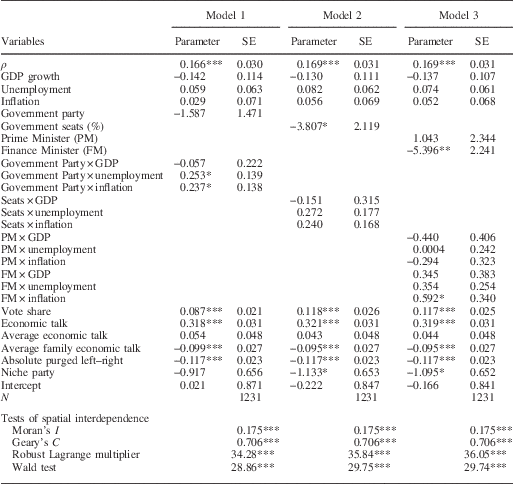
Recall that we theorize that parties, and in particular government parties, will respond to worsening economic conditions by emphasizing the economy more.Footnote 9 These expectations occur within the context of party competition, and the spatial literature suggests that parties will respond to economic conditions in a similar fashion as their ideological rivals. Table 1 shows the estimates for three SAR models of economic emphasis. Model 1 uses a simple dichotomous variable (called government party) to distinguish those parties controlling government portfolios from those that do not. Model 2 uses a continuous variable (government seats) from 0 to 1 that weights the percentage of government seats that each party controls (a value of 0 indicates an opposition party and a value of 1 indicates a single-party government). Model 3 parses out the government accountability relationship into both the PM and FM.Footnote 10
Spatial Autoregression Results for the Interactive Effects of Economic Conditions and Government Status on Campaign Emphasis of the Economy

Note: weights matrix represents the inverse of absolute relative distance (purged left–right score) at election t. All economic emphasis variables are country demeaned to control for unobserved country heterogeneity.
**p<0.05, *p<0.1 (two-tailed).
With SAR models there are essentially two different components: the pre-spatial component and the spatial component. The pre-spatial component includes parameter estimates that we can interpret in the same fashion as estimates from any OLS model. Then, we can filter the resulting pre-spatial predicted values ( $$X\hat{\beta }$$
) through the weights matrix (W) and the spatial parameter estimate (
 $$\hat{\rho }$$
) to produce predicted values (
 $$\hat{Y}$$
) for each observation.
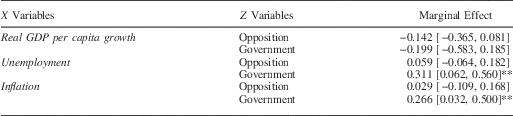
Our principal expectations focus on the interactive relationships between economic conditions, accountability, and economic emphasis. As we include these in the model specification interactively, we can get a good initial assessment of the estimated substantive effects by examining the pre-spatial marginal effects (for Model 1) in Table 2. This table provides the pre-spatial marginal effects (and 95 percent confidence intervals) of economic conditions for parties based on accountability (opposition and government parties) on the emphasis of economic issues. Holding everything else constant, government parties respond to worsening unemployment and inflation by emphasizing the economy more (statistically significant at the 95 percent confidence level). The marginal effects of economic growth are in the expected negative direction, but are not statistically significant. On the other hand, opposition parties do not respond to economic conditions by modifying their average level of economic emphasis, though the pre-spatial marginal effects for opposition parties are, as expected, in the same direction as those for government parties. These results provide moderately strong support for our first theoretical proposition and strong support for our second theoretical proposition.
Pre-Spatial Marginal Effects for Growth, Unemployment, and Inflation Across Government Status
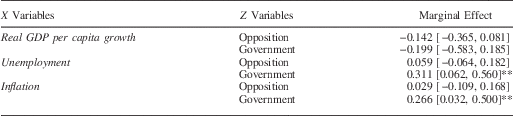
Note: marginal effects reported are β X+(β XZ×Z)|Z=1. Brackets contain 95% confidence intervals.
**p<0.05, *p<0.1 (two-tailed).
The next two models allow us to assess whether responsiveness to economic conditions varies based on the percentage of government seats controlled by each party (Model 2) or party control over the commanding heights of economic policymaking (Model 3). We depict the marginal effects of unemployment and inflation on economic emphasis in the two panels of Figure 1. Figure 1 shows that the extent to which a party responds to unemployment and inflation depends on whether the party is a part of government, and what percentage of government seats that party controls. Although the estimated effects for opposition parties (i.e., when government percentage equals 0) are in the expected positive direction, they are not statistically significant. In both of the panels in Figure 1, we see evidence that, as a party controls a higher percentage of government seats, they are much more responsive to worsening economic conditions.Footnote 11 The estimated relationships for real GDP per capita growth are in the expected negative direction but are not statistically significant.Footnote 12
Marginal effects of unemployment and inflation on economic emphasis across values of percentage of government seats Note: dashed lines indicate 95 percent confidence intervals.
Figure 2 shows the responsiveness of four categories of parties (based on which positions in government they controlled) to unemployment and inflation.Footnote 13 For both economic variables, controlling the finance ministry appears to be a more important determinant of economic emphasis than controlling the PM. For parties that control the FM but not the PM (labeled “FM Only” in Figure 2), the impact of both unemployment and inflation is positive and statistically significant at the 5 percent level if we use a one-tailed hypothesis test.Footnote 14 The effects of both unemployment and inflation are positive and statistically significant for parties that control both the FM and PM. But for parties that control the PM but not the FM (labeled “PM Only” in Figure 2), neither economic indicator is a statistically significant predictor of economic emphasis.
Marginal effects of unemployment and inflation on economic emphasis across the PM’s party and ownership of the finance portfolio Note: vertical lines indicate 95 percent confidence intervals. PM=Prime Minister; FM=Finance Minister.
The spatial perspective suggests that parties craft their strategies at least partly based on the strategies of ideologically similar parties; therefore, if parties behave in this way, then we would expect a positive and statistically significant ρ parameter. The estimated ρ is indeed statistically significant and positive in all three models (0.17), indicating parties that are in closer ideological proximity (elements of the W matrix with higher values) will be more highly correlated in their economic emphasis.Footnote 15 This confirms the expectation that ideologically proximate parties will exhibit similar strategies with respect to campaign strategies on the economy.
With this in mind, it is important to re-examine how the pre-spatial marginal effects depicted in Table 2 (Model 1) occur in the context of party competition. For example, the effects of unemployment on economic emphasis depend on the strength of the spatial autocorrelation (ρ), the pattern of interconnectivities between parties (W), and the amount of economic emphasis by all the parties in the system for that election (which is a function of Xβ). We expect that strategic party emphasis of economic issues will be a function of what rival parties are doing, how those parties are connected, and the strength of that connection.
To better assess the substantive effects of Model 1 (Table 1) and the interactive effects (Table 2), we generate the marginal effect of a 1 SD increase in unemployment (+3.83 percent) for a government party. As the post-spatial marginal effect depends on the ideological landscape and how the different parties in it are emphasizing the economy, it is important to demonstrate how these marginal effects change across multiple scenarios in terms of rival parties’ behavior.
In the top half of Figure 3, we show the marginal effect of a 1 SD increase in unemployment for a government party (labeled “G” and located at 0). In the bottom half, we provide five otherwise identical scenarios in terms of the distribution of parties from left to right (parties are located at −40, −15, 0, 15, and 40). In each scenario, we vary the values of economic emphasis for the government’s two most ideologically proximate parties (at −15 and 15) with lines to the left (representing less than average economic emphasis) and lines to the right (representing greater than average economic emphasis).Footnote 16
Marginal effect of a 1 SD increase in unemployment for a government party across five scenarios of economic emphasis by ideologically proximate parties Note: the top panel represents the predicted marginal effect of a 1 SD increase in unemployment (+3.834 percent) on economic emphasis by a government party across five scenarios of economic emphasis by other parties. The bottom panel represents the five scenarios of the distribution of other parties (depicted vertically at −40, −15, 0, 15, and 40), as well as those parties’ values of economic emphasis (depicted horizontally, with left lines indicating below average values).
To interpret the results displayed in this figure, we suggest starting with the middle scenario, which represents an election in which all five parties are emphasizing the economy to an average extent, and working to the outside. As the value of economic emphasis for all parties in this scenario is set to 0, there is no spatial lag effect and the post-spatial marginal effect is equivalent to the pre-spatial marginal effect.Footnote 17 If we examine the scenario to the immediate left, in which the two ideologically proximate parties emphasize the economy a little less, we can see the influence of our estimated ρ. In this scenario, the spatial contagion effects on the government party cause it to emphasize the economy less. Likewise, in the right-side scenario, merely having the two ideologically proximate parties emphasize the economy a little more than average induces an increase in emphasis by the government party. These spatial contagion effects are more pronounced in the first and last scenarios depicted in this figure, where the rival parties’ strategies involve a considerable de-emphasis or emphasis, respectively, on the economy. Scenarios such as these induce robust responses by the government party in terms of its economic emphasis.
Of course, the tendency for the government party to be responsive to the behavior of other parties depends on their relative proximity. We account for this behavior by weighting the impact of each party in the weights matrix by the inverse of their absolute distance from each other. As expected, the behavior of the most distant parties leads to smaller responses from the government party than the behavior of more proximate parties. In Figure 4, we demonstrate how moderating the values of economic emphasis for the two ideologically distant parties (at −40 and 40) influences the government party’s response to worsening unemployment. In Figure 4, we see that changes in campaign strategies by more distant parties have a minimal impact on the government party. As the government party is unlikely to be directly competing with these parties for the support of undecided voters, it is largely unmoved by even substantial changes in their campaign strategies. These two figures together demonstrate the utility of evaluating the effects of economic conditions on campaign strategies within the context of the spatial environment in which parties are competing.
Marginal effect of a 1 SD increase in unemployment for a government party across five scenarios of economic emphasis by ideologically extreme parties Note: the top panel represents the predicted marginal effect of a 1 SD increase in unemployment (+3.834 percent) on economic emphasis by a government party across five scenarios of economic emphasis by other parties. The bottom panel represents the five scenarios of the distribution of other parties (depicted vertically, at −40, −15, 0, 15, and 40), as well as those parties’ values of economic emphasis (depicted horizontally, with left lines indicating below average values).
The control variables in our models work largely as expected. Larger parties (represented by high values of vote t−1) and more centrist parties (represented by low values of absolute purged left–right score) emphasize the economy more. The previous levels of economic emphasis influence current levels, inducing more emphasis at the party level (economic emphasis t−1) and an alternating effect at the party family level (average family economic emphasis t−1).
Discussion and Conclusion
The idea that political elites attempt to spin economic realities during elections is not novel or controversial. Thus, it is somewhat surprising that the vast majority of research on the influence of the economy on election outcomes have ignored the efforts of elites. An important first step for understanding these linkages is the development of theories about how elites shape their messages.
This paper represents a first effort to develop a general theory that explains the degree to which strategic parties emphasize economic concerns in their election manifestos. We derive theoretical expectations about the emphasis of economic issues in manifestos based on the increased salience of the economy during tough economic times. Our results indicate strong support for our theoretical propositions. Rather than running away from poor economic performances, governing parties talk about the economy more during bad economic times because of its high level of relative salience. The degree to which they do so depends on their role in economic policymaking and the behavior of their ideological neighbors.
These findings have important implications for economic voting, spatial models of party competition, and valence voting. First, this study raises questions about the absence of strategic elites in studies of economic voting (see Hellwig Reference Hellwig2012 for a notable exception). By omitting any measures of the strategic activity by competing elites, these actions are implicitly assumed to either not matter or to always cancel each other out. If the tendency of voters to hold government parties accountable for poor economic performance is a function of the portrayal of economic conditions by elites during the campaign process, then our findings suggest that we must first explore the impetus for parties to emphasize the economy. Our paper indicates that parties are purposive in making the economy a more or less salient issue in election campaigns. Therefore, it is likely that the processes by which parties strategize about salient issues and the manner in which voters hold parties accountable are intricately linked. Studies evaluating one or the other must carefully consider how strategic parties (both in government and in opposition) can attempt to mitigate or exacerbate the economic vote.
Second, if formal models of party competition intend to produce general theories of strategic behavior, then they should consider taking issue salience and other valence concerns more seriously. Voting models based on the relative distance between voters and parties can only go so far in explaining voters’ decisionmaking. This study suggests that spatial models should strive to incorporate valence assessments, which other scholars have found to have high explanatory power (Clarke et al. Reference Clarke, Sanders, Stewart and Whiteley2004). Although it may not be immediately obvious how to incorporate features such as perceived competence or assessments about which party is the best economic manager into spatial models, scholars have shown that this can be done (e.g., Adams Reference Adams2001). This project demonstrates that party strategy is a function of both valence considerations and relative ideological proximity.
The final implication pertains to valence voting. Rather than campaigning on issues other than the economy during hard economic times, government parties emphasize the economy more. As interesting as these results are from a valence perspective, they do not tell the complete story. We still do not know, for example, how the content of economic emphasis varies in response to economic conditions for the government parties versus other parties. For example, is the increased emphasis a result of parties offering alternative potential solutions to the economic problems in an attempt to change voters’ perceptions of which party would be the most competent economic manager moving forward? Or is the increased emphasis a result of government parties trying to improve voters’ assessments of leader images? Although the CMP data offer sufficient time-series cross-national data for an examination of our basic theoretical propositions, they are unable to help us distinguish between these alternative explanations. We leave it to future research to explore these questions in-depth.