Introduction
Borderline personality disorder (BPD) is a serious form of psychopathology associated with distress, suicide, impaired functioning, and considerable health-care costs (Skodol et al. Reference Skodol, Gunderson, Pfohl, Widiger, Livesley and Siever2002; Yen et al. Reference Yen, Shea, Sanislow, Grilo, Skodol, Gunderson, McGlashan, Zanarini and Morey2004; Ansell et al. Reference Ansell, Sanislow, McGlashan and Grilo2007). The clinical presentation, treatment and disability of individuals with BPD is complicated by its high degree of co-morbidity with other major mental disorders (Zanarini et al. Reference Zanarini, Frankenburg, Dubo, Sickel, Trikha, Levin and Rennolds1998; Zimmerman & Mattia, Reference Zimmerman and Mattia1999), as about 75% of individuals with a lifetime BPD diagnosis meet criteria for a lifetime mood disorder and about 73% meet criteria for a lifetime substance use disorder (Grant et al. Reference Grant, Chou, Goldstein, Huang, Stinson, Saha, Smith, Dawson, Pulay, Pickering and Ruan2008). Because BPD typically presents along with other disorders that have high social costs, a better understanding of the associations of BPD and its co-morbidity with other psychiatric disorders has important public health and etiological implications.
BPD co-morbidity is usually examined through bivariate approaches (e.g. odds ratios) that demonstrate the diagnostic co-occurrence between BPD and another disorder. This approach has been useful in indicating the high levels of co-morbidity between BPD and many other DSM-IV disorders, for example an association between lifetime BPD and generalized anxiety disorder demonstrated by an odds ratio of 8.3 (p<0.01; Grant et al. Reference Grant, Chou, Goldstein, Huang, Stinson, Saha, Smith, Dawson, Pulay, Pickering and Ruan2008). The bivariate approach to BPD co-morbidity can also be useful in understanding specific pair-wise relationships between disorders, in addition to patterns of risk (e.g. increased risk of major depression in individuals with BPD). However, simultaneous consideration of a larger number of disorders may indicate important patterns of relationships between BPD and other disorders that would not emerge from bivariate analyses.
Multivariate methods to understand better the co-morbidity associated with BPD are available, and they provide the potential for new insights into the nature of co-morbidity. As their name suggests, multivariate models consider multiple disorders simultaneously, with the aim of uncovering underlying structures that account for observed co-morbidity. Multivariate modeling of co-morbidity has converged on a model with two broad dimensions as providing a good fit to data on a diverse group of common mental disorders (Krueger et al. Reference Krueger, Caspi, Moffitt and Silva1998; Eaton et al. Reference Eaton, South, Krueger, Millon, Krueger and Simonsen2010). The first dimension, internalizing, represents the propensity to experience unipolar mood and anxiety disorders such as major depression, generalized anxiety disorder, panic disorder, social and specific phobias. The second dimension, externalizing, represents the propensity to experience disinhibitory disorders such as substance use disorders, antisocial personality disorder (ASPD) and conduct disorder. Some studies have also shown that internalizing encompasses two subfactors: distress and fear (Krueger, Reference Krueger1999; Vollebergh et al. Reference Vollebergh, Iedema, Bijl, de Graaf, Smit and Ormel2001; Slade & Watson, Reference Slade and Watson2006). Distress is associated with disorders such as major depression, dysthymia and generalized anxiety disorder, whereas fear is associated with disorders such as panic disorder, social phobia and simple phobia (Eaton et al. Reference Eaton, South, Krueger, Millon, Krueger and Simonsen2010).
To date, the position of BPD in the internalizing and externalizing structure of co-morbidity has not been examined extensively, although some authors have suggested links between BPD and internalizing and externalizing forms of psychopathology (e.g. Crowell et al. Reference Crowell, Beauchaine and Linehan2009). We are aware of only one previous study that addressed this issue in a sample of young adults in South Florida (James & Taylor, Reference James and Taylor2008). The study concluded that BPD may be best conceptualized in men as reflecting a confluence of both the distress subfactor of internalizing (referred to by some authors as ‘anxious-misery’) and the externalizing dimensions; in women, the results indicated that BPD could either be conceptualized as relating to (1) both distress and externalizing or (2) distress alone (James & Taylor, Reference James and Taylor2008). Although this study provided an important first step in understanding multivariate BPD co-morbidity, its generalizability is limited by several factors, including its focus on individuals aged 19–22 years, its strict geographic constraints, and its sample size (n=1197). A larger, more representative, US sample could ensure generalizability, yield more precise model estimates, and clarify the somewhat ambiguous results obtained regarding structural connections between BPD and common mental disorders in women. The present study addresses these issues.
Our aim was to integrate BPD into the internalizing–externalizing model in a general population sample, which would provide at least two benefits. First, the overall model would be more thoroughly explicated. As more disorders are examined for their role in this model, multivariate patterns of co-morbidity and the latent dimensions that account for them become clearer. Incorporating a variety of disorders helps to ensure that the ‘universe of content’ for each broad dimension is adequately sampled. Extending investigations of this model to disorders not yet studied is important in evaluating its ability to organize more diverse forms of psychopathology, and may also delineate other dimensions beyond those linked to the most studied common mental disorders (i.e. mood, anxiety, substance use, and antisocial disorders; Andrews et al. Reference Andrews, Goldberg, Krueger, Carpenter, Hyman, Sachdev and Pine2009).
Second, unlike many other disorders, the symptoms of BPD seem to incorporate features of both the internalizing and externalizing dimensions. This possibility makes BPD a potentially informative disorder in the internalizing–externalizing framework. For instance, diagnostic criteria such as affective instability due to mood reactivity would seem to relate more strongly to internalizing, whereas others, such as impulsivity and inappropriate, intense anger would seem to relate more strongly to externalizing. Therefore, BPD could be understood as a confluence of internalizing and externalizing, which could have important implications for structural work on psychopathology and for conceptualizing BPD itself. Empirical findings that BPD cross-loads on both internalizing and externalizing would demonstrate that the BPD diagnosis, as currently conceptualized, is linked to at least two dimensions rather than a single dimension. In the present study, we investigate how BPD fits into the internalizing–externalizing framework in a large and representative sample of community dwelling adults in the USA.
Method
Participants
This study used data from 34 653 individuals who participated in the wave 2 National Epidemiologic Survey on Alcohol and Related Conditions (NESARC) in 2004–2005, which was a second assessment of the individuals from the wave 1 NESARC conducted in 2001–2002. Previous reports have detailed both wave 1 and wave 2 methods (Grant & Kaplan, Reference Grant and Kaplan2005; Grant et al. Reference Grant, Kaplan, Shepard and Moore2005). In brief, wave 1 (n=43 093) consisted of a representative sample of the civilian, non-institutionalized US population aged ⩾18 years with oversampling of African-Americans, Hispanics and young adults. Race/ethnicity was assessed through census-defined categories selected by the respondent. Participants from wave 1 were contacted to participate in wave 2, and 86.7% of eligible individuals agreed to participate. Forty-eight per cent of the wave 2 sample were women. Participants ranged in age from 20 years to >90 years: 25.4% were <35, 31.1% were 35–49, 24.1% were 50–64, and 19.3% were ⩾65 years. White subjects comprised 70.9% of the sample, African-Americans 11.1%, Hispanics 11.6%, Asians or Pacific Islanders 4.3%, and American Indians and Alaska Natives 2.2%. After complete description of the study to the subjects, written informed consent was obtained.
Assessment
DSM-IV diagnoses were made using the Alcohol Use Disorder and Associated Disabilities Interview Schedule – DSM-IV Version (AUDADIS-IV; Grant et al. Reference Grant, Harford, Dawson, Chou and Pickering1995, Reference Grant, Dawson, Stinson, Chou, Kay and Pickering2003; Ruan et al. Reference Ruan, Goldstein, Chou, Smith, Saha, Pickering, Dawson, Huang, Stinson and Grant2008). The AUDADIS is a structured interview designed for administration by experienced lay interviewers. AUDADIS-IV test–retest estimates are similar to other structured interviews (e.g. the DIS, the CIDI) used in large-scale psychiatric epidemiologic surveys (reviewed in Wittchen, Reference Wittchen1994). The present study used lifetime diagnoses (representing the combination of lifetime diagnostic assessments from wave 1 AUDADIS with a ‘since last interview’ diagnostic assessment from wave 2 AUDADIS; that is, if the person met lifetime diagnostic criteria at wave 1 or in the interval between waves 1 and 2, they received a lifetime diagnosis at wave 2). There were two exceptions: (1) BPD, which was assessed as a lifetime diagnosis at wave 2 only, and (2) ASPD, which was represented in our analyses by the lifetime diagnosis at wave 1 (i.e. we did not incorporate wave 2 information into our ASPD diagnostic variable because ASPD is conceptualized in DSM-IV as a disorder that should not emerge de novo in adults, in the time interval between the two interviews).
We included two AUDADIS-IV assessed mood disorders (major depressive disorder and dysthymic disorder) and five anxiety disorders (panic disorder with agoraphobia, social phobia, specific phobia, generalized anxiety disorder, and post-traumatic stress disorder). Reliability values for these diagnoses ranged from fair (κ=0.42, specific phobia) to good (κ=0.64, major depressive disorder) (Canino et al. Reference Canino, Bravo, Ramirez, Febo, Rubio-Stipec, Fernandez and Hasin1999; Grant et al. Reference Grant, Dawson, Stinson, Chou, Kay and Pickering2003; Ruan et al. Reference Ruan, Goldstein, Chou, Smith, Saha, Pickering, Dawson, Huang, Stinson and Grant2008).
We also included four substance use disorders: alcohol dependence, nicotine dependence, marijuana dependence, and any other drug dependence. A variable representing any other drug dependence was created for the present study to increase variation in these somewhat infrequent behaviors and thus to allow for meaningful estimates of covariation with other disorders. This drug dependence variable was a compilation of the following: dependence on sedatives, tranquilizers, opioids, amphetamines, hallucinogens, cocaine, inhalants/solvents, heroin, or any other drug. Good to excellent AUDADIS test–retest reliability for alcohol and drug dependence (κ=0.70–0.84) is documented in clinical and general population samples (Grant et al. Reference Grant, Harford, Dawson, Chou and Pickering1995, Reference Grant, Dawson, Stinson, Chou, Kay and Pickering2003; Chatterji et al. Reference Chatterji, Saunders, Vrasti, Grant, Hasin and Mager1997; Hasin et al. Reference Hasin, Carpenter, McCloud, Smith and Grant1997a), as was good to excellent convergent, discriminant and construct validity of AUDADIS alcohol and drug dependence diagnoses in studies examining US (Hasin et al. Reference Hasin, Muthén, Wisnick and Grant1994, Reference Hasin, Van Rossem, McCloud and Endicott1997c, Reference Hasin, Stinson, Ogburn and Grant2007; Hasin & Paykin, Reference Hasin and Paykin1999) and international samples (Cottler et al. Reference Cottler, Grant, Blaine, Mavreas, Pull, Hasin, Compton, Rubio-Stipec and Mager1997; Hasin et al. Reference Hasin, Grant, Cottler, Blaine, Towle, Üstün and Sartorius1997b; Pull et al. Reference Pull, Saunders, Mavreas, Cottler, Grant, Hasin, Blaine, Mager and Üstün1997; Üstün et al. Reference Üstün, Compton, Mager, Babor, Baiyewu, Chatterji, Cottler, Göğüş, Mavreas, Peters, Pull, Saunders, Smeets, Stipec, Vrasti, Hasin, Room, Van den Brink, Regier, Blaine, Grant and Sartorius1997; Vrasti et al. Reference Chatterji, Saunders, Vrasti, Grant, Hasin and Mager1997; Canino et al. Reference Canino, Bravo, Ramirez, Febo, Rubio-Stipec, Fernandez and Hasin1999; Nelson et al. Reference Nelson, Rehm, Ustun, Grant and Chatterji1999), including clinical reappraisals. The any other drug dependence variable we created had good internal consistency (Cronbach's α=0.77).
Finally, we included two personality disorders: ASPD and BPD. Although the other diagnoses included in the present study were Axis I disorders, ASPD has consistently been demonstrated to be an indicator of externalizing in previous research (Eaton et al. Reference Eaton, South, Krueger, Millon, Krueger and Simonsen2010). BPD diagnosis required that respondents endorse five or more of the DSM-IV diagnostic criteria, at least one of which was associated with social or occupational dysfunction.Footnote 1Footnote † The AUDADIS-IV uses multiple questions to assess DSM-IV personality disorder criteria. For example, the first BPD criterion regards ‘frantic efforts to avoid real or imagined abandonment’. One of the AUDADIS-IV items used to assess this criterion asks, ‘Have you often become frantic when you thought that someone you really cared about was going to leave you?’ Test–retest reliability of the BPD diagnoses showed good reliability (κ=0.71; Ruan et al. Reference Ruan, Goldstein, Chou, Smith, Saha, Pickering, Dawson, Huang, Stinson and Grant2008). ASPD diagnosis required the endorsement of sufficient childhood symptoms before age 15 in addition to lifetime adult symptoms occurring since age 15. Test–retest reliability of the ASPD diagnoses showed good reliability (κ=0.67; Grant et al. Reference Grant, Dawson, Stinson, Chou, Kay and Pickering2003).
Statistical analyses
All analyses were conducted in Mplus version 5.21 using the Mplus defaults: the WLSMV estimator and delta parameterization for confirmatory factor analyses, and the WLSM estimator and oblique Geomin rotation for exploratory factor analyses (Muthén & Muthén, Reference Muthén and Muthén2010). The WLSM and WLSMV estimators allow for fitting models to data derived from a complex sampling design (e.g. NESARC) with categorical observed variables. All diagnoses were treated as categorical variables, and all analyses incorporated the wave 2 weighting, clustering and stratification variables. Sample weights were re-estimated at wave 2 to ensure that the sample remained representative of the US population in 2000.
Exploratory factor analyses used the scree test, available fit indices, and factor interpretability to determine dimensionality; confirmatory factor analyses used available fit indices. The fit indices used for model evaluation were the Comparative Fit Index (CFI), the Tucker–Lewis Index (TLI), the root mean squared error of approximation (RMSEA), and the number of free parameters in the model.Footnote 2 Values of CFI/TLI>0.95, and values of RMSEA<0.06, are commonly used guidelines for inferring reasonably good model fit (Hu & Bentler, Reference Hu and Bentler1999). The number of free parameters in a model represents how many parameters were free to be estimated, rather than being constrained to a certain value (e.g. constrained to be equal to another parameter or to zero); the smaller the number of free parameters in a model, the less complex the model, and thus the greater parsimony it shows in fitting the data. In the confirmatory factor analyses, we thus defined the optimal model as the model with the best fit as judged by CFI, TLI and RMSEA; in the case where two models might have very similar fit indices, the most parsimonious model (the model with the fewest freely estimated parameters) was defined as the more optimal model. Confirmatory factor analysis was first conducted to determine the fit of the baseline internalizing–externalizing model (with distress and fear internalizing subfactors) in each sex. We then fit models with BPD loading on distress, fear and/or externalizing. To ensure that the higher-order internalizing–externalizing model was identified, the loadings of distress and fear on internalizing were constrained to equality.
Results
We began by investigating the structure of BPD in the present study's data to determine its dimensionality. If later analyses were to demonstrate that BPD showed cross-loadings on two or more dimensions (e.g. distress, fear and externalizing), such a finding could be due to BPD being a multidimensional diagnostic construct. The scree test, examination of fit indices and interpretability of factors indicated that, in these data, BPD is best represented by a single factor. That is, a one-factor model provided a nearly perfect fit to the data (CFI=0.99, TLI=0.99, RMSEA=0.03; all standardized loadings on the single factor were >0.68; in a two-factor solution, the two factors were correlated 0.83). Thus, any findings in the following analyses that BPD cross-loaded on two or more dimensions would not be due to BPD itself consisting of more than one underlying dimension.
Because BPD status was not assessed at wave 1, we considered whether it might have impacted which individuals participated at wave 2. We identified four wave 1 BPD-related constructs that correlated significantly with wave 2 BPD, which could be used to infer whether BPD was related to attrition: past year breakup of a marriage/steady relationship [χ2(1)=0.49, p=0.49], previous suicide attempt status [χ2(1)=6.73, p=0.01], and wave 1 antisocial [χ2(1)=1.80, p=0.18] and histrionic [χ2(1)=0.16, p=0.69] personality disorders. Only having attempted suicide was significantly related to respondent status; individuals who responded at wave 2 were more likely to have attempted suicide. Given that only one of these BPD-related constructs was related to attrition, it seems unlikely that differential follow-up by BPD status substantially impacted our results.
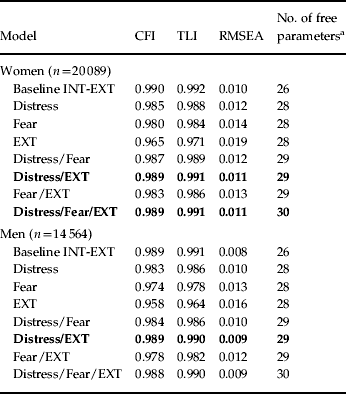
We next sought to replicate the internalizing–externalizing structure of common mental disorders, excluding BPD. Each diagnosis was parameterized to load on one of three factors as identified by previous research: (1) major depression, dysthymia, generalized anxiety disorder, and post-traumatic stress disorder loaded on the distress subfactor of internalizing; (2) panic disorder with agoraphobia, social phobia, and specific phobia loaded on the fear subfactor of internalizing; and (3) ASPD, alcohol dependence, marijuana dependence, nicotine dependence, and other drug dependence loaded on the externalizing dimension. The distress and fear factors were subsumed under a higher-order internalizing dimension, which was correlated with the externalizing dimension. Exploratory and confirmatory factor analyses supported our use of subfactors. Distress and fear were correlated [r=0.77, 99% confidence interval (CI) 0.73–0.80 in women; r=0.72, 99% CI 0.67–0.77 in men] significantly less than unity. This internalizing–externalizing parameterization (Table 1) provided similarly good fit in women (CFI=0.990, TLI=0.992, RMSEA=0.010) and men (CFI=0.989, TLI=0.991, RMSEA=0.008).
Fit indices and number of parameters for models' fit

CFI, Comparative fit index; TLI, Tucker–Lewis Index; RMSEA, root mean squared error of approximation; INT, internalizing; EXT, externalizing.
‘Baseline INT-EXT’ models indicate the fit of the higher-order model of internalizing–externalizing (including distress and fear internalizing subfactors) without the inclusion of BPD. Other models indicate on which (sub)factor(s) BPD was parameterized to load (e.g. ‘Distress/EXT’ indicates BPD loaded on distress and externalizing). Bolded models are the best-fitting models within women and men indicated by fit indices.
a Number of freely estimated parameters.
After establishing the good fit of internalizing–externalizing in both women and men, we turned our attention to the location of BPD within this framework. We fit seven possible models of how BPD might fit into the internalizing–externalizing structure. For example, BPD could load on a single dimension: distress (model 1), fear (model 2), or externalizing (model 3). BPD could also be influenced by multiple latent propensities toward distress, fear and externalizing. In such a case, BPD could load on both distress and fear (model 4); distress and externalizing (model 5); fear and externalizing (model 6); or distress, fear and externalizing (model 7). We refer to these models as distress, fear, externalizing, distress/fear, distress/externalizing, fear/externalizing, and distress/fear/externalizing respectively. BPD could also load on different factors in women and men.
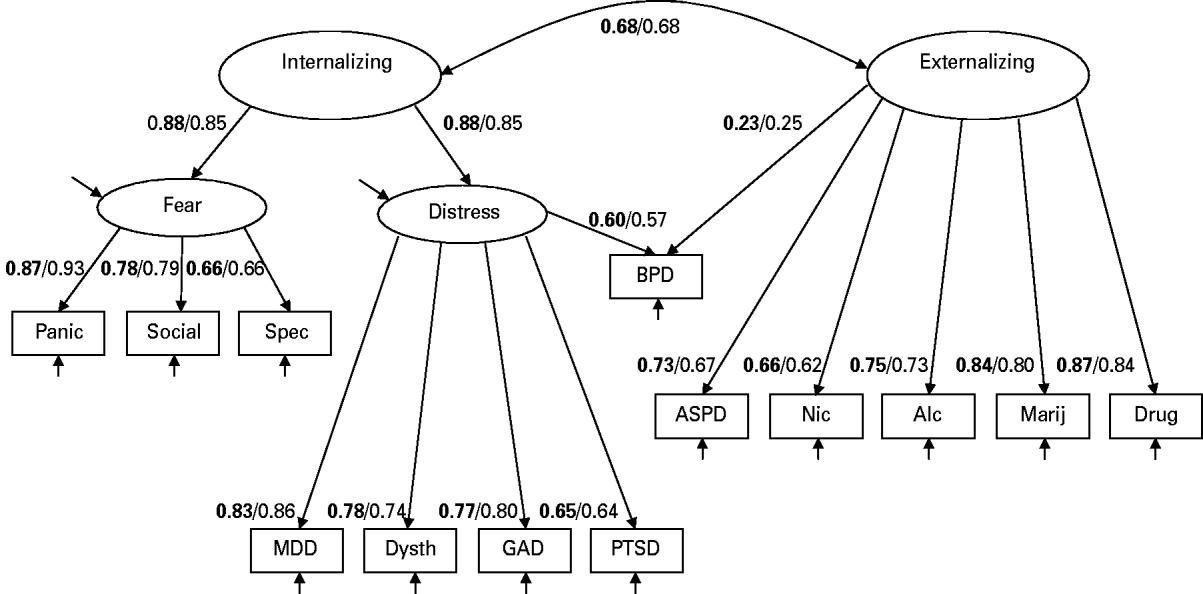
To identify the optimal location of BPD in internalizing–externalizing, each of the seven models above were fit separately within each sex (see Table 1). In women, all models fit the data well, but, relatively speaking, two models fit best when considering all three fit indices: distress/externalizing (CFI=0.989, TLI=0.991, RMSEA=0.011, 29 free parameters) and distress/fear/externalizing (CFI=0.989, TLI=0.991, RMSEA=0.011, 30 free parameters). The two models have identical fit indices, but the distress/externalizing model has one fewer freely estimated parameter. In keeping with our criterion for defining the optimal model, distress/externalizing was chosen, as its fit was identical to that of distress/fear/externalizing, but it was more parsimonious in terms of parameterization. In men, as in women, all models fit well, but the distress/externalizing model fit best (CFI=0.989, TLI=0.990, RMSEA=0.009, 29 free parameters); the distress/fear/externalizing model showed only a slightly worse fit (CFI=0.988, TLI=0.990, RMSEA=0.009, 30 free parameters) but one additional parameter. The distress/externalizing model was thus chosen as optimal in men because it provided better fit and greater parsimony than all other models. Therefore, in both genders, the optimal model indicated that BPD was related to both distress and externalizing. This model and its parameter estimates for women and men are depicted in Fig. 1.
The best-fitting model in women and men. Values are standardized factor loadings (all significant p<0.001). Bold values are for women; non-bold values are for men. Panic, panic disorder with agoraphobia; Social, social phobia; Spec, specific phobia; MDD, major depressive disorder; Dysth, dysthymic disorder; GAD, generalized anxiety disorder; PTSD, post-traumatic stress disorder; BPD, borderline personality disorder; ASPD, antisocial personality disorder; Nic, nicotine dependence; Alc, alcohol dependence; Marij, marijuana dependence; Drug, other drug dependence. Arrows without numbers indicate unique variances, including error.

We used DIFFTEST, a χ2 difference test for the WLSMV estimator in Mplus, to supplement our fit index results, noting that DIFFTEST may reject good models in large samples. For women, DIFFTEST preferred the least parsimonious model (distress/fear/externalizing) to our more parsimonious model (distress/externalizing). The distress/fear/externalizing model, however, was clearly not optimal: the BPD fear loading was 0.11, indicating that fear accounted for a trivial 1.23% of BPD variance, and was the only model parameter not significantly different from zero, even given our very large sample (n=20 089) of women. For men, with a smaller sample size (n=14 564) and less power, DIFFTEST failed to reject distress/externalizing compared to distress/fear/externalizing (p=0.29). For both genders, distress/externalizing accounted for slightly more BPD variance than did distress/fear/externalizing (e.g. for women, R 2=0.567 v. 0.557 respectively). We interpreted these results as being largely congruent with the fit index results.
The foregoing analyses identify BPD's location in the internalizing–externalizing framework, but another question remains: How much of the variance in BPD is captured by distress and externalizing? It could be the case that, even when BPD is fit most optimally into the internalizing–externalizing structure, it is still not well captured. Examination of BPD R 2 values in women (0.57) and men (0.54), however, indicated that this was not the case: more than half of the variance in BPD was captured by its associations with distress and externalizing. Furthermore, the factor loadings of BPD on distress (0.60 and 0.57 for women and men respectively) were more than twice as large as the loadings of BPD on externalizing (0.23 and 0.25); squaring these loadings indicates that distress accounted for 36% of BPD variance in women and 32.5% in men whereas externalizing accounted for only 5.3% and 6.3% respectively. These results highlight the relatively stronger association of BPD with distress than externalizing.
Discussion
Previous research has established that BPD is highly co-morbid with many diverse forms of psychopathology. Although its bivariate relationships with other disorders have been examined, there have been limited multivariate examinations of diagnostic co-morbidity. We integrated BPD into a well-established empirically derived model of common forms of psychopathology, the internalizing–externalizing model. The determination that BPD is ‘located’ in both distress and externalizing helps to explain the patterns of co-morbidity of BPD and presents implications for the conceptualization and classification of mental disorders. Most notably, it seems that BPD is associated with more than one underlying dimension (i.e. the distress subfactor of internalizing and the externalizing dimension, albeit more strongly with the former). This finding was robust across gender.
Links between BPD, distress, and externalizing
Our aim was to examine how BPD fits into the latent internalizing–externalizing structure of psychopathology to improve understanding of the co-morbidity of BPD with other disorders. We first demonstrated that the internalizing–externalizing model fits the NESARC data fairly well and then determined the location of BPD within the model. When considered within this internalizing–externalizing structure, our results indicate that BPD is best conceptualized as a distress and externalizing disorder. Analyses using data from women and men separately converged on this result. These findings extend previous results (James & Taylor, Reference James and Taylor2008) to a national and representative sample, present a similar picture of BPD's structural location for men, and help to clarify somewhat ambiguous previous results for women (in our findings, BPD in women is a disorder of distress and externalizing rather than solely distress).
The notion that BPD relates to distress is in keeping with previous research indicating that emotional dysregulation is a core feature of BPD; our results supplement this conceptualization by also documenting the relevance of the externalizing liability dimension to BPD (Sanislow et al. Reference Sanislow, Grilo, Morey, Bender, Skodol, Gunderson, Shea, Stout, Zanarini and McGlashan2002; Skodol et al. Reference Skodol, Gunderson, Pfohl, Widiger, Livesley and Siever2002; Paris, Reference Paris2007; Selby & Joiner, Reference Selby and Joiner2009). The notion that BPD is unidimensional while also being connected to the two latent dimensions of distress and externalizing pathology may seem counterintuitive. However, it is compatible with a liability threshold perspective on multiple underlying contributions to BPD risk. In a liability threshold model, BPD liability is a single dimension, ranging from very low levels of BPD symptomatology to very high levels, and a threshold demarcates the location on this dimension, where the liability reaches a sufficiently high level for an individual to receive a BPD diagnosis. Our results demonstrating that BPD is a unidimensional construct indicate that there is indeed a single liability dimension for BPD. Our results demonstrating that BPD is connected to distress and externalizing suggest that these two separable liability dimensions each contribute to an individual's liability level. Both distress and externalizing liabilities push an individual closer to the diagnostic threshold for BPD. However, distress has a much stronger relationship to BPD than does externalizing (Fig. 1), and distress accounts for more BPD variance; thus, an increase in distress would move the individual closer to the diagnostic threshold than would an equivalent increase in externalizing.
Implications
Co-morbidity and classification
Our results suggest that the current conceptualization of BPD co-morbidity, and perhaps of mental disorders in general, deserves reconsideration. BPD shows co-morbidity with a wide array of disorders because of shared liability at a latent level. Rather than conceptualizing the prototypical BPD patient as suffering from numerous disorders, many BPD patients may be understood as having a high level of the latent internalizing and externalizing liabilities, manifesting as both BPD and other diagnoses (Livesley, Reference Livesley, Maj, Akiskal, Mezzich and Okasha2005, Reference Livesley2008).
Our findings also support the notion that rationally derived groupings of disorders, such as the Axis I–Axis II distinction in DSM-IV, may not reflect the true state of nature. In our findings, two Cluster B personality disorders (ASPD and BPD) showed links with Axis I disorders at the latent level. Indeed, the Axis II diagnoses were well integrated into the model; the factor loadings of these two personality disorders were frequently similar to, and sometimes larger than, the factor loadings of the Axis I disorders. Putatively distinct disorders seem closely related at a latent level, supporting calls for revising the nosology to reflect the continuity of Axes I and II (Siever & Davis, Reference Siever and Davis1991; Krueger, Reference Krueger2005). Determining how additional Axis I and II disorders fit into these latent structures would be a valuable direction for future research.
Etiology
These results have implications for thinking about the origins of BPD and its co-morbid disorders. BPD seems to originate from liabilities shared with a variety of other disorders. These liabilities for internalizing (and distress and fear) and externalizing are heritable, with unique environmental effects playing a role in how this liability manifests (Kendler et al. Reference Kendler, Prescott, Myers and Neale2003). This suggests that a substantial portion of BPD's etiology, and the etiology of the co-morbidity it shows with other disorders, lies at the genetic level. Research on BPD etiology and co-morbidity etiology should focus on understanding genetic predispositions to internalizing and/or externalizing in addition to the specific environmental inputs that may determine how this liability is expressed (for examples of this approach, see Kendler et al. Reference Kendler, Aggen, Czajkowski, Røysamb, Tambs, Torgersen, Neale and Reichborn-Kjennerud2008; Torgersen et al. Reference Torgersen, Czajkowski, Jacobson, Reichborn-Kjennerud, Røysamb, Neale and Kendler2008).
Treatment
With regard to treating BPD and its co-morbid conditions, our results suggest that a compelling focus of intervention may lie at the latent liability level. Instead of treating various manifestations of underlying propensities, clinicians might address the underlying liability to experience distress and to externalize, keeping in mind that BPD seems to be more a disorder of distress than externalizing. Such an approach, if successful, would be likely to benefit both BPD and its concomitant disorders. For instance, rather than focusing interventions on emotional instability, depression and anxiety in a BPD patient, a psychological or pharmacological intervention aimed at decreasing the individual's overall tendency to experience distress might facilitate improvement across these areas more effectively and efficiently. Similarly, interventions targeting latent externalizing broadly might show diffuse impacts on problem behaviors such as impulsivity, risk taking, aggression, substance use, and self-injury frequently seen in individuals with BPD. Treatment research would thus be well served to investigate interventions that affect BPD and its co-morbid conditions at the level of latent liability dimensions (Barlow et al. Reference Barlow, Allen and Choate2004).
Limitations
This study is not without its limitations. First, this study used diagnostic information rather than symptom-level data. Although this dichotomization of the disorders was modeled statistically, it still addresses structural questions at a different level of analysis than does the use of symptom-level data (Markon, Reference Markon2010). Future studies would benefit from using additional types of variables (e.g. manifest ordinal variables) and other assessment batteries. Second, the diagnoses in this study were made by extensively trained lay interviewers rather than clinicians. Another limitation is that several of our models fit well, and the necessary use of the WLSMV estimator precluded the calculation of other fit indices (e.g. the Bayesian information criterion, BIC) that could have further clarified our results. Finally, the lifetime diagnoses required retrospective self-reporting, the accuracy of which are subject to phenomena such as memory accuracy, insight and social desirability. That said, the robustness of our results, coupled with corroboration from previous research using dimensional manifest indicators (James & Taylor, Reference James and Taylor2008), deserves careful consideration. Even with these caveats in mind, the results of the current study can inform thinking about BPD's place in the structure of mental disorders. Specifically, although BPD diagnostic criteria were best represented as a single factor in the current research, BPD is connected to both distress and externalizing pathology.
Conclusions
The current study has demonstrated that BPD fits well into the internalizing–externalizing structure of mental disorders, and latent liability dimensions account for more than half of the variance in the BPD diagnosis. This pattern of interconnections with underlying liability dimensions and other disorders was similar in women and men. These connections at the latent level account for BPD's observed co-morbidity and have implications for understanding classification, etiology and treatment. These findings support the notion that it may be useful for studies of BPD to focus on connections with underlying liability dimensions. In turn, and more broadly, these findings support the notion that underlying liability dimensions may be key constructs in the search for etiology and effective interventions for co-morbid mental disorders.
Acknowledgements
This work was supported by grants U01AA018111 (NIAAA), R01DA018652 (NIDA), K05AA014223 (NIAAA) to D.S.H. and F31DA026689 (NIDA) to K.M.K. The NESARC was sponsored by the National Institute on Alcohol Abuse and Alcoholism (NIAAA) and funded, in part, by the Intramural Program, NIAAA, National Institutes of Health, with additional support from the National Institute on Drug Abuse.
Declaration of Interest
None.