The importance of the regeneration of te reo Māori, the Indigenous language of Aotearoa (New Zealand), has been acknowledged for some time. ‘After nearly two centuries of contact with Europeans, the Māori language of New Zealand was, by the 1960s, threatened with extinction’ (Spolsky, Reference Spolsky2003, p. 553). The term ‘language regeneration’ is deliberately chosen here as it suggests ‘growth, regrowth, development, and redevelopment’ (Hohepa, Reference Hohepa2006, p. 294), more so than other terms used by sociolinguists when discussing endangered languages, such as ‘language revival, language reversal’ or ‘language revitalisation’. The impetus for regeneration arose partly from widespread ‘ethnic revival’ in the 1960s and 1970s (Fishman, Gertner, Lowy, & Milan, Reference Fishman, Gertner, Lowy and Milan1985, p. xii), described by Spolsky as ‘a spurt of concern for ethnic identity’ (2003, p. 560). In New Zealand, the Māori activist group, Ngā Tamatoa, is credited with raising awareness about the importance of teaching te reo Māori in schools (Spolsky, Reference Spolsky2003). This led to initiatives in adult relearning of te reo Māori, and full immersion te reo Māori programs for preschoolers and elementary-aged students (Kohanga Reo and Kura Kaupapa Māori, respectively). In more recent years, education for secondary and tertiary students has been made available in te reo Māori, along with a wide variety of specialist bilingual and full-immersion units established within English-medium schools. Te reo Māori literally means ‘the Māori language’, but embedded in language are cultural practices, protocols, and understandings that are termed ‘tikanga Māori’. Neither tikanga nor te reo Māori can be taught or learned separately. It is important, therefore, that readers of this article understand that where ‘te reo Māori’ occurs, ‘tikanga Māori’ is also implied.
Indigenous peoples from other parts of the globe consider New Zealand's efforts of language regeneration to be successful and at times, enviable (Fishman, 1990, 1991, Reference Fishman2001, as cited in Spolsky, Reference Spolsky2003). Māori-medium education is regularly cited in the international literature as an intervention that has successfully addressed Indigenous language loss (May & Hill, Reference May, Hill and Hornberger2008). Along with New Zealand Sign Language and English, te re Māori has official status as a national language. Moreover, some aspects of Māori language and culture have become accepted as everyday practice in schools, hospitals, and other state institutions (Durie, Reference Durie2011). However, most would agree that use of te reo Māori in such institutions is largely superficial and there remain significant gaps between policy and practice in areas of welfare, health, and opportunity (Walker, Eketone, & Gibbs, Reference Walker, Eketone and Gibbs2006).
Despite some substantial gains, te reo Māori remains in a critical stage: from 2001 to 2006 numbers of speakers (both Māori and non-Māori) declined from 25.2% to 23.7% (Waitangi Tribunal, Reference Waitangi2010, p. 103). The decline is concerning, particularly in light of aspirations reported at national hui (hui — meetings or gatherings, both formal and informal) in the Te Reo Mauriora report that the language could only be considered safe if 50% of Māori spoke it (Te Puni Kokiri, 2011). The same report recommends that 80% of Māori should speak te reo Māori on a daily basis by 2050. For these figures to become real rather than aspirational, measures for language regeneration, in addition to those currently in place, must be afforded attention. Concerns about language survival are as relevant today as they were in the 1970s (Hutchings et al., Reference Hutchings, Barnes, Taupo, Bright, Pimaha and Lee2012). This article examines an avenue for Indigenous language regeneration seldom considered: learning te reo Māori as a subject in English-medium secondary schools. The sector warrants closer attention from those concerned with language regeneration, not least because of sheer numbers: according to 2011 roll return data for Years 7 through 13, the number of Māori students in bilingual/immersion schools was 5.4%, whereas 94.6% of Māori students attended English-medium schools (Ministry of Education, n.d.).
Spolsky and Shohamy's (2000) framework for analysing language policy is used by Spolsky (Reference Spolsky2003) to discuss the success or failure of Māori language policy in New Zealand. In his analysis, Spolsky offers an alternative interpretation to the typical postcolonial ‘lost and regained’ account of te reo Māori, arguing that te reo Māori regeneration should be seen as ‘the continued effort of two groups of people sharing common space . . . negotiating the way in which that sharing should be instantiated as regards language choice’ (Spolsky, Reference Spolsky2003, p. 555). Spolsky's viewpoint resonates with many of the struggles identified by participants in this study, hence the application of the framework. Consisting of three components — language ideology, language practice, and language management — that contribute to language policy (Spolsky, Reference Spolsky2003), the framework has proved a valuable analytical lens for this research.
Context for the Study
In recent years, Ministry of Education policies around learning languages have progressed to reflect a growing awareness in New Zealand that learning languages other than English has many positive benefits. Since 2010 schools have been required to offer a second-language program as an ‘entitlement’ for students in Years 7–10 (East, Reference East2008). While the addition to the national curriculum of the Learning Languages area signals increased government support, there are no specific guidelines or mandatory policies for the teaching of languages, including te reo Māori. This has led to schools making their own decisions about what languages to teach, to whom, and to what level (Scott, Reference Scott2011). Although there is no statistical data available to indicate the basis for school decision making, anecdotally it appears that decisions are made based on teacher availability/expertise and demand from students to learn a particular language. Enrolment statistics show that numbers of students learning te reo Māori as a subject in secondary schools (Years 9–13) has been declining; in 2008, 26,339 students were enrolled compared to 22,813 in 2012 (Ministry of Education, n.d.). This information is a warning signal that interest in, and motivation to learn New Zealand's Indigenous language among young people who have the potential to learn the language is decreasing.
The purpose of the research reported here was to investigate factors influencing students’ decisions about whether or not to choose te reo Māori as a subject when given the opportunity to make choices (in this school, from Year 10 onwards). Although schools alone cannot save threatened languages, ‘they can be a strategic resource for exerting indigenous language and education rights’ (Hornberger, Reference Hornberger2008), and they play a vital role in language shift and maintenance (Spolsky, Reference Spolsky2003). Findings indicate that factors surrounding students’ choices are complex and multifaceted. As indicated previously, our understanding of this complexity can be enhanced with the application of Spolsky and Shohamy's language policy framework (2000). The first component, language ideology, refers to beliefs and attitudes about language and language use, including in this study those of the students, parents, senior management and teaching staff. The second component, language practice, comprises the choices of language or language forms; in this study, students’ decisions to learn, or not to learn, te reo Māori. The third and final component, language management, is defined as either individual or institutional controls over the language practice or ideology of the students (Spolsky, Reference Spolsky2003; Spolsky & Shohamy, Reference Spolsky, Shohamy and Lambert2000).
The Research Design
The research was conducted in an English-medium, girls-only secondary school, where Māori were just 14% of the student population. Despite this small number, I deemed it important that a Māori world view should underpin all aspects of the research process; the research questions, along with my own beliefs about what is ethical in research, demanded this. So, the project, while never claiming to be ‘Kaupapa Māori Research’ — that is, ‘research by Māori, for Māori and with Māori’ (Smith, Reference Smith1999, as cited in Walker et al., Reference Walker, Eketone and Gibbs2006, p. 333) — was underpinned by kaupapa Māori philosophy in several respects. Primarily, the research was driven by a desire to improve opportunities for the learning of te reo Māori by all in the school community, so whānau-linked (Whānau — extended family or family group) concepts of generosity, cooperation, and reciprocity were prioritised ahead of any individual need to produce research outputs, or meet academic agendas. Moreover, the notion of ‘respect’ in research was paramount: ‘Respect is a reciprocal, shared, constantly interchanging principle which is expressed through all aspects of social conduct’ (Smith, Reference Smith1999, p. 120).
In the bicultural context of New Zealand, transparent and culturally responsive engagement with stakeholders must be a priority for educational research (Taiwhati, Toia, Te Maro, McRae, & McKenzie, Reference Taiwhati, Toia, Te Maro, McRae and McKenzie2010). Such transparency and culturally responsive engagement must include explicit description of the researcher's own agendas and motivations. As the researcher in this study, I am a New Zealander of both Māori and New Zealand European descent, and like many of the student participants in the study, chose not to study te reo Māori beyond Year 9 at secondary school. Several intermittent attempts to revive my own learning have led to no more than a rudimentary understanding of some everyday formulaic language chunks, and a few formal greetings. So now, unable to converse and participate in situations where te reo Māori is increasingly used, I welcomed the opportunity to conduct this research, in the hope that my experience might not be replicated by the younger generation.
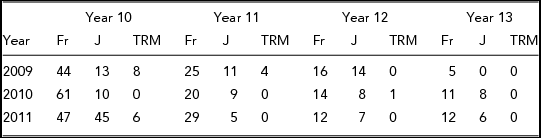
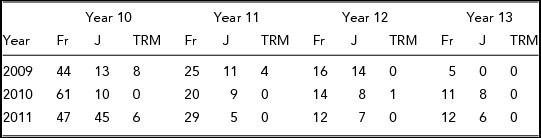
The principal and te reo Māori teacher of one English-medium secondary school were approached and invited to participate in the research. The school is a medium-sized, decile 7, inner-city girls’ school for students in Years 7 to 13 (ages 11–18), with an enrolment of approximately 800 students. School deciles range from 1 to 10 where decile 1 schools draw their students from low socio-economic communities and, at the other end of the range, decile 10 schools draw their students from high socio-economic communities. Deciles are used to provide funding to state and state-integrated schools. The lower the school's decile, the more funding it receives. A school's decile is in no way linked to the quality of education it provides. New Zealand European/Pakeha students comprise 49% of the student population, and Māori 7%, with other ethnic groups, including Indian, Asian, Pacific, European, British and African, making up the remaining 46%. Initial discussions revealed that both the principal and te reo Māori teacher were concerned and disappointed that the number of students choosing te reo Māori in Year 10 and subsequent senior levels at the school was very low, particularly in comparison to those choosing the other language options, Japanese and French (some minor details have been changed to ensure anonymity of participants). The learning languages curriculum was structured at the school so that all students in Years 7, 8, and 9 took each of the three languages offered for one term. A term is approximately 10 weeks and students had two or three sessions of each language per week. Thus, by the end of Year 9, students had learned te reo Māori for three terms over 3 years. The rationale underpinning this curriculum design was to introduce students to each of the three language options in order that they could make informed subject choices for Year 10 and beyond. Towards the end of Year 9, students could choose up to two languages, or opt for no languages. The research was initiated in 2010 and Table 1 shows numbers of students choosing languages in Years 10 to 13 from 2009–2011. It is important to note that while te reo Māori is offered in the school Choices booklet, it is not guaranteed as a face-to-face option. Historically, students who have chosen the option in Years 11, 12, and 13 have studied by distance through the New Zealand Correspondence School.
Numbers of Students Choosing Languages
Note: FR = French; J = Japanese; TRM = te reo Māori.
Clearly, the number of students choosing te reo Māori was significantly less than those choosing alternative language options of French and Japanese. The only Year 12 student who took te reo Māori in 2010 did so by correspondence, and her interview responses are referred to in the findings section. What was behind her and other students’ decision making, and specifically, why were so few choosing te reo Māori? The research questions were:
1. What factors influence Year 9 students’ decisions to choose te reo Māori as an option in Year 10?
2. What are parents’/caregivers’ beliefs and perceptions about te reo Māori as an option for their children entering Year 10?
3. What factors have influenced the student's choices currently taking te reo Māori as an option in Year 12?
4. In what ways does the school infrastructure impact on the uptake of te reo Māori as an option in Year 10 and beyond?
The research was primarily qualitative as this approach aligns more comfortably with a Māori world view (Walker et al., Reference Walker, Eketone and Gibbs2006), although some quantitative measures were used to provide baseline data. Year 9 students were the focus of the study because they would be making choices about options in Year 10. Three methods of data collection were used. First, students and their parents/caregivers were invited to complete a questionnaire of mainly Likert-scale items that investigated attitudes and beliefs about learning a language other than English, attitudes and beliefs about learning te reo Māori, and factors which influenced their (or their daughter’s) subject choices. Following on from this, focus group interviews were held with a group of students who intended to take te reo Māori in Year 10, and a group of students who did not. The focus groups enabled the researcher to probe students’ attitudes, beliefs, and decisions about language learning in more depth. Finally, individual interviews were conducted with the only student studying te reo Māori in Year 12 by correspondence (Ahorangi), the Head of Languages Department (Giuliana), te reo Māori teacher (Hera), and the Deputy Principal in charge of Curriculum (Cathy). All names used are pseudonyms.
To begin with, 60 questionnaires were distributed to Year 9 students who had recently completed one term (approximately 10 weeks) of te reo Māori and their parents/caregivers, 120 in total. Approximately one third of participants returned the questionnaires. This is only slightly lower than the typical 40% return rate (Cohen, Manion, & Morrison, Reference Cohen, Manion and Morrison2000). The low return rate could have been due to the fact that the questionnaires were distributed at the end of the year when families receive large numbers of communications from the school, some of which go unnoticed. Alternatively, it may be an indication that students and families are either indifferent to, or satisfied with, languages education being offered at the school. Despite the small numbers, some clear indications of participants’ attitudes, beliefs, and ideas about learning languages emerged.
Findings
Participant details from the returned questionnaires showed that only two of the fourteen parents/caregivers spoke a language other than English (both Chinese), although four indicated they belonged to ethnic groups other than NZ European (responses were from one Indian, one Chinese, and two ‘mixed’). Students, on the other hand, represented a much more diverse group, indicative of the school population. Six of the 23 respondents spoke languages other than English on a regular basis (two Cantonese, one each of Hindi, Tongan, Niuean and French) and 19 indicated ethnicities other than NZ European, including 2 Māori. On the whole, then, the majority of questionnaire respondents were monolingual English speakers, but represented a range of ethnic groups. As the questionnaire was offered only in English, it is possible that parents who spoke another language as their first language were not easily able to complete it, which could be an added factor in the small number of returns. These participant details are relevant in light of the nature of the questions about learning languages.
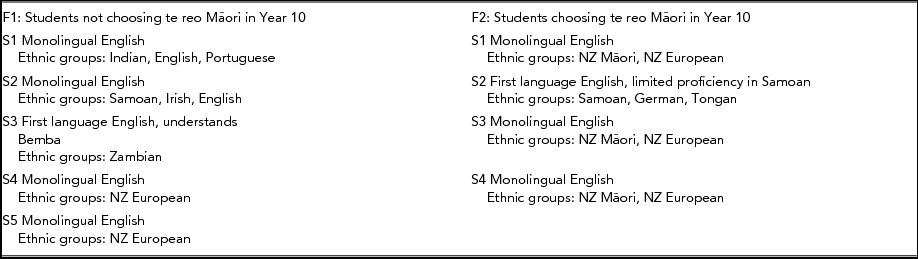
The findings from the questionnaires were able to be explored in depth during individual and focus groups. Focus group 1 comprised five students not choosing te reo Māori in Year 10 who volunteered to be interviewed. Focus group 2 comprised the four students who were choosing te reo Māori in Year 10. Table 2 shows relevant details for these participants.
Linguistic and Cultural Backgrounds of Focus Group Participants

Note: F = focus group; S = student; NZ = New Zealand
Findings are reported according to key themes that address the research questions. Ways in which the components of Spolsky and Shohamy's (2000) framework — language ideology, language practice, and language management — interact to influence students’ decision making, is evident in each of the themes that emerged from analysis of the data. The four key themes are: attitudes and beliefs about language learning, attitudes and beliefs about learning te reo Māori, the status of te reo Māori in the school, and factors influencing students’ subject choices.
Attitudes and Beliefs About Language Learning
Results from the questionnaires, focus groups, and individual interviews revealed that students, parents/caregivers, and staff held positive attitudes towards learning a language other than English. Reasons for this were mainly related to the perceived benefits of learning about ‘other cultures’. Students believed that learning a language was worthwhile for travel, helping others, learning about how language works, and learning about the history and general knowledge of a culture. There was a consensus among students and teachers interviewed that international languages held a more ‘exotic’ appeal than te reo Māori and this was in part due to the overseas trips offered to students of French and Japanese. Senior teacher Cathy reasoned:
Kids say, well I can go on the Noumea trip and that's a HUGE attraction or them. [X] said that she would take the girls to Japan and that probably has contributed to the rise in numbers, you know . . . so, what can te reo offer? (Individual interview)
There was also a belief that foreign languages had more practical relevance and would be more useful for students in their futures, because these were spoken in several countries outside of New Zealand.
The HOD languages teacher, Giuliana, herself multilingual and a native speaker of French, held strong views about the importance of learning languages for students to gain empathy and understanding of cultures other than their own. She also noted though, that while some students held positive attitudes about language learning, the attraction of a wider range of specialist subjects from Year 10 onwards (such as dance and drama), combined with the perception by some that learning a language would not help them in their future careers, meant numbers choosing languages diminished in the senior school. Giuliana felt there was a prevailing monolingual attitude in New Zealand: ‘In New Zealand, English is the primary language. If you speak English you will be fine. Why speak German, French, Japanese, Chinese?’ (Individual interview).
Attitudes and beliefs about language learning arise predominantly from participants’ language ideologies.
Attitudes and Beliefs about Learning te reo Māori
One of the most convincing findings was that all parents/caregivers, students and teachers surveyed and interviewed believed that te reo Māori should be a choice. Reasons were that te reo Māori is an official national language of New Zealand, it is unique to New Zealand as a heritage language, and students should have the right to choose to learn the language. One parent (non-Māori) explained why te reo Māori should be offered as an option:
Because it is one of New Zealand's three national languages and is what differentiates us from other countries. I also think it is important for students to have the choice to become fluent in Māori rather than just learn the basics. (Questionnaire)
Despite the strong belief that te reo Māori was important, unique, and should be an option, many believed that it was not relevant for future study or career options. This was verified by the focus group of students not choosing te reo Māori as an option in Year 10. One student explained:
Thinking of the long term and stuff, like if I don't stay in NZ, like if you’re living in NZ you wanna know like the history of the people . . . but if I wanna get a job in another country and I said I could speak Māori then maybe they wouldn't know what it was . . . (S3, F1)
Although the view that te reo Māori held little, if any, relevance for future study and career plans was held by many, it was interesting to note that more than one quarter of those surveyed responded they were ‘not sure’ to the question ‘Do you think te reo Māori will be useful for you in the future?’
Just over half of students surveyed responded that they enjoyed learning te reo Māori. Students’ experiences of the subject were explored in more depth during the focus groups and it was revealed that most enjoyed te reo Māori, including those who were not continuing with it in Year 10. It emerged that students enjoyed interactive activities such as games and role plays more than worksheets and written tasks. Some students suggested that they would like to have learned more about the history of the culture alongside language learning:
In Māori we just go straight into learning the language. Just personally, I like to know about the history of the country, know all the stuff about it as well as knowing the language. (S3, F1)
Some students’ lack of enthusiasm was linked to their perception that they were not good at learning languages.
All teachers and all students who had chosen te reo Māori as a subject expressed concern at a lack of respect for, and understanding of, te reo Māori among the general student body.
It's not the teachers’ fault, it's the students’. I think there's a bad attitude amongst the students about Māori . . . it's uncool to do anything or take anything Māori, and it's the whole fear of the unknown so you mock it . . . people will walk around school and mock a karanga [a formal ceremonial call to welcome visitors] for example that we’ve just done in church and they’ll be like ‘ahh ahh ahh ahh’ and all this kind of stuff and it's just cos they don't know the significance of it. (Individual interview, Ahorangi)
Teachers interviewed felt that this lack of understanding was also evident among some staff and board members. The te reo Māori teacher felt that not everyone was supportive of te reo Māori, and that professional development would be beneficial for things like basic protocols and pronunciation of commonly used Māori words and names. She explained:
Tikanga and language would be more useful at this point because there are still teachers that don't know a lot about the tikanga and it would be really useful for them to know in their classrooms, like sitting on the tables — little things, but if we’re all on the same page. (Individual interview, Hera)
The following comment from a student highlights the importance of teachers understanding protocols and being ‘on the same page’:
Well in Māori class, you know how it's tapu [sacred, prohibited, set-apart, restricted, forbidden] to sit on the desk, well in other classes, teachers they just let you. You get told different things in Māori and in English you don't have to do it. Cos like our RE [religious education] teacher will just say like you can sit on the desk if there's not enough chairs but you get taught differently in Māori. (S2, F2)
So, while it was clearly evident that all participants believed te reo Māori should be available for those wishing to learn it, there was some uncertainty about its relevance, and a wide range of beliefs about its value as a language. Attitudes and beliefs about learning te reo Māori also arise from participants’ language ideologies.
The Status of te reo Māori in the School
The extent to which the school valued and incorporated te reo Māori was the theme that had the most variation in the answers. Questionnaire results showed that more people agreed than disagreed that the school valued te reo Māori, but half of the parents and almost one quarter of the students were ‘not sure’ about this.
Teachers and students interviewed acknowledged the positive things the school did to promote and incorporate te reo Māori, but also felt that more could be done in this regard. Giuliana, reflecting on the research during her interview said:
You know what, it [the interview schedule] just really made me think a bit more deeply about everything in regards to Māori because I do think it's quite disadvantaged and as I said we could do more. (Individual interview)
Small numbers of students choosing te reo Māori in Year 10 and beyond seemed to both perpetuate and be perpetuated by institutional policies. Te reo Māori had no permanent classroom, had only one small display area, and the teacher was part-time with additional responsibility for another curriculum area. Furthermore, the te reo Māori teacher had no designated office space or computer (although had access to shared work spaces). During an interview with deputy principal Cathy, it became clear that the lack of resourcing linked directly to school policy:
The policy is that a full timer gets a room and we don't have enough rooms . . . we haven't got enough space and that's the long and short of it . . . I guess it's more than difficult. I think it's impossible [to assign a dedicated space for te reo Māori]. (Individual interview)
Cathy explained that the only way to afford te reo Māori dedicated space was if numbers increased. This, she acknowledged, was difficult because certainty about whether or not the subject would be offered in Years 11, 12, and 13 could not be given:
Well, why would we [offer te reo in Year 11 to the four students taking it in Year 10]? If one of those people falls out or two of those people fall out then that's a significant amount of money when you’ve got RE [religious education] classes with 33 in them. So, it's trying to be equitable . . . the implication of a class of two people means that another class has to be 40 people . . . it then becomes inequitable. (Individual interview)
Although some school policies appeared to negatively impact on te reo Māori, there seemed to be a genuine desire by senior management for the subject to attract more students. The decision to make te reo Māori compulsory for a term each in Years 7, 8, and 9 (along with Japanese and French) was a planned attempt to increase student uptake of te reo Māori as an option in Year 10 and beyond. Cathy explained:
I had done it specifically to encourage the uptake of te reo Māori because if I don't do that then people who are coming in at Year 9, and there were about 30 students, would never have had any experience because they may have had none at primary school, which is often the case. (Individual interview)
During Giuliana's interview it emerged that there were no prizes or awards specifically for te reo Māori, whereas both Japanese and French had several prominent awards and end-of-year prize-givings. Giuliana acknowledged this and stated that a cup for te reo Māori would be put in place for the following year.
Te reo Māori teacher, Hera, confirmed that more could be done in the school to include te reo and tikanga Māori:
The whole presence of tikanga Māori and te reo around school, I don't think it's — it's not a high priority. It seems to be like, a bit of a token — when we have an event, they’ll say a greeting . . . there is bits, but I do think at every assembly it should be normal to greet everybody in Māori and in other languages, but first in Māori . . . to show the girls that it is of value, that it is our heritage and one of the official languages. It would be nice if this was led from the top. (Individual interview)
All students in focus group 2 agreed strongly that te reo Māori was not valued by the school, particularly in relation to other language options:
I think the school should fund Māori more because it seems like French and Japanese and other subjects get more funding. I understand that more people are taking those subjects, but if they promoted Māori more then lots of people would take Māori. (S4, F2)
So, while there was acknowledgement that as New Zealand's heritage language and culture te reo Māori deserved prominence at the school, there were also clear indications that some were unsure about the extent to which it was valued there. Teachers, along with students who had chosen te reo Māori, signalled they believed it could, and should, be afforded more prominence and status. Here, the perceived status of te reo Māori in the school was again linked to language ideologies, but was also influenced by language practices and language management decisions.
Factors Influencing Students’ Subject Choices
The student questionnaire listed seven factors that participants were asked to rank in order of importance when choosing subjects for Year 10. The factors ranked as follows: Career choice; Enjoyment of subject/perception of ability (same level of importance); Parents/Caregivers’ advice; The teacher of the subject; and Teachers’ advice/perception of difficulty of the subject (same level of importance).
Interview responses confirmed the importance of future careers as the key deciding factor when making subject choices. All students had ideas about what they wanted to do, although understandably at age 14 years, most were not absolutely sure. Students had high expectations of themselves, with most talking about the possibility of working and/or travelling overseas. Those who had chosen te reo Māori for Year 10 were highly motivated by their belief that this would be advantageous in several career paths; for example, on Māori television, the police force, and teaching. One student said: ‘There's more job opportunities and you can get more money if you speak Māori’ (S1, F2).
Of equal importance were enjoyment and ability when making subject choices. Some students noted, however, that the timing of selecting options, the end of Term 3, could be problematic. One student explained:
It was a bit hard because I didn't know what Māori was going to be like. I didn't know if I was going to enjoy it or not because when we were choosing I was in French so I didn't know if I could learn it or not (because I wasn't doing it until Term 4). (S1, F1)
Students’ perceptions of their own ability is linked to their perception of the difficulty of a subject, which was also a strong influence on choice. One student who had not chosen te reo Māori or any language in Year 10 succinctly said: ‘I really suck at languages’ (S1, F1).
An additional factor affecting subject choice, which had not been included in the questionnaire, was the lack of certainty that te reo Māori would be offered after Year 10. While students may have wanted to take the option in Year 10, they were reluctant when the school was not able to guarantee it would be offered in Years 11, 12, or 13. Apart from Ahorangi, who was learning te reo Māori by correspondence in Year 12, the Year 9 students did not know of anyone else who had taken this through to senior levels.
When people were choosing their options heaps of people wanted to choose Māori but they didn't know if they could take it at NCEA [National Certificates of Educational Achievement — New Zealand's national qualifications for senior secondary school students] because they only see people taking French and Japanese, so they didn't know if Māori was an option at NCEA so they thought there's no point in taking it next year if you’re just going to drop it in Year 11 and so everyone was unsure about that because like the school didn't say anything about it. (S2, F2)
Students, then, were significantly motivated to choose subjects they believed would be valuable for their future careers. This was the case for students who had chosen te reo Māori, as well as for those who had not. However, another unanticipated factor was the lack of certainty te reo Māori would be offered in subsequent years. Students were not able to confidently plan a learning pathway that included te reo Māori at this school. Here, it is apparent that all three components of Spolsky and Shohamy's (2000) framework — language ideologies, language management, and language practices — interact to influence students’ decision making.
Discussion
In this study, there appeared to be a positive ideology towards te reo Māori. Participants reported positive attitudes and beliefs about te reo Māori, stating that it deserved a unique and significant role in the school. However, this did not translate into language practices, that is, decisions to learn the language, because of more powerful beliefs that te reo Māori held little or no value for future careers. Spolsky and Shohamy explain the role of ideologies in practice and policy: ‘beliefs both derive from and influence practice. They can be a basis for policy, or a policy can be intended to confirm or modify them’ (2000, p. 4). School policy makers must be cognisant of their power to modify beliefs. The number of participants ‘not sure’ about the relevance of te reo Māori are poised to be influenced either way. It could be that ‘the systematic injection of te reo into everyday New Zealand’ (Macalister, as cited in Day, Reference Day2012, p. 6) is influencing people to value and respect our heritage language. Such possibilities must be capitalised upon, particularly in light of the positive ideologies towards te reo Māori emerging from this research, which included mostly non-Māori participants.
While most believed that the school valued te reo Māori, Māori students unanimously disagreed that this was the case. This finding echoes strongly Delpit's (Reference Delpit1988) assertion that ‘those with less power are often most aware of its existence’ (p. 282). Māori students, a minority in the school and holding very little power, were keenly aware of the lack of status their language and culture was afforded. This belief was a result of the disparity the students saw between te reo Māori and the international languages offered. In their eyes, the international languages were valued more by the school because they had a higher profile and were more well resourced, resulting in more students choosing these options. Investigating the wider effects of Māori students feeling marginalised, undervalued, and being denied access to learning their heritage language and culture was beyond the scope of this research. However, the disempowering effects this can have has been well documented (e.g., Barnes, Hutchings, Taupo, & Bright, Reference Barnes, Hutchings, Taupo and Bright2012; Bishop & Glynn, Reference Bishop and Glynn1999; Webber, Reference Webber2012; Whitinui, Reference Whitinui2011). A further limitation in this research was the small number of Māori participants.
Language ideologies are not the sole influence on language practice and policy (Spolsky & Shohamy, Reference Spolsky, Shohamy and Lambert2000). Language management, that is, individual or institutional controls, also have important, and arguably more compelling, influences on language practices. One such control, the compulsory learning of te re Māori in Years 7, 8, and 9, reflected the positive ideologies espoused. However, most components of language management in the school, such as the time of year for choosing subject options, the absence of dedicated teaching and office space, uncertain subject pathways for senior students, and the lack of te reo Māori's visibility at prize-givings and other significant school events, negatively impacted on the uptake of te reo Māori by students. Many of these language management decisions were financially driven, reflecting the tension between language rationalisation and language rights (Akinnaso, Reference Akinnaso1994), and evidence ways in which decision makers ‘inadvertently create barriers through policy and procedures that result in inequitable and unfair treatment of Māori’ (Hutchings et al., Reference Hutchings, Barnes, Taupo, Bright, Pimaha and Lee2012, p. 44). The weight of these constraints appears to have significantly outweighed any positive beliefs and attitudes towards the learning of te reo Māori.
Conclusion and Ways Forward
The data detailing students’ language practices outlined at the beginning of this article showed that when able to choose (from Year 10 onwards), most opted not to learn a language at all. Of those who did, very few chose te reo Māori, opting instead for international languages. Spolsky and Shohamy's theoretical framework (2000) has provided insights that contribute some explanation for these choices, although Spolsky himself acknowledges ‘the interrelationship of management with practice and ideology is the most problematic issue in language policy’ (2003, p. 554).
Language ideologies play a significant role in language choice, but even students whose ideologies propel them towards te reo Māori find themselves constrained by language management practices in the school. If schools genuinely want their espoused ideologies to have an impact on te reo Māori regeneration, then management decisions and policies must be based on ‘more than mere economic rationales’ (Fishman, Reference Fishman2001). Schools must work to address what has essentially become ‘structural racism’ (Barnes et al., Reference Barnes, Hutchings, Taupo and Bright2012, p. 16). Decision makers need to be aware that plans for language learning have a powerful influence on ideologies, and view their policy decisions as having the power to assign, rather than assess the status of a language (Spolsky & Shohamy, Reference Spolsky, Shohamy and Lambert2000). This power can be harnessed to positively influence those ‘not sure’ about te reo Māori's relevance and value in today's world.
The research identified ways in which the school could encourage increased uptake of te reo Māori in Year 10 and beyond. Suggestions from participants included: increased prominence at school events; tangible support from senior management, such as a dedicated classroom, office, and display area; and professional development for all staff. Finally, and most importantly, te reo Māori must be consistently offered as a subject in senior years. Students need to see this option listed in curriculum choices and must be guaranteed a pathway for learning te reo Māori, regardless of student numbers. It is significant and positive that the school has already acted on some of these recommendations: there now exist dedicated awards for te reo Māori at school prize-givings; there is increased prominence of te reo Māori at school events; staff have had professional development about culturally inclusive pedagogies; and most significantly, a small number of senior students are learning te reo Māori with a dedicated teacher.
It can be problematic to justify a guaranteed pathway for learning te reo Maori to management holding a narrow view of ‘equity’, where funds are distributed according to student numbers. However, there are rationales more compelling than mere financial ones. Articles 23 and 27 of the 1996 Universal Declaration of Linguistic Rights state:
Education must help to foster the capacity for linguistic and cultural self-expression of the language community of the territory where it is provided.. . . All language communities are entitled to an education which will enable their members to acquire knowledge of any languages related to their own cultural tradition. (UNESCO, 1996, p. 9)
An even more compelling argument in the New Zealand context is that failure to offer te reo Māori is a breach of the Treaty of Waitangi. In 1996, the Waitangi Tribunal found that the treaty included a guarantee to requiring ‘affirmative action to protect and sustain the language, not a passive obligation to tolerate its existence and certainly not the right to deny its use in any place’ (as cited in Spolsky, Reference Spolsky2003, p. 564). Affirmative action must occur in language management and policy decisions.
As stated in the introduction, such affirmative action is already in place in educational settings in which te reo Māori is the sole language used. These are undeniably the most effective means for increasing numbers of fluent speakers, and therefore a vital component of language regeneration. Graduating students from these environments are a joy to behold and evidence ways in which learning in and through one's language and culture provides a solid foundation for success (in any and all of its manifestations), confidence, and citizenship in many and varied communities. Currently, however, such settings cater for a disproportionately small number of school-aged students — 5.4% — and are only ‘pockets of success’ (Durie, Reference Durie2011, p. 132) in the language-regeneration landscape.
Durie (Reference Durie2011) states that planning for te reo Māori regeneration needs to be future focused and not in response to crises. If te reo Māori is to relinquish its ‘endangered species’ status, one such future focus must be in English-medium schools, which it has been argued here wield a powerful influence on students’ language ideologies and practices. These institutions are responsible for educating the vast majority of young New Zealanders, both Māori and non-Māori. Findings here signal that the grounds of English-medium secondary schools are fertile for the regeneration of te reo Māori. Many may despair that regeneration efforts in these contexts is too difficult, preferring to concentrate efforts in total-immersion environments where competing for status with English and other international languages is less problematic. The implications of making te reo Māori a more realistic and desirable subject in English-medium schools are not insignificant, with questions about resourcing likely giving rise to consternation from all education stakeholders. However, to ignore those schools attended by almost all New Zealand students as possible sites for te reo Māori regeneration is, I would argue, far greater cause for consternation.
About the Author
Maree Jeurissen lectures on the Graduate Diploma of TESSOL in the School of Curriculum and Pedagogy, The Faculty of Education, The University of Auckland. She has a background in primary school teaching, including ESOL. Current research endeavours include collaborations between principals and ESOL teachers, secondary school students’ uptake of Te Reo Māori as a subject, and the impact of after school reading programmes on whānau literacy practices.