Rigid endoscopy
Rigid endoscopy accounts for a significant number of the procedures performed in our ENT out-patient clinic. Rigid endoscopy can be used to examine the nasal vestibule, and enable decrusting of the sinuses and removal of stents. The views obtained from the rigid endoscope are excellent, but will at times be limited because of fogging or debris on the lens. To limit the impact of both of these common problems, we have developed a system for setting up our anti-fog solution. This system has a number of benefits, and is simple, quick and easy to set up.
Equipment
This consisted of anti-fog solution, a 5 ml syringe, a cardboard receiver and gauze.
Set-up
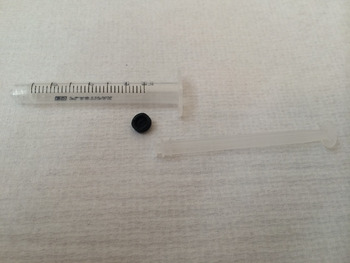
The syringe is taken apart (Figure 1); the bung is removed from the end of the plunger and placed back into the syringe where it is gently pushed to the bottom, creating a watertight seal. The syringe is then pushed through the cardboard side of the receiver. The syringe is filled with anti-fog solution and gauze is placed into the receiver. This whole process takes less than 30 seconds.
In the initial set-up, a syringe is taken apart; the bung is detached and reinserted to create a watertight seal.

The endoscope can now be dipped into the anti-fog solution, and can either be used directly or any excess solution can be gently brushed off with the gauze.
Advantages
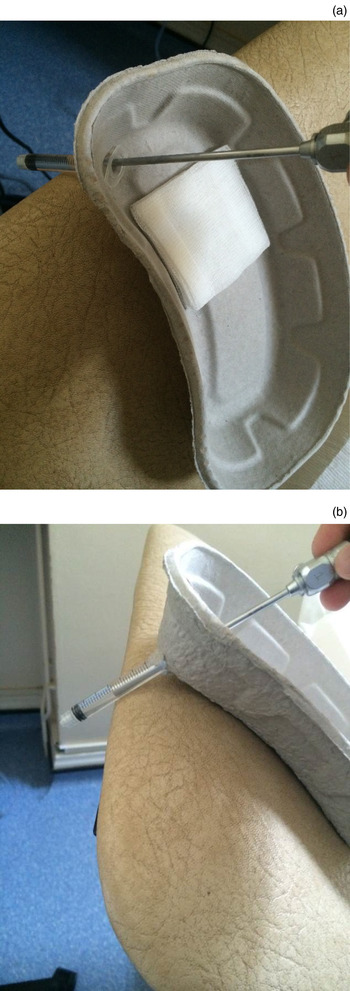
This system is quick, inexpensive and easy to set up. The system can be placed on the elevated head of an examination couch to enable easy access (Figure 2). Any instruments used during the examination can be placed in the receiver for safekeeping and easy access. By dipping the lens end of the rigid endoscope in the anti-fog solution, an even coating is ensured. The entire system can be thrown away after each patient use, promoting good infection control.
Images (a and b) showing the positioning and ease of use of the anti-fog system.