In February 2007 the Office of Fair Trading (OFT) published a study on the UK's Pharmaceutical Price Regulation Scheme (PPRS). The latter has in various forms played a role in setting NHS medicine prices since the late 1950s. The OFT's report concluded that the 2005 version of the PPRS (which sought in the main to regulate pharmaceutical company profits earned from the NHS via calculations taking into account capital investment levels and the research, promotional and managerial costs incurred in relation to the sale of patented medicines in the UK) was ‘outdated, perverse and unfit for purpose’. It concluded that even though the PPRS might need to be retained as a form of ‘reserve regulation’, it ought to be largely replaced by product by product ‘value based pricing’ (VBP).
It may be argued that in reality the establishment of the National Institute for Health and Clinical Excellence (NICE) already represented a significant step in this direction, even by 2007. VBP involves using health economics techniques like those employed by NICE to link (patented) medicine prices to the cost per Quality Adjusted Life Year generated by their use. The OFT's detailed proposals also envisaged that as and when the first medicine in a class loses patent protection, all other product prices in that group should drop to a function of the generic/commodity price of the ‘first off’ patent molecule. This approach would further cut expenditure on innovative pharmaceuticals by reducing the financial benefits of patent protection for those research based companies offering products that are not first in class, perhaps even when the latter have unique clinical advantages.
The OFT's report was greeted with approval in much of the media, reflecting in part the public relations skill and investment put into its launch and also the widespread perception that large pharmaceutical companies make ‘billions of pounds of excessive profit’. The Independent, for example, ran a story headlined ‘Energetic OFT head turns his guns on Big Pharma’ (Mesure, Reference Mesure2007). It began ‘John Fingleton, the Irish Head of the Office of Fair Trading, set himself on a collision course with Big Pharma yesterday after declaring that the NHS was being overcharged to the tune of £500 million per year for some drugs.’
The latter estimation was largely based on a critique of statin-based medicine costs. The first product in this class, simvastatin, had at that time relatively recently lost patent protection. The OFT argued that the price difference between the generic simvastatin which then became available and still patented products with higher prices permitted by the PPRS was illegitimate.
The extent to which the OFT's prescription represents a desirable way of determining the prices of the medicines purchased by the NHS, or indeed other health care providers, is debateable. At the time authors such as Adrian Towse – the Director of the pharmaceutical industry linked Office of Health Economics – questioned the validity of some of its arguments (Towse, Reference Towse2007). By contrast, Professor Karl Claxton of the University of York – an institution which has made important contributions to the establishment and work of NICE – judged most of the expressed concerns about the OFT's proposals to be ill-founded (Claxton, Reference Claxton2007).
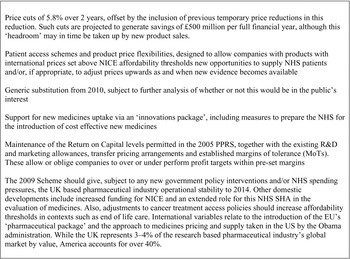
In February 2008 the Department of Health (DoH) announced that it was withdrawing early from the 2005 PPRS agreement. After a period of what the participants describe as ‘robust negotiation’ a new version of the PPRS came into effect in January 2009 (DoH, 2008; BIS, 2009). Its key terms are summarised in Figure 1. Even critics of the past PPRS welcomed the fact that the new arrangements would cut £500 million a year from the NHS medicines bill (Collier, Reference Collier2008). Such commentators emphasised their view that prices ‘should reflect a medicine's clinical value’.
Key elements of the 2009 PPRS

Against this background this article sets the ongoing discussion of VBP in a broad economic and social policy context. It considers issues relating to the politics of national and international drug price regulation and public interests in, on the one hand, equitable and affordable access to existing medicines and, on the other, investment in innovation for the future. Key policy questions include ‘is VBP as proposed by the OFT and allied commentators a viable solution to the problems posited by critics of the traditional PPRS mechanisms?’ and ‘are there any alternative approaches to pharmaceutical pricing and investment incentivisation that might in future be more likely to serve British, European and/or global interests?’.
In the context of the present financial crisis and factors such as declining North Sea oil reserves it is also pertinent to ask ‘is private sector led pharmaceutical innovation effectively exhausted, or does it have the potential to contribute significantly more to human welfare?’ and ‘to what extent can the UK maintain future standards of living if it cannot keep a leading role in pharmaceutical research and commercially successful innovation?’.
The view taken here is that bio-pharmaceutical research has a long-term potential to contribute to not only new health gain in areas ranging from viral disease and cancer treatment to neurological illness prevention and the delay of ageing processes, but also to areas such as energy and food production and environmental protection. Some influential commentators may now believe that the UK, and the European Union more broadly, can for differing reasons no longer match either the US or China and India in bio-pharmaceutical research and industry led drug development. But the view underpinning this article is that this is not inevitably so, and that well informed public policies could help restore national and perhaps also regional competitivity.
The political economics of health and pharmaceutical care
At the time of the NHS' creation in the late 1940s there was hope amongst British (and US) policy makers (based largely on the model provided by the introduction of penicillin) that new medicines, coupled with better access to health care, would radically improve the health and productive potential of the country. That is, that pharmaceutical industry success could help ‘win the peace’, as well as the war against disease. It was no coincidence that the Association of the British Pharmaceutical Industry was established in its modern format in 1948, alongside the radical restructuring of the UK medicines market associated with the creation of the NHS. National health and industrial ambitions were better aligned than might sometimes be understood.
Nevertheless, the Treasury was even at that time concerned about the affordability of nationalised health care, and the opportunities that private suppliers to the NHS might have to take undue gains from the public purse. In the case of medicines, there were fears that firms might in effect ‘bribe’ GPs and other prescribers to give costly but sometimes needless treatments to their patients at the expense of the healthy tax payer.
From a political perspective it is easy to understand why tensions surrounding the creation of the NHS were in the early 1950s focused on the issue of free prescriptions. It was, overtly at least, on this issue that Harold Wilson resigned from the 1952 Labour Cabinet. Although at that time total medicines spending (in manufacturers’ price terms) accounted for <10% of total NHS outlays, it was far less politically hazardous to highlight this area of expenditure than it would be to question other components of health service spending. Anxieties about drug costs to a degree embodied less readily expressed concerns about the affordability of the NHS as a whole.
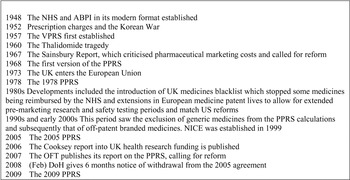
The establishment of the Voluntary Price Regulation Scheme (VPRS) for NHS medicines in 1957 (the forerunner of today's PPRS – see the chronology presented in Figure 2) was aimed at allaying political concerns about the affordability of pharmaceuticals. Notwithstanding the advent of the Thalidomide tragedy at the start of the 1960s (which changed fundamentally previously positive public attitudes to drug innovation) the VPRS was initially successfully in doing this by linking allowed NHS prices to export prices obtainable on ‘the world free market’.
An outline chronology of the PPRS

Yet those involved in negotiations at that time were privately aware that this approach could, in addition to underpinning the British research based pharmaceutical industry's strategically important global success, in many cases have driven up public expenditure in the UK (Taylor and Maynard, Reference Taylor and Maynard1990). This was because export prices were in reality often higher than home sale prices.
As has also become apparent in contexts such as health care quality regulation and professional representation (Salter, Reference Salter2004, Reference Salter2008), the underlying drivers and objectives of drug price control schemes are more complex than they may superficially appear. This fact is linked to not only electoral sensitivities about the overall costs of tax-funded health care but also the interplay of policies aimed on the one side keeping domestic consumption levels affordable and on the other maintaining nationally based capacity to generate international earnings.
Today's issues
It would be outside the scope of this article to explore why countries such as the US and those of Western Europe adopted contrasting approaches to health care funding and the encouragement of pharmaceutical research investment in the decades after the Second World War. But as the ‘losing winner’ of the 1939–1945 conflict Britain was and remains in what may be described as a hybrid policy position. The establishment of the state funded, non-market, NHS was vital in terms or restoring population confidence in the body politic at a time of failing Empire. Yet on the global stage and in areas such as banking Britain was and remains more closely aligned to the market competition related values of the US than it is to what might be seen as statist European traditions.
Even today the NHS has a special political significance in the UK, despite the fact that current challenges to the health and wellbeing of the British people differ radically from those faced at the start of the 1950s. Then TB was still a major threat, whereas now the prevention and amelioration of chronic non-infectious diseases in later life dominates the NHS workload. In a globalised economy it is harder than it was in the 1950s for politicians and the electorate to define a ‘British’ pharmaceutical industry, while increasing population affluence and diversity have transformed patterns of health and health care demand. Voters may still, however, regard the NHS as a vital nationally provided (as opposed to, say, an EU required) institution.
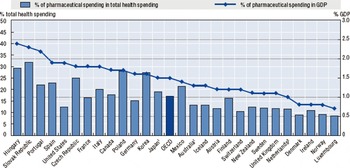
NHS expenditure on pharmaceuticals remains a high profile topic, albeit that it still stands at only 10% of total health service costs when expressed in manufacturers' price terms. Although the overall level of GDP devoted to the NHS rose significantly during the Blair and early Brown eras, the UK is still a middle to low ranking nation in terms of pharmaceutical expenditure (Figure 3). The available data in addition indicate that it has modest domestic promotional outlays, balanced by relatively high (and to date successful) pharmaceutical research spending. Under the PPRS promotional costs have in the NHS market been kept to under half the level of research investment. Yet internationally pharmaceutical marketing costs typically exceed those of research.
Pharmaceutical spending in total health spending. Source: Pharmaceutical pricing in a global market (OECD, 2008)

A principal driver of increased NHS spending in the last decade has been an increase in the relative cost of health sector labour. This accounts for >70% of all NHS outlays. Such growth must, especially in a period of economic downturn, be paid for by either reductions in the numbers of people employed, or future wage rate reductions or savings in other forms of NHS spending. The political significance of the OFT's 2007 intervention and the 2009 PPRS reforms relates in part to this situation, even though in reality its impact on the research based industry's income may prove less draconian than some commentators have suggested. For example, in areas like cancer care accepted NHS medicine prices could rise as a result of the access review recently conducted by Professor Mike Richards (Richards, Reference Richards2008).
Arguably, the internationally exceptional extent of generic prescribing by British doctors, the work of NICE, and the efforts of PCTs and similar commissioning agencies to ensure cost effective (or at least low cost) medicines use limit the advantages that the OFT's approach to VBP can offer. Against this record of proven achievement in NHS pharmaceutical expenditure control objective commentators might well conclude that its main ‘active ingredient’ would be cutting short the patent life related earnings of a proportion of innovative medicines that prescribers judge to have significant clinical advantages over pharmaceutically related off-patent products.
As such, the OFT's recommended approach to VBP was similar to the ‘therapeutic area reference pricing’ scheme already in place in countries such as Germany, rather than the economically rather more sophisticated arrangements being established in, say, Sweden. Nevertheless, it is a matter of record that the OFT chose publicly to associate its proposals with the latter rather than the former. This is perhaps not least because German policy on pharmaceutical pricing (notwithstanding that country's efforts to encourage the parallel importing of medicines) is seen by some as maintaining a relatively high domestic price based for older off patent products, which may help to protect the position of companies with a weak innovative record.
It could be that relatively few participants in the pharmaceutical pricing policy debate fully understand the significance of this point. But an intellectual case can made in support of the view that interventions modelled on the German approach would be more likely to undermine national and international interests in maintaining private investment in research for the future than it would be to improve access to medicines.
Questions for the future
There are a wide range of concerns that would need to be resolved for an informed public policy approach to the questions identified at the start of this article to be rigorously established. The pharmaceutical (research) market is complicated by issues such as its atypical reliance on intellectual property protection. In the particular context of the desirability and viability of VBP and its possible impacts on NHS medicine pricing and pharmaceutical spending, key considerations include:
Can the clinical value of a medicine be determined with any degree of reliability at around half way through its patent life – that is, at the time of launch? The answer to this is that with modern agents such as anticancer medicinesFootnote 1 that for optimum effect will need to be taken as components of complex regimens involving other new or established treatments, judging their ‘objective’ worth to consumers via the sorts of calculation used by NICE will in many instances be impossible until well after relevant patent terms have expired. This implies that, even with the pricing flexibilities and patient access scheme possibilities embodied in the 2009 PPRS, innovators could be unable to generate the levels of return needed to justify further investment. One possible interpretation of this conclusion is that it would be in the public's interest for new medicine pricing to be based anticipated benefits and individual and group willingness to pay in life threatening or ending circumstances, as necessary regulated to keep overall innovator returns and activities within agreed boundaries. That is, that the past PPRS approach is superior to the VBP option, because although the latter may have theoretical advantages they cannot in practice be realised.
What is the proper function of price signals in innovative markets? Following on from the above, in commodity markets prices serve to balance known consumer utilities against the availability of given goods or services. Yet in areas where patents or similar provisions exist to encourage investors to take financial risks in order to have a future chance of benefiting not only themselves but also humanity, prices may be regarded as having a more complex function. Attainable new product prices may – regardless of the medicine's specific benefits – serve as indicators of the shortfall between what currently available treatments offer and the outcomes for which consumers are prepared to pay. This may be a difficult reality for some to accept, but this does not necessarily mean that it should be rejected as untrue.
How should QALY affordability thresholds be set? There is no easy answer to this critically important question. It may practically be the case that in relation to determining levels of affordability this country will to a considerable extent (regardless of VBP per se) be obliged to follow the lead set by health care providers elsewhere, where the choices of individuals facing major health problems may have a more significant part to play than is so in the NHS context. It could also be argued that different communities within regions such as Europe should be able to set different treatment affordability levels. But with medicines as opposed to, for instance, surgical and nursing intervention this conflicts with single market rulings. In addition, NICE type QALY affordability thresholds relate to incremental rather than their average costs. This distinction is another example of an important consideration that is not normally fully understood by participants in the medicines pricing policy debate. It means that even comparatively low priced medicines, which may be clinically more effective than any available alternative, can be judged unaffordable once generic medicines become available in the therapeutic area concerned. In such circumstances forcing down prices to near commodity levels would undermine public interests in ongoing innovation.
To what extent do current techniques satisfactorily compute the true value of the individual and societal gains generated by new medicines? The measures used by agencies such as NICE do not, to date at least, take into account benefits over and above those gained by the individual in immediate receipt of treatment, such as the additional gains to his or her family of, say, a delayed or avoided death. Nor do they include estimates of the longer term ‘dynamic efficiency’ related gains for society as a whole. (Smallpox eradication is an illustration of a gain that should remain of benefit throughout the remainder of human history.) For this and other reasons NICE type calculations cannot possibly represent the full value of pharmaceutical innovation to communities. Nor do they necessarily measure the experienced worth of personal treatments to individuals – for example, a dying patient may value taking part in a medicines evaluation for altruistic reasons. For this reason it is encouraging that further research has been commissioned on the extent to which such ‘externalities’ should in future be taken into account by NICE, although this should ideally have been undertaken by agencies which do not profit from the use of existing techniques.
To what extent might radically changed approaches to intellectual property law and/or the role of clinicians in managing budgets covering all therapy related costs either alter the perceived cost effectiveness of innovative medicines, or obviate the need for centrally determined drug prices? Such issues have a potentially important relevance to the changing nature of the world medicines market, and the way in which public interests in this area can best be defended in advanced democracies. In a century where pharmaceutical advances remain urgently needed but will probably for both social and technical reasons be slower than was the case in the second half of the twentieth century longer patent terms (perhaps balanced by new approaches to assuring marginal cost access to innovative treatments in poor communities) could help make approaches like value based pricing more viable, or even obviate the need for supply side pricing interventions in richer communities.
Such considerations warn against assuming that economists have developed a comprehensive and reliable set of measures for valuing pharmaceutical innovations, that can be used to set new medicine prices without risking harm to patients and/or populations. Yet at the same time a pragmatic view is that in settings such as the modern NHS (and most other developed world health care systems) it is unlikely that political forces will permit pharmaceutical prices to be set without reference to governmental and electoral interests. Despite the challenges inherent in moving further towards VBP its advocates point to potential advantages in areas such as funding innovation, provided this is accepted as a central policy objective (Thornton, Reference Thornton2007).
Politicians who see their power as being dependent on their perceived ability to deliver ‘health’ to ‘their’ voters could if anything in future become more unwilling to permit clinicians or other directly involved care providers the power independently to control what medicines are judged affordable, and what prices reasonable. But if it is accepted that drug pricing is a political rather than a merely technocratic issue it can also be logically argued that policy makers have a responsibility to, as far as they are able, consider all the public interests at stake, and try to avoid the intellectual corruption implicit in taking a uni-polar view of such a complex field. In particular, they should seek openly to balance public interests in optimising minimal cost access to currently available treatments against investing in research and development that will ultimately contribute to enhanced future welfare.
This to date remains from an academic perspective a relatively poorly investigated area. But in increasingly genericised pharmaceutical markets such as that of the NHS it may be suggested that there is a today a greater risk of under-investing in innovation than in assuring access, not least because of the moral hazards that the politicisation of health care provision inevitably brings. This is not to say that the political regulation and direction of health care markets does not have demonstrable benefits. Rather, it is to argue that the latter must always to a degree to be offset by not always easily discernable disadvantages and risks, which should be honestly recognised and where possible be effectively mitigated.
Conclusions
One possible response to the NHS drug pricing policy debate of the last few years would be to suggest that policy makers can now and in the future (whether or not further attempts to introduce ‘value based pricing’ are introduced) do little more than ‘muddle through’. They can only try as best they can to take account of the inherent conflicts between differing (legitimate) social goals, and where possible institute checks to prevent any one interest becoming unduly dominant. Seen from this perspective, the historical development and performance to date of the PPRS system may not appear as wanting as has the OFT suggested in 2007, because its architects have for several decades attempted to achieve just such a balance. This implies that the ‘mixture as before’ is the correct prescription, because in truth there is no alternative.
The potential advantages of an alternative system based on the OFT's interpretation of ‘value based pricing’ may have on occasions been over-sold, perhaps in part due to factors related to the varying interests of competing regulatory and governmental agencies. From a political policy standpoint ‘health economics’ might also be thought of as an entity or group with distinct sectional interests.
Further undermining the financial benefits awarded by pharmaceutical patents at a time when the protection afforded by product branding has all but been eliminated could have serious medium and long term consequences. If attempts to introduce VBP have a destructive impact on the now hard pressed research based pharmaceutical industry business model, this could in time impose costs on the UK far greater than that of the annual NHS medicines bill. This is not least because future levels of direct public funding for activities such as research in institutions like Universities could also suffer as a result of further weakening intellectual property protection for innovative medicines. There is some evidence that the availability of public funding is positively associated with the existence of a potential for profit taking in the wider global economy.
However, viewed from a less critical perspective the 2009 PPRS and associated developments may have a more positive impact on the research based pharmaceutical industry than pessimists fear. Provided a robust understanding of what is meant by value in the pharmaceutical sector can be achieved, and an informed respect for the financial survival requirements of the rapidly changing research based pharmaceutical industry is gained by organisations like NICE and/or their political controllers, further progress towards ‘value based pricing’ for medicines could bring benefits to not only in this country, but perhaps in Europe more widely.
To the extent that the OFT's 2007 report has stimulated an open minded, intelligent, debate as to how national and international medicines markets might be further enhanced it has therefore given some value for the money invested in it. But in the final analysis the outcomes of all such exercises will ultimately depend on good fortune, as well as good will and sound judgement. No form of predictive economic or other social scientific analysis can ever remove the inherent uncertainties of human and scientific development.
Declaration of interests
David Taylor has been a Director of the Association of the British Pharmaceutical Industry and an Associate-Director of the Audit Commission for England and Wales. As Professor of Pharmaceutical and Public Health Policy at the School of Pharmacy, University of London, he has been in receipt of grants and relevant non-personal payments from organisations ranging from NICE to the Pharmaceutical Research Manufacturers of America (PhRMA). This article is based on a contribution to an LSE debate held in February 2008, revised in August 2009.