Health has an important role in the acquisition of human capital. Childhood health is a primary determinant of a person's physical human capital and plays a crucial role in human capital acquired through schooling. Modern studies find that differences between siblings in infant and childhood health translate into differences in cognitive ability, educational attainment, and earnings in adulthood (Behrman and Rosenzweig Reference Behrman and Rosenzweig2004; Case, Fertig, and Paxson Reference Case, Fertig and Paxson2005; Black, Devereux, and Salvanes Reference Black, Devereux and Salvanes2007; Oreopoulos et al. Reference Oreopoulos, Stabile, Walld and Roos2008; Royer Reference Royer2009). Studies of shocks to childhood health resulting from price shocks (Alderman et al. Reference Alderman, Behrman, Lavy and Menon2001), drought and civil war (Alderman, Hoddinott, and Kinsey Reference Alderman, Hoddinott and Kinsey2006), and the phasing in of deworming drugs (Miguel and Kremer Reference Miguel and Kremer2004) also reveal a positive relationship between childhood health and educational attainment.
This article explores this relationship between health and human capital in the United States at the beginning of the twentieth century, testing whether differences in childhood health both across and within households can account for variations in the educational attainments of World War II enlistees. The period during which these enlistees grew up witnessed extensive improvements in public health in the form of better sewage and sanitation, better understanding of diseases and the ways to combat them, and improvements in the general awareness of good health practices. Among the major developments were the establishment of boards of health and sanitary districts throughout the 1890s and 1900s, expanding access to public water supplies and sewage systems, chlorination of water supplies beginning in 1902 and sedimentation of water beginning two years later, and increasing rates of milk pastueurization in the early 1900s (Preston and Haines Reference Preston and Haines1991; Cutler and Miller Reference Cutler and Miller2005). The results of these improvements were profound, with mortality rates falling, average adult heights rising, and the mortality penalty associated with living in urban areas disappearing (Preston and Haines Reference Preston and Haines1991; Costa and Steckel Reference Costa and Steckel1997; Komlos and Lauderdale Reference Komlos and Lauderdale2007).
The dramatic improvements in health were matched by equally impressive improvements in the educational attainments of Americans. The first decades of the twentieth century were a period in which public school systems improved and expanded throughout the country and increasing importance was placed on children attending and completing school. School attendance rates rose and translated into higher literacy rates and greater numbers of high school graduates (Goldin Reference Goldin1998; Goldin and Katz Reference Goldin and Katz2008). As the United States rapidly transformed into a healthier nation, it was simultaneously becoming a more educated one.
Hoyt Bleakley (Reference Bleakley2007) finds that the eradication of hookworm during this period led to increases in school enrollment, attendance, and literacy in the American South. The negative relationship between being in utero during the 1918 influenza pandemic and adult socioeconomic status and educational attainment found by Douglas Almond (Reference Almond2006) further supports the link between health and human capital in the early-twentieth century. The goal of this study is to test whether such a relationship existed more broadly over cohorts born from the late nineteenth century to the Great Depression using data on the heights and educational attainments of World War II enlistees.
I link army enlistment records to federal census records to construct a sample of sets of brothers with both childhood and adult characteristics observed. These linked sibling data afford a unique opportunity to look at variation in childhood health within households and its effects on educational attainment in a historical context. While Bleakley and Almond suggest that poor health led to poor educational outcomes in the early twentieth century, the shocks they focus on affect entire cohorts potentially leading to changes in educational and public health institutions that would influence educational investment decisions. The within-family comparisons of this article allow for assessing the role of family educational investment decisions holding the broader environmental conditions and educational institutions constant, highlighting the ways in which individual families responded to health shocks in the early twentieth century.
The results using the full set of army enlistees reveal that at an aggregate level, the secular trend of rising educational attainment in the first decades of the twentieth century mirrored that of improvements in health as proxied by adult height. This relationship holds across time as well as space, with higher average educational attainments across cities and states correlated with lower child morbidity rates and higher average heights. The linked brother data demonstrate that differences in childhood health across brothers within a household translated into significant differences in educational attainment. These results suggest that even when holding parental and environmental characteristics constant, negative shocks to childhood health had important consequences for long-term outcomes in the early twentieth century. I find that this relationship between height and educational attainment is stronger in cities with worse childhood disease environments, suggesting that the relationship is being driven by differences in height resulting from differences in childhood health rather than simply being the product of height discrimination.
Given the dramatic public health improvements over this period, the results of the article raise the possibility that a substantial portion of the increase in American educational attainments was made possible by improvements in health. The strength of the relationship between childhood health and educational attainment for the United States offers important lessons for education and health policies in developing countries today facing levels of childhood disease and school enrollment rates comparable to those of the United States in the 1920s and 1930s. The experience of World War II enlistees suggests that improvements in health and education go hand in hand; attempts to improve educational institutions and increase an economy's human capital stock depend on a population healthy enough to take advantage of those improvements.
DATA
Height as a Historical Measure of Health
A major difficulty in executing a study of health and education for the early twentieth century is finding historical data on health. Historical health measures are often aggregated at a level that makes them unusable for a study of individual outcomes. Mortality statistics at the city or state level provide a way to capture the overall health of the population and geographic variation in conditions but make it difficult to estimate a meaningful relationship between health and educational investments. Consider a city with high mortality rates because of underinvestment in public works. If such a city shows a similar distaste for investment in educational institutions, the inhabitants may have both poor health and low educational attainment but the link between the two may signify nothing more than an aversion to public investment, not a causal link from poor health to low educational attainment. Individual-level data that can pick up within-household variation in health is required to identify the impact of health on human capital formation.
Variation in birthweight is the most common way to identify within-household differences in childhood health in the modern literature (see for example Beherman and Rosenzweig Reference Behrman and Rosenzweig2004; Devereux and Salvanes Reference Black, Devereux and Salvanes2007; Oreopoulos et al. Reference Oreopoulos, Stabile, Walld and Roos2008; Royer Reference Royer2009). These birthweight data have no historical counterpart. An alternative is to focus on adult height, information that is available at the individual level in historical military records. Adult height, as the cumulative product of childhood health experiences, offers a potentially useful proxy of childhood health. Several studies confirm that a variety of measures of childhood health are indeed correlated with adult stature. Jere R. Behrman and Mark R. Rosenzweig (Reference Behrman and Rosenzweig2004) and Sandra E. Black, Paul J. Devereux, and Kjell G. Salvanes (Reference Bleakley and Lange1930) both find a positive relationship between birthweight and adult height. Carlos Bozzoli, Angus Deaton, and Climent Qintana-Domeque (Reference Bleakley and Lange1930) find a positive relationship between infant mortality rates and adult heights for the United States and Europe in the second one-half of the twentieth century. In terms of the impact of specific childhood diseases on height, Hans-Joachim Voth and Timothy Leunig (Reference Voth and Leunig1996) argue that smallpox had a strong negative effect on the heights achieved by survivors, estimating that smallpox reduced adult height by as much as one inch.
While height is a promising proxy for childhood health, it is not without its problems. First and foremost, much of the variation in height in the population is driven by genetics rather than within-family variation in childhood health. Karri Silventoinen (Reference Bleakley and Lange2003) finds that 80 percent of the variation in height in modern Western societies is due to genetics rather than environmental factors. Given this large component of height that is unrelated to childhood health, adult height is a noisy measure of childhood health. This raises standard issues of a mismeasured variable, most importantly attenuation bias. Beyond this econometric issue is a more fundamental concern that height fails to capture important differences in childhood health experiences and can in fact be inversely related to childhood health in certain circumstances. These concerns stem from two important features of childhood development: children with negative health shocks early in life often experience catch-up growth later in life and the children who survive negative health shocks early in life may have done so because they had a high health endowment to begin with.
The issue of catchup growth is raised in Deborah Oxley's (Reference Bleakley and Lange2003) critique of Voth and Leunig's study of smallpox. Oxley notes that while short term diseases do have a direct effect on nutritional status at the time of the disease, these effects are often limited to the duration of the disease and do not necessarily lead to long-term stunting. Richard Steckel's (Reference Steckel1986) study of American slaves indeed found that slaves could overcome even protracted periods of poor nutrition and still attain healthy adult heights. However, Steckel notes that this catch-up growth was unusual; other developing countries with short child populations tended to have short adult populations. To the extent that catch-up growth does occur, height differences across individuals as adults will tend to understate differences in their childhood health histories.Footnote 1
The selection issue is more problematic. Suppose that children have an unobserved health endowment that is drawn at random from some distribution. A child with a better health endowment would both achieve a greater adult height and be more resistant to disease. If diseases strike children randomly, the set of individuals not experiencing a disease would have health endowments matching the distribution from which they were initially drawn. Individuals that did experience a childhood disease would have a different distribution of health endowments as the children with the lowest health endowments may die from the disease. Those children that survive would have a health endowment that is higher on average than the mean of the distribution at birth.
If mortality rates from childhood diseases are relatively low, we can still expect the average height of adults that experienced a childhood disease to be lower than adults that had healthy childhoods. However, in cases of very high infant and child mortality rates, it is possible for the survivors of childhood disease to be taller on average than children with disease-free childhoods, a phenomenon documented by Bozzoli, Deaton, and Quintana-Domeque (Reference Bleakley and Lange2008) in extremely poor countries. This does not render height a meaningless indicator of childhood health, it simply requires a more nuanced interpretation of differences in height. Specifically, height is a measure of both the health shocks a person was subjected to as a child as well as the person's unobserved health endowment.
World War II Enlistment Records
While height is a useful proxy for childhood health, it must be observed jointly with information on educational outcomes to assess the relationship between health and human capital formation. As with health measures, individual-level educational attainment measures are rare in historical data sources. The enlistment records of individuals serving in World War II provide a unique opportunity to observe both individual heights and detailed information on educational attainment in a large, nationally representative sample. An enlistment card with personal details was filled out for each individual enlisting in the army for World War II and kept on file. The National Archives and Records Administration obtained these cards and digitized the information on them.
The personal details on these cards include years of secondary and post-secondary education, height, weight, and demographic information including race, year of birth, state of birth, state and city of residence at the time of enlistment, and year of enlistment. Given the large number of individuals drafted into the army for World War II, more than ten million men were inducted through the Selective Service System; these enlistment records offer a nationally representative sample of individuals with both education and health statistics reported at the individual level.Footnote 2 The records include individuals who enlisted between 1938 and 1943. Given this five-year range of enlistment dates and the wide range of ages for individuals at the time of enlistment, the records include individuals born between the late 1890s and the early 1920s.
The education information in these enlistment records is as detailed as one could hope for in a large historical sample. Short of having measures of cognitive ability, years of educational attainment is the best measure of human capital accumulation typically available even in modern studies. The only other large data source with comparable individual educational attainment data for the early twentieth century is the 1940 federal census. However, the federal census contains no information on health status. As argued in the previous section, the height information in the enlistment records offers a useful proxy of childhood health experiences making the dataset uniquely suited to investigating the links between health and education.
Howard Bodenhorn, Timothy W. Guinnane, and Thomas A. Mroz (Reference Bodenhorn, Guinnane and Mroz2013) raise a concern about using heights from military records. The authors demonstrate that selection into military service on unobservables correlated with height complicates the interpretation of height as a proxy for health. Two features of the data in this study help alleviate these concerns. First, World War II is unique in terms of the scale of conscription into military service. The ten million men inducted through the Selective Service system vastly exceed the number of conscripted American men in any other conflict (as a point of comparison, fewer than two million men out of a much larger total population were inducted during the Vietnam War). With the required registration of all males between the ages of 18 and 45 with the Selective Service and the incredibly high number of these men chosen by lottery for service, concerns of self selection into service are substantially reduced. The second advantage of this particular study is the ability to use family fixed effects by identifying sets of brothers among the enlistees, eliminating any unobserved traits correlated with height common across brothers.
Nonetheless, it is important to recognize that the sample of enlisted men will tend to be healthier and more educated than the general population. Registrants in the Selective Service System had to meet minimum physical and educational standards to enlist. Registrants could be rejected for being below height and weight cutoffs, having any of a wide range of physical defects or medical conditions, and for being illiterate. On the basis of these standards, 30 percent of registrants were rejected (Selective Service System 1947, Table 22).Footnote 3 The loss of the least healthy and educated men from the sample will tend to lead to estimates that understate the strength of the relationship between health and education both by excluding individuals with the severe health shocks most likely to impact household resource allocation decisions and by reducing the amount of variation in height driven by health leading to a larger attenuation bias when using height as a noisy proxy for childhood health. The online Data Appendix contains a detailed explanation of the physical and educational standards for enlistees, statistics on the number of rejected and enlisted men by physical defect, and a discussion of the consequences of this selection problem.
One final concern with using the heights in the enlistment records is, that given the young ages of many enlistees, individuals may not have reached their terminal heights. Age controls are included in all analysis to account for the possibility that the youngest enlistees are still growing. The young ages also raise the possibility that educational careers were interrupted by the war. To limit the sample to those individuals who have completed their educational careers, I calculate the number of years out of school as age minus years of secondary and post-secondary education minus 14. I then keep only those individuals who have been out of school for two or more years.Footnote 4 Even with this restriction, the sample of enlistees still offers several million observations of adult males born between the late 1890s to the early 1920s with information on educational attainment, adult height as a proxy for childhood health, and a set of demographic variables including race, state of birth, state and county of residence at the time of enlistment, year of birth, and year of enlistment.
HEALTH, HEIGHT, AND EDUCATION IN THE AGGREGATE
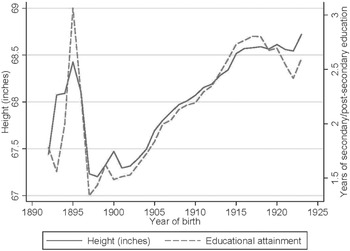
Figure 1 offers a simple but telling picture of the relationship between health and education among World War II enlistees. The figure plots the mean height and educational attainment by year of birth for enlistees born between 1892 and 1923. The large means for height and educational attainment in the earliest years are a result of officers from World War I re-enlisting for World War II. These officers were more highly educated and taller than the other enlistees of the same age, highlighting the correlation between height and education within cohorts. Removing these officers produces steadily increasing heights and educational attainments across the entire time span, demonstrating a similarly strong correlation in height and education over time. The increases in average heights and average educational attainment over these decades are remarkable both for their rapid pace and for their similarity to one another. It is clear that the first decades of the twentieth century were a period of steady gains in both health and human capital for the population of the United States.
MEAN HEIGHT AND EDUCATIONAL ATTAINMENT BY COHORT, 1892–1923

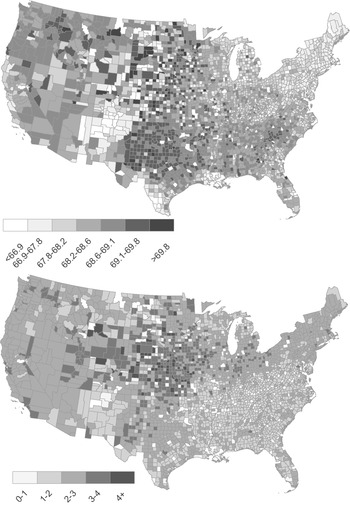
An alternative view of the aggregate relationship between health and education is given by Figure 2 which shows mean height and educational attainment by county of residence. These maps reveal substantial heterogeneity across locations in terms of both height and educational attainment, with a range in mean heights of more than three inches and the mean educational attainment varying from under one year of high school to four full years of high school. Regional differences are stark and highlight the value of having data for the nation as a whole rather than extrapolating from a small number of states. The Midwest and in particular the more recently settled areas of the Midwest, clearly led the country in both educational attainment and height. The South is striking for its relatively tall but poorly educated population. Looking within the South it becomes clear that despite the counterintuitive relationship between Southern heights and educational attainment relative to the rest of the country, a positive relationship between height and educational attainment exists within the region, with northern Texas and Oklahoma leading the region in both average height and average educational attainment.Footnote 5
MEAN HEIGHT IN INCHES (UPPER PANEL) AND MEAN YEARS OF SECONDARY AND POST-SECONDARY EDUCATION (LOWER PANEL) BY COUNTY OF RESIDENCE FOR WORLD WAR II ENLISTEES

These trends are suggestive of a strong link between health and education. While the spatial variation in height may be due to genetic variation, the change in average height over time shown in Figure 1 could not realistically be driven by changes in genetics. The secular trend in height is far more likely the result of improvements in health due to environmental reasons (better sanitation, higher average incomes, etc.) that were concurrent with improvements in educational attainment. If these aggregate trends in height are the product of changes in nutrition, parental health, or any other factor that varies across but not within households, height will not allow for identifying the effects of childhood health separately from these other household and community characteristics correlated with height. However, if height varies with health factors that can differentially impact brothers who otherwise share the same environmental and household characteristics, it is possible to disentagle these effects. Once such child-specific health factor would be the incidence of childhood disease.
Ideally one could test whether the heights of enlistees vary significantly with their own histories of childhood disease to confirm that height is a useful proxy for childhood health. Unfortunately, there is no information on the health histories of the individual enlistees. What is possible is to test whether variation in heights across cities and states is correlated with the disease environments of those cities and states.Footnote 6 To measure disease environment at the state level I use an average of state level mortality rates by disease for 1910, 1920, and 1930.Footnote 7 To measure the disease environment at the city level, I collected data on disease-specific morbidity and mortality rates from the Public Health Reports of the United States Public Health Service. Average morbidity and mortality rates between 1918 and 1924 are availabe at the city level.Footnote 8 I have collected these data for both large cities (defined as those with a population greater than 100,000 in 1925) and small cities (with a population between 10,000 and 100,000 in 1925). The analysis will focus on the large city data as they are more reliable than the small city data.Footnote 9
The expected impact of these diseases on average adult height will depend on whether they target children or adults. Diseases that target younger children will potentially lead to stunting and shorter average adult heights. Diseases targeting adults will lead to worse health and higher mortality rates but not stunting; terminal heights have already been reached. It is therefore important to distinguish between diseases targeting children and diseases targeting adults in the analysis. To do so, I use data from the 1880 federal census and from the 1921 to 1925 annual mortality statistics published by the census bureau to group diseases into those targeting infants, those targeting children, and those targeting adults.
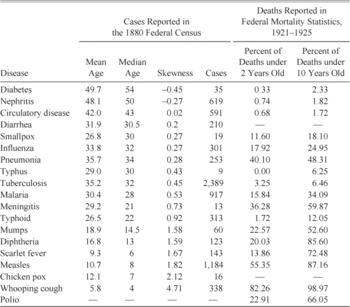
The 1880 federal census included questions about sickness on the day of enumeration, providing unique data on the incidence of specific diseases by age. While the 1880 census was conducted well before the enlistees were born, it is the only source for counts of cases rather than counts of deaths for a wide range of diseases. Given that all enlistees have survived to adulthood, cases are a more relevant figure than deaths. Table 1 reports the mean age, median age, and skewness for the age distribution of cases for major diseases from the Integrated Public Use Microdata Series (IPUMS) 1 percent sample of the census (Ruggles et al. Reference Ruggles, Alexander, Genadek, Goeken, Schroeder and Sobek2010).
I consider two ways to categorize the diseases based on these statistics. Looking at the median ages, there is a cluster of diseases with median ages below ten, then a sizeable gap before another small cluster at teenage median ages, and then another large gap before reaching diseases with median ages well into adulthood. Given this distribution, I categorize diseases as primarily targeting infants if the median age is below ten, older children if the median age is between 10 and 20, and adults if the median age is greater than 20. Alternatively, one can look at how skewed the age distribution is for each disease in 1880, identifying infant and childhood diseases as those skewed toward younger ages. As with the median age, there are three clusters of diseases by skewness with distinct gaps between them, those with a skewness greater than two, those with a skewness between one and two, and those with a skewness less than one. I define infant diseases as those falling into the first cluster, diseases affecting older children as those in the second cluster, and adults diseases as those in the third cluster.
AGE DISTRIBUTION OF CASES AND DEATHS FOR MAJOR DISEASES

Notes:
The number of cases is the number of individuals reported as having that particular illness on the day of the census (see the online Appendix for more details).
Sources:
Data on cases are compiled from the IPUMS 1 percent sample of the 1880 federal census. Data on mortality are taken from the annual mortality statistics reports of the Census Bureau.
I supplement these 1880 census data with mortality rates by disease from 1921 to 1925, a time period when most of the enlistees were children, collected from annual mortality statistics published by the census bureau. The last two columns of Table 1 present the percentage of deaths under two years old and under ten years old by disease as reported in these annual mortality statistics. These mortality data confirm that the age distributions of cases from 1880 match quite well with the age distributions of deaths at the time that the enlistees are children. Those diseases with low median ages in the 1880 census also tend to have a high percentage of deaths occurring at young ages in the 1921 to 1925 mortality statistics.
To categorize diseases using the mortality statistics, I focus on whether a large percentage of the deaths are under two years of age, suggesting infants are being targeted, or whether a large percentage are under ten years of age, suggesting older children are being targeted. Diseases targeting adults would have only a small percentage of deaths under ten years of age. I consider two different cutoffs for defining large: 25 and 50 percent. For example, using the 25 percent cutoff, diphtheria would be considered a disease affecting older children since greater than 25 percent of the deaths are under ten years old but fewer than 25 percent of the deaths are under two years old.
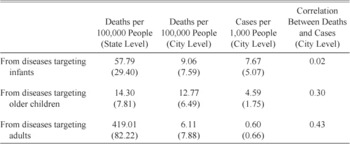
This gives four ways of grouping diseases: the median age in 1880, the skewness in 1880, the 25 percent cutoff in 1921–1925, and the 50 percent cutoff in 1921–1925. The final categorization is based on the the majority outcome of these four approaches. In all cases except meningitis at least three of the four approaches yield the same categorization of the disease. The final set of infant diseases following this approach includes whooping cough, chicken pox, measles, and diarrhea.Footnote 10 Diseases affecting older children are scarlet fever, polio, diphtheria, and mumps. Diseases affecting adults are small pox, typhoid, malaria, influenza, meningitis, diabetes, circulatory disease, pneumonia, and nephritis. Summary statistics for the state-level mortality rates and city-level morbidity rates by disease type are given in Table 2.
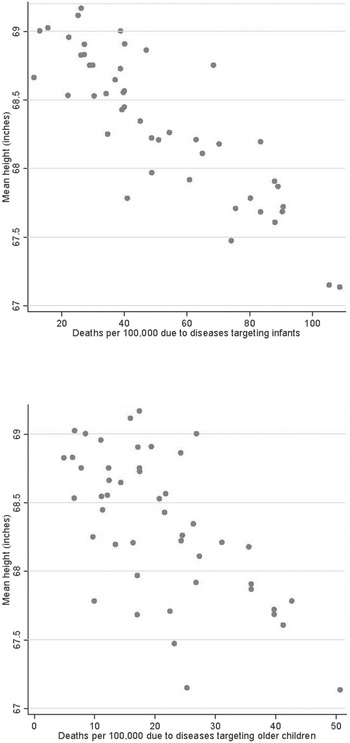
Figure 3 plots average height for the full sample of enlistees as a function of mortality rates for diseases targeting infants and diseases targeting older children. The figure shows that the substantial variation in disease environment seen in the summary statistics is highly correlated with the variation in height across states. As one would expect, high levels of childhood disease are associated with lower average heights.
SUMMARY STATISTICS FOR MORBIDITY AND MORTALITY RATES BY STATE AND CITY

Notes:
Standard deviations are given in parentheses. The state level figures include data for 47 states (data are not available for Alaska, Hawaii, and Nevada). The city level figures include data for the 74 largest cities. Note that the sets of diseases differ between the state and city level data so the means cannot be directly compared.
Sources:
City-level data are taken from reports of the Department of Public Health (1926a, 1926b). State-level data are taken from Grant Miller's database of state mortality rates for 1900 to 1936.
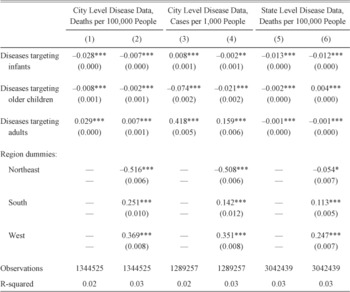
Table 3 reports the results of regressing height on local levels of disease incidence controlling for enlistee race and a quadratic in age. The regression results are consistent with height being a function of childhood disease environment. For both the state-level and city-level disease data, an increase in the incidence of childhood diseases is associated with a statistically significant decrease in adult height. These effects are quite large. A one standard deviation increase in the city-level infant disease mortality rate decreases the expected height of an enlistee by roughly 0.21 inches while a one standard deviation increase in the state-level infant disease mortality rate decreases expected height by 0.38 inches. Furthermore, the levels of disease incidence actually explain a large portion of the variation in average height across cities and states. When city- and state-level average height is regressed on the disease incidence variables, the R Footnote 2 of the regressions are 0.29 and 0.82 respectively, suggesting that variation in disease incidence can account for nearly one-third of the variation in average heights across cities and the majority of the variation in average heights across states. The importance of categorizing diseases by typical age of incidence is highlighted by the positive, significant coefficients on adult diseases in the city-level regressions. These suggest that adult diseases are positively correlated with average height. This is consistent with height being invariant to adult health. A disease as an adult will not make an individual shorter. It will instead affect average height by killing individuals in poor health. Given a positive correlation between height and health endowments, this will lead to more deaths among shorter individuals, increasing the average height of adults surviving disease.
MEAN HEIGHT AND MORTALITY RATE BY DISEASE TYPE FOR STATES

MARGINAL EFFECTS OF MORTALITY RATES ON STATURE, HEIGHT IN INCHES AS DEPENDENT VARIABLE

∗ = Significant at the 10 percent level.
∗ = Significant at 5 percent level.
∗∗∗ = Significant at 1 percent level.
Notes:
Robust standard errors in parentheses. Omitted region is the Midwest. All regressions control for race and quadratic in age.
Sources:
World War II Army enlistment records, reports of the Department of Public Health, and Grant Miller's database of state mortality rates.
It should be noted that these results might be partly driven by differences in income and nutrition across cities and states. Lower incomes could lead to malnutrition and stunting. If malnutrition also increases the incidence of disease, height and disease will be negatively correlated even if it is malnutrition and not disease that is causing stunting. Controlling for region in the regressions eliminates regional variation in average income and average nutrition levels helping to somewhat alleviate these concerns. Additionally, there is a medical literature focused on modern developing countries that links infant disease to stunting even after controlling for nutrition prior to the onset of disease (see, e.g., Rowland, Cole, and Whitehead Reference Rowland, Cole and Whitehead1977; Adair and Guilkey Reference Adair and Guilkey1997). There is also a growing medical literature on the pathways through which disease directly impacts growth (see Stephensen (Reference Stephensen1999) for a review of studies on the impact of infection on nutritional status of young children).
At the aggregate level, the enlistee records reveal that both the health and human capital stock of the U.S. population experienced steady and substantial increases during the first decades of the twentieth century. The disease incidence regressions suggest that the observed height differences among enlistees are due at least in part to differences in childhood disease environment, making difference in height between brothers a useful proxy for differences in their childhood health histories.
HEIGHT AND EDUCATION WITHIN FAMILIES
While these aggregate results suggest a potentially strong relationship between height and educational attainment, they may be driven by household characteristics or local environmental characteristics correlated with both height and education. To control for these characteristics, I match the enlistment records to federal census data, incorporating information on the enlistees’ childhood households and identifying sets of brothers in the sample. With the census data I can control for observed household characteristics including household location, family size, and family income. By establishing sets of brothers in the enlistment records, I can further control for unobserved household and environmental characteristics by looking at how differences in health between brothers translate into differences in educational attainment.
Matching Enlistee Records to the Federal Census
This matching process is time consuming and requires sampling the enlistees rather than attempting to match the full sample to census records. Given that I ultimately want to use brothers to control for family characteristics, I first limit the set of enlistees to those who have a potential brother in the records. Individuals are defined to be potential brothers if they share the same last name, were born in the same state, lived in the same state and county at the time of enlistment, and were born within three years of each other. The restriction on the difference in ages is used to ensure that the brothers grew up in similar environments. The greater the difference in ages between brothers, the more likely it is that household income, educational resources, or some other important but potentially unobserved variable, differed across the two brothers.
The restrictions on having similar locations of birth and residence increase the likelihood of successful matches. However, these restrictions do lead to the sample of potential brothers being underrepresentative of geographically mobile individuals and families. In the IPUMS sample of the 1930 federal census, 13 percent of households with multiple brothers contained brothers born in different states. In the online Appendix I show that these mobile families were larger, wealthier, more urban, and had more variation in schooling across children than less mobile families. In the IPUMS sample of the 1940 census, 9 percent of men in their 20s had moved across states in the previous five years. These individuals had higher educational attainments and earnings than less mobile individuals. The linked sample of brothers may therefore be underrepresentative of pairs of brothers from wealthier families more willing to vary educational investments across children and of pairs with at least one highly educated, high earning brother.
A 10 percent sample of these sets of potential brothers is then linked to the federal census. Linking is done by searching for individuals by first name and last name, state of birth, and year of birth in an electronic database of the 1920 or 1930 federal census records.Footnote 11 If two potential brothers have unique matches in the federal census I then check images of the original census records to determine whether the individuals had the same parents.Footnote 12 If they did, the brothers are confirmed as a match and included in the final dataset. Information on their parents’ occupations, ages, and places of birth are transcribed from the census records, as well as the number of children in the family, their ages, and their genders.Footnote 13
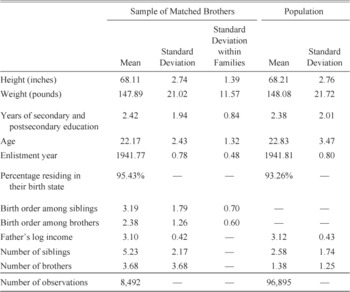
The end result is a sample of 4,478 sets of brothers that contains information on the height, weight, and educational attainment of each brother from the World War II enlistment records, as well as information on the location of their childhood household, birth order, family size, and parental occupations and incomes from the federal census.Footnote 14 Table 4 provides summary statistics for the sample of matched brothers. For comparison, the height, weight, and education statistics are also provided for the entire set of potential brothers in the World War II enlistment records and household statistics are given for all households with at least one child from the IPUMS 1 percent sample of the 1930 federal census. In terms of height, weight, educational attainment, and father's income the sample of successfully linked brothers looks representative of the general population. What does differ substantially for the brother sample relative to the population is family size and composition. The matched brothers come from substantially larger families that tend to have more sons than daughters relative to the general population. This feature of the data is unsurprising given that families have to have at least two sons to be in the sample. It does raise a concern about the generalizability of any results from the matched brothers. It is quite possible that the relationship between health and educational investments varies by family size. Indeed, the estimates of the relationship between height and educational attainment presented later in the article are sensitive to whether controls for family size and birth order are included. Consequently, while the sample appears representative of the population in terms of education, height, weight, and family income, the results of this study may not be applicable to families consisting of only one or two children.
SUMMARY STATISTICS FOR THE SAMPLE OF WORLD WAR II ENLISTEES MATCHED TO THEIR CHILDHOOD HOUSEHOLDS

Notes:
Father's income is measured in hundreds of 1950 dollars. Population is defined as all potential brothers in the enlistment records for the individual characteristics and all households in a 1 percent sample of the 1930 census with at least one child for the household characteristics. Number of observations for the population corresponds to the number of potential brothers in the enlistment records. 198,126 households from the 1 percent sample of the 1930 census are used for the household characteristics.
Sources:
The matched brothers data are from the World War II Army enlistment records linked to the complete 1930 federal census. The population data are drawn from the World War II Army enlistment records and the IPUMS 1 percent sample of the 1930 federal census.
Individuals within the same family look similar to one another on average but there is still substantial variation. Height, weight, and particularly educational attainment are highly correlated between brothers, with the standard deviation of these characteristics within a family typically one-half as large as the overall standard deviation of the variables in the population. However, the within-family standard deviations in Table 4 are still large enough to suggest sufficient variation between brothers to estimate the effects of health on education within families.
Estimation Strategy
The simplest approach to estimating the relationship between height and educational attainment with the sample of linked brothers is a simple linear regression of educational attainment on height and other characteristics of the following form

where Ei,j is the educational attainment of individual i from family j, Xi,j is a vector of observable characteristics for individual i, Zj is a set of observable characteristics for his family, qj is a term capturing unobservable family characteristics and ei, j is an individual-specific error term assumed to be independent of the other terms in the equation. The individual characteristics include the primary variable of interest height as well as birth order among siblings and a quadratic in age. The family characteristics contained in Zj include household location, family size, race, and family income. The problem with estimating equation (1) is that qj , capturing such variables as local school quality and parental tastes for investment in children, is unobserved and potentially correlated with height leading to an omitted variable bias for the estimated coefficient on height. To address this problem, the variation within households can be exploited by including family fixed effects. Estimating Equation (1) with the inclusion of family fixed effects will produce an unbiased estimate of the coefficient on height. The drawback is that the fixed effects will absorb any variables that do not vary across brothers such as family size, father's income, and local disease environment.
An alternative approach to estimating the relationship between height and educational attainment is motivated by the distribution of educational attainment in the sample of brothers. More than 25 percent of the brothers report zero years of secondary and post-secondary education. More than 30 percent report being high school graduates with exactly four years of secondary education and no post-secondary education. With such clear bunching at zero and four years of secondary education, a nonlinear functional form for modeling the relationship between height and education seems reasonable. Of particular interest are the effects of height on the probability of attending high school, the probability of graduating high school, and the probability of attending college. The difficulty with using these binary dependent variables and a nonlinear functional form is that incorporating family fixed effects presents an incidental parameters problem that potentially leads to inconsistent estimates of all of the coefficients, not just the fixed effects (Greene Reference Behrman and Rosenzweig2004).
A conditional logit specification presents a way around the incidential parameters problem. Consider the probability of graduating high school modeled as a function of personal characteristics and a family fixed effect using the logistic cumulative density function Λ(·):

where HSi,j is an indicator variable equal to one if individual i from family j graduated from high school, Xi,j is a vector of observable individual characteristics, and aj is the fixed effect for family j. Following the approach proposed by Chamberlain (Reference Chamberlain1980), it is possible to condition on the sum of HSi,j within a family to rewrite the probability of high school graduation in a way that no longer depends on the family fixed effect. In the case of a pair of brothers for which only one brother graduated high school, this reduces Equation (2) to:

Equation (3) is a conditional logit model in which the estimation of b through maximum likelihood does not depend on the family fixed effects. This conditional logit model offers a way to obtain an estimate of the effect of height on the binary educational outcomes that does not suffer from the omitted variable bias problems of the basic logit model or the incidental parameters problem of the logit model with family fixed effects. The drawback of the conditional logit model is that it requires the sum of the indicator variable across brothers to be equal to one, substantially reducing the sample size.
Results
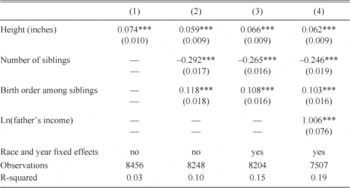
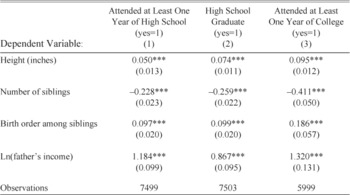
Table 5 presents regression results in which individual educational attainment is regressed on height and a set of household characteristics. While these regressions clearly do not control for unobserved household characteristics and will produce biased coefficient estimates, they do offer insight into how household characteristics related to educational attainment in the first one-half of the twentieth century, something previous studies have not been able to examine due to data limitations. The most striking results are the large and highly significant coefficients on height across all specifications. A one-standard-deviation increase in height is associated with an additional 0.1 to 0.15 years of secondary and post-secondary education, a large increase given that the average level of secondary and post-secondary schooling is only 2.4 years. This is comparable in magnitude to the marginal effect of a 10 percent increase in father's annual income on schooling. Interestingly, the inclusion of father's log income in the regression has only a small effect on the height coefficient. Family income would have been one of the primary concerns in terms of omitted variable bias with a regression of education on height and yet the data suggest that the exclusion of father's log income leads to only a very small bias on the height coefficient. Beyond height and family income, family structure also proves important in explaining differences in educational attainment, with family size having a large and significant negative coefficient, and the coefficients on sibling order suggesting that younger siblings receive more education than their older brothers and sisters.
ORDINARY LEAST SQUARES (OLS) REGRESSION RESULTS FOR THE EFFECTS OF HEIGHT AND HOUSEHOLD CHARACTERISTICS ON EDUCATION, YEARS OF SECONDARY AND POST-SECONDARY EDUCATION AS DEPENDENT VARIABLE

∗ = Significant at the 10 percent level.
∗ = Significant at 5 percent level.
∗∗∗ = Significant at 1 percent level.
Notes:
Robust standard errors clustered by childhood state of residence in parentheses. All regressions control for a quadratic in age. Only individuals with completed educational careers are included in the regression sample.
Sources:
World War II Army enlistment records linked to the 1930 federal census.
The logit estimates in Table 6 produce very similar results when looking at the set of binary educational outcomes (high school attendance, high school completion, and college attendance). As with the years of educational attainment regressions, increases in height and father's log income are both associated with improvements in educational outcomes. Once again a larger family size makes it less likely an individual will graduate from high school or attend college but conditional family size, the later a child is in birth order, the more likely he is to graduate high school and attend college. This is an important distinction and one that underscores the value of having detailed data on families. The correlation of educational attainment and birth order in the data is negative. However, these results suggest that this negative correlation is driven by the effects of family size while within families younger brothers actually receive more educational investment than their older brothers.
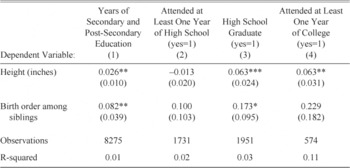
The large height coefficients from the regressions in Tables 5 and 6, while possibly an indicator of childhood health's direct impact on educational attainment, are also likely to be a product of better parents investing more in both education and health or areas with better health environments also having better schooling resources. To control for these unobserved characteristics, Table 7 presents the results from including family fixed effects. The magnitude of the height coefficient in the years of schooling regression, column (1), is roughly cut by two-thirds when including family fixed effects but the coefficient remains positive and significant. This suggests that even once controlling for household and environmental characteristics, childhood health as proxied by height has a significant impact on overall educational attainment.Footnote 15
LOGIT ESTIMATES OF THE EFFECTS OF HEIGHT AND HOUSEHOLD CHARACTERISTICS ON EDUCATION OUTCOMES

∗ = Significant at the 10 percent level.
∗ = Significant at 5 percent level.
∗∗∗ = Significant at 1 percent level.
Notes:
Robust standard errors clustered by childhood state of residence in parentheses. All regressions control for race, birth state, and a quadratic in age. Only individuals with completed educational careers are included in the regression sample.
Sources:
World War II Army enlistment records linked to the 1930 federal census.
Variation in height within families also proves to be important in explaining differences in high school graduation and college attendance. Columns (2), (3), and (4) of Table 7 give the results of the conditional logit regressions. While the coefficients on height are small and statistically insignificant for the high school attendance regression, the coefficients on height in the high school graduation and college attendance regressions are positive and significant suggesting that taller brothers are more likely to graduate high school and attend college.
ESTIMATES OF THE EFFECT OF HEIGHT ON EDUCATIONAL ATTAINMENT WITH FAMILY FIXED EFFECTS

∗ = Significant at the 10 percent level.
∗ = Significant at 5 percent level.
∗∗∗ = Significant at 1 percent level.
Notes:
Robust standard errors clustered by family in column (1) and childhood state of residence in columns (2), (3), and (4) in parentheses. All regressions control for a quadratic in age. Only individuals with completed educational careers are included in the regression sample. Column (1) is an OLS regression. Columns (2), (3), and (4) are conditional logit regressions.
Sources:
World War II Army enlistment records linked to the 1930 federal census.
It should be noted that one drawback of the family fixed effects approach is that it is only identifies the difference in education between the siblings. This difference could be driven by lower educational attainments for the child in poor health, greater educational attainment for the healthy sibling, or a combination of both. Three different mechanisms could plausibly explain the result of a positive relationship between height and educational attainment within families: (i) a negative health shock may simply impair the ability of the afflicted child to attend school or lower the return to schooling for the afflicted child and have no effect on the healthy sibling, (ii) families may shift resources to the healthy child if returns to education are positively correlated with health, increasing that child's educational investment in addition to decreasing the afflicted child's educational investment, and (iii) parents may allocate more resources to that unhealthy child to compensate for a poorer endowment but those additional resources are insufficient to close the gap with the healthier child.Footnote 16
In a study of the educational attainments of children in utero during the 1918 influenza pandemic and their siblings, John Parman (Reference Parman2013) finds evidence suggesting that individuals with a younger sibling experiencing a negative health shock actually have greater educational attainments on average than individuals with younger siblings who do not experience a health shock. This result, reinforced by Almond (Reference Almond2006) finding that the influenza cohort had lower educational attainments than other cohorts, suggests that the height coefficient is likely being driven by the second mechanism: families were shifting resources to the healthier sibling in response to higher returns to education for the healthy child, enabling the healthy child to achieve greater schooling at the expense of his less healthy sibling. This is consistent with Bleakley, Dora Costa, and Adriana Lleras-Muney (Reference Bleakley, Costa and Lleras-Muney2013) work on trends in height, educational attainment, and income over the past two centuries. They find little correlation between height and schooling in the nineteenth century but a much stronger relationship in the twentieth century, arguing that the movement from a brawn- to a brain-based economy increased the complementarities between health and schooling. The family fixed effects results suggest family resource allocations were responsive to those complementarities, shifting educational investments toward healthier siblings.
Interpreting the Effects of Height on Educational Attainment
These fixed effect and conditional logit results provide strong evidence that childhood health has a significant impact on educational attainment even after controlling for unobserved household and environmental characteristics. However, it is difficult to use them to assess just how large the effect of a childhood health shock is on educational outcomes. Differences in height are clearly correlated with differences in childhood health as demonstrated by the disease incidence regressions for the full set of enlistees. However, there is also a great deal of random variation in height that is not due to differences in childhood health. It is important to consider the downward bias introduced by this random variation in height when assessing the magnitude of the estimated coefficients and consequently the strength of the relationship between health and education. Suppose that height for individual i is given by

where h 0 is a baseline height, healthi captures an individual-specific components of health that influence height, familyi captures traits specific to the individual's family that influence height (which may be health-related), and ei is a random component of height with mean zero and uncorrelated with the other terms. While it is the effect of the health component of height on educational attainment that is of interest, the estimated coefficient on height is also picking up the effects of ei (g familyi is absorbed by the family fixed effects). The observed height can be thought of as the health component of height (the variable of interest) plus mean zero measurement error in the form of ei .
This measurement error will lead to an attenuation bias for the estimated height coefficient, the magnitude of which will depend on the ratio of the variance in height due to variation in health relative to the overall variance in height after removing the family-specific component. This overall variance in height can be approximated with the sample variance of height within families (approximately two inches squared). The variance in height due to health is harder to assess. As a very rough approximation, one can take the stunting of one inch estimated by Voth and Leunig (Reference Voth and Leunig1996) for smallpox as the effect of a severe childhood disease on height and write the variance due to health in terms of the probability p of being afflicted with such a disease. The variance of the health related component would then be p(1 – p). Even in the extreme case of p equal to 0.5, minimizing the attenuation bias, the ratio of the variance of height due to health relative to the overall variance in height would be 0.125, suggesting that the seemingly small coefficients on height in Tables 7 and 8 actually imply sizeable effects.Footnote 17
To get a sense of just how large these effects are, consider the change in height from the 1900 to 1920 birth cohorts. The mean height for enlistees born in 1900 was 67.32 inches while the mean height for the 1920 cohort was 68.47 inches. Using the conservative estimate of a attenuation bias coefficient of 0.125 and the height coefficient from column (1) of Table 7, a one inch increase in height is associated with a 0.20 year increase in secondary and post-secondary schooling. Thus, the change in height from the 1900 birth cohort to the 1920 birth cohort would lead to predicted change in educational attainment of 0.24 years, 16 percent of the actual change in educational attainment between these cohorts (1.47 years of secondary and post-secondary schooling to 2.93 years). Improvements in childhood health and nutrition as proxied by height can therefore account for 16 percent of the improvements in educational attainment for the United States in the first decades of the twentieth century. The magnitude of this effect is in line with existing studies on health and human capital in the early twentieth-century United States. Bleakley and Fabian Lange (Reference Bleakley and Lange2009) find that a one-standard-deviation change in hookworm infection rates was associated with a 2 percentage point increase in school enrollments, roughly one-fifth of the 9 percentage point increase in enrollment rates between 1910 and 1920. Bleakley (Reference Bleakley2010) estimates that cohorts born after anti-malaria campaigns in states with high malaria rates had incomes, proxies for productive human capital, that were 10–20 percent greater than those of cohorts born before the campaigns relative to cohorts in states free of malaria. Thus the implied contribution of rising health to rising educational attainments of 16 percent for the nationally representative sample of enlistees is consistent with the existing literature on the specific examples of hookworm and malaria eradication.
When considering the magnitude of these effects, it is important to recall that the effects are being estimated using only enlisted brothers. As discussed in detail in the online Appendix on Data Sources, being in the enlistment records implies that the brothers both passed the minimum physical and educational standards for the army. Therefore neither brother had a physical condition that prevented them from serving in the military. Whatever childhood health shocks the shorter brother may have faced, he recovered from them to an extent that he was able to serve in the army. This estimated variation in educational investments is being driven by health shocks that are severe enough to cause stunting but not so severe that they leave the child permanently disabled. The presence of these significant coefficients on height for enlistees therefore suggests that even if a person recovered from a childhood health shock in terms of health, there were lasting impacts in terms of educational attainment and associated labor market outcomes.
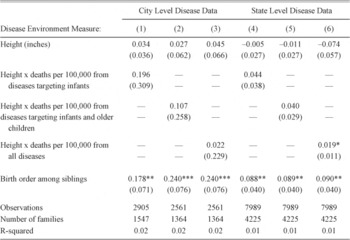
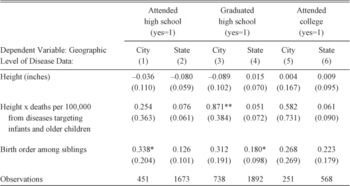
One potential criticism of this approach to interpreting the coefficients, and to interpreting height as a proxy of childhood health in general, is that the the coefficient on height may simply be picking up the effects of height discrimination, either by parents or by educators. If this is the case, then the attentuation bias previoulsy described is not relevant and the coefficient would represent a small effect and one not necessarily related to childhood health. The city and state disease environment data offer a way to test whether this relationship between height and educational attainment is being driven by height discrimination rather than by the effects of childhood health. If the relationship is driven by variation in childhood health, the relationship should be stronger in those cities and states with worse childhood disease environments (variation in height due to health would be more substantial in these locations leading to a smaller attenuation bias for the height coefficient). If the relationship is instead driven by height discrimination, the effects of height on educational attainment should not be correlated with the disease environment. By including an interaction between height and the local disease environment, it is possible to test whether the effect of height is stronger in cities where childhood disease is more prevalent.
ESTIMATES OF THE EFFECT OF HEIGHT ON EDUCATIONAL ATTAINMENT WITH FAMILY FIXED EFFECTS AND DISEASE ENVIRONMENT INTERACTIONS, YEARS OF SECONDARY AND POST-SECONDARY EDUCATION AS DEPENDENT VARIABLE

∗ = Significant at the 10 percent level.
∗ = Significant at 5 percent level.
∗∗∗ = Significant at 1 percent level.
Notes:
Robust standard errors clustered by family in parentheses. All regressions control for a quadratic in age. Regression sample includes only those individuals with completed educational careers.
Sources:
World War II Army enlistment records linked to the 1930 federal census, reports of the Department of Public Health, and Grant Miller's database of state mortality rates.
CONDITIONAL LOGIT ESTIMATES OF THE EFFECT OF HEIGHT ON EDUCATIONAL OUTCOMES FOR BROTHERS WITH DISEASE ENVIRONMENT INTERACTIONS

∗ = Significant at the 10 percent level.
∗ = Significant at 5 percent level.
∗∗∗ = Significant at 1 percent level.
Notes:
Robust standard errors clustered by childhood state of residence in parentheses. All regressions control for a quadratic in age. Regression sample includes only those individuals with completed educational careers.
Sources:
World War II Army enlistment records linked to the 1930 federal census, reports of the Department of Public Health, and Grant Miller's database of state mortality rates.
Tables 8 and 9 present the results from incorporating these interaction terms into the family fixed effect regressions. In all specifications, the coefficient on the interaction term is positive suggesting that the marginal effect of height on educational attainment is larger in cities with higher levels of disease. This is evidence that the coefficient on height is indeed picking up the effects of childhood health on educational attainment rather than simply height discrimination. In an attempt to bolster this interpretation, I calculate pairwise correlations between the standard deviation of heights within brother pairs and the various measures of city- and state-level disease environment. The one correlation that proved to be significantly different than zero was between the standard deviation of brother heights and the number of infant deaths from disease at the city level, which had a positive correlation of 0.04, significant at the 5 percent level. This positive correlation suggests that there is greater variation in height between brothers in cities with worse disease environments, offering further support that exposure to disease is driving at least a portion of the variation in heights in the brothers sample.Footnote 18
CONCLUSIONS
The scope and scale of the World War II enlistment records offer a detailed picture of the links between childhood health and human capital both over time and across individuals. The steady growth in the American human capital stock over the first decades of the twentieth century was matched by equally impressive improvements in health. Younger cohorts of enlistees enjoyed greater health and educational attainment than their older counterparts as did enlistees from healthier cities and states.
These aggregate trends in health and educational attainment, while impressive in terms of their rapid pace and high correlation, do not come as a surprise. As national income rises, we generally expect improvements in both health and education. Where the enlistment records offer a unique insight is the relationship between health and education within families. The matched brothers data reveal that even after controlling for observed and unobserved family characteristics, differences in height between brothers predict differences in educational attainment implying that differences in childhood health across brothers had long-term consequences in terms of human capital formation. This suggests that improvements in health in the early twentieth century may very well have been a necessary prerequisite for the United States’ remarkable gains in educational attainment over that period.
The exact mechanisms through which childhood health influenced educational attainment remain unclear. The higher educational attainment of the healthier brother could simply be a product of having more days on which he was healthy enough to attend school but his brother was not. If this were the case, improvements in public health would directly lead to increased educational attainment. However, if the differences in educational attainment were the product of parents choosing to invest more in their healthier sons, it is less clear how improvements in public health would translate into improvements in educational attainment. How parents redistribute resources across children when the health of those children improve would determine the extent to which health advances impact educational attainments. If health improvements save resources that could then be transferred to educational investment, educational attainments would rise. However, if they simply lead to a redistribution of resources already devoted to educational attainment, declines in child morbidity may lead to a more equitable distribution of resources across children without a clear impact on overall average educational investment.
These are issues that warrant further exploration. Understanding how childhood health impacts the ability to attend school, the returns to that schooling and family decisions about educational investments will advance our understanding of how the United States achieved its gains in education over the first one-half of the twentieth century. Such an understanding of the evolution of the health and human capital of the American population would provide insight into not only how the U.S. economy evolved but also how educational and health policy reforms may influence the economic growth of countries still struggling with high levels of childhood morbidity today.