Remote Indigenous Education is a highly politicised space caught between policy rhetoric that often positions remote schools as substandard and in need of intervention (Forrest, Reference Forrest2014; Hughes & Hughes, Reference Hughes and Hughes2012; Wilson, Reference Wilson2014), and narratives — particularly from remote Aboriginal Australians — which emphasise that formal schooling must sustain, rather than diminish, local languages, values, epistemologies and priorities (Minutjukur & Osborne, Reference Minutjukur and Osborne2014; Minutjukur et al., Reference Minutjukur, Patterson, Anderson, Gibson, Kitson, Martin and Larry2014; Nakata, Reference Nakata2007; Osborne, Lester, Minutjukur, & Tjitayi, Reference Osborne, Lester, Minutjukur and Tjitayi2014; Tjitayi & Osborne, Reference Tjitayi and Osborne2014; Wearne & Yunupingu, Reference Wearne and Yunupingu2011). Historically, boarding schools located in regional or metropolitan centres have provided an alternative to remote schooling for some Aboriginal students. In recent years, following calls from Aboriginal leaders including Noel Pearson (Reference Pearson2011, Reference Pearson2014) and Marcia Langton (Throwden, Reference Throwden2013), and as a consequence of recommendations made in the Review of Indigenous education in the Northern Territory (Wilson, Reference Wilson2014), the boarding school option has gained momentum within public discourse and policy as a strategy to address the educational needs of Aboriginal students located in regions classified as remote.
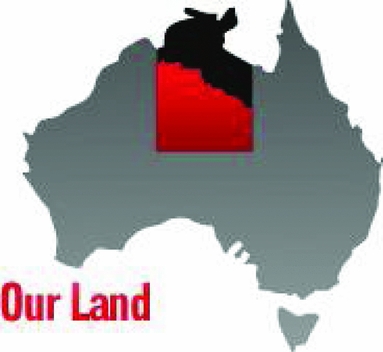
The geographical focus of this study is within the footprint of the Central Land Council (CLC), covering the southern half of the Northern Territory and including what are considered some of Australia's most disadvantaged communities. According to the Australian Bureau of Statistics’ classification system (ABS, 2011), Alice Springs is geographically ‘remote’, and the broader Central Land Council region is ‘very remote’ (see Figure 1). These regions are considered remote from a metro-centric perspective and Guenther, Halsey, and Osborne (Reference Guenther, Halsey and Osborne2015) argue they could more correctly be referred to as central from the perspective of Aboriginal people living in remote or very remote communities. In this sense, community-based schools are in fact local, while metropolitan boarding schools are remote (Bleby, Reference Bleby2017).
Geographical region of the Central Land Council (shown in red) within the Northern Territory.

According to the CLC web site (www.clc.org.au), the region covers 771, 747 square kilometres and encompasses 15 Aboriginal language groups representing more than 24,000 Aboriginal people. Approximately, 7% of secondary aged young people living in the CLC region are enrolled in boarding programs, but a current Northern Territory Government policy initiative aims to increase remote student participation in boarding, particularly those from smaller very remote communities.
This paper maps current boarding programs accessed by young Aboriginal Centralians (i.e., those living in central Australia), identifies factors that increase their participation in such programs, and suggests ways to strengthen boarding programs and to better prepare prospective Aboriginal boarders. A brief overview of literatures and debates relating to remote Aboriginal education and boarding is provided first, along with some general figures regarding boarding placements of Aboriginal students from within the CLC footprint. A visual model is offered to highlight issues of socioeducational advantage (SEA) (as defined by ACARA, 2013) regarding access to boarding schools and existing scholarship programs, with reflections on the impact of brokering as an effective strategy to increase access and participation.
Methodology
This paper is authored by five scholars representing diverse personal and professional experiences within the discipline of Aboriginal education. For ‘outsider researchers’ (Martin, Reference Martin2006) working within Indigenous research spaces, identifying and interrogating one's own implicit values, assumptions and institutional representations is necessary in pursuing ‘less partial and distorted accounts of the entire social order’ (Harding, Reference Harding1992, p. 583). According to Indigenous scholars, this type of critical self-reflection is also important in redressing historically power-laden, colonialist tendencies towards Indigenous peoples, including research of Indigenous peoples (Bishop, Reference Bishop2011; Nakata, Reference Nakata2007; Rigney, Reference Rigney1999; Smith, Reference Smith2012). Further reflections on ethical/methodological considerations for ‘outsider’ researchers involved in this study have been developed in a series of publications (Guenther, Osborne, Arnott, & McRae-Williams, Reference Guenther, Osborne, Arnott and McRae-Williams2015; Osborne, Reference Osborne2016). Aboriginal scholar Lester-Irabinna Rigney (Reference Rigney1999), a co-author of this paper, articulates an Indigenist research paradigm and approach, whereby centring Aboriginal voices within research methodologies is integral to decolonising Indigenous research spaces. The arguments Indigenous scholars make for decolonising methodologies have shaped our approach for this work including drawing on Indigenous scholarship and voices for framing the work, working closely with an Indigenous board throughout the project, and adopting an informal narrative approach for sharing stories and experiences, rather than channelling interviews towards researchers’ assumptions through highly structured questioning sequences.
This paper draws on a recent evaluation conducted on behalf of the Centrecorp Foundation by three of the authors (Osborne, Benveniste, & Rigney, Reference Osborne, Benveniste and Rigney2016). The Centrecorp Foundation is a not-for-profit organisation which aims to ‘make a beneficial and ongoing difference to the lives of Aboriginal people in Central Australia’ (http://www.centrecorpfoundation.com.au/). Their education sponsorship program provides funds to, among other things, assist Aboriginal students from the region with boarding school fees. The authors evaluated the progress and experiences of more than 180 Aboriginal students who had accessed the program over a five-year period. Ethics approval was received from UniSA in February 2016 (Ethics protocol Centrecorp Evaluation, Application ID: 0000035093). The evaluation included analysis of quantitative data provided by the Centrecorp Foundation and eight of the destination schools provided clarifying data regarding enrolment and departure dates, year 12 completions and postschool student destinations, where known. To obtain qualitative data, the families of students enrolled in Centrecorp's scholarship program were contacted with requests for interviews. A database was provided by the Centrecorp Foundation as part of the evaluation. Family representatives of 56 students participated in semistructured face-to-face or phone interviews following prior informed consent as required within the UniSA ethics approval process. Interview transcripts were coded and analysed against the key questions for the evaluation which focussed on the types of support Centrecorp provided to students and families, the program's impact on student enrolment, attendance and year 12 completions, postschool transitions to employment and further education, program outcomes, success factors and suggestions for improvement of the program. The research team subsequently worked with the Centrecorp Foundation board over a series of presentation and feedback sessions. Centrecorp provided permission to use the evaluation as a basis for further development within this paper.
The evaluation found that a large proportion of students accessing Centrecorp's education program were sponsored to attend interstate boarding schools. Stories of families utilising Centrecorp's flexible funding model to pursue a range of education opportunities led to further investigation to better understand the wider landscape of boarding school opportunities for all Indigenous boarding students within the CLC region.
Further information for this paper was obtained through publically available data sets, personal communication and collaboration with various organisations, including the Association for Independent Schools of the Northern Territory. This data informs a general picture of central Australian student enrolments in residential boarding programs and adopts a mixed methods approach ‘to develop multiple perspectives and a [more] complete understanding’ (Klassen, Creswell, Plano-Clark, Clegg-Smith, & Meissner, Reference Klassen, Creswell, Plano-Clark, Clegg-Smith and Meissner2012, p. 378) of the research questions.
This paper is also broadly informed by the work of authors Guenther, Disbray and Osborne within the Remote Education Systems (RES) project (Guenther, Disbray, & Osborne, Reference Guenther, Disbray and Osborne2016). This five-year project was completed in June 2016 within the Cooperative Research Centre for Remote Economic Participation (CRC-REP) (see https://crc-rep.com/). The RES project sought to privilege Aboriginal voices in remote education research through interviewing Aboriginal participants, including in local languages wherever possible (Ninti One, 2013; Osborne, Reference Osborne2013, Reference Osborne2016), supporting presentations by Aboriginal educators, authoring academic publications (Burton & Osborne, Reference Burton and Osborne2014; Minutjukur & Osborne, Reference Minutjukur and Osborne2014; Tjitayi & Osborne, Reference Tjitayi and Osborne2014), and working under a largely Aboriginal advisory group. The advisory group was active in discussing and workshopping key ideas and provided active, ongoing oversight to all aspects of the research within RES, including methodology. Findings of this research project were presented back to partners, stakeholders and participant communities through formal presentations and the production of an interactive e-book (Guenther et al., Reference Guenther, Disbray and Osborne2016). Co-author Benveniste (forthcoming) is currently completing a Doctoral thesis examining the experiences of central Australian students in boarding school. This paper draws on these themes, issues and data where it is relevant to the CLC region.
The Remote Education Context
In national education and employment figures, there is a disparity between Indigenous and nonIndigenous rates of school attendance, literacy and numeracy results measured via NAPLAN, school completion and transition to employment figures (Guenther, Reference Guenther2013; Long & North, Reference Long and North2009; Wilson, Reference Wilson2014). These measures have been selected for targeted intervention under the Australian Government's Closing the Gap policy (Turnbull, Reference Turnbull2016). Statistical disparity between Indigenous and other Australians on these measures increases with remoteness (Long & North, Reference Long and North2009), which contributes to media narratives and academic discourse framing remote Aboriginal and Torres Strait Islander Australians in terms of being ‘lesser’, or ‘behind’ and in need of intervention (Forrest, Reference Forrest2014; Martin, Reference Martin2012; Tudge, Reference Tudge2014; Wilson, Reference Wilson2014). However, such representations of minorities are rejected by critical theorists (Ladson-Billings, Reference Ladson-Billings1999; Milner, Reference Milner2008), international scholars (Delpit, Reference Delpit, Weis and Fine1993; Moll, Amanti, Neff, & Gonzalez, Reference Moll, Amanti, Neff and Gonzalez1992) and, in particular, by Indigenous scholars both internationally (Bishop, Reference Bishop2011; Smith, Reference Smith2012) and in Australia (Arbon, Reference Arbon2008; Ford, Reference Ford2005; Guenther, Disbray, & Osborne, Reference Guenther, Disbray and Osborne2015; Moreton-Robinson, Reference Moreton-Robinson1998; Nakata, Reference Nakata2007; Sarra, Reference Sarra2011b). These scholars critique the tendency to demonise and blame minority communities for their apparent failure and challenge the constructs on which assumptions are based.
In the Northern Territory, the Wilson review of Indigenous education (Reference Wilson2014) set out key policy drivers for renewed Indigenous Education policy and practice. The key priorities include: improving school attendance (NESA, 2015), Direct Instruction (Good to Great Schools Australia, 2014) as an English language instruction pedagogical model and winding back local secondary schooling in smaller communities, while encouraging remote students towards boarding programs.
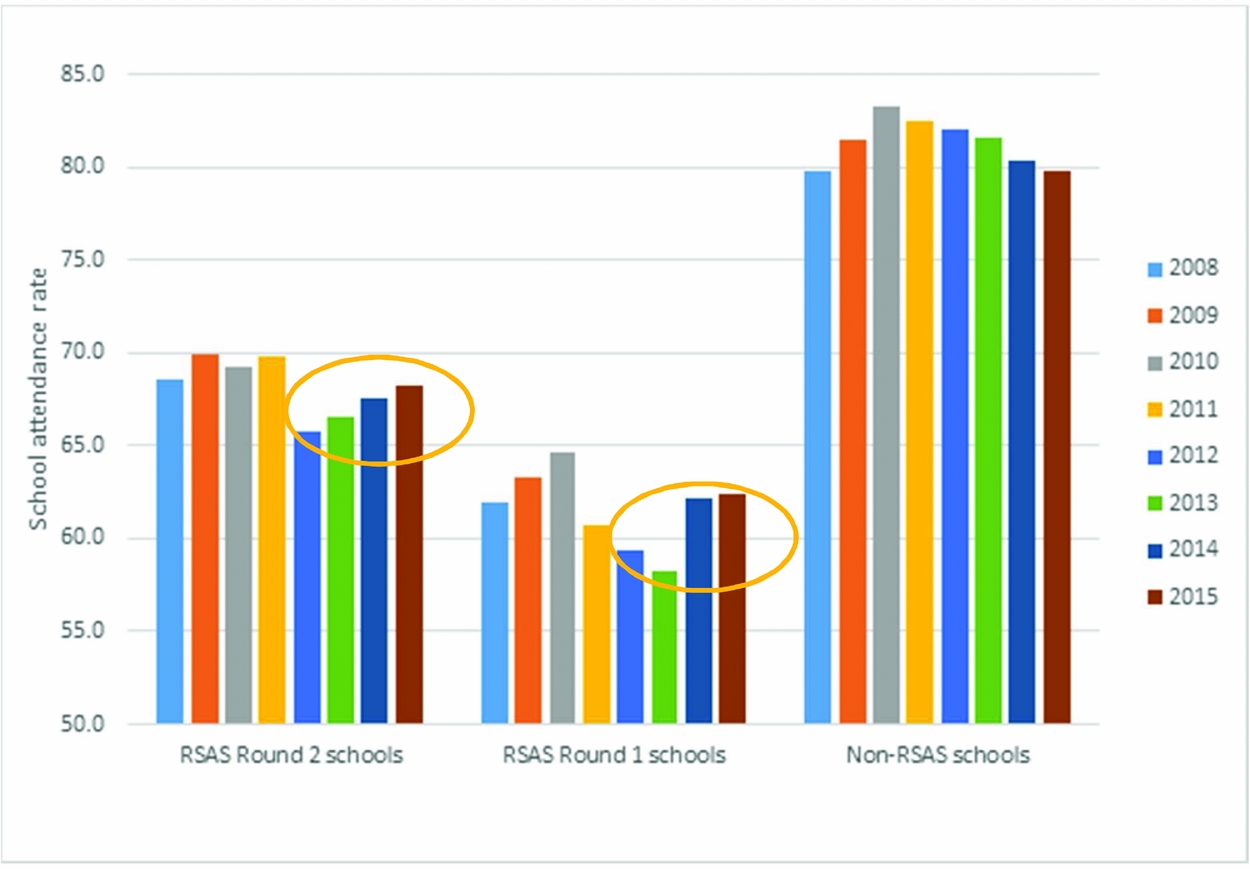
To date, Northern Territory Government school attendance initiatives, such as Every Child at School Every Day, Improving School Enrolment and Attendance through Welfare Reform (SEAM), coupled with the Commonwealth-funded Remote School Attendance Strategy (RSAS), have had a negligible impact on overall attendance rates, with patchy results. Figure 2 shows overall attendance rates for very remote schools nationally from 2008 to 2015.
Attendance rates from 2008 to 2015 for very remote schools nationally. Data are grouped according to round 1, round 2, and nonRSAS very remote schools.Source: A Red Dirt Journey (Guenther, Osborne and Disbray, Reference Guenther, Disbray and Osborne2016).

Schools in the first round of RSAS (40 schools in a $28M program, see NESA, 2015) showed a 4% increase in attendance in the first year of RSAS and no change in the second year, whereas round 2 schools showed 0.5% improvement in both the first and second years of the initiative. Schools that were not identified for the program showed a slight decrease in attendance during that period. In all three cohorts, 2015 attendance rates are virtually the same as 2008 figures. These figures led to declarations of failure and despair by the then Northern Territory Education Minister Peter Chandler (Oaten, Reference Oaten2016), although the Federal Minister, Nigel Scullion has continued to describe the program as a success (Everingham, Reference Everingham2016).
In the Northern Territory, attendance-focussed strategies are in place, Direct Instruction trial sites have been established, and a range of local, regional, intra and interstate boarding options are being considered and developed. It is too early to suggest that there is evidence as to the merits of these policies and actions, although concerns have been raised about aspects of the current approach, such as a broad implementation of the Direct Instruction model in question (Luke, Reference Luke2014; Sarra, Reference Sarra2011a).
The aforementioned five-year RES project explored the demands that students, parents, communities and employers place on remote education (see http://crc-rep.com/remote-education-systems). The researchers found that the proportion of local nonteaching staff and school funding levels have a far greater impact on attendance and performance, as measured by NAPLAN results, than attendance-focussed strategies currently in place (Guenther, Reference Guenther2016). Through analysis of publically available data sets, interviews, presentations by remote education stakeholders (Minutjukur et al., Reference Minutjukur, Patterson, Anderson, Gibson, Kitson, Martin and Larry2014; Osborne et al., Reference Osborne, Lester, Minutjukur and Tjitayi2014) and workshops, the research also found that from Aboriginal perspectives, a successful remote education emphasised the importance of language, identity and belonging, culture and country, getting a job and the notion of strong social and intercultural capacity, often described as ‘being strong in two worlds’ (Guenther, Reference Guenther2015; Guenther et al., Reference Guenther, Disbray and Osborne2015 , Reference Guenther, Disbray and Osborne2016).
Boarding Schools for Aboriginal Secondary Students: Perspectives and Debates
Boarding as the ‘Only’ Alternative for Remote Communities
In response to frustrations with progress in remote education, some commentators have implied that governments are not capable of providing an adequate secondary education in remote locations. For instance, in his article published in The Australian (November 5, 2004), Noel Pearson, Director of the Cape York Institute for Policy and Leadership, wrote: ‘There is not sufficient scale, and the teachers and specialisations required to provide a proper secondary education are impossible with small student populations’. A similar perspective was outlined in Wilson's (Reference Wilson2014) review, suggesting a lack of alternatives for remote secondary students:
The only way to meet the needs of a small and thinly distributed student population for substantial secondary education including a breadth of options in the senior years is to aggregate students into larger groups. (p. 143)
Nevertheless, it is well-understood within the boarding school industry that, ‘boarding is certainly not for everyone’ (AIEF, 2015, p. 21). Pearson acknowledges the potential dangers of sending young Aboriginal people away from their home communities. He proposes ‘orbits’, where students can move more fluidly between home and less familiar social and educational spaces, so as to ‘avoid economic integration becoming a one-way ticket for the young away from their origins, a prospect that many parents and community elders dread’ (Pearson, Reference Pearson2006, p. 2).
Chris Sarra (Reference Sarra2008) warns of the potential negative impacts of long-term boarding on Aboriginal students: ‘The problem is if they don't succeed there, there's often no going back to where they've come from either, so they're left in no man's land’. In Australia, there is no empirical evidence in relation to enrolment rates, retention, completion or postschool destinations of Aboriginal boarding school students. Further, it seems that the impact on communities of removing the brightest and best students from local education programs has not been considered.
Rather than seeing boarding as the only option, we argue that to increase secondary schooling participation, retention and completion rates among Aboriginal students living in remote or very remote communities, greater investment is needed in local schools. For those families that do opt for boarding for their child, initiatives that broker between families, community schools and boarding schools need to be strengthened. Attention to ‘both ways capital’ is required to affirm and strengthen Aboriginal students’ sense of identity, belonging and wellbeing within boarding programs, and to pursue opportunities for all-Aboriginal student boarding programs to acquire ‘powerful’ Western social and academic codes (Delpit, Reference Delpit, Weis and Fine1993) through increasing targeted interactions with mainstream social and educational contexts. The question of the system's capacity to cater for the volume of students being encouraged towards boarding programs is not addressed in this paper but is explored in other publications by the authors (see Guenther et al., Reference Guenther, Disbray and Osborne2016).
The Historical and Philosophical Context of Aboriginal Boarding
To date, there has been little local and targeted analysis of the underlying philosophical or sociological assumptions of Australian boarding schools and their purported benefits to remote Aboriginal and Torres Strait Islander students. Despite strong recommendations and actions taken as a result of the Wilson (Reference Wilson2014) review, including the development of the Indigenous Education Strategy (Northern Territory Department of Education, 2015), there is little data and information available regarding how the boarding school experience affects remote student achievement (Stewart, Reference Stewart2015). This is surprising, considering the long history of boarding programs within the Indigenous Education landscape. As outlined in Benveniste, Guenther, Dawson, and Rainbird (Reference Benveniste, Guenther, Dawson and Rainbird2016), there is widespread acknowledgement that in countries where assimilationist policies were prevalent, the historical purpose of boarding schools was to assimilate Indigenous peoples into the dominant society (Evans-Campbell, Walters, Pearson, & Campbell, Reference Evans-Campbell, Walters, Pearson and Campbell2012; Smith, Reference Smith2012).
Boarding schools were built on earlier assimilatory practices, such as protectionism, ‘civilising’, paternalism, Christianisation and Social Darwinism. Across coloniser countries, most Indigenous scholars describe the outcomes and impacts of historical boarding programs as harmful to language, culture, identity and wellbeing. The policy mantra ‘Kill the Indian . . . save the man’ (Grande, Reference Grande2004, p. 14) was utilised across North America until well into the 20th century and is echoed by Indigenous scholars, educators and communities in coming to terms with the impact of ‘a hidden curriculum that not only advocated the termination of Indian-ness, but also of Indians’ (Grande, Reference Grande2004, p.14).
Work by Mander (Reference Mander2012) has shown that, although the language has shifted from the era of assimilation policies in Australia, for contemporary remote Australian Aboriginal students, the experience of transitioning to boarding schools still comes with many complexities regarding student identity, belonging and wellbeing. Nevertheless, contemporary discourse can tend to slip into language that suggests that the boarding experience is essentially beneficial for everyone (Pearson, Reference Pearson2004). In public discussion, there is little mention of the potential difficulties inherent in placing young remote Aboriginal and Torres Strait Islander students, some of whom may have experienced significant trauma in various forms, into institutions far from their familial, social and cultural context and support systems. Moreover, little is known about the impacts of boarding on the human and social capital of remote communities. Therefore, while it is widely assumed that boarding is ‘good’, there is limited analysis to support this assumption as yet. Critical analysis of the impact of the experience of boarding on students, families and communities is therefore urgently required.
Findings – Mapping the Boarding School Landscape
Current Boarding Options
The models of boarding on offer for central Australian Aboriginal students broadly fit into two categories:
(1) Scholarships to fee paying schools: The provision of full or partial scholarships to high-cost independent schools based in metropolitan centres. Through the means-tested student assistance payment, Abstudy (Department of Human Services, 2016), the Commonwealth provides a significant portion of the per-student costs, but also contributes through funding programs such as Yalari, the Indigenous Youth Leadership Program (IYLP), and the Australian Indigenous Education Foundation (AIEF). These programs are also financially supported through corporate and benevolent organisations.
(2) Low/no fee Aboriginal boarding programs: Boarding schools or hostels that cater for much larger or exclusively remote Aboriginal cohorts at low or no cost to the student. Wiltja Secondary College, Yirara College, Kormilda College and Worawa Aboriginal College are examples of facilities that provide free boarding for remote Aboriginal students (further information about these schools is provided in the Appendix). Following recommendations from the Review of Indigenous Education in the Northern Territory (Wilson, Reference Wilson2014), the Northern Territory Department of Education has established a Transition Support Unit (Northern Territory Department of Education, 2016), which has begun brokering between schools and families to assist in placing potential boarding enrolments. This initiative has included strengthening the Wangkana Kari Hostel at Tennant Creek (a hostel linked to local schooling) and building regionally-based boarding facilities across the northern region of the Northern Territory as well as actively working between families, communities and destination schools to encourage increased participation in boarding programs.
Both options — providing scholarships to fee paying schools and encouraging increased participation in low/no fee Aboriginal boarding programs — address themes of better opportunities for students, building social capital and practical reconciliation. During the course of the research, we also became aware of a cohort of ‘hidden boarders’, where families make their own arrangements to send young people to stay with extended family members or trusted family friends to attend schools and access other opportunities such as sporting programs based in regional centres and cities. The reasons described for making such arrangements are similar to the broader narratives of opportunity and building social capital but families leverage the assets of kin and connectedness to avoid complications of administrative processes and institutionalisation of their young.
Boarding Scholarships
Access to boarding scholarship programs, such as those offered by AIEF, Yalari and IYLP, requires significant advance planning (12–18 months). It involves collaboration between the family, the target school and the scholarship provider; submission of substantial amounts of paperwork; participation in a competitive interview process; and evidence that the applicant is highly likely to successfully complete their schooling. Family and/or student social stability and ‘socio-educational advantage’ are important factors in determining whether a student is considered for a scholarship.
SEA is purported to measure key factors that correlate with educational outcomes. It is calculated for school communities and individual students from direct and indirect data using a measure known as the Index of SocioEducational Advantage (ICSEA) (ACARA, 2013). An ICSEA score is not a measure of wealth, but takes into consideration a range of data including parental occupations, their levels of formal and informal education, and information sourced from ABS Population and Housing Census data. The assumption is that employment categories (unemployed, unskilled, professional, senior management) and parental education (high school noncompletion through to postgraduate degrees) determine the SEA of students in a specific school community. Within this calculation, Indigeneity and remoteness are factored in as disadvantages, a paradigm that has been questioned in framing notions of educational advantage and disadvantage (Guenther, Bat, & Osborne, Reference Guenther, Bat and Osborne2014; Guenther et al., Reference Guenther, Disbray and Osborne2015):
ICSEA (student) = SEA (student) + student Indigenous status + SEA (school cohort) + Percent Indigenous student enrolment + Remoteness (ACARA, 2013, p. 10).
The reach and impact of more visible and influential scholarship programs within the CLC footprint, such as AIEF and Yalari, is largely limited to families that demonstrate significant SEA and stability. This approach to student selection is exemplified in a statement by The Scots College (2015), an AIEF and Yalari partner school:
Contrary to popular opinion, we do not seek applicants. We firmly believe that the boys who will be most successful at Scots are the ones with the drive and ambition to seek us out, via their families or schools. (p. 32)
Family interviews conducted for the Centrecorp evaluation showed that education alternatives are largely negotiated by families utilising their own networks, drawing on the educational experiences of family and friends. Access to scholarships also relies on the family's ability to locate and secure funding through available scholarship programs. In some scholarship programs, a broker plays a critical role in assisting families to secure a boarding placement, working with schools and families, providing assistance with forms, explaining processes, expectations and requirements. Many families interviewed described situations of social disruption such as relationship breakdown or young people disengaging from school, home or the community. In these situations, alternative schooling and accommodation arrangements were often necessary and sought within short time frames, limiting access to boarding scholarship programs that are relatively inflexible in their capacity to respond to social instability and make placements within short time frames.
The careful selection process used by such scholarship programs deflects the burden of increasing participation and improving student outcomes in remote education to local remote schools and more accessible, but significantly less-well-resourced initiatives. With a limited cohort of students in the CLC region whose families possess the SEA and social stability to negotiate the requirements of a scholarship boarding program independently, we suggest that the role of brokers could be expanded to work more closely between schools and families in supporting this process. Strengthening participation in boarding therefore requires investment in remote primary and secondary schools, and the communities they are located in, both to improve the overall socioeducational conditions and to better prepare students for the social and academic challenges they face should they move away from their community in order to continue their education in a boarding school.
Although the focus here is considering improved access to scholarship programs, improvements in preparing students for boarding school experiences could also benefit students in low/no fee paying schools with largely or entirely Indigenous student enrolments. Despite some degree of familiarity with fellow students, issues of unaddressed trauma, lack of preparedness for unfamiliar social and academic contexts and distractions with conflicting priorities such as cultural and community events continue to drive high rates of student turnover and at times, student enrolment numbers well below capacity.
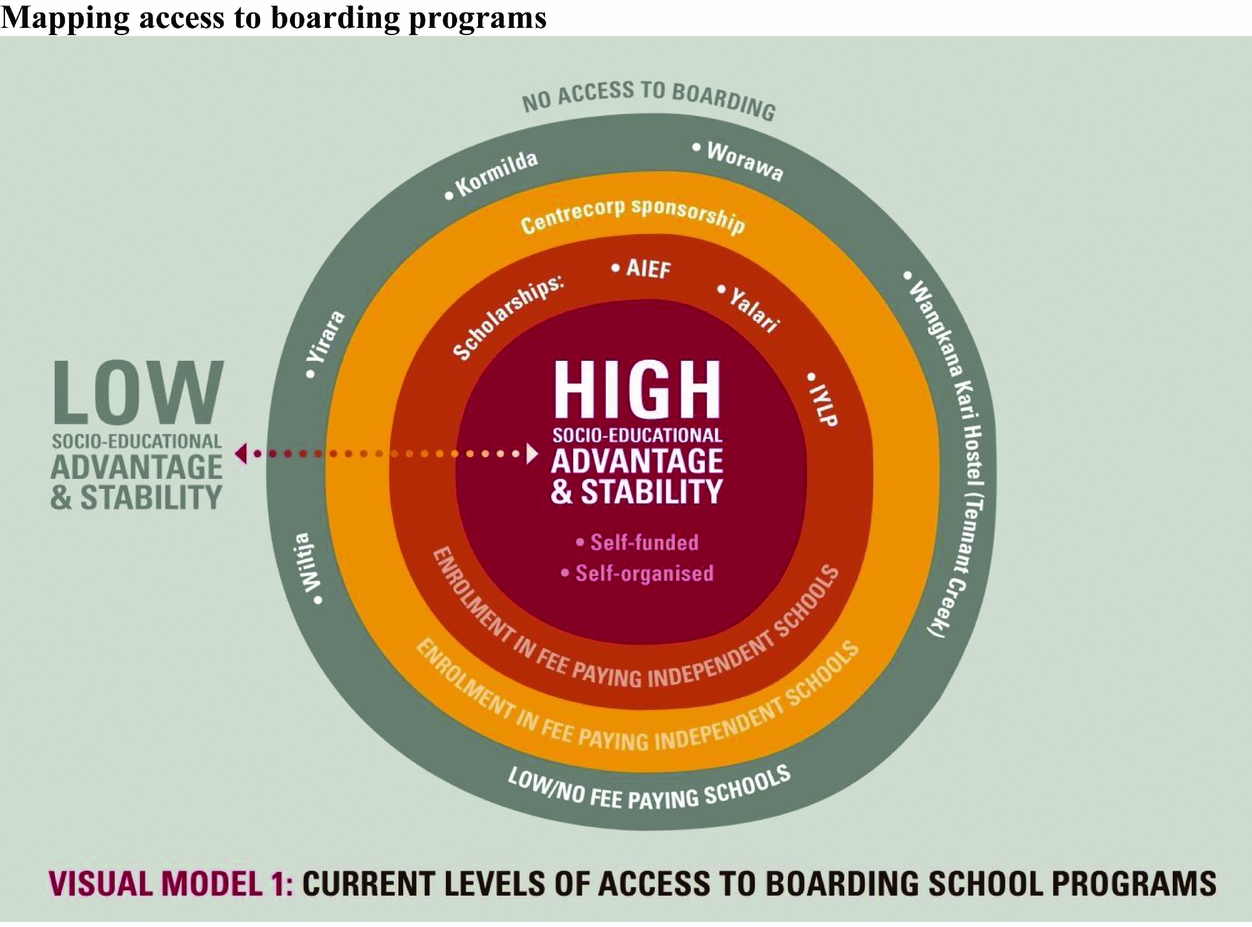
Mapping Access to Boarding Programs
Visual model 1 (Figure 3) broadly maps the socioeducational preconditions that enable or limit access to the various boarding and scholarship programs that Centralian young people attend. This is not by any means an exhaustive list of programs and supporting organisations currently available, but alternative models being developed in the Northern Territory in response to the Wilson Review, such as remotely-located regional boarding facilities, are largely to the north and are unlikely to be taken up by young people from within the CLC footprint, with the exception of a small-scale hostel model based in Tennant Creek (Northern Territory Department of Education, 2016). ‘Hidden boarders’ with homestay or family accommodation arrangements do not figure in this data.
Visual model 1 depicting access to boarding school programs.

Inner circle: Students with a high degree of SEA are located in the inner circle of the visual model. This means that their families are able to self-fund and secure an enrolment at a boarding school without the assistance of a scholarship or broker. The boarding schools in this category would typically be recognised as higher quality, and possibly ‘elite’ schools where Aboriginal and Torres Strait Islander students are a small minority of students. Within the scope of the Centrecorp evaluation and other publically available data sets, we did not find any Aboriginal students enrolled within a self-funded/self-organised boarding arrangement, however, Centrecorp provided informal feedback indicating that they are aware of a number of families who do self-fund and self-organise both formal boarding school places, as well as homestay arrangements within families to enable access to various schooling and sporting opportunities. The destination schools are mostly high fee-paying independent schools such as those listed below under circle 2 and 3.
Circle 2: Scholarship programs that are well-resourced, politically promoted and place students exclusively in high fee-paying schools are located in circle 2. These include AIEF, Yalari and IYLP. In the Northern Territory, The Smith Family (a national education charity) is the Commonwealth funded partnership broker for IYLP students, working between schools, families and students to administer the scholarship program. Drawing on Pearson's (Reference Pearson2011) language of high expectations, the student's intention and likelihood of year 12 completion is paramount in the consideration of scholarship candidates. Social stability becomes an important criterion for student selection, as these programs are largely risk-averse and promote high retention and year 12 completion rates as an indicator of success (for further discussion of boarding school ‘success’, see AIEF, 2015, p. 14).
These programs provide financial contribution in addition to Abstudy funding with a contribution required from families in some cases (e.g., AIEF). Through a written application process requiring references, statements of parental/guardian support and previous school reports, students must demonstrate their potential for retention and schooling completion in order to move through to the competitive interview stage. We found some examples where a successful placement in a boarding program listed in circle 3 or 4 led to a scholarship offer being made for placement within a circle 2 program.
Examples of schools in circle 2 include: IYLP schools: Immanuel College, Pembroke School, Rostrevor College, Westminster School (South Australia), The Geelong College, St Patrick's College, Loreto College (Victoria), St Philip's College, St John's College, Kormilda College (Northern Territory), St Joseph's College, St. Scholastica's College and St. Gregory's College (New South Wales). AIEF schools: Ipswich Grammar (Queensland), The Scots College, Pymble Ladies’ College and St Vincent's College (New South Wales).
Circle 3: The Centrecorp sponsorship program is located in circle 3. This program is not reliant on government support and makes scholarship funds available by utilising financial returns on corporation investments. This sponsorship program is more flexible than those in circle 2, affording access and opportunities to students and families within relatively short timeframes, although the family is still required to produce a letter of offer from a target school to secure sponsorship. Centrecorp does not broker or negotiate enrolments, therefore families must utilise their own networks and capabilities to access the program, often via a parent or a family friend who is an old scholar or has a personal connection to the target school community. Analysis of interview data shows that many families sought out funding and enrolment opportunities at relatively short notice due to a shift in the family's social or financial circumstances.
Students sponsored through Centrecorp attend fee-paying schools including: Immanuel College, Rostrevor College, Woodcroft College (South Australia), The Geelong College, Kardinia International College, St. Patrick's College (Victoria), Scotts College, Trinity Grammar School, Meriden Anglican School for Girls, Newington College (New South Wales), Clontarf Aboriginal College (Western Australia) and St Philip's College (Northern Territory). Schools such as Immanuel College and Rostrevor College in Adelaide, for example, have also made significant investments into their overall Aboriginal boarding program and staff, providing established networks which are utilised to support students attending through an arrangement with Centrecorp.
Circle 4: Programs that are far more accessible and cater for large or exclusively cohorts of Aboriginal boarders at low or no cost to the family/ student are located in circle 4. These schools include Wiltja Secondary College, Worawa Aboriginal College, Yirara College, Marrara Christian College and Kormilda College. The Wangkana Kari Hostel at Tennant Creek is solely an accommodation facility and students are placed at schools within Tennant Creek. A process of selective invitation is applied with some expectations of behaviour and long-term commitment to the placement, reflected in this recommendation from a 2012 review of Wiltja Secondary College:
It is important that students who are chosen to come to Wiltja meet all the criteria around wanting to come, having family support and showing good learning and behaviour skills. (Wiltja, 2015, p. 5)
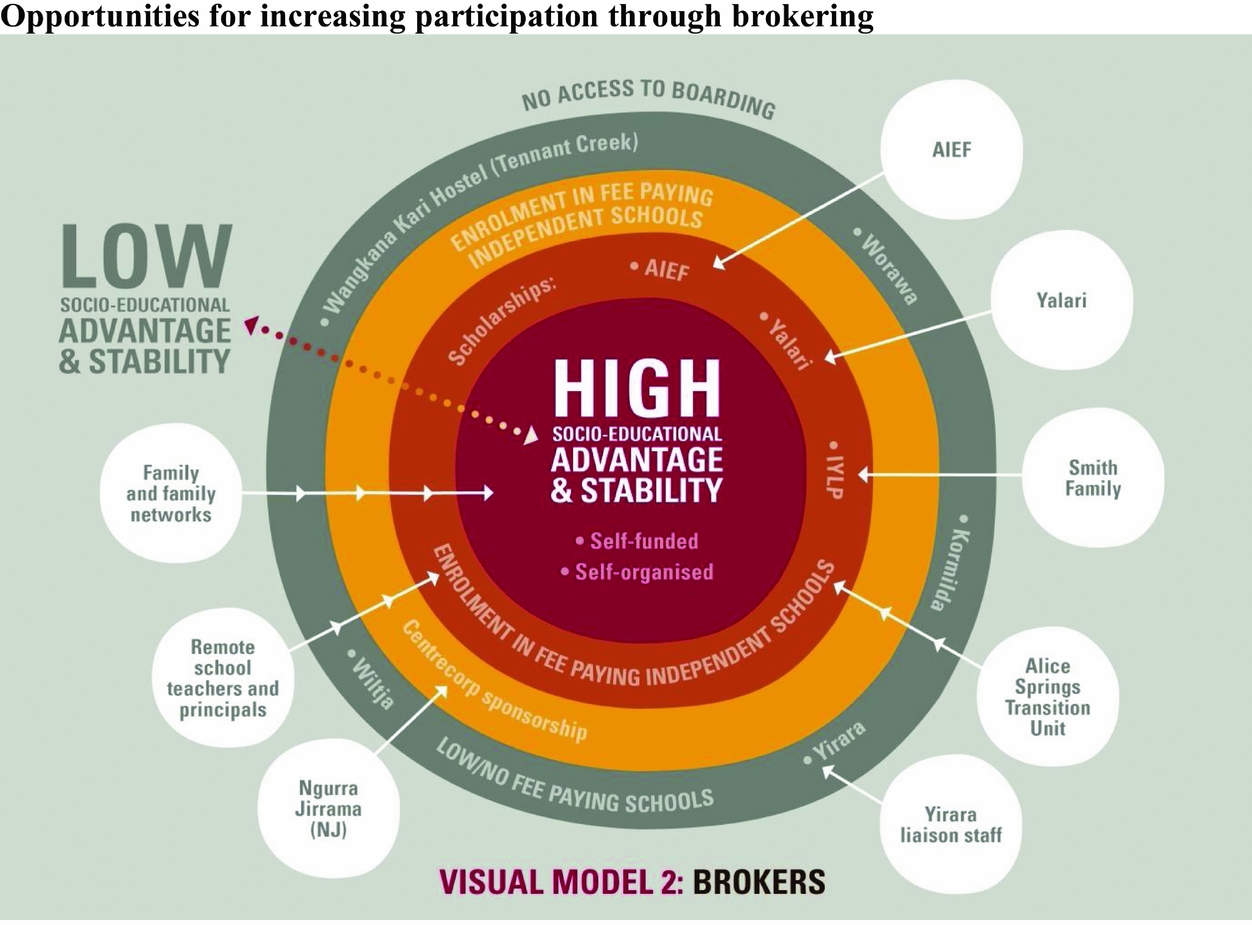
Wiltja Secondary College is an Adelaide-based state government boarding school exclusively for Aboriginal students. Students are not required to secure funds or sit a competitive interview in order to attend. Teaching staff in Alice Springs and in very remote communities act as brokers for Wiltja at no cost to the program. Currently, students attend from regional, remote and very remote communities across three states and territories — South Australia, Western Australia and the Northern Territory.
Yirara College is an Aboriginal boarding school based in Alice Springs managed by the Finke River Mission. The school employs liaison staff who broker enrolment negotiations between families, Abstudy and Yirara College. Other than some preferred minimal guidelines around behavioural expectations and school engagement, relatively few demands are placed on students to secure a place at the school.
Wangkana Kari Hostel has had a patchy and difficult history but is currently strengthening their position under a renewed policy direction and funding made available following the 2014 Wilson review. A residential facility is made available to orient students to the routines and behaviours that are expected in a boarding school. Students attend Tennant Creek High School or study through the Northern Territory Open Education Centre (see Northern Territory Department of Education, 2016).
Outside the circles (no access to boarding): Boarders make up a small percentage of the cohort of secondary school-aged young people living in the CLC region. There are many young people who are not well-prepared to access or succeed in a boarding school program, while others prefer community-based day student alternatives for a variety of reasons. While we are arguing for improving access to boarding programs, we are also highlighting the need to develop a policy and investment strategy for this much larger ‘outside the boarding model’ cohort of young people if the stated goals of Closing the Gap are to be realised in relation to the measures of attendance, NAPLAN results, school completion and transition to employment (Turnbull, Reference Turnbull2016).
It should be noted that the visual model is limited in the sense that there may be families with the socioeducational capacity to pursue opportunities through Centrecorp or other scholarship programs, but select Wiltja Secondary College, Yirara College or Wangkana Kari Hostel as the facility of choice for a variety of reasons. These might include a preferred schooling model, families feeling more confident in sending their child to a program with a larger cohort of Aboriginal students or historical affiliations between the school and community.
Mapping Boarding Enrolments
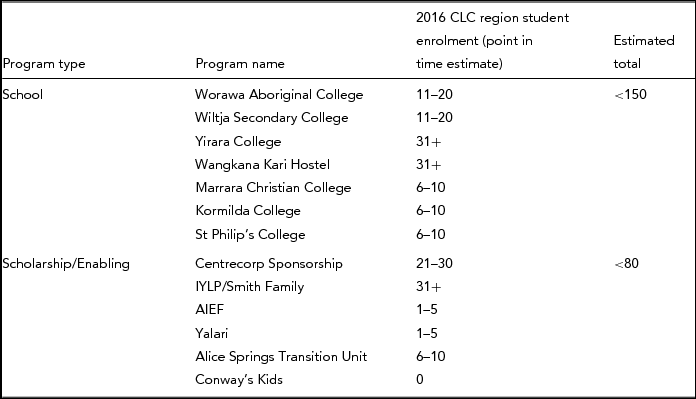
Two program types are represented in Table 1. The first refers directly to schools with dedicated Aboriginal boarding programs where families and schools collaborate directly with the school to secure enrolment and boarding. The second group represents scholarship and enabling programs that work with multiple partner schools. A more detailed description of each school and scholarship program is provided as appendix.
CLC Region Point in Time Boarding Enrolment Estimates by Program Type

Source: Centrecorp Evaluation Data, Publically Available Data, Personal Communication, Association of Independent Schools of the Northern Territory.
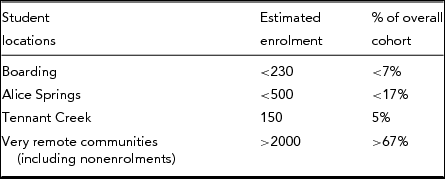
The Australian Bureau of Statistics (ABS, 2016) suggests that approximately 60% of Aboriginal people within the CLC region are under 30 years of age. It is reasonable to assume, then, that of the 24, 000 Aboriginal people in the region, around 3 000 young people would fall within secondary school age-range (12–17 years old; secondary/high school includes school years 7–12 in the Northern Territory).
Table 2 summarises population and student enrolment data from publically available sources (clc.org.au, myschool.edu.au, ABS, 2016). Myschool data shows that there are less than 500 Aboriginal high school day students in Alice Springs, and approximately 150 in Tennant Creek, totalling between 600 and 650 Aboriginal day students enrolled in the two larger towns within the CLC region. This study estimates that between 200 and 250 Aboriginal students (approximately 7 %) from the region were in boarding programs at any point in time in 2016. Taken together, these figures indicate that approximately two-thirds, or more than 2000 Aboriginal secondary aged students in the region, are attending local schools in very remote communities outside of Alice Springs and Tennant Creek, or are not enrolled in school. A further cohort of students living with family members interstate, or attending schools outside of formal scholarship arrangements that are not accounted for within publicly available data sets is not represented here. These ‘hidden boarders’ are not visible within the data sets used to track students from the CLC region for this study. An analysis of Abstudy ‘living away from home allowance’ data is a method that may locate a number of this cohort.
Location and Distribution of Aboriginal High School Students Within the CLC Region

Source: http://myschool.edu.au/, http://www.clc.org.au/, boarding estimates from Table 1.
Following recommendations of the Wilson review, secondary schooling programs in very remote communities are being scaled back and students are being encouraged towards boarding programs, particularly in smaller communities where resources for sustaining secondary schooling are more marginal. It is anticipated that the number of unenrolled students and the potential for engagement of these students in secondary programs will become clearer as the Northern Territory Government's focus on boarding develops. A number of such studies are currently underway. These figures highlight the need for further research, investment and policy focus in relation to a broader range of strategies which should include: improving access to existing boarding programs, engagement initiatives for those students not currently enrolled in schooling and strengthening remote community school programs as an important platform for improving attendance, engagement and transition to and from boarding programs.
Opportunities for Increasing Participation Through Brokering
Visual model 2 (Figure 4) indicates the key role played by brokers in providing support between families and schools to access programs. Some boarding schools maintain long-standing relationships with specific families or communities, but disinvestment in very remote secondary programs and limited direct contact between some scholarship programs, boarding schools and students’ families and communities is of concern. Without an established working relationship between schools, scholarship programs and families, the likelihood of success in boarding programs for students whose families do not enjoy strong SEA is diminished. In these circumstances, a broker can play a vital role. Programs such as IYLP, Yalari and AIEF have made important contributions to the Aboriginal boarding landscape nationally through working with independent schools to make commitments to Aboriginal education, utilising the resources and goodwill available within each school community. These initiatives have forged new opportunities for students that were not available to previous generations and these efforts deserve recognition and celebration, but there is more to do.
Visual model 2 showing the relationship between boarding schools and brokers, families and remote schools.

One of the disadvantages in accessing the more visible, high stakes scholarship programs (circle 2) is the primacy placed on retention and completion rates in considering applicants. Very remote students represent approximately 75% of Aboriginal school-age students in the CLC region (see Table 2) yet are least well-placed to make guarantees of staying in — and completing — school within boarding programs. As boarding programs increase in response to government initiatives, the pool of available Centralian students who can readily access scholarship programs and complete their schooling under existing terms will decrease. Therefore, new strategies and investment into building capacity for successful educational engagement in and away from the local community school need to be enacted to enhance existing models.
In the Northern Territory, The Smith Family acts as the partnership broker for IYLP programs. Table 1 shows that in the CLC region, investment in building brokering capacity has yielded higher participation in IYLP scholarships (31+) when compared to similar scholarship programs such as Yalari and AIEF (<10 combined). The Northern Territory Education Department has identified that working between families, local remote schools and boarding programs is integral to increasing student participation and retention in boarding programs and, as a consequence, has established the Alice Springs Transition Unit to develop to develop this type of approach.
There are small-scale examples of individuals or groups acting as a broker to secure an enrolment and funding support through Centrecorp. For example, the Ngurra Jirrama Foundation (www.ngurrajirrama.org.au) has brokered enrolment and accommodation placements for students from Ti Tree (a small community 200 kms north of Alice Springs) attending Meriden Anglican School for Girls and Trinity Grammar School in Sydney, and assists with information and communication to support these students in their schooling. In such cases, brokers have negotiated access to programs, but attrition rates generally remain quite high. As the boarding school policy matures across the Northern Territory, we suggest that it is important to increase investment in brokering programs and to strengthen these programs to be more effective in the supports they provide in order to encourage student access and retention. Utilising and engaging families is also necessary to strengthen students’ experiences of boarding school. A number of examples were also found where foster carers secured access for Aboriginal children in their care.
We suggest that strengthening relationships between families, communities and local remote schools is also necessary in strengthening postboarding transitions. It is also worth considering the potential benefits of building relationships with primary-aged students to better prepare them and their families for boarding as well as supporting negotiations when social disruptions exclude potential candidates from scholarship programs. Investment into brokering therefore needs to be two-fold: (1) to be more readily available to work between families and destination boarding schools, and (2) to be more actively involved with the local remote schools, students, families and communities.
Families: Central to Boarding Success
Moving beyond quantitative analysis of data sets, findings from the qualitative components of the research which informed this paper highlighted key perspectives from families accessing boarding. In particular, the vital role of family in providing ongoing opportunities for success during and beyond the boarding experience was evident.
Kinship Capacity
Approximately 20% of all students who sought funding assistance for interstate schooling through Centrecorp were not enrolled in an institutional or residential boarding program, yet represent another cohort of boarding students. These students sought assistance for school fees to attend both public and private schools in metropolitan areas, but their accommodation was organised through family or close and trusted family friends. In these cases, Aboriginal families are perhaps more easily able to access accommodation with family and friends than nonAboriginal families, as this informal arrangement of sharing care and parental responsibilities is culturally embedded within the frame of kin and reciprocal obligation and is less likely to be seen as burdensome by ‘non-nuclear’ family members. While this cohort is invisible within the publically available data sets accessed for this study, anecdotal evidence suggests that student numbers are significant.
Positive Attrition
The Centrecorp evaluation showed that a number of families proactively move their children between remote local schools, boarding schools and the wider family network. Under current measures of schooling, this pattern would be recorded as a series of noncompletions or failures. Centralian families, however, described this type of movement as positive attrition whereby, a short placement in a boarding program was considered a positive step towards a second or third more certain attempt to complete schooling. The following comments from parents interviewed for the Centrecorp evaluation reflect a sense of short-term boarding as one step towards success:
He showed great achievements in rugby but had another snap over some social issues. . . . He is now doing well at [a local school] and the private school interstate schooling transformed him to achieve. He still does workouts and study routines that were developed interstate which was not possible previously. He needed to return to his dad in Alice. . . .I'm trying to get him back to the interstate school for Year 11 and 12.
She's not receiving support at the moment because she's living with family in Adelaide . . . but it [sponsorship] more or less helped me get her away in order for her to keep learning and keep being educated . . . because while she was here it wasn't working
Given these experiences, boarding programs will need to be more flexible in order to increase participation and student retention in boarding into the future. The orbits that Pearson (Reference Pearson2006) argues for can only be possible if families, communities, brokering partners and boarding schools maintain established and trusted relationships to help negotiate movement between home and school as required.
Opportunities for Building Both Ways Capital
The argument for boarding schools draws on narratives of acquiring social and cultural capital. One the one hand, families interviewed for the Centrecorp evaluation echo this narrative:
I think that's one of the best things is education for kids and the opportunity to go away from Alice Springs because I think that's what . . . kids need to know there is more to life than your town
That's what's helped my kids see, you do have to work for your money, people work and they get an education and it's not bad to get an education
The routine in itself, getting up, it's a routine, that's what you've got to do. So the same in work, you've got to get up, go to work, stay for the day . . . so all that stuff [they learn from boarding]
However, others voiced their concerns regarding the potential negative impacts on students’ identity, language, culture and wellbeing:
In some ways, my kids have missed out on learning from family and being on country with the focus on school attendance. When we were kids we often missed school and learned things from the grandparents being out hunting and doing other things. That's something I wish my kids had. My son is light skinned and so it's hard for interstate schools to understand that inside, he's a desert boy with those values and strengths. He does things differently and that doesn't always fit neatly with schooling models.
. . . we've still got it at our fingertips . . . we just can't get out there much to preserve it ourselves . . . so that's a hard thing, and I said to [my son] once you do Year 12 and have time then go back and connect and learn . . .
These concerns reinforce the importance of schools and scholarship programs building meaningful relationships with — and within — the home communities of students and their families. There are some encouraging and innovative examples of ‘both ways’ social and cultural capital development through secondary schooling exchanges. One such example is the Yiramalay/Wesley Studio School (www.yiramalay.net), a collaboration between the Wesley College in Melbourne and the Fitzroy Valley community in the West Kimberley region in the north west of Western Australia. This type of regional collaboration and attention to the development of long-term ‘both ways’ relationships and capital would be worth exploring across the CLC region in the Northern Territory, although it is important to note the Yiramalay model has not been independently evaluated.
One aspect of the boarding school landscape that demands further exploration is the perceived worth of social, human and cultural capital on offer within boarding school communities. Such capital is often viewed in terms of ranking the social-educational advantage of the target school, leading some scholarship programs to make claims of placing students in ‘good’ schools or the nation's ‘best’ schools. Scholarship programs linked to high fee independent schools entail careful student selection with limited placements available. Boarding programs that can take larger cohorts of students from the CLC region are likely to cater primarily or exclusively for Aboriginal students, limiting opportunities for the acquisition of Western social and cultural capital that largely underpins the logic of advocating for boarding programs. Far-reaching policy changes such as the wholesale endorsement of boarding schools as the solution to remote education need further definition and differentiation in regards to their social and academic aims, and consideration must be given to how such programs can facilitate the orbits between home and metropolitan boarding contexts that Pearson argues for.
Conclusion
Interview data gathered within the Centrecorp evaluation suggest that the reasons families seek boarding placements are varied. Relatively few students participate in the more-visible and well-funded national scholarship programs, although brokering is an effective strategy for increasing participation in these programs. Many families seek boarding opportunities in response to periods of social disruption, yet such circumstances narrow their access to the full range of boarding options. This study finds that investment into brokering strategies, the development of both-ways capital educational models, and more flexible scholarship access and administration processes could be explored on a larger scale to enable wider participation in boarding and encourage stronger rates of student retention, completion and postschool engagement in further learning and employment. There is a paucity of research available to inform Indigenous boarding policy initiatives and the current policy context lacks clarity and definition around important questions such as: ‘what sort of social and cultural capital is beneficial for young Aboriginal people’?, ‘what are the preconditions for access and success in boarding programs’?, and, ‘what are the policy and investment priorities that could be clarified and strengthened to better-prepare young Aboriginal people and their families for success in completing school, including within boarding programs’?

About the Authors
Sam Osborne is the Associate Director, Regional Engagement (APY Lands) in The University of South Australia. He has worked in Aboriginal Education since 1995 include teaching Pitjantjatjara language programs, various research projects and a range of leadership role, including Principal (Ernabella Anangu School). In 2017, he completed a PhD focussing on education in the tristate area of Central Australia.
John Guenther is the Research Leader for Education and Training in the Batchelor Institute of Indigenous Tertiary Education. He has led research and evaluation projects relating to education, training, child protection, family violence, children and families in the northern Australia for the last 15 years.
Tessa Benveniste is a PhD candidate at the Appleton Institute (CQUniversity, Adelaide). Her thesis explores the expectations, experiences and outcomes of boarding school for remote Aboriginal students, families and communities. She has volunteered at several boarding and community programs since 2012, and has experience working across remote communities in central Australia including the Anangu Pitjantjatjara Yankunytjatjara lands and Alice Springs. In 2018, she will commence a research position at the Centre for Indigenous Health Equity Research, Cairns.
Professor Lester-Irabinna Rigney is a descendant of the Narungga, Kaurna and Ngarrindjeri peoples of South Australia. He is an expert on Aboriginal Minority Education. He is a Research Fellow at Kings College, London, and Professor of Education at the Centre for Research in Education at The University of South Australia. He is best known for his theorisation of Indigenist Research Epistemologies and Aboriginal Education putting him at the forefront for schooling and language rights from 1990s to the 2000s. Professor Rigney has worked across the Pacific on Indigenous Education from New Zealand, Taiwan to Canada.
Samantha Disbray has worked as a community and research linguist in the vibrant and dynamic language ecology of Central Australia since 1998. She has researched Warumungu, an endangered language spoken in Tennant Creek in the Northern Territory and published a learner's dictionary. She studied children's Wumpurrarni English narratives in her 2008 PhD dissertation. Samantha has also worked with Central Australian Aboriginal educators and activists teaching Aboriginal languages in school settings. From 2012 to 2016, Samantha was a Senior Research Fellow with Charles Darwin University, working on the Remote Education Systems project.