Introduction
Rice (Oryza sativa L.) is one of the most important food crops in the world. Rice crops require large amounts of water and nitrogen (N). Rice is a staple food for more than 60% of the world's population, and it is estimated that the demand for rice will increase to 852 million tons by 2035 (Patel et al., Reference Patel, Anup, Munda, Ghosh, Bordoloi and Kumar2010; Zhang et al., Reference Zhang, Xu, Shi, Li, Huang and Wang2010). Water and nitrogen are important factors that affect rice plant growth, yield, composition and quality (Haefele et al., Reference Haefele, Jabbar, Siopongco, Tirol-Padre, Amarante, Sta Cruz and Cosico2008; Zhang et al., Reference Zhang, Xu, Shi, Li, Huang and Wang2010; Ye et al., Reference Ye, Liang, Chen, Liu, Gu, Guo and Li2013; Tian et al., Reference Tian, Feng, Zou, Zhang, Zhu and Miao2014). Water is the main driver of rice crop development worldwide. Water deficiency causes nutrient deficiencies in plants, which affects their growth (Azeem et al., Reference Azeem, Sun, Javed, Jabran, Saifullah and Du2021a, Reference Azeem, Wenxuan, Changyan, Javed and Abbas2021b). Water resources are becoming scarce because of the increasing world population and food demand (Azeem et al., Reference Azeem, Sun, Javed, Jabran, Saifullah and Du2021a, Reference Azeem, Wenxuan, Changyan, Javed and Abbas2021b). Crops that require high water supply during their growth periods, such as rice, face several problems. Nitrogen availability in the soil is another important factor in the growth of rice plants (Xiang et al., Reference Xiang, Wang and Liu2017a, Reference Xiang, Fu, Zhen, Shuang and Wei2017b). Climate change and poor agricultural practices lead to nitrogen deficiency in soils worldwide (Wu et al., Reference Wu, Liu, Liu, Wang, Gu, Jin, Lei, Zhai and Wang2018). The main challenge in rice-growing regions is to utilize these scarce water resources along with poor nutrient soils to achieve maximum production (Bouman and Tuong, Reference Bouman and Tuong2001; Belder et al., Reference Belder, Bouman, Cabangon, Guoan, Qiulang, Yuanhua, Spiertz and Tuong2003; Ding et al., Reference Ding, Yang, Tong, Han, Chen and Tang2015; Xiang et al., Reference Xiang, Wang and Liu2017a, Reference Xiang, Fu, Zhen, Shuang and Wei2017b; Daniels et al., Reference Daniels, Sharpley, Harmel and Anderson2018; Wu et al., Reference Wu, Liu, Liu, Wang, Gu, Jin, Lei, Zhai and Wang2018). This is due to water shortage and poor nutrient availability in the soil.
Owing to water shortage and poor nutrient availability in the soil, the Ministry of Agriculture and Rural Affairs of China proposed the strategic plan of ‘Zero Growth in Fertilizer Utilization by 2020,’ and problems such as the lack of water resources and severe soil non-point source pollution in rice-growing regions in China need to be solved urgently (Sun et al., Reference Sun, Li, Meng, Guo, Wu, Yi and Chen2011a, Reference Sun, Sun, Liu, Yang, Chen, Jia and Ma2011b; Wen et al., Reference Wen, Zhao, Wang, Tang, Kang, Yuan and Shi2019). Therefore, the best rice variety for these regions is the variety that can be grown under water- and nitrogen-deficient conditions. Furthermore, establishing optimum water and nitrogen management strategies can overcome water shortage and nitrogen deficiency problems in rice-growing areas in China (Yu et al., Reference Yu, Zhang, Chen, Li and Wang2019). Several studies have reported that the interaction between irrigation and nitrogen application has a significant effect on rice plant height. Higher nitrogen fertilizer application can alleviate the problems in plant height caused by water shortage (Lu et al., Reference Lu, Ren, Liu, Yan and He2016; Zhu et al., Reference Zhu, Shi, Hong, Cheng and Wang2019). A previous study found that irrigation, along with nitrogen application and the top-dressing method, significantly affected chlorophyll content in the leaves of rice plants. The effect of irrigation and the top-dressing method on soil and plant analyser development (SPAD) values was apparent during the reproductive growth stage of rice. The effects of nitrogen amount during the entire rice growth period, SPAD value, and rice yield during the milk maturity period were highly correlated.
Several studies have described the effects of different irrigation methods and nitrogen applications on the growth of rice plants (Sadras and Lawson, Reference Sadras and Lawson2013). The effect of the combination of dry and wet alternating irrigation with a reasonable nitrogen application rate is better than that of the ‘conventional irrigation + low nitrogen application’ or ‘conventional irrigation + high nitrogen application’ treatment, with the combination treatments generating a significant increase in grain yield and quality in rice (Li et al., Reference Li, Wang, Yuan, Liu and Yang2008; Sadras and Lawson, Reference Sadras and Lawson2013; Xu et al., Reference Xu, Wang, Zhai, Sun and Li2015). Buhaliqiemu et al. (Reference Buhaliqiemu, Bai, Huang, Wang, Jin and Zhang2018) described the effects of nitrogen fertilization on the yield of different rice varieties. Wen et al. (Reference Wen, Zhao, Wang, Tang, Kang, Yuan and Shi2019) reported that increasing nitrogen application promoted the growth of rice plants. Controlled irrigation of rice varieties resulted in water saving of 23.5%, high effective tiller number and grain formation rate, and increased yield by 4.42–4.93%.
Many studies have been conducted on rice growth, yield and quality in relation to water, nitrogen, and their combination in the southern rice regions of China. Most studies have been conducted using single-factor analysis of rice crops. Therefore, there is a lack of information on the behaviour of different rice varieties under a combination of irrigation and nitrogen fertilization. Therefore, the objective of this study was to investigate the responses of different rice varieties to different irrigation and nitrogen regimes to determine the best water and nitrogen regimes for maximum production.
Materials and methods
Materials
The experiment was conducted at Wensu Rice Experimental Station of the Xinjiang Academy of Agricultural Sciences (41°16′N, 80°12′E) from 2019 to 2020. The cropping system was a single rice crop system cultivated between April and October and fallow in winter. Sixteen rice varieties were collected and provided by the Institute of Nuclear Technology and Biotechnology of the Xinjiang Academy of Agricultural Sciences (online Supplementary Table S1). The basic physical and chemical properties of the experimental field soil are given below: total salt content, 2.4 g/kg; pH, 8.23; EC, 1.05 ms/cm; total nitrogen, 1.901 g/kg; available nitrogen, 147.7 mg/kg; available phosphorus, 57.2 mg/kg; available potassium, 115.0 mg/kg; and organic matter, 38.31 g/kg.
Methods
Experimental design
The experiment used a random block design with two main factors: irrigation method and nitrogen application rate. The total plot area was 45 m2, with row spacing of 25 cm, plant spacing of 10 cm, and planting area of 1.8 m2 per variety (75 plants per plant). The normal fertilization treatment (F1) comprised 150 kg ha−1 urea (N ≥ 46%), 225 kg ha−1 calcium phosphate, and 75 kg ha−1 agricultural potassium sulphate. Seedlings were sown on 6 April and transplanted into the field on 6 May. Urea was applied three times separately on 16 May, 26 May, and 6 June during the tiller stage at 90 kg ha−1 each time, for a total of 270 kg ha−1. The reduced fertilization treatment (F2) comprised calcium phosphate 225 kg ha−1 and agricultural potassium sulphate 75 kg ha−1. In the F2 treatment, urea was applied at 75 kg ha−1 each time, for a total of 225 kg ha−1. Phosphate and potassium were applied as base fertilizers at a time similar to that in the F1 treatment. All fertilization methods were broadcast manually. Water was maintained at a shallow depth during the tillering stage, and water treatment was initiated on 25 June. Irrigation was applied every 5 days for normal watering treatment (W1) (maintaining 2–3 cm water layer), with a total water usage of 8.7 t ha−1 from transplanting to harvest. The water reduction treatment (W2) comprised irrigation applied every 10 days, with a total water usage of 5.22 t ha−1 until harvest. In all treatments, water was cut off on 7 September.
Measurement indexes
Growth period survey
The full growth period was defined as the number of days between the seedling emergence and maturity. During this period, seedling raising, transplanting, maximum number of tillers, full grain stage (when more than 80% of the tops of the plants were exposed), and mature stage (when more than 95% of the plants were mature) were recorded for each rice variety.
Plant height and SPAD value
From the tiller stage to the full heading stage, 10 plants of each variety were selected at a fixed place; plant height was determined using a measuring tape every 12 days (d); and the SPAD value of the full-blown leaves of each variety was measured with a chlorophyll meter (SPAD-502 plus; Japan). For each variety, 10 leaves were measured from the upper, middle and lower parts of each leaf, and the average value was recorded. The same method was used to determine plant height and SPAD values during harvest.
Yield and its components
At maturity, all rice varieties were harvested, and the number of effective grains per plant, grains per spike, thousand-grain weight and yield were determined (using six plant samples per variety). After harvesting, drying and threshing, the water content of the grains was measured using a handheld rapid moisture analyser (LDS-1H; Top Instrument) and weighed to convert the yield per hectare (15% moisture). The yield traits measured in the laboratory included effective panicles, kernels per panicle, seed-setting rate and 1000-grain weight.
Rice quality
The rice processing quality was determined as a percentage of whole rice using a milled rice machine (LTJM-2099; Top Instrument). Nutritional qualities, including amylose content, protein content and taste value were determined using a rice taste meter (RCTA-11A; Satake Manufacturing Co., Ltd., Suzhou, China).
Data processing
The assumptions of parametric statistics were tested to verify the normality and homogeneity of variance using the Shapiro–Wilk normality test and Levene's test before further analysis. Cluster analysis and analysis of variance were performed using water and nitrogen as the main factors to determine the main and interaction effects of different parameters (P < 0.05). Furthermore Duncan's multiple-comparison test (P ≤ 0.05) was used for multiple comparisons to measure the significant difference between each treatment. All analyses were conducted using SPSS 17.0, and graphs were generated using GraphPad Prism 7.0.
Results
Analysis of yield traits among different rice varieties
Sixteen rice varieties were classified based on their yield and response characteristics to different water and nitrogen treatments. The average yields of the 16 rice varieties under different treatments were used for cluster analysis (online Supplementary Fig. S1). Cluster analysis showed that, for a Euclidean distance of 10, the 16 rice varieties could be divided into three types according to yield: high (I), medium (II) and low (III), accounting for 50.00, 43.75 and 6.25%, respectively.
Analysis of yield components of rice varieties under different water and nitrogen treatments
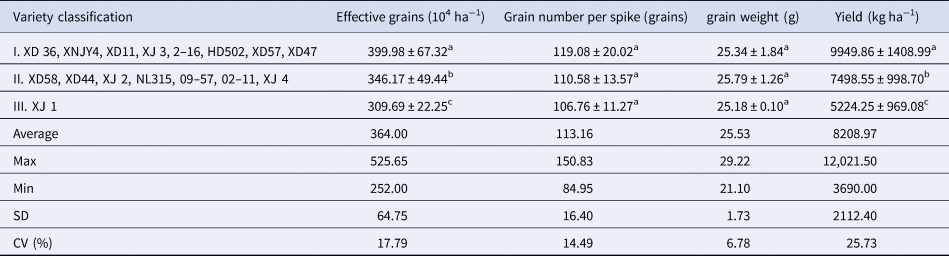
The average values of effective grains per spike, grains per spike, thousand-grain weight and yield of the 16 rice varieties across the water and nitrogen fertilizer treatments were 364.00 × 10⁴ grains ha−1, 113.16 grains, 25.53 g and 8208.97 kg ha−1, respectively (Table 1). There were significant differences in the number of effective grains and yields between types I and III. The coefficients of variation (CVs) were 6.78–25.73%, with the lowest for thousand-grain weight and the highest for yield.
Yield components for the rice varieties across the irrigation and nitrogen fertilizer treatments

Note: I represent high-yield, II represent middle-yield, III represent low-yield. Values are denoted as mean Average ± SD. Different letters (a-b-c) within a column denote the significantly difference at P < 0.05 level according to Ducan's multiple-comparison test (variety classification is I, n = 24; variety classification is II, n = 21;variety classification is III, n = 3).
Effects under different water and nitrogen treatments on yield traits of rice varieties
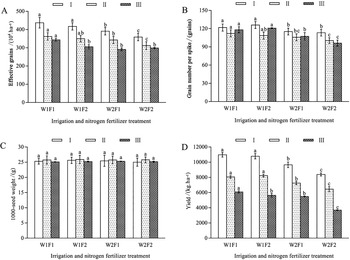
Water and nitrogen treatments had significant effects on the number of effective grains, grains per spike and yield of rice varieties, but had no effect on the thousand-grain weight. Compared with W1F1 (normal fertilizer with normal water), there was no difference in the effective grains per spike of type I. Differences for type II were also not significant, and the effective panicles of type III were remarkably reduced by 11.01% (Fig. 1A). Under the W1F2 (normal water with reduced fertilizer) treatment, compared with W1F1, the effective grains per spike of types I–III were significantly reduced by 10.63, 5.42 and 15.29%, respectively. When comparing W2F1 (reduced water with normal fertilizer) and W1F1, the effective grains per spike of types I–III were significantly reduced by 17.97, 13.95 and 12.93%, respectively. Comparing W2F2 (reduced water and reduced fertilizer) and W1F2, the effective grains per spike of types I and II were significantly reduced by 14.05 and 10.85%, respectively, but there was no difference in type III for the W2F2 treatment. Compared to W2F1, to W2F2 the effective grains per spike of types I and II were significantly reduced by 8.21 and 9.02%, respectively, but no difference was observed for type III. Thus, W2F1 affected the number of effective grains per spike in all rice types. W1F2 had the maximum effect on effective grains per spike for Type III, and W2F2 had the maximum effect on types I and II.
Effect of irrigation and nitrogen fertilizer treatments on yield traits of rice varieties. A represents effective grains, B represents grain number per spike, C represent 1000-seed weight, and D represents yield. I represents high yield. II represents medium yield. III represents low yield. W1F1 represents the normal watering and fertilizer treatment. W2F1 represents the water reduction and normal fertilizer treatment. W1F2 represents the normal watering and reduced fertilization treatment. W2F2 represents the water reduction and reduced fertilization treatment. Bars denote Average ± SD. Different letters indicate significant differences (P < 0.05) according to Duncan's multiple-comparison test (variety classification is I, n = 24; variety classification is II, n = 21; variety classification is III, n = 3).

When comparing W1F1 to W1F2, there was no difference in the number of grains per spike between types I and III. Furthermore, there was no significant difference in the number of grains per spike for type II (Fig. 1B). Comparing W1F1 to W2F1, the grains per spike for types I, II and III were significantly reduced by 5.41, 5.76 and 9.19%, respectively. Comparing W1F1 with W2F2, the number of grains per spike for types I–III was significantly reduced by 6.98, 10.53 and 18.59%, respectively. Compared to those under W1F2, the grains per spike of types I–III were significantly reduced by 10.05, 7.58 and 20.43%, respectively, under W2F2. Comparing W2F1 to W2F2, there was no significant difference in the grains per spike of types I and II, but it was significantly reduced in type III by 10.35%. Thus, W2F1 affected the grains per spike of types I–III; W1F2 had no effect on the grains per spike; and W2F2 had the greatest effect on the grains per spike of type III. Figure 1C shows that the water and nitrogen treatments had no effect on the thousand-grain weight of types I–III.
When comparing W1F1 to W1F2, there was no difference in the yields of types I and II, but that of type III was significantly reduced by 7.46% (Fig. 1D). For W1F1, the yields of types I, II and III were significantly reduced by 11.96, 9.92 and 9.87%, respectively, compared to those of W2F1. Under W1F1, the yields of types I, II and III were significantly reduced by 23.59, 19.71 and 39.34%, respectively, compared to those under W2F2. For W1F2, the yields of types I, II and III were significantly reduced by 22.29, 21.61 and 34.45%, respectively, compared with W2F2. Under the W2F1 regime, the yields of types I–III were significantly reduced by 13.21 11.07 and 32.70%, respectively, compared to those under W2F2. Thus, W2F1 and W2F2 affected the yields of types I–III; W1F2 significantly affected yield of type III; and W2F2 significantly affected yields of types I–III.
Quality traits of rice types under different water and nitrogen treatments
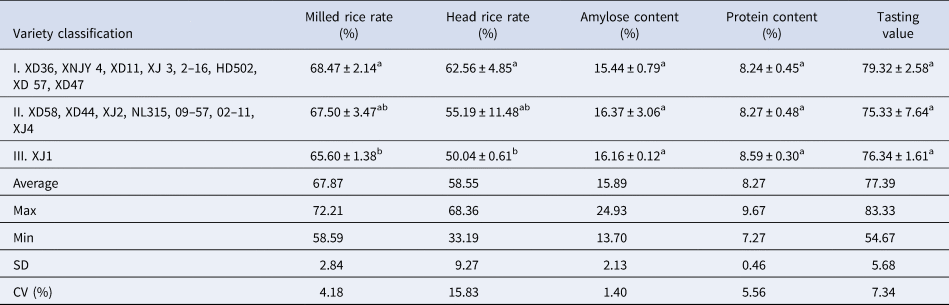
Under different water and nitrogen treatments, the average values of polishing rice yield, whole rice yield, amylose content, protein content and taste value of the 16 rice varieties were 67.87, 58.55, 15.89, 8.27 and 77.39%, respectively (Table 2). There were significant differences between rice types: the polishing rate and whole rice rate of type I differed significantly from those of type III, but not from those of type II. The CVs among the various indices ranged from 1.40 to 15.83%, with amylose content having the lowest and whole rice rate showing the highest.
Quality characters of rice varieties with different irrigation and nitrogen fertilizer treatments

Note: I represent high-yield, II represent middle-yield, III represent low-yield. Values are denoted as mean Average ± SD. Different letters (a-ab-b) within a column denote the significantly difference at P < 0.05 level according to Ducan's multiple-comparison test (variety classification is I, n = 24; variety classification is II, n = 21;variety classification is III, n = 3).
Effects of water and nitrogen treatments on rice quality traits
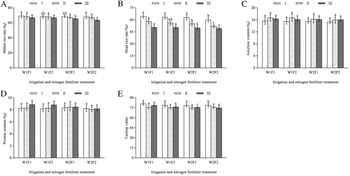
Water and nitrogen treatments had significant effects on the rice polishing rate, whole rice polishing rate, protein content and taste value of various rice types, but had no effect on amylose content (Fig. 2A). W1F1 showed no significant difference in the polishing rate of types I–III compared with W1F2. W1F1 showed no significant difference in the polishing rate of types I and II; however, in type III, it was significantly reduced by 1.89% compared to that under W2F1. Under W1F1, the polishing rates of types I and III were significantly reduced by 1.78 and 4.85%, respectively, but no significant difference was observed in type II compared to that under W2F2. In W1F2, the polishing rate of type III was significantly reduced by 4.78% compared with that in W2F2. In W2F1, the polishing rate of type III was significantly reduced by 3.02% compared with that in W2F2. Thus, water deficiency affected the polishing rates of types I and III. Fertilizer deficiency had no effect on the polishing rate of the various rice types under normal water conditions and had a significant effect only on the polishing rate of type III under W2F2. In W1F1, there was no significant difference in the whole polishing rice rate of types I–III compared to that in W1F2 (Fig. 2B). Under W1F1, the whole polishing rice rates of types II and III were significantly reduced by 4.65 and 1.38%, respectively; however, there was no difference in type I compared with that under W2F1. In W1F1, the heading rates of types I–III were significantly reduced by 7.09, 9.85 and 2.90%, respectively, compared to those in W2F2. In W1F2, the whole polishing rice rates of types I–III were reduced by 5.69, 7.19 and 2.67%, respectively, compared with those in W2F2. Under W2F1, the whole polishing rice rates of types I–III were reduced by 5.10, 5.45 and 1.54%, respectively, compared to those under the W2F2 treatment. Thus, water reduction affected the polishing rates of type II and III rice. For all rice types, W1F2 had no effect, whereas W2F2 had a significant effect on the overall rice polishing rate.
Effect of irrigation and nitrogen fertilizer treatments on yield characters of rice varieties. A represent milled rice rate, B represent head rice rate, C represent amylose content, D represent protein content, E represent tasting value. I represents high yield. II represents medium yield. III represents low yield. W1F1 represents the normal watering and fertilizer treatment. W2F1 represents the water reduction and normal fertilizer treatment. W1F2 represents the normal watering and reduced fertilization treatment. W2F2 represents the water reduction and reduced fertilization treatment. Bars denote mean Average ± SD. Different letters indicate significant differences (P < 0.05) according to Duncan's multiple-comparison test (variety classification is I, n = 24; variety classification is II, n = 21; variety classification is III, n = 3).

The water and nitrogen treatments had no effect on amylose content in any of the rice varieties (Fig. 2C). In W1F1, there was no difference in the protein content of types I–III compared to that in W1F2 (Fig. 2D). Under W1F1, the protein content of type III was significantly reduced by 4.54%, with no difference between types I and II compared to that under W2F1. In W1F1, the protein content of type III was reduced by 7.89%, but there was no difference between types I and II compared to that in W2F2. Under W1F2, the protein content of type III was reduced by 7.51%, but there was no difference between types I and II compared to that under W2F2. In W2F1, the protein content of type III was reduced by 3.51%, but there was no difference between types I and II compared to that in W2F2. Thus, water reduction affected the protein content of type III. Treatment with W1F2 had no effect on the protein content of any rice variety, and that of type III was affected only by the W2F2 treatment.
In W1F1, the taste values of types I and III were reduced by 2.68 and 2.97%, respectively, but no difference was observed in type II compared to that in the W1F2 treatment (Fig. 2E). In W1F1, the taste values of types I and III were reduced by 3.04 and 3.81%, respectively, but no difference was observed in type II compared with that in W2F1. In W1F1, the taste values of types I and III were reduced by 2.57 and 5.08%, respectively, but no difference was observed for type II compared with that in W1F2. In W1F2, the taste value of type III was reduced by 2.17%, but with no difference was observed for types I and II compared with that in the W2F2 treatment. Comparing W2F2 with W2F1, the taste value of type III was reduced by 1.32%, but there was no difference between types I and II. This indicated that W2F1 affected the taste values of types I and III. W1F2 affected the taste values of types I and III, whereas W2F2 affected only type III.
Changes in the growth period of rice types under different water and nitrogen treatments
There were significant differences in the full growth periods of the different rice varieties (online Supplementary Fig. S2), with a range of 163–173 d. The growth period range for type I was 165.5–170.5 d across the different water and nitrogen treatments; that for type II was 165–170 d; and that for type III was 159–163 d. W1F1 did not cause a difference in the growth period of types I–III as compared to W1F2. Under W1F1, the growth period of types I and II were significantly shortened by 1.76 and 1.68%, but no significant difference was observed for type III compared to that under W2F1. In W1F1, the growth periods of types I–III were significantly shortened by 2.93, 2.85 and 2.45%, respectively, compared to those in W2F2, and similarly, by 2.93, 2.85 and 2.45%, respectively, compared with those in W1F2. In W2F1, the growth periods of types I and II were significantly shortened by 1.19%, but in type III, they were not significantly affected compared to those in W2F2. Thus, the rice growth period was not affected by the fertilizer reduction treatment but was shortened by the water reduction treatment.
Plant height of rice varieties during main growth periods under different water and nitrogen treatments
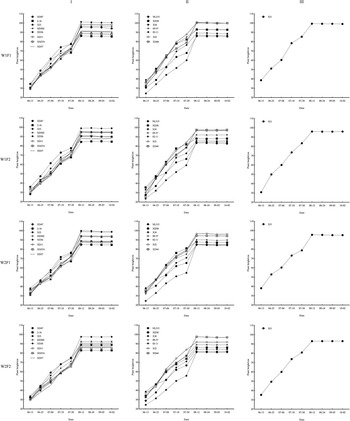
The plant height of each rice variety under different water and nitrogen treatments showed an increasing trend with the growth process, reaching a maximum height at the full heading stage and decreasing slightly at the mature stage (Fig. 3). Types I and III exhibited similar growth patterns. Among the type II plants, XJ4 had the slowest growth and development and NL315 had the lowest plant height at the mature stage. In W1F1, the plant heights of types I–III at the maturity stage decreased by 1.25, 2.89 and 3.13%, respectively, compared with those in W1F2. In W1F1, the plant heights of types I–III at the maturity stage decreased by 1.38, 3.83 and 4.02%, respectively, compared to those in W2F1. In W1F1, the plant heights of types I–III at maturity decreased by 4.05, 5.60 and 6.05%, respectively, compared with those in W2F2. In W1F2, the plant heights of types I–III at maturity decreased by 2.84, 2.79 and 3.02%, respectively, compared with those in W2F2. In W2F1, the plant heights of types I–III at maturity decreased by 2.71, 1.83 and 2.10%, respectively, than those in W2F2. This suggested that water reduction had a greater effect on plant height at rice maturity than fertilizer reduction.
Plant height of rice varieties during the main growth period. I represents high yield. II represents medium yield. III represents low yield. W1F1 represents the normal watering and fertilizer treatment. W2F1 represents the water reduction and normal fertilizer treatment. W1F2 represents the normal watering and reduced fertilization treatment. W2F2 represents the water reduction and reduced fertilization treatment. Bars denote mean ± SD (n = 3).

Changes in SPAD values of rice varieties during main growth periods
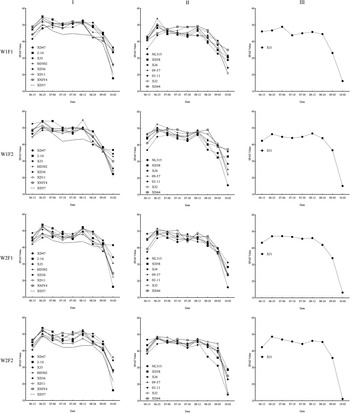
The chlorophyll SPAD values of rice varieties under different water and nitrogen treatments ranged within 11.10–54.70, presenting a trend of ‘initially increasing and then decreasing’ with the growth process (Fig. 4). On October 2 (2019 and 2020), the SPAD values (mature period) of types I–III were 28.88, 28.76 and 16.2, respectively, under the W1F1 treatment. In W1F1, the SPAD values of types I–III were reduced by 1.84, 1.60 and 6.79%, respectively, compared with those in W1F2. In W1F1, the SPAD values of types I–III were reduced by 2.01, 15.19 and 18.52%, respectively, compared with those in W2F1. In W1F1, the SPAD values of types I, II and III decreased by 5.02, 21.91 and 31.48%, respectively, compared with those in W2F2. In W1F2, the SPAD values of types I–III decreased by 3.25, 20.64 and 26.49%, respectively, compared with those in W2F2. In W2F2, the SPAD values of types I–III were reduced by 3.07, 7.91 and 15.91%, respectively, compared with those in W2F2. Thus, water or fertilizer reduction treatments significantly affected SPAD values and affected type III the most.
SPAD values of rice varieties during the main growth period. I represents high yield. II represents medium yield. III represents low yield. W1F1 represents the normal watering and fertilizer treatment. W2F1 represents the water reduction and normal fertilizer treatment. W1F2 represents the normal watering and reduced fertilization treatment. W2F2 represents the water reduction and reduced fertilization treatment. Bars denote mean ± SD (n = 3).

Discussion
Water and nitrogen nutrition are two key factors in rice plant growth and development, yield and quality formation (Haefele et al., Reference Haefele, Jabbar, Siopongco, Tirol-Padre, Amarante, Sta Cruz and Cosico2008; Zhang et al., Reference Zhang, Xu, Shi, Li, Huang and Wang2010; Sun et al., Reference Sun, Li, Meng, Guo, Wu, Yi and Chen2011a, Reference Sun, Sun, Liu, Yang, Chen, Jia and Ma2011b; Liu et al., Reference Liu, Li, Zhao, Wang and Yang2012; Ye et al., Reference Ye, Liang, Chen, Liu, Gu, Guo and Li2013). Appropriate irrigation and fertilization are important for alleviating water shortages, controlling soil nonpoint source pollution, protecting the ecological environment and ensuring healthy development of agriculture (Wang et al., Reference Wang, Xu and Liu2016). Therefore, it is important to clarify the response characteristics of rice varieties in the Xinjiang rice-growing areas to water and nitrogen resources to formulate appropriate water and nitrogen management measures. Cluster analysis was used to divide the 16 rice varieties into three categories according to their yield responses: high-yield (type I) accounted for 50%, middle-yield (type II) for 43.75% and low-yield (type III) for 6.25%. The yield characteristics of the three rice varieties under the four water and nitrogen treatments were analysed using variance analysis. The number of effective grains per spike was significantly higher for type I than for types II and III. There was no significant difference in the thousand-grain weight, but there was a significant difference in yield among the three types, indicating that increasing the number of effective grains per unit might have greatly increased the rice yield. In addition, the effective grains per spike and grains per spike had larger CVs among the three types than the other yield components. This was 2.62 and 2.14 times the CV for thousand-grain weight, indicating that raising the total grains per spike was an effective way to increase rice yield (Yang et al., Reference Yang, Du, Wu, Liu, Wang and Zhu2007; Lu et al., Reference Lu, Ren, Liu, Yan and He2016; Wu et al., Reference Wu, Yuan, Cao, Zhang, Wang, Wang and Sun2019).
Rice yield is an important factor affecting rice yield. Several studies have shown that different combinations of water and nitrogen significantly influence yield components (Jiang et al., Reference Jiang, Zhang and Yin2017, Jin et al., Reference Jin, Chen, Wang, Yao and Chen2020). Under the same water treatment conditions, a lower nitrogen application rate can influence the grain structure and rice yield, resulting in a reduction in rice yield (Liang et al., Reference Liang, Chen, Tang, Wang, Zhang and Lv2015, Gu et al., Reference Gu, Dong, Zhao, Chen, Hong and Han2016). Under water-reduction treatments, rice yield can decrease by approximately 30% (Bai et al., Reference Bai, Cang, Jiao, Zhang and Zhai2015; Xu et al., Reference Xu, Wang, Zhai, Sun and Li2015; Jiang et al., Reference Jiang, Zhang and Yin2017). Our variance analysis of the yield characteristics of the 16 rice varieties showed significant effects of water and nitrogen treatments on effective grains per spike, grains per spike and yield of each type, but had no effect on the thousand-grain weight (Table 1). Treatment with W1F2 only had a significant effect on the effective grains per spike and type III yield. The effective grains per spike of type II had a significant impact on the grains per spike of type III as well as on the yields of types I–III. This showed that the effect of water on rice yield and its constituent factors was greater than that of nitrogen fertilizer and had a significantly greater effect on crop growth and yield than nitrogen fertilizer (Xue et al., Reference Xue, Ying, Xiao, Xiao and Qu2010; Liang et al., Reference Liang, Chen, Tang, Wang, Zhang and Lv2015; Xu et al., Reference Xu, Wang, Zhai, Sun and Li2015; Gu et al., Reference Gu, Dong, Zhao, Chen, Hong and Han2016; Sui et al., Reference Sui, Zhao, Liu, Huang, Lin and Chen2018). Rice quality is mainly determined by the genetic characteristics of the variety and is affected by environmental and cultural factors (Cai et al., Reference Cai, Zhu, Wang, Yang, Zheng and Qian2002; Liu et al., Reference Liu, Li, Zhao, Wang and Yang2012). Many studies have shown that increasing the nitrogen application rate can improve the processing quality of rice; however, excessive or insufficient nitrogen application may reduce it (Xu et al., Reference Xu, Xu, Gao and Wang2013; Xing et al., Reference Xing, Ma, Wu, Xu and Ma2018). The polishing rice and head rice rates of type I did not differ greatly from those of type II and were higher than those of type III. There were no differences in the amylose content, protein content or taste value among the rice varieties. In addition, among the quality traits of the three types, the CVs of the whole rice production rate were 3.79-, 11.31-, 2.85- and 2.16-times the CVs for polishing rice production rate, amylose content, protein content and taste value, respectively. This indicates that increasing the overall rice production rate is an effective way to improve rice quality (Liu et al., Reference Liu, Li, Zhao, Wang and Yang2012). Variance analysis of the quality characteristics of the 16 rice varieties under different water and nitrogen treatments showed that the water and nitrogen treatments significantly affected the rice polishing rate, whole rice rate, protein content, taste value and amylose content of each type. Water reduction had significant effects on the polishing rate and taste value of type I; whole rice rate of type II; and polishing rate, whole rice rate, protein content and taste value of type III. Treatment with W1F2 only affected the taste values of types I and III; however, water reduction affected the polishing rate, whole rice rate, protein content and taste value of type III, as well as the whole rice rate of types I and II.
The growth period of rice varieties is mainly determined by their genetic characteristics and external environmental factors, such as water and fertilizer (Zhu et al., Reference Zhu, Shi, Hong, Cheng and Wang2019). Plant height is an agronomic trait that is closely related to rice population quality and grain yield (Zhou et al., Reference Zhou, Zhao, Gu, Zhang and Xu2006). It changes in an ‘S’ shape throughout the growth period, and the SPAD value of rice leaves shows a trend of ‘initially increasing and then decreasing’ in the whole growth period. Many studies have shown that water and nitrogen levels can affect the length of the entire growth period of rice, plant height at maturity and the SPAD value of leaves in each growth period (Zhang and Tao, Reference Zhang and Tao2013; Zhang et al., Reference Zhang, Yu, Gao, Wang, Wang and Li2018; Yu et al., Reference Yu, Zhang, Chen, Li and Wang2019). Similarly at the growth period under W2F2, rice plant height and leaf chlorophyll synthesis are reduced (Zhou et al., Reference Zhou, Zhao, Gu, Zhang and Xu2006; Zhang and Tao, Reference Zhang and Tao2013). Furthermore, significant differences were found in the growth periods of the different rice varieties (Fig. 1). Yield type was positively correlated with the growth period of the rice variety, and fertilizer reduction had no effect on the growth period. The rice growth period was reduced by 1.68–2.93% under the decreasing period, and plant height at maturity reduced by 1.25–6.05% under W2F2. The inhibitory effect of water reduction on the rice plant height at maturity was greater than that of fertilizer reduction. The chlorophyll SPAD values of rice varieties under different treatments ranged within 11.10–54.70, showing an ‘initially increasing and then decreasing’ trend with the growth process, but the time for different varieties to reach the maximum values were different. Water reduction or fertilizer reduction affected the SPAD value of rice that was found in this study (Xiang et al., Reference Xiang, Wang and Liu2017a, Reference Xiang, Fu, Zhen, Shuang and Wei2017b; Meng et al., Reference Meng, Zhou, Zhang and Wu2019).
Conclusions
A field experiment was conducted to evaluate the effects of different irrigation regimes and different amounts of nitrogen fertilizer on 16 rice varieties. The water-deficient regime reduced the growth period of the 16 tested rice varieties by 1.68–2.93%. Furthermore, water-deficient regimes have a significant impact on rice yield and quality compared with nitrogen-deficient regimes. In contrast, water deficiency along with the nitrogen-deficient regime significantly reduced the polishing rate, protein content, growth parameters and taste value of the 16 rice varieties, from 1.25 to 6.05%. It is concluded that management of irrigation and nitrogen fertilizer strategies may help achieve maximum production in rice regions, where water is scarce and nitrogen is limited in the soil. The findings of this study may help increase the growth of rice worldwide under the same climate and environmental conditions as those used in this study. Further studies are required to explore other environmental parameters to achieve this increase.
Supplementary material
The supplementary material for this article can be found at https://doi.org/10.1017/S1479262123000187
Acknowledgments
This work was financially supported by the Special Project for Basic Scientific Activities of Nonprofit Institutes of the Government of the Xinjiang Uygur Autonomous Region key research and development project (2021B02002-3). We thank International Science Editing (http://www.internationalscienceediting.com) for editing this manuscript.