The constitutional framework in transitional countries is a terrain on which political incumbents struggle to expand and define their influence. Under semi-presidentialism – with two separately chosen chief executives – this struggle is particularly manifested in conflicts between presidents and prime ministers.Footnote 1 Experiences of semi-presidentialism in Central and Eastern Europe have resulted in numerous disputes between presidents and prime ministers, where some of the most salient examples are the stalemating conflicts between President Lech Walesa and several prime ministers in Poland 1991–95, between President Leonid Kuchma and several prime ministers in Ukraine 1994–2004, as well as the critical clashes between President Viktor Yuschenko and Prime Minister Viktor Yanukovich in Ukraine in 2006–07.
In this article we ask to what extent and in what ways intra-executive conflicts increase the risk of pre-term termination of governments. Comparing eight semi-presidential systems in Central and Eastern Europe – Bulgaria, Croatia, Lithuania, Moldova, Poland, Romania, Ukraine and Russia, comprising a total of 65 instances of intra-executive (president–cabinet) coexistence between 1991 and 2007 – we examine the link between intra-executive conflict and cabinet instability.
This sample represents a deliberate attempt to cover transitional countries with different forms of semi-presidential regimes (premier-presidential and president-parliamentary). Also, in the period under review, all these countries have experienced an uncertain transitional phase, making them especially appropriate for the kind of analysis we have in mind. In transitional countries, effects conventionally associated with cabinet instability – disruptive policy making, political unpredictability and lack of political accountability – are generally considered undesirable, as potential threats to the fragile democratization process.
The article is thus related to the rich body of literature on institutional design and democracy performance.Footnote 2 More specifically, it contributes to the more limited albeit growing research on the pros and cons of semi-presidentialism.Footnote 3 Proponents of semi-presidentialism have declared it to be an advantageous constitutional arrangement for new democraciesFootnote 4 while sceptics have associated it with institutional conflict and political risks.Footnote 5
The few existing previous studies of intra-executive conflicts in semi-presidential regimes have mainly been occupied with explaining why such conflicts occur in the first place. In particular, Oleh Protsyk has analysed the coexistence of popularly elected presidents and prime ministers in semi-presidential regimes, focusing on what specific institutional features excerbate intra-executive conflicts.Footnote 6 Still, there are no comparative and systematic analyses of how intra-executive conflicts are actually related to political outcomes in semi-presidential regimes. By empirically exploring the link between intra-executive conflict and cabinet duration, this article contributes to our understanding of semi-presidentialism. The analysis is partly based on data from an expert survey, conducted in 2002–5 among scholars and officials with expertise on executive-legislative issues in the countries under examination. The article also utilizes a number of indicators of constitutional practices (1991–2007) to assess the conflict level in the eight countries under review.
DEFINITIONS OF SEMI-PRESIDENTIALISM AND THE FOCUS ON CENTRAL AND EASTERN EUROPE
To define semi-presidentialism and account for crucial differences between semi-presidential regimes, we adhere to the commonly used distinction between premier-presidential and president-parliamentary systems originally suggested by Matthew Shugart and John Carey.Footnote 7 The criteria are as follows: under premier-presidentialism (1) the president is elected by a popular vote for a fixed term in office; (2) the president has considerable constitutional authority; (3) there also exist a prime minister and cabinet, subject to the confidence of the assembly majority. In president-parliamentary systems (1) the president is elected by a popular vote for a fixed term in office; (2) the president appoints and dismisses the prime minister and other cabinet ministers; (3) the prime minister and cabinet ministers are subjected to both parliamentary and presidential confidence; and (4) the president typically has some legislative powers and the power to dissolve the parliament.Footnote 8
In this study, the premier-presidential cases are Bulgaria 1991–2007, Croatia 2000–7,Footnote 9 Lithuania 1991–2007, Moldova 1991–2000,Footnote 10 Poland 1991–2007, Romania 1991–2007 and Ukraine 2006–7.Footnote 11 The president-parliamentary cases are Croatia 1992–2000, Russia 1991–2007 and Ukraine 1991–2006.
There are good reasons for focusing exclusively on post-communist countries in this study. Semi-presidentialism has become an extremely popular form of government in the third wave of democratization and has emerged as the most common regime type in Central and Eastern Europe. Moreover, analysing different forms of semi-presidentialism in transitional societies adds to our understanding of the potential risks and advantages associated with this particular regime type. A possible objection would be that our sample entails an examination of countries that are both democratic and less than fully democratic and, at the same time, covers different types of semi-presidentialism; and that the empirical results of our investigation may partly be attributed to the fact that some of our countries today are at best semi-democracies or hybrid regimes (e.g. Russia).Footnote 12 Here, however, the issue of different levels of democratization is considered to be only of secondary importance. Our sample is exclusively made up of transitional countries, and the important thing is to investigate the pros and cons of both types of semi-presidentialism under such conditions.
SEMI-PRESIDENTIALISM, INTRA-EXECUTIVE CONFLICT AND CABINET INSTABILITY
How are the two types of semi-presidential arrangements related to intra-executive conflict? In premier-presidential systems, underlying executive–legislative antagonism between president and parliament often appears in the form of intra-executive conflict between the president and the cabinet. Since premier-presidentialism provides the legislature with the exclusive power of prime minister dismissal, the cabinet is primarily dependent on parliamentary support for claiming authority to control the executive branch, and its political orientation is likely to be in the parliament's favour rather than in the president's. This is particularly the case if there is a stable and coherent majority in parliament. Even if the cabinet initially emanates from a compromise outcome of strategic interactions between the president and the parliament, it is likely to drift during its tenure in office towards the ideal point of the parliament. Intra-executive conflicts are thus to be expected.Footnote 13
In president-parliamentary systems the institutional lines of conflict are more uncertain. Here, the constitutional framework provides both the president and the parliament unilateral power to dismiss the cabinet, which makes the distribution of dismissal powers a somewhat less effective predictor of the likely alliances and possible lines of conflict. Generally though, in president-parliamentary systems the president has an overall stronger position in the cabinet formation process than is the case in premier-presidential systems. Typically, the president has the power to nominate a prime minister candidate without consulting or having recommendations from the parliament. Thus, the likelihood of a ‘united’ executive without intra-executive conflicts is generally higher in a president-parliamentary regime than in a premier-presidential one.Footnote 14 Still, intra-executive conflict has been a quite frequently occurring phenomenon in some of the contemporary president-parliamentary systems as well.
Our main theoretical expectation is that intra-executive conflicts have a negative impact on the durability of cabinets, especially in a context of transition. As already noted, the effects of intra-executive conflict have so far been largely neglected in the research on semi-presidentialism. The literature on cabinet durability and termination, however, is quite considerableFootnote 15 although comparative researchers have mainly focused on parliamentarism and presidentialism, rarely on semi-presidential systemsFootnote 16 (or on the institutional variation within semi-presidentialism). This may also explain why previous studies of cabinet survival have not systematically included intra-executive conflict as an explanatory variable. Here the idea is to add to our knowledge by providing actual empirical substantiation of such instances of cabinet instability.
What are the theoretical arguments underpinning our hypothesized relationship between the level of intra-executive conflict and cabinet durability? In president-parliamentary systems the logic behind this is quite straightforward. Since the president in these systems has unilateral power to dismiss the prime minister, cabinet resignation is to be expected under intra-executive conflict. When challenged by a rebellious prime minister, the president may quite easily use the threat of dismissal in order to sub-ordinate the prime minister under his firm control. If the prime minister still does not comply, the president has the choice to go all the way and replace the prime minister.
In premier-presidential systems, by contrast, authority to dismiss the cabinet rests exclusively with the parliamentary majority. Consequently, the prime minister can be expected to stand up to the president and survive any intra-executive conflict as long as the parliament is supportive. Actually, this factor has been put forth as an inherent advantageous mechanism of premier-presidentialism, i.e. that the system can still function through a prime minister supported by a parliamentary majority.Footnote 17 Thus, given the formal distribution of power, we expect cabinet turnover to be relatively more frequent under intra-executive conflict in president-parliamentary systems than in premier-presidential systems.
Even so, we can identify informal norms and practices related to the dual executive structure of premier-presidentialism that may enhance cabinet instability under intra-executive conflict. Both the president and the prime minister can claim their legitimacy on popular elections, but the former leans on a direct electoral mandate while the latter is ‘only’ indirectly elected through parliamentary elections. Typically in premier-presidential systems, the relatively limited constitutional powers provided to the presidency do not correspond to the prestigious and popular legitimacy upheld by its incumbent. But the president can exert strong influence on the cabinet by leaning on his popular mandate and – as is particularly salient in a transitional context – his greater popularity as compared to the other branches. Under intra-executive conflict a rewarding strategy to the president is thus to ‘go public’ and criticize the government with negative effects on the cabinet's credibility.Footnote 18 This may ultimately force the prime minister out of office despite the fact that the president lacks formal dismissal powers. If, in addition, the president also possesses informal partisan power this affords him extra-constitutional powers to censor the cabinet.Footnote 19 In a transitional context where the institutionalization process is still incomplete, the importance of personal authority and informal powers is even more profound and the president's opportunities to undermine the survival of cabinets thus more favourable. To better illustrate presidential influence over prime ministers in premier-presidential systems, we will explore some case study examples in the final sections of the article. First, however, we need to provide empirical support for the hypothesized link between intra-executive conflict and cabinet instability in semi-presidential regimes.
DATA AND MEASUREMENT ISSUES
In order to collect information on how post-communist semi-presidential systems have worked in practice, a total number of 50 country experts on constitutional and political issues were included in an expert survey conducted in 2002–5.Footnote 20 In addition to the expert survey data, we also draw on conventional country reports and up-dates as well as previous research, in order to determine the level, character and outcome of institutional conflicts. Country reports from the East European Constitutional Review (EECR),Footnote 21 Radio Free Europe/Radio Liberty (RFE/RL)Footnote 22 and Freedom House's Nations in Transit (NiT)Footnote 23 are among the sources used. Furthermore, a number of case-study volumes on the post-communist countries have been particularly useful.Footnote 24
In this article, the term intra-executive refers to the relation between the president and the cabinet. Intra-executive conflict is generally understood here as struggles between the president and the prime minister/cabinet over the control of the executive branch. More specifically, and in order to reach an operational definition, the relationship between the president and the cabinet has been considered as conflict ridden when there has been an observable clash between the president and the prime minister and/or between the president and other government ministers, manifested through obstructive or antagonistic behaviour from either side, directed towards the other.
Conflicts can thus be observed in concrete disputes, such as in public statements where criticism is levelled against the other side, in disagreements over key appointments or dismissals, in different interpretations of constitutional prerogatives, in interference in each other's political domains, or finally, in personal disputes or in strong disagreement over policy directions. By this definition, we encompass a relatively broad set of conflicts. Admittedly, some conflicts are more critical than others for the overall stability of the political system, but the manifestations of these critical conflicts can still be different from case to case, and we have accordingly chosen to capture as many kinds of conflict as possible at the outset.
Providing accurate judgements about the level of conflict between institutions across a wide range of countries is of course a tricky task. What one observer might consider an open fight between two branches of government may be just a small bickering in another viewer's eyes. Furthermore, an institutional conflict might be latent or covert and may therefore not reach the wider society. Such conflicts are not easily accessible and cannot be uncovered by, for example, text analysis or by examining public statements. Our strategy has been to capture only manifest and observable conflicts.
Based on the results from the expert survey, from reports as well as from previous research, the level of conflict is compressed into ordinal estimations. In some recent works, Protsyk uses a simple dichotomy (low and high) to determine the level of conflict in a number of semi-presidential systems.Footnote 25 Here, we have used a similar strategy, but initially coded on an ordinal scale: low, medium and high conflict. When no significant conflict between the president and the cabinet has been reported, the relationship has been considered as non-conflictive and hence the conflict-level estimated as low. Under periods with episodic but manifest and observable conflict, the level has been estimated as medium. Finally, instances of durable and severe tension between the president and the cabinet have been estimated as high levels of conflict.
In some cases we have also consulted experts (from the expert survey) for their opinion on the final coding. Given that the number of country experts for some of the countries was insufficiently small, all estimations are backed up by secondary data sources. As a rule we have recorded an observation of conflict only if it could be substantiated by at least two independent sources. Whenever it has been too difficult to obtain a clear picture of the institutional relations, we have abstained from making a definitive assessment. This has particularly been the case for very short-lived cabinets with an interim character, i.e. caretaker governments that have held office in a limited period after the dismissal of the old cabinet up until new parliamentary elections have been completed.
For the purpose of reliability a few case examples could demonstrate how the coding decisions were made. The relation between President Walesa and Prime Minister Pawlak in Poland in 1994–95 is an illustrative example of a quite straightforward high-conflict case. Here, severe tension was manifested by several different attributes, such as negative public addresses and a long-lasting institutional tug-of-war (e.g. frequent remittances of laws to the constitutional court, presidential vetoes, disagreements over powers and prerogatives).Footnote 26 The intensity of this conflict has been well documented by both expert accounts and secondary literature,Footnote 27 making us quite confident in coding the intra-executive coexistence as ‘highly’ conflictive. In some other instances though, it was less obvious how to make a distinction, especially when the level of conflict shifted considerably over the cabinet period. In such cases we decided to code within a simple range, i.e. as low–medium or medium–high. The coexistence between President Snegur and Prime Minister Sangheli in Moldova in 1994–96 is a case in point. Various sources reported a rather compliant and cooperative intra-executive relationship in the initial year, but a gradual deterioration in the following year, resulting in an open conflict in 1996 under which the president publicly accused the cabinet of incompetence and called on a parliamentary vote of no-confidence.Footnote 28 Accordingly, this case was coded as a ‘medium–high’ conflict.
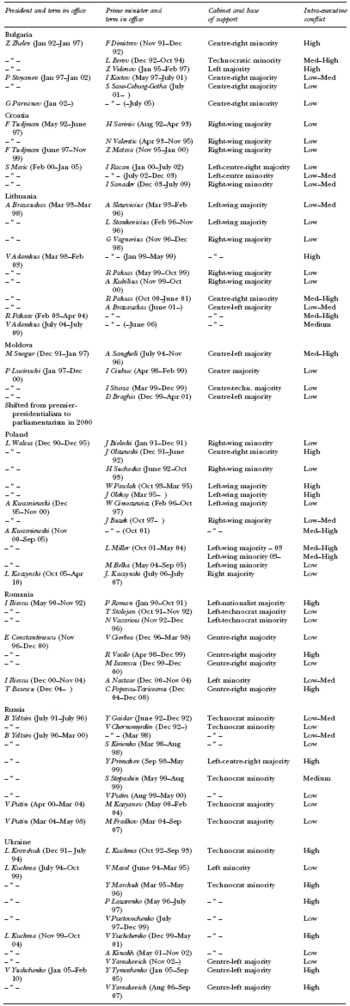
It should be noted that in our subsequent analysis the ordinal scale described above is collapsed into a high–low dichotomy where medium, medium–high or high levels of intra-executive conflict qualify as ‘high’, and low and low–medium count as ‘low’. The findings of our exploration of the levels of intra-executive conflict 1991–2007 are presented in the Appendix.
AN EMPIRICAL ASSESSMENT OF INTRA-EXECUTIVE CONFLICT AND CABINET STABILITY
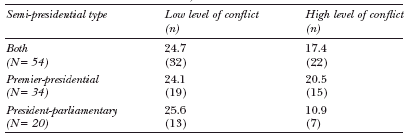
We proceed with an empirical test of our hypothesis about intra-executive conflict and cabinet survival in the semi-presidential systems of Central and Eastern Europe. Following a standard definition in the literature, we have considered a cabinet terminated once a new cabinet formation is necessary (including when new elections have been held), i.e. it does not matter whether or not the cabinet formation results in a reinstatement of the same cabinet. What is important is that new negotiations are necessary before the cabinet can be reconstituted.Footnote 29 A rather straightforward and commonly used measure of duration is the number of days, weeks, months or years the cabinet remains in office after inauguration.Footnote 30 Table 1 displays the length of cabinet survival – as measured by months in office, under low and high levels of intra-executive conflict – in the two varieties of semi-presidentialism in post-communist Europe, i.e. premier-presidential systems and president-parliamentary systems. The measure is in whole months from the starting month of the formal investiture.
Cabinet Duration Under Low and High Levels of Intra-executive Conflict (average months) 1991–2007

Note: The total number of cabinets (54) is lower as compared to the 65 cases of intra-executive coexistence documented in Table A1. This is due to the fact that these 65 cases of intra-executive coexistence do not correspond to 65 new cabinets. For example, when a newly or re-elected president faced a cabinet formed prior to the presidential elections, this was classified as a new case of intra-executive coexistence. However, such cases do not qualify as cabinet shifts, which is why the total number of cabinets/cases in this calculation decreases somewhat.
Source: See Appendix, Table A1.
The results in Table 1 are clearly in favour of our hypothesis. Under low levels of intra-executive conflict (see Appendix), the average length of cabinet survival is 24.7 months. Under high levels of conflict, the average cabinet duration is some 17 months. Looking at the outcome for the two semi-presidential categories in Table 1, we find – quite expectedly – that the conflict level has indeed a significant impact on cabinet survival in the president-parliamentary category. Here, high levels of intra-executive conflict have apparently shortened the average cabinet survival time by more than one year (some 15 months), as compared to cabinet survival under less conflict-ridden periods. But there is an observable effect also in the premier-presidential category. Under low levels of conflict, the average cabinet duration is just over 24 months. Under high levels of conflict, the corresponding period is 20.5 months.
However, the figures in Table 1 do not tell us anything about the reasons for the cabinet shifts. It is therefore necessary to try to establish whether or not intra-executive conflicts as such have forced cabinets to leave office before regular elections.
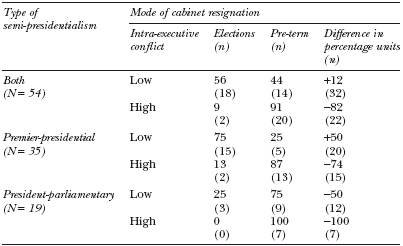
Table 2 displays the mode of cabinet resignation, by distinguishing between cabinet changes brought about by ordinary parliamentary elections, and cabinet changes brought about by pre-term resignation.Footnote 31 The results are quite conclusive: under high levels of intra-executive conflict, pre-term resignation of the cabinets has occurred in 91 per cent of the cases. Under low levels of conflict, the corresponding figure is 44 per cent.
Mode of Cabinet Resignation and Intra-executive Conflict (%) 1991–2007

Note:-The mode of cabinet resignation as measured in terms of whether the cabinets have stayed in office until regular parliamentary elections (‘Elections’) or if they have failed to survive their whole term (‘Pre-term’).
Source:-See Appendix, Table A1.
Furthermore, the correlation between (high levels of) intra-executive conflict and the mode of cabinet resignation proves to be strong in both semi-presidential categories. While the presidents in premier-presidential systems do not have the formal powers to dismiss the cabinet, they have apparently used other means of influencing the destiny of governments. We may also note from Table 2 that pre-term dismissal under high levels of intra-executive conflict has been a rule without exception in the president-parliamentary systems. Recalling our tentative assumption about cabinet survival in president-parliamentary systems, we may thus conclude that these results provide empirical backing to this assumption – under high levels of intra-executive conflict, the president is likely to dismiss the prime minister.
ALTERNATIVE EXPLANATIONS?
There is of course reason to assume that other variables are of significance with regard to the mode of cabinet resignation as well. For one thing, conventional wisdom suggests that minority governments are less durable than majority governments.Footnote 32 Previous research has also identified the level of party system fragmentation as a determinant of cabinet survival.Footnote 33 A high level of party system fragmentation is likely to increase the difficulties for cabinets to keep parliamentary support and thus to endure a full term in office. Similarly, we would probably expect cabinet turnover to be greater, all else being equal, during the early years of transition. Our initial correlation tests (not reported here) also suggest that cabinet type, party system fragmentation and post-communist period may be significant.
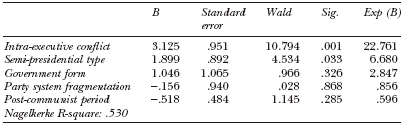
Thus, we cannot yet determine if there really is a single and significant effect of intra-executive conflict on the mode of cabinet resignation.Footnote 34 Since we are dealing with a relatively limited number of cases, the use of more advanced statistical techniques is somewhat precarious. Nevertheless, with the caveat that the results should be interpreted with some caution, we will undertake a logistic regression test of the assumption that intra-executive conflict has a significant overall effect on cabinet survival. Since the ‘mode of cabinet resignation’ variable is dichotomous, we cannot apply (OLS) linear regression in this case. Instead, we will have to use logistic regression, which has the advantage of making the form of the relationship linear whilst treating the relationship itself as non-linear. In Table 3, the regression coefficients are reported with the mode of cabinet resignation as dependent variable (0 = elections, 1 = pre-term) and with five independent variables: intra-executive conflict (0 = low, 1 = high), type of semi-presidentialism (0 = premier-presidentialism, 1 = president-parliamentarism), government form (0 = majority, 1 = minority), the level of party system fragmentationFootnote 35 (0 = low, 1 = high) and post-communist period (0 = 1990–94, 1 = 1995–99, 2 = 2000–5, 3 = 2005–7).
Logistic Regression Test (mode of cabinet resignation)

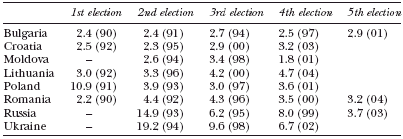
Note:-Logistic method: forced entry method (‘Enter’). Dependent variable: Mode of cabinet resignation (0 = elections, 1 = pre-term). The independent variables are coded as: intra-executive conflict (low/high), semi-presidential type (premier-presidential/president-parliamentary), government form (majority/minority), and party system fragmentation (low/high) and post-communist period (1990–94, 1995–99, 2000–4, 2005–7). Party system fragmentation is calculated by using the Laakso and Taagepeera effective number of parties index. The equation of the index is as follows: N = (Σpi 2)−1 where N denotes the number of effective parties and Pi is the share of votes or seats (in this case seats) won by the ith party. For the number of effective parties by country, see Table A2 in the Appendix. When the effective number of parties has been found to be below 3.5, the level of fragmentation has been coded as ‘Low’, and from 3.5 and above as ‘High’.
From the logistic regression test in Table 3, we find that intra-executive conflict is by far the strongest predictor among the included variables. In probability terms we may interpret the figures to indicate that the chances of pre-term cabinet resignation – when controlling for other variables – are almost 23 times higher under high intra-executive conflict, (see Exp (B) in Table 3). We also find that the semi-presidential type in itself is quite a strong predictor, which is hardly surprising considering the results in Table 2. The presidents in the president-parliamentary systems have used their power to dismiss the prime ministers quite frequently, and accordingly, the regression test suggests that the odds of pre-term cabinet resignation are about seven times higher in president-parliamentary systems than in premier-presidential systems (Table 3). More unexpectedly, neither cabinet type and post-communist period nor party system fragmentation prove to be nearly as strong predictors as intra-executive conflict in the overall regression model. These results clearly support our assumption that intra-executive conflicts, as such, are likely to have a significant negative effect on cabinet stability in both premier-presidential and president-parliamentary systems.
So far, descriptive statistics have been backed up with a logistic regression analysis, but we still need to explore in more depth just in what ways intra-executive conflict increases the risk of pre-term termination of governments. In the next section, we will provide some empirical in-depth illustrations from our cases in order to show that intra-executive conflicts, as such, are likely to have a significant negative effect on cabinet duration.
EXPLORING THE LINKS BETWEEN INTRA-EXECUTIVE CONFLICT AND CABINET INSTABILITY
To what extent are the specific institutional features of premier-presidentialism and president-parliamentarism relevant to the relation between intra-executive conflict and cabinet instability? The institutional mechanisms behind cabinet dismissals in president-parliamentary systems can be illustrated by the cases of Russia and Ukraine (1991–2006). Whenever the prime ministers in Russia and Ukraine have entered into conflict with the president it has led to the subsequent dismissal of the prime minister.
As for Russia, most observers would probably agree on the description of the relationship between the president and the government as ‘strong president–weak government’ (at least if we consider the period up until the end of Vladimir Putin's presidency in 2008). The president's strong hold over prime minister appointment and dismissal, as well as his overall influence over the cabinet's work have reduced the likelihood of cabinets challenging the president. Consequently, the frequency of intra-executive conflict in Russia has generally been quite low. The country did, however, experience rather frequent changes of prime ministers in the 1990s. A manifest example of intra-executive struggle did occur under the cabinet of Yevgeny Primakov in 1998–99, under which president–prime minister relations were marked by rivalry. Primakov had close links to the old Soviet/Russian security apparatus and to the powerful ministries of defence, interior and foreign affairs, and his focus, naturally, tended to move away from economic issues towards the presidential domain of foreign and internal political affairs. Yeltsin, furthermore, disliked the popularity and independent power of Primakov and decided to replace him with a more loyal and dependent person.Footnote 36
In the case of Ukraine, the relatively more frequent occurrences of intra-executive conflict reflect the high level of political tension that has continuously disrupted the country's political system. Leonid Kuchma's ten years as president (1994–2004) were marked by institutional rivalry, both between the president and the prime ministers, and between the president and the parliament. Kuchma used the dual authority structure of the president-parliamentary system to ‘hide’ behind the prime ministers in order to avoid popular dissatisfaction stemming from the consequences of ineffective economic reforms.Footnote 37 Up until 2004, Kuchma had clashed with no less than seven prime ministers, all of whom he consequently dismissed. Apparently, institutional instability has also continued in the post-Orange Revolution era (2005 and onwards) and even after the shift from president-parliamentarism to premier-presidentialism in 2006. Under the presidency of Viktor Yuschenko, there were a number of intra-executive struggles, some resulting in stalemating clashes between the president and the cabinet, perhaps most clearly demonstrated by the tug-of-war between Yuschenko and Yanukovich in 2006–7. The still unconsolidated premier-presidential framework under which the latter conflict occurred may in fact have prolonged the political deadlock at the time, as President Yuschenko, in accordance with the premier-presidential definition, was left without the power of prime minister dismissal.
Recall that the definition of premier-presidentialism stipulates that the prime minister is subjected to parliamentary confidence, i.e. only the parliament is provided with the power of prime minister dismissal. The president is therefore constitutionally destined to accept the cabinet as long as it is tolerated by the parliament. However, the results from our data show that intra-executive conflict has not only been associated with cabinet instability in the president-parliamentary systems, but also in the premier-presidential ones. These findings suggest that we have to look beyond the distribution of cabinet dismissal power factor for possible explanations. Although we find only limited theoretical guidance in the literature for interpreting this phenomenon, some factors that are related both to the specific context of post-communist transition but also more generally to the institutional feature of premier-presidentialism can be pointed out.
The puzzle is such that the presidents often find that their prestige and popularity exceeds their formal constitutional powers, while prime ministers, who possess the main share of executive powers, often lack sufficient legitimacy among the population. Survey data report that popular support for presidents is consistently higher than for other political institutions (including the prime minister) all throughout Central and Eastern Europe.Footnote 38
These imbalances have tended to favour a go-public strategy by the presidents under intra-executive conflict. By publicly criticizing the government through media addresses and public speeches – with negative effects on the cabinet's credibility – the presidents can make it more or less impossible for prime ministers to remain in office. This strategy has proved to be effectively used by several presidents in the post-communist context. For instance, in 1999, Lithuanian President Valdas Adamkus openly voiced his criticism against Prime Minister Gediminas Vagnorius. Public opinion turned out to be strongly on the side of Adamkus, and Vagnorius ultimately had little choice but to resign.Footnote 39 Similarly, Poland's first post-communist president, Lech Walesa (1990–95), repeatedly used the option of public critique directed against the government. On several occasions, he threatened to assume the prime minister post in order to expedite reforms, even though this would have violated the constitutional order severely. Fortunately, in most cases Walesa's public statements, although arguably damaging to a constitutional culture, were not followed by action. Rather, this was mainly rhetorical tactics aimed at putting pressure on the government – tactics that proved to be quite ‘successful’ in so far as all prime ministers that entered into conflict with Walesa stepped down as a consequence.
The president in premier-presidential systems may also use formal instruments to make life more difficult for the cabinet, such as veto power and remittances of legislative bills to the constitutional court. In the post-communist countries, we can point out many such cases where institutional prerogatives have exacerbated intra-executive conflict and ultimately resulted in the resignation of government. The cohabitation between the centre-liberal oriented Bulgarian President Zheliyu Zhelev and the left-wing cabinet of Zhan Videnov in 1994–96 is illustrative. The president used his rather limited prerogatives to challenge the government. An important asset in this respect was his power to appoint and dismiss high-ranking military officers as well as his claimed constitutional responsibility for shaping defence policy and overall defence strategy. Zhelev thus blocked several military appointments proposed by the government, and played out the judicial card and filed a number of government petitions to the constitutional court for review. Finally, Zhelev combined the institutional blocking strategy with the go-public option by bringing his case to the public. In a series of publicized and televised announcements, Zhelev unleashed harsh criticisms against the government and the left-wing majority in parliament, claiming that they were solely responsible for the downturn of the Bulgarian economy and the deep socio-economic crisis that the country went through at the time. The president's strategies contributed to an already growing public dissatisfaction with the government, which ultimately led to the resignation of the Videnov cabinet in December 1996.Footnote 40
In a nutshell, the outcome of intra-executive conflict in terms of cabinet instability relates to the dual executive structure built into the premier-presidential system. Among factors that have been identified by scholars as particularly disadvantageous to the prime minister vis-à-vis the president in the post-communist countries are a general lack of party system coherence, prime minister responsibility for unpopular policies, and the fact that several of the prime ministers have brought with them a technocratic mindset, often being less inclined to pursue grassroots organization and party building. In addition, relatively weak administrative capacity of the prime ministers' offices (often competing with quite extensive presidential offices) has partly impeded effective reforms.Footnote 41 In the post-communist countries, such factors have strongly favoured the side of the presidents under intra-executive conflict, and, accordingly, forced the prime ministers and their cabinets to resign.
CONCLUSIONS
The aim of this article has been to contribute to our understanding of the effects of semi-presidentialism in transitional countries and we have applied a narrow focus on intra-executive conflict in relation to survival of cabinets. The dual executive structure of semi-presidentialism carries the risk of intra-executive struggles between the president and the prime minister. Previous studies have quite convincingly demonstrated that intra-executive relations in semi-presidential systems are affected by the nature and extent of the cabinet's support in parliament as well as by the degree of presidential control over the cabinet. However, the actual effects of intra-executive conflicts in the two types of semi-presidential systems have so far not been systematically explored.
The present empirical investigation has supported the assumption that intra-executive conflict generates cabinet instability. The data revealed that pre-term resignation of cabinets in both premier-presidential and president-parliamentary systems have clearly been more frequent under periods of intra-executive conflict than under periods of peaceful relations within the executive. In addition, our logistic regression test indicated that intra-executive conflict is a more powerful predictor of pre-term cabinet resignation than any of the other factors included, i.e. the type of semi-presidential system, the form of government, the level of party system fragmentation, and the post-communist period.
Although limited in scope, the empirical analysis provides a certain basis for arguing that the occurrence of intra-executive conflict in semi-presidential systems is likely to produce relatively high rates of cabinet turnover. In president-parliamentary systems, the logic behind this relationship is quite obvious. Since the president in these systems possesses unilateral power to dismiss the prime minister, this is a most likely outcome of any serious conflict between the president and the prime minister.
In premier-presidential systems, however, cabinet instability is not linked to dismissal powers (since these are not provided to the president). Although further research is required, we have pointed out some possible explanations in terms of both formal and informal means. A key factor seems to be the higher status of the presidency as compared to the prime minister position. The president can put considerable constraints on the prime minister and the cabinet by leaning on his popular mandate. As illustrated by our cases, a particularly rewarding strategy is for the president to go public and display distrust in the cabinet, thereby indirectly forcing the cabinet to step down. In a transitional context of limited party system institutionalization and lack of parliamentary coherence, the imbalance is strongly to the advantage of the president. Admittedly, a more substantial account for party system factors can probably contribute to our further understanding of these mechanisms. For one thing, presidential party influence and intra-party negotiations are crucial factors not sufficiently explored here.
It may be argued that our empirical findings – the relationship between the different types of semi-presidentialism and cabinet instability – could be attributed primarily to the fact that some of our countries have more semi-authoritarian features than others, and that this negatively affects the possibility of making generalizations. However, our research task has not been to control for democratic/authoritarian features, but more modestly to establish empirically the link between intra-executive conflict and cabinet instability, as a base for discussion and further research.
The wider question is whether one should also consider cabinet stability to be a measure of regime stability? Some scholars have argued quite strongly against such an assumption, since the disadvantages of frequent cabinet shifts may not be as serious as they appearFootnote 42 while others have argued that cabinet instability is indeed related to regime instability. One of their main arguments is that short-lived cabinets do not have sufficient time to develop sound and coherent policies and reforms, which may endanger the viability of democracy and regime stability, especially in new democracies.Footnote 43 In the context of recent regime transitions there is typically a need for far-reaching political reforms, and short-lived cabinets obviously have less time to develop coherent policies, which may ultimately constitute a threat to the democratization process and regime stability. Poland under Walesa's presidency is an illustrative case, where important policy reforms (relating to privatization and decentralization) were delayed and/or abandoned as a consequence of frequent shifts of cabinets. At the same time, we should be careful to point out a causal relationship between cabinet instability and policy ineffectiveness. In several of the post-communist countries, cabinets have resigned as a consequence of already failed policy reforms, and it would thus be misleading to implicate that ineffective policy reforms may be attributed to cabinet instability alone. But then again, failure to provide clear directions of the economic reforms – typical of several post-communist countries in the early 1990s – tended to be further complicated by frequent rotation of cabinets and changes of prime ministers. At the end of the day, cabinet instability tends to interrupt or delay policy reforms, something that can have negative long-term effects on transitional societies as well as on new democracies.
Appendix
Level of Intra-executive Conflict (1991–2007)

Note:-Cases of short-lived governments, which have held office less than a year, as well as cases where we have been unable to obtain sufficient information about intra-executive relations, have not been assessed and are excluded from the list.
The Effective Number of Parties in the Lower House of Parliament

Note: Based on the proportion of seats(Ns). The equation of the index is as follows: N =(Σpi 2)−1 where N denotes the number of effective parties and Pi is the share of votes or seats won by the ith party.
Sources: Electoral data from the International Foundation for Electoral Systems(IFES), www.ifes.org; and K. Armingeon and C. Romana, Comparative Data Set for 28 Post-Communist Countries, 1989–2004, University of Berne, Institute of Political Science, 2004.
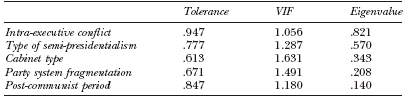
Collinearity Diagnostics of Logistic Regression, Mode of Cabinet Termination

Note:-The logistic regression model(Table 3), calls for a test of multicollinearity. Table A3 reports the collinearity coefficients on the variables included in the logistic regression test. The VIF indicators show whether a predictor has a strong relationship with the other predictors, and values in the range between 5 and 10 are to worry about. In this case, there are no such high values, and we can also conclude from the other two types of values, that there is little reason to be concerned about multicollinearity. The tolerance values in the first column should be above 0.1, and the eigenvalues in the third column, should not vary too much among the variables if we want to rule out collinearity problems. Both conditions are apparently satisfying in this model.
Dependent variable: Mode of cabinet termination.