Democracy as identification of popular subjectness
The uncertainty about the possibilities of a democratic settling of European integration is, to a large extent, related to the seemingly obvious absence of a European demos. In one way or the other, democratic legitimacy needs to be grounded in the collective will of the members of a constituted political community. As far as the EU is concerned, the plausibility and requisiteness of Europe as a demos was tested out in the experiment of European constitution-making. The question is if and under what conditions constitutional designing can be conveyed to a self-recognizing political community. The search for the reconstitution of democracy in the EU correlates with the search for the expression of the collective identity of the underlying subject of a European democracy.
This article addresses the critical issue of how the drafting and ratification of the EU-Constitutional Treaty (CT) has been related to the expression of collective identities. The common view holds the self-identified political community as – at least partially – independent of constitutional design. Against this, it will be observed how EU democracy operates through the identification of popular subjectness. It is thus proposed to view a European collective identity not as the basic infrastructure of a European democracy, but as a contingent by-product of entering into democratic practice. Most essentially, this practice consists of upholding the validity of democratic norms and procedures as applicable to the institutional-constitutional framework offered by the EU. In this way, the democratic legitimacy of the emerging polity is linked to public demands that signify an underlying social constituency. The further assumption is that such discursive representations of the constituting people of a European democracy are encouraged by the process of democratic consolidation and constitutionalisation, which the EU has entered at the beginning of the new century. We would thus expect a proliferation of public debates in the wake of EU-constitution making, which have conveyed competing images of the democratic subject and allowed for innovative ways of bringing together discourses of national, European or transnational belonging.
At the conceptual level, this postulated link between the emerging polity and its social constituency needs to be further specified. Against the substantialist understanding of collective identity and subsequently also democracy as rooted in a particular culture or community, an operational perspective will be developed. This perspective accounts – with reference to the work of John Dewey – for the emergence of the democratic subject (the ‘public’ of democracy) as a consequential effect of the discursive ways of dealing with shared concerns. The democratic consolidation of the EU can then be analysed through competing practices of signifying the demos and claiming for its distinctiveness and coherence.
For the purpose of this article, ‘popular demands’ will be categorized along the axis of three consolidated modes of situating the democratic subject in relation to the legal-institutional order of the EU: (a) an intergovernmental audit model, which postulates a zero-sum relationship between existing national identities and in which political decisions need to relate back to the national constituents as the main carriers of democracy; (b) a federal model, which postulates a zero sum relationship between the national and European elements of a collective identity and where the legitimacy of the new polity can be grounded in an integrated European political community, and (c) a cosmopolitan model, which postulates a positive sum relationship of nested identities and where the legitimacy of the new governance designs depends on their capacity to respect diversity and universal rights.
To investigate the competitive field, in which popular demands are raised, we need to turn to the public sphere that has been opened by EU-constitution-making. More specifically, we will turn our attention to the unfolding of public and media debates that deliver justifications for consolidating the legitimacy of a constitutional order of the EU. The basic unit of analysis refers to claims that postulate a particular kind of polity-constituency relationship. By reconstructing this practice of representative claims-making in public and media debates, the salience of identity politics and the dominant narratives of belonging in political contestations on EU constitution-making can be established. The case will be illustrated by a comparative content analysis of media debates during the ratification period of the EU Constitutional Treaty (2004–2005) in French and German quality newspapers.
Democracy as rooted in popular subjectness
In debating the democratic legitimacy of the EU, it has been frequently sustained that democracy is rooted in a collective, which is given substance by a historically and culturally distinct identity. This view on collective identities as the cultural expression of the unity and diversity of a political community replicates the self-description of democratically constituted nation states. In a democracy, any exercise of power needs to be justified as an articulation of popular will and subjectness. Whether emphasis is put on the idea of democracy as a process of collective will formation or on the idea of democracy as a control of power, a strong voluntaristic assumption is made, which puts trust in the freedom and autonomy of the ‘people’ to be their own master in history.
In the European Union, this ‘nationalistic’ tradition of substantiating collective identities is continued by applying the basic rhetoric of popular sovereignty as a source of democratic legitimacy. Against functional theories that treat European integration as a self-justifying project, democratic theorists insist that integration needs to be publicly defended and justified.Reference Offe and Preuss1, Reference Eriksen and Fossum2 This inevitably raises the question of the nature of the underlying public of political justification. By assuming that the internally coherent demos must exist prior to democracy, the substance of a European democracy is sought in the manifestations of culture, traditions and distinct ways of life, which can be traced back in historical accounts, located in socio-structural terms or counted empirically (e.g. through public opinion surveys). However, the distinctiveness of Europe as a civilisationReference Giesen3–Reference Eisenstadt6 or as a space of cultural diversity and multiple, historically rooted identitiesReference Shelley7–Reference Landfried9 provides only weak indicators for an identity that would be able to sustain democracy. Many authors have therefore concluded that the EU suffers from a democratic deficit, which is partially grounded in a deficit of social and cultural integration, and cannot easily be overcome by institutional reform.Reference Cederman and Kraus10 The formal democratisation and constitutionalisation of the European Union would remain incomplete as long as the emerging polity cannot rely upon a robust, durable and self-identified political community.Reference Bartolini11 Without such a constituted political community or demos any democratic solution would be unfeasible. The constitutional design of the emerging European polity is in this way linked back to the substantial features of its underlying social constituency. The democratic reconstitution of Europe could only be completed through the reconstitution of the social carriers of democracy.
The ‘deficit’ thesis is a particular way of replicating the basic rhetoric of democracy and applying it to a new institutional setting without challenging the taken for grantedness of collective identity. Following this line, research has mainly been concerned with mapping and administering the plurality of existing identities that mark the European space. In particular, Eurobarometer data have been used for demarcating a plural identitarian field, in which attitudes expressing people’s belonging can be scaled as being more or less Europeanised.Reference Kohli12–Reference Citrin and Sides14 In most of these surveys, it is taken for granted that a meaningful common identification exists prior to, and independently of, its discursive articulation.
Democracy as the identification of popular subjectness
In a critical review of the different uses of the term ‘identity’ in the social sciences, Brubaker and Cooper (Ref. Reference Brubaker and Cooper15, p. 5) note a fundamental ambivalence of treating collective identity as a category of analysis while at the same time recognising its character as a category of practice. Social analysts have sought the essence of ‘sameness’ or ‘groupness’ but are able to find merely ‘identity talk’ and ‘identity politics’. This ambivalence is reflected in the dual orientation of many academics who claim to be analysts of collective identities and, at the same time, protagonists of identity politics.
The literature on EU-democracy could be taken as a prime example of this dual orientation of academics as analysts of the unity or diversity of identities and as promoters of a new type of identity politics. There is a tendency to analyse formal democracy as the end product of a political community in search of its political vocation instead of analysing democratic practice as a particular mode of signifying popular subjectness. Collective identity is thus seen as a creation of culture and not discourse. Democracy, on the other hand, in ideal terms, is seen as a creation of discourse but, in real terms, it is still seen as bound to the existence of a culturally integrated community.Reference Dryzek16 In this article, it is proposed that the operational understanding should be applied both to the ‘making of’ democracy and collective identity. Hence, there is no need for a theory of democracy and a theory of collective identity, there is a need for a theory of practice that relates the discourses on democracy to the discourses of collective identity.
Such discourses, which signify the constituents of democracy, are bound to the operation of political systems and their claims for the legitimacy of collective decision making.Reference Nassehi17 Political discourse distinguishes itself through its inherent logic of focusing and categorising the ‘self’ of communication.18] In this sense, the operation of the political system through collectively binding decision-making is constantly (re)producing the imagination of society as a collectivity, to which such decisions are applied. Collective identity is therefore not substantiated in any cultural contents unless also expressed through discourse (Ref. Reference Delanty and Rumford19, p. 50). This implies that there is no political discourse that is not also linked to collective identification and representation. In turn, there can be no substance of collective identity that exists independently of its discursive representation. Notions of collective identity need to be discursively represented and have no existence ‘beyond discourse’. Only discursive practice can constitute collective identities and, since there is no other practice than discursive practice, there can be no collective identity independent of its discursive expression (Ref. Reference Laclau and Mouffe20, p. 107).
The intuition that the identity of the collective subject of democracy is to be considered as a consequential effect of entering into a shared discursive practice was first and prominently expressed by John Dewey.Reference Dewey21 His notion of the public speaks against the commonly held belief that democracy is located within pre-existing communities (either based on ethnic bonds, on cultural commonalities or on a consensus of faith, belief or values). Quite to the contrary, Dewey argues that the need for democracy, i.e. the need of public involvement, emerges whenever issues transgress the boundaries of taken for granted communities.Reference Marres22 Dewey further lays the groundwork for an operational theory of democracy, in which the ultimate aim of democracy is not considered as the achievement of the good life (and consequently the constant normative choice of what is good or bad), but as the experience of shared concerns and the discursive ways of dealing with it.
Cathleen KantnerReference Kantner23 has taken up these insights to conceive a pragmatic model of community building that is applicable to a transnational context. A collective identity in the strong sense could thus emerge “‘in the group members’ discourses about important policy issues” (Ref. Reference Kantner23, p. 516). This solution to the problem of collective identities trusts in the capacity of individuals to sort out their own destiny collectively and to identify a common interest. The question that is left open here is how the group members themselves and their ‘important policy issues’, i.e. the ‘public and its problems’, can be constituted, if not through the very same discourse on popular subjectness and identity.
Dewey himself dedicates some interesting lines to this representative function of discourse in relation to collective problem-solving. Some of his writings indicate indeed that public debates should not only be analysed with regard to their function of identifying common concerns, but also with regard to the production of meaning about what constitutes popular subjectness. Only if there are signs and symbols can collective action be ‘arrested for consideration, and esteem and be regulated’ (Ref. Reference Dewey21: p. 152).
But when phases of the process are represented by signs, a new medium is interposed. As symbols are related to one another, the important relations of a course of events are recorded and are preserved as meanings. Recollection and foresight are possible; the new medium facilitates calculation, planning and a new kind of action which intervenes in what happens to direct its courses in the interest of what is foreseen and desired. (Ref. Reference Dewey21: pp. 152–153)
This new medium for the representation of ‘common problems’ can be called a collective identity. It is the symbolic representation of a collective practice, which describes itself in terms of a popular democratic subject. Through its representative function the public discourse about common problems does not therefore endow an existing political community with an identity, it rather constitutes the very ‘public and its problems’. The fact that the public of democracy can only be called into existence through representation puts into question its ‘authoritative role’ as the constituent of democracy. The public becomes visible only through its representatives: ‘the obvious external mark of the organization of a public or of a state is thus the existence of officials’ (Ref. Reference Dewey21: p. 27). The political organisation of the public leads to the state but it is only by means of representation that a public is organised and made effective. Through representation, the association of the public adds to itself political organisation and ultimately, ‘the public is a political state’ (Ref. Reference Dewey21: p. 35).24
The publicness of the state and the external public here form an intrinsic unity. Dewey points to the inverted logic of democracy according to which the represented is constituted by the representative. He identifies the same ‘populist reason’ that is elaborated by LaclauReference Laclau25 who states that the public can only be perceived as emerging out of the justificatory logic of representation. The public (or the people) is the collective name for these acts of representation. ‘A public is imparted only to support and to substantiate the behaviour of officials’ (Ref. Reference Dewey21, p. 117).
In a Deweyan sense, there is thus no way to conceive of the public as outside and independent of discursive and representative practice. Any substantial notion of a public as a subject in history is misleading. In the ‘great society’ it is not a question of homogenising or enlightening the public as the subject actor and the carrier of democracy. The ‘great society’ can only give evidence of a public that ‘is so bewildered that it cannot find itself’ (Ref. Reference Dewey21, pp. 122–123). The public is only given substance through the ongoing representative discourse. ‘Without such communication the public will remain shadowy and formless, seeking spasmodically for itself, but seizing and holding its shadow rather than its substance’ (Ref. Reference Dewey21, p. 142).
The strength of Dewey’s work lies in the conceptualisation of the conditions for the emergence of the public as an addressable, but in no way substantial, entity. The public comes into being as a consequential effect of a discourse that signifies its own realm of validity. Public discourse promises to address anybody and yet ends up with given audiences. Identity discourse circulates around this ‘problem of the public’ to discover and identify itself in terms of popular subjectness. Warner (Ref. Reference Warner26, p. 114) speaks in this sense of a public as poetic world-making. All public discourse is poetic in the sense that its performance, which is addressed to a public, must also characterise the world in which it attempts to circulate and it must attempt to realise that world through address. A public discourse says ‘Let the public exist’ and ‘Let it have this character, speak this way, see the world in this way’ (Ref. Reference Warner26, p. 114).
European integration has seemingly not introduced a radical shift in the semantics of Western political societies defined as democracies. Democracy is still held up as the basic organising and legitimating principle, which is to be detached from the nation-state and transposed to transnational and supranational units of political ordering. This implies, first of all, that the particular kind of relationship between the ‘people’ as the constituents of a polity needs to be redefined.Reference Splichal27 A constitutional moment such as that established by the Laeken process introduces a new discursive constellation in the political representation of the democratic subject. This particular discursive formation of collective representation is not dependent on founding but on entering successfully into democratic practice.
The conditions under which publicness can exert this performative function and work as ‘poetic world-making’ need to be elaborated by further specifying the link between discourse and collective representation through which democracy operates. We thus need to analyse discourses that deal with the undecided question of a European democracy. We need to approach the ‘fetish’ of popular subjectness of a European democracy.
EU-constitution making as the signification of the people of democracy
Our approach of relating the quest for European identity to democracy has led us to a research design that explores EU-constitution making as an attempt to construct popular democratic subjects. By entering into a process of explicit constitution-making, the idea of a democratic subject is underlying the justificatory practice, which collects ‘good reasons’ for why Europeans are better off in ‘doing things together’. Democracy unfolds in this discursive practice of reason-giving for collectively binding decisions and choices. As I argued in the previous section, collective identity comes in to the extent that such reasons and justifications are interrelated with social imaginaries and identities, which do not precede but result from the process of representation through public discourse (Ref. Reference Laclau25, p. 161).
The question of how to introduce European identity and mobilise it in a multi-identitarian field has a clear political connotation. To the extent that the EU-constitutional project was a PR-product,Reference Moravcsik28 it attempted to enter European identity politics by actively promoting trust and solidarity among European citizens. In the political struggle on the constitutional design of the EU, the question of how multiple identities can coexist and co-evolve in Europe became vital for modelling different paths of reform and testing out their viability.Reference Eriksen and Fossum2 These identity selling efforts were also backed by academic work aimed at demonstrating through opinion surveys that individuals can, and in fact do, hold multiple identities.Reference Risse29 By measuring collective identities at the aggregated level of individuals’ attitudes, such surveys can only end up in a substantialist notion of collective identity, which relies on predefined categories to which the respondents have to reply, but in which the individuals’ life histories tend to disappear.Reference Eder30
The approach here is different in the sense that it does not look at social groups as carriers of collective identities, but rather as containers of identity discourses. Different role ascriptions need to be embedded in a plural representative field, which is given discursive form and which signifies the social groups or the ‘people’ as the carriers of identity. The question of European democracy can then be reconstructed as the confrontation between different identity discourses, where the designation of the people through national democracy is put into question. In the political struggle about the democratic reconstitution of Europe, such competing solutions to the quest of allocating the popular sovereignty of the people crystallise in different master stories, which are held by narratives that signify a particular polity-constituency relationship. The kind of narratives we seek would thus need to distinguish different options for the institutional/constitutional designing of the EU related to a particular vision of popular sovereignty. Three master stories for locating public authority and popular subjectness in Europe can be distinguished:31
(1) Audit Democracy: Zero-sum Relationship between Existing National Identities Reference Checkel and Katzenstein32
This story builds on the classical division of labour between fully sovereign nation states allocating popular sovereignty and negotiating the quest of collective identities, and an international or European arena of interest negotiation. National governments appear in this story as delegated national interest representatives. The kind of trust and solidarity that is needed to make democracy work would be provided by relatively stable and historically rooted national identities. Different national identities would stand in a zero-sum relationship and European integration is aimed at taming potential conflicts between them. A European identity would not only be unnecessary, it would also potentially harm the integrity of the national community. This is manifested in the increase of conflicts between the two levels, which can only be overcome by a clear delimitation of competencies and a self-restriction of the EU to market-building, negative integration and auditing the normative integrity of the member states.
(2) Federal Democracy: Zero-sum Relationship between European and National Identities
This story applies elements of the established plots of the history of nation building to the European Union. In a federal Union, the interrelation between collective identities is likewise perceived as a zero-sum game with the new elements of supranational identification slowly replacing the traditional elements of national and subnational identities. The European institutions appear in this story as common interest representatives. Democracy would be grounded in a thick European identity with the potential to overcome national identity, or at least allowing for restricted identity pluralism by territorially demarcating the sub-identities within the federal union. A strong political identity needs to prevail at the federal level grounded in a constitutional patriotism, which gives expression to the wish for unity of the new political entity rooted in citizenship rights and practice and establishing bonds of mutual recognition between its plural cultural expressions.Reference Magnette33, 34
(3) Cosmopolitan Europe: Positive Sum Relationship between Nested Identities
This story combines elements of human rights universalism and global solidarity with a particular democratic arrangement. In a postnational, cosmopolitan Union, the interrelation between different identity discourses would lead to a positive sum outcome. European identity would be nested happily in persisting patterns of national identification.Reference Checkel and Katzenstein35 In order to be able to display this reconciliatory function, the European constitutional project needs to give expression to a cosmopolitan vocation that can be transposed to the universal and inclusive community of democracy.Reference Eriksen36 European institutions would appear in this story side by side with international organisations and global civil society as elements of an inclusive and encompassing democratic process that represents humanity. The EU-setting would thus be post-identitarian, and the persisting plural identities would be significantly constrained by the necessity to respect diversity and cosmopolitan values. In this sense, there would be an institutional guarantee that the particularity of collective identities is always counterbalanced by reflexivity, which is displayed in the discursive references to the ‘unity in diversity’ of the shared political space of Europe.
However, defining collective identities in relation to EU constitution-making is not a straightforward process. By assuming its democratic vocation, the EU defined the need to enter into a debate on its ethical self-understanding and to arrive at a positive signification of its ‘unity’. On the other hand, the EU was equally committed to the preservation and continuation of linguistic, religious, ethnic and historical diversity, and to the reconciliation of the distinctive national traditions of its member states and citizens. The constitution-makers’ ambition to set a coherent framework of plural belongings under a shared umbrella of identification needed to be communicated. The discursive contents of the European ‘constitutional identity’ based on the blending of its own democratic objective with respect to cultural diversity needed to be made salient and contested. Thus, the question to be answered is how EU-constitution-making as a bid for collective identification has been taken up by the collective actors and groups that populate the European identitarian space.
Constitutional debates in the media: identitarian battlefield or discursive Babel?
The persuasive power of European constitution-making as an identitarian project depends on the process of its public representation, i.e. on its capacity to create enduring resonance and to speak to a wider European public. The mass media are the principal arena for the public (re-)presentation of identitarian narratives. The mass media are also the place to challenge EU-constitution-making as an identitarian project. Mass media are expected to turn European constitution-making into an identitarian battlefield where nationalists strike back, communitarians defend a Christian Europe, and cosmopolitans support membership of Turkey.
Drawing on a comprehensive media survey of constitutional debates in French and German quality newspapers between 2001 and 2005, the performance of the media in turning EU-constitutional debates into an identitarian battlefield can be scrutinised more closely.37 The overall research question is whether and to what extent the media open an identitarian battlefield around EU-constitution-making representing the people of an emerging European democracy.
The particularity of an identitarian battlefield consists of linking narratives of collective belonging to social carriers. This requires, first of all, the task of identifying the narratives that are dominantly expressed in media discourse. A systematic content analysis of newspaper debates will enable us to categorise discursive elements along the three master narratives for the allocation of political authority and popular sovereignty in Europe identified above. The assumption is that existing normative options for a democratic reconstitution of Europe (the three RECON models) need to be turned into stories with a capacity to produce feedback effects from the general public. Secondly, the analysis needs to link the particular narratives to social carriers. For that purpose, the research will rely on the so-called claims-making approach, which explores the battleground of European identities through claims-making activities of collective actors or individuals. Claims-making consists of the public articulation of political demands, proposals or criticisms, ‘which, actually or potentially, affect the interests or integrity of the claimants and/or other collective actors in a policy field’ (Ref. Reference Statham38, p. 12). Such a discursive act can in different ways be linked to the question of collective identity. In surveying media debates on European constitution-making, we can distinguish between claims that straightforwardly raise the question of collective identity as an issue of concern in relation to EU-constitutional choices and the justificatory logic of claims-making that uses identitarian references and values to defend particular positions in constitutional debates.
In segregating identitarian references in EU-constitutional debates, the emphasis will be on the performative function of discourse in signifying popular subjectness. Can we describe the contours of a European subject of democracy as a retroactive effect of naming through shared discursive practice? If yes, how are the people signified? Is collective identity primarily represented through membership in a community of co-nationals with ‘thick’ ethnic ties? Is it represented through membership in a cultural community or civilisation, whose members share the same strong beliefs and values? Or is it represented through membership in a community of compatriots who do not have much in common apart from shared ‘humanity’? (Ref. Reference Eriksen and Fossum2, p. 23).
Identity as a topic of constitutional debates
The overall salience of collective identity and belonging as elements of story building in media debates on constitutional ratification in France and Germany was low. In spite of the high intensity of media contention in both countries, only in a few instances did collective identities become topical in a way that questioned the taken-for-granted reality of membership in the national community (RECON model 1). We distinguish between unspecified references to a European identity (however defined), specific references to a European community of values and Christianity (RECON model 2) and specific references to a civic Europe of justice and rights (RECON model 3). In total, such identitarian statements made up less than 4% of the claims that were publicly raised in relation to EU-constitution-making (for the full range of issues in constitutional debates, see Ref. Reference Vetters, Jentges and Trenz39).
The major part of identitarian statements to be found in constitutional debates in the newspapers was unspecific, i.e. not expressing a positive or negative identification with a European constitutional order, but rather dealing with European identity in a hypothetical way: should it exist, can it exist, and how can it be promoted? Such statements typically denounce the constructedness and artificial character of a European identity to distinguish it from the thick ties that bind the community of co-nationals. The ‘invented story’ of European integration cannot easily overcome the ‘hard core’ of national unity. Collective identity thus appears in this story as partly constructed, and, as such, open to be re-shaped by European re-invention, and partly substantial, and, as such, putting limits to European integration. The Europe of nation states is needed to protect this substantialist character of collective identities and also European institutions must be committed to the preservation of diversity and the integrity of its national and subnational units. A polity with only delegated powers to the EU level can best accommodate this trade-off between the newly invented European-ness and the deeply rooted national belongings.
The third narrative, referring to the notion of European cosmopolitanism and symbolised in a Europe of rights that is based on a plurality of life forms and the recognition of difference, was only marginally taken up in the newspapers. In particular, the expectation to enhance a civic notion of belonging through the Charter of Fundamental Rights was not met. The idea of a rights-based Union had only low media salience and did not become the magnet for societal claims-making activities. In total, only 42 statements emphasised a Europe of justice and rights, which is less than 1% of all instances of contentious claims-making in the four newspapers analysed. A constitutional patriotism that identified with a catalogue of fundamental rights of European citizens was not used as an identity marker in newspaper discourse in France and Germany.
Why did the ratification debate not offer a platform for those who conceived the constitutional project as a logical step forward on the road towards a cosmopolitan Europe? The spirit of cosmopolitanism was spread mainly by the European institutions applying the universal principle of subsidiarity to European identity constructions: identifying oneself as European should not be seen as interfering with narrower identities of national or regional kind. At the same time, the EU was committed to the preservation and continuation of linguistic, religious, ethnic and historical diversity and to defining a positive sum relation between the distinctive traditions of its member states and citizens.Reference Stråth40, Reference Schulz-Forberg41 In the highly contentious ratification debates in France, and partly also in Germany, such a ‘friendly approach’ to the reconciliation of multiple European belongings had little chance to set the media agenda. The new contentiousness of European integrationReference Hooghe and Marks42 might also account for the failure of the Charter of Fundamental Rights to set the agenda for a collective self-understanding of the Europeans. The Charter stood for a basic consensus of the Europeans on human rights and could as such neither be mobilised in relation to interest politics nor to identity politics.
While cosmopolitan principles and fundamental rights were marginalised in the media discourse, the collective self-understanding of Europe was more successfully mobilised in relation to the second narrative claiming a shared identity of the Europeans based on common values and culture. This holds almost exclusively for the notion of a Christian Europe. The drafting of the preamble and the reference to God was the most salient issue linked to a debate about the identitarian grounding of a politically united Europe. In total, 69 instances of claims-making can be found referring to the Christian heritage of Europe in relation to EU-constitution-making. The debate about a Christian Europe is also one of the few cases of successful outside mobilisation. Churches and religious organisations were the principal claimant in both countries. As such, the debate resembles rather a case of lobbyism by strong moral authorities than the successful opening of an identitarian battlefield. In Germany, state actors either amplified positively the claims of Church actors (the Christian-democratic opposition) or were non-responsive (the red-green government). In France, the debate was much more controversial, with state actors and political parties defending French laicism against the Church. Claims in favour of a reference to God were typically promoted by foreign actors and the Vatican. The external voice for a Christian Europe was perceived as a threat to French laicism, which allowed national actors to play off republican French identity against the perceived intrusion of European values.
Three waves of debating the preamble and its (lack of) reference to God can be distinguished. The topic was first raised by Members of the European Convention in 2002, who also tried to mobilise their respective parties within the national and European Parliaments. The European People’s Party (EPP) was the strongest proponent of a reference to the European religious heritage in the preamble, while other parties within the EP were divided on the issue. In a second wave, the topic was raised by the governments of the Member States during the Intergovernmental Conference (IGC) in 2003 and 2004. The proposal to include a reference to Christianity in the preamble was backed by a majority of the Member States but categorically rejected by France, which threatened with veto positions in the IGC. Church and civil society actors launched their lobbying campaign mainly in this phase and the topic became most salient in the media. Thirdly, and with much less frequency, the call for a Christian Europe was used in the ratification campaigns of 2005 for demarcating pro- or anti-European cleavages. In the consensual German debate the issue was only occasionally raised by a small number of MPs of the regional Christian Socialist Union (CSU) to give a reason for their rejection of the CT. In the highly controversial French referendum debate, the non-reference to religious symbols in the final draft of the CT was praised as a victory of French laicism. Appeals from other Member States to include a reference to God in the constitutional document were rejected by all main domestic players.
The French republicans perceived the notion of a Christian Europe as a threat to the exclusivity, but also to the potential inclusivity, of national identity. The criteria for political inclusiveness are then to be established within the domain of French republicanism, while the reference to the notion of Christian Europe would still allow remaining culturally exclusive: while national citizenship is granted according to legal rules and guarantees, the recognition of being European remains purely cultural. As the European identity thus cannot be acquired it is turned negatively to demarcate the European from the non-European French and Germans. By reference to Europe, the national community can uphold its political inclusiveness and, at the same time, insist on a new primordial distinction in the delimitation of collective identity: you can be identified as a French Muslim but not as an Arabic European. The Christian Europe is the most visible (and in contrast to racism also more legitimate) signifier of this communitarian heritage of a common civilisation that demarcates a higher level of distinctiveness than the Europe of nation-states.
Yet it should be noted that the limited range of the debate on a Christian Europe made its status as a hegemonic identitarian counter-discourse against the official variant of secular cosmopolitan Europeanism rather dubious. Mobilisation took place only for short periods and was not linked to plural democratic voices, but to the higher moral authority of the Churches. By most of its proponents, the idea of a reference to the religious heritage of Europe was also not introduced as a new particularism, but was defended in inclusive and universal terms allowing for the identification of different religious faiths with the European political project. The prominence of Christianity points therefore, once more, to the ambivalence of European cosmopolitanism, which a Christian identity claims to be a part of.
In the absence of internal consolidation and the positive identification of a democratic subject as the carrier of the EU-constitutional project, Europeans could alternatively recur to external delimitation as a strategy of identity building. Such negative identifications would become salient in the attempts to draw the external borders of Europe. It is surprising however that accession of Turkey did not figure prominently as a concern of claims-making in constitutional debates for the period analysed. This might reflect a specific bias of quality newspapers in dealing with collective identities in a reflexive way, which does not allow for sharp delimitations. It can also be partly explained by the different sequencing of the membership debate on Turkey and the EU-constitutional issue. Turkish membership became topical only after 2005, and was by then already decoupled from the issue of EU-constitution-making. Delanty and RumfordReference Delanty and Rumford19 point to another and deeper reason for this difficulty of external delimitation of a European identity. If Europeans are not very united among themselves, giving them a discursive form of unity, it is also unlikely that Europeans will unite against the other (Ref. Reference Delanty and Rumford19, p. 76). Thin identities, such as constitutional patriotism or cosmopolitan Europeanism, are therefore self-restrictive identities, which can neither draw on inclusive nor exclusive identity markers.
We might therefore conclude that an explicit, enduring and encompassing debate about the re-allocation of collective identities and the signification of a democratic subject in the process of EU-constitution-making did not take place. Quality newspapers did not question (but also did not explicitly reaffirm) the taken for granted reality of the nation state as a sovereign and exclusive space of identity formation. They occasionally raised the question of a European identity as a hypothetical and normative construction to overcome national identity towards higher levels of inclusiveness – a debate that was mainly linked to the notion of a Christian Europe rather than to secular Europeanism. Finally, they point to the ambivalence of European cosmopolitanism and its self-restrictive logic as a thin identity marker, which proved insufficient to demarcate a space of collective identification of the Europeans.
Thus far, the survey has only examined explicit references to a common European identification in constitutional claims-making. Yet, although collective identities are not topical, they are not necessarily absent or irrelevant. It would be wrong to assume that media and journalists necessarily need to talk about collective identity as such. It is rather by debating controversial issues that ethically relevant aspects are raised (Ref. Reference Kantner43, p. 516). We therefore need to locate collective identities not only in the topicality of claims-making but also in the justificatory practice of the political contestation of EU-constitutional choices.
Collective identity as part of a justificatory practice in constitutional debates
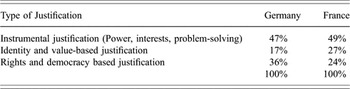
In order to determine the possible impact of contentious claims-making on collective identity formation, it is decisive whether broad and enduring public debates unfold over controversial policy issues. Only such identity- and value-laden policy conflicts have the potential to involve participants from different national origins and their relevant publics in a debate about the shared ethical self-understanding of a political community.Reference Kantner43 We therefore have to seek parallel policy debates in France and Germany, where participants make regular use of identity justifications. Among the claims that were justified,44 references to problem-solving clearly prevailed in the ratification phase in both countries (Table 1). Hence, the emphasis on output-efficiency that was traditionally claimed to legitimise EU policies is almost routinely reproduced in the constitutional debates. Traditional power politics and concerns related to the efficiency and functionality of governance were critical in shaping contestation on Europe, and not identity conflicts, as expected by Hooghe and Marks.Reference Hooghe and Marks42 The degree of politicisation (highly contentious referendum in France against elite consensus re-affirmed by parliamentarian ratification in Germany) did not fundamentally change but rather reaffirmed this pattern. The emphasis on rights, democracy and identity as the major innovation of the constitutional proposal clearly resurged as a justificatory device of public claims-making in both countries. In addition, the French and German debates developed in slightly different directions with regard to the reference to normative and identitarian justifications. Public claims-making in Germany gave preference to the expression of universal rights rather than common values in defending the constitutional choices. In the French debate, value-based justifications were more widely used and contributed to the higher degrees of politicisation in the media.
Type of justifications used in ratification debates in Germany and France (Nov. 2005–June 2005)

N = 1.674.
The analysis of ratification debates is based on 1.674 claims found in 616 articles. The German sample consists of 651 claims from 230 articles, while the French sample contains 1,023 claims collected from 386 articles.
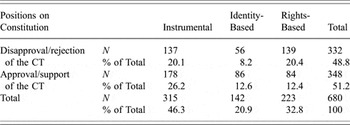
Hooghe and Marks’ claimsReference Hooghe and Marks42 confirm, however, that the basic decisions related to joining, enlarging, or deepening the regime at stake in the constitutional debates between 2001 and 2005 were a constant irritation and a standing temptation for political elites to raise public expectations and that the conflict structure of membership issues was biased towards identity. Approval/disapproval of the Constitutional Treaty was the single issue in our sample of constitutional debates, in which identity justifications were regularly (although not predominantly) present in both countries (see Table 2).
Justifications given in support/rejection of the CT, aggregated data France and Germany (2001–2005)

N = 680.
The analysis is based on 4.291 claims segregated from 2.916 articles.
Table 2 shows the distribution of supporters and opponents of the Constitutional Treaty in relation to the justificatory logic of the debate. Against the hegemonic promotion of the constitutional project by the governments and its backing by an all-partisan consensus in most Member States, the supporters and opponents of the CT had an almost equal say in media debates. With a total of 680 claims, around 9% of all claims raised in constitutional debates made a direct and justified statement on either approving or disapproving the project of EU constitution-making. The enhanced conflicts over the EU constitutional issue and its overall public resonance is one necessary – but not sufficient – condition to be met for opening an identitarian battlefield on European integration. As a further condition, identity-related arguments must be raised in the justificatory logic of the debate. This latter condition was only partially met. In about half of the cases the constitution was supported by reference to power, functionality and efficiency, and about one quarter of the cases justified the constitutional choice by reference to either identity, rights or democracy. In turn, the CT was most typically rejected by reference to rights and democracy, closely followed by references to power and interests. The official rights-based justification that was trying to construct a constitutional patriotism around fundamental rights and democracy as the core components of the political Europe was thus mainly used in a negative sense in media discourse. Identity-based justifications (such as the defence of national identity against Europe) played only a minor role as a reason for rejecting the CT.
With regard to actors who made specific use of identity justifications in either supporting or rejecting the CT, we find a clear dominance of national governments opposed by domestic civil society actors, and less so by political parties. The identitarian confrontation thus went beyond the traditional lines of party conflicts and included broader societal groups. Further, the almost complete absence of EU actors and institutions as promoters of the EU constitutional project in identitarian terms is striking. Collective identities are thus still mainly negotiated among domestic actors. The identitarian battlefield opened up by EU constitution-making was much narrower than expected, considering the highly contentious debates. As shown by Ref. Reference Vetters, Jentges and Trenz39, the degree of contentiousness correlated with a trend of domestification of debates (in terms of actors, addressees and issues) and a return of power games in France, whereas the German case of ‘tamed’ contention allowed for a controlled mobilisation of European identity references by elite actors and a transnational opening of the debate.
Facing identitarian Babel
This article has applied a non substantialist-operational notion of collective identity formation as a consequential effect of entering into a shared discursive practice. The European collective identity has not been sought in any substantial sense as the objective expression of an organic community. The intuition was rather that the process of constitutionalisation and democratisation of the EU would generate particular notions of democratic subjects. With shared discourse we mean an ongoing discursive practice that, in a Deweyan sense, actively involves and passively reaches the public. In this sense the public could be expected to be constituted as a consequential effect of entering into a shared discursive practice. Discourse is inclusive and ‘shared’ in this sense of identifying and signifying collective actors’ positions.
In 2002, the EU officially entered a process of explicit constitution-making, where elites stepped forward as the natural carrier of identity discourse to mobilise public support and, in relation to democracy, to signify the people as the constituting subjects. By recognising its distinctiveness in the enforcement of citizens’ rights and the respect of cultural diversity, the EU-constitutional project could only be given expression as a variant of cosmopolitanism. EU-constitution-makers thus sought to enter a positive-sum relationship with existing plural identities in Europe. We have seen that the problem of imagining the constituting people of European democracy lies precisely in this difficulty to establish hegemonic discourse, in a field that is already occupied by multiple and shifting signifiers.
What kind of conclusion can be drawn from this survey of constitutional debates and their overall impact on the collective identification of the constituency of an emerging European democracy? In line with other studies on the multiplication of collective identities,Reference Hannerz45–Reference Beck and Grande49 we can conclude that identity discourse in Europe becomes increasingly diversified. In contemporary plural and fragmented societies the signification of democratic subjects can no longer rely on hegemonic designations. Instead of an identitarian battlefield between contested notions of belonging we find an identitarian Babel. This Babel is not simply manifested in multiple coexisting identities. It does not unfold trough the articulation of identitarian pluralism but rather reflects the difficulties of fixing any discursive form for the articulation of collective identities. Faced with the volatility of media attention, the contingent element of identity discourse also becomes the dominant element.
Under these circumstances, the loyalty of citizens becomes a scarce resource not only for EU-constitution-makers but also for national authorities. What the European experience can teach us is that this absence of a hegemonic signification of the ‘people’ is not simply a constraint to contextualised national democracy, but also the stimulus for a re-launch of democratic practice that is nourished by the new uncertainty about collective identity. Maybe the Babel of identities that characterises Europe is even the first truly democratic way of dealing with (undemocratic) collective identities. Rather than searching for the conditions of an identity within Europe or the EU, the European way of self-observation would thus become a chance to look beyond popular subjectness. Delanty and Rumford (Ref. Reference Delanty and Rumford19, p. 76) identify the cosmopolitan disposition of Europe in precisely this capacity to enter into a reflexive relation to one’s identity: ‘Europe does not exist except of a discursively constructed object of consciousness and Europeans also do not exist as people with a shared past. To be European is simply to recognize that one lives in a world that does not belong to a specific people’ (Ref. Reference Delanty and Rumford19, p. 77).
Hans-Jörg Trenz is research professor at ARENA, and attained his habilitation at Humboldt University Berlin and a PhD in social and political sciences at the European University Institute in Florence. His main research interests are in the areas of media, communication and public sphere, civil society, European civilization and identity, migration and ethnic minorities, cultural and political sociology, social and political theory, democracy and constitutionalism in the European Union. His main publications include: ‘European civil society. Between participation, representation and discourse’, Policy and Society, (1) (2009); ‘Understanding media impact on European integration: enhancing or restricting the scope of legitimacy of the EU’, Journal of European Integration, 30(2), 291–309 (2008); ‘Reconciling diversity and unity: language minorities and European integration’, Ethnicities, 7(2), 157–185 (2007); and Europa in den Medien. Das europäische Integrationsprojekt im Spiegel nationaler Öffentlichkeit (Frankfurt a.M./New York: Campus, 2005).