INTRODUCTION
Gephyroberyx darwinii (Johnson, Reference Johnson1866) is a subtropical trachychthyid fish occurring in the 42°35′N–35°00′S latitudinal range (van Guelpen, Reference van Guelpen1993). Its original distribution is very wide: Atlantic and Indo-Pacific Oceans also including the Australian and New Zealand waters (van Guelpen, Reference van Guelpen1993; Al Sakaff & Esseen, Reference Al Sakaff and Esseen1999; Andrade et al., Reference Andrade, de Souza Soares, Barreiros, Gasparini and Hostim-Silva2004; Kim et al., Reference Kim, Go and Imamura2004). Gephyroberyx darwinii was caught for the first time in the Mediterranean in 1961 on a bank along the Algerian coast (Dieuzeide, Reference Dieuzeide1963). This specimen, measuring 63 cm of total length and weighing 4.4 kg, was classified from a photograph taken by the fisherman before eating it. Although no anatomical portion of this specimen has been preserved, the Algerian record has been considered as valid and the species G. darwinii is still included in the most recent checklist of Mediterranean marine fishes as Atlantic immigrant (Psomadakis et al., Reference Psomadakis, Giustino and Vacchi2012).
This paper reports the capture of one specimen of G. darwinii from Sicilian waters.
MATERIALS AND METHODS
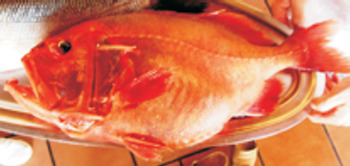
On 22 August 2011, one specimen of Darwin's slimehead G. darwinii (Johnson, Reference Johnson1866) (Figure 1) was caught by trammel net at 20 m depth, about 1 km offshore the harbour of S. Agata di Militello (38°05′N 14°37′E), in the southern Tyrrhenian Sea. The specimen was bought by a restaurant owner, Mr Franco Mentesana, who photographed, weighed and then cooked it; only the head, deprived of gill arches, and an abdomen portion bearing ventral scutes and the base of ventral fins were frozen and supplied to our research centre. These fish parts were used to count the scutes and the rays of pelvic fins and to take 18 measurements of the fish head with a caliper providing a precision to 0.1 mm. Other morphometric features were inferred by analysing a digital image of the specimen by AutoCAD software as follows: (i) the five longest measurements out of 18 were picked as benchmarks to obtain the remaining measures; and (ii) five separate simulations were computed; at each simulation, one of the five chosen measurements was used to derive all of the others. The most reliable simulation was selected to estimate any missing measurement; to this purpose, the derived measures were plotted against the real ones and the respective regression lines were calculated for each simulation. A further check was carried out on the averaged derived measures plotted against the real measures. The best expected model is the one that produces a regression line with intercept 0 and angular coefficient 1, i.e. the one that coincides with the bisecting line of the first quadrant. The missing measures were inferred from the most reliable simulation according to a combination of: (i) the highest coefficient of determination (R-square); (ii) the highest overlap of the regression and bisecting lines; and (iii) the highest percentage of minimal residuals.
Specimen of Gephyroberyx darwinii caught in the southern Tyrrhenian Sea.

RESULTS
The fresh specimen (Figure 1) presented a red colour on the back and a pink colour on the abdomen; red tongue; a white protuberance on the symphysis of the lower jaw; black gill cavity; red fins with white tips. It weighed 4380 g (round body weight) and presented the following features: oval, compressed body; head with concave upper profile in the interorbital area and large skin-covered mucous cavities in the eye area; relatively small eyes; large mouth, obliquely angled when closed; jaws with bands of minute teeth; well developed vomer and palatine teeth; preopercle bearing two spines on its inferior part, with the upper spine shorter than the lower one; opercle with a prominent spine extending beyond the rear edge; forked caudal; and 11 well developed scutes (sc) along the belly ventral midline; first dorsal fin with the 3rd and the 4th spines being the longest. The meristic formula, with asterisk indicating characters inferred from photographs, is *D, VIII + 13(14?); *A, III + 11(12?); *P, 15; V, I + 6; *ll, 27; sc, 11.
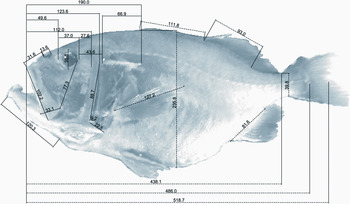
Figure 2 reports the morphometric features of the specimen obtained as described above, based on the simulation whereby the opercular spine was taken as fixed measure (R-square = 0.997; regression line y = 0.97942*x; % minimal residuals = 22.2).
Morphometric data (mm) measured on the specimen's head (solid lines) and inferred from the most reliable simulation (dashed lines).

The following are the principal morphometric data, expressed as a percentage of the estimated standard length: head length 40%; preorbital length 11.5%; eye diameter 7.5%; upper jaw length 20.7%; pectoral fin length 25.8%; maximum body height 47.8%; and interorbital width 13.3%.
DISCUSSION
The biometric studies carried out on G. darwinii from different areas of the world (Maurin & Quéro, Reference Maurin and Quéro1982; Kotlyar, Reference Kotlyar1996) report the relative morphometric indices (% of standard length) of its main characters to vary as follows: head length 33.3%–42.6%; preorbital length 8.6%–13.2%; eye diameter 7.1%–16.3%; upper jaw length 20.9%–29.7%; pectoral fin length 18.7%–28.4%; maximum body height 40.3–53.0%; and interorbital width 8.8%–18.5%. According to the studies of Maurin & Quéro (Reference Maurin and Quéro1982) and Kotlyar (Reference Kotlyar1996), the meristic formula for G. darwinii is: D, VII–IX + 12–15; A, III + 10–12; P, 13–16; V, I + 6; ll, 26–31; sc, 8–16. The morphometric and meristic features of our individual correspond to those reported in the literature for other specimens of G. darwinii caught in other areas.
On a worldwide level, two other species have been included in the genus Gephyroberyx Boulenger, Reference Boulenger1902—i.e. G. japonicus (Döderlein in Steindachner & Döderlein, Reference Steindachner and Döderlein1883) from Japan and G. philippinus Fowler, Reference Fowler1938 from the Philippines—although Kotlyar (Reference Kotlyar1996) considered them as synonyms of G. darwinii due to a considerable overlap of meristic features. The presence of 8 spines on the first dorsal fin with the 3rd and the 4th being the longest, the lateral-line scales with spines and the prominent opercular spine extending beyond the rear edge of the opercle, the concave upper profile of the head in the interorbital area, a small eye diameter (approximately 5 times the head length) distinguish this species from the confamilial Hoplostethus genus (Maul, Reference Maul, Fischer, Bianchi and Scott1981; Merrett & Wheeler, Reference Merrett and Wheeler1983; Moore, Reference Moore and Carpenter2002).
Gephyroberyx darwinii is an Atlantic immigrant, caught for the first time in the Mediterranean in 1961 along the Algerian coast on a 280-m deep bottom (Dieuzeide, Reference Dieuzeide1963). Since that date, the occurrence of this species has been hypothesized in the Strait of Sicily on the basis of non-documented captures by commercial trawlers (Bianchini & Ragonese, Reference Bianchini and Ragonese2007). However, since G. darwinii can be easily misidentified with Hoplostethus spp. (Merrett & Wheeler, Reference Merrett and Wheeler1983), trawlers' records should be considered anecdotal. The fisherman who had caught the specimen described in the present paper stated that he had caught another individual of the same species in the past but did not take pictures thereof nor preserve it; therefore also this capture remains anecdotal.
The estimated standard length of our specimen, which was obtained from the combination of derived and real measurements, is 49.3 cm. Since G. darwinii may reach a total length of 60 cm (Maul, Reference Maul, Fischer, Bianchi and Scott1981; Andrade et al., Reference Andrade, de Souza Soares, Barreiros, Gasparini and Hostim-Silva2004) or more, as in the case of the Algerian specimen measuring 63 cm of total length (Dieuzeide, Reference Dieuzeide1963), our specimen is supposedly an adult. Gephyroberyx darwinii adults live in association with rocky substrates, also in submarine canyons and hard bottom outcrops (van Guelpen, Reference van Guelpen1993) at a bathymetric range from 60 m to 1000 m depthFootnote 1 , while juveniles are recorded at lower depths than adults (9–536 m) (Bunkley-Williams & Williams, Reference Bunkley-Williams and Williams2004). Therefore, our low depth capture has to be considered exceptional.
Since this species has been documented only twice in the Mediterranean during a long lapse of time (i.e. 50 years), our hypothesis is that this species has not yet established in the basin.
ACKNOWLEDGEMENTS
The authors are deeply grateful to Mr Franco Mentesana, owner of La Perla Restaurant at Naso (Messina), who provided portions of the specimen and photographs; to Arch Dr Francesco Sciré for elaborating measurements via AutoCAD, and to Dr Alexander Kotlyar for his precious elucidation on the species ascribable to the genus Gephyroberyx.