1. Introduction
The theme of the 45th JACET Summer Conference–6th English Education Seminar (Kyoto, Japan, 20–21 August 2018) poses a challenge and a question: Revisiting classroom research: Who are the practitioners? In this paper, I coalesce two plenaries given on consecutive days. The first focuses on the theoretical and practical issues of integrating research into language learning and teaching. The second develops the ethical, epistemological, and pedagogical issues raised when learners, as well as teachers, explore their praxis as co-researchers. Such contextually-dependent, thoughtful, thought-provoking explorations are, I suggest, examples of praxis. I posit that these curiosity-led, practitioner-generated studies indicate a rich vein of valuable material for applied linguistics and language education alike. They exemplify Kahneman's (Reference Kahneman2012) ‘slow thinking’; resisting the temptation to jump to ‘quick solutions’, instead taking time to puzzle and probe (Hanks, Reference Hanks2019a). Here, I explore the conference theme from the perspective of Exploratory Practice (EP) (Allwright & Hanks, Reference Allwright and Hanks2009; Hanks, Reference Hanks2017a), considering both challenges and benefits of Fully Inclusive Practitioner Research, in which learners and teachers integrate research into language teaching and learning.
I begin by unpacking the conference title:
Revisiting classroom research
• What is research?
• What is classroom research?
Who are the practitioners?
• What is a practitioner?
• What is practitioner research?
• Who can lead, conduct, or enact, practitioner research?
I situate this discussion in the Aristotelian notion of praxis, as discussed by Arendt (Reference Arendt1958), Bannell (Reference Bannell, Field and Graham1997), Carr (Reference Carr1987, Reference Carr2004) and Flyvbjerg (Reference Flyvbjerg2001). While Arendt focusses on praxis as action (in relation to speech), both Carr and Flyvbjerg relate praxis to phronesis, arguing that phronesis or ‘ethical, practical wisdom’ is dependent on context. Practitioners, they argue, have potential for greater insight into the theoretical and practical demands of their work than outsiders. Likewise, Bannell (Reference Van Manen1990) defines praxis as combining knowledge and action in teaching, while van Manen (Reference Van Manen1990) sees it as ‘thoughtful action: action full of thought and thought full of action’ (p. 128). Moreover, Langelotz et al. (Reference Langelotz, Mahon and Dahlberg2020) remind us that praxis is useful because of ‘its sensitivity to context [and] its resistance to universalistic stances, models or frameworks’ (p. viii). Consequently, praxis affords explorations of ‘alternative educational possibilities at classroom, organisational and societal levels’ (Reference Langelotz, Mahon and Dahlberg2020, p. viii). This plenary talk highlights such possibilities in EP around the world.
I speak as a practitioner. I am a teacher, teacher educator, and researcher in language education. It is not that I shed one identity to take on another, but rather that all are integrated into a complex, dynamic being. Consequently, I refute binary notions of teacher-or-researcher, preferring instead the notion of practitioner-researcher.
2. Integrating research into language teaching and learning
To ‘revisit classroom research’, it is worth examining research itself. This section briefly analyses notions of research, and classroom research, then practitioner research. I focus on ways in which research may be integrated into language teaching and learning, considering a number of studies from different educational contexts around the world.
2.1. Research
All research is governed by our ontological and epistemological stances. From setting research questions, through the methods/tools/instruments employed, and the data collected, generated and analysed, each decision is influenced by what the individual deems worthy of attention. Thus:
All research is interpretive: it is guided by a set of beliefs and feelings about the world and how it should be understood and studied. […] Each interpretive paradigm makes particular demands on the researcher, including the questions he or she asks and the interpretations the researcher brings to them. (Denzin & Lincoln, Reference Denzin and Lincoln2003, p. 33)
This useful characterisation chimes with Yates’ (Reference Yates2004) analysis of what constitutes good educational research. She argues that it:
• Is technically convincing with systematic and innovative methods;
• Clearly offers clear contributions to knowledge and consequently may change our way of viewing the world or the phenomenon;
• Is significant, in that it is meaningful to individuals and/or the wider population.
Consequently, as Yoshida et al. (Reference Yoshida, Imai, Nakata, Tajino, Takeuchi and Tamai2009) suggest, research may take many forms, and requires a constant re-evaluation of commonly held tenets about what is, or can be, good research.
More recently, in the correspondence between Paran (Reference Paran2017) and Medgyes (Reference Medgyes2017a, Reference Medgyes2017b), Medgyes proposes that many teachers find research irrelevant. Paran disputes this assertion, but presents only arguments for the continuation of third-party research. While Medgyes refutes many of Paran's arguments, he does agree that relying on intuitions is inadvisable. Meanwhile, Sato and Loewen (Reference Sato and Loewen2019), and Marsden and Kasprowicz (Reference Marsden and Kasprowicz2017) concur that there is a need for more dialogue between researchers and teachers. Sadly, however, these recent commentators seem unaware of the long history of EP and its guiding principle of integrating research and pedagogy is overlooked.
My intention here is not to denigrate the kind of large-scale third-party research projects that have often yielded helpful results. It is rather to carve out a space for the contributions that practitioners might, if inclined, make to research. For such a space to be established, academic researchers and practitioners alike may need to bring critical scrutiny to bear on their own cultures and practices. For example, crucial aims for research are often characterised as rigour, impact and originality. But, if we claim to be rigorous, then critical questions must then be asked:
• Who decides what is rigorous?
• Who says what is impactful?
• Who arbitrates on originality?
What one individual sees as ‘original’ may be banal or incomprehensible for another. Similarly, impact is already defined in a variety of sometimes contradictory ways; for example, the effects of research in contexts outside academia, or the effects of research on the research community, or impact via practitioner agency. One person's rigour may be anathema to another; for example, to rigorously include multiple viewpoints may be desirable to some, but a foreign concept to others. As Cochran-Smith and Lytle (Reference Cochran-Smith and Lytle2009) suggest, a pre-requisite for all engaged in these discussions is broad awareness, and deep comprehension, of these differences of opinion.
In order to aid such awareness and comprehension in research activity, we might then probe further:
• Who sets the research agenda?
• Who conducts the research?
• Who reports on the research?
• Who benefits from the research?
• Who decides what ‘counts’ as research?
The answers to these critical questions indicate the cultural awareness that is needed when contemplating integrating research into classroom language learning and teaching. Research, then, is a complex, systematic, ethical and dynamic exploration of issues relevant to those engaging in language teaching and learning.
2.2. Classroom research
Bailey (Reference Bailey and Celce-Murcia2001) crystalises the definition of Classroom Research as ‘where’ research is conducted. By this definition, it is any kind of investigation that takes place inside a classroom. This is a reasonable starting point, but it is too general for our purposes today. In contemplating the conference theme of Revisiting classroom research, we need to examine more recent developments in the field. There are often assumptions of quasi-medical traditions of research in which large-scale quantitative methods such as experiments, randomised control trials, or questionnaires and surveys, are utilised in educational contexts. This approach may have many benefits, but as others (e.g. Allwright, Reference Allwright, Edge and Richards1993, Reference Allwright2005) have indicated, it positions teachers/learners as subjects to be counted, measured, or experimented upon.
From the perspective of ‘end-users’ (i.e. teachers/learners), integrating such research into their practice is problematic. Borg (Reference Borg2010) suggests teachers are unwilling to engage in it, since it is seen as time-consuming, esoteric, and/or not directly relevant to their needs. As Burton (Reference Burton1998) notes: ‘orthodox research does not provide what teachers want to know; teachers seek understanding and illumination rather than explanation and definition’ (Burton, Reference Burton1998, p. 425).
Therefore, it is unlikely to appeal to practitioners hoping to engage in exploring or theorising their practice. Consequently, orthodox research is not the focus of my talk. Instead, I turn to the latest developments that involve practitioners as active agents (a key element of praxis).
2.3. Practitioner research
Iterations of Practitioner Research (see Zeichner & Noffke, Reference Zeichner, Noffke and Richardson2001 for extensive discussion) are influenced by Stenhouse's (Reference Stenhouse1975) idea of teachers-as-researchers who probe their own context. They are also rooted in Lortie's (Reference Lortie1975) suggestion of a cadre of teacher-researchers, who work together with academic researchers to provide greater insights into the issues, challenges, and problems in their classroom teaching. Some, for example, EP, are also influenced by Freire's (Reference Freire1972) powerful notion of learner agency in pedagogy.
Action Research (AR) offers ‘a way of theorizing current practice and transforming practice in the light of critical reflection’ (Carr & Kemmis, Reference Carr and Kemmis1986, p. 221). Although this may be idealistic, it is nevertheless, a praxis goal worth pursuing. AR has been adopted by many since it was first suggested as a way for those in the profession to critically examine their educational practices. There are now many different forms: Collaborative AR (Burns, Reference Burns1999, Reference Burns2010), Emancipatory AR (Carr & Kemmis, Reference Carr and Kemmis1986), Exploratory AR (Smith, Reference Smith, Dikilitaş, Smith and Trotman2015), and Participatory AR (Kemmis & McTaggart, Reference Kemmis, McTaggart, Denzin and Lincoln2003). Nevertheless, some defining characteristics are common to all:
[AR is] contextual, small-scale, and localised – it identifies and investigates problems […] it aims to bring about change and improvement in practice […] it provides for collaborative investigations by teams of colleagues, practitioners and researchers [… and …] changes in practice are based on the collection of information or data (Burns, Reference Burns1999, p. 30)
AR has also been characterised as following a set of procedures in which teachers may introduce an innovation, evaluate it, and begin afresh ‘typically through a number of investigative cycles’ (Borg, Reference Borg2013, p. 8). Such research is usually conducted by teachers, sometimes in collaboration with academics. Borg promotes the transformational benefits of Practitioner Research for teachers, citing the potential for motivation, reflection, and ‘developing their instructional repertoires’ (Borg, Reference Borg2013, p. 216). This, however, does not afford the possibility for learners (and others) to engage.
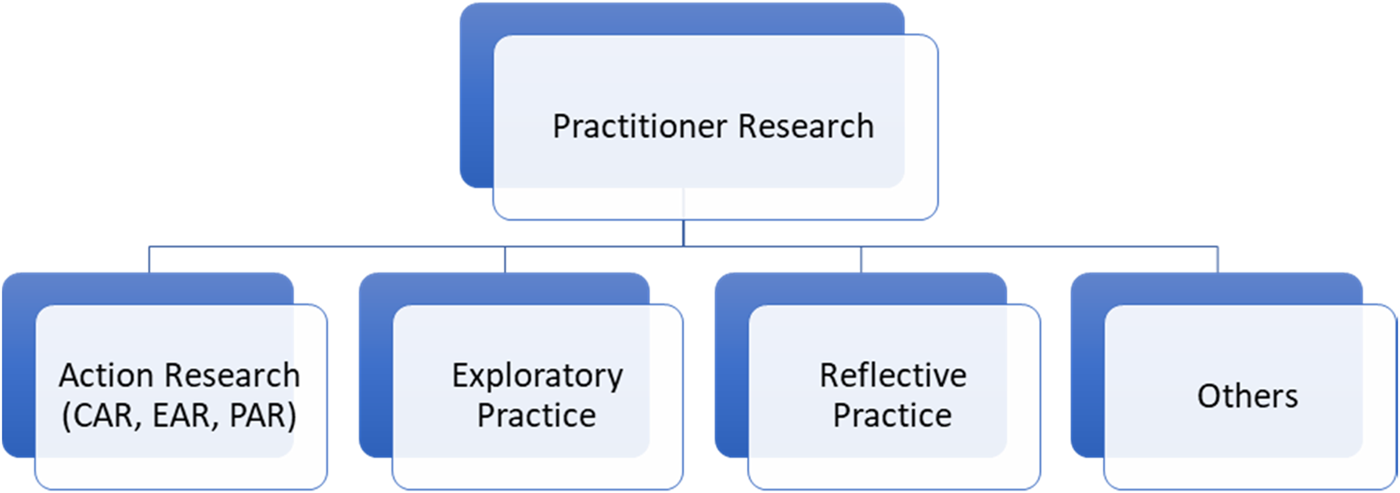
A recent development is EP, which is distinctive in inviting not only teachers, teacher educators, but also learners to engage in explorations of their practice (see Allwright & Hanks, Reference Allwright and Hanks2009; Hanks, Reference Hanks2017a). As the debates in sections 2.1 and 2.2 demonstrate, EP is underreported in some quarters. Consequently, I focus attention now on the notion of learners and teachers as co-researchers in/through/with EP. First, to clarify the array of approaches, I conceptualise Practitioner Research as a family tree (see Hanks, Reference Hanks2017a, Reference Hanks2019a). This embraces different forms, focussing on language learning and teaching in classrooms and beyond (see Figure 1). The ‘family’ can grow as new siblings arrive, or as distant cousins are recognised, or as new marriages bring in new family members.
Practitioner research family tree (adapted from Hanks, Reference Hanks2017a, Reference Hanks2019a)

In the past, the possibility of Practitioner Research has met with resistance from those who are unwilling to accept that teachers can be researchers. Unsurprisingly, even more resistance is displayed when considering learners as partners in this enterprise. However, as Hanks (Reference Hanks2019a) argues, the paradigm is shifting, not only in language education, but also in fields such as policing, healthcare, urban research (see N8 Research Partnership, 2016 https://www.n8research.org.uk/research-focus/co-production/) to include notions of co-produced research. Although I favour such inclusive approaches to research, I do not say that these are the only approaches that are ethical and valid. However, I do note that EP has frequently been overlooked. Therefore, I seek to establish a space in which EP is recognised, alongside the more traditionally accepted versions of research. My point is not to prioritise one over another, but rather that there needs to be a culture of mutual acceptance and co-existence across the field. It is entirely possible to find teachers (and learners) who do not want to do research (see Marsden & Kasprowicz, Reference Marsden and Kasprowicz2017), and this must be respected. Yet, there are practitioners eager to engage. Even if keen, though, there are very real challenges for practitioners. Teachers and learners already have heavy workloads that may preclude research activity. After all, as Burns (Reference Burns2010) argues, teachers are not remunerated (in time or money) to conduct research. Practitioners considering research may, then, be pulled in different directions as the demands of practice conflict with the requirements of older conceptions of research, as shown in the left-hand diagram in Figure 2.
Integrating research and practice by ‘bending the arrows round’ (adapted from Hanks, Reference Hanks2017a)

As a way to deal with the paradox I return to my title, ‘Integrating research into language teaching and learning’. I propose that we bend the two arrows around to reconceptualise this conundrum. Rather than pulling in different directions, the arrows in the right-hand diagram of Figure 2 are integrated. Practitioners explore practice (conducting research), whilst also engaging in practice (teaching and learning). Research and pedagogy are thus combined in a sustainable ecological cycling and recycling of curious questioning, puzzling, and pedagogy.
2.4. EP
In EP, the research questions (‘puzzles’) are set by the practitioners: teachers, teacher educators and learners. This makes the research immediately relevant to the practitioners themselves. Practitioners set their research agenda, and their investigative activities, which are naturally cognisant of context and contextual constraints, since they live and work there, and can aid teachers and learners to gain insights into their pedagogic practices. Such insights are also useful for academic researchers, who might not teach but surely retain the capacity to learn.
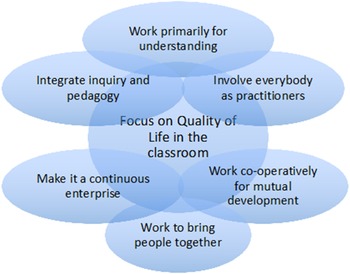
EP, then, ‘is a way of getting teaching and learning done so that the teachers and the learners simultaneously develop their own understandings of what they are doing as learners and teachers’ (Allwright, Reference Allwright, Gieve and Miller2006, p. 15, original emphases). This integration of research and pedagogy may be difficult to comprehend at first, but, as discussed below, it is not only possible, but also productive. In this way, ‘what helps the researcher also helps the teacher, and at the same time helps the learners to understand more about language learning/teaching’ (Hanks, Reference Hanks2017b, p. 38 original emphases), and vice versa. These ideas stem from the framework of principles encompassing quality of life, working for understanding, collegiality, and sustainability as proposed in EP (see Figure 3).
Exploratory practice principles (summarised from Allwright & Hanks, Reference Allwright and Hanks2009; Hanks, Reference Hanks2017a, Reference Hanks2019a)

2.5. Integrating research and practice: Examples of EP
The notion of schoolteachers-as-researchers is contested in some quarters. Yet, there is evidence of teachers in state secondary school contexts in Brazil engaging in EP. Teachers such as Soares (Reference Soares2008), Sena (Reference Sena, Allwright and Hanks2009) and Siqueiros (Reference Siqueiros, Allwright and Hanks2009) all worked with young learners to investigate their puzzles about, respectively, using class blogs, student visualisations of classroom learning, and use of first language/second language (L1/L2) in class. They reported high levels of motivation, and no detriment to the language learning goals (quite the contrary), as a result of these activities. Elsewhere, Hiratsuka (Reference Hiratsuka2016) worked with state-school teachers to investigate intercultural issues in team-teaching in Japan. He concluded that actualising the EP framework of principles worked better when the team-teachers both engaged, that their attitudes towards their partner, and that the timing of any data collection affected the success of the actualisation.
Moving to Higher Education institutions, in China, Zhang (Reference Zhang2004) investigated university student attitudes to group work in extensive reading classes, and Li (Reference Li2006) probed motivation with her English for Academic Purposes (EAP) class. In both cases, they incorporated their research questions into the overall syllabus, inviting their students to explore their research questions. As teachers-engaging-in-research, they found renewed interest in scholarship, while as researchers-employed-also-to-teach, they (re-)discovered their love of teaching. In Japan, Tajino and Smith (Reference Tajino and Smith2005) probed university student attitudes to interpersonal relations in their classes. Tajino et al. (Reference Tajino, Stewart and Dalsky2016) highlighted the notion of ‘team-learning’ as opposed to merely ‘team-teaching’. Reference Kato and HanksKato and Hanks (in press) examined learner-led investigations of their learning-process, and Pinner (Reference Pinner2016) investigated learner/teacher narratives charting their fluctuating levels of motivation using EP. Smithers (Reference Smithers2018) worked with ‘elderly’ learners (some in their seventies and eighties) to explore issues of quality of life in language learning. Considering curriculum, Smith (Reference Smith, Yoshida, Imai, Nakata, Tajino, Takeuchi and Tamai2009) worked on a collaborative effort between curriculum designers, students, students and himself (lecturer) to redesign their EAP course. He argued that this multilevel collaboration was highly effective in activating student pride in their work, and productive in facilitating faculty development and student-teacher cooperation.
Meanwhile, working with adults in the UK, Dar (Reference Dar, Bullock and Smith2015) worked with her Teaching English to Speakers of Other Languages (TESOL) class to investigate student barriers to doing homework. Banister (Reference Banister, Slimani-Rolls and Kiely2018a, Reference Banister, Barkhuizen, Burns, Dikilitas and Wyatt2018b) probed teacher/learner perceptions of learning lexis in an EAP context, and Costantino (Reference Costantino, Slimani-Rolls and Kiely2018, Reference Costantino and Kostoulas2019) explored Modern Foreign Language (MFL) student perceptions of written feedback on their work. Concurrently, Banister, Costantino, and Dar, all full-time teachers, reflected on their own developing understandings of their research questions.
Turning to teacher education and Continuing Professional Development (CPD) settings, in Finland, Vaattovaara (Reference Vaattovaara2017) worked with university teachers to investigate their passion (or otherwise) for research in pedagogy. Meanwhile, in Turkey and Northern Cyprus, Dikilitaş and Hanks (Reference Dikilitaş and Hanks2018) worked with teachers, teacher educators, curriculum developers in universities and colleges to encourage engagement with innovative practitioner research. Relevant here were Trotman's (Reference Trotman, Dikilitaş and Hanks2018) reflections on mentoring language teachers, Karanfil's (Reference Karanfil, Dikilitaş and Hanks2018) investigation of his learners’ ‘free reading’ practices, and Ergünay's (Reference Ergünay, Dikilitaş and Hanks2018) exploration of learners’ reading comprehension. In Brazil, Miller and Barreto (Reference Miller, Barreto, Meyer and Albuquerque2015) examined post-lesson dialogues and feedback with novice teachers in state schools using EP as their theoretical and practical framework. Miller (Reference Miller2009) has been particularly active in this area, and adheres to her collegial principles, working and publishing collaboratively (Miller & Cunha, Reference Miller, Cunha and Dikilitaş2017; Miller et al., Reference Miller, Barreto, Kuschnir, Sette, Bezerra, Cunha, Braga, Gil and Vieira-Abrahão2008). Moreover, Slimani-Rolls and Kiely (Reference Slimani-Rolls and Kiely2018) worked with MFL and EAP teachers in the UK over several years to chart their responses to researching their university classrooms, concluding that EP ‘has the potential to transform teaching’ (p. 202).
Of the above, all researchers were employed to teach (EFL, EAP, MFL), and only four were conducting the research as part of doctoral studies. The findings and discussions from their investigations indicate complex flows of interest on the part of practitioners, depending on the other demands on their time.
So, what might EP look like in situ? As Hanks (Reference Hanks1999, Reference Hanks2015a, Reference Hanks2015b), indicates, the starting point is ‘puzzling’; identifying questions that have troubled or excited practitioners. Importantly, the focus is on puzzling deeply, not ‘problems’, for problems can easily lead to the kind of hasty answers that Kahneman (Reference Kahneman2012) counsels against. We (teachers/learners/researchers) need to resist the lure of quick-fix solutions. Puzzling about pedagogy involves an open-ended approach. In my earlier work, employed at a British university as a teacher/teacher educator with responsibility for CPD sessions, I invited colleagues to express their puzzles about pedagogy. Their questions covered a range of topics.
What puzzles teachers?
• Why do some students come onto a course not prepared, or willing, to learn?
• Why are my students so unwilling to speak?
• Why are my students not able to retain newly learned vocabulary?
• Why do my students bombard me with questions when I'm in the middle of answering questions anyway?
• Why can't my [Middle Eastern] students learn to spell in English?
• Why do I feel nervous when students ask me questions about grammar?
(selected from Hanks, Reference Hanks2017a)
In our CPD workshops, the teachers seemed delighted to have been asked for their own questions rather than investigating one from a third party. Their enthusiasm increased as they investigated. However, this was not uniform: some seemed interested, while others were happy just to have shared their question with the group but went no further. This continued for ten years, and even after I moved to another department, having little formal contact, my former colleagues have made EP their own, using it as a springboard into research and scholarship.
In Hanks (Reference Hanks, Tarone and Soneson2012, Reference Hanks2015b, Reference Hanks2017a, Reference Hanks2017b), I have presented studies of EP in EAP, tracking teachers as they moved from initial interest, through using everyday pedagogic practices (e.g. student projects) as investigative tools. Two individuals stand out: ‘Bella’ and ‘John’ (all monikers were agreed with participants). John expressed the fears of many teachers faced with the prospect of incorporating research into their workload: ‘I'd be really interested but I think it would turn into a hugely time-consuming thing […] I'm just thinking of time. […] what have I got to produce?’ (John, in Hanks, Reference Hanks2017a, p. 146).
This echoes the points made by Burton (Reference Burton1998) and Burns (Reference Burns2010). John was an experienced teacher and had also done some traditional research earlier. He knew of the additional time that is usually required, and wary of increasing his workload. Once reassured that he could work with the students to discuss his puzzle as part of speaking practice in a lesson (he opted for a pyramid discussion), he exclaimed: ‘Oh I could do that. I'm quite happy to do that. I thought I was in for writing up a project’ (John, in Hanks, Reference Hanks2017a, p. 146).
John's enthusiasm developed over the 10-week programme. He suggested ways in which EP could be extended from learners investigating their puzzles and giving oral presentations, into writing up their findings. He focussed on the learners as they worked in groups to share puzzles, investigate together, using interviews, questionnaires, library searches, and collect, collate data, and present their findings. At the end of the 10-week-period, he reflected:
It's given them an excellent speaking and writing opportunity […] they can see it's entirely relevant to what they're going to be doing […]
That's what EP has done, it's made all the work we're doing relevant to their needs. […] It's a gentle way into heavyweight research. (John, in Hanks, Reference Hanks2017b, p. 46)
John also investigated his own puzzle (about students who were unprepared/unwilling to study), but he downplayed this, sharing instead the puzzles/explorations of his students, and integrating their/his research into his classroom pedagogy. His story was so rich that I considered his case as a teacher-researcher and, separately, his interactions with his students as co-researchers as they integrated research and pedagogy: this was a ‘gentle way’ into research.
In a different context (teaching pre-undergraduate students), more than a year later, and quite unaware of John's work, another teacher, Bella, expressed interest in exploring her puzzle. She had noticed that Middle Eastern students in her multilingual class struggled with English spelling. Initially, she thought that this was due to them grappling with a different script (Arabic) from Roman script, but soon realised that her Japanese students in the same class, who also struggled with a different script, seemed not to have this problem. Although curious about EP, she hesitated, saying ‘It's making the time, isn't it?’ (Bella, in Hanks, Reference Hanks2015b, p. 624); nevertheless, she did not give up. Her puzzle stayed with her, and a week later, she decided to share her question with her Arabic-speaking students in class. Their response surprised her: ‘They were all sort of shouting out these, not the answers, but [I said] ‘Why… none of you can spell?’ [laughs]. They've all got their own ideas’ (Bella, in Hanks, Reference Hanks2015b, p. 626).
She reported their excitement as they tried to explain, and this encouraged her to investigate further. Nevertheless, Bella continued to grapple with the challenges of integrating research and pedagogy during the 11 weeks of the course. The majority of her time was spent teaching, preparing classes, marking student work, and doing the accompanying administrative tasks. She did manage some reading (though she reported it was unsatisfactory for her purposes), and, importantly, she discovered that other colleagues were interested in the same question. At the end of the investigation, she had not ‘solved the problem’ (focusing on problems/solutions is something that EP explicitly argues against) but had instead gained a deeper understanding of the difficulties her students faced: ‘I'm enjoying [EP] […] It's helping me to answer the question why they find it difficult. […] I feel like I understand more about the problems they have and the things I need to think about as a teacher’ (Bella, in Hanks, Reference Hanks2017a, p. 241).
The combination of talking to her students and colleagues, as well as reading articles and books by academic writers, continued to pique her interest. She reported that another teacher had a similar puzzle, and subsequently they worked together to prepare and deliver a CPD workshop on teaching English spelling in class. Later, Bella presented her work at a national conference, wrote blogs and papers about her EP experience, and ultimately presented internationally. All this was of her own volition with only gentle nudges or steers from me. It was her hard work, intellectual drive, and her own integrated research, or scholarship.
3. Learners and teachers as co-researchers exploring praxis
In most of the cases mentioned above, the main actors are teachers: practitioners of teaching. The possibility of learners also researching has generally been underestimated. I now discuss examples of learners and teachers working as co-researchers in/through/with EP to theorise and utilise their pedagogic practices.
3.1. Who are the practitioners?
The question posed by the conference theme recalls Tudor's proposition:
… in order to understand precisely what takes place in our classrooms, we have to look at these classrooms as entities in their own right and explore the meaning they have for those who are involved in them in their own terms. (Tudor, Reference Tudor2001, p. 9)
That is, we need to seek the perspectives of teachers and learners as active agents who contribute to the meaning-making of language learning and teaching. I have found that learners, teachers, teacher educators, are both willing and very capable of conducting research into their contexts (see Hanks, Reference Hanks, Yoshida, Imai, Nakata, Tajino, Takeuchi and Tamai2009, Reference Hanks2018, Reference Hanks2019b, Reference Hanks2019c, Reference Hanks2020).
Admittedly, published studies of learners engaging in research appear scarce. But learners’ accounts are rarely published under their own names. Even when they are, these accounts usually form part of a larger publication, under someone else's name. This is because guidelines for ethical research such as BAAL (2016) or BERA (2018) stipulate, reasonably enough, that vulnerable participants (i.e. learners) should be anonymised. This protection is extended to incorporate language learners and teachers, who are positioned as less-powerful respondents or informants in research than the academic researchers. Consequently, the contributions of learners and teachers as co-researchers are frequently obscured. Nevertheless, careful reading of the literature reveals that there are studies in which learners have explored their practice. On occasion, they use their real names thus gaining much-needed acknowledgement for their work; an ethical imperative of equal weight. In sum, ‘the practitioners’ are both teachers and learners.
3.2. Learners as co-researchers
Echoing the call for learners to be involved ‘not as objects of research, but as fellow participants and therefore as co-researchers’ (Allwright, Reference Allwright2003, p. 129), the EP Rio de Janeiro group focussed on learners and teachers (Allwright & Miller, Reference Allwright, Miller, Soneson and Tarone2012; Miller, Reference Miller2009; Miller et al., Reference Miller, Barreto, Kuschnir, Sette, Bezerra, Cunha, Braga, Gil and Vieira-Abrahão2008). One key member of the group, Walewska Braga, provides inspiration for ‘Potentially Exploitable Pedagogic Activities’ (PEPAs). Over the years, she has invited her learners (aged 11–16 years) in various classes in their municipal (state secondary) school to puzzle about their language learning experiences. For example, one group of young teenagers asked: ‘Why don't the English classes prepare us for the job market?’ (Braga, Reference Braga, Allwright and Hanks2009, pp. 247–248). Braga describes students discussing the question in their English class, then interviewing hotel receptionists, newsagents (workers within their orbit), to address their question. This PEPA enthused learners and teachers alike, as they raised critical questions about their practice.
With another class, a group of students (whose classmate had fallen pregnant aged 16) asked: ‘Why do so many teenagers get pregnant, in spite of having so much information?’ (Silva & Braga, Reference Silva, Braga, Allwright and Hanks2009, pp. 212–215). Here, Braga and her teenaged student, Daniela, describe integrating the research with their learning/teaching of English: reading newspaper/web articles, discussing the issue in class and presenting a poster. Then, the girls whose poster it was, interviewed the boys in the class, thus raising awareness of this reality for teenagers. They went beyond the classroom to interview a student's mother (who had herself fallen pregnant while still at school). This question, which originally elicited giggles from the boys in the class, was taken seriously, carefully investigated, and their findings raised social issues relevant to the students themselves. It did not solve the problem of teenage pregnancies, but it did help the girls to express their opinions, and possibly educated the boys in the consequences of certain behaviours. This is not far removed from research in social sciences and gender studies, and the insights gained could help academic researchers understand the phenomenon from a teenager's viewpoint.
In the same class, another group also asked a socially relevant question: ‘Why do we cheat?’ (Magno & Braga, Reference Magno, Braga, Allwright and Hanks2009, pp. 210–211). Starting with their own classroom practice (where cheating was rife, though disapproved of), the students’ findings also came from outside the school, where they saw cheating at every level, from traffic violations to corrupt politicians. Later, focusing explicitly on pedagogy, Andrade (Reference Andrade and Hanks2017) examined the preferences and behaviours of her young learners. Having opened her research question up to them, she discovered that, contrary to her expectations, they did not hate school (or their teacher), but rather they were acting out the violence, poverty, and lack of respect they saw in everyday life.
Although poorly-funded (in education, as in many parts of the world, resources are scarce in Rio), careful reading indicates the learners conducted small-scale, rigorous, critical and original work, with undeniable impact not only on their language learning, but also in their developing understandings of society and social problems.
In the UK, Dawson et al. (Reference Dawson, Ihara, Zhang and Stewart2017) explored their learning in EAP, fostering a ‘culture of inquiry’ (p. 12) relevant to the learners themselves. In Japan, Stewart invited her students to investigate the EP framework itself. Her students critically examined the EP principles in Allwright & Hanks (Reference Allwright and Hanks2009), asking ‘What do they mean by “Quality of Life?”’ (Stewart et al., Reference Stewart, Croker, Hanks, Barfield and Minematsu2014, p. 137) and investigating for themselves. Stewart comments that she could not answer the question alone, but ‘[w]ith the help of the posters the students created and shared publicly, we could […] suggest new directions that might enhance the quality of that experience as individuals and as a learning community’ (Stewart et al., Reference Stewart, Croker, Hanks, Barfield and Minematsu2014, p. 142).
3.3. EP: Research relevant to practitioners
Inspired by the EP principles, I have worked with EP in my EAP setting in the UK. My initial assumption was that EAP's goal-oriented nature could be antithetical to EP, because of the high stakes of EAP in the UK and the different time-pressures of pre-sessional and in-sessional courses. I thought students might want to focus on traditional lessons and approaches, however, quite the opposite picture emerged.
To begin, I invited adult learners in my in-sessional EAP classes to puzzle about their learning. I say ‘puzzling’ deliberately, to convey that this was a playful activity: students were not performing or trying to gain marks; they joked with each other (and me) as they wrote on post-it notes. However, their questions revealed thoughtful concerns. Spanning issues such as homework, vocabulary-learning, fluctuating language competencies, teaching accuracy/fluency, and motivation, these puzzles resonate with learners and teachers alike:
What puzzled my in-sessional learners?
• Why don't some students do their homework?
• Why do I sometimes understand quite well and sometimes I find difficult, despite I speak with the same person?
• Why don't you remember the new words when you have just learned a few minutes ago?
• Why do some teachers think only to teach to improve the accuracy level of their students and not the fluency?
• Why do I feel like learning more every time I attend English class?
(Puzzles selected from Allwright & Hanks, Reference Allwright and Hanks2009, p. 277)
A year later, I invited groups of pre-sessional EAP students to share their puzzles about their learning experiences:
What puzzled my pre-sessional learners?
• Why do I feel anxiety about studying at a British university?
• Why do I never like writing class?
• Why do teachers give so much homework?
• Why am I happy to go to the English lessons?
(Puzzles selected from Hanks, Reference Hanks2017a, p. 237)
Each time there was a playful, yet purposeful, atmosphere as students laughed and joked together. My co-teacher on the pre-sessional programme, Jane, described this as a ‘buzz’. I connect this with Winnicott's (Reference Winnicott1971) description of play as ‘an experience, always a creative experience, and it is an experience in the space-time continuum, a basic form of living’ (p. 59). Hanks (Reference Hanks2017a) argues that ‘play, playfulness, puzzlement and puzzling are essential aspects of what it is to be human, and a crucial part of the learning (and researching) process’ (pp. 110–111). It is a ‘powerful resource for human resistance to the mechanisation of our [learning/teaching] lives’ (p. 111). Their questions were serious (in some cases deeply serious), while also playing with pedagogical, philosophical, social possibilities. This form of seriously playful curiosity encouraged the students to question their learning processes.
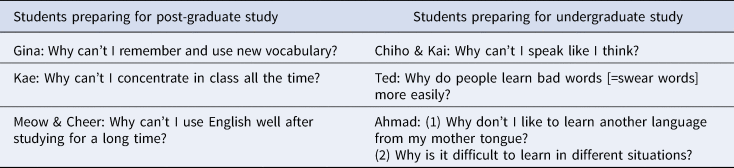
With students at different stages of their learning journeys, and on different courses, I have found learners keen to share a range of fascinating puzzles. Some of their questions are similar to those of their teachers (e.g. motivation, vocabulary learning), others are surprisingly different. Table 1 presents the puzzles of two groups of EAP students preparing for post-graduate and undergraduate-level study. They were invited to investigate their puzzles in groups, as this enabled them to practise their academic and language skills concurrently. Pseudonyms are used, in accordance with my institution's regulations.
What puzzled the participants?

Meow (a Thai student preparing for an MSc in Healthcare) was particularly enthusiastic about the process. When asked to explain how she identified her puzzle, she exclaimed: ‘I think it's very helpful for me if I can understand what puzzle I have. And I just find “Oh I have a lot of puzzle that I never thought about it before!”’ (Meow, in Hanks, Reference Hanks2017a, p. 122).
Meow had identified six puzzles, and finally chose one: a question about her inability to use English well despite many years of study. When she articulated it in a class mingling activity, two other students (one Chinese, ‘John’, the other Japanese, ‘Cheer’) joined her. Their group conducted a small study, with the support of their teacher, to investigate their struggles with English. Meow and Cheer were highly-motivated, and remained actively engaged in this small-scale research throughout the programme, coming regularly to be interviewed.
This is not to say they were uncritical, however. Meow identified the benefits of investigating questions about language learning, and reflected on her own changing behaviours as she learned more: ‘I tried to speak more and […] when I speak ‘oh did I do some grammar mistake when I speaking?’ Because normally I speak without thinking of grammar, so now I think about grammar before I speak’ (Meow, in Hanks, Reference Hanks2017b, p. 46).
Cheer pondered her struggles with communication, and broadened her scope to wonder about research itself. She had worked for a number of years in healthcare, and was aware of AR in her field. She identified potential confusions over the distinction between AR and EP, as she reflected on her own experiences: ‘Maybe other people expect some action research. So through EP they expect their puzzlement solved by EP […] But a little bit different. Now I can understand’ (Cheer, in Hanks, Reference Hanks2017b, p. 44).
Cheer critically examined EP as well as her own puzzle. This meta-puzzling was salutary for me, and significant for others delving into the epistemologies of research. As she noted (and in line with Kahneman's (Reference Kahneman2012) notion of ‘fast thinking’), she already knew the ‘answer’ to her ‘problem’ with speaking. Yet, she consistently avoided situations where she could/should practise speaking. However, in interviews with me, she spoke in English regularly. Here she relaxed; after the first, stilted encounter, she often laughed, made jokes, and conveyed her meaning clearly. She highlighted this herself at the end of my study, commenting that the interviews had been helpful in developing her confidence to speak. This exemplifies Allwright and Hanks’ (Reference Allwright and Hanks2009) notion of a key developing practitioner puzzling and theorising about practice of learning.
Arguably, these learners were mature and ready (almost) for post-graduate study. Perhaps pre-undergraduate students would be different. Working with international students preparing for undergraduate study in the UK, I discovered that they enjoyed the element of mutual development when working as co-researchers alongside their teacher: ‘We can learn a lot of things from the lecture, but I think […] we are studying, the teachers are also studying, so interaction is very beneficial to both teachers and students’ (Chiho, in Hanks, Reference Hanks2015a, p. 122).
Her classmates also conveyed deep thinking about pedagogy. One Japanese student, ‘Ted’, puzzled about vocabulary learning, specifically: why taboo words are more memorable than ordinary words. He found the fact the answer was unknown, highly motivating. He maintained he enjoyed researching language learning, rather than ‘display’ topics such as recycling: ‘We know we have to do recycling […] so I can't find any point to write an essay, but something new I can write about it’ (Ted, in Hanks, Reference Hanks2015a, p. 122).
Another student reflected on his EP experience: ‘I think it's very important because the education is not just teaching, it's teaching from one side and learning from other side’ (Ahmad, in Hanks, Reference Hanks2015a, p. 126). Ahmad had discovered a new respect for his group-mates, as they wrote their assignment on their EP experiences. He also exhibited empathy for his teachers, realising that both sides need to work together for learning to take place.
4. Discussion and concluding remarks
As Tajino and Smith (2005) maintain, ‘understandings of classroom life, imperfect and ever-changing as they may be, remind learners and teachers that learning arises from curiosity’ (p. 468). Many practitioners do respond positively to the opportunity to inquire, to explore playfully and seriously, into their learning. But acknowledging their work requires a new way of thinking about classroom research and pedagogy. This is the nexus of insightful practical activity and context-dependent theorising that is encompassed by praxis. In EP, the action is ‘action for understanding’. When practitioners investigate with the aim of not just ‘doing’ but also ‘understanding’, they find a relevance in research. Such relevance was missing from the kinds of orthodox research indicated by the respondents in studies by Borg (Reference Borg2010) and Marsden and Kasprowicz (Reference Marsden and Kasprowicz2017). In EP, not only do practitioners seem to find self-initiated research into their classroom practices more relevant, but also their motivation seems to be enhanced.
Utilising the EP principle of ‘integrating the work for understanding [research] into normal pedagogic practice’ (Allwright & Hanks, Reference Allwright and Hanks2009, p. 260), seemed to reduce the issue of workload for teachers like John and Bella because (they said) they saw the relevance of the research to the participants, both teachers and learners, and felt it was worthwhile. The learners also highlighted the immediate relevance of the research to their needs. EP honoured the needs of both learners and teachers, and prioritised questions that were important to them in their daily teaching/learning practice.
Naturally, there will always be individuals who do not want to engage. Some teachers, or learners, will not have the time or the inclination to inquire, investigate and explore their practice. Reasons might include: it is not the right moment; interests lie elsewhere; simply want to teach or learn in class and go home. This is reasonable; we cannot know what pressures our students and colleagues face, we need to accept that. Therefore, notwithstanding my own positive experiences of EP, I recommend that it remains an invitation not an obligation. For those who choose it, EP provides ways of creating space for practitioners to puzzle about pedagogy, and to have their work acknowledged and respected.
In closing, I contend that the frequently presented choice of ‘either teacher or researcher’, is a false dichotomy. True scholarship resides in those who embrace both. ‘Fully inclusive practitioner research’ (see https://www.fullyinclusivepr.com/) affords opportunities for practitioner agency that are, I believe, ethically, pedagogically, desirable. But what role, then, does the academic researcher have? In my view, the answer is multidirectional. Firstly, many in the field seem unaware of the imaginative and creative work in EP. Much of this plenary has highlighted practitioner publications from across the field, demonstrating that assertions about practitioners not conducting research are unfounded. I suggest the academic researcher's role is to bring local activity/ies to global attention, showcasing this innovative work through publications, presentations, and plenaries. Secondly, there is a risk that, in staying local (since conferences, journals, are expensive), practitioner-researchers could become isolated, focusing inward on their own puzzles and explorations, unaware of vibrant work in other contexts. The academic researcher's role here is to bring the outside world in: making connections, introductions, and building networks. For example, without my input (as teacher-educator-researcher), it is unlikely that Bella or John would have heard of EP. Had I not existed, Bella, for example, would not have met other practitioner-researchers through my networking activities, nor participated in symposia or publications on EP. Undoubtedly, her talent would have blossomed eventually in any case, but arguably her contact with EP (through me) gave her the initial nudge she needed. Ethically, though, I see a dilemma (see Hanks, Reference Hanks2017a, Reference Hanks2019a, Reference Hanks2019b for further discussion): my institution conformed to the need to pseudonymise, yet pseudonymising teachers like Bella deprives them of the recognition they rightly earned. This could engender resentment. Should not Bella's contributions be acknowledged under her own name?
A thornier question remains unanswered: Who decides what ‘counts’ as research? EP challenges traditional assumptions about who does what and why, but is itself routinely under-valued. Therefore, I posit, epistemologies of research and pedagogy, which constrain researchers, teachers, learners, to particular roles and activities, need more critical examination. It is not that the epistemologies themselves are at fault, but rigidly adhering to one worldview to the exclusion or denigration of another which is problematic. Flyvbjerg (Reference Flyvbjerg2001) called for a cessation of the ‘science wars’, and to do so we need to acknowledge, cite, and promote the kind of co-produced research (sometimes called scholarship) conducted by practitioners. Their robust questions and creative methods afford a rich tapestry of profound insights for the field. Inviting learners, teachers, teacher educators, to act as co-researchers exploring practice-as-research expands the scope of research. It is ethically sound, enhances quality of life and develops our understandings of praxis in language education.
Returning to the conference themes, in revisiting classroom research it is clear that the ‘practitioners’ are the teachers and learners, and, indeed, teacher educators and academic researchers. Working together, they set the agendas for fully inclusive practitioner research to involve everybody as practitioners developing their own understandings. Here, learners and teachers are seen as powerful actors in their own right, co-producing research which is relevant to their needs. EP thus embodies an ambitious, imaginative, conceptually grounded approach to the research-pedagogy nexus.
Judith Hanks is Associate Professor at the School of Education, University of Leeds. She has been centrally involved in Exploratory Practice since 1997, working with international colleagues to develop a framework of principles for fully inclusive practitioner research She is co-convenor of the AILA Fully Inclusive Practitioner Research Network.