1. Introduction
This paper analyzes the relation between culture, institutions and economic development using the example of Indonesia. The former Dutch colony and largest insular state with 240 million inhabitants is the world's fourth most populous country with the fifth largest labor force (Central Intelligence Agency, 2012). Despite the fact that Indonesia has had a real economic growth exceeding 7% for at least 25 years (Molnar & Lesher, Reference Molnar and Lesher2008), it is still confronted with serious economic challenges: it ranks 115th out of 179 countries in the Index of Economic Freedom; unemployment rates hovered around 7–8% in 2012 (Heritage Foundation, 2012); GDP per capita is still extremely low, ranking 157th with $4,000 in 2009 (though it has hugely improved since 1970 when it was approximately $100), meaning approximately 29% of the population lives below the international poverty line (Asian Development Bank, 2010: 65); and important industry sectors operate only at about 70% of their capacity (Chowdhury & Islam, Reference Chowdhury and Islam2011). Furthermore, Indonesia still has to be considered as rather underdeveloped, ranking 137th in terms of life expectancy at birth. The Human Development Index (HDI), which refers to 2011, highlights the very large gaps in well-being and life opportunities. The HDI for Indonesia is 0.617, which ranks the country 124th out of 183 countries where data is provided (United Nations Development Program, 2011). Finally, Transparency International (2010) places Indonesia among the world's most corrupt nations, as it ranks 110th out of 180 countries in the Corruption Perception Index.Footnote 1 After 30 years of authoritarian rule by Suharto, an era that ended only a decade ago, in 1998, the young Indonesian democracy is still vulnerable and the consolidation of democracy will strongly depend on Indonesia's future economic performance.
Acknowledging the fact that Indonesia is inextricably interwoven with the global economy, the question arises of how it can organize its economic and political system in accordance with the functional necessities predetermined by external forces. In other words, how can Indonesia cope with a capitalistic market economy and how can its catch-up development be fruitfully accompanied by economists.Footnote 2 The experience with transition processes in Eastern Europe recently demonstrated impressively that countries with a compatible cultural background are much more successful in overcoming existing difficulties created by economic globalization than countries with a very different institutional framework. Consequently, an enhanced understanding of which cultural factors are important for Indonesia and how these factors contribute to economic development will be this paper's central concern. This analysis clearly demonstrates the need for a cultural approach to the economic situation of Indonesia, since it requires solutions adaptable to the world economy. Taking into account the fact that successful economic development does not only depend on importing formal institutions, but also hinges decisively on the interaction with informal constraints, culture is an important determinant of economic outcome (see e.g. Guiso et al., Reference Guiso, Sapienza and Zingales2006). Therefore, in order to adapt economic policies and thereby prevent institutional traps, which may otherwise lead to loss of popular support for democratic and economic reforms, it is essential to understand culture and the ways in which different cultural factors support or constrain the functioning of formal institutions. Employing a cultural approach to economicsFootnote 3 allows for the inclusion of the complex cultural conditionality of economic behavior.
The argument of the paper will proceed as follows: In Section 2, the theoretical framework will be developed. A cultural approach to economics will be introduced, clarifying the general relation between culture and economy. In Section 3, the implications for economic development are then pointed out, using the theoretical frameworks of social order and catch-up development. Together, they provide the methodological tools for the analysis of how cultural factors relate to economic development.
The cultural approach to economics emphasizes the cultural legacy and historic evolution of cultural factors. Hence, the analysis in Section 4 is conducted following the chronological emergence of cultural key factors in Indonesia's history. The focus of the analysis will be on the identification and interpretation of cultural factors with regard to their compatibility with the global economic model and the implications for economic development (Section 5).
Section 6 highlights the second dimension of culture by gaining insights into present day cultural constructions. With the findings of Sections 3 and 4, a solid basis is created, which can then be used for an enhanced comprehension of Indonesia's catch-up development during the past decade. These insights point out promising as well as adverse qualities of Indonesia's cultural factors in respect to the catch-up process.
Finally, recommendations will be drawn for the design of future economic policies in Indonesia (Section 7) and the results will be briefly summarized (Section 8).
2. A cultural approach to economics as a framework to analyze economic catch-up development
Fundamental to the economic analysis of economic change is the nowadays famous distinction between ‛formal rules’ and ‘informal constraints’ (North, Reference North1990; for a discussion, see Hodgson, Reference Hodgson2006).Footnote 4 This notion takes into account the fact that in reality social orders consist of legal and non-legal rules, explicit and tacit rules as well as planned and unplanned (i.e. spontaneous) ordersFootnote 5 and that the emergence of institutions depends significantly on people's shared mental models (ideologies, religion, etc.; Denzau & North, Reference Denzau and North1994). Those formal rules and informal constraints do not, however, exist independently from one another, rather, as a combination, they form the constraints for human interaction (Kingston & Caballero, Reference Kingston and Caballero2009: 170–172).Footnote 6 Following this distinction, formal rules are legal rules enacted at the political level explicitly codified by laws, while informal constraints are non-legal rules like norms and conventions. The compliance of such non-legal rules cannot be judicially enforced.
According to our understanding, culture is the ongoing interplay between formal rules and informal constraints that emerges in the historical development of every society and must be learned (and reflected) by every individual in the course of his or her socialization (see e.g. Goldschmidt & Remmele, Reference Goldschmidt and Remmele2005; Hodgson, Reference Hodgson, de Paula and Dymski2005, Reference Hodgson2006). Consequently, it is necessary to see the endogeneity of culture in its two consequences. First, informal constraints do not only relate to formal rules in a simple, causal manner of constraining or fostering the efficacy of formal rules. Rather ‘the complex interaction of formal rules and informal constraints . . . dominate[s] our lives’ (North, Reference North1990: 83). Hence, secondly, it is the specific quality of this interdependent relation that is put into focus in the cultural approach to economics. Accordingly, such an approach highlights the relevance of certain questions, such as how formal rules evolve over time, how they evolve out of informal constraints and vice versa, whether their functional relation exhibits, for example, complimentary or undermining characteristics, or how external developments are reflected and integrated into formal rules on the one hand, and into informal constraints on the other.Footnote 7
A starting point for an adequate understanding of culture can still be found in the evolutionary social philosophy of Friedrich August von Hayek. Hayek (Reference Hayek1973: 11) shares the view that rules govern the thoughts and actions of man and specifies, with regards to the character of these rules, that they are the ‘product of the experience of generations’. With this expression, he highlights the dynamic character of rules over time and sums up the process underlying the development of rules. As Hayek (Reference Hayek1979: 155) clarifies, the experience mentioned above represents the cultural evolution, which, in analogy to biological evolution, selects advantageous practices introduced for unknown or accidental reasons. However, cultural evolution differs in an important aspect from its biological counterpart: Acquired properties can be passed on in their institutionalized form to the next generation. Thus, cultural evolution is: ‘A decentralized process where, in a society or polity, different individuals or groups of persons experiment with alternative practices and where from these competing practices the ones that are perceived as more advantageous become more widely adopted’ (Vanberg, Reference Vanberg2001: 80). Hence, institutions and human rationality, as well as the competence of dealing with these institutions, are dynamically intertwined in the structural dimension. This complex connection leads once again to the issue of embeddedness (Granovetter, Reference Granovetter1985) and thereby emphasizes the insight that culture cannot be treated as an additive factor to the nature of human life and behavior. Instead, it needs to be seen as a central constituting element. Economic phenomena result from human activities, and do so over time. Furthermore, these activities are bound to rules formed within a cultural context, which also evolves through time. Combining both aspects elucidates why the examination of economic processes has to be understood as a cultural phenomenon.
Equally important is the adequate comprehension of how the accumulated cultural legacy is passed on to the next generation. The process of ontogenetic enculturation explains this. As discussed above, cultural learning concentrates on the strategy, hence the intention of the perceived pattern of behavior. Dux (Reference Dux, Vogel, Dux and Elvin2010, Reference Dux2011) emphasizes that this process is beyond mere transmission of content, requiring a constructive competence on behalf of the learner. Using this constructive mechanism, the individual develops, via the interaction with society, the ability to deal with its specific socio-cultural environment (Dux, Reference Dux, Vogel, Dux and Elvin2010: 103–104). Consequently, there is no absolute autonomy of the individual in respect to society and the economy, just as to their culture. Instead, individualization has to be understood as a process of enculturation. In fact, taking the insights of evolutionary anthropology seriously, the analysis of economic phenomena must necessarily take into account the cultural qualities of society, which appear to be so central to the evolution of the specific individual's economic reflections and behavior.
3. Catch-up development and society
In general, economists share a common understanding of development as a ‘catch-up’ process in which less developed countries take advantage of the technological paths previously forged by more developed countries (Burkett & Hart-Landsberg, Reference Burkett and Hart-Landsberg2003: 148).Footnote 8 Thus, catch-up development implies ‘that countries tend to imitate the economic behavior of more advanced countries and – if they want to reduce the gap – have to do so at a rapid pace’ (Zweynert, Reference Zweynert2006a: 183).Footnote 9 More specifically, there are three main factors determining the process of catch-up development. First, the developmental path a country pursues is strongly shaped by its cultural legacy. Second, one needs to consider the country in its economic as well as political and military situation when competing against other countries. And third, the interaction between newly imported formal institutions and persisting local informal constraints should be considered as well (see Zweynert, Reference Zweynert2006a: 183–185). The cultural legacy, in its historical emergence until the recent socio-political developments in Indonesia, provides the structure and content of Section 4 of this paper. It will be shown that a serious imitation of the Western economic modelFootnote 10 was not pursued until the end of the pancasila past in 1998.Footnote 11 Competition-related aspects are therefore mainly discussed in the context of the transition to the democratization period in Section 5, as it marks the beginning for the catch-up development process in Indonesia.
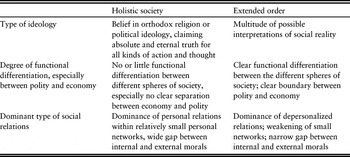
Corresponding to this focus, the paper uses a theoretical framework to illustrate the cultural and historic influence on the specific social organization, in which the ontogeny of the ‘embedded’ individual takes place with all its consequences for economic development (Granovetter, Reference Granovetter1985). The illustration works along the comparison of two ideal types of social organization. On the one hand the holistic society is characterized by the general validity of a single moral logic for all spheres of society: Typically, religion or ideology can offer such guiding principles, unifying people according to one unquestionable kind of rationality. On the other hand, there is the extended order, also referred to as the functionally differentiated order, where multiple rationalities prevail in the different sub-systems of society. People in a functionally differentiated order act according to an economic, i.e. capitalistic, logic when buying and selling things, to a political logic when searching for solutions to political problems, to a juridical logic when judging a crime. Hence, the extended order frames the sub-systems of interaction, and, in its sub-sectors, competing kinds of spontaneous orders (cf. Zweynert & Goldschmidt, Reference Goldschmidt2006: 901).Footnote 12
Holistic societies often ensure the claim of universal validity of the one rationality via hierarchical structures. Furthermore, a strong hierarchical organization of society results in an increase in personalized social relations, as hierarchy with its aim for social control shows a much lower coverage when compared to abstract media of social interaction, like money. These factors cause people in holistic societies to be organized in relatively small groups, leading to a split in moral standards depending on whether one is dealing with group members or group outsiders. Max Weber (Reference Weber1923: 303–304) denotes the contrast between loyalty toward members of one's own group and disloyalty toward outsiders in terms of internal and external morals. Because an extended order, on the other hand, relies in large part on the abstract interaction with individuals that are not personally known, this moral dichotomy is confronted with the incentive to treat all other persons as equals and hence to overcome the gap. In the terminology of Mark Granovetter (Reference Granovetter1973, Reference Granovetter1985, Reference Granovetter2005), there are strong ties among individuals in the small groups of holistic orders and weak ties in the extended order connecting more individuals beyond personal acquaintances. The distinction between internal and external morals in a holistic order provides an explanation for the difficult acceptance of formal, imported institutions, as they fall, due to their external characteristic, under the less benevolent judgment of the external moral. Hence, the change from a holistic to an extended order is often accompanied by objections emphasizing the dissolution of ‘social unity’ and consequent fragmentation of society (Zweynert, Reference Zweynert2006a: 186). Due to these reasons, we consider it crucial to understand the degree to which a society is organized as a holistic or extended order, as this is an essential constituting factor regarding the quality of informal constraints and of the formal–informal institutional interplay. Having said this, it is clear that it is not ‘culture’ that shapes the transition from a holistic society toward an extended society, but rather that these country-specific patterns are a cultural characteristic themselves.

Source: Zweynert and Goldschmidt (Reference Goldschmidt2006: 902).
Just recently, North et al. (Reference North, Wallis and Weingast2009) suggested a similar concept to explain economic performance by distinguishing two kinds of orders, which differ in the way they control the threat of violence: A limited-access order is characterized by the compensation of potential violence with economic privileges. Those with access to violence form a coalition, within which, by specialization with regard to vital functions of a state, a rent-creating elite is protected from the competing efforts of others. In contrast, an open-access order, via a thorough democratic system, allows for any individual to compete for power in the political sphere. Moreover, such competition not only reduces rents but also, more importantly, increases the ability of the economic and political system to rapidly adapt to environmental changes and shocks, which naturally all societies face over time.
It must, however, be stressed that in reality no pure form of either type exists, and that societies do not exist somewhere in between, but rather that a coexistence of factors from both orders prevail. Nevertheless, this contrasting theoretical framework helps to analyze specific cultural and historical factors in terms of their compatibility with the Western economic model, which is based on a functionally differentiated order.
4. Indonesia from a cultural perspective
The focus of the second – more descriptive – part of this paper is on the identification of cultural factors in Indonesia's history and their analyses with regard to the compatibility with the Western economic model. Four major cultural categories can be distinguished: The Javanese worldview kejawen, Islam, colonialism and the regimes of Sukarno and Suharto, denoted as pancasila past. The first three categories refer to the cultural legacy and capture century-old cultural factors. Kejawen, Islam and colonialism are believed to provide nationally relevant cultural categories, significantly conditioning the economic behavior of many people in Indonesia.Footnote 13 However, they correspond to the concept of cultural legacy, as introduced above, and should therefore be understood in accordance to its theoretical implications, which makes clear that it cannot deliver an explicative pattern that fully determines or understands the behavior of the ‘Indonesian individual’.
Kejawen
Kejawen is selected because of its relevance for the largest ethnic group in Indonesia, inhabiting the economically most significant and densely populated island, Java, where almost half of the Indonesian population lives. Furthermore, the values and principles of Javanese culture are an important part of the state ideology, pancasila. This gives kejawen a high relevance on the national level when compared with other relatively homogenous ethnic or cultural groups and categories (see e.g. Magnis-Suseno, Reference Magnis-Suseno1981, Reference Magnis-Suseno1997: 20–21Footnote 14; Mulder, Reference Mulder2005: 81, 95–100).
Although most Javanese nowadays officially belong to Islam – and certainly identify themselves as Muslims – when it comes to explaining their behavior, they often refer to kejawen categories. Mulder (Reference Mulder2005: 17) understands kejawen not as a strictly religious category,Footnote 15 in spite of the fact that main aspects of kejawen can be traced back to Hindu–Buddhist influences during early periods, and Islamic ones during later periods, in Javanese history (cf. Woodward, Reference Woodward1989: 245). Instead, he argues that kejawen transcends its religious plurality, interpreting it as a systematic worldview, representing Javanese ethics and way of life. It therefore provides a key to understanding the way in which the Javanese view human nature and society (Mulder, Reference Mulder2005: 16–17).
In general, the Javanese worldview kejawen is essentially shaped by the ideals of unity and harmony. On the mystical level, this is represented by the desire of the individual to reunify with its origin, the universal truth, the oneness of being, and thus attain inner peace (Mulder, Reference Mulder2005: 91–92). ‘The idea of unity implies orderliness’ (Mulder, Reference Mulder2005: 67). This is why behaving in accordance to its orderly role is the individual's utmost duty. That way the harmonic equilibrium is maintained and chaos, injustice and poverty are believed to be avoided (Mulder, Reference Mulder2005: 32–40). Furthermore, the social order is one of hierarchy. The loyalty and moral admiration coming from people in lower positions is expected to find its reciprocal response among the superior class by providing moral orientation and protection. The superior position hence comes with obligations, too. Accordingly, this social constellation has to be interpreted as a patron–client relationship (Magnis-Suseno, Reference Magnis-Suseno1981: 59–60), often conflicting with the working principles of a market economy and the functional differentiation of social systems.
The fundamental concept of harmony results into two guiding principles dominating social interaction and helping to mitigate different interests: respect and rukun, i.e. the avoidance of conflicts (Magnis-Suseno, Reference Magnis-Suseno1981: 37–39). One type of behavior deriving from rukun is the unanimous accordance through mutual consultation (Mulder, Reference Mulder2005: 68) – a procedure often referred to in Indonesia as a specific kind of Indonesian democracy (Magnis-Suseno, Reference Magnis-Suseno1981: 47). In order to cope with the claim of rukun, the individual needs to subordinate the pursuit of her personal interest to the sake of the collective good (Anderson, Reference Anderson1990: 51). Another behavioral concept implied by rukun is gotong-royong (Guinness, Reference Guinness1986, Reference Guinness and Hill1994). It represents the ‘ideals of mutual assistance and the sharing of burdens’ (Mulder, Reference Mulder2005: 68) and is expressed in collective work aimed at helping individuals or pursuing a common goal (Magnis-Suseno, Reference Magnis-Suseno1981: 47). However, gotong-royong should not be understood in terms of the individual merging into the collective, totally unaware of individual interests. Rather, it allows the individual to express a social attitude without having to neglect one's own interests.Footnote 16
Aside from the social aspects of the outer world, the quest for harmony also applies to the self. To attain inner peace, one should learn the ‘attitudes of acceptance, patience, humility, self-knowledge and modesty’ (Mulder, Reference Mulder2005: 74). Thus, the affairs of the material outer world should be avoided, as amassing riches and striving for material improvement are not worthy of pursuit. Consequently, an economic theory focusing mainly on wealth maximization rather than accounting for sustainable development does not seem adequate in the particular case of Indonesia.
Islam
Max Weber (Reference Weber1930) highlighted the relationship existing between religion and economic accumulation. Accordingly, one might ask whether Islam – the religion practiced by almost 90% of Indonesians – significantly influences economic catch-up development.Footnote 17 The sources of the ‘Islamic paradigm’ (Mirakhor & Askari, Reference Mirakhor and Askari2010) are the Qur'an – Allah's words to His Messenger, the Prophet Muhammad – and the Sunnah, the body of knowledge that has been collected about the Prophet's life to serve as a guideline for all Muslims worldwide. The interpretation of these two sources began in the Middle East and ‘various forms of Islam are logical consequences of the process of the cultural synthesis that occurs when Islam enters into a certain cultural setting’ (Jamhari, 2002: 33). While on Java many aspects of the Muslim faith have merged with Javanese culture in a syncretic way to form what has previously been discussed as kejawen, in other parts of Indonesia Islam has often coexisted, sometimes conflictually, with traditional norms (Dijck, Reference Dijck1984). The relevance of kejawen for the Javanese, which has already been pointed out, mitigates the significance of Islam, as far as its cultural impact is concerned. For these reasons, it is important to specify the share of the Indonesian population following a predominantly Muslim orientation. Among scholars, Indonesia's Muslim community (ummah) is divided into two main categories: abangan and santri (Fealy et al., Reference Fealy, Hooker, White, Fealy and Hooker2006: 39). Santri Muslims are those who seek to adhere strictly to the ritual and legal requirements of Islam, these being a central part of their lives. Abangan Muslims, in contrast, are nominal and less orthopraxis Muslims. According to Fealy et al. (Reference Fealy, Fealy and Hooker2006: 41), an increasing number of Muslims in Indonesia now pray and fast regularly and seek to live their lives strictly according to Islamic law.Footnote 18
Most countries in which Muslims represent the main share of the population show a considerably low level of economic development and democratic elements. Whether Islam contributes to the low economic performance is a controversial issue.Footnote 19 However, while it has been argued that modern Islam contains all necessary components for economic progress and development, especially by protecting individual freedom, encouraging private enterprises, upholding social justice, encouraging hard work, accumulating knowledge and skills, and moderating investments, savings and consumption (e.g. Ariff, Reference Ariff1991: 254), there seems to be an agreement among institutional economists that the rent-seeking behavior of politicians and bureaucrats is the main reason for poor economic performance (Chapra, Reference Chapra1993; Kuran, Reference Kuran1997; Leipold, Reference Leipold2001, Reference Leipold2006; Mirakhor & Askari, Reference Mirakhor and Askari2010). Kuran (Reference Kuran1997), for instance, highlights the fact that there are certain positive attitudes of moderate Islam toward important aspects of a market economy – its financial regulations, contracting guidelines, distributional instruments and behavioral norms like the general acceptance of the pursuit of economic success – and that rent-seeking behavior has nothing to do with Islamic beliefs.Footnote 20 Moreover, Mirakhor and Askari argue that Islam might be highly productive due to the internalization of formal institutions by its followers, the latter being consciously aware of the necessity of compliance with the rules given by the Creator and prescribed by the Law Giver, as directly emphasized or strongly implied by the Qur'an and in the tradition of the Prophet. Such a behavior results in a significant reduction of uncertainty and transaction costs, as well as the promotion of coordination and collective action (Mirakhor & Askari, Reference Mirakhor and Askari2010: 55).
Leipold (Reference Leipold2001: 5, 32), however, provides convincing arguments to the contrary, emphasizing that the economy is embedded in an institutional setting, and two crucial structural characteristics of (orthodox) Islamic institutions constrain economic development. First, there is the absolute role of divine rationality, which in its superiority blocks any efforts of institutional developments informed by human reasoning. Faith and economic behavior belong together, just like religion, state and the economy. There appears to be no room for secular and plural ideologies, and hence for the development of law beyond the formulations of the Qur'an and Sunnah (Leipold, Reference Leipold2001: 18–26). The second aspect he highlights is the persisting legacy of tribal characteristics. By referring to the continuing tribal and ethnic conflicts for dominance within the Muslim community, just as the division into Sunnites, Shiites and other smaller groups, he sees proof of only partial success in overcoming the socio-structural elements prevalent in tribal society, from which Islam arose. Together with the stagnating development of law, this leads to an observable dominance in most Arabic countries of tribal networks and rules, and, in Asian Islamic countries, of family-based ones. These ties are the specific sources of trust allowing for economic interactions, which Islamic law has not been able to provide. Leipold (Reference Leipold2001: 26–32) then concludes that such tribal- or family-based institutional frameworks are closely tied to corruptive behavior and nepotism.
Colonialism
During the colonial period, the people of Indonesia were confronted for the first time with Western ideas and formal Western institutions along with elements of a market economy.Footnote 21 Monetization spread throughout the colony. Drastic changes in the socio-economic sphere not only caused people to adapt to the demands of a capitalistic logic (Knight, Reference Knight and Alavi1982) and shape their attitudes accordingly, but also led to the development of specific elements in kejawen and Islam (Mulder, Reference Mulder2005: 78). The colonial time in Indonesia started with the arrival of the Portuguese in 1498. Later, the Dutch gained influence over the archipelago. In 1602, the Dutch founded the United East Indies Company (VOC),Footnote 22 which, despite it being a trading company, possessed quasi-governmental rights (Schulze, Reference Schulze, Eggebrecht and Eggebrecht1995: 128). The VOC pursued its aims with determination and brutality, holding the spice monopoly by the mid-17th century (Drakeley, Reference Drakeley2005: 28). The monopoly, however, continued to be challenged from various sides (Drakeley, Reference Drakeley2005: 27). The transformation from a colonial trading enterprise, with a few scattered but key trading posts, into a real colonial territorial power to secure its commercial activities caused the VOC to go bankrupt at the end of the 18th century (Drakeley, Reference Drakeley2005: 34–35). Soon the Dutch started directly administering vast territories in the archipelago and claimed possession of the land, mainly in Java, forcing the local population to pay rent for using the land (Drakeley, Reference Drakeley2005: 39–40). This resulted in large profits for the Dutch but also triggered some serious Javanese uprisings, which endangered the ‘early uncertain phases of transition from company to state colonial rule’ (Drakeley, Reference Drakeley2005: 37). These were the last major conflicts and challenges to the power of the Dutch until the mid-20th century (Drakeley, Reference Drakeley2005: 38).
The VOC controlled much of the maritime trade and thus had a significant impact on Indonesian traders and merchants. The Javanese shipping industry came to an end. Drakeley (Reference Drakeley2005: 35) finds that this development ‘accentuated an existing Javanese tendency, one especially associated with the inland courts, toward a somewhat Java-centric, less outward-looking worldview’. Apart from this drastic decline in Javanese maritime trade, and although the pressure by the VOC was no longer directed to regional rulers but to the population at large, thus having a greater impact on the economy as a whole, Indonesia was far from being under Dutch control (Brown, Reference Brown2003: 70–71; Drakeley, Reference Drakeley2005: 35–36).
This situation changed drastically in the early 18th century, when the Dutch introduced land rent (Drakeley, Reference Drakeley2005: 39). Because collection was all but impossible, the Dutch sold land to Europeans, who acquired not only the land, but also the right to use the labor of its residents. With the introduction of the Cultivation System, the Dutch modified several aspects of this policy to their advantage. They reinstated local authorities in order to secure one-fifth of the crops produced by the peasants for Dutch exports while the authorities were compensated with 1% of the production (Goor, Reference Goor, Dahm and Ptak1999: 159). The system of in-kind payments and labor for their rulers strongly resembled tradition, providing ‘a fig leaf of legitimacy, which reduced the level of animosity that might otherwise have been generated’ (Drakeley, Reference Drakeley2005: 41). For the first time in their Indonesian colonial history, the Dutch made high profits. Bearing in mind that such exploitation is morally indefensible, according to the theory previously discussed, the success of the mechanism hinged on the smooth reconciliation of the imported formal institution (Western ‘tax’ system) and the prevailing local informal constraints (traditional tribute system). By introducing the Cultivation System, the Dutch exerted significant influence that led to an increased division of labor and the circulation of money (Drakeley, Reference Drakeley2005: 40), essential elements in an extended order.
In the mid-19th century, new formal institutions were introduced based on the model of European national states, ranging from health services and education facilities to public administrations of economic affairs and credit unions as well as modern laws and regulations (cf. Brown, Reference Brown2003: 102–103; Drakeley, Reference Drakeley2005: 47; Vickers, Reference Vickers2005: 36). The liberal era, which effectively started in 1870 with the Agrarian Law, providing freedom and security to entrepreneurs (Ricklefs, Reference Ricklefs1981: 118), thus exposed the Javanese to the idea of functional differentiation for the first time. The formal institutions, however, were far from having a sound relationship with local informal constraints. Drakeley (Reference Drakeley2005: 47) points to the contradictory characteristics of the colonial legal system in respect to traditional or Islamic law. Moreover, the administration was ‘cumbersome . . . and alien’ (Drakeley, Reference Drakeley2005: 47). Despite controversies about the reasons,Footnote 23 the liberal era led to a decline in the living standards of most Javanese, especially the peasants (cf. Ricklefs, Reference Ricklefs1981: 119; Brown, Reference Brown2003: 90–91). The situation was different for the Javanese aristocracy. Not only were its members able to compensate their loss of political power by economic benefits during the period of the Cultivation System, but also, besides their 1% share, they further increased their income by corruptive behavior and other ways, to ‘squeeze additional amounts out of the villagers’ (Drakeley, Reference Drakeley2005: 40). By the time of the liberal era, those who had access to education and were employed in the new institutions of the colonial administration were mainly members of the court societies (Drakeley, Reference Drakeley2005: 45; Vickers, Reference Vickers2005: 14–15). Hence, at the beginning of the 20th century, there was a large disparity in wealth distribution (e.g. Booth, Reference Booth1998: 312).
The first decades of the 20th century represented a period of profound changes. The traditional forms of social organization were seriously challenged. The loss of political power of traditional rulers, their inglorious role in the Cultivation System, the frustration with economic outcomes, etc., all contributed to the masses being dissatisfied with their traditional leaders (Mulder, Reference Mulder2005: 78). Proven social patterns of mastering critical situations were failing and the traditional organization of village life was being distorted. These experiences and the confrontation with Western ideas and ideologies provoked changes in various cultural factors. Although some, especially those with access to Western education, were opening up to the ideas of ‘Marxism, socialism, humanism and nationalism’ (Mulder, Reference Mulder2005: 78), others responded by revitalizing specific Javanese or Islamic elements and organizing movements inspired by messianic expectations. The emphasis on the Javanese worldview, as previously discussed, has been placed in that period. Turning from the outer to the inner sphere meant that the ‘frustrations of human existence do not seem to matter any longer’ (Mulder, Reference Mulder2005: 80). Despite the comfort of this practice, the Javanese did not submit themselves to an uncontrollable fate. The messianic movements (Vickers, Reference Vickers2005: 46–47) were expressing their hope for change and represented the beginning of the protests against the Dutch, and can thus be seen as the forerunners of a proto-nationalist movement.
In summary, the colonial period has left an ambivalent legacy regarding the conditions for economic development. The introduction of Western (colonial) formal institutions represented a first step toward a functional differentiation of Indonesian society. The spread of market-economy elements, however, was accompanied by a decline in the living standards of most people, contributing to a general distrust and negative attitude toward a Western market economy. Moreover, these changes eroded the informal constraints underpinning the inherited social organization and in doing so prevented the people from finding solace in traditional values. Nevertheless, in this climate of uncertainty and frustration it was kejawen and Islam that succeeded in providing the vehicle that was to lead the people toward promising social change.
Pancasila past
The end of colonialism marked the beginning of independent Indonesia, and for the first time the country was faced with the challenge of taking endogenous action to create a social order within the new boundaries of a sovereign state. Pancasila past captures the period between 1945 and 1998 and analyzes the cultural legacy in its interaction with the structural level. Pancasila is Indonesia's national philosophy, consisting of the five principles of belief in one God, humanitarianism, nationalism, democracy and social justice. Sukarno first drafted the name pancasila and the five principles on 1st June 1945 (McGregor, Reference McGregor2007: 3).
When sovereignty was turned over to Indonesia in 1949, the formal institutions, once introduced by the Dutch, had evolved into a ‘fragile amalgam of two adversary states’ (Anderson, Reference Anderson1990: 101). Anderson refers to the reassembled institutions of the Dutch, which were confronted with accusations of collaboration, and to the institutions of the Indonesian Republic, which had suffered from the Republic's dissolution by the Japanese occupants during the Second World War. This hybrid administration of Western descent was yet to be challenged with local developments and the informal constraints of those employed.
While the administration in the early 19th century had primarily been staffed with members of (former) court societies, in the beginning of the 1950s a large variety of members of the Indonesian society penetrated the state apparatus. Their loyalties varied greatly, going from paramilitary organizations to ideological groupings to their local communities, but hardly to the state (Anderson, Reference Anderson1990: 103). This alone, along poor administrative discipline, would provide fertile ground for internalized patronage practices to further undermine the functioning of government institutions. If not members of the bureaucracy, they belonged to the armed forces. The state was unable to establish disciplinary, let alone loyal ties to ‘its’ soldiers, hence respective institutions were being established through the ‘strength and pervasiveness of traditional patron–client relationships as primary means of social organization’ (Drakeley, Reference Drakeley2005: 88).
The situation resembled anything but an effective institutional boundary between the economy and polity. In fact, the control over major economic assets by the bureaucratic elite or the army (cf. Anderson, Reference Anderson1990: 108; Drakeley, Reference Drakeley2005: 104; Geertz, Reference Geertz1956: 156) indicates clear-cut characteristics of a holistic society. In reference to the concept of a limited-access order by North et al. (Reference North, Wallis and Weingast2009: 56, 60), the army and political elite find themselves in a double balance, in which the balance of the distribution and organization of violence potential (army) and political power (political elite) on the one hand corresponds to the distribution and organization of economic power on the other.Footnote 24
Moreover, other aspects indicate a holistic order of society. Especially the role of pancasila, which, after Sukarno's initial formulation, became further emphasized and elevated to state ideology under Suharto (Drakeley, Reference Drakeley2005: 120; Vatikiotis, Reference Vatikiotis1993: 95). Even if the terms and principles applied in pancasila refer to Javanese ethics (Morfit, Reference Morfit1981: 844; Mulder, Reference Mulder2005: 94), the aim of pancasila was mainly to provide the Indonesian state with a means of strengthening national identity and legitimate the kind of government its leaders meant to implement (Magnis-Suseno, Reference Magnis-Suseno and Forrester1999: 221–227).Footnote 25
Certainly, many elements were alienated and applied to contexts in which they received new meaning, but people were exposed to a massive propaganda program (Antlöv, Reference Antlöv, Antlöv and Hellman2005: 48) emphasizing somewhat familiar values of ‘order, unity, continuity and stability’ (Morfit, Reference Morfit1981: 846). Consequently, with regard to economics, pancasila put ‘the interest of the whole society over those of any individual’ as stressed in the ‘eight paths of equalization’ (Morfit, Reference Morfit1981: 846). Despite the negative notion for material concerns in kejawen, pancasila attaches more value to economic development, as indicated by ‘increasing economic growth’ put forward in the ‘trilogy of development’ (Morfit, Reference Morfit1981: 845). Nevertheless, arguing in line with Pejovich (Reference Pejovich2003: 7), who sees a ‘culture of individualism’ as a requirement for a successful, functioning market economy, the adverse attitude of pancasila with regards to individual concerns is highly conflicting with fundamental working properties of a market economy.
In many ways, the holistic tendencies rooted in the era of Sukarno have been amplified. The state, together with a more influential army, intensified its control over the polity and the economy. By drawing upon ideological support via pancasila, Suharto promoted an absolute validity of those ideas, which legitimized his system and constrained the unfolding of differing interpretations of social reality. Formal governmental institutions were hardly of the Western type, but rather strongly personalized and largely modeled after patron–client relationship patterns, which were thereby reinforced and constituted formally on a higher societal level. On a smaller scale, they continued to undermine the proper functioning of any formal governmental institution. Along with the continuous economic growth in Indonesia, kejawen has developed an increasingly beneficial attitude toward the pursuit of economic advantage (Mulder, Reference Mulder1992: 157). Nowadays, this change in factors of the cultural legacy is accompanied – as pointed out before – by a progressing ‘Islamization’ (e.g. Drakeley, Reference Drakeley2005: 126; Mulder, Reference Mulder1992: 115; Webber, Reference Webber2006: 402).
5. Implications for economic development
Following the theoretical framework introduced in Sections 2 and 3, there are several indications found in the cultural legacy of Indonesia that characterize a holistic society. As the analysis of the idealized cultural factors in kejawen and Islam has shown, social relations are strongly shaped by some kind of morality based on family or tribal rules (Schwarz, Reference Schwarz1995: 133–161). Transforming formal rules into extended-order institutions while informal constraints still obey a holistic system will result in a large gap between internal and external morals. This is common for a system of morals evolving from relatively small personal networks and is perfectly in accordance with the theory of holistic societies. Moreover, these findings are in line with the prevailing type of ideology, especially the emphasis on divine rationality as the one absolute truth in Islam, constraining the possible interpretations of social reality, but this also applies to the logic of harmony in kejawen, which dominates all spheres of society. During the pancasila past, from Indonesia's independence until the end of Suharto's rule, holistic qualities continued to prevail and shape society. The absence of boundary between the political and economic spheres clearly proves this. Furthermore, pancasila, the unifying political ideology, proclaiming universal validity, supports the singular logic inherent in a holistic social order.
It has been mentioned that neither social order exists in its pure form, even under the patterns of idealized cultural factors, which leads us to examine the criteria that define an extended order in this particular context. While the religious ideology of Islam denotes a well and tightly defined path of divine rationality, the practical philosophy of kejawen, despite the all-embracing principle of harmony it pursues in its interpretation of social reality, is much more open. This arises not only from the integration of Islamic elements, but also through the general acceptance of pluralistic ideas helping to attain the abstract aim of harmony. Moreover, the Dutch exerted significant influence during colonization, introducing the Cultivation System, causing increased labor division and circulation of money, all of which are essential characteristics of an extended order.
Several other meaningful factors of the cultural legacy in terms of compatibility with the Western economic model have emerged from our case study. A number of adverse properties can be found, e.g. the informal constraints underlying kejawen, which, by emphasizing the inner sphere, generally devalue concerns about the outer material world, such as striving for material improvement. Furthermore, the implication of rukun, which subordinates individual concerns to the collective aim of social harmony, is an opposing tendency with regard to the culture of individualism necessary for the effective functioning of a market economy. This tendency appears to have become further consolidated during the pancasila past, in which collective and non-individual goals represented the way toward the development of society. During the colonial period, in which Indonesians were intensely and for the first time confronted with the institutions of a market economy, living standards declined throughout the larger part of the population. This obviously contributed to a general distrust and negative attitude toward Western market economy models. It has been highlighted that there are, however, further – beneficial – attributes of the cultural legacy with regard to a Western economic model. Therefore, hasty conclusions about a generally adverse attitude toward individualism in kejawen need to be seen with care, as the inward directed quality brings with it a focus on the individual, away from any social or collective considerations.
However, the persistency of holistic patterns has obviously been supported by their dual presence, both in the realm of informal constraints, as embodied in small social networks, and in the formal social order, thus posing the greatest challenge to establishing a Western economic model at the end of the 20th century.
6. Catch-up development in Indonesia
However, from 1967 to 1997 – because of the positive business environment established by Suharto's New Order – Indonesia experienced a sort of ‘economic miracle’ (Hofman et al., Reference Hofman, Rodrick-Jones and Thee2004: 11–13; Thee, Reference Thee, Lloyd and Smith2001). GDP grew by an average of 7% per annum. Rapid growth was accompanied by significant gains in the development of human capital and a structural modernization of the economy, away from agriculture and toward industrialization, while poverty was reduced significantly. Indonesia's success was built on strong macroeconomic policies combined with major investments in infrastructure, agriculture, education and health to link the poor population to that rapid growth. Yet, over the same period of time, the country's formal financial, legal and political institutions did not keep pace with the reforms or with Indonesia's increasingly complex and open economy.Footnote 26
With the end of Suharto's regime and the beginning democratization in 1998, significant steps toward a successful economic development in Indonesia were undertaken, i.e. Indonesia pursued major reforms, this time of its institutions, including constitutional and electoral reforms, the establishment of an independent central bank and independent judiciary, decentralization, and liberalization of the press and civil society (Hofman et al., Reference Hofman, Rodrick-Jones and Thee2004). However, as pointed out before, what is accomplished on the institutions’ formal level will not bear fruit if informal constraints do not support their functioning. Thus, if the formal law changes, individuals must acquire new normative expectations and must learn new ways of handling these normative expectations (Engel, Reference Engel2008).
During the past decade, essential improvements have been made to prevent adverse informal constraints from impeding development. Accordingly, the formalization of democratic institutions has prevented both the coming into power of orthodox Islamic parties and the establishment of an institutional environment adverse to economic development. Moreover, the reform of the electoral system was successful in pushing many military officials out of office during the local elections in 2005 and 2006 (McGibbon, Reference McGibbon2006: 331). Their continuing presence in the polity along with their connections to the economy has posed a major obstacle to the functional differentiation of society. Furthermore, Western market economy institutions have met with increasingly beneficial tendencies toward materialistic appreciation in Javanese culture and the generally market-economy friendly characteristics of Islam. Mulder (Reference Mulder1992: 157) points out that the inward directed quality of kejawen has been evolving toward matters of the outer and material world. The experience of a failing protection and support by the elite has caused large parts of the population to lose confidence in the patrimonial hierarchy (Mulder, Reference Mulder1992: 132–133). He argues that economic security and opportunities – as can be found in the idea of a social market economy – are more important than the old idea of inner peace in the context of a dissolving system of social relations.
Gerke (Reference Gerke and Beng-Huat2000: 153), taking stock of the rapid capitalist economic development, also comes to the conclusion that hierarchical ideals are eroding: ‘[P]restige and status became negotiable values, depending mainly on a person's lifestyle and consumption patterns, and no longer based on traditional established values and hierarchies’. To clarify this argument, the following extract describes our own observations made throughout several visits to Indonesia's main university-city Yogyakarta on Java:
When going out for lunch or dinner, it is quite common that they put two, in some cases even three, cellular phones on the table in front of them. The technical standards of those phones are rather higher than those common among students in Europe. (Personal Minutes IV, April 2008)
Although most students belong to the elite rather than to the poor masses, they are not extremely rich and often live in very poor housing, having to struggle with their daily expenses. Thus, the observation described above can be understood as a very conscious public demonstration of material wealth. The growing opportunities of social mobility due to the expanding education-system, as described by Magnis-Suseno (Reference Magnis-Suseno1989: 83), also serve to weaken the validity of the traditional hierarchical order.
In any case, there are major drawbacks in other settings where imported formal institutions clash with local informal constraints. Especially patron–client relationship patterns, which are part of the Javanese cultural tradition and which tightened during the pancasila past, are known for undermining the aims of formal governmental institutions by providing fertile soil for corruptive behavior.
A prominent example is the rule of law, which is institutionally formalized, but effectively non-existent (McGibbon, Reference McGibbon2006: 334; Webber, Reference Webber2006: 402, 409).Footnote 27 To put it differently: Indonesians perceive the rule of law as being synthesized and externally imposed. Thus, it remains unused, contrary to inherited patterns of thought, in this case patronage and informal hierarchies. Legal disputes are frequently solved through social contacts involving both informal and formal (e.g. the police, the army, politicians) authorities. The one with the most powerful relations will win the dispute. Empirical results highlight this situation. For example, an elaborate Environmental Law having been formally adopted (Waddell, Reference Waddell2006), a provincial environmental agency included in our research has, according to a local consultant, intervened only once to deal with the polluting activities of a company in the past.
Several entrepreneurs have reported regular visits by the national police requiring them to pay special fees (bribes) in relation to – among other things – violations of the Environmental Law. Although the police draws on the law as a justification for demanding fees, which may indeed be interpreted as a way of enforcing legal norms as formulated in the law, such a practice is far from being a just and effective application of the rule of law. The local consultant further explained:
If payments take place, then the amount of it is mainly determined by factors such as personal contacts to ‘influential officials’, the police's perception of the profitability of the company and the entrepreneur's estimation about the credibility of threats by the police, such as the withdrawal of business license. (Personal Minutes II, December 2007)
The information obtained demonstrates that, aside from the largely arbitrary commissions taken by the police, who in this fashion sideline the courts – bodies that, anyhow, would probably not ensure the proper application of the law (cf. Webber, Reference Webber2006: 408–409) – the patronage of powerful political figures is the dominating factor in the setting of rules. Therefore, the current situation still corresponds to the general finding of Rademakers (Reference Rademakers1998: 1,010) a decade ago: ‘Good relationships with state officials are regarded as more important for business success than co-operative inter-firm linkages’. The need to rely primarily on personal relations is closely connected to the lack of an effective legal system. A holistic order is characterized by the fact that personal relations secure the trust necessary for social and consequently economic interactions. This is the crucial difference with extended orders, which are based on interactions between mainly unknown individuals. Effective laws, as money, represent abstract media, which create trust beyond personal ties. Like money, the rule of law bestows more complex and impersonal social interactions with the necessary trust, a quality that is indispensable for economic development. The informal local rules of patron–client relationships thus continue to offset the efficiency of the imported formal institutions of law.
From a cultural point of view, this has to do with the offsetting power of patron–client relationships as well as the misuse of the legal system under Suharto. The rule of law is a crucial factor for enhancing the emergence of interactions between personally unknown individuals by providing trust – a central aspect of an extended order. When the functioning of the legal system is undermined by prevailing patron–client relationships, the absence of the rule of law causes continued reliance upon interactions with personally known individuals and thus strengthens such behavioral patterns. This situation must be viewed as an institutional trap with regard to the further process of economic development in Indonesia. Another aspect of informal constraints hampering essential conditions for successful economic development is the influential role of the army. Since the end of the pancasila past, the armed forces have maintained a powerful position in Indonesia's society (Mietzner, Reference Mietzner2009: 320). This military legacy has even caused political parties to recruit their own paramilitary forces (Mietzner, Reference Mietzner2009: 380). Despite the progress discussed earlier, the military continues to strongly interfere in the political and economic spheres. Hence, as long as the informal dominance of the army is not curbed, the formal separation of polity and economy will remain ineffective in reality (Azra, Reference Azra2006; Abu Dhabe Gallup Center, 2011; McGibbon, Reference McGibbon2006; Webber, Reference Webber2006).
7. Lessons for economic catch-up development in Indonesia
The implications with regard to economic policies, when applying a cultural approach, mainly revolve around two different concepts. First, in case of severe incompatibilities between formal rules and informal constraints, solutions explicitly accounting for the informal preconditions of formal settings should be introduced (Zweynert, Reference Zweynert2006b). Second, if the citizens wish to establish a market system modeled on a Western approach, politicians need to engage in marketing strategies, understanding ‘culture as a toolkit’ (Zweynert, Reference Zweynert2009: 346–354) in order to create a public climate conducive to the acceptance of institutions, which at first sight seems less appealing to the people. The politicians’ role as a ‘public entrepreneur’ (Schnellenbach, Reference Schnellenbach2007) and as a ‘cultural entrepreneur’ (Kubik, Reference Kubik, Ekiert and Hanson2003) further implies that prevailing cultural patterns beneficial to a compatible economic model need to be the focus of special support.Footnote 28 At this point, a third dimension in terms of policy recommendations based on a cultural approach emerges. We have seen that it is crucial that some key formal institutions function well, and thus high priority should be placed on those specific institutions.
Consequently, Geoffrey Hodgson (Reference Hodgson, de Paula and Dymski2005: 95) argues that ‘institution building must involve a judicious combination of careful legislation with simultaneous efforts to encourage the development of habits and other informal cultural features that are consistent with policy goals. Legislation cannot go faster than the development of human habits and informal social norms’. A cultural approach can therefore make a contribution by clarifying priorities – thanks to its insights – with regard to sustaining reforms in specific sectors concerned with formal institutions.
We are first going to discuss the implications derived from this last aspect in the case of Indonesia. The analysis of recent catch-up development has shown that the lack of an effective formal law has far-reaching consequences on the persistency of adverse cultural factors.Footnote 29 Institutional shortcomings cause people to continually rely on personal networks, which prevent the extension of the sphere of trust necessary to the creation of a functionally differentiated market order. Moreover, the de facto legal impunity allows the army to obtain political and, especially, economic privileges. Because of this, an essential condition for economic development, namely the separation of the economic and political spheres, cannot be attained. The progress initiated by reforms of the election system can only be sustained if the rule of law challenges the military's economic privileges. Another factor warranting the prioritization of policies with regard to formal law is the spread of an increasingly orthodox Islam, which threatens the pluralistic ideological basis of the state, and will continue to gain pace as long as the law is not seriously enforced, especially as concerns corruptive behavior (cf. Baswedan, Reference Baswedan2004). Thus it should be clear that, from the perspective of a cultural approach, political measures aimed at strengthening a functioning legal system are indispensable on the path toward economic development.
As for the second general idea of a cultural approach, namely the politician as a ‘cultural entrepreneur’ and its implications in terms of policy, the following options are suggested: A major issue opposing the evolution of an extended order and thereby hampering economic development is the family notion of Javanese morals. Suharto tried to project the idea of the family upon the state. By doing so, he strongly contributed to the manifestation of personalized patron–client relationships. Politicians therefore need to object to ideas that establish parallels between society at large or the government, on the one hand, and cultural references to family or patron characteristics on the other. A family-based moral code does not provide the necessary moral basis for orientation within the rather anonymous society that is to be created. Further research should analyze and determine how the interaction between unknown individuals can be promoted within the Indonesian cultural context.
The ‘cultural entrepreneur’ is faced with adverse qualities in Javanese culture. Many promising opportunities can be found and used to strengthen conductive elements. The democratic factors that form part of kejawen, particularly as specified by the principle of rukun, stress the value of mutual consultation and unanimous accordance. Referring to these ideas, which are deeply rooted in Indonesia's cultural legacy, politicians are offered a powerful tool to consolidate democracy. Suharto's decision to use ‘democracy’ as a label for his political system (pancasila democracy) perhaps did not only represent a strategic move toward the international community but also referred to a deeply rooted democratic desire in Javanese culture. Taking up these democratic principles in order to promote democracy may be one of the most effective means available to help control the persisting abuse of political and economic privileges.
Moreover there are other factors of kejawen supporting a Western market-economy model. In Section 2, we pointed out that the logic of harmony, despite its all-encompassing ideological aim, offers a multitude of interpretations of social reality. Suharto used this philosophy of kejawen to secure his rule and check Muslims’ aspirations toward establishing an Islamic state. In order to guard the pluralistic ideological basis of the Indonesian state from this resurgent threat, drawing on the specified attributes of the Javanese worldview continues to be a useful political instrument.
Only 50 years back, many Javanese were kept from engaging in the pursuit of material gains. It was said that this was due to the kejawen focus on the inner sphere and away from general concerns for the outer world. However, over the last decades, young Indonesians have increasingly defined their social status according to the valuation of consumer goods. This not only challenges the substance of the old hierarchical order and thereby patron–client patterns, but also helps to promote the functioning of the market economy in general (Inozemtsev, Reference Inozemtsev2009). Thus, the ‘cultural entrepreneur’ should aim to support this trend, directly by, for example, facilitating private enterprises to take these conditions into account and help people acquire new normative expectations (for a detailed discussion on cultural entrepreneurship in a different context, see Klamer, Reference Klamer2011).
8. Conclusion
This paper has explored central cultural factors that play a role in Indonesia's economy, highlighting those that either benefit or constrain economic development and which must be taken into account. The case study clearly demonstrates the need for a cultural theory of economics to analyze catch-up development in non-Western societies. While a neoclassical approach readily suggests focusing on economic liberalization, privatization and stabilization, a cultural approach better reflects the citizens’ constitutional interests by taking into account the existing cultural framework. By focusing on the interaction between persisting informal constraints and (imported) legal institutions in the catch-up process of the past decade, we were able to gain further insights into the effects of the factors previously identified. Based on these insights, some very basic suggestions were outlined with regard to the design of future economic policies in Indonesia. The goal of this paper, however, is not to elaborate concrete policy implications for Indonesia or to reduce the problem by simply pointing out barriers to adopting a market economy. Rather, the findings of this paper can be seen as a basis and starting point to explore in further detail the relevance and implications of every factor as well as the specific design of economic policies in Indonesia. By doing so, the paper contributes to the growing literature on institutional transplantation and the question of how to move from a holistic to a more extended society (e.g. Kingston & Caballero, Reference Kingston and Caballero2009; Zweynert, Reference Zweynert2009; Zweynert & Goldschmidt, Reference Goldschmidt2006).
Acknowledging the fact that countries like Indonesia are part of a globalized economy and, consequently, face the systematic challenges generated by a world-wide market, two questions arise: First, how can Indonesia find and establish an institutional setting that fits into the existing world economy and make the country competitive, and second, what culture-specific characteristics should Indonesia maintain and cultivate to achieve a competitive position within the world market? Having asked that, few doubts remain about the fact that corruptive behavior is a major obstacle on Indonesia's path to economic growth. The cultural aspects of this corruption as well as its economic consequences have been addressed in this paper. However, the dynamics and opportunities of Indonesia's cultural legacy were also highlighted. Indonesians are not condemned to the inevitable fate of corruption. North et al. (Reference North, Wallis and Weingast2009: 65) point to the difference between mere elections and the set of institutions necessary for democracy to work and generate ‘responsiveness to citizens’ interests while helping to limit corruption’. The year 2008 was the sixth consecutive year in which the level of corruption in Indonesia had fallen (World Bank, 2009). If Indonesia manages to establish a working democracy that includes a corruption-free environment – most suitable if linked to the already existing set of democratic values existing within its own culture, which should be especially cultivated – that may already in itself be key to a better economic future.