Introduction
Cerebral small vessel disease (SVD) is characterized by disease of the small perforating arteries that supply the subcortical white matter structures and gray matter nuclei, leading to lacunar infarcts and leukoaraiosis. SVD is a major predictor of vascular cognitive impairment (VCI) and is the most common cause of vascular dementia (Makin, Turpin, Dennis, & Wardlaw, Reference Makin, Turpin, Dennis and Wardlaw2013). The primarily subcortical pattern of pathology in SVD leads to a cognitive profile dominated by deficits in executive functioning and processing speed, while problems with episodic memory are relatively mild (Lawrence et al., Reference Lawrence, Patel, Morris, MacKinnon, Rich, Barrick and Markus2013).
The Brief Memory and Executive Test (BMET) is a quickly administered cognitive screening tool designed to detect VCI commonly seen in patients with SVD (Brookes, Hannesdottir, Lawrence, Morris, & Markus, Reference Brookes, Hannesdottir, Lawrence, Morris and Markus2012). It can be used to generate a profile index based on a comparison of executive functions/processing speed and orientation/memory which is sensitive and specific in relation to this disorder. The BMET has recently been validated in a large multicenter sample of 200 patients with SVD (Brookes, Hollocks, Khan, Morris, & Markus, Reference Brookes, Hollocks, Khan, Morris and Markus2015), showing good sensitivity (93%) and specificity (76%), and outperforming other commonly used cognitive screening tools, namely, the Montreal Cognitive Assessment (MoCA) (Nasreddine et al., Reference Nasreddine, Phillips, Bédirian, Charbonneau, Whitehead, Collin and Chertkow2005) and the Mini-Mental State Examination (Folstein, Folstein, & McHugh, Reference Folstein, Folstein and McHugh1975).
While it has already been shown that the BMET is sensitive to cognitive impairment in SVD and, therefore, can be used to help in overall diagnosis (Brookes et al., Reference Brookes, Hollocks, Khan, Morris and Markus2015), a further issue is the extent to which it can be used to predict everyday functional outcomes. The assessment of functional outcomes in stroke is of importance for understanding overall prognosis and to inform the allocation of clinical resources (Jongbloed, Reference Jongbloed1986). A main functional outcome measure is the degree of disability conferred on the patient by their impairment, in this context the extent to which the cognitive deficits might cause a reduction in everyday living skills, or activities of daily living. These can be divided into two main aspects: (1) instrumental ADL (IADL), which are day-to-day tasks and typically involve the manipulation of objects or a degree of planning and organization (e.g., preparing a meal, doing the shopping, and handling finances; and (2) basic ADL (BADL), as measured by the Barthel Index (Wade & Collin, Reference Wade and Collin1988) which are more focused on physical disability (e.g., bladder status, toilet use, or climbing the stairs).
From a neuropsychological perspective, IADL abilities are more closely related to cognitive functioning (Barberger-Gateau et al., Reference Barberger-Gateau, Commenges, Gagnon, Letenneur, Sauvel and Dartigues1992; Cahn-Weiner, Boyle, & Malloy, Reference Cahn-Weiner, Boyle and Malloy2002; Monaci & Morris, Reference Monaci and Morris2012; Schmitter-Edgecombe, Parsey, & Cook, Reference Schmitter-Edgecombe, Parsey and Cook2011), and in particular executive functioning predicts the decline of IADL longitudinally (Cahn-Weiner et al., Reference Cahn-Weiner, Farias, Julian, Harvey, Kramer, Reed and Chui2007). In contrast, BADLs are primarily associated with motor deficits (Mercier, Audet, Hébert, Rochette, & Dubois, Reference Mercier, Audet, Hébert, Rochette and Dubois2001; Sackley, Reference Sackley1990). In SVD, there have been no studies looking at which specific domains of cognitive functioning are more strongly related to IADL; however, lower scores on general measures of cognitive functioning have been associated with poorer IADL (Mok, Reference Mok2004).
A related outcome is quality of life (QoL), which has been shown to correlate strongly with cognitive functioning, specifically executive functioning, in a preliminary study of SVD by our group (Brookes, Herbert, Paul, et al., Reference Brookes, Herbert, Paul, Hannesdottir, Markus and Morris2014). In dementia, more widely, QoL has been associated with greater disease severity (Karlawish, Casarett, Klocinski, & Clark, Reference Karlawish, Casarett, Klocinski and Clark2001), but is also strongly associated with increased psychological and behavioral symptoms, and in particular depression (Banerjee et al., Reference Banerjee, Smith, Lamping, Harwood, Foley, Smith and Knapp2006; Shin, Carter, Masterman, Fairbanks, & Cummings, Reference Shin, Carter, Masterman, Fairbanks and Cummings2005).
The aims of this study are three-fold: (1) To explore the association between the BMET measured cognitive function in SVD and activities of daily living and quality of life as a means of further validation of the measure. (2) Second, to examine the relationships in more detail with respect to cognitive profile. In particular, to investigate the correlations between the BMET total score, and the executive functioning / processing speed and orientation memory index scores with IADL, BADL and QoL. It is currently not known whether the specific deficits in SVD have any impact on functional ability. Based on the previous findings relating to other conditions we would expect that if the BMET is sensitive to functional impairment in SVD, scores should correlate with poorer IADL and QoL, but not BADL. (3) Third, to compare the relative associations between the BMET, Montreal Cognitive Assessment [MOCA; (Nasreddine et al., Reference Nasreddine, Phillips, Bédirian, Charbonneau, Whitehead, Collin and Chertkow2005)], and Mini-Mental State Examination [MMSE; (Folstein et al., Reference Folstein, Folstein and McHugh1975)] scores and activities of daily living and quality of life.
Methods
This study was approved by the London Bridge Research Ethics Committee (11/LO/0636); and all participants gave informed consent before taking part in this study.
Participants
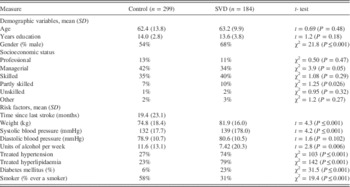
Two-hundred participants with lacunar stroke were recruited from 19 sites across the English Stroke Research Network as a part of the BMET validation study (see Brookes et al. Reference Brookes, Hollocks, Khan, Morris and Markus2015, for full details). In addition, 303 healthy controls were recruited from GP practices across London, UK. Individuals with cardiovascular risk factors and other related comorbidities were included, but individuals with a past history of stroke, TIA, other co-occurring neurological or psychiatric diagnoses were excluded. The only exception being the inclusion of people with either depression and/or anxiety which are both common after stroke. After excluding several participants who were unable to complete the testing schedule, the final analysis included 184 participants with SVD and 299 healthy controls. Those excluded did not significantly differ from the included group on any of the descriptive variables presented in Table 1.
Descriptive statistics of demographic and clinical variables for participants with small vessel disease and controls

SVD=small vessel disease.
All SVD participants were tested >3 months post-stroke to exclude any acute effects of stroke on cognitive performance. All patients included in the study presented with a clinical lacunar syndrome (e.g., hemiparesis, hemisensory deficit, sensorimotor deficit, ataxic hemiparesis, clumsy hand dysarthria) or partial lacunar syndrome (e.g., pure motor stroke affecting face and arm or arm and leg) with an MRI confirmed lacunar infarct in an anatomically corresponding location. Lacunar infarction was defined as a subcortical infarct ≤1.5 cm in diameter, on MRI.
For all cases, MRI scans were centrally reviewed to confirm eligibility and to grade the degree of leukoaraiosis using the Fazekas’ scale (Fazekas, Chawluk, Zimmerman, & June, Reference Fazekas, Chawluk, Zimmerma and June1987). SVD patients were included if they had either isolated lacunar infarcts (n=122) or lacunar infarcts with leukoaraiosis (Fazekas grade ≥ 2; n=74), and both first and recurrent lacunar infarcts were included (with 151/184 participants having only one recorded stroke). Exclusion criteria were as follows: (1) stenosis > 50% in the extracranial or intracranial cerebral vessels, or previous carotid endarterectomy; (2) cardioembolic source of stroke, defined according to the TOAST criteria as high or moderate probability; and/or (3) the presence of a cortical infarct > 1 cm diameter on MRI.
Measures
The Brief Memory and Executive Test (BMET) incorporates tests divided into two main categories: (1) executive functioning and processing speed which includes (i) letter-number matching, (ii) motor-sequencing, (iii) letter-sequencing and (iv) number-letter sequencing; and (2) orientation and memory which includes (i) orientation, (ii) five-item immediate repetition, (iii) five-item delayed recall, (iv) five-item delayed recognition memory. As part of the standardization procedure, raw scores on each of the eight BMET subtests are recoded on a 0–2 scale based on age group (Brookes et al., Reference Brookes, Hollocks, Khan, Morris and Markus2015). This is then used to generate a total score (0–16) and both an executive functioning/processing speed (0–8) and orientation/memory index score (0–8).
The Montreal Cognitive Assessment (MoCA) is a 10-min cognitive screening tool designed to detect mild cognitive impairment. The MoCA includes tests of visuo-spatial abilities, short-term memory recall, attention, concentration, abstraction, and working memory and has a total score of 30 (Nasreddine et al., Reference Nasreddine, Phillips, Bédirian, Charbonneau, Whitehead, Collin and Chertkow2005).
The Mini-Mental State Examination (MMSE) is a brief cognitive screening measure which includes 11 questions and takes approximately 5–10 min to complete. The MMSE includes a range of measures covering orientation, memory attention and ability to follow verbal and non-verbal instructions (Folstein et al., Reference Folstein, Folstein and McHugh1975).
The Instrumental Activities of Daily Living questionnaire consists of 8 questions about daily activities important for independent living (Lawton & Brody, Reference Lawton and Brody1969). These questions ask whether the participants could independently use the telephone, perform laundry, shop, use public transport, prepare meals, and take responsibility for their own medications, do the housekeeping and handle finances. Because of significant ceiling effects within this sample (i.e., most participants scoring 8/8), this variable was recoded to a dichotomous variable with anyone scoring <8 being recoded “0” and anyone scoring 8 being recoded as “1”.
The Barthel’s Index of Daily Living measures functional disability by quantifying patient performance in 10 activities of daily living (Wade & Collin, Reference Wade and Collin1988). These activities cover both self-care (bathing, dressing, feeding, grooming, etc.) and mobility (transferring themselves independently and climbing the stairs) and is scored 0–20. As with the results on the IADL responses to this questionnaire were scored on a dichotomous scale with scores of 20 being recoded as “1” and those with scores < 20 being recoded as “0”.
The Stroke Specific - Quality of Life Scale (SS-QoL) was developed specifically as a measure of QoL for use in stroke trials and provides a measure of different domains of QoL as well as a total score (Williams, Weinberger, Harris, Clark, & Biller, 1999). Due to the chronic nature of SVD, and because the SS-QoL had been developed for a single post-acute stroke assessment, the scale items were modified into the present tense to reflect general current experiences (e.g., “I often have to stop and rest during the day”).
The National Adult Reading Test - Revised (NART-R) (Nelson & Willison, Reference Nelson and Willison1991); is a brief reading test used to provide an estimate of premorbid intellectual functioning (IQ). The NART-R is administered by presenting the participant with a list of 50 words and asking them to read each word aloud. In this study, the number of errors were recorded and used as a covariate in our statistical analysis.
The Geriatric Depression Scale (GDS) (Yesavage et al., Reference Yesavage, Brink, Rose, Lum, Huang, Adey and Leirer1982), is a 30-item self-report measure used to identify symptoms of depression in older adults. In this study, we included the GDS as a covariate to control for any effect of low mood on cognitive performance.
Statistical Analysis
Descriptive statistics are presented in Table 1 and group differences on these variables between participants with SVD and healthy controls were compared using independent samples t tests for continuous variables and chi-squared (χ 2 ) tests for dichotomous variables. In this study age, gender, premorbid IQ, and GDS score were included as covariates due to their known influence on cognitive performance. Educational background was not included as covariate because it was highly collinear with premorbid IQ.
To investigate the relationship between the BMET scores and activities of daily living, two logistic regressions models were constructed using BADL and IADL as dependent variables and BMET score as the independent variable. We then included age, gender, and premorbid IQ, followed by GDS score added as covariates in the model in a predefined hierarchical order. Finally, the model was repeated with the MoCA and MMSE scores added to the model. However, as the MoCA and MMSE scores were highly collinear, these were added to model separately as alternative variables. These analyses were first conducted for the BMET executive functioning/processing speed index score and then repeated using the orientation/memory index score and the BMET total score.
We then conducted a series of multiple linear regression models with the BMET scores again as independent variables but now using QoL as the dependent variable. Again age, gender, GDS score, and MoCA/MMSE scores were added to the models using a predefined hierarchal approach. As with the logistic regressions these analyses were first conducted for the BMET executive functioning/processing speed index score and then repeated using the orientation/memory index score and the total score.
Results
Descriptive Statistics
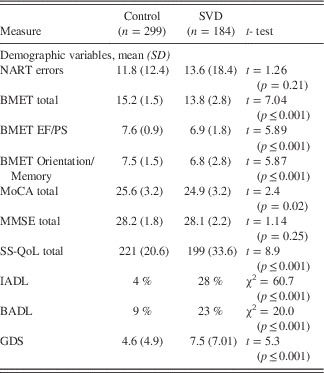
Demographic characteristics of the SVD and control populations are shown in Table 1. The SVD cases scored significantly lower on the BMET executive functioning/processing speed (SVD, mean 6.9; SD=1.8; control, mean 7.7; SD=0.9; t=5.9; p≤.001) and orientation/memory subscales (SVD, mean 6.8; SD=1.5; control, mean 7.7; SD=0.9; t=5.9; p≤.001) as well as the BMET total score (SVD, mean 13.8; SD=2.8; control, mean 15.2; SD=1.5; t=7.04; p≤.001). In addition, the SVD group were more likely to have a score of <8 on the IADL (χ 2 (1)=60.7; p≤.001) and BADL (χ 2 (1)=20.0; p≤.001), with 28% and 23% of SVD participants not achieving a perfect score on the IADL and BADL, respectively. This was compared to only 4% and 9% in the control sample (see Table 2). In the SVD group, the distribution of IADL scores <8 was 19% scoring 6–7, 7% scoring 4–5, and 2% scoring 0–3, and for BADL those scoring <20 was 11% scoring 19, 10% scoring 14–18, and 2% scoring <14.
Scores on measures of cognitive functioning, quality of life and activities of daily living for participants with small vessel disease and controls

BMET=Brief Memory and Executive Test; EF=executive functioning; PS=processing speed; MoCA=Montreal Cognitive Assessment; MMSE=Mini Mental State Examination; SS-QoL=Stroke Specific - Quality of Life scale; IADL=instrumental activities of daily living; BADL=basic activities of daily living; GDS =Geriatric Depression Scale.
Furthermore, the SVD group had a poorer quality of life (SVD, mean 198.8; SD=33.6; control, mean 220.9; SD=20.6; t=8.9; p≤.001). As referenced above (see the Methods section), the MoCA and MMSE measures are highly correlated with each other (r=.53; p≤.001) and so will be considered separately in the models presented below. Similarly, the BMET scores were significantly correlated with both the MoCA (executive functioning/processing speed, r=.39; p≤.001; memory/orientation, r=.42; p≤.001; total score, r=.48; p≤.001) and MMSE (executive functioning/processing speed, r=.36; p≤.001; memory/orientation, r=.27; p≤.001; total score, r=.37; p≤.001), although to a slightly lesser degree.
Regression Analysis of the BMET Cognitive Scores and Activities of Daily Living
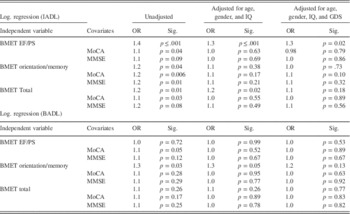
In the initial model, the BMET executive function/processing speed index score was significantly related to IADL (OR=1.4; p≤.001, model statistic: χ 2 (1)=14.5) and when both age, gender and IQ was included in the model this association remained (OR=1.3; p≤.001, model statistic: χ 2 (4)=26.6). Furthermore, the association remained significant after controlling for the GDS score (OR=1.3; p=.02; model statistic: χ 2 (5)=51.5; see Table 3 for full results). In addition, neither the MoCA (OR=0.98; p=.79) nor MMSE (OR=1.0; p=.86) were significantly associated with IADL when the BMET executive function/processing speed index score was also included in the model. For both, the memory index and BMET total score, similar results were found, with the exception that the relationships were no longer significant after controlling for the GDS score. To ensure that any possible relationships between the MoCA and MMSE and IADL are not masked by the presence of the BMET scores within the model we repeated the analysis replacing the BMET scores with the MoCA and then the MMSE score. We found that, even in the absence of the BMET, neither the MoCA (OR=1.0; p=.55; model statistic: χ 2 (5)=46.35) nor the MMSE (OR=1.1; p=.41, model statistic: χ 2 (5)=46.7) were significantly related to IADL.
Logistic regression analyses looking at the relationships between BMET scores and activities of daily living in small vessel disease

BADL=basic activities of daily living; BMET=Brief Memory and Executive Test; EF=executive function; GDS=Geriatric Depression Scale; IADL=instrumental activities of daily living; MMSE=Mini-Mental State Examination; MoCA=Montreal Cognitive Assessment; OR=odds ratio; PS=processing speed; SS-QoL=Stroke Specific - Quality of Life Scale.
In contrast to IADL, neither the BMET executive function/processing speed index score (OR=1.0; p=.72; χ 2 (1)=0.13) nor the BMET total score were significantly associated with BADL (OR=1.1; p=.15, model statistic: χ 2 (1)=4.7) in the initial model. However, the BMET orientation/memory index score (OR=1.3; p=.02, model statistic: χ 2 (1)=2.0) was significantly related to BADL, but this effect did not survive correction for age and IQ (OR=1.2; p=.08, model statistic: χ 2 (3)=9.9). When controlling for age and IQ neither the MoCA total score (OR=1.1; p=.22), nor the MMSE total score (OR=1.0; p=.80), were significantly related to BADL. Repeating each model with the BMET scores excluded confirmed that neither the MoCA total score (OR=1.0; p=.90, model statistic: χ 2 (5)=24.4), nor the MMSE total score (OR=1.0; p=.82, model statistic: χ 2 (5)=24.4), were significantly related to BADL.
Regression Analysis of Associations between the BMET Cognitive Scores and Quality of Life in SVD
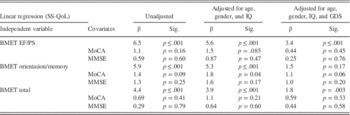
In the initial regression model, the BMET executive function/processing speed index score was significantly related to quality of life (β=6.5; p≤.001, model statistic: F(1,182)=23.3; p≤.001; effect size: r2 Adjusted =0.11). The addition of age, gender, and IQ did not significantly influence the relationship between the BMET executive function/processing speed index score and quality of life (β=5.6; p≤.001; model statistic: F(4,179)=7.5; p≤.001, effect size: r2 Adjusted =0.12), and none of these covariates were significantly associated with quality of life (age, β=0.4; p=.09; gender, β=5.2; p=.31; FSIQ, β=0.22; p=.09).
After the addition of the GDS total score to the model, the BMET executive function/processing speed index score was still significantly associated with quality of life, as was the GDS score (BMET total, β=3.4; p≤.001, GDS total, β=-3.5; p≤.001, model statistic: F(5,178)=55.8; p≤.001, effect size: r2 Adjusted =0.60). Finally, neither the MoCA total score (β=0.44; p=.45) nor the MMSE total score (β=0.27; p=.75) was significantly related to quality of life, and their addition to the model had no effect on the relationships described above. This process was repeated using both the BMET orientation/memory index and the BMET total score resulting in comparable results for the total score (β=1.8; p≤.001), but with the orientation/memory subscale (β=1.5; p=.17) not significantly associated with quality of life (see Table 4 for full regression models). Finally, repeating the models with the BMET scores excluded revealed that the MoCA total score (β=1.1; p=.04, model statistic: F(5,178)=55.8; p≤.001; effect size: r2 Adjusted =0.58) did significantly predict quality of life, while the MMSE total score (β=1.2; p=.13, model statistic: F(5,178)=50.8; p≤.001, effect size: r2 Adjusted =0.58) did not.
Linear regression analyses looking at the relationships between BMET scores and quality of life in small vessel disease

BMET=Brief Memory and Executive Test; EF=executive function; GDS=Geriatric Depression Scale; MMSE=Mini-Mental State Examination; MoCA=Montreal Cognitive Assessment; PS=processing speed; SS-QoL=Stroke Specific - Quality of Life Scale.
Discussion
In this study, we have demonstrated that, as well as being sensitive to cognitive impairment in patients with SVD, scores on the BMET are significantly associated with functional outcomes. Specifically, we have shown that deficits in executive functioning and processing speed, the defining neuropsychological features of SVD, are associated with reduced IADL and poorer QoL. Furthermore, the addition of cognitive screening measures not specifically designed to detect VCI, such as the MMSE and MoCA, provides little additional value when trying to predict scores on measures of quality of life or activities of daily living. This research strongly suggests that there is clinical utility in tailoring the selection of cognitive screening tools to specific patient groups and that screening patients for symptoms of depression should not be overlooked, particularly given its association with functional outcome measures.
A main result from this study is that executive functioning and processing speed deficits as measured by the BMET were strongly associated with both IADL and quality of life. This was in contrast with the BMET memory/orientation scores which, although significantly related to IADL in the initial models, did not survive correction for the presence of depressive symptoms. This is consistent with the finding that executive functioning, rather than memory, is more strongly related to functional outcomes in other patient groups, such as Alzheimer’s disease (Martyr & Clare, Reference Martyr and Clare2012) and also longitudinally in elderly populations (Cahn-Weiner et al., Reference Cahn-Weiner, Farias, Julian, Harvey, Kramer, Reed and Chui2007). These results are likely to be driven by the fact that in SVD memory functioning is relatively spared and, therefore, may make a lesser contribution to poor functional outcomes in this group. This, along with our finding that scores on the MMSE and MoCA were not strongly related to functional outcomes, highlights the importance of using cognitive assessment tools that are tailored to the specific neuropsychological profiles of the patient group. While the need for tailored assessments for VCI has been known for some time (Hachinski et al., Reference Hachinski, Iadecola, Petersen, Breteler, Nyenhuis, Black and Leblanc2006), the BMET now provides a validated screening tool that can be administered briefly (~10 min) specifically tailored for SVD (Brookes et al., Reference Brookes, Hollocks, Khan, Morris and Markus2015).
We had hypothesized that if the BMET is sensitive to functional impairment in SVD scores should be related to poorer IADL, but not BADL. Consistent with this hypothesis, we found that neither executive functioning/processing speed nor overall cognitive ability was significantly associated with BADL in this sample. While scores on orientation/memory were significantly correlated with BADL, this relationship did not hold when accounting for age, gender, and pre-morbid IQ. This supports the suggestion that IADL are generally more associated with cognitive difficulties (Cahn-Weiner et al., Reference Cahn-Weiner, Boyle and Malloy2002; Monaci & Morris, Reference Monaci and Morris2012), while BADL are related to physical impairments, such a motor function (Mercier et al., Reference Mercier, Audet, Hébert, Rochette and Dubois2001), which can deteriorate with age.
In addition to the relationship between the BMET scores and functional outcomes, we also identified a significant effect of depression on both IADL and quality of life. It is now well established that mood problems are a common consequence after stroke, particularly SVD (Brookes, Herbert, Lawrence, Morris, & Markus, Reference Brookes, Herbert, Lawrence, Morris and Markus2014) and that it has a significant impact on quality of life (Brookes, Willis, Patel, Morris, & Markus, Reference Brookes, Willis, Patel, Morris and Markus2013). Our results again indicated that both deficits in executive functioning/processing speed, and symptoms of depression, are significantly associated with quality of life.
However, in our analysis looking at predictors of IADL or QoL, we found that, even when depression was added to the model, it did not remove the associations between executive functioning/information processing and either measure. Furthermore, the exact relationship between depression and functional outcomes in SVD is unclear. For instance, reductions in IADL scores may be directly related to different components of depression, such as a reduced motivation, or apathy, which is also a common consequence of SVD (Hollocks et al., Reference Hollocks, Lawrence, Brookes, Barrick, Morris, Husain and Markus2015). Alternatively, cognitive biases associated with low mood may lead to an overly negative perception of current abilities. However, it should also be noted that depression has been associated with a greater awareness of symptoms, a so-called “depressive realism,” which may in fact lead to an accurate understanding of functional difficulties in some patients (Mograbi & Morris, Reference Mograbi and Morris2014).
In this study, we have presented evidence that deficits in executive functioning and processing speed, common in SVD, are significantly related to functional outcomes. Furthermore, we demonstrated that this relationship can be examined effectively using the BMET, but not by cognitive screening tools that are not tailored to the specific neuropsychological profile of VCI. Despite several strengths, such a large and well-phenotyped sample of patients and controls, this study should be considered in the context of several limitations. For instance, given the cross-sectional nature of this analysis, we are unable to investigate the directionality of the associations between cognition and functional outcomes. While here we have assumed that a worse performance on cognitive measures leads to poorer quality life and IADL, further studies are required to help confirm this directionality, and explore the possibility of any bidirectional relationships between these measures. We have shown that factors other than cognition, such as symptoms of depression, also play an important role in functional outcomes. However, there are several other factors not accounted in this study for such as the presence of fatigue (van de Port, Kwakkel, Schepers, Heinemans, & Lindeman, Reference van de Port, Kwakkel, Schepers, Heinemans and Lindeman2007) or the availability of social support which may also have a significant impact on outcomes in SVD. Future research may benefit from more comprehensive evaluation of the physical and psychological factors that may influence quality of life and activities of daily living in this population.
SVD is a complex and heterogeneous condition, including those with asymptomatic radiological changes through those presenting with lacunar infarct and vascular dementia. In this study, we took an inclusive approach, including the full range of patients presenting with lacunar stroke due to SVD. This may be relevant given that those patients with multiple or recurrent infarctions are likely to perform more poorly on test of cognition (Arboix et al., Reference Arboix, Font, Garro, García-Eroles, Comes and Massons2007) and so as a result may have poorer functional outcomes. Future research with a larger sample size may benefit from dividing cases into sub-groups based on clinical characteristics and the extent of cerebral pathology on MRI. A further limitation of this study was that both informant ratings and self-ratings of IADL and quality of life were not taken. While it is important to acquire self-report of the participant’s difficulties, it should be noted that these are difficulties as perceived by the individual and may be vulnerable to many biases. However, evidence from early-stage Alzheimer’s disease suggest self-report scales are useful and that caregiver-reports can be influenced by factors such as stress (Martyr, Nelis, & Clare, Reference Martyr, Nelis and Clare2014). Therefore, future research should replicate our current findings using both self- and caregiver-reports of functional outcomes.
In conclusion, scores on the BMET are significantly associated with functional outcomes in SVD over and above other cognitive screening tests not designed to assess the neuropsychological profile of VCI. This provides additional evidence that the BMET is a sensitive tool for the assessment of the psychological consequences of SVD. The associations between the BMET and functional outcomes are driven primarily by deficits in executive functions and processing speed, while symptoms of depression are additionally related functional outcomes. This is of particular clinical relevance given that there are both psychological (Broomfield et al., Reference Broomfield, Laidlaw, Hickabottom, Murray, Pendrey, Whittick and Gillespie2011) and pharmacological (Robinson et al., Reference Robinson, Schultz, Castillo, Kopel, Kosier, Newman and Starkstein2000) interventions available for depression and cognitive rehabilitation strategies, such as goal management training (Levine et al., Reference Levine, Robertson, Clare, Carter, Hong, Wilson and Stuss2000; Spikman, Boelen, Lamberts, Brouwer, & Fasotti, Reference Spikman, Boelen, Lamberts, Brouwer and Fasotti2010), which could be used for executive difficulties. Our results suggest that the detection and treatment of these symptoms would likely have a positive effect on the functional outcomes of those with SVD.
Acknowledgments
We thank Vanessa Herbert, Cerys Bradley-Scott, and Emma Cooper for assistance with testing the normative sample. The BMET study was funded by The Stroke Association (TSA2010/08). Recruitment to the BMET study was supported by the NIHR Stroke Clinical Research Network. Hugh Markus is supported by an NIHR Senior Investigator award and his work is supported by the Cambridge University Hospitals NIHR Comprehensive BRC. Matthew Hollocks is supported by a Stroke Association/British Heart Foundation Grant (TSA BHF 2010/01). Rebecca Brookes was supported by a Stroke Association Grant (TSA2010/08). Robin Morris is supported by MRC and ESRC awards. He also receives consultancy fees from P1Vital Limited unrelated to this project. The authors disclose no competing interests financial or otherwise.