Introduction
Due to its rise as a global means of communication, the English language has been increasingly used by and between non-native speakers (henceforth NNSs), leading to a growing interest in what has come to be known as English as a Lingua Franca (ELF) in English language teaching (ELT). As noted by Jenkins (Reference Jenkins2006: 159), ‘many of those who start out thinking they are learning English as a foreign language end up using it as a lingua franca’. This suggests that ELT materials need to be developed in ways that correspond with the emerging needs of such language learners. However, ‘the prevailing orientation in […] ELT materials still remains undoubtedly towards ENL [English as a Native Language]’ (Jenkins, Reference Jenkins2012: 487). It is not yet clear how well ELF perspectives have been integrated into teaching materials to date.
This paper investigates current ELT materials in Japan from an ELF perspective, where the aim of the ELF approach – learning English in order to communicate with people who have different mother tongues – is very present in language education policies. Despite this clearly stated aim, there are no official guidelines as yet for ELF-oriented teaching methods and materials. Therefore, it has become imperative (1) to analyse ELT coursebooks that are used in Japan from an ELF perspective, (2) to suggest a systematic way of displaying the ELF-orientation in coursebooks, and (3) to consider how we might develop and utilise materials to better support the aims of an ELF approach to ELT.
ELF and materials development
English as a Lingua Franca (ELF) is defined by the website of the Vienna-Oxford International Corpus of English (VOICE) as ‘English used as a common means of communication among speakers from different first-language backgrounds’. Since it is used as a means of communication between speakers of many different L1s, the possible outcome is a high level of (linguistic) variability (Ferguson, Reference Ferguson2009). Following Friedrich and Matsuda (Reference Friedrich and Matsuda2010: 20), I understand ELF as a term that refers to ‘the function or use of English as a common language among people who do not share a first language’.
In addition, the term ELF is used when referring to a new ELT approach. Graddol (Reference Graddol2006: 87) predicts that quite a few ‘[ELF] ideas are likely to influence mainstream teaching and assessment practices in the future’. Indeed, it is reasonable to propose that a new approach to ELT is already emerging, in which the goal is to enable learners to communicate not only with NSs (the traditional goal of EFL) but also to communicate with other NNSs: ‘[w]ithin ELF, intelligibility is of primary importance, rather than native-like accuracy’ (Graddol, ibid.: 87). As Hino (Reference Hino2009: 109) notes, one of the salient characteristics of ELF is that
this approach would not necessarily presuppose ‘national’ varieties. Under the ELF paradigm, users of English would be free to speak their individual varieties as long as they hold on to the core features to ensure international intelligibility.
One of the main ideas and methodological suggestions behind ELF is found in the practice of exposing learners to a wide range of NNS varieties of English (Jenkins, Reference Jenkins2004). Another important methodological implication comes with placing the emphasis of ELF on ‘raising awareness of EILFootnote 1 contextual factors’ (Jenkins, ibid.: 116). Cogo (Reference Cogo2012: 104) claims that ELF makes learners ‘aware of different ways of speaking English, [and] of language variability and change’, offering learners some choice in their use of English. Baker (Reference Baker2012: 69) points out that ‘English as a global lingua franca forces us to go beyond notions of teaching a fixed language and cultural context as adequate for successful communication.’
ELF-oriented features in materials that have been discussed by researchers include: (1) broad representations of English users and uses of English (in terms of nationalities, cultural and linguistic backgrounds); (2) different varieties of English in audio-visual materials; and (3) topics that intend to raise learner awareness concerning the sociolinguistic realities of the English language (Matsuda, Reference Matsuda and Edge2006). Two particular textbooks, Englishes of the World (Yoneoka & Arimoto, 2000) and English Journal (ALC, March 2011), represent people from different countries in the world and include samples of different varieties of English, recorded in unscripted interviews that contain non-standard forms. However, there are as yet few empirical studies that systematically examine the ELF features of English coursebooks in countries such as Japan – where ELF is promoted as part of national language policy. It is the aim of this paper to address this lacuna.
ELF and the Japanese context
An explicit call for a shift from EFL to ELF appears in the 2003 action plan proposed by the Ministry of Education, Culture, Sports, Science and Technology (MEXT):
English has played a central role as the common international language in linking people who have different mother tongues. For children living in the 21st century, it is essential for them to acquire communication abilities in English as a common international language.
(Regarding the Establishment of an Action Plan to Cultivate ‘Japanese with English Abilities’, MEXT 2003, emphasis added).
More recently, in 2011, MEXT released a proposal and a set of priority policies for improving abilities among learners studying English as a Lingua Franca, explicitly referring to the term ELF.
In the Japanese context, all state schools are required to follow the national curriculum, using only coursebooks that have been inspected and approved by MEXT. Kiryu, Shibata, Tagaya, and Wada (Reference Kiryu, Shibata, Tagaya and Wada1999) investigate how such approved coursebooks deal with cross-cultural awareness. They indicate that the 1993 and 1998 coursebooks for SHS students have a somewhat higher tendency to refer to the US and Japan. This inner circle (IC) (Kachru, Reference Kachru1992) orientation is also observable in representations of English users and English uses in approved coursebooks for 7th-grade English learners, specifically during the period from 1997 to 2002 (Matsuda, Reference Matsuda2002). This observation tallies with Matsuda's (Reference Matsuda2003: 719) broader conclusion that ‘English is still being taught [around the world] as an inner-circle language, based […] on […] coursebooks with characters and cultural topics from the English-speaking countries of the inner circle’.
As noted earlier, however, there are signs that this situation is gradually changing. Where the Japanese Secondary School English Language Curriculum once aimed ‘[t]o develop an understanding of, appreciation for, and a desirable attitude toward the modes of life, manners, and customs of English-speaking peoples’ (advocated in 1951), there has been a discernible shift in cultural emphasis from IC cultures to foreign cultures in general. The current Course of Study for lower secondary schools indicates that special consideration is now to be given to those ‘[m]aterials that are useful in deepening the understanding of the ways of life and cultures of Japan and the rest of the world, raising [wider] interest in language and culture’ (MEXT, 2003). Moreover, the Course of Study for oral communication courses for upper secondary schools states that:
The language elements should be contemporary standard English in principle. However, consideration should also be given to the fact that different varieties of English are used throughout the world as means of communication (MEXT, 2003).
While this guideline expresses a tolerance towards different varieties of English, it still leaves ‘textbook writers and the teachers [with] the same old American or British English […] at least for the production models’ (Hino, Reference Hino2009: 112). In summary, changes towards ELF have begun to appear over the decades in the official policies and materials used in the state sector, although there is still a noticeable gap between theory and practice.
Methodology
In this paper, I investigate the following research question:
To what extent do the English coursebooks that are published and used (in secondary schools in the state sector) in Japan have features of the ELF approach?
The inquiry reported below covered six ELT coursebooks for seventh grade students and ten English-II coursebooks for 11th graders (all approved by MEXT). These are listed as follows:
Junior-high-school coursebooks:
Columbus (Togo et al. 2006), New Crown (Takahashi et al. 2006), New Horizon (Kasajima et al. 2006), One World (Matsumoto et al. 2006), Sunshine (Sano et al. 2006) and Total English (Horiguchi et al. 2006)
Senior-high-school coursebooks:
Crown (Shimozaki et al. 2004), Vista (Ikeda et al. 2004), Pro-vision (Haraguchi et al. 2004), Unicorn (Ichikawa et al. 2004), Exceed (Morizumi et al. 2004), Vivid (Minamimura et al. 2004), Power On (Jinbo et al. 2004), All Aboard (Kumura et al. 2004), World Trek (Asaha et al. 2004) and Polestar (Hashiuchi et al. 2004)
By way of analysis, I employed a taxonomy that I first created for a project in 2011 (Takahashi, Reference Takahashi2011). Specifically, I investigated the following features of these coursebooks as categorised according to (1) Exposure purpose and (2) Awareness-raising purpose. Each of these categories will now be explained in turn.
Exposure purpose: representation
The analysis methods for coursebook representation (1–4, listed below) are based on categories originally proposed by Matsuda (Reference Matsuda2002):
1 Nationality of characters.
2 Number of words uttered by each character.
3 Locations of dialogues.
4 Types of communication.
Firstly, I examine the nationalities of the characters represented in the dialogues of each coursebook. I count the numbers of characters from each country, along with the number of words uttered by each character of each nationality. Although I am aware that ELF users cannot necessarily be identified with a speaker's nationality, this study may uncover either more (or less) dominant uses or users of English within specific coursebooks. Thus, my examination may reveal important (representational) contrasts relative to an ELF-orientation.
As for types of communication, I first distinguish whether a dialogue is same-country or mixed-country, and I then subcategorise the interaction using a taxonomy of nine context types, as follows:
Same-country uses
1 between speakers from the same IC country
2 between speakers from the same OC country
3 between speakers from the same EC country
Mixed-country uses
4 between NSs
Between NSs and NNSs
5 between NSs and NNSs from the learner's home country
6 among NSs, NNSs from the learner's home country, and from countries other than the learner's home country
7 between NSs and NNSs from countries other than the learner's home country
Between NNSs
8 between NNSs from the learner's home country, and from countries other than the learner's home country
9 between NNSs from countries other than the learner's home country
Categories 5 to 9 above are my original contribution, and the rest are based on Matsuda (Reference Matsuda2002).
These communications are then counted. Again using Matsuda's categories (2002: 188), I categorise dialogue locations into seven groups, including the learner's home country, IC countries, OC countries and EC countries other than the learner's home country. I then count the numbers of different locations within each category.
Awareness-raising purpose: contents/topics of the coursebooks
For each coursebook, I search for sections and sentences that contain information on any of the following ELF-related contents/topics:
1 The current/future situation of English
a Number of speakers
b Contexts of uses
c Domains of uses
d English as an international language
e Sociolinguistic complexity of the English language
2 English varieties
a Existence of different varieties
b Names of varieties
c Characteristics/forms of varieties
d Function/creativity of locally legitimated English; identity expressed by using locally legitimated English
3 Linguistic imperialism and critical awareness
a English domination
b (In)equality in communication
c Ownership of English
4 ELF contexts and uses
a Departure from EFL
b Same-country English uses within a nation with many languages
c Mixed-country uses between NNSs
5 New model(s)
a Departure from an EFL model
b Pluralization of standards
c International intelligibility as a goal
d Concerns/attitudes related to new models
e Learner's choice
6 Multicultural topics
I count the number of coursebook chapters that include coursebook ELF traits (1–5, as listed above). I also count the number of different coursebook ELF traits that are included in each chapter.
Indicating the degree of ELFness
For the purpose of comparison between books, I select eight ELF features that display the ELFness of each book numerically. Feature 1 indicates the proportion of non-Japanese NNS characters to the total number of characters featured in the book. Feature 2 shows the countries from which these non-Japanese NNS characters originate relative to all the countries of origin represented in the coursebook. Feature 3 indicates the proportion of words uttered by non-Japanese NNS characters relative to the total number of words uttered in dialogues throughout the coursebook. According to previous studies and the current analysis, the majority of characters featured in the coursebooks come from IC countries and from the learner's home country. Therefore, the active participation of other characters would offer a striking contrast between more ELF-oriented coursebooks and less ELF-oriented coursebooks.
Continuing from this, Feature 4 indicates the proportion of OC and EC countries that are featured as dialogue locations in a coursebook. Feature 5 specifies the proportion of mixed-country uses of English between NNSs to the total mixed-country uses of English in each coursebook. The preceding analysis shows all of the mixed-country uses found in the coursebooks, with the majority of these taking place between NSs and NNSs. In order to more clearly indicate the degree of ELF-orientation among the books, I decided to focus on NNS-NNS communication for Feature 5.
Feature 6 gives the number of chapters that contain ELF-related contents/topics in a coursebook. Feature 7 shows the number of different ELF-related contents/topics found in the coursebook, and Feature 8 specifies the number of chapters that contain topics about OC countries and EC countries other than Japan.
Taking into account certain structural differences (JHS coursebooks mainly consist of dialogues, for example, while SHS coursebooks consist primarily of readings), I compare representations among JHS coursebooks, and various contents and topics among SHS coursebooks.
Results
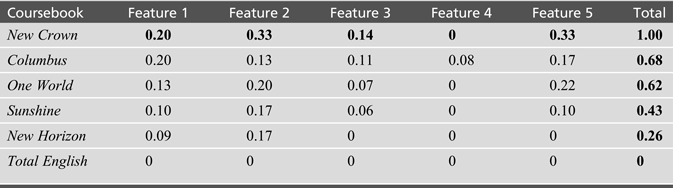
Table 1 summarises the scores of ELF Features 1–5 in the JHS coursebooks. Note that Table 1 displays decimal figures rather than percentages.
Scores of Features 1–5 (Junior-high-school coursebooks)

The overall score shown in Table 1 is the sum of the scores for Features 1–5. The score of New Crown (1.00) is the highest of all. This is also the only book to represent characters from the three different linguistic circles: IC, OC, and EC countries (Japan and China). Furthermore, it features characters from a variety of IC countries (specifically, the US, the UK, and Australia). EC characters utter more words than IC characters in New Crown (EC 462; IC 361). Whilst there are four lessons in New Crown that include mixed-country English uses between NNSs, there are no lessons that include either any mixed-country English uses between NSs, or same-country uses between NSs. It could be said that the emphasis in New Crown is more on mixed-country English uses that involve NNSs.
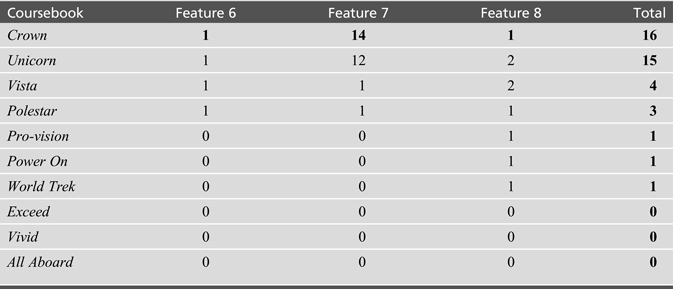
Let us now turn to Table 2, which shows ELF scores (Features 6–8) from the ten SHS coursebooks.
Scores of ELF Features 6–8 (Senior-high-school coursebooks)
As can be seen, Crown has comparatively more ELF-oriented features than the other nine SHS coursebooks (see Table 2). In Crown, there is one chapter (‘Singlish Bad; English Good’, Lesson 6) that evidences some traits from 1a–5e (Appendix 3): thus, the score for Feature 6 is one. Fourteen different traits appear in the lesson and so the score for Feature 7 is 14. To illustrate, here are 4 (out of the total of 14) sentences that present ELF-related content:
1 Current situation of English, 1a Number of speakers: ‘Today, 350 million people speak English as their mother tongue, but more than a billion speak it as a second language’ (p. 87)
2 English varieties, 2c Characteristics/forms of varieties: ‘As the English language grows in the world, it is creating new dialects called “Englishes”’(p. 85)
3 Linguistic imperialism and critical awareness, 3c Ownership of English: ‘English now belongs to whoever uses it, not just to native speakers’ (p. 90)
4 ELF contexts and uses, 4c Mixed-country uses between NNSs: ‘Most English speakers in Asia today use the language to communicate not with native speakers but with other Asians’ (p. 91).
Since the same chapter refers to an OC country, Singapore, the score for Feature 8 is one. The overall score (16) is calculated by simply adding the separate scores for Features 6–8.
Discussion
Overall, English is represented as mostly taking place between a NS and a Japanese character in JHS and SHS coursebooks. The majority of English uses are those taking place between a NS and a NNS (50, which is approximately 78 per cent out of the total 64 mixed-country uses in JHS coursebooks); 47 uses are those between a NS and a Japanese speaker; and only 9 uses are those between NNSs (approximately 14 per cent). The coursebooks have changed over decades and now feature more NNSs and international use of English among NNSs (without the presence of any NS) (see Takahashi, Reference Takahashi2011). However, this proportion still does not seem to reflect the increasing opportunities for English communication between NNSs, nor does it display a clear shift from EFL to ELF as recommended in official policy documents.
On the other hand, I found a dramatic change in a JHS coursebook. A new perspective appears in the representation of New Crown. It is an instance of communication between EC characters (Japanese and Chinese) in the first lesson of the book. This is unique because it is the very first dialogue that the 7th-grade students (first-year learners in formal English education) see in their coursebook – and this sort of occurrence is not found in the previous analysis.
Turning now to the contents and topics found in the textbooks, four SHS books were found to have lessons that include ELF traits 1a–5e: ‘Singlish Bad; English Good’ (Lesson 6, Crown); ‘English as a World Language’ (Lesson 10, Unicorn); ‘India’ (Lesson 4, Vista); and ‘One Language or Many?’ (Lesson 11, Polestar). Two of the SHS coursebooks include written forms of (so-called) non-standard English: ‘Often the grammar [of Singlish] is a little simpler, or just different…in a shop…you may hear the customer bargaining with the salesclerk, “Cheaper, can or not?”’ (p. 142, Lesson 10: ‘English as a World Language’, Unicorn); ‘Every Singaporean speak. Me too. It not a dialect’ [dropping the third-person-singular ‘s’, and a be-verb ‘is’], and ‘Got coffee or not? Got!’ (p. 86, 88, Lesson 6: ‘Singlish Bad; English Good’, Crown).
Why are these forms of non-standard English included? Aren't teaching materials supposed to present a target model to learners? What is crucial and calls for some discussion (for the material developers) is the purpose behind their inclusion. If it is to make learners become (more) aware of the existence of different varieties of English, then the inclusion of these non-standard forms can act alongside other representations of characters, dialogue locations, and types of communication as another means of raising awareness of ELF/EIL contextual factors. After all, representations of characters and locations, and types of communication will not (by themselves) lead to an abandonment of the target model. Therefore, changes in representation might be easier to effect than changes in other aspects of the coursebooks (such as reading content).
Adding to the features found in the current analysis, discussion topics might also be used as a means of introducing learners to issues related to ELF. SHS student participants in my previous study (Takahashi, Reference Takahashi2011) exchanged ideas in focus groups that considered such issues as English varieties and new models. To illustrate, here is an example of a student evaluating the relative merits of NS and NNS speech models during a focus group discussion:
Student: I prefer a native speaker [as a target model to a NNS], but, why do I think so? Is English spoken by a native speaker different from that spoken by a non-native speaker?
Researcher: What do you think?
Student: Pronunciation is the only difference [between the two], pronunciation, accents, and so on, it's better not to care about it so much. It's OK as long as I can make myself understood [in that English].
Without being given any answer, this participant reached her own conclusion, identifying international intelligibility as her most important goal. What this observation suggests is that it would be worth trying to give learners the opportunity to at least think about issues related to ELF – in the form of both readings and discussion topics.
On the other hand, the presence of ELF features in learning materials could confuse learners if no reason is given for their inclusion. The main reason for introducing varieties of English (including NNS varieties) is to encourage learners to become aware of the range of varieties of English, and to develop, at least in the long run, an understanding of variations in the language they are learning. Another purpose behind the inclusion of ELF features is to make people more aware that the primary reason for English learning and teaching is to help learners attain a level of international intelligibility (not necessarily NS-like accuracy) under the aims of ELF approach. If both material writers and users share the first purpose, then the current NS model and related assessment methods will not change. As concerns the second purpose, however, we should discuss how we assess international intelligibility and how we specifically deal with non-standard forms.
Conclusion and implications
To conclude, an ELF-orientation is found in different forms and to differing degrees among the coursebooks analysed in the current study. This is seen clearly in the sheer number of different non-Japanese NNS characters that are used in the books, and in instances of communication that exist exclusively between NNSs. This is apparent as well as in the number of different ELF traits found in the readings.
The fundamental decision to include ELF-oriented features in teaching materials depends on the perceived goals of English teaching in individual contexts. Since the current focus is not suggesting an alternative model, it is sensible to select feature(s) that will not change the current target model, thereby giving consideration to the reasoning behind particular inclusions.
I suggest that English teachers should discuss with one another how best to utilise ELF-oriented materials in the classroom; for instance, examples of genuine communication between internationally-intelligible NNS speakers can help learners realise that ‘nativelike pronunciation and perfect grammar are not prerequisite[s] for successful communication’ (Matsuda, Reference Matsuda and Edge2006: 70). It might be beneficial as well to use additional materials such as audio recordings (presentations given by NNSs from online TED talks, for example) in the classroom. The purpose behind using such recordings is as follows: to expose learners to different varieties of English; to provide learners with authentic NNS speech (not recorded by NS actors using various accents) which reflects an appropriate level of international intelligibility; and to show learners examples of English usage between NNSs. This can provide an opportunity to show learners one example of ‘a fluent bilingual speaker, who retains a national identity in terms of accent, and who also has the special skills required to negotiate understanding with another non-native speaker’ (Graddol, Reference Graddol2006: 87). I am hoping that my study will invite more scholars, teachers, publishers, and policy makers to consider developing teaching materials with an ELF perspective, choosing to make materials more appropriate for teaching and learning in their own unique contexts. I also hope that the taxonomy that I have created and demonstrated in this paper will be applied to coursebooks in other countries, and not restricted solely to the analysis of teaching materials used in Japan.
 REIKO TAKAHASHI is Junior Associate Professor at Gakushuin Women's College in Tokyo. She graduated from the University of Edinburgh, UK, and her doctoral research is on ELF-oriented features in ELT materials and the attitudes of Japanese people (learners and teachers of English) to the ELF-oriented materials. She completed her Master's Degree in Linguistic Studies (concentrating on Language, Culture and Society) at Syracuse University, USA. Her current research interests include English as a Lingua Franca, World Englishes, and ELT. Email: reiko.takahashi@gakushuin.ac.jp