I. Ceylon's Kristallnacht
In the small hours of 29th May 1915, a group of Muslims jeered at a Buddhist procession which had just been ordered not to pass their mosque on Kandy's Castle Hill Street; the Buddhists rushed at the mosque and, after a battle, succeeded in desecrating it. Throughout the south-western quadrant of the island, the Sinhalese, most of whom practised Buddhism, were soon attacking the Moors, a Muslim minority who prospered as merchants and money-lenders. After some vacillation, the Governor, Sir Robert Chalmers, declared martial law. By 5th June, the heavy-handed agency of the armed forces, together with the exhaustion of unattacked Moorish property, had quelled the outbreak. 4,425 shops and homes had been attacked, as had 103 mosques; 25 Moors had been killed and 189 wounded;Footnote 1 in not a single peruwa of the Western Province did Moorish property escape damage.Footnote 2 Martial law lasted for another three months, during which the authorities imposed many harsh and apparently arbitrary punishments. The period of martial law, which soon entered the nationalist lexicon as the infamous “One Hundred Days”, was the aspect of the affair most remembered by the non-Moorish Ceylonese.Footnote 3
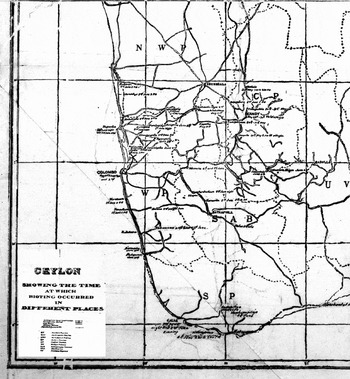
Official map showing dates and places of disturbances.

It is also the aspect that has loomed largest in the eyes of historians. In the historiography of twentieth century Sri Lanka,Footnote 4 it is usually assumed that the Sinhala-literate lower middle class, who were moved not by the liberal, Ceylon-wide nationalism of the westernised elite that came to power at Independence, but by the more basic forces of language, culture, religion and myth, had little influence over the island's political and constitutional direction before the electoral victory of S.W.R.D. Bandaranaike in 1956.Footnote 5 (Bandaranaike had founded the populist, communalist Sinhala Maha Sabha in the 1930s; his coalition's victory signalled the upsurge of a ‘more democratic and populist form of nationalism which was at the same time fundamentally divisive in its impact on the country’, the single most important event being that year's Official Language Act, or ‘Sinhala Only’ Act to critics.Footnote 6) A pillar of this orthodoxy is the dominant analysis of the pogromFootnote 7 of 1915. The pogrom's significance in Sri Lanka's political (as distinct from social or economic) history is believed to lie only secondarily, if at all, in its events and causes, and mainly in the Western-educated elite's reaction to the harshness of the suppression, which is held to be the midwife of Ceylonese nationalism.Footnote 8 The pogrom itself was far removed from the rarefied plane of high politics, being the more-or-less spontaneous result of (with varying emphases) religious tension and economic grievances at the popular level, exacerbated by the indecisiveness of the Governor, the weakness of the authorities, and the opportunism of local looters and professional criminals.Footnote 9 The focus is whether the motives of the individual rioters were mainly religious or mainly economic, rather than whether the pogrom was orchestrated, and, if so, by whom and to what end.
Despite receiving so little attention, the possibility of orchestration is roundly dismissed. One is asked to believe that despite the scale and speed of the destruction, there was no orchestration beyond ‘the success of local agitators’,Footnote 10 and that the Ceylonese individuals and organisations whose influence extended throughout the “riot provinces” took no active part. Most historiansFootnote 11 have merely touched upon the role of the largest grouping of Ceylonese organisations, that which may loosely be called the Sinhala-Buddhist nationalist movement. The consensus is that at most the movement, through a long propaganda effort, created the necessary ‘psychological environment’.Footnote 12 The likelihood, I shall argue, is that the movement played a much more direct and active role. But in order to see how this might be possible, let us first survey the movement's history, ideology, organisation, and influence over the Sinhalese populace.
II. The Sinhala-Buddhist Movement
The Buddhist revival began in the middle of the nineteenth century, in response to the encroachments of Christian missionaries. It gained fresh impetus in 1873, through the Buddhist-Christian debate known as the Panadura Controversy, and in the 1880s, after the arrival of the Theosophists. By the early twentieth century, Buddhist revivalism had acquired a Sinhalese nationalist edge, and the conjoined concept, Sinhala-Buddhist nationalism, was the most popular and radical of the ideological strands that were competing in the Ceylonese polity. It encompassed the Buddhist Theosophical Society, the Young Men's Buddhist Association, the Maha Bodhi Society, and other associations. Its leading lights were the self-styled “Anagarika Dharmapala”, a quasi-messianic preacher who inspired the campaigns to protect the sacred spaces at Kalutara and Anuradhapura, and Piyadasa Sirasena, the editor of the Sinhala Bauddhaya, which, alongside other journals and literary and dramatic works, was winning over the literate Sinhalese.
Buddhist revivalism was just one strand of the evolving Sinhalese national consciousness; others were temperance, the revival and purification of the Sinhala language and culture, a critique of the (supposed) economic subjugation of the Sinhalese,Footnote 13 and a mythology— the Dhammadîpa concept—in which the Buddha had granted the whole of the island of Lanka to Sinhabahu the lion-armed king and his Aryan followers.Footnote 14 Antiquity, religion and racial purity were the foundation of Sinhala-Buddhist nationalism's legitimacy: ‘Two and a half millions of people of Aryan origin with a most noble religion with noble traditions should not be treated as upstarts.’Footnote 15 So the Sinhala-Buddhist ideologues vilified the non-Sinhalese inhabitants of their divinely-ordained home, and castigated the British for the “Lion Race's” economic and political subserviency. Capitalistic development of ancestral lands had reduced ‘once-independent sons of the soil’ to a state of ‘effeminacy and semi-slavery’.Footnote 16 In this circumstance, the ‘alien’ Moors ‘by Shylockian methods became prosperous like the Jews’Footnote 17 and ‘made our own money a weapon with which to give knocks on our heads’.Footnote 18 The strands were woven into a syncretic whole: ‘From the day the foreign white man stepped in this country, the industries, habits and customs of the Sinhalese began to disappear and now the Sinhalese are obliged to fall at the feet of the Coast Moors and Tamils.’Footnote 19
The temperance strand gave the Sinhala-Buddhists their first taste of mass organisation. They were active in the temperance campaign of 1904, which at its height encompassed 600 local associations ‘with perhaps 200,000 members or one-fifth of the adult male [Sinhalese] population of the island’.Footnote 20 Afterwards the Sinhala-Buddhists edged out the other faiths and ideologies, and took command. They represented liquor as a Western importation that was contrary to the tenets of Buddhism; being heavily taxed, it was a convenient stick with which to beat the Government. This overtly political dimension was more prominent after 1912, when they revived the campaign through new local and national associations.Footnote 21
The revival gathered momentum, winning over sections of the press which had previously looked askance at the Sinhala-Buddhist radicals. According to an ‘eminently conservative’Footnote 22 journal, The Sinhalese,
‘the breast of the Sinhalese youth, who knew not what patriotism is, now throbs with sudden vehemence on the mention of the word “Sinhalese” . . . Associations, Unions, Societies, Sabhas, Samagamas and scores of similar bodies are scattered all over our Island home. Each of these is doing its part . . . for the regeneration of a once mighty nation. And, with this new spirit in the air, a great future for the Lion Race is assured.’Footnote 23
Most of these samagam had been established or re-established in the prosperous south-western quadrant. Local notables had taken the lead at village level, albeit with the aid of pamphlets, the vernacular press, and speakers from Colombo.Footnote 24 Although the samagam promoted a novel and abstract cause, their popularity was enhanced by harnessing the villagers’ long-standing piety and by bringing practical benefits. The samagama at Paranagama, near Attanagala, was supported by the Buddhist clergy and collected premiums to insure villagers against sickness and other emergencies. And yet it also served the wider Sinhala-Buddhist cause. Its patrons were prominent national figures, including the Dharmapala and Charles Batuwantudave.Footnote 25 Every quarter its officers joined their counterparts from 60–70 other villages at a meeting of the Attanagala Samagama,Footnote 26 which in turn sent delegates to the biannual general meetings of the Total Abstinence Central Union in Colombo. One such was held in January 1915 and presided over by Dr C.A. Hewewitarne, the Dharmapala's brother and a veteran of the 1904 campaign.Footnote 27 He told the 150 delegates that the spread of the samagam and the support of the Buddhist priesthoodFootnote 28 amounted to a gradual national awakening, and that they should work to turn their Temperance Convention into their National Convention.Footnote 29
The priests were one component of what is sometimes called the Sinhalese “local elite”;Footnote 30 others were shop-keepers, small-business men, notaries, school teachers, and minor headmen and other junior government officials; most were of Low-Country origin. This elite must have formed the backbone of the movement in the provinces, for its members appear in every record of a samagama. In Kalutara, for instance, the local activists were mostly, in the words of an exasperated civil servant, ‘Buddhists of the Fisher caste . . . possessed of too much money and cursed with a smattering of education’.Footnote 31 Often they collaborated with local members of the new “national elite”, which comprised Low-Country capitalist magnatesFootnote 32 and Western-educated professionals, or ‘idle nouveux riches Sinhalese whose ostentation of wealth and power wins over the ignorant villager’.Footnote 33 In the Kandyan foot-hills and highlands, samagam were founded in the areas to which many of these upwardly-mobile Low-Country people had migrated over the past century of economic development. Where the Low-Country population was sparser—Nuwara Eliya,Footnote 34 RatnapuraFootnote 35 or the hinterland of Matale,Footnote 36 for instance—no samagam existed and no vernacular newspapers were published. Thus, despite the ideologues’ appeals to antiquity and economic grievance, Sinhala-Buddhism was a movement of the beneficiaries rather than the victims of “modernisation”.
The rising elites' relations with the old hierarchy of caste, nobility and feudal obligation, from whose ranks the government appointed most of the important indigenous officials, fell between two poles: mergence and co-operation on the one hand, and separation, confrontation and displacement on the other. Relations tended towards the first pole in the Low-Country, where many members of the new elites were drawn from the old,Footnote 37 and towards the second in the Kandyan provinces, where the old hierarchy, whose submission to foreign rule was comparatively recent, possessed greater distinctness from the low-caste, Low-Country in-comers. In the Western and Southern Provinces the mergence of old and new elites had progressed so far that many headmen, like the police duraya and his brothers in Paranagama,Footnote 38 became leading activists in the local samagama. Whereas in Kegalle the activists ‘assume[d] an arrogant independence of the headmen which not infrequently develop[ed] into actual opposition,’ their influence depending upon their wealth and education, the vernacular press and other propaganda, and trying and fining members for drunkenness and immoral conduct. The Assistant Government Agent was worried, for at village level the colonial administration depended upon the headmen's influence.Footnote 39 These patterns were also evident during the pogrom itself, when Low-Country headmen and policemen, unlike their Kandyan counterparts, were more likely to be fomenting or acquiescing in riots than quelling them.Footnote 40
The Sinhala-Buddhists were cutting the ground from beneath the old order's feet in another way. Their societies’ schools educated the majority of Buddhist pupils;Footnote 41 the Young Men's Buddhist Association extended their reach to the Government's schools;Footnote 42 and the Dharmapala tried to extend it to the nursery, for which he advocated ‘the construction . . . of a dummy white man which the children should be taught to strike so as to acquire in their early years a contempt for the European.’Footnote 43 The Sinhala-Buddhist schools taught the glories of the Sinhalese kings rather than the glories of the Empire, and vilified the island's other races and religions.Footnote 44 Teachers were ‘more zealous in fostering disaffection than in encouraging healthy imperial aspirations’,Footnote 45 which ‘[did] not promise well for the loyalty of the rising generation entrusted to their care.’Footnote 46
The Sinhala Buddhist movement was not a flawless tower of strength. It suffered internal division and mismanagement;Footnote 47 it lacked a unified hierarchy; and with the Dharmapala now aloof from practical politics,Footnote 48 there was no charismatic leader around whom to rally. As a relieved civil servant noted, ‘a leader such as Parnell is sought [but not found] . . .’Footnote 49 But the movement still enjoyed considerable influence over the Sinhalese villager. At its strongest points it drew upon his religious devotion and his resentment of the Moor; it educated his children; it provided for him in time of sickness; it disseminated much of his information about the outside world; and it enjoyed the support of many of his social superiors, including minor government officials. In the political fray these were immense advantages over Ceylon-wide nationalism and British imperialism: the former's appeal was purely Enlightenment-rational, drawing upon no pre-existing loyalties, lacking a local network, and providing no useful services; the latter relied upon the inertia and passivity of the governed and the decaying traditional hierarchy, and, failing those, upon brute force. Moreover, the Sinhala-Buddhists’ rise was set to continue, on account of the expansion of their socio-economic constituency, the extension of their network of samagam, and the gradual fruition of their educational effort.
****
Thus by 1915 the Sinhala-Buddhist activists had acquired considerable political and social muscle. This they began to flex in February, when the Supreme Court ruled that the government had acted legally in ordering a Buddhist perahera to cease drumming as it passed the mosque at Gampola. Moors elsewhere now dared to demand restrictions on the rite of sabda puja (“offering of sound in veneration”), even in Kandy, the very cradle and citadel of Sinhalese Buddhism. The Sinhala-Buddhists took this as an ‘insult [to] [their] nationality and [their] religion’,Footnote 50 and replied with a flurry of activity. Through the samagam they organised mass meetings,Footnote 51 one of which was told that village headmen had been asked to draw up lists of all males aged 18–45.Footnote 52 According to a prominent Moor, ‘during May a series of meetings [was] held in Buddhist school-rooms, from even the neighbourhood of which Moors were rigorously excluded.’Footnote 53 Where no samagam existed, itinerant activists from the Low Country preached and distributed pamphlets.Footnote 54 A small band of radicals founded the Young Lanka League and published a special edition of a new newspaper, the Dinamina, which included a reproduction of the Lion Flag of Sinhalese nationalism; it soon sold out and had to be reprinted. Meanwhile, The People appeared to be hinting at a strategy: ‘our rights and privileges must be guarded peaceably if we can, by more drastic measures if we must’.Footnote 55
III. Was the pogrom orchestrated?
It might seem strange to suppose that the movement which had built the only potential mobilising network in the riot provinces, and which had passionately advocated the hatred and destruction of the Moor, played no part in organising the pogrom which befell that race during Wesak week. But that has long been the historiographical consensus,Footnote 56 even though only two historians have considered the orchestration issue in detail. One is Blackton, who muses over the possibility of a ‘regional plot’, but then dismisses it because ‘any widespread conspiracy against the British would have been betrayed by some involved in it’.Footnote 57 The other is Roberts, who considers seven hypotheses and concludes by hovering between the last two of them. Either there was some uncoordinated planning in different places on the part of members of the “local elite” and/or members of the “national elite”, or the pogrom was not at all planned but ‘common causal and background factors . . . threw up riot leaders who were, in part, associated with similar organisations and were centred in the local elite’.Footnote 58
Symptoms of orchestration
If one must choose between these hypotheses, the first is the more convincing, for there were many symptoms of orchestration (of some kind) and few of popular spontaneity. In many places Wesak lanterns and prayer flags were left up long after Wesak Day, 28th May, had passed, and ‘Sinhala’ was chalked on the shops and homes of the Sinhalese and ‘Hambaya’ on those of the Coast Moors. Although some markings may have been no more than self-defence on the part of Sinhalese, others were made on the orders of outsidersFootnote 59 or were all made on the same night and consisted of a single line that would be obvious only to someone—a mob leader, for instance—who was looking for it.Footnote 60 Other phenomena point the same way. Before some riots women and children had been less visible than usual,Footnote 61 and groups of men had stood around in huddles on the streets when they would normally have been at work;Footnote 62 afterwards notables who had refused to take part received anonymous letters abusing them as ‘women’.Footnote 63 Sometimes weapons were accumulated in temples,Footnote 64 stones piled near mosques and shops,Footnote 65 and temple bells rung to assemble crowds.Footnote 66 Far from being manifestations of opportunistic criminalityFootnote 67 or of a grande peur Footnote 68 or of inter-communal ‘spontaneous combustion’,Footnote 69 these crowds were usually disciplined, purposeful and led.Footnote 70 Inhabitants of a village in the Western Province were reported to have looked upon the pogrom as a yuddaya (“war”): a flag was carried, the mob obeyed its leaders, and ‘a letter was discovered upon a Buddhist priest which alluded to the calling out of all men between certain ages for the yuddaya.’Footnote 71 Where there was no mob, other tactics sufficed. A ‘small body of men’ ran around the Kegalle bazaar breaking open Moors’ shops; then the opportunistic townspeople, including women and children, looted the goods.Footnote 72 Gangs of thugs and fighters known to officialdom as “rowdies” played the same role in other towns and villages.Footnote 73 Such reports suggest that the pogrom was to a great extent orchestrated, at least on a local scale.
Whether there was also orchestration on a larger scale—provincial, regional or national, for instance—is a more complex and contentious issue. Five categories of evidence bear upon it: the simultaneity of outbreaks in separate places; the activities of itinerant gangs and other mobile agitators; false rumours; the activities of individuals and samagam associated with the Sinhala-Buddhist movement; and the methods of mobilisation used on the fringe of the pogrom area, where there were few samagam.
Simultaneity
Some civil servants made much of simultaneity, believing that the outbreak of riots in different places at the same time proved coordinated pre-arrangement between local agitators.Footnote 74 But in truth it took the pogrom over a week to reach its full extent, and if riots broke out at separate places on the same day, that may only show that news, rumours or itinerant agitators reached those places at the same time. Simultaneity alone proves nothing.
Gangs
The activities of itinerant gangs shed more light on the issue of large-scale pre-arrangement. The gangs fomented and led disturbances, often far from their members’ homes, and should not be confused with the crowds of villagers and townsmen who attacked their Moorish neighbours. Nor should they be mistaken for professional criminals,Footnote 75 for if criminal gain were their motive they would not have left the loot to the locals or set it alight.Footnote 76 The gangs comprised “rowdies”, the most notorious of whom were the Vahumpura people of Wanawahala and other villages around Peliyagoda, near Colombo. These “Wanawahalas” had long acted as a kind of Buddhist commando, participating in the religious confrontations of 1903, 1883 and 1846.Footnote 77 In 1915 they showed up in Kandy. Predictions of a violent clash were flying around the town's Sinhalese community in the week before the outbreak.Footnote 78 During the evening after the outbreak, H.P.R. Jayawardene, the Kacheri Mudaliyar, came across a group of ten Wanawahalas.Footnote 79 One of them was an old acquaintance who said that between 150 and 200 Wanawahalas had travelled to Kandy in separate groups in the days before the outbreak. They had come ‘especially to see the [Castle Hill Street] mosque being broken’; having succeeded, they were about to go home by the night mail train. When asked, he refused to say who had asked them to come, but did not deny that they had been asked by someone. An obvious suspect is the Kandy Panniyaloka Society. As a part of the Sinhala-Buddhist network it had the means, and as the organiser of the Castle Hill Street “carol party”Footnote 80 (itself a recent Sinhala-Buddhist inventionFootnote 81) it had the motive. And according to a Colombo official there was ‘evidence’—unfortunately he did not say what—‘that the Carol party for the Kandy Wesak [had been] trained in Colombo.’Footnote 82 So it is probable that Wanawahalas were in the crowd on Castle Hill Street on 28th May. Perhaps, contrary to what was written in exculpation of the Sinhalese,Footnote 83 it was they who had looted a shopFootnote 84 and attacked a young MoormanFootnote 85before Footnote 86 the Moors’ jeering from the mosque supposedly provoked the first violence, and they who had brought the clubs, iron piping and large stones that littered the desecrated mosque the next morning.Footnote 87 The next day Wanawahalas were prominent amongst the armed crowds that assembled at the Maligawa (Kandy's main temple) and later attacked Moors’ shops.Footnote 88 In the evening a group of them offered flowers and chanted “Sadhu!” at the Maligawa, and then, as promised, caught the mail train home.Footnote 89
Thus some Wanawahalas were back in Colombo District in good time to participate in the pogrom there. This they proceeded to do. As befits a “commando”, gangs of them attacked the Moors’ shops in one village and left for the next, leaving the local men to finish off the looting.Footnote 90 At least two groups tried to enter Colombo in order to protect other vahampuras or to attack the Moorish quarter.Footnote 91 Many other gangs of rowdies (not all Wanawahalas) were active elsewhere in the WesternFootnote 92 and CentralFootnote 93 Provinces. In the Southern Province, gangs, or agitators of some other kind, moved down the coastal railway from Colombo, leading the disturbances along the way;Footnote 94 at the railhead at Matara they turned and moved inland as far as Deniyaya.Footnote 95 They were the sine qua non of civil disorder: none broke out before their arrival,Footnote 96 and Hambantota District, beyond the railhead, remained quiet.Footnote 97
If the gangs colluded with the locals, that may point to pre-arrangement. In places the Buddhists and Muslims made a local pactFootnote 98 or villagers started the looting themselves for fear that outsiders would get there first.Footnote 99 Elsewhere, however, the local ringleaders (often headmen) seemed to have arranged for ‘professional assistance’ from the Wanawahalas or other gangs, or to have led their followers to collaborate with rioters in neighbouring villages.Footnote 100 In the worst-affected areas, ‘each village appears to have turned out en masse for the destruction of Moorish property in its vicinity and to have furnished a detachment to march, with the nucleus of rioters from such centres as Colombo and Siyane Korale East, upon the next centre to be attacked’.Footnote 101
False rumours and their propagators
Despite all this, more mobs were mobilised by rumour-mongers’ words than by gangs’ deeds. In Kalutara, where almost every Moorish shop suffered looting, ‘the Sinhalese were inflamed with wild stories that the Moors had attacked Sinhalese temples, had ravished Sinhalese women, &c’. Then more fuel was added: ‘as Great Britain was at war with Turkey the Sinhalese had been given by Government a six days holiday to do as they pleased with the Moors.’Footnote 102 Variants of these stories appeared in almost every report of a riot—which is understandable, as both were highly conducive of civil disorder. The first played upon popular piety and economic rivalry, and created a sense of danger and a desire for revenge. The second overcame the fear of official retribution that might have held the other emotions in check. Although neither contained a grain of truth, their plausibility was enhanced by circumstances—the police were supine and other forces scarce—and sometimes also by embellishment: the Gampola Perahera Case was misrepresented as a ban on all Buddhist processions,Footnote 103 and the Governor, a keen Pali scholar,Footnote 104 was claimed as a Buddhist (a cause of mirth in Whitehall).Footnote 105
Not by chance were these myths so common and convenient. In many parts of the Western Province, men in cars or on bicycles travelled from village to village calling out that the Moors were coming; the mobs thus assembled were incited to attack the Moors’ mosques, homes and businesses.Footnote 106 On 1st June a ‘large number’ of headmen attended a meeting in the Colombo Kacheri, and then went back to their villages and proclaimed that ‘a large number of Moors were coming from the Borella side’.Footnote 107 The rumours could be even more potent when they played upon Buddhist piety. Armed villagers rushed into Kandy when they heard of a threat to the Maligawa (the “Temple of the Tooth”, Ceylonese Buddhism's holiest site);Footnote 108 then mob leaders appeared and directed them.Footnote 109 Similarly, tom-tom beaters called inhabitants of the villages around Gampola to assemble for a pinkama (a procession of gifts to the vihara and priests). Once assembled, ‘a preacher from a Buddhist society’Footnote 110 told them that the wicked hambayas were obstructing the pinkama, and that they must therefore teach these Moors a lesson by tearing down the mosque. This they did, and then sacked eighty-nine shops and homes for good measure.Footnote 111
Orchestration by the Sinhala-Buddhist movement?
Gampola's preacher was not the only Sinhala-Buddhist activist who served as a ringleader. Others were reported to have played the same role in Colombo,Footnote 112 Ambepussa,Footnote 113 Hissala,Footnote 114 Hanwella,Footnote 115 Mirigama,Footnote 116 Pepiliyawela,Footnote 117 Veyangoda,Footnote 118 Attanagala,Footnote 119 Urapola,Footnote 120 Paranagama,Footnote 121 and KaleliyaFootnote 122 in the Western Province;Footnote 123 Rambukkana,Footnote 124 Warakapola,Footnote 125 Badulla,Footnote 126 and KegalleFootnote 127 in Sabaragamuwa; Upper and Lower Dumbara,Footnote 128 Kandy,Footnote 129 and Katugastota,Footnote 130 in the Central Province. Even where no samagama is mentioned, the ringleaders almost always belonged to the social groups that supplied the samagam's local leadership.Footnote 131 Damage to Moors’ homes, shops and mosques was most severe where the samagam were most numerous.Footnote 132 No riots broke out where there was neither a Sinhala-Buddhist network nor gangs and agitators sent from neighbouring districts that did have such a network.
Does any of this demonstrate the Sinhala-Buddhist movement's complicity in the pogrom? The traditional answer is ‘not necessarily’. The correlation between the extent of the movement's network and the intensity of the pogrom is consistent with the ‘psychological environment’ theory:Footnote 133 where the samagam's anti-Moor propaganda had been most intense, so also was the pogrom when, without the samagam's complicity, it occurred. And that many riots were led by the Sinhala-Buddhist activists who had conducted this propaganda may be no more than a ‘natural coincidence’. Almost all riot leaders belonged to the ‘local political elite’, and members of that elite ‘invariably’ belonged to the local samagama; but ‘it does not necessarily follow . . . that the riot leaders used . . . the samagam to give positive and violent expression to [their] antipathies.’Footnote 134 However, to reconcile the two explanations is rather tortuous: one must argue that the activists wore their samagam hats when calling for the destruction of the Moor, but somehow took them off before giving effect to that exhortation.
In any event, the hats seem to have stayed on. The upsurge of Sinhala-Buddhist activity before the pogrom has already been noted. It continued during the fateful week. At Kaleliya, which had at first escaped damage, an orator declared that ‘unless something was done there would be nothing to report to the Samagama’;Footnote 135 soon one of the Moors’ elders had been shot and some of the Moors’ homes sacked.Footnote 136 At a pre-arranged signal, members of the 60–70 village branches of the Attanagala Samagama assembled near the town. They were told,
‘The Tambies are insulting our nationality and our religion. We must harass the Tambies, and they must be driven out of Ceylon. We have received letters to the effect that Tambies are being harassed all over the place, and [we have been] ordered to break their boutiques and mosques. We will give our lives for this. Go without fear, and break the churches [sic] and boutiques of the Moors and loot their property.’ (Emphasis added.)
Then they were given free arms, food and arrack, and were led off in parties to attack the Moors’ shops.Footnote 137 When two villagers asked the officers of the Paranagama branch to pay part of the post-pogrom compensation levy from the self-help fund to which they had contributed,Footnote 138 the officers refused because the villagers had not joined them in attacking the local Moors; and now that the villagers were trading with the Moors again, they would be punished with assault or bogus litigation.Footnote 139 A similar accusation was recorded against three activists of the Attanagala Samagama.Footnote 140
There was also much plotting at Rambukkana. P. H. Abraham de Silva, a prosperous merchant and Low-Countryman, had established a ‘village help society’. Before the pogrom it ‘very frequently’ held meetings at which ‘inflammatory speeches [were] made . . . by persons who were afterwards discovered to be agitators in Colombo.’Footnote 141 At a meeting on 22nd May, activists denounced the Moors and the Government, and invited the Sinhalese of the town and the surrounding villages to a perahera on 31st May. On 30th May, ‘a man [came] down from Kandy and told the people to keep all their Wesak lamps lit on the 30th and 31st, which is not usual.’Footnote 142 (Emphasis added.) The next day a crowd of two or three thousand turned out for the perahera. Amongst them were no women and children, as there would ordinarily be for a perahera, and they were armed with clubs. Soon they were pelting the Moors’ shops with road metal that had been heaped ready for them.Footnote 143 By 10 p.m. the town was ablaze.Footnote 144 Two days beforehand, Silva ‘had sent the whole of his property’ down to his relations in Galle, where it was intercepted and found to contain various items of anti-Moor and anti-British propaganda.Footnote 145
What should be made of these reports? First, they deserve credence, being detailed, derived from multiple sources, and not based upon the notoriously unreliable testimony given at the courts martial set up to try alleged rioters. Second, the likelihood is that they represent only the tip of the iceberg: in Kandy the British officials heard almost none of the rumours of impending conflict that were flying around the Sinhalese community; in the Low Country, where Sinhalese officials tended to be more sympathetic to the pogrom, the British antennae must have been blunter still. So there is no reason to think that Paranagama was not typical of the other sixty or so branches of the Attanagala Samagama, or that Attanagala and Rambukkana were not typical of other nodal points. Third, do the reports prove co-ordinated planning? It is conceivable that, in accordance with Roberts’ sixth hypothesis, they demonstrate nothing more than uncoordinated planning on the part of samagam in different places. But these samagam existed in neighbouring districts; they were affiliates of a national organisation; and there is direct evidence that in four places—Rambukkana, Attanagala, Wanawahala and a village in Hapitigam KoraleFootnote 146—they were taking orders from outside. How likely is it that the left hand did not know what the right was doing?
Orchestration on the fringe
In the Western Province a police superintendent got the impression that ‘[the pogrom] was organised at the temperance union centres, and false rumours were spread in the other centres, where there were not temperance societies.’ And ‘the Temperance Union usually sent speakers to districts where there was no outpost.’Footnote 147 This plugging of gaps is also evident on a larger scale. On the fringe of the pogrom area, where the Low-Country Sinhalese population was too small to sustain a network of samagam, a pattern emerges: agitators from neighbouring Sinhala-Buddhist strongholds attempted to foment and lead disturbances, sometimes with the aid of local Low-Countrymen. Agitators from Pusawella and Kandy, including the well-known ‘trouble-makers’ P.B. RatnayakeFootnote 148 and Upasaka,Footnote 149 infiltrated Nuwara Eliya District; no riots broke out beyond the areas they reached.Footnote 150 Similarly, in Ratnapura District Low-Country agitators arrived by train and dispersed to outlying areas; European guards blocked their way at Kahawatta on the Rakwana road, and beyond there no disturbances broke out.Footnote 151 In Kendangomuwa, ‘enormous crowds of villagers paraded the streets from early morning in the most orderly manner’; when the morning train from Colombo arrived, ‘two or three Low-Country Sinhalese got down, blew a whistle and addressed the people[,] who at once commenced to loot’.Footnote 152 In other villages resident Low-Country Sinhalese took the lead.Footnote 153
The same pattern appears in the North Western Province. Kurunegala District was subjected to a ‘practically simultaneous’ attack by ‘bands of raiders’ who came from neighbouring Beligal and Hapitigam Korales and Matale District and were assisted by resident Low-Country sympathisers.Footnote 154 Alawwa was attacked by bands of Low-Country Kegalle men who forded the Maha Oya at various points and assembled in the town between in the morning of 1st June.Footnote 155 Meanwhile two gangs from Negombo, on the coast, crossed the river at separate points and met in Pannala, which they proceeded to sack.Footnote 156 ThereFootnote 157 and ‘at every [other] place before operations were commenced a preposterous proclamation appears to have been read to the effect that the Governor of Ceylon had committed the lives and property of the Moors to the Sinhalese in general and to Ambagahalan Bandaranaike in particular.’Footnote 158 The proclamation was even heard in Kurunegala District, over fifty miles inland of Pannala.Footnote 159 As in Nuwara Eliya and Ratnapura, the “no Low-Countrymen = no riots” rule held true: ‘where a Low-Country agitator was arrested on suspicion—as at Wellawa—the whole unrest disappeared, and where—as in Kurunegala—prominent Buddhists either left the place or were so closely watched that they were unable to stir up trouble, no trouble arose.’Footnote 160 In apparent frustration, a well-known ‘temperance orator’ called out:
‘Come along, you Sinhalese, today is your day. If you don't come out today and wreck the Moor boutiques, when will you come?’
He was swiftly arrested; ‘his excuse was that he was so drunk that he did not know what he was doing.’Footnote 161
****
Thus there are signs of a degree of pre-arrangement and central co-ordination. The Sinhala-Buddhists staged a crescendo of propaganda and agitation against the Moors in the months before the pogrom. The Wanawahalas seem to have acted as the movement's “commando” again, this time in places as far apart as Kandy and Colombo District. In every locality the same pair of false but plausible rumours was circulated; where Sinhala-Buddhist activists and societies existed, they are almost always identified with the propagation of these deceits, and with otherwise planning, inciting and leading the pogrom. It is likely is that they did so in concert with each other. The reports of agitators and gangs radiating from the vicinity of Colombo and acting in concert with the local samagam demonstrate orchestration in the areas concerned; the systematic influxes of Low-Country agitators to Ratnapura and Nuwara Eliya Districts are suggestive of the same phenomenon. The evidence of disciplined gangs’ simultaneously crossing the southern boundary of the North Western Province at various points along its seventy-mile length, and reading the same false proclamation, indicates a high degree of collaboration between the activists in the neighbouring parts of the Western, Central and Sabaragam Provinces. The general picture is that of the Sinhala-Buddhist movement planning and leading the pogrom wherever its outposts existed, and plugging the gaps with mobile agitators who co-operated with local Low-Country sympathisers.
This is not to say that the pre-arrangement was total and flawless. With the rank-and-file not party to the plot, mobilisation could be a hit-and-miss affair. In some places the mobs went home when persuaded that the rumours were false. Elsewhere they seem to have got out of hand. A civil servant alleged that in Colombo District ‘influential Sinhalese, while conniving at or actively instigating the looting of Moorish property, endeavoured in many instances to ensure the escape of the Moors . . .’Footnote 162 It is likely that the rumours and looting, once initiated, did develop a momentum of their own amongst a populace whose hostility to the Moor had been well primed. And it must be remembered that the Sinhala-Buddhist movement was a coalition rather than a monolith, and that it lacked experience of organising disturbances of so sudden and violent a nature. So not all of its affiliates must have been party to any design, and those that were need not have acted with complete thoroughness, competency and success. This may account for such phenomena as the absence of riots in the Southern Province before the mobile agitators’ arrival, despite the existence of samagam there,Footnote 163 and the appearance in Kegalle of ‘arrangement [not] for months or weeks beforehand, but for days and hours’.Footnote 164 Nonetheless, the most plausible explanation of the evidence is that, within these limits, the pogrom was orchestrated by the Sinhala-Buddhist movement.
IV. Why deny central orchestration?
Some writers have seized upon the theory's most obvious weakness, the absence of evidence against particular national Sinhala-Buddhist leaders, in order to dismiss any suggestion of central direction.Footnote 165 But they have left unexplained much of the evidence adduced in the last section; we may conclude that there was some kind of central design, even though we shall not be sure of its exact nature and of the precise identity of its devisers unless fresh sources come to light. Another reason for light dismissal is the persistence of the belief, inherited from the Colonial Secretary, military officers and planters, that any central design must have taken the form of a “rebellion” against British rule, possibly with the assistance of German agents. The idea is then dismissed on the grounds of the assailants’ lack of paramilitary organisation, the absence of evidence of German intrigue, the scarcity of attacks on Government forces and installations, and the fact that Europeans qua Europeans seem not to have been attacked at all.Footnote 166 But there may still have been a plot against the Moors, or a plot against the British that stopped short of open rebellion, or both.
In 1981 Roberts considered and rejected both possibilities. In the first place, he argued that the Sinhala-Buddhist members of the “national elite” were insufficiently militant and radical, that organising a pogrom would be wholly out of character. The pogrom was certainly more sudden, violent and bitter than previous campaigns; but it was not entirely merciless or wholly novel. Property rather than people were the organisers’ main targets;Footnote 167 in 1904 the agitation had become almost as widespread and the same local units of organisation, the samagam, had coerced opponents and reluctant supporters, albeit by less harsh means.Footnote 168 So the tactics of 1915 can be seen as a progression from those of the past, the greater aggressiveness being due to the Moors’ perceived provocations and the radicalisation of the leaders, activists and public.
In the second place, Roberts argued that only the “national elite” had the contacts and influence necessary to give central direction; and that because only one member of that elite appears in his sample of local riot leaders, there could have been no central direction.Footnote 169 But by definition, central plotters need not also have acted as local leaders, so their absence from a sample of the latter comes as no surprise. The sample tells us who were the NCOs, but not whether there was a high command, and, if so, who were its members and what were its plans.
In the third place, Roberts used to think it ‘fantastic’ and ‘an insult to the intelligence of the national elite’ that the alleged conspirators could have hoped to challenge British rule by attacking the Moors.Footnote 170 Later he regretted applying Western rationality and substituted a thesis in which millenarianism and zealotry were the chief motives for what may, in part, have been an ‘elliptical’ attack upon the British.Footnote 171 Such a thesis must account for the fact that in many places Sinhalese nationalist slogans and flags were introduced by mob leaders and taken up enthusiastically by their charges.Footnote 172 It does so with the aid of the Subaltern Studies. The flags and slogans were consciously adopted symbols of the local leaders’ millenarian hopes and fears; ‘Guha's exposition of the inversions and emulations of the tribal peasants challenging the British state and/or Hindu supremacy provides suggestive analogues’.Footnote 173 In general Roberts attributes political initiative to a distinct class of local activists: the temperance agitation of 1904, for instance, was initiated by local elites in the Southern Province, but ‘hijacked’ in June by ‘members of the middle class (rather like the pattern identified in some instances in India by the Subaltern Studies)’.Footnote 174
The Subalternist thesis is open to question. If the mobs and their leaders adhered so strongly to millenarianism, why did those leaders use nationalist symbols and rallying cries? Would not millenarian equivalents have been more effective? Moreover, although local notables may have initiated the temperance campaign of 1904, powerful national figures led the more overtly nationalist revival of 1912, and the rural samagam were strongest around their family seats.Footnote 175 Furthermore, the Lion Flag of Sinhalese nationalism had been devised by leading Sinhala-Buddhists in the 1880s, and they had been attempting to popularise it ever since. Such efforts were evident in 1915: in March, in the Dinamina, and during the pogrom itself, when the itinerant cars promoting the attacks distributed rolls of flags.Footnote 176 (Presumably, ownership of newspaper publishers or of cars counts as a disqualification for “subalternity”.) There is little to suggest that the economic interests or ideological loyalties of local activists differed significantly from those of the possessors of more money and Western education; all spoke Sinhala, practised Buddhism and benefited from “modernisation”. Hence it is unlikely that the local activists adopted the proffered flags with separate ideas in mind.
Read with the evidence of central co-ordination, the nationalist symbols have a different significance. Far from being evidence of stupidity or zealotry or fantasy, the pogrom was a perfectly rational strategy for advancing Sinhala-Buddhist nationalism vis-à-vis the colonial regime and the other Ceylonese factions. In early 1915 Sinhala-Buddhism's national leaders faced several large obstacles. Apart from the state grants for education, they were excluded from all the institutions of the state; the transfer of more power to the Ceylonese was not likely during a world war, and in any event the more “respectable” and co-operative Ceylonese factions would probably have been the beneficiaries. The Moors’ growing and multiplying encroachments upon sabda puja threatened a grave reverse for the cause, there being little record or prospect of beating the Moors at their own game of furthering sectional interests through the colonial legal system. Memoranda and petitions counted for even less effective. Only through extra-constitutional pressure could the Sinhala-Buddhists hope to defend ‘[their] religion and [their] nationality’ and bring closer the realisation of Sinhalese nationhood. In the absence of desperate courage and paramilitary organisation like that of the Irish Republican Brotherhood, challenging the armed might of the Empire was not even an option; and doing so would have carried little credibility in the eyes of the villagers, whose fear of, and sometimes respect for, the regime had long been evident. Conversely, through false rumours those emotions could be mobilised in support of the alternative extra-constitutional strategy, a pogrom against the Moors. Long-standing popular religious devotion and resentment of the Moors’ economic pre-eminence were congruent with the Sinhala-Buddhist ideology, and, through clever propaganda, could be mobilised in furtherance of it. The war made this all the easier, through the (small) rise in prices, the Caliphate's joining the Empire's enemies, and the transfer of men and material to active theatres. And by attacking the Moors, whom even the most “respectable” of Sinhalese notables tended to detest,Footnote 177 the movement overcame the dilemma which had long stymied extra-legal political campaigns in India: that of either resorting to such violence that “respectable” indigenous opinion tolerated the colonial power's repressive measures, or else of not being violent enough to make the Raj take notice.
Nonetheless, in terms of the colonial government's possible responses, the pogrom strategy put the Sinhala-Buddhist movement in the terrorist's classical “win:win” position. Either officials could try to mollify the mobs with concessions over the procession disputes, thus allowing the Sinhala-Buddhists to claim a great victory and to incite the public to wring further concessions from an obviously weak Raj, or they could institute a campaign of repression harsh enough to pacify the island without compromise. Such was the weakness of the government's intelligence network and local administration that effective repression was bound to entail too wide a trawl of suspects, leading to mass arrest and detention on insufficient evidence, and thus handing a propaganda victory to colonialism's critics. Wider considerations militated in favour of repression: success for the Sinhalese nationalists would encourage their more numerous counterparts in India, and leniency would antagonise the Empire's Muslims, whose loyalty was already torn between Caliph and King-Emperor.Footnote 178 In the event the government did choose repression, and the predictable injustices and Sinhalese outcry followed. (Officials’ efforts peacefully to disperse the mobs ranged from firing warning shots to prevailing upon co-operative local notables; major concessions were never offered.)
Thus, on an objective assessment, the pogrom was the movement's best political strategy. Were the movement's leaders capable of realising this? The most likely answer is a qualified ‘yes’. The movement did not consist entirely of millenarian fantasists and irrational zealots, prominent though the latter may have been, and the Government of India had interned the increasingly febrileFootnote 179 Dharmapala in Calcutta, whence he inspired newspaper readers without interfering in practical operations. The real leaders were lawyers, businessmen and would-be politicians who led a mass movement and ran schools, newspapers and public campaigns. As such they possessed sufficient political sophistication to calculate the exigencies of realpolitik and to act accordingly. But equally they had little in common with the isolated, young terrorists who had deliberately tried to provoke repression in Russia, India and Ireland. The agitations of 1896 and 1903 had brought concessions from the government, and they might have supposed that a bigger campaign, conducted when the Empire could ill afford internal disruption, would extract more still.
V. Ceylon's Amritsar
The central tenet of Sinhala-Buddhism was the right of the Buddhist Sinhalese to political, economic and religious ascendancy; Ceylon's other races and religions must be reduced to the very state of subjugation that the Sinhala-Buddhists believed themselves to be living in. To this end, the Sinhala-Buddhist leaders had acquired channels for mass propaganda, a mobilising network throughout the most developed part of the island, and experience of organising campaigns and disturbances. In 1915 they deployed these resources again, but in response to a graver threat and with wider public support, and hence more aggressively and destructively. Ultimately, their pogrom succeeded not only in its ostensible purpose of defending sabda puja, but also in furthering Sinhalese nationalism (and Ceylonese nationalism too): for afterwards nationalists of all shades propagated a convenient account of the pogrom and its aftermath in which the Moors and the British were the true aggressors and the Sinhalese the true victims.Footnote 180 It was this version that stuck in the consciousness of the politically aware Ceylonese (and also in that of too many historians). Ceylon's Kristallnacht became Ceylon's Amritsar.Footnote 181
But in truth it was the Sinhala Buddhists who organised the pogrom and the hail of anti-Moor propaganda beforehand. Alhough the Government's subsequent brutality was an invaluable aid to the nationalist propagandists, it was not the pogrom's cause. The initiative lay with the various strands of nationalism, and the Sinhala-Buddhist strand in particular. The historiographical focus upon the Ceylonese response to the suppression is therefore misplaced: it was not the pogrom that made nationalism, but nationalism that made the pogrom.
This is not the first study to have questioned the consensus that Sinhala-Buddhist nationalism enjoyed little political influence before 1956. But now the challenge must be taken farther. Sri Lanka's political direction in the twentieth century was determined by the rising and most influential section of the population, the beneficiaries of modernisation. In the battle for their allegiance, colonialism and Ceylon-wide nationalism were trailing behind Sinhala-Buddhist nationalism by 1915 (although this was later disguised by the rise of the Ceylon National Congress and by the employment of the Tamils rather than the Moors as the chief “other”). While Ceylon-wide nationalism's organisation was still embryonic, Sinhala-Buddhism was wielding political power through a mass movement. The pogrom shows that this power was greater and more entrenched than is usually thought. Hence 1956 is the more explicable and the roots of the present strife are the deeper.