1. Introduction
Political leaders and elites matter tremendously in shaping a country's political development (Rustow, Reference Rustow1970; Burton and Higley, Reference Burton and Higley1987; Higley and Burton, Reference Higley and Burton1989; Bova, Reference Bova1991; Huntington, Reference Huntington1991). The idiosyncratic traits and values of leaders, alongside institutional forces, largely affect their behaviors and policies (Dreher et al., Reference Dreher, Lamla, Lein and Somogyi2009). Deliberative and participatory democracy that engages ordinary people in policy making represents a major worldwide trend of political advancement in the past few decades (Fung and Wright, Reference Fung and Wright2003; Cabannes, Reference Cabannes2004; Fishkin, Reference Fishkin2009; He and Warren, Reference He and Warren2011). While many prominent studies reveal the salutary effects of deliberation on the citizens and public opinion (Luskin et al., Reference Luskin, Fishkin and Jowell2002), to date, we lack systematic understanding of the elites’ role in advancing or impeding the progress of deliberative practices. It is particularly important to understand the elites in authoritarian regimes as their beliefs and behaviors largely determine to what extent citizens’ voices matter, and more importantly, whether deliberative practices lead toward substantial democratic development.
In this paper, we argue that political elites’ democratic orientation serves as an important driver behind the development of Chinese democracy. Drawing on a national survey of public officials in China, we reveal that their latent democratic beliefs derive from the native political culture, individual characteristics, and social and institutional influences. These latent beliefs, in turn, affect their attitudes and behaviors of practicing deliberative democracy, a new form of socialist democracy that China has promoted. Our findings suggest that local officials may either open up promising ground for improving democratic governance, or turn deliberative democracy into window dressing.
This paper contributes to the scholarship of political leadership, deliberative democracy, and authoritarian politics in threefold. First, while the literature exists about leaders in democracies, understandings of political elites in authoritarian regimes remain limited because of a lack of access to data. We advance this understanding by focusing on how cultural and political traditions alongside personal and social influences have shaped the Chinese notion of democracy as captured in the new survey data. Second, much of the literature in deliberative democracy focuses on citizens, yet government officials play a significant role in determining whether to involve the public in decision-making. This study offers the first insight on political elites in deliberative and participatory governance, which further sheds light on the gateway through which citizen deliberation enters the existing political system. Third, authoritarian deliberation, the marriage of authoritarianism and deliberative processes, is a remarkable phenomenon that has generated scholarly interest, especially around China (He and Warren, Reference He and Warren2011). Yet it remains unclear whether deliberation will result in electoral democracy or a consolidation of the party rule. Our study provides the first empirical evidence that seeks to understand the prospect of authoritarian deliberation through the lens of the key player government officials.
This paper proceeds as follows: we start by outlining elites’ impacts on political development drawing on the literature of democratic transition and leadership. Extending this logic, we highlight elites’ roles in advancing participatory and deliberative democracy. The subsequent section zooms in on elites’ personal characteristics, particularly their beliefs of democracy. We underline that Confucian values alongside the doctrine of the Chinese Communist Party (CCP) has nurtured an alternative conception of democracy in China, which has profoundly shaped its democratic progress. Next, we discuss ‘socialist deliberative democracy’, one of China's recent political developments. We argue that it coincides with the Confucian notion of democracy, minben, and the CCP's political heritage of mass line, both of which emphasize making benevolent policies by listening to the people. We then empirically examine the hypotheses, present the results, and discuss the implications in Sections 3, 4, and 5.
2. Political elites and political development
Political leaders and elites matter tremendously in the transition, development, and breakdown of democracy (Diamond et al., Reference Diamond, Lipset and Linz1987; Heper and Sayari, Reference Heper and Sayari2002). From Bulgaria and Taiwan to Brazil, to name a few, the third-wave of democratization has particularly manifested the role leadership plays. Alongside social, economic, and cultural factors, the transition to democratic systems often involves key figures responding to demands and steering changes from the top (Diamond, Reference Diamond2008; Kesgin, Reference Kesgin2013). Elite groups’ ideologies, confrontation, and choices largely determine the mode of the transition and the form of the new government (Diamond et al., Reference Diamond, Lipset and Linz1987; Munck et al., Reference Munck, Leff and Leff1997; McFaul, Reference McFaul2002). Democracy is not consolidated until elites in power embrace democratic values and settle agreements (Diamond, Reference Diamond1999). Beyond the moments of regime change, incumbents in office can affect the transparency and accountability of governance within the democratic institution. For instance, fiscal transparency can vary considerably by officials’ ideologies and popular support (del Sol, Reference del Sol2013). Leaders may also conceal information from voters in order to co-opt coalition members and retain power (Goldstene, Reference Goldstene2004; De Mesquita and Smith, Reference De Mesquita and Smith2010; Shin and Moon, Reference Shin and Moon2017). Leaders who cling to power, furthermore, pose substantial threats to democracy. Democracy faces the hazard of recessing to ‘managed’ forms or authoritarian rules when leaders break the ‘institutional routinization’ of the transition of power through free and fair elections (Lipman and McFaul, Reference Lipman and McFaul2001; Przeworski, Reference Przeworski2015).
Participatory and deliberative democracy have been proliferating around the world in the past few decades (Chambers, Reference Chambers2003; Fung and Wright, Reference Fung and Wright2003; He and Warren, Reference He and Warren2011). Ordinary people have been increasingly involved in policy deliberation and decision-making. Although civil societies act as key advocates for open governance, we highlight that the government plays an indispensable role as it has to respond to demands by opening up some access for people to participate. Indeed, democratic innovations around the world are often accompanied by governmental efforts. For instance, Iceland's reform of the Constitution through crowdsourcing came into existence at least partly due to its then-Prime Minister's desire to involve ordinary people in the process (Aitamurto, Reference Aitamurto2012). Similarly, Mongolian leaders took the initiative to introduce Deliberative Polling – a procedure of policy deliberation in a mini-public – in major public decisions and the amendment of the Constitution (Fishkin, Reference Fishkin2018). These examples suggest that political elites who embrace public participation may provide gateways for deliberative democracy to enter an existing system. Governments’ reluctance to release information in available forms, in contrast, presents a major obstacle for people to provide input for government behavior (Brito, Reference Brito2008).
Elites’ influence becomes particularly prominent in authoritarian regimes (Shi, Reference Shi2000). Opportunities for political development are often created by the top leadership as a means to renew legitimacy and enhance governing capacities (He and Warren, Reference He and Warren2011). Deliberative democracy (xieshang minzhu in Chinese), which the rest of this paper will discuss in greater detail, signifies a remarkable example of state-driven political advancement in China (He and Warren, Reference He and Warren2011). Since 2012, the CCP has initiated nationwide efforts to promote deliberative democracy following its official endorsement of the new form of socialist democracy. China has rapidly constructed a deliberative system that is unprecedented in advanced democracies, and incorporates the Party, governments, legislature, grassroots, the non-ruling parties, the public, and non-governmental organizations (Central Committee of the Chinese Communist Party, 2015). Without a strong civil society, deliberative practices in China are inevitably impacted by governmental behaviors. Government officials often have significant leeway to determine when to consult the people, on which issues, and to what extent people's will are put into practice (He, Reference He2011).
Apart from the top-down approach, local governments serve as another major site for experimenting with democracy in China. Over the years, various practices have included village elections, public hearing, and participatory budgeting (He, Reference He2011). As traditional strategies of stability maintenance become increasingly ineffective in resolving social conflicts, local officials have turned to trial new communicative approaches. For instance, Huizhou held a deliberative meeting to resolve conflicting interests among villagers (He, Reference He2018). Yet democratic practices in an authoritarian regime are not costless; in fact, local officials have to be incentivized to test boundaries at great personal risk. For example, Deliberative Polling was piloted in a township in China, largely due to local leaders’ commitment to delivering public goods by consulting the people directly. The local government, then, engaged closely throughout the entire procedure including setting the agenda, mobilizing villagers, organizing consultation meetings, and implementing the decisions (Fishkin et al., Reference Fishkin, He, Luskin and Siu2010). Hence, the prospect of China's deliberative democracy, unsurprisingly, ‘remains contingent on the wisdom of the CCP elites and local leaders, who must be sufficiently enlightened as to be motivated by the legitimating effects of deliberation’ (He and Warren, Reference He and Warren2011: 283). In the following section, we zoom in on the influences of elites’ democratic beliefs, with a particular focus on the Confucian tradition.
2.1 Chinese elites’ conception of democracy: the Confucian gene
Numerous historical examples have shown that political leaders’ values and beliefs can determine the prospect of a country's democracy. As Diamond rightly points out, ‘because of their disproportionate power and influence, elites matter most for the stability and consolidation of democracy, not only in their behaviors but also in their beliefs.’ (Diamond, Reference Diamond1999: 66). Heper and Sayari (Reference Heper and Sayari2002), for instance, contended that the values and personalities of Turkish leaders have profoundly shaped the evolution of Turkish politics since the founding of the country. Another prominent example is Singapore, which remains an anomaly among economically developed countries in that it lacks an electoral democracy. It is widely believed that the design of Singapore's political system is largely attributed to its former Prime Minister Lee Kuan Yew's conviction that Western democracy is unsuitable for Asian societies (Zakaria, Reference Zakaria1994).
Lee's argument has generated long-lasting debate regarding whether democracy stands as a universal value (Dalton and Ong, Reference Dalton and Ong2005; Diamond, Reference Diamond2008). Huntington, among others, contended that the notion and value of democracy varies significantly according to cultural traditions and ‘the extent to which their attitudes, values, beliefs, and related behavior patterns are conducive to the development of democracy’ (Huntington, Reference Huntington1991: 22; Shi, Reference Shi2000; Lu and Shi, Reference Lu and Shi2015). Indeed, Confucianism represents a dominant value in Asia that has profoundly impacted Asian countries’ democratic progress (Dahl, Reference Dahl1989; Diamond, Reference Diamond2008; Shi and Lu, Reference Shi and Lu2010). Although democracy in the West is commonly understood as the freedom of speech and free elections, democracy in countries like China and Singapore is often associated with paternalistic guardianship (Lu and Shi, Reference Lu and Shi2015; Bell, Reference Bell2016). According to the guardianship philosophy, merited officials are selected to govern on behalf of the people (Bell, Reference Bell2016). They are considered to be ‘democratic’ if they genuinely care about the livelihood of the people, listen to their needs, and serve them with good policies (Lu and Shi, Reference Lu and Shi2015). Such a notion of democracy is deeply rooted in the Confucian philosophy of minben, which means people are the basis for imperial rulers (Shi and Lu, Reference Shi and Lu2010). In order to maintain power, the rulers are encouraged to genuinely take care of the people's interest, otherwise they can be overthrown by the people if they lose the mandate of heaven.
Although the Asian values of democracy have been fading due to rapid economic growth (Diamond, Reference Diamond2008), many Chinese elites and ordinary people still understand democracy in ways that resonate with deep-rooted Confucian values. Common understandings of democracy include government responsiveness to people's needs (Dickson, Reference Dickson2005) and government care about the majority's view (Lu and Shi, Reference Lu and Shi2015). According to recent Asia-wide polling, China has the smallest proportion of people who understand democracy in terms of freedom and liberty compared with other Asian countries and regions (The Asian Barometer Survey, 2016). Only a quarter of Chinese people view democracy in terms of procedures including party competition and elections, whereas the majority understands democracy in terms of good governance and social equality (The Asian Barometer Survey, 2016). Such understanding of democracy has largely produced the paternalistic nature of governance in Asian countries. Research has shown that the Chinese perceive their relationship with the state as hierarchical, rather than reciprocal, as is prevalent in liberal democracy (Shi, Reference Shi2000).
Deriving from Confucian values, the CCP has developed a set of socialist democratic principles. The mass line, for instance, was developed by Mao and the leadership of the CCP during the Yan'an Rectification Movement. It has served as a substitute for party competition and elections, constituting the political basis for the CCP's leadership (Dickson, Reference Dickson2005). Mass line consists of the mass view and the mass working methods (Mao, Reference Mao1943). The mass view – all for the masses, all depends on the masses – underscores the CCP's legitimacy that officials exercise authority on behalf of the people. The mass working methods – from the masses, to the masses – encourage officials to listen closely to the people and serve them through benevolent policies (Kennedy and Shi, Reference Kennedy and Shi2014). The mass line closely reflects the guardianship notion of democracy. It assumes the Party members are superior to the masses in their talent and vision, hence they are selected as the ‘vanguard’ to work on behalf of the people's interest (Jing, Reference Jing2004). It encourages the cadres to consult the people and learn about their needs, but the cadres make policies for the masses since the masses are shortsighted (Jing, Reference Jing2004). And by bringing policies back to the people to interpret and iterate this interactive process as a work routine, the Party is able to maintain support from the people.
Mass line has been reinforced and developed throughout leadership transitions post-Mao. All derivatives, however, maintain the cultural gene of minben to serve the CCP's legitimacy. For instance, Deng has emphasized that ‘we should have people's support and approval for everything we do (Yu, Reference Yu2016). The ‘three represents’ theory put forward by Jiang Zemin articulates that the CCP should represent the fundamental interest of the vast majority of the Chinese. Starting in 2013 upon his inauguration, Xi Jinping launched a nation-wide ‘mass line education’ campaign for the purpose of maintaining the flesh-and-blood ties between the Party and the people. He constantly warns that the loss of people's support would undermine the Party's ruling basis.
Hence the CCP's decades of indoctrination of the mass line principle that embodies the cultural root of minben should have profoundly impacted Chinese political elites’ notion of democracy. We therefore put forward the first hypothesis that the latent understanding of democracy of Chinese elites resonates with elements of the Confucian tradition and the mass line.
H1:
Chinese political elites understand democracy according to the Confucian tradition and the mass line.
We further study personal attributes that may affect elites’ democratic orientations. The literature on leadership has long underscored that the personal characteristics of individual leaders can influence their policy choices and political outcomes (Colgan, Reference Colgan2013; Kesgin, Reference Kesgin2013). Although political institutions largely shape individual behaviors, there is a growing literature that considers leaders as independent actors whose attributes and life experience can impact domestic politics and international affairs (Mcdermott, Reference Mcdermott2007). Existing research has shown that, for instance, more educated leaders are often more public-spirited in delivering public goods and more likely to generate economic growth (Jones and Olken, Reference Jones and Olken2005; Besley et al., Reference Besley, Montalvo and Reynal-Querol2011). Leaders who are from lower social-economic classes are more likely to invest in public expenditure and fiscal performances (Hayo and Neumeier, Reference Hayo and Neumeier2014). Leaders who are entrepreneurs prior to holding the office are more inclined to initiate reforms (Dreher et al., Reference Dreher, Lamla, Lein and Somogyi2009), while those with military experiences are more likely to involve in militarized events during their tenure (Horowitz and Stam, Reference Horowitz and Stam2014). Therefore, we anticipate that Chinese officials’ democratic orientation is impacted by their personal background. We thereby pose the second hypothesis:
H2:
Chinese political elites’ beliefs of democracy vary according to personal characteristics.
2.2 The socialist democracy: from mass line to deliberative democracy
The transition into a ‘socialist deliberative democracy’ marks one of China's recent political advancements. At the end of the Hu-Wen administration in 2012, the CCP put forward deliberative democracy as the democracy ‘with Chinese characteristics’ and called for ‘broad, multi-level, and institutionalized development’ (Hu, 2012). The intriguing marriage of deliberation and authoritarianism raises the question of whether it makes a substantial stride toward political reform, or instead serves another strategy for co-opting oppositions and strengthening the Party rule. The prospect of this new socialist democracy, we argue, largely depends on political elites’ beliefs and behaviors. Elites’ genuine support of public participation may open up promising ground for democratic practices. Their pragmatic use of deliberation to collect legitimacy and appease social conflicts in the name of democracy, on the other hand, ultimately reinforces the one-party rule. Furthermore, local officials can easily turn deliberative democracy to window-dressing, if they believe the ordinary people are incapable of participating in decision-making. Hence it is critical to understand elites’ beliefs about and behaviors toward deliberative democracy.
The following passage from the CCP's official discourse may serve as the basis for understanding elites’ perception of deliberative democracy: ‘We must ensure the leadership of the Party, the people as masters of the country and the rule by law…Extensive consultations should be carried out on major issues relating to economic and social development as well as specific problems involving the people's immediate interests…to solicit a wide range of opinions, gather wisdom of the people, increase consensus, and build up synergy’ (The Eighteenth Party Congress Report, 2012). The implication from this statement is threefold: first, deliberative democracy does not challenge the Party's leadership. Second, the government practices Chinese deliberative democracy by widely consulting the people and non-governmental actors in decision-making. And third, the goal of the consultation is to make better policies and gather support.
A closer reading into the discourse suggests an inherent connection between this new deliberative democracy, the minben guardianship, and the Party's political heritage mass line. Chinese deliberative democracy was promoted alongside the Party's nationwide ‘mass line education’ campaign starting in 2013. Consistent with the minben philosophy and mass line, deliberative democracy, at core, still emphasizes that the Party and government make decisions on behalf of the people and serve the people by making benevolent policies. And the means through which they make policies is to widely consult the non-ruling parties and the public. Essentially, the government retains the discretionary power to make decisions. Deliberative democracy, however, upgrades the old-fashioned Party line from the revolutionary era into the formal institution of the state and a modern form of democracy. While mass line is a democratic working style that largely relies on local cadres’ self-discipline, deliberative democracy establishes formal institutions that grant people channels to voice opinions and impact decision-making. Borrowing the close linkage with the same term in advanced democracies, the legitimization of deliberative democracy appears a remarkable advancement in political reform. It responds to the increasing demand for democracy without conceding electoral democracy, while creating new institutional resources for solving emerging social conflicts.
Hence, we argue that instead of importing the core concept from advanced democracies, the Chinese deliberative democracy is rooted in its native political tradition. It develops the CCP's political heritage that emphasizes that officials should listen closely to people's needs and serve the people through benevolent policies. The new ‘socialist deliberative democracy’ repackages mass line while preserving the cultural root of guardianship. We therefore anticipate that the Chinese officials perceive and practice the new deliberative democracy according to their existing democratic beliefs that are shaped by the Confucian tradition and mass line. Elites vary in their democratic orientations, and the differences play into their attitudes toward and behaviors of practicing deliberative democracy. Officials who inherently are more democratic-oriented may hold more favorable attitudes toward deliberative democracy. They should also be more likely to support deliberative democracy and engage the public in their daily work. Accordingly, we formulate the following hypotheses:
H3:
Chinese elites’ attitudes toward the socialist deliberative democracy align with their inherent notion of democracy.
H4:
Chinese political elites practice the socialist deliberative democracy according to their inherent notions of democracy.
3. Data and methods
We test the hypotheses using a new national survey of Chinese officials. The survey was part of a research program ‘Developing Socialist Deliberative Democracy’ that was launched by the Chinese Central Compilation and Translation Bureau, Tsinghua University, and Sun Yat-sen University. The survey aimed to understand local officials' perceptions of democracy and their understandings, attitudes, and behaviors toward the socialist deliberative democracy.
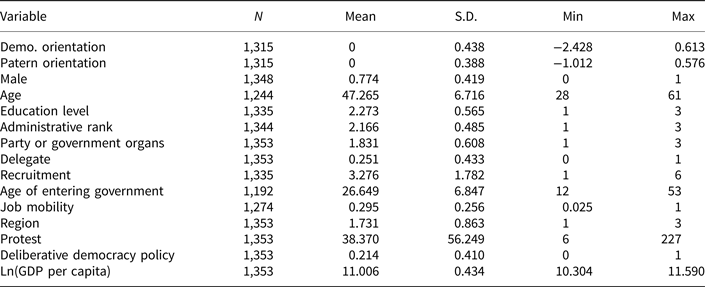
Respondents were selected using quota sampling on the basis of geographic regions and administrative levels. Twelve provinces representing all six major geographic regions of China were sampled.Footnote 1 The sample emphasizes officials at or above the deputy section/county level (fuchuji), who are the main bodies of decision-makings in localities. The respondents filled out the survey while receiving periodical trainings at province-level party schools. From March to June 2015, a total of 2,223 public officials completed the questionnaire anonymously. Table 1 presents a descriptive summary of the respondents. Respondents are composed of roughly three quarters male and one quarter female. Ninety percent of all respondents have college degrees or above; one in three hold advanced degrees. Respondents’ average age is 47.2; they have worked in the system for 20.3 years, on average, and have spent 5.4 years in their current positions. Respondents work in various departments including government, the party, legislature, legal systems, and state-owned enterprises. A quarter of them are at the deputy section/county level (fuchuji), nearly half of them are at the section/county level (zhengchuji), and one in five is at the deputy-bureau/department level (futingji).
Description of main variables

4. Results
4.1 Latent conception of democracy
We have anticipated that Chinese political elites’ conceptions of democracy resonate with elements of minben and the mass line. A multiple-choice question that directly measured their understanding of democracy asked ‘what do you think democracy means?’ Response choices included statements that describe direct democracy, electoral democracy, and the mass line, respectively. The results suggest that 32.4% of officials agree that democracy refers to the belief that ‘public officials are willing to listen to the people and make policies according to their will for the people,’ which precisely describes the minben guardianship and mass line. Interestingly, 33.7% understands democracy as direct democracy that ‘all major issues should be discussed by the people themselves, and decisions should be made according to the majority rule.’ Only 19.1% of the officials believe that democracy refers to representative democracy that involves elections.
To further diagnose the latent structure of Chinese elites’ understanding of democracy, we extracted survey questions that elaborated the guardianship notion and the mass line. The questions ask about how officials understand their relationship with the people, including (1) to what extent one believes officials are parents of the people; (2) to what extent one agrees that the mission of the officials is to obey upper-level officials; (3) to what extent one views himself as the servant of the people's will, and (4) to what extent officials should respond to people's need timely. Considering that many officials hold different notions on democracy, we also included questions that tapped the general relations between government and citizen and their views toward public participation. These questions address (5) to what extent the government and the people are in equal status in order to have direct conversation, (6) to what extent one believes people's participation can improve policy making, and (7) to what extent people's participation impacts social stability. A complete list of the questions is included in the Appendix.
We first used Principal Component Analysis to identify the inter-correlation of these questions (α = 0.46). The first principal component stands out to account for 30% of the total variance, suggesting that a dominant latent trait exists in one's responses to these questions. The second component accounts for 16% of the total variance, which suggests an orthogonal second dimension exists in their conception of democracy. We cross-validated the components using Latent Trait Analysis models and obtained almost identical results (r = 0.98).
We then performed Confirmatory Factor Analysis to identify the latent structure of officials’ conception of democracy. Figure 1 shows the loading patterns of items on two dominant latent factors. Five out of the seven questions load significantly (P <0.001) and substantially (>0.4) on the first common factor, and other two questions load on the second factor though insignificantly. The two-factor model fits well to the data (χ 2 = 70.82, df = 8, P <0.001) and is considerably better than three-factor models (χ 2 difference = 97.6, df difference = 5). The first latent variable, which we call democratic orientation, is manifested by five indicators: government–citizen equality, values of citizen participation, servants of people's will, responsiveness to the people's needs, and concerns of social stability. The second factor is manifested by two indicators: obedience to the upper-level authority and paternalism; we therefore call this factor authoritarian-paternalistic orientation. The results suggest that Chinese officials’ conception of democracy incorporates multiple dimensions including the Confucian tradition, the CCPs mass line doctrine, concerns of stability, views of public participation, and government–citizen relations, which is considerably different than the notion of democracy in the West. Hypothesis 1 is thus supported.
Two-factor confirmatory factor analysis model.

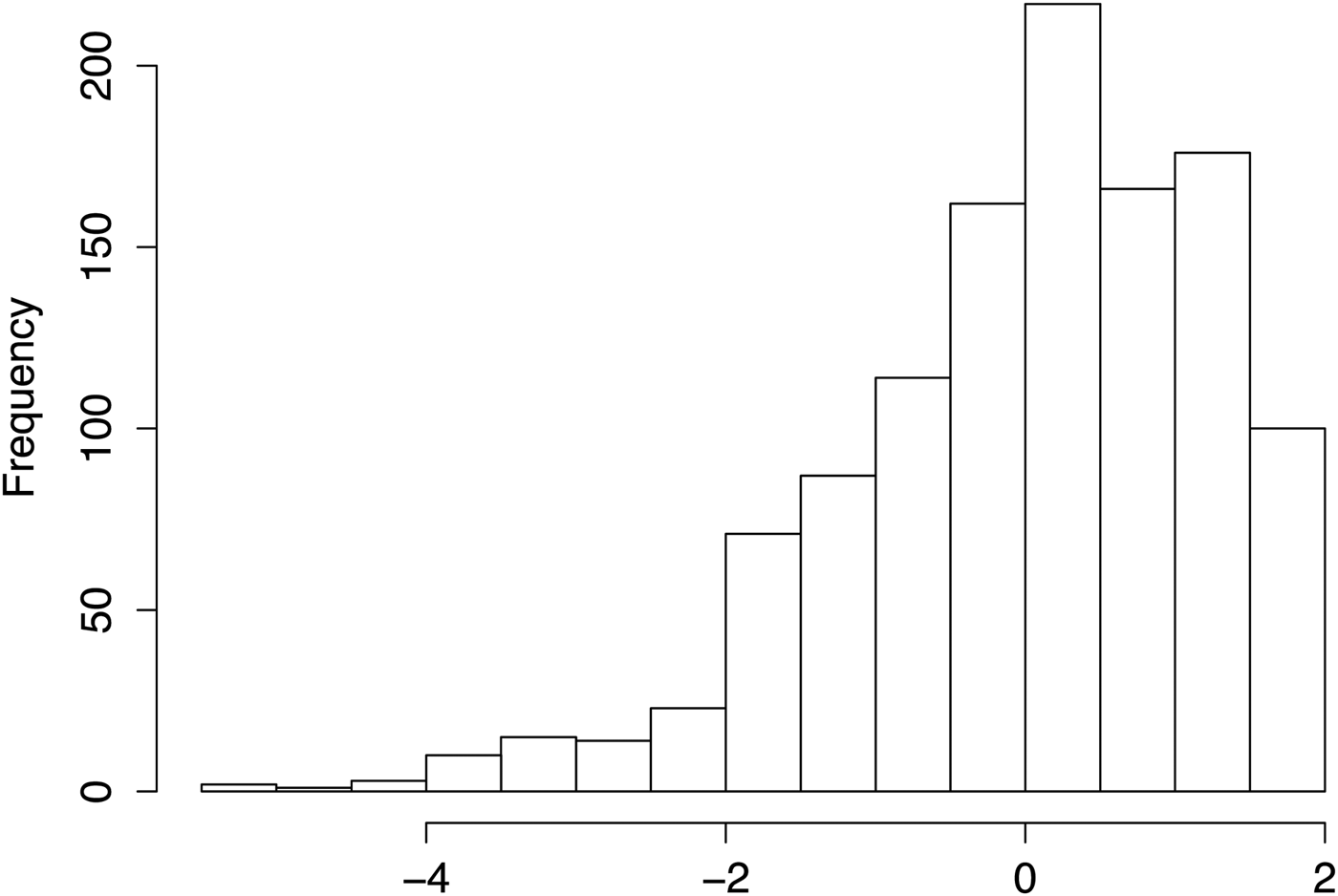
Figure 2 displays the distribution of the democratic orientation. It shows that Chinese officials vary substantially in terms of how they view their relationships with the people (mean = 0, S.D. = 1.26, medium = 0.28). While many officials consider themselves servants of people's will, a substantial body believes the government dominates the people, doubts the effectiveness of public participation, and are concerned that public participation may risk the social order. We now use the score of one's democratic orientation (the first common factor) as our main explanatory variable below because it is more significant and robust than the second factor. Note that different from the conventional meaning, we use the term democratic orientation in the Chinese sense to refer to the belief of equal status between the government and citizens, value for public participation in decision-making, less concern about stability, and the view of oneself as servant of the people.
Distribution of Chinese officials’ democratic orientation.

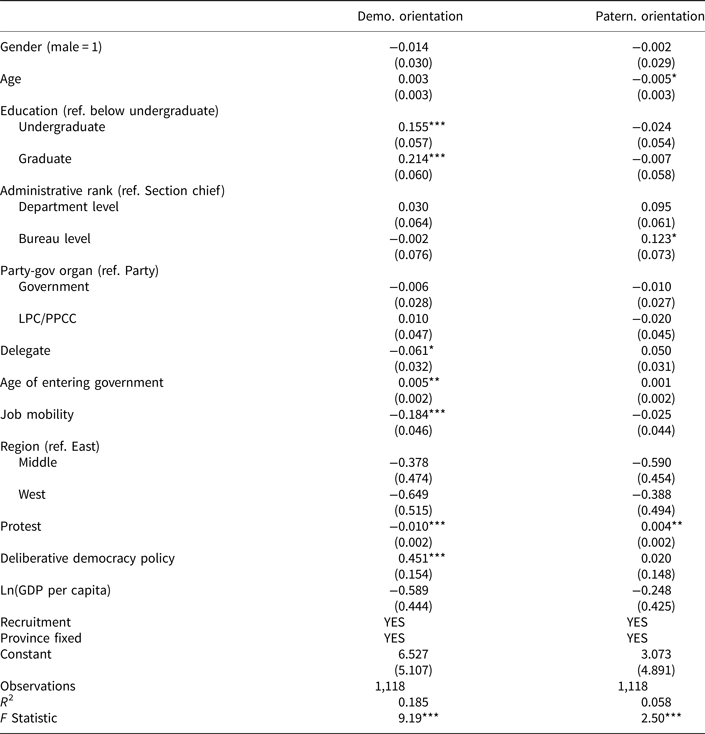
We now proceed to examine the second hypothesis, which aims to explain the significant variation in Chinese officials’ beliefs of democracy. We included three sets of explanatory variables. The first set of variables contains personal demographic information including gender, age, and education attainment. The second set captures officials’ political identity including administrative rank, type of units, role of delegation, age of entering government, and job mobility. And the third set of variables describes external social and institutional influences including the level of local protestsFootnote 2 and policies of deliberative democracy.Footnote 3 We also controlled for region-level variables including GDP per capita, and the region and province fixed-effects to detect the correlation more precisely. Table 2 displays the results of multiple regressions on Chinese officials’ democratic orientation and authoritarian-paternalistic orientation. The dependent variables in the regression models were the predicted scores of democratic orientation and authoritarian-paternalistic orientation from the above Confirmatory Factor Analysis. The independent variables included personal and political characteristics, as well as region-level variables.
Regression of officials’ democratic and paternalistic orientations

Standard errors are given in parentheses. ***P < 0.01, **P < 0.05, *P < 0.1.
Three general patterns manifest in the ordinary least squares (OLS) regressions that explain the variation in officials’ democratic beliefs (Table 2). First, individuals’ demographic characteristics can influence one's political orientation, though to a limited extent. Consistent with our expectation, the more educated officials are more likely to hold democratic orientation in viewing the relationship between officials and citizens, controlling for any other individual and regional level variables. We did not find gender or age having a substantial impact. Second, officials’ political status and experiences exert more substantive and significant influences on their political orientations. Compared to the lower level officials, the Bureau level officials significantly prefer paternalistic orientation with an increase of 0.123. Officials who are the elected/selected delegates of local people's congress, political consultative conference, and local party congress are less likely to hold a democratic orientation. Interestingly, the older the respondents enter into party and government units, the more likely they perceive official–citizen relation in a democratic manner. One-year lateness of entering the government is significantly associated with 0.005 units’ increase in the score of democratic orientation. Job mobility, which is measured by the ratio of years serving the current position with the years of serving government in total to capture the speed of position mobility, is significantly negatively associated with democratic orientation. The slower the respondents mobilize over positions, the more likely they are to oppose democratic orientation.
Third, the variation of political orientation also attributes to region-level social and institutional factors. After controlling for individual level characteristics, the volume of local protests significantly influences both one's democratic orientation and paternalistic orientation but in different directions. Local protest is negatively associated with officials’ democratic orientation but positively associated with paternalistic orientation. It suggests that officials in regions with larger threats of social stability are less likely to hold democratic orientations and more likely to hold authoritarian and paternalistic views. Lastly, institutional influences matter – officials from provinces that enforced the policy of developing socialist deliberative democracy were significantly more likely to prefer democratic orientation.
4.2 Perception of deliberative democracy
We next probe officials’ perceptions of the new socialist deliberative democracy and the sources of differential perceptions. The survey solicited officials’ attitudes toward deliberative democracy using two questions. The first question asks ‘What do you think deliberative democracy is most effective for?’ The other question uses public hearing as a concrete form and asks ‘which of the following statements about public hearings best resonate with your beliefs?’ The complete questions are available in the Appendix. We find that 24.1% of the public officials believe deliberative democracy is most effective for improving decision-making, 18.9% values its function of promoting public participation, 16.5% considers deliberation as a means of reconciling interests. In addition, 14.2%, 10.3%, and 9.8% of the officials emphasize that deliberative democracy is most useful for supervising public officials, gaining public support, and resolving conflicts, respectively.
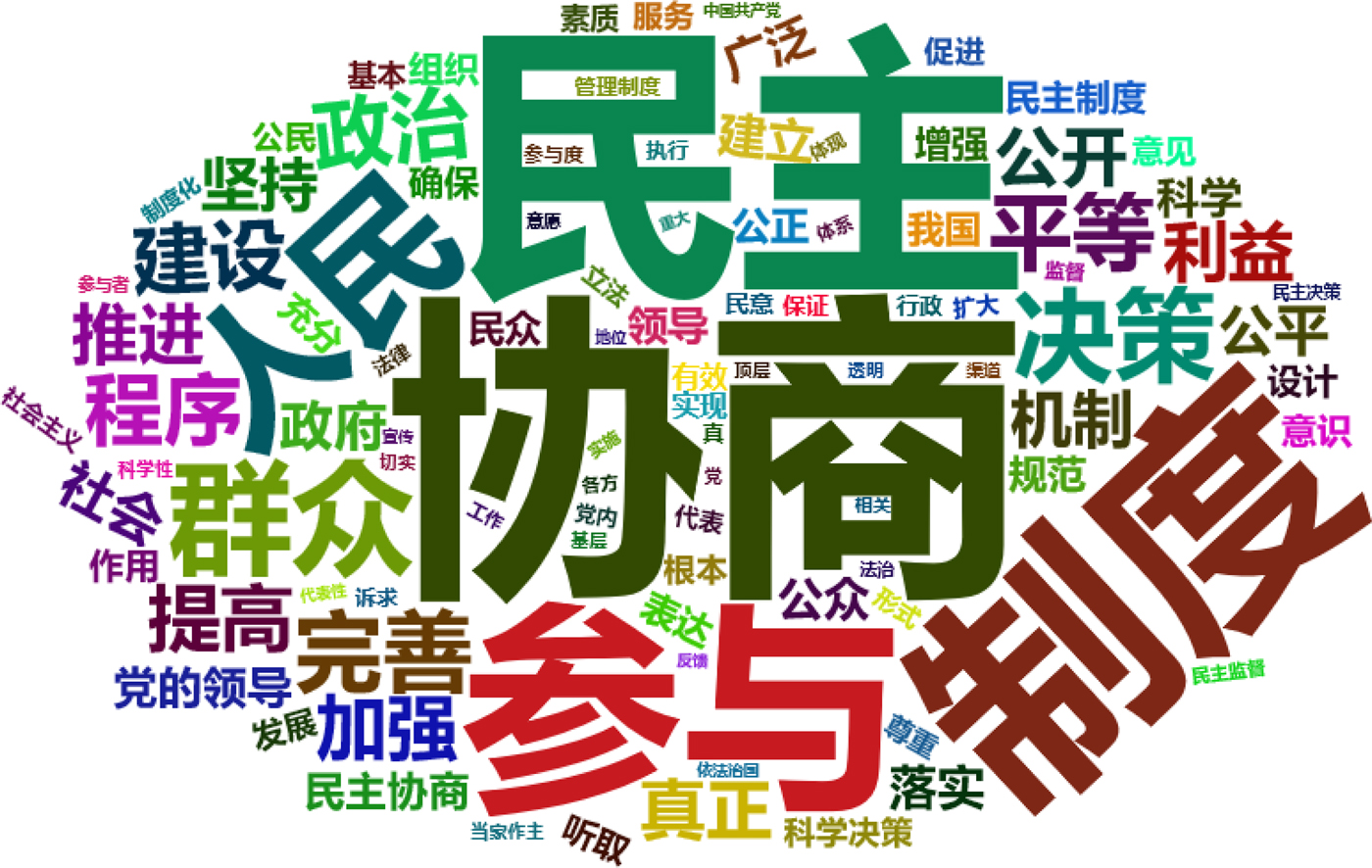
Intuitively, officials’ responses fell into two streams: valuing democratic governance including democratic decision-making, public participation, and supervision of power, versus utilitarian considerations that serve the strengthening of the authoritarian rule including appeasing conflicts, reconciling interests, and gathering public support. The dual value system of deliberative democracy in Chinese officials is consistent with officials’ policy recommendation to advance deliberative democracy, which was measured with an open-ended question ‘In your opinion, what are the key elements to promote the institution building of deliberative democracy in China?’ We analyzed the texts of officials’ answers and presented the frequencies of popular words in Figure 3. The figure exhibits that the most popular value system Chinese officials held is the value of democratic governance, which is represented by words such as democracy (民主), participation (参与), and decision-making (决策). Meanwhile, some officials understood the deliberative democracy as the ruling strategy, which was depicted by words such as masses (群众), party leading (党的领导), and interest (利益).
Word cloud of Chinese officials’ perception on deliberative democracy.

We anticipate the contradictory views of deliberative democracy are attributed to officials’ latent democratic orientations. Results from T-tests show that officials who view deliberative democracy in terms of democratic governance have consistently higher scores of democratic orientations than those who emphasize utilitarian functions in consolidating the status quo. Figure 3 displays the average democratic orientations of officials who value democratic governance (top panel) versus those who emphasize utilitarian functions (bottom panel). It shows that officials who value the objective of promoting public participation are significantly more democratic oriented (M = 0.05) than others who do not share such objective (M = −0.07, P <0.001). Similarly, those who understand deliberation as a method of improving decision-making (M = 0.05) have significantly higher scores of democratic orientation than other respondents (M = −0.13, P <0.001). On the contrary, officials who emphasize the function of deliberation in reconciling interests (M = −0.04) are significantly less democratic-oriented than others (M = 0.04, P <0.01). Similarly, officials who understand deliberative democracy as a means for resolving conflicts are less democratic oriented (M = −0.12) than others (M = 0.05, P <0.01). Officials who believe deliberative democracy is useful for gathering public support are less democratic oriented (M = −0.03) than others who do not emphasize this function (M = 0.01, P <0.05).
We replicated the analyses on another question, which referred to public hearing as a concrete form of deliberative democracy, and found the same pattern. As shown in Figure 4, officials with higher scores of democratic orientation consistently view public hearings positively as a way of improving the transparency of decision-making (M = 0.09) and promoting public participation (M = 0.07). The less democratic oriented officials, on the other hand, are significantly more likely to consider public hearings as a political show for the purpose of promotion (M = −0.29), or a procedure that does not produce any substantial impacts (M = −0.11).
Chinese officials’ perceptions of deliberative democracy by democratic orientation.

Hypothesis 3 is thus supported: Chinese officials exhibit opposite views toward the newly endorsed deliberative democracy according to their latent democratic orientations. More democratic-oriented officials in the Chinese sense – those who view themselves as servants of the people who should respond to the people's needs, believe government and citizens are equal, value public input, and are less concerned about risks of social stability – tend to view socialist deliberative democracy positively as a means to improve democratic governance. Contrarily, those who are less democratic inherently tend to emphasize the utilitarian functions of maintaining social stability and collecting support. Some even view public deliberation as an instrument for career advancement or window dressing that yields little actual impacts (Figure 5).
Chinese officials’ perceptions of public hearings by democratic orientation.

4.3 Behaviors of public engagement
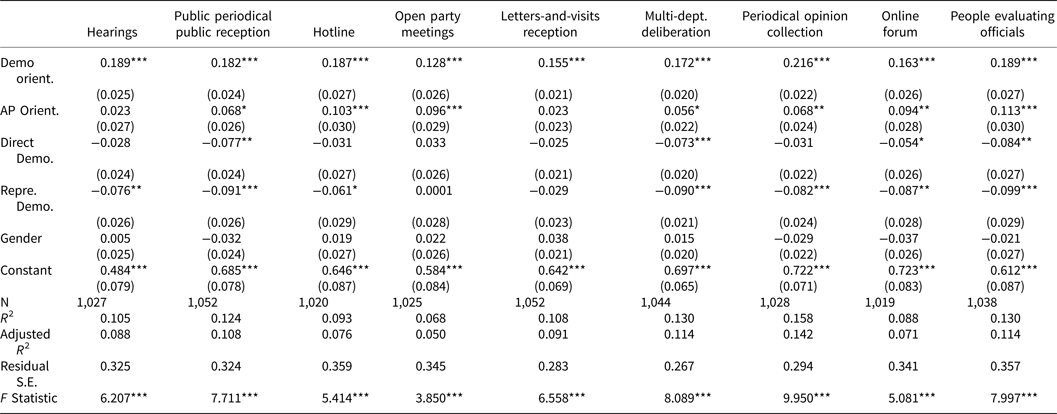
Lastly, we test the fourth hypothesis, which posits that officials’ behavioral patterns of practicing the new deliberative democracy align with their latent democratic orientations. We anticipate that the more democratic oriented an official is, the more likely he is to engage the public in daily work; whereas the more paternalistic and authoritarian an official is, the less likely he is to engage the public. The survey asks officials to report how often they engage in a list of behaviors that are considered to be practicing deliberative democracy in the Chinese context. The behaviors include public hearings, online forums, mayor hotlines, reception of visits and letters, open party meeting, and multi-department policy deliberation, as well as collecting opinions from the people periodically, and having their performances evaluated.Footnote 4 The complete question is available in the Appendix.
We formulate the following multiple regression to test this hypothesis. The model is written as follows:
 $$\hbox{DP} = \; \beta _0 + \; \beta _1\hbox{DemoOrient} + \; \beta _2\hbox{AP}\; \hbox{Orient} + \; \beta _3X + \; \varepsilon $$
where the dependent variable DP (deliberative practices) denotes the linear transformation of individual-level frequencies of public engagement. The independent variables are DemoOrient, which denotes one's score of democratic orientation manifested by five indicators, and AP Orient denotes one's authoritarian-paternalistic orientation manifested by two indicators. X is a vector of control variables that include one's demographic information such as age group, gender, level of education, and political identities including administrative levels and years in current position. We also control for one's conception of democracy that has three categories: deliberative democracy, representative democracy, and direct democracy. We performed OLS regressions and report the estimated coefficients in Table 3.
Regression analysis for Chinese public officials’ public consultative behaviors

Standard errors are given in parentheses. ***P < 0.01, **P < 0.05, *P < 0.1.
Control variables including age group, level of education, administrative levels, and years in current positions are included but not reported.
The results show that consistent across all nine means of practicing deliberative democracy, democratic orientation has a significant and positive effect. A unit increase of one's democratic orientation is associated with 0.12–0.21 increase in frequencies of public consultation (P < 0.01), controlling for individual characteristics and one's view of democracy. It suggests that democratic-oriented officials in the Chinese context tend to actively employ various means to interact with the people. Interestingly, counter to our expectation, authoritarian-paternalistic orientation is also positively associated with some practices of deliberative democracy, though the effect is much less substantial. It suggests that authoritarian and paternalistic-oriented officials tend to use conventional means such as periodical public reception, hotline, and periodical opinion collection to hear from the people. It is possible that these officials view themselves as the parents of the people who should learn about public opinion periodically, or they simply follow instructions from the upper-level authority. The effect of authoritarian-paternalistic orientation is, however, not significantly associated with more authentic forms of public deliberation such as public hearing, or dealing with people's complaints in a face-to-face manner such as letters-and-visits reception. In addition, one's view of democracy also plays into their manners of daily decision-making. Compared with those who endorse deliberative democracy, officials who endorse representative democracy are consistently and significantly less likely to consult the public. It is plausible that officials who endorse representative democracy hold views of elitism, thus believing that merited officials should make decisions on behalf of the people. We did not find significant effects of personal characteristics in influencing deliberative practices.
5. Discussion
The prospect for democracy cannot be fully understood without taking account of the key players. Elites, particularly their beliefs of democracy, have profound influences on political development. Previous literature on deliberative democracy has largely overlooked elites’ role in facilitating or inhibiting open governance that engages the public in political processes. This study fills the gap by zooming in on an authoritarian context where the progress of democracy is particularly premised on governmental behaviors. We find that many Chinese officials understand democracy according to the Confucian tradition of minben and the CCP's political heritage of mass line, that officials should listen to the people and make benevolent policies for them. Personal characteristics, political identities, and social and institutional factors all influence the understanding of democracy. Elites’ attitudes and behaviors toward the new socialist deliberative democracy align with their latent beliefs. While many officials embrace deliberative practices as a genuine means to improve democratic governance, others emphasize the utilitarian functions of consolidating the party rule, or believe it is merely a political show. Democratic-oriented officials are more likely to engage the public in daily decision-making, especially through interactive channels such as public hearing and online forum.
Our study offers new insights about authoritarian elites’ conception of democracy. Consistent with the existing literature, we find that democracy, including the new deliberative democracy, is commonly understood in ways that coincide with the cultural and political tradition (Shi and Lu, Reference Shi and Lu2010; Lu and Shi, Reference Lu and Shi2015). It suggests that the Chinese version of deliberative democracy inherits, rather than imports, its core concept from the native political heritage. We further identify personal and social characteristics that factor in the beliefs about democracy. Our findings suggest that aside from cultural and institutional impacts, authoritarian officials are individual actors whose values are deeply shaped by personal experiences and political identities. Moreover, by identifying a latent structure of the belief of democracy, we reveal that elites’ notions are composed of multiple dimensions, including the guardianship philosophy from the Confucian tradition, the CCP's political indoctrination, concerns of stability, value of public input, and view of government–citizen relationship.
Although the set of notions are considerably different from the West, our study suggests that they may take a democratic turn given the right kind of pressure and institution. Officials who genuinely embrace these values, including the duties of listening to the people, not only view deliberative democracy as the new institutional source for improving democratic governance, but also actively engage the people in their daily work via various methods. The legitimization of deliberative democracy, coupled with elites’ genuine beliefs of democracy, can open up promising ground for public participation, democratic decision-making, and supervising power. A growing body of citizens with increasing access for politics, in turn, may transform authoritarianism toward higher levels of responsiveness, transparency, and accountability. To that end, deliberative democracy may propel substantial political development in China.
The consequence that individual leaders and localities have significant leeway in practicing deliberative democracy can be double-edged, however. Democratic deliberation and consultation may vary in authenticity, substance, and sustainability. As our paper shows, many officials view deliberative democracy as a functional tool to appease conflicts, reconcile interests, and gather public support. This different approach of promoting deliberative democracy, apparently, will lead to distinct outcomes. Borrowing the legitimacy that deliberative democracy grants while exploiting the utilitarian value of maintaining stability, the CCP may develop a new strategy of co-optation that eventually strengthens the governing capacity and consolidates the party rule. In that sense, deliberative practices can turn to window-dressing. Furthermore, the practices can become vulnerable to the turnover of leaders. After all, officials lack incentives to appeal to the people without procedural accountability. Embedding layers of deliberative institutions on top of an authoritarian system may produce a resilient one-party system in the long run: deliberative authoritarianism can serve a middle ground without conceding to electoral democracy.
There are some limitations to the conclusions we are able to draw given the fact that the survey data were with limited reach. First of all, the survey was limited by the sample, which was drawn based on administrative levels and geographical regions. Future studies should aim to acquire more nationally representative samples of Chinese officials or match the data with statistics of Chinese officials once they are publicly available, to gain a comprehensive scope of understanding. Officials’ responses may have been self-censored by political fear. Although respondents in our study remain anonymous, officials may have been concerned to report authentic information. In the future, researchers may consider methodological efforts that minimize the possibility of social desirability. Moreover, surveys going forward should aim to include a broader list of questions that capture more diverse dimensions of the conception of democracy and behaviors of public engagement. Future studies should particularly explore elites’ role in adopting or impeding innovative – and more authentic – forms of deliberative democracy in authoritarian context. Last but not least, the current data did not allow us to examine how elites impact the choice of topics for deliberation. It is worth exploring in future studies how government officials determine which issues are permitted or banned from deliberation.
6. Conclusion
Our study enriches the discussion of deliberative democracy by bringing forward the key role political elites play. Drawing on a new survey of Chinese officials, we reveal that personal, social, and institutional factors alongside cultural and political traditions have deeply shaped elites’ understandings of democracy, especially the new socialist deliberative democracy. Our study suggests that authoritarian deliberation may lead toward distinct prospects for democracy, contingent on to what extent elites embrace it as a means to improve democratic governance, or view it as a pragmatic tool to consolidate the status quo. Scholars in the future may extend the study of political elites in advancing or impeding democratic governance to various contexts.
Acknowledgements
This work was made possible by the Larry Yung Dissertation Fellowship at Stanford University, the National Social Science Fund of China [grant number 15CZZ036], and Beijing Social Science Foundation [grant number 16ZGB005]. The authors would thank Jiagang Chen and the survey team for sharing the data. We are grateful for Baogang He, Deyong Ma, Hendrik Wagenaar, Mark Warren, James Fishkin, Jon Krosnick, Jennifer Pan, and the anonymous reviewers for their comments on earlier drafts of this article. Correspondence concerning this article should be addressed to Kaiping Zhang, 243 Ming Building, Department of Political Science, School of Social Sciences, Tsinghua University, Beijing, China, 10084. Email: kaipingz@tsinghua.edu.cn.
Kaiping Zhang is an assistant professor in the Department of Political Science at Tsinghua University. She received her Ph.D. from the Department of Communication at Stanford University, her M.A. degree from Michigan State University, and B.A. degree from Tsinghua University. Her research interest ranges from democratic governance, public opinion, the psychology of political behavior to the role of media in political engagement.
Tianguang Meng is an associate professor in the Department of Political Science at the School of Social Sciences in Tsinghua University, and the director of The Research Center on Data and Governance. His research interest includes Chinese government and politics, public opinion and policy making, Internet governance, comparative political economy, and political methodology such as big data analytics and experimental methods. His articles have been published in Comparative Political Studies, Global Environmental Change, Social Science Research, International Journal of Public Opinion Research, and Cass Journal of Political Science. He earned his B.A. and Ph.D. degrees in political science from Peking University. Previously, he was a visiting scholar at Harvard University and University of California, San Diego.
Appendix: A Survey on Developing Socialist Deliberative Democracy
Democratic orientations
1. On a scale of 1–5, where 1 indicates ‘extremely disagree’ and 5 indicates ‘extremely agree,’ what do you think of the following statements?
(a) The mission of officials is to follow upper-level authorities
(b) The mission of public officials is to serve the people
(c) Officials are parents of the people
(d) Public officials must respond to peoples need timely
2. On a scale of 1–10, where 1 indicates ‘extremely unimportant’ and 10 indicates ‘extremely important,’ to what extent do you think public participation in decision-making impacts social stability and development?
3. On a scale of 1–5, where 1 indicates ‘absolutely impossible’ and 5 indicates ‘absolutely possible,’ to what extent do you think the party and the government can converse with the people in an equal manner?
4. On a scale of 1–5, where 1 indicates ‘extremely useless’ and 5 indicates ‘extremely useful,’ to what extent do you think people's participation in policy making is useful in improving policies?
Attitudes toward deliberative democracy
1. What do you think deliberative democracy is most effective for? Choose the three statements that best describe your own view.
(a) Promoting public participation
(b) Reconcile conflicting interests
(c) Improving scientific decision-making
(d) Supervising public officials
(e) Resolving conflicts and disputes
(f) Gathering public support
2. Which of the following statements about public hearings best resonate with your beliefs?
(a) Make government decision-making more transparent
(b) Allow people to participate in decision-making
(c) Supervise public officials
(d) Make the implementation of policies more smooth
(e) A performance-driven political show
(f) Merely a procedure that does not have much substantial effect
Practices of deliberative democracy
1. On a scale of 1–4, where 1 indicates ‘never,’ 2 indicates ‘occasionally,’ 3 indicates ‘sometimes,’ and 4 indicates ‘very often,’ how do you describe your or your department's daily exercise of deliberative democracy?
(a) Public hearings
(b) Reception of visits and letters
(c) Hotline
(d) Open party meeting
(e) Deliberation between departments
(f) Collect opinions from the people periodically
(g) Open online forums
(h) People evaluate officials’ performance annually