


Introduction
Diagnostic stewardship is an evidence-based framework designed to ensure the right test is ordered for the right patient, at the right time, in the most appropriate care setting, with results reported and interpreted in ways to encourage the right action. Misuse or overuse of diagnostic tests, tests performed in the incorrect patient care setting, inappropriate repeat or serial testing, and unnecessary laboratory test send-outs all contribute to escalating healthcare costs and inefficient care. These practices can also extend hospital length-of-stay (LOS), drive inappropriate antimicrobial use, inadvertently identify surveillance-based, not clinically relevant, healthcare-associated infections (HAIs), and promote the development of antimicrobial resistance. Diagnostic stewardship enhances the chances of achieving the right diagnosis which can improve antimicrobial use and reduce antimicrobial resistance, resulting in better patient outcomes, more efficient care, and improved institutional costs and metrics. Reference Fabre, Davis and Diekema1
In the United States, diagnostic testing can also impact the hospital-acquired condition (HAC) Reduction Program (in part through higher Laboratory-Identified events [Lab-ID] from unnecessary testing), the Center for Medicare and Medicaid Services (CMS) Star Rating Program, and the Leapfrog Safety Grade Program. Hospitals that perform poorly in these programs can face consequences, including a 1% reduction in Medicare payments for HAC penalties, and reputational consequences from low CMS Star ratings or poor Leapfrog grades.
Recognizing the value of stewardship interventions, the Centers for Disease Control and Prevention (CDC) released its “Core Elements of Hospital Diagnostic Excellence” in 2024, describing key steps needed to improve diagnoses in the hospital setting. 2 Essential to this recommendation was the application of diagnostic stewardship to commonly misused microbiologic tests such as Clostridioides difficile, urine cultures, blood cultures, and multiplex molecular testing panels. A business case analysis for key stakeholders helps support hospital adoption. Prior work has demonstrated the importance of developing business cases for infection prevention and antimicrobial stewardship, showing that a clear and objective financial rationale can enhance program support. Reference Perencevich, Stone, Wright, Carmeli, Fisman and Cosgrove3
The goal of this article is to provide a simplified framework for business-case development for diagnostic stewardship programs within U.S. healthcare systems. This article addresses key economic measurements related to the diagnostic pathway with an emphasis on the financial impact of a stewardship intervention. To calculate costs, practical measurable outcomes are employed using estimates available from public databases, published literature, or institutional data. Key performance metrics are defined with the goal of improving healthcare quality, safety, and efficiency. Finally, concise business cases for five high-yield diagnostic test stewardship interventions are provided.
Methodology
Framework for business-case development
Defining the scope and objectives
The first step in business-case development of a medical center or health care systems diagnostic stewardship program is to define the scope and objectives. The scope clarifies the recommended tests or interventions of focus, which are chosen based on alignment with institutional priorities, national safety goals, clinical outcomes, and operational feasibility. In general, it is important to guide decisions about high-value, high-impact interventions with diagnostic utilization data. Common high-yield, low effort targets include respiratory molecular multiplex panels, advanced molecular diagnostics (broad-range polymerase chain reaction, metagenomic next-generation sequencing, microbial cell-free DNA testing), procalcitonin levels, blood, respiratory, and urine cultures, and C. difficile testing. Included within the scope for each test or intervention of focus are the following:
-
• Clear definition of the problem.
-
• Description of the current state of the diagnostic testing or intervention undergoing evaluation, including an annual cost analysis.
-
• Outline of the patient care setting(s) where the diagnostic stewardship intervention will occur (e.g., ambulatory office setting, emergency department, inpatient intensive and non-intensive care units).
-
• Identification of key stakeholders for the proposed stewardship intervention.
The objectives should clearly state the goal of the stewardship intervention. In general, these goals are measurable and clinically meaningful, anchoring on avoiding tests that do not bring clinical value to achieve the proper diagnosis, in concordance with national guidelines. While a cardinal value is enhancing clinical outcomes, with associated reductions in unnecessary antimicrobial days of therapy or reducing hospital LOS, additional focus should be on the expected financial benefits and reputational advantages of the intervention with reference to the HAC Reduction Program, value-based purchasing (VBP), and CMS Star Ratings. Reference Zakhour, Haddad and Kerbage4–6
Calculating the costs of the current state of the diagnostic test targeted for intervention
As one of the core principles of diagnostic stewardship programs is to target inappropriate test use, it is necessary to first calculate the cost of the current state of a diagnostic test targeted for stewardship intervention. By having a “baseline” cost estimate, the total net return on investment (ROI) of the proposed intervention can be calculated. We provide these estimates for five specific cases, but further estimates can be made with the following approach used in this report. Baseline costs can be broken into the following categories, where applicable:
-
• Laboratory costs: test cost approximation includes reagents and consumables, instrumentation, and overhead needed to perform the testing in current state. This information can be obtained by hospital laboratory leadership as it is calculated routinely in annual budget analyses.
-
• Information technology (IT)/electronic health records (EHR) costs: it can be assumed that the IT/EHR costs for a specific test are small in comparison to the total IT/EHR related activities of a given institution and are fixed in nature. To account for this, baseline IT/EHR costs can be assumed to be $0.
-
• Clinical costs: clinical costs will vary depending on the test targeted for intervention and can include costs associated with antimicrobial use, isolation precautions, or test-related adverse events as well as current penalties or value-based payments. The impact on hospital LOS can be considered.
Antimicrobial costs can be calculated as days of antimicrobial therapy or cost per dose using cost estimates obtained from pharmacy acquisition costs or 340B ceiling pricing (if applicable). 7,8 If those are unavailable, average wholesale acquisition costs can be used as rough approximations. Imaging costs can be calculated using internal data from hospital accounting systems Reference Carroll and Lord9 (if available), Medicare cost reports, 10 or from published literature. Isolation and test-related adverse event costs can be approximated using published literature.
Calculating the costs of diagnostic stewardship intervention
Diagnostic stewardship programs require investment at multiple levels. Program investments include project management support, informatics resources for EHR clinical decision support (CDS), and analytics infrastructure for tracking test utilization and outcomes. Clinical investments include physician/provider, pharmacist, and laboratory support for guideline development and education. Finally, laboratory costs may include new test platform acquisition and instrument verification or validation with additional potential longstanding effects on operational budgets depending on reagent and consumable costs, and any additional overhead costs related to sample processing.
Despite the multi-level investment needed to support diagnostic stewardship programs, it is important to note that most hospitals already have the infrastructure in place to easily develop such initiatives. Since the release of CDC’s Core Elements of Hospital Antibiotic Stewardship Programs (ASP) in 2014, 11 which included formal financial, information technology, and human resources support as a core element of a dedicated antimicrobial stewardship program, and the subsequent Center for Medicare and Medicaid Services (CMS) final rule in 2019 mandating formal ASPs, 12 most hospitals have implemented formal ASPs, with nearly 95% of acute care hospitals meeting all seven of CDC’s hospital core elements in 2021. 13 Although additional investments would be needed to expand these programs to include more robust diagnostic stewardship initiatives, the framework for such programs is likely already in place at most centers, mitigating many of the upfront implementation costs. In some settings, some of these costs will even be fixed, allowing for rapid adoption.
Cost savings should incorporate three categories of return:
-
1. Direct savings from reduced unnecessary testing
-
○ Calculated as expected number of tests reduced, multiplied by cost per test.
-
• Test volume reduction calculation can be based on internal data analysis (compared to hospital baseline) or from proportion of overused tests from the published literature.
-
• Test cost can be obtained by laboratory leadership as there is likely some variation in price based on vendor, location, and test volume.
-
-
-
2. Downstream cost avoidance
-
○ Calculated through reduction in antimicrobial and imaging costs, time in isolation precautions, and test-related adverse events.
-
• Antimicrobial costs can be calculated as days of antimicrobial therapy or cost per dose avoided using cost estimates as described above.
-
• Imaging, isolation, and test related adverse event costs can be approximated as described above.
-
-
-
3. Reduced penalty-based reductions (HAC Reduction Program) and incentive-based payments (VBP)
-
○ HAC reduction program and VBP performance are multivariate and influenced by numerous clinical, operational, and environmental factors.
-
○ Including financial savings from diagnostic stewardship introduces several limitations: the savings are difficult to attribute, challenging to predict, highly dependent on external benchmarks, and often categorized as soft or avoided costs rather than direct savings (revenue generating) compared to the current state VBP adjustment.
-
Modeling should include conservative and best-case estimates to enhance credibility.
Calculating ROI using expected savings
Once the cost and anticipated savings of the diagnostic stewardship intervention are completed, ROI can be calculated using expected savings as a simplified proxy. As hospital budgets operate on an annual cycle, analysis should prioritize demonstrating financial return within the next fiscal year. However, longer time frames–two to three years–should be considered for initiatives requiring capital investments, such as new testing platforms, where a longer ROI is expected.
-
• Expected savings: Calculated by subtracting future state annual costs (with incorporated savings) from current state annual costs.
Ongoing evaluation of key performance metrics
Measures of success need to be defined prior to implementation and monitored prospectively after the diagnostic stewardship intervention has been put in place. Utilization metrics include test volume per patient-days or encounters. Secondary downstream measures include antimicrobial days of therapy, LOS, and publicly reported HAI incidence. 14 Financial outcomes should capture test cost avoidance, operating margin improvement, penalty dollars avoided, and incentive dollars earned. External outcomes may include performance in CMS Star Ratings and Leapfrog Safety Grades, which have both financial and reputational implications. Reference Zakhour, Haddad and Kerbage4,6,Reference Davis, Painter, Lakkad and Dare15
Business case examples
Below are examples of five diagnostic stewardship targets that are often inappropriately used in healthcare settings. Each test chosen was vetted by subject matter experts (SMEs) in diagnostic stewardship through the Society for Healthcare Epidemiology (SHEA) Diagnostic Stewardship Interest Group and was based on literature review supporting diagnostic stewardship strategies to improve clinical care and reduce unnecessary costs. Reference Davis, Painter, Lakkad and Dare15–20 The impact magnitude, implementation feasibility, and resource intensity were also considered when curating this list, and various strategies were provided, when available, for local adoption.
To design these business case examples, certain assumptions were made by the committee to facilitate development. First, all cost analyses were estimated for a typical 200-bed community hospital with 20 intensive care unit beds. Cost assessments for other types of healthcare facilities such as critical access hospitals, large academic medical centers, or hospitals that serve specific populations (eg, oncology) would need to be adjusted. Second, for each diagnostic test, a “standard practice” scenario was defined to generate a baseline annual cost for each test prior to the stewardship intervention. Each “current state” represents a common real-world example for each test’s stewardship practices in U.S. healthcare facilities; all potential testing options were not modeled. The “standard practice” scenarios for the five business case examples include:
-
1. C. difficile testing: One step testing process (PCR) available and ordered at clinician discretion.
-
2. Urinalysis/urine culture (UA/Ucx): UA and Ucx ordered at clinician discretion as separate orderables (no link between UA result and Ucx performance).
-
3. Procalcitonin (PCT): test available in-house and is readily orderable by clinicians; no stewardship in place.
-
4. Multiplex respiratory pathogen panels: Available in the outpatient (OP)/emergency department (ED)/inpatient (IP) setting and ordered at clinician discretion; no stewardship in place.
-
5. Blood cultures (Bldcx): Test ordered at clinician discretion, no stewardship or CDS tool (CDST) available.
For each business case example, the scope, objectives, description of the intervention, current state cost analysis, future state cost and savings analysis, and expected savings are described using the framework established above.
Clostridioides difficile testing
Diagnostic challenges in Clostridioides difficile infection (CDI)
Clostridioides difficile infection (CDI) is associated with significant morbidity, mortality, and healthcare costs. Primary CDI increases healthcare expenditures by approximately $24,000 per patient, with even higher costs for recurrent infection. Reference Malone, Armstrong, Gratie, Pham and Amin21,Reference Zhang, Palazuelos-Munoz, Balsells, Nair, Chit and Kyaw22 Hospitals are also subject to penalties under the Medicare HAC Reduction Program, where hospital-onset CDI (HO-CDI) accounts for 16.7% of the performance score. 23
CDI is a clinical diagnosis supported by laboratory testing, but hospitalized patients may experience diarrhea for many reasons and frequently have asymptomatic C. difficile colonization. Reference Pora, Ng-Wong and Donskey24,Reference Riggs, Sethi, Zabarsky, Eckstein, Jump and Donskey25 Highly sensitive assays such as nucleic acid amplification tests (NAAT) and glutamate dehydrogenase (GDH) immunoassays cannot distinguish colonization from active infection, leading to overdiagnosis if used alone. Toxin immunoassays are more specific but less sensitive and may miss true infections. Current guidelines therefore recommend a two-step algorithm using NAAT and/or GDH screening followed by toxin A/B immunoassay testing. Reference Kelly, Fischer and Allegretti26 Implementation of two-step testing has been associated with an approximate 50% reduction in HO-CDI and a 40% reduction in CDI-specific antibiotic use. Reference Turner, Krishnan and Nelson27,Reference Moffa, Carr and Shively28
Diagnostic stewardship interventions for CDI
The two primary diagnostic stewardship interventions for CDI are the two-step testing described above, and clinical decision support (CDS) to restrict repeat testing and testing of patients on laxatives (unless the laboratory or infection prevention is contacted for permission), with both interventions likely being additive in impact (see Supplementary Materials (SM) Table 1). For example, CDS combined with testing restrictions achieved a 33% reduction in test ordering and a 57% reduction in HO-CDI rates at a single academic center. Reference Khuvis, Alsoubani, Mae Rodday and Doron29 On a larger scale, the Henry Ford Health system reported net savings of nearly $7 million across five hospitals, roughly $1.4 million per hospital, with two-step testing and hard stop rules limiting repeat testing and testing in the setting of recent laxative use. Reference Shallal, Cherabuddi and Podsiad30
Return on investment
The ROI for C. difficile diagnostic stewardship is driven by reduced unnecessary testing, less antibiotic use for false positive tests, fewer Lab-ID events, and avoided delays in hospital discharge. Implementing a two-step algorithm combined with CDS can feasibly reduce C. difficile testing by 33%, and Lab-ID events by 75%, making it a cost-effective strategy (see SM Table 1). Reference Boly, Reske and Kwon18,Reference Turner, Krishnan and Nelson27,Reference Khuvis, Alsoubani, Mae Rodday and Doron29,Reference Rock, Abosi and Bleasdale31,Reference Madden, Cox, Poulter, Lyman, Enfield and Sifri32
Urine culturing
Inappropriate urine culture use in patients with asymptomatic bacteriuria
Asymptomatic bacteriuria is a common condition that does not merit antibiotic treatment outside of select indications (pregnancy, urologic procedures with potential for mucosal injury). Reference Nicolle, Gupta and Bradley33 However, inappropriate urine culture testing in patients without urinary tract infection (UTI) symptoms is frequently performed by providers, resulting in unnecessary antibiotic treatment, adverse events, and increased healthcare costs. Reference Leis, Rebick and Daneman34 Additionally, inappropriate urine culture testing may impact the number of reportable catheter-associated urinary tract infections (CAUTIs) by healthcare facilities as the urine culture result is a key component of the National Healthcare Safety Network (NHSN) definition. This contributes to the HAC score of hospitals that participate in the CMS value-based purchasing program which affects CMS payments. 35
Diagnostic stewardship interventions to prevent unnecessary urine cultures
When evaluating a patient for a UTI, conditional urine culturing is when a urine culture is only performed if predefined UA criteria indicating inflammation are met such as pyuria. Cutoffs are typically < 10 WBC per high power field although different parameters have been suggested and used in clinical practice. Reference Claeys, Trautner and Leekha36,Reference Advani, North and Turner37 Select patient groups are typically excluded from conditional cultures (infants, pregnant women, urology preop patients) to avoid complications or consequences from asymptomatic bacteriuria or missed infection. Conditional urine culturing reduces the number of urine cultures performed, which prevents unnecessary antibiotic use, decreases CAUTI rates, and improves healthcare costs. Reference Yogo, Saade and Ransom38–Reference Watson, Trautner and Russo40 For example, conditional culturing protocols are associated with a 40% reduction in cultures performed, Reference Vaughn, Gupta and Petty19,Reference Claeys, Brown and Pineles41–Reference Trautner, Grigoryan and Petersen43 a 30% reduction in CAUTI, and similar reductions in antibiotic use. Reference Claeys, Brown and Pineles41,Reference Mullin, Kovacs and Fatica44 When combined with CDS requiring testing indication, these outcomes improve even more dramatically with a 30 to 85% reduction in urine culture volume and additional reduction in antibiotic use Reference Yogo, Saade and Ransom38 (see SM Table 2).
Return on investment
The ROI for conditional urine culture with or without CDS indications is driven by cost savings from fewer urine cultures, decreased antibiotic use, and fewer adverse events, including CDI. Approximate cost savings with these interventions have been estimated to exceed $1,800,000 over 6 hospitals (based on a 21% urine culture reduction and a cost per urine culture of $39), or more than $200,000 per year for a 200-bed hospital Reference Claeys, Zhan and Pineles39,Reference Watson, Trautner and Russo40 (see SM Table 2).
Procalcitonin
Inappropriate use of procalcitonin
Although procalcitonin (PCT) has been shown to be a potentially useful biomarker for reducing antibiotic treatment durations in pneumonia Reference Schuetz, Christ-Crain and Thomann45 and sepsis, Reference Gutierrez-Pizarraya, Leon-Garcia, De Juan-Idigoras and Garnacho-Montero46 clinical studies have consistently demonstrated a limited real-world impact, likely due to high reliance on adherence to PCT-guided antibiotic treatment algorithms for success. Reference Papp, Kiss and Baka47,Reference Pepper, Sun and Rhee48 Real-world PCT implementation in adult populations has been plagued with improper use and low adherence to defined algorithms. Reference Ammar, Lam and Duggal49–52 As a result, various diagnostic stewardship strategies have been attempted to improve adherence, including test order restriction Reference Abbas, Vernaz, von Dach, Vuilleumier, Harbarth and Huttner53 and electronic medical record CDSTs, Reference Belfiore, Jankowski, Isache, Smith and Feldhammer54,Reference Hisey, Mahowald and Tolan55 with limited success. In addition, in recent years, the recommended antibiotic therapy durations for community-acquired pneumonia have been reduced to as few as 3–5 days, Reference Dinh, Ropers and Duran56–Reference Gupta, Klompas and Rhee58 further decreasing the value of PCT in clinical practice. Thus, multiple institutions have chosen to forego PCT entirely.
Diagnostic stewardship interventions for procalcitonin
Recognizing the above problems with PCT and its high cost, it is an optimal target for de-implementation. A baseline assumption of low adherence to PCT-guided antibiotic treatment algorithm is made with the intervention of discontinuing PCT use in the adult population (see SM Table 3). As PCT is recommended for use in febrile infants, Reference Pantell, Roberts and Adams59 this population is excluded from this exercise.
Return on investment
The ROI for PCT de-implementation is relatively simple with cost savings driven by reduction in PCT test performance (see SM Table 3). As the baseline assumption is one of limited to no adherence to a PCT-guided treatment algorithm, PCT discontinuation is modeled to have no effect on antibiotic use or antibiotic associated adverse events.
Expanded multiplex respiratory pathogen panels
Limited clinical utility of expanded respiratory pathogen panels (RPPs)
Use of RPPs has been broadly adopted over the past decade and saw a sharp rise in use after the SARS-CoV-2 pandemic. Reference Molloy, Hall and Markham60,Reference Toepfer, Rutkowski and Sahni61 However, widespread implementation has not demonstrated improvement in clinical outcomes including antibiotic prescribing, emergency department (ED) length of stay, or hospitalization. The only impact identified has been the appropriate use of influenza antivirals. Reference Clark, Lindsley and Wigmosta62–Reference Bennett and Bissaillon65 In contrast, economic analysis of targeted first line testing with a narrow panel for clinically high-yield viruses such as influenza, respiratory syncytial virus (RSV), and SARS-CoV-2 can improve healthcare resource utilization Reference Garcia-Rodriguez, Janvier and Kill66 with the same impact on appropriate rapid antiviral initiation. Reference Schneider, Holm and Bang67,68 In addition, Medicare coverage policy differentiates between smaller (≤5 targets) and larger (>5 targets) multiplex panels in outpatient or ED-only settings 68 ; testing panels with fewer targets (eg, influenza A/B, RSV, and SARS-CoV-2 only) align better with reimbursement policy and clinical utility, especially when rapid results can actively inform clinical management decisions (eg, whether to prescribe an antiviral). Due to limited evidence showing improved health outcomes, expanded RPPs (panels targeting additional respiratory pathogens plus influenza A/B, RSV, and SARS-CoV-2) are generally not considered medically necessary for patients with self-limited illnesses and can result in reduced or denied payor coverage unless specific criteria are met. Reference Levin, Mayer, Puius, Arora and Gileles-Hillel69 Consequently, extended RPP testing may lead to significant non-reimbursed hospital costs or increased out-of-pocket burden for patients, up to $1,800 per test. 70 Consequently, many hospitals have implemented diagnostic stewardship strategies to optimize application of expanded RPP testing and avoid low value patient care and excess costs. Reference Baghdadi, Johnson, Krein, Harris and Morgan71
Diagnostic stewardship interventions for expanded RPPs
To improve expanded RPP diagnostic stewardship, CDS tool implementation with an order prompting clinicians to perform targeted testing rather than expanded RPP for scenarios in which a limited viral panel is appropriate (eg, patients with mild respiratory symptoms being discharged to home) can be considered (see SM Table 4). Expanded RPPs would then be reserved for higher yield scenarios (immunocompromised patients or those being admitted to the intensive care unit). Such approaches have demonstrated a 33–40% Reference Ellis, Chen and Anicich72 reduction in expanded RPP testing, reducing costs by preventing overutilization. Reference Ellis, Chen and Anicich72,Reference Kressel, Cheatham and Chang73 Healthcare systems with mandatory upfront limited targeted testing algorithms (no upfront expanded RPP testing) have seen even larger (60%) reductions in expanded RPP testing (internal communication from MGF).
Return on investment
Practically, the ROI for expanded RPP CDS is driven by their substitution with less costly smaller panel testing (influenza A/B, RSV, and SARS-CoV-2). However, CDS may also reduce overall respiratory test volume by reducing low-yield testing, resulting in further cost savings. Reference Ostrow, Savlov, Richardson and Friedman74 Our model assumes no change in antibiotic prescribing and adverse events with expanded RPP CDS implementation (see SM Table 4).
Blood cultures
Suboptimal blood culture ordering practices
Bloodstream infections are a significant cause of morbidity and mortality, and blood cultures remain the cornerstone of diagnosis. Reference Goto and Al-Hasan75 However, blood cultures are often overused in the clinical setting, Reference Fabre, Carroll and Cosgrove76–Reference Shelly, Kunz, Mittal, Corwin, Chapman and Ender80 and focused stewardship interventions to improve ordering practices is an emergent clinical need. Additionally, blood culture collection and processing are resource intensive; even a modest decrease in blood culture utilization (20%) can result in significant cost savings. Although there is less data on the impact of blood culture stewardship interventions on reducing antibiotic use or the misidentification of central line associated bloodstream infections (CLABSI), some studies have reported a beneficial impact on these outcomes which would further lead to cost reductions and a reduction in CLABSI and MRSA bacteremia by 33–80%. Reference Woods-Hill, Colantuoni and Koontz81,Reference Wang, Zhou and Shay82 Finally, 10–30% of positive blood cultures represent blood culture contamination, which has been associated with unnecessary antibiotic use, longer hospital stays, unnecessary healthcare resource use, and misdiagnosis of sepsis. Reference Schinkel, Boerman and Bennis83,Reference Doern, Carroll and Diekema84 Efforts to reduce contamination rates, particularly in patients with low likelihood of bacteremia, not only improve clinical outcomes, but also reduce costs, with reports of up to twice the savings compared to reducing unnecessary blood cultures in that population alone. Reference Zwang and Albert85
Diagnostic stewardship interventions targeting blood culture collection and blood culture contamination
Interventions targeting blood culture collection only in scenarios with high probability of bacteremia (sepsis/septic shock, endovascular infection, meningitis, etc..) or for when documentation of bacteremia clearance is needed to guide management (eg, S. aureus bacteremia), can reduce blood culture utilization by up to 30% with no impact on mortality or readmission rates (see SM Table 5). Evidence-based strategies to prevent contamination, including chlorhexidine for skin antisepsis and standardized collection by trained phlebotomists, reduce blood culture contamination by 40–60%. Reference Fabre, Klein and Salinas78,Reference Sautter, Parrott and Nachamkin86
Return on investment
ROI is largely driven by the cost saved by reducing the overall number of blood culture bottles used and by preventing unnecessary laboratory work up of contaminated cultures. While the costs associated with unnecessary antibiotic use, CLABSI misattribution, and hospital length of stay can also be considered (see SM Table 5).
Reputational and financial impact of reduction in healthcare-associated infections
A recognized driver for adoption of diagnostic stewardship is its positive impact on healthcare-associated infection surveillance events including C. difficile infection (75% reduction), CAUTI (30% reduction), CLABSI and MRSA bacteremia (33–80%). Reference Singh, Claeys and Advani16 All metrics are based on laboratory testing. Beyond reputational impact of publicly reported HAIs, these metrics are also part of the CMS HAC reduction program, along with the CMS patient safety and adverse events composite measure and surgical site infections. Hospitals are penalized with a 1% reduction in overall CMS reimbursement if they are in the worst 25% of hospitals nationwide. 87 For a typical 200-bed community hospital, this 1% reduction is estimated at $200,000–$600,000 annually. 14,Reference Vsevolozhskaya, Manz, Zephyr and Waters88,Reference Genovesi89 The impact of adopting the three diagnostic stewardship interventions for C. difficile, conditional urine culturing, and blood culture stewardship could significantly reduce 4 of 6 HAC metrics, making hospitals much less likely to have a $200,000 to $600,000 annual penalty.
Conclusion
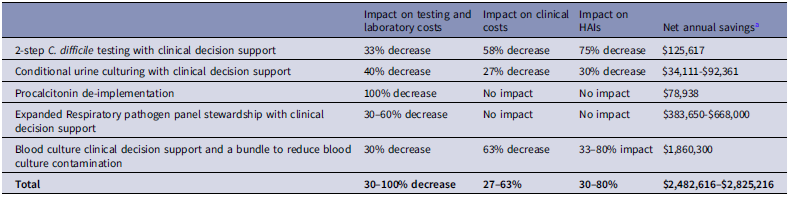
Diagnostic stewardship is a cost-effective approach to improving patient care and optimizing healthcare delivery. Here, we have provided a framework for business-case development for diagnostic stewardship interventions and provide examples of these business cases for five commonly misused diagnostic tests and the potential savings attributed to each (see Table 1). Healthcare facilities should adopt these templates to meet the needs of their institutions with the goal of rapid implementation of these measures to optimize clinical outcomes and operational efficiency.
Impact of diagnostic stewardship interventions on testing, HAIs and costs

Table 1. Long description
The table presents data on the impact of various diagnostic stewardship interventions on testing and laboratory costs, clinical costs, healthcare-associated infections (HAIs), and net annual savings. It has five rows and five columns. The columns are labeled ‘Intervention’, ‘Impact on testing and laboratory costs’, ‘Impact on clinical costs’, ‘Impact on HAIs’, and ‘Net annual savings’. The rows list different interventions and their respective impacts. Row 1: 2-step C. difficile testing with clinical decision support, 33 percent decrease, 58 percent decrease, 75 percent decrease, $125,617. Row 2: Conditional urine culturing with clinical decision support, 40 percent decrease, 27 percent decrease, 30 percent decrease, $34,111-$92,361. Row 3: Procalcitonin de-implementation, 100 percent decrease, no impact, no impact, $78,938. Row 4: Expanded Respiratory pathogen panel stewardship with clinical decision support, 30-60 percent decrease, no impact, no impact, $383,650-$668,000. Row 5: Blood culture clinical decision support and a bundle to reduce blood culture contamination, 30 percent decrease, 63 percent decrease, 33-80 percent impact, $1,860,300. The total impact ranges from 30-100 percent decrease in testing and laboratory costs, 27-63 percent decrease in clinical costs, 30-80 percent decrease in HAIs, and net annual savings of $2,482,616-$2,825,216.
a Net annual savings does not include potential HAI reductions. Details about how net savings were calculated can be found in the supplementary materials.
HAI: healthcare-associated infections.
Supplementary material
The supplementary material for this article can be found at https://doi.org/10.1017/ash.2026.10839.
Financial support
None reported.
Disclosures
The following disclosures reflect what has been reported to SHEA. To provide thorough transparency, SHEA requires full disclosure of all relationships, regardless of relevancy to the guideline topic. Evaluation of such relationships as potential conflicts of interest is determined by a review process which includes assessment by the SHEA Conflict of Interest Committee and may include the Board of Trustees. The assessment of disclosed relationships for COI will be based on the relative weight of the financial relationship (ie, monetary amount) and the relevance of the relationship (ie, the degree to which an association might be interpreted by an independent observer as related to the topic or recommendation of consideration). The reader of this guidance should be mindful of this when the list of disclosures is reviewed. SET has received sponsored grant support from SeLux diagnostics. She has served as a consultant for CarbX and has received royalties from UpToDate. JHR has received past grant funding from the Centers for Disease Control on blood culture stewardship and received travel support and speaker payments from bioMérieux. All others: no disclosures.

 Open access

