Introduction
Blattella germanica (Linnaeus, 1767) is a cosmopolitan, omnivore, and nocturnal species. It is one of the most widespread urban pest species in the world as well in Argentina (Rehn, Reference Rehn1945; Crespo and Valverde, Reference Crespo, Valverde, Claps, Debandi and Juñet2008; Tang et al., Reference Tang, Bourguignon, Willenmse, De Coninck and Evans2019). Different techniques are used for the control of this species, including biological, physical, and chemical strategies. For about a century, the use of synthetic insecticides has been the main tool for cockroach control (Mallis, Reference Mallis1969). The indiscriminate and continuous use of insecticides generated the selection of tolerant individuals leading to resistant populations of B. germanica around the world. The earliest records of resistance in this species date from the early 1950s, when resistance to chlorinated insecticides and pyrethrins was detected in field populations from various regions of the USA and Europe (Keller et al., Reference Keller, Clark and Lofgren1956; Cornwell, Reference Cornwell1968). Subsequently, resistance to organophosphates, carbamates, pyrethroids, and fipronil was observed (Cochran, Reference Cochran1989; Ladonni, Reference Ladonni1997, Reference Ladonni2001; Fardisi et al., Reference Fardisi, Gondhalekar and Scharf2017; Wu and Appel, Reference Wu and Appel2017; Chen et al., Reference Chen, Pei, Li, Fan and Liu2020) and also the presence of cross-resistance to different active principle was registered (Fardisi et al., Reference Fardisi, Gondhalekar, Ashbrook and Scharf2019). In the case of pyrethroids, resistance in B. germanica is mainly due to changes in the target site and to an increase in metabolic detoxification. The target site of pyrethroids is the voltage-gated sodium channel present in the membranes of excitable cells (Soderlund Reference Soderlund2008; Narahashi, Reference Narahashi1996, Reference Narahashi2002). Specific mutations in the sodium channel gene lead to a decrease in the affinity of the insecticide with its target, which causes a decrease in the toxic effects, but do not alter the general function of the sodium channel. This type of mechanism is called knock-down resistance (kdr); mutations in the sodium channel gene associated with resistance have been identified in many insect species, including B. germanica (Dong, Reference Dong1997; Dong and Scott, Reference Dong and Scott1991; Dong et al., Reference Dong, Valles, Scharf, Zeichner and Bennett1998; Miyazaki et al., Reference Miyazaki, Ohyama, Dunlap and Matsumura1996; Tan et al., Reference Tan, Liu, Nomura, Goldin and Dong2002). In this species, two mutations were identified: L993F and F999S (Liu et al., Reference Liu, Valles and Dong2000; Pridgeon et al., Reference Pridgeon, Appel, Moar and Liu2002). The first one is the most frequent and it is associated with a substitution of leucine (L) for phenylalanine (F) (Miyazaki et al., Reference Miyazaki, Ohyama, Dunlap and Matsumura1996; Dong, Reference Dong1997), while the second one is a substitution of an F for a serine (S) (Pridgeon et al., Reference Pridgeon, Appel, Moar and Liu2002). Both mutations are located in the transmembrane segment 6, domain II (IIS6) of the channel protein. Additionally, the C764R and E434K mutations confer higher levels of resistance to pyrethroids when L993F mutation is also present (Liu et al., Reference Liu, Valles and Dong2000; Tan et al., Reference Tan, Liu, Nomura, Goldin and Dong2002).
The metabolic resistance to insecticides in insects consists of an increase in the processes of enzymatic detoxification of xenobiotics, which may be due to an increase in the activity of detoxifying enzymes such as esterase or mixed function oxidases, or to an over expression of these enzymes (Umeda et al., Reference Umeda, Yano and Hirano1988; Enayati and Motevalli, Reference Enayati and Motevali2007). This increase in the detoxification process causes a decrease in the toxicity of the insecticide in the resistant strains. Metabolic resistance can be reduced or eliminated through the use of synergists, which are chemical compounds that raise lethality by inhibiting detoxifying enzymes in insects (Metcalf, Reference Metcalf1967). Synergists are no toxic for insects themselves, but increase insecticide toxicity by prolonging insecticide's half-life into the animal (Soderlund and Bloomquist, Reference Soderlund and Bloomquist1990). The intensity of the synergic effect varies depending on the type of insecticide and the species. Synergists act on metabolic mechanisms by inhibiting specifically the enzymes involved in the detoxification of insecticides. Piperonyl butoxide (PBO) is a specific inhibitor of oxidase activity (Casida, Reference Casida1970; Hodgson and Levi, Reference Hodgson, Levi and Jones1999), while triphenyl phosphate (TPP) inhibits the activity of carboxyl esterases.
In this work, we studied the resistance mechanisms of a field strain of B. germanica from Argentina, and characterize it by toxicological, enzymatic, and molecular approaches.
Materials and methods
Biological material
The experiments were carried out using nymphs and adults of B. germanica belonging to susceptible and pyrethroid-resistant strains. The susceptible strain was reared in the absence of insecticides for over 20 years, while the resistant strain was established in 2015 from a sample collected in the locality of Villa Gesell (Buenos Aires, Argentina). Insects from both strains were maintained in our laboratory in a controlled environment at 22–25°C under a 12:12 h L: D photoperiod, fed with rabbit pellet and water ad libitum.
Chemical compounds
The following chemicals were used for toxicological bioassay: β-cypermethrin technical grade, provided from Chemotecnica S.A. (Buenos Aires, Argentina); the synergists PBO (90%) and TPP (99%) from Sigma-Aldrich (Saint Louis, MO, USA). Acetone analytical grade, provided by Sintorgan S.A. (Buenos Aires, Argentina), was used as solvent. Chemicals used for enzymatic activity bioassays were 7-ethoxycoumarin (7-EC) and 7-hydroxycoumarin (7-OHC) from Sigma-Aldrich. The specific substrate 7-coumaryl permethrate (7-CP) was synthesized in our laboratory according to the method described by Santo-Orihuela et al. (Reference Santo Orihuela, Picollo, Audino, Barrios, Zerba and Masuh2006).
Toxicological experiments
β-cypermethrin toxicity: Toxicity of β-cypermethrin and the resistance ratio (RR) of the strains of B. germanica were determined as follows. Groups of ten susceptible or pyrethroid-resistant first instar nymphs were exposed for 1 h to filter papers treated with different concentrations of β-cypermethrin in acetone based on the protocol of Alzogaray and Zerba (Reference Alzogaray and Zerba2001). For this, circular filter papers of 9 cm diameter were loaded with 0.7 ml of increasing concentration solutions of β-cypermethrin in acetone. Only one concentration was applied to each filter paper. A glass ring was placed on each filter to avoid insects to leave the arena during the exposure time. Control group was exposed to a filter paper treated with the same volume of acetone. The concentration ranges used for each strain were 2.7510−4; 8.3610−4; 0.0025; or 0.0077 mg cm−2 for the susceptible strain and 0.0085; 0.019; 0.034; 0.068; 0.14; 0.27; 0.55; or 1.10 mg cm−2 for the resistant one. After the exposure period, insects were transferred to clean containers for 24 h. After this, mortality was determined for each concentration of β-cypermethrin in each strain. Specimens were considered dead when they did not show any kind of movement. Three independent replicates were made for each strain.
Toxicity of β-cypermethrin in the presence of synergists: The role of the enzymatic detoxification in the resistance mechanism was studied from a toxicological approach. For this, the toxicity of β-cypermethrin was determined in the presence of specific inhibitors of mixed function oxidases and esterases (PBO and TPP, respectively). Groups of first instar nymphs from both strains were pre-exposed to each inhibitor before the exposure to the pyrethroid to determine toxicity. Circular filter papers of 9 cm diameter were treated with 0.7 ml of a solution of 1.10 mg cm−2 of PBO or 2.75 mg cm−2 of TPP, using the same methodology described above. The PBO and TPP concentrations used were determined in preliminary assays and no toxic effects of synergists were observed during or after exposure. Insects were pre-exposed for 1 h to each synergist and then they were transferred to filter papers treated with β-cypermethrin, where they remained for 1 h as previously explained (Santo-Orihuela et al., Reference Santo-Orihuela, Vassena, Carvajal, Clark, Menacho, Bozo and Marcet2017; Fronza et al., Reference Fronza, Roca-Acevedo, Mougabure-Cueto, Sierra, Capriotti and Toloza2020). After this period, the groups of cockroaches were put into clean containers for 24 h, subsequently mortality was recorded as described above. Three independent replicates were made for each synergist and each strain.
Detoxifying enzyme activity assays
The activity of the enzymes of the esterase and P450 mixed function monooxygenases (MFO) was determined in first instar nymphs from the susceptible and resistant strains. The effect of pre-exposure to β-cypermethrin on enzymatic activity was additionally studied in both strains. Susceptible and resistant nymphs 3–4 days old post-hatching were used. For the pre-exposure experiment, groups of ten nymphs from each strain were exposed to a surface treated with lethal concentrations 20% of β-cypermethrin (6.3810−4 mg cm−2 for the susceptible strain and 0.04 mg cm−2 for resistant one) for 1 h, before the measurement of enzymatic activity. The methodology was adapted and fine-tuned specifically for first instar nymphs of B. germanica based on the work of Von Santos Veloso et al. (Reference Von Santos Veloso, Pereira, Guedes and Oliveira2013).
Activity of P450 monooxygenases
The activity of MFO was determined through the O-deethylation of 7-EC as a substrate. 7-OHC, a fluorescent product, was measured in a 96-well micro-plate fluorescence reader (Fluoroskan Ascent, Thermo Scientific, Helsinki, Finland) with 390 nm excitation and 440 nm emission. Nymphs of both susceptible and resistant strains were used. To study the effect of the exposure to pyrethroids in enzymatic activity, groups of susceptible or resistant nymphs were pre-exposed to a surface treated with a sub-lethal concentration of β-cypermethrin, as was detailed above. Each individual underwent a cut between the thorax and the abdomen. These were placed in one of the 96 wells of a black polystyrene micro-plate (PerkinElmer, Massachusetts, USA) together with 100 μl of 0.05 M phosphate buffer and 4 mM 7-EC. The specimens remained fully immersed in the solution which allows the diffusion of the substrate toward the tissues. The reaction was stopped after 4 h incubation at 30°C by adding 100 μl of glycine buffer (10−4 M) that acts as an inhibitor of the enzyme activity. For each sample individual, a similar well with glycine buffer before incubation was used as a blank. The individuals were centrifuged at 2000 × g for 30 s in a refrigerated centrifuge (4237R, ALC International SRL, Cologna Monzese, Italy) to precipitate them in the wells (Roca-Acevedo, Reference Roca-Acevedo2015). A calibration curve was done using increasing concentrations of the fluorescent product 7-OHC in phosphate buffer (308.38, 616.75, 925.13, and 1233.50 total picomol of 7-OHC per well). Finally, fluorescence produced by 7-OHC in each well was measured.
Activity of pyrethroid esterases
The activity of the esterases was determined by the hydrolysis of the 7-coumaryl permethrate (7-coumaryl [1R, S] cis-trans-3-[2,2-dichlorovinyl]-2, 2-dimethyl-cyclopropane carboxylate; 7-CP). This compound is a synthetic substrate with a chemical structure similar to pyrethroids, allowing the measurement of the esterases which participates specifically in the hydrolysis of these insecticides (Santo-Orihuela et al., Reference Santo Orihuela, Picollo, Audino, Barrios, Zerba and Masuh2006). The 7-CP is hydrolyzed by these enzymes, generating the fluorescent product 7-OHC (Santo-Orihuela et al., Reference Santo Orihuela, Picollo, Audino, Barrios, Zerba and Masuh2006, Reference Santo Orihuela, Vassena, Zerba and Picollo2014, Reference Santo-Orihuela, Vassena, Carvajal, Clark, Menacho, Bozo and Marcet2017; Roca-Acevedo et al., Reference Roca-Acevedo, Picollo, Capriotti, Sierra and Santo-Orihuela2015). For esterase measurements, homogenates of first instar nymphs of B. germanica from each strain were used. To determine the effect of the exposure to pyrethroids in the enzymatic activity, groups of nymphs from both strains were pre-exposed to a sub-lethal concentration of β-cypermethrin, as was already explained. The activity of the enzyme was measured in homogenates of nymphs of the first stage of B. germanica from each strain, with or without a pre-exposure to β-cypermethrin. To obtain homogenates, one nymph was placed into an Eppendorf tube with 210μl of phosphate buffer and was homogenized using a plastic mortar. Then, the mixture was centrifuged with a Bio-vortex (Biospec, Bartlesville, OK, USA) and 190 μl of the supernatant of each homogenate was removed with a micropipette and transferred to the wells of the micro-plate. To start the enzymatic reaction, 20 μl of 7-CP (3.5 mMin 2-methoxy-ethanol 99.5%, Merck, Argentina) was added to each well and a final volume of 240 μl was completed with 30 μl of phosphate buffer. Sample blanks lacking homogenate were used. A calibration curve was performed (15.42, 154.19, 308.38, 616.75, 1233.50 total picomol of 7-OHC per well). Activity was measured at 25°C every 1 min for 30 min with the assay being linear over this time. Values of enzymatic activity for both enzymes were expressed in relative fluorescence units that were transformed to picomol of 7-OHC min−1 using the calibration curve. These values were corrected according to non-specific fluorescence produced in the sample blanks. Data were analyzed using Ascent Software 2.6 (Thermo Scientific, Vantaa, Finland) and Microsoft Excel (Redmond, WA, USA). Each micro-plate was considered as one replicate and five replicates were made per enzyme
Sequencing of domain II of the sodium channel
RNA extraction, cDNA preparation, and polymerase chain reactions (PCR)
Individuals from the resistant strain were selected after a pre-exposure to 0.433 mg cm−2 (lethal concentrations 70%) of β-cypermethrin as described above, in order to select the resistant individuals from the strain. The central nervous system (CNS), constituted by the brain and ganglia, was microdissected from male and female adults under saline solution and immediately placed in cold Trizol for RNA extraction. Pools of ten CNS from either susceptible or resistant individuals were used.
The total RNA was extracted using TRIzol reagent (Ambion, Brazil), according to the manufacturer's instructions. To check the RNA integrity, a 2% agarose electrophoresis gel with TBE 1x buffer stained with BrEt was performed. Integrity and amount of RNA was evaluated from images of the gel with the software ImageJ (Schneider et al., Reference Schneider, Rasband and Eliceiri2012). Subsequently, 1 μg of total RNA was treated with DNAse I (Promega, USA), according to the manufacturer's instructions. First-strand cDNA synthesis was performed with MMLV Reverse Transcription Kit (Applied Biosystems, Brazil) and poly-T primer, according to the manufacturer's instructions.
The cDNAs obtained from resistant and susceptible individuals were used as a template for the PCR reaction. Specific primers (BgParaFw: 5′-GATCGTTCAGATTGTTGAGAGTC-3′ and BgParaRev: 5′-AACTGCGTCTGCTCCTTTGG-3′) were designed to amplify a fragment of 673 bp representing amino acidic positions 873 to 1097 (equivalent to nucleotidic positions 2619 to 3291) in the domain II of sodium channel protein. This fragment covers the area where the mutations associated with pyrethroid resistance in B. germanica were reported (L993F, F999S) (Miyazaki et al., Reference Miyazaki, Ohyama, Dunlap and Matsumura1996; Dong, Reference Dong1997; Pridgeon et al., Reference Pridgeon, Appel, Moar and Liu2002). To design the primers, one sequence from a resistant individual carrying the L993F mutation and other from a susceptible individual were analyzed (GenBank accession numbers U73584 and U73583, respectively); the primers designed are common to both sequences. The cycling was: initial denaturation: 5 min at 95°C; 40 cycles: 30 s at 95°C (denaturation), 30 s at 65°C (annealing of the primers), 1 min at 72°C (extension), and a final extension cycle at 72°C for 5 min. The PCR products were sent to MACROGEN (South Korea) for sequencing using the primers described above. The sequences obtained were aligned using the Bioedit program (Hall, Reference Hall1999).
Statistical analysis
The toxicity of β-cypermethrin in the presence or absence of synergists was determined for both strains by estimating the toxicological parameters using software based on the probit method (PoloPlus Version 2.0, Le Ora Software). The differences between the lethal concentrations 50% (LC50) (mg cm−2) values were considered statistically significant only when the 95% confidence intervals did not overlap (Russell et al., Reference Russell, Preisler and Savin2007). The RR and the synergism ratio (SR) were determined establishing a relationship between the toxicological parameters obtained for each strain in the presence and absence of synergists. The RR is the ratio between the LC50 of the resistant strain/LC50 of the susceptible strain, while SR is the ratio between LC50 without pre-exposure to synergists/LC50 with pre-exposure to synergists, of each strain. A value of SR ≤ 1 indicates that there is no synergism and an SR > 1 indicates a synergism. In addition, RRs were also calculated in the presence of synergists, using the LC50 values of the resistant and the susceptible strains calculated after the exposure to TTP (RR+TPP) or PBO (RR+PBO).
For the analysis of enzymatic activity, one-way ANOVA was used, followed by Tukey's test for post-hoc comparisons. The differences were considered significant when P < 0.05. A log10 transformation of the data was applied in the case that they did not match the assumptions of the model.
Results
In order to characterize pyrethroid resistance in B. germanica, the LC50 of β-cypermethrin was calculated. Values of 0.0018 and 0.18 mg cm−2 were obtained for LC50 of the susceptible and resistant strains, respectively. Hence the calculated RR was 100 (61.8–157.6) (table 1). This value indicates that 100 times more β-cypermethrin is needed in the resistant individuals to reach the same toxicological effect obtained for the susceptible strain. Furthermore, LC50 values were obtained for each strain in the presence of PBO or TPP synergists (table 1). For the susceptible strain, a significant decrease in LC50 was observed after pre-exposing to PBO, with an SR of 12.85 (7.95–19.73). This value indicates that the inhibition of MFO by PBO increased the toxicity of β-cypermethrin almost 13-fold in this strain. On the other hand, when insects were pre-treated with TPP, it was not observed a significant decrease in the LC50 of β-cypermethrin and the SR was 1.28 (0.81–1.97), indicating that esterases do not have a preponderant role in the detoxification of β-cypermethrin in these insects. In the resistant strain, a significant reduction in LC50 of β-cypermethrin was observed after treatment with TPP, with an SR of 9.5 (4.14–19.68); pre-exposure to PBO also reduced the LC50 in this strain with an SR of 2.9 (1.8–4.5), although this difference was not statistically significant. The increase in toxicity observed in the resistant strain after the exposure to both inhibitors suggests that both enzymes contribute to resistance through a higher detoxification of β-cypermethrin, but with a greater contribution of the esterases. When RRs were calculated in the presence of synergists, a decrease in resistance is observed when both strains were treated with TPP, confirming the role of increased metabolism of esterases as a mechanism for resistance in this strain (RR+TPP = 13.57); however, increase in MFO metabolism cannot be confirmed by the observation of toxicological results, since an increase in the resistance was observed when RR was calculated after pre-exposure to oxidase inhibitor PBO (RR+PBO = 442.85), due to a high increase in the toxicity on the susceptible strain. This result may be associated to the presence of different isoforms of MFO with different sensitivity to the inhibition with PBO. To confirm the role of a possible increase in the MFO metabolism in the resistant strain, enzymatic activity was measured, and results are shown below.
Lethal concentration 50 (LC50) of β-cypermethrin with and without pre-exposure to synergists calculated for both cockroaches' strains

N = 90.
At the biochemical level, the enzymatic activity of pyrethroid esterases showed significant differences between the susceptible and the resistant strain (F = 11.49; P < 0.0001; fig. 1). The means of activity were 185.76 picomol 7-OHC min−1 and 276.02 picomol 7-OHC min−1 for the susceptible and the resistant strains respectively, showing that basal activity was approximately 1.5-fold higher in resistant nymphs compared to susceptible ones. Additionally, pre-exposure to β-cypermethrin produced an increase in esterase activity of 1.15 times in both strains, although this difference was not statistically significant. When esterase activity of pre-exposed insects was compared between strains, a 1.5 times higher and statistically significant increase was observed in resistant specimens (318.12 picomol 7-OHC min−1 and 212.37 picomol 7-OHC min−1 for the resistant and susceptible strains, respectively; F = 11.49; P < 0.0001).
Pyrethroid esterase activity in nymphs of both cockroaches' strains with and without pre-exposure to β-cypermethrin. The means obtained for the susceptible and resistant strain with and without pre-exposure to β-cypermethrin are shown. The letters indicate: S (susceptible), Sp (pre-exposed susceptible), R (resistant), and Rp (pre-exposed resistant). Error bars represent the standard error. Different letters indicate statistically significant differences (F = 11.49; P < 0.0001; Tukey's test for post-hoc comparisons; N = 182).

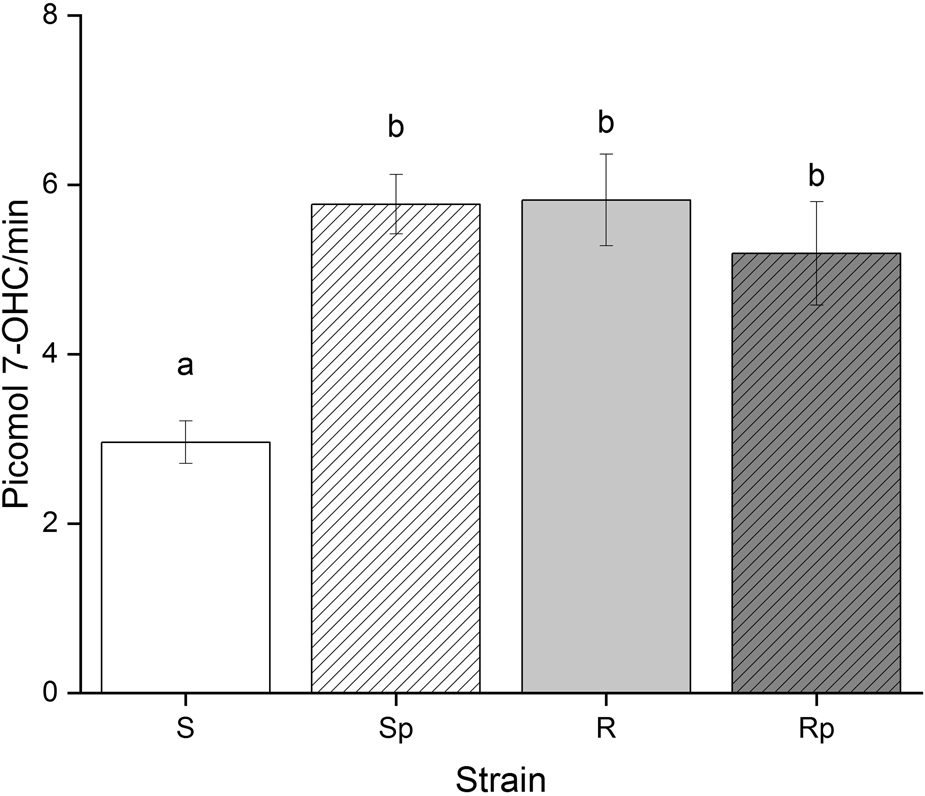
Resistant insects showed a 2-fold higher activity of oxydases compared to susceptible cockroaches (fig. 2). Mean values were 2.96 picomol 7-OHC min−1 and 5.82 picomol 7-OHC min−1 for the susceptible and the resistant strain, respectively (F = 9.95; P < 0.0001). The pre-exposure to β-cypermethrin produced in susceptible nymphs a 2-fold and significant increase in the activity of oxidases, reaching the basal levels measured in the resistant strain, being the means of 5.77 picomol 7-OHC min−1 (F = 9.95; P < 0.0001; fig. 2). However, in the case of resistant insects, pre-exposure to β-cypermethrin did not increase oxidase activity, being the mean of the latter 5.19 picomol 7-OHC min−1.
The activity of P450 monooxygenases in nymphs for both cockroaches' strains with and without pre-exposure to β-cypermethrin. The means obtained for the susceptible and resistant strain with and without pre-exposure to β-cypermethrin are shown. The letters indicate: S (susceptible), Sp (pre-exposed susceptible), R (resistant), and Rp (pre-exposed resistant). Error bars represent the standard error. Different letters indicate statistically significant differences (F = 9.95; P < 0.0001; Tukey's test for post-hoc comparisons; N = 191).

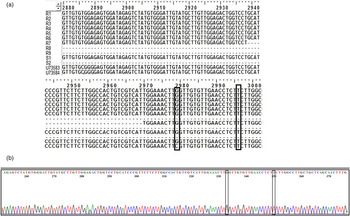
To determine the presence of possible mutations in the sodium channel associated to resistance in the strain studied in this work, the domain II of the gene was amplified from the CNS susceptible (S) and resistant (R) individuals. Primers were used to amplify a 673 bp sequence representing amino acidic positions 873 to 1097 in the sodium channel protein, encompassing the domain II of the channel, where mutations associated to pyrethroid resistance are located in insects. This fragment covers the areas where the L993F and F999S mutations that confer resistance in B. germanica were reported (Miyazaki et al., Reference Miyazaki, Ohyama, Dunlap and Matsumura1996; Dong, Reference Dong1997; Pridgeon et al., Reference Pridgeon, Appel, Moar and Liu2002). cDNA was prepared from pools of ten CNS from each strain. One fragment of PCRs from susceptible strain and eight independent PCRs from resistant strain were sequenced and compared. These sequences were compared with each other, as well as with two deposited in GenBank: U73583 that corresponded to a susceptible individual and U73584 that belonged to a resistant one that carried the L993F mutation; the quality of the chromatograms obtained allowed unequivocally genotypification in the sites of interest (fig. 3). No differences were observed between the susceptible and resistant strains in the study. Furthermore, both showed no differences with the sequences of the susceptible individuals U73583, but a difference with the U73584 sequence that had a cytosine (C) instead of a guanine (G) at 2979 position (fig. 3). This substitution of a C for G by individual U73584 results in the substitution of the amino acid phenylalanine (F) by the leucine (L) (L993F) at position 993 of the protein. In our case, the susceptible and resistant specimens presented an L in this position of the protein, as in the U73583 sequence. In the case of the F999S mutation, we neither observed the substitution of a thymine (T) for a C that resulted in an amino acid change from phenylalanine to serine at position 2996 in the protein described by Pridgeon et al. (Reference Pridgeon, Appel, Moar and Liu2002).
Nucleotide sequence from cDNA of the portion 2880 to 3000 of domain II of sodium channel: (A) resistant (R, 1–9); susceptible (S, 1–2); U73583 (susceptible, NCBI); and U73584 (resistant, NCBI) individuals. The positions of substitutions C2979G and T2996C (associated to kdr mutations L993P and F999S respectively) are boxed. S2, R8, and R9 insects are not shown in the sequence given that the chromatograms obtained are not of enough quality to univocally determine a sequence. (B) Representative chromatogram of the region of interest. Sites where possible substitutions associated to resistance would be present are boxed.

Additionally, nucleotide changes at positions 2886 and 2889 of the cDNA sequences were observed in our study strains with respect to the GenBank sequences (fig. 3). The changes correspond to the substitution of a T for a C (C2886T) and of an adenine (A) for a G (G2889A). Given that these changes do not modify the amino acid since they are synonymous mutations and the fact that they were found in both the susceptible and resistant strains under study, a relationship between these mutations and the resistance in these individuals cannot be attributed.
Discussion
In this work, the resistance mechanisms of a field strain of B. germanica from Buenos Aires, Argentina, were determined at the toxicological, enzymatic, and molecular levels. The results obtained suggest that resistance to pyrethroids in this strain may be mainly associated with increased enzymatic detoxification since no kdr mutations in the voltage-dependent sodium channel have been found. This significant increase in enzymatic activity was mainly observed in esterases, suggesting a major participation of these enzymes in pyrethroid detoxification. Moreover, the pre-exposure to sub-lethal concentrations of β-cypermethrin increased the activity of both esterases and MFO activity in the susceptible strain.
The RR of the strain of B. germanica under study for β-cypermethrin at the toxicological level was 100, indicating an elevated degree of uniformity in the population. Similar RR values have been reported in literature by other authors in pyrethroid-resistant strains of B. germanica (Scharf et al., Reference Scharf, Neal, Marcus and Bennett1998; Valles et al., Reference Valles, Dong and Brenner2000; Wei et al., Reference Wei, Appel, Moar and Liu2001; Chen et al., Reference Chen, Pei, Li, Fan and Liu2020). In this study, we found that treatment with synergists increased the toxicity of pyrethroid in both strains, showing the participation of detoxifying enzymes in the metabolism of this insecticide. Particularly, pre-treatment with PBO increased almost 13-fold the toxicity of β-cypermethrin in the susceptible strain, while it was not modified by pre-exposure to TPP. In contrast, treatment of the resistant strain with both synergists produced significantly higher nymph mortality (SR = 2.9 and 9.5 for PBO and TPP, respectively), suggesting that both enzymes are important in the detoxification process of this pyrethroid in resistant specimens. Wei et al. (Reference Wei, Appel, Moar and Liu2001) studied the levels of resistance to permethrin and deltamethrin of a resistant strain of German cockroaches collected from Opelika, Alabama, and they found RRs of 97 and 480 for permethrin and deltamethrin, respectively. When insects were treated with PBO or S,S,S,-tributyl phosphorothritioate (DEF), a specific esterase inhibitor, a significant synergistic effect was observed with both compounds that increased the toxicity of permethrin as well as deltamethrin; SRs were 6.6 and 74 for permethrin and deltamethrin, respectively, when insects were treated with PBO, and 3.6 and 46 for each mentioned insecticides, respectively, when insects were treated with DEF. Values of SR for PBO were higher than those obtained for DEF, indicating that MFO play a more important role in the detoxification of pyrethroids than esterases in these cockroaches' strain. In contrast, we found in this work an opposite result, in which a higher activity of esterases was measured in the resistant individuals, indicating that in the strain we studied, this group of enzymes had a major role in the detoxification of pyrethroids. Meanwhile, Limoee et al. (Reference Limoee, Enayati, Khassi, Salimi and Ladonni2011) also studied the effect of PBO on the toxicity of permethrin in three field strains of B. germanica collected from different hospitals in Kermanshah, Iran. They observed that toxicity for this insecticide raised 1.87, 2.51, and 2.38 times in each strain after exposure to PBO. These synergism values were similar to that obtained by us for the B. germanica strain under study, treated with the same synergist.
In accordance with the information provided by the SR, we observed that treatment of the resistant strain with TPP caused a higher increase in the toxicity of β-cypermethrin than the pre-exposure to PBO, indicating a major intervention of esterases as a mechanism of resistance. This was confirmed when RR was calculated in the presence of TPP, obtaining a decrease in resistance (RR+TTP = 13.57). On the other hand, inhibition of MFO in the susceptible strain caused a high decrease in LC50 of β-cypermethrin, so RR in the presence of PBO was higher than RR without synergists (RR+PBO = 442.85). This may be associated to the presence of different isoforms of MFO in the susceptible as well as in the resistant strain, which participate in the detoxification of pyrethroids and have different susceptibility to inhibition with PBO (Scott, Reference Scott1990; Valles and Yu, Reference Valles and Yu1996). Further studies are needed to confirm this observation.
Since the complete reversion of resistance was not observed only by the pre-treatment with synergists, possibly one or more additional mechanisms would be involved in the resistance of these strains in addition to increased enzymatic detoxification. In the case of our study, pre-treatment with both TPP and PBO did not increase the toxicity of β-cypermethrin in the resistant strain to the levels calculated for the susceptible one. This may be associated to a joint increased detoxifying activity of both groups of enzymes (esterases and MFO) in the resistant strain, so further studies in which both synergists are applied simultaneously may be useful to clarify this hypothesis.
Subsequently, the enzymatic activity was measured and the data obtained were in the line of the conclusion regarding the role of esterase and P450 monooxygenases in β-cypermethrin resistance assessed by the toxicological results in the presence of synergists TPP and PBO. Esterases and MFO showed a significantly higher basal activity in the resistant strain. Several authors have reported increased enzymatic activity in resistant individuals of B. germanica (Hemingway et al., Reference Hemingway, Dunbar, Monro and Small1993; Valles and Yu, Reference Valles and Yu1996; Scharf et al., Reference Scharf, Neal, Marcus and Bennett1998; Valles, Reference Valles1998; Valles et al., Reference Valles, Dong and Brenner2000; Enayati and Motevali, Reference Enayati and Motevali2007). The higher detoxifying capacity observed in several insecticide-resistant insects may be related to an increase in either the amount of enzyme (gene amplification and up-regulation of gene expression) or the effectiveness or detoxification capacity of enzymes (Hemingway and Karunaratne, Reference Hemingway and Karunaratne1998; Hemingway and Ranson, Reference Hemingway and Ranson2000). Prabhakaran and Kamble (Reference Prabhakaran and Kamble1993, Reference Prabhakaran and Kamble1994, Reference Prabhakaran and Kamble1995) reported ten different esterase isozymes in B. germanica differing in composition and activity between insecticide-resistant and susceptible strains. These authors observed an increased production of the E6 esterase isozyme in the resistant strain compared to the susceptible one. In this work, we observed an increase in the esterase activity that hydrolyzes carboxylic ester bonds. Furthermore, we also observed an elevation in the O-deethylation of 7-etoxycoumarin associated to MFO activity in the resistant strain, as has been described for pyrethroid-resistant strains of Drosophila melanogaster (Meigen, 1830) and Triatoma infestans (Klug, 1834) (Prevec et al., Reference Prevec, Okoampah and Morton1992; Desousa et al., Reference Desousa, Cuany, Brun, Amichot, Rahmani and Bergé1995; Santo-Orihuela et al., Reference Santo-Orihuela, Vassena, Zerba and Picollo2008). We observed a 2-fold increase of MFO activity in the strain under study, while Valles and Yu, (Reference Valles and Yu1996) observed an 18-fold difference in ethoxycoumarin O-deethylase activity increase in pyrethroid-resistant males of B. germanica.
Pre-exposure to β-cypermethrin generated an elevated activity of MFOs only in the susceptible nymphs, a phenomenon which has been already reported in literature for the German cockroach (Khan and Matsumura, Reference Khan and Matsumura1972; Brown et al., Reference Brown, Zhang, Wen and Scott2003). On the other hand, pyrethroid esterases activity showed a slight increase in both strains due to pre-exposure to the insecticide. The absence of an increase in the activity of oxidases in the resistant strain could possibly be related to the pre-exposure time or insecticide concentration used, which cause no observable effect. It has been observed in previous works that exposure to sub-lethal concentrations of insecticides may cause changes in general enzymatic activity and not only in the detoxifying metabolism. Von Santos Veloso et al. (Reference Von Santos Veloso, Pereira, Guedes and Oliveira2013) observed a reduction in the activity of amylase, cellulase, and cysteine proteinase in three strains of the corn weevil Sitophilus zeamais (Motschulsky, 1855), after exposure to the LC10 of cypermethrin for 24 h.
Finally, at the molecular level, the results indicate that there were none of the resistance-associated mutations reported for this species (L993F, F999S) (Dong, Reference Dong1997; Pridgeon et al., Reference Pridgeon, Appel, Moar and Liu2002), located in the fragment of the sodium channel gene analyzed here. Although modifications were observed in the amplified fragment compared to the sequences present in GenBank for B. germanica, these would not be linked to the resistance observed in the phenotype since both strains are silent mutations. Anyway, these results indicate a genetic variability in this region of the gene. Even though this silencing change does not have consequences in the susceptibility or resistance to pyrethroids, they can be useful for population studies. Most kdr mutations in insects are associated with the domain II of the gene, the region that was analyzed here. Even though it is unlikely that any mutation associated with resistance may be present outside this region of the gene, substitutions associated to resistance in other region of the gene cannot be ruled out. Putting these results together with toxicological and biochemical observations made in this work, resistance of the B. germanica strain under study may be more likely associated to a mechanism of metabolic increase. Our results suggest that high levels of resistance can be reached in B. germanica by metabolic mechanisms, even in the absence of kdr mutations. However, the coexistence of other resistance mechanisms are not discarded since the complete reversion of resistance was not achieved by the pre-treatment with synergists. Having said this, some authors indicate a decreased cuticular penetration to pyrethroid in resistant individuals of B. germanica (Anspaugh, Reference Anspaugh, Rose, Koehler, Hodgson and Roe1994; Wu et al., Reference Wu, Scharf, Neal, Suiter and Bennett1998; Valles et al., Reference Valles, Dong and Brenner2000; Chen et al., Reference Chen, Pei, Li, Fan and Liu2020).
We have demonstrated a possible mechanism of pyrethroid resistance in a strain from Buenos Aires, Argentina being the first documentation in this country that addresses both metabolic resistance and modifications in the insecticide site of action hypothesis. On the other side, it was found that pre-exposure to sub-lethal concentrations of pyrethroids increases the enzymatic activity of the German cockroach, in susceptible as well as resistant individuals, decreasing the field after the application of insecticides, constituting a serious problem for the control effect of this pyrethroid. This phenomenon is evidenced by the reversal of intoxication symptoms observed in this pest. Knowledge about resistance mechanisms in this species is very important to improve management strategies for its control.
Acknowledgements
GRA, MS, SO, PGA, and VS are researchers from CONICET. EB is a postdoctoral fellowship holder from CONICET. Thanks to the financial support of Agencia Nacional de Promoción Científica y Tecnológica (PICT 2015-1023; PICT 2017-1512; PICT 2018-0275).
Conflict of interest
None.