At 5.30 p.m. on 28 December 1946 Sir William Hamilton Fyfe, Vice-Chancellor of the University of Aberdeen and leader of a delegation sent by the Inter-University Council for Higher Education in the Colonies, pushed his way through the undergrowth into the ‘bush’ a few miles north of the town of Ibadan in Nigeria until he reached a clearing where it was possible to see a few yards ahead. He planted his walking stick firmly into the ground and said: ‘Here shall be the University of Nigeria.’Footnote 1
Thus begins the memoir of Kenneth Mellanby, founding principal of University College Ibadan (UCI). In the years around World War II, Britain turned towards a new colonial policy defined by ‘development’. A new generation of colonial universities was one of its most striking features, often now overlooked. British government commissions reported in 1945, forming a blueprint for new university colleges in the West Indies, Malaya, Uganda, Gold Coast and Nigeria.Footnote 2 British academics like Kenneth Mellanby headed out to the colonies to establish them. As the opening scene of his book suggests, one of the first questions they considered was the space the universities should occupy: how the African ‘bush’ would be transformed into a modern university.
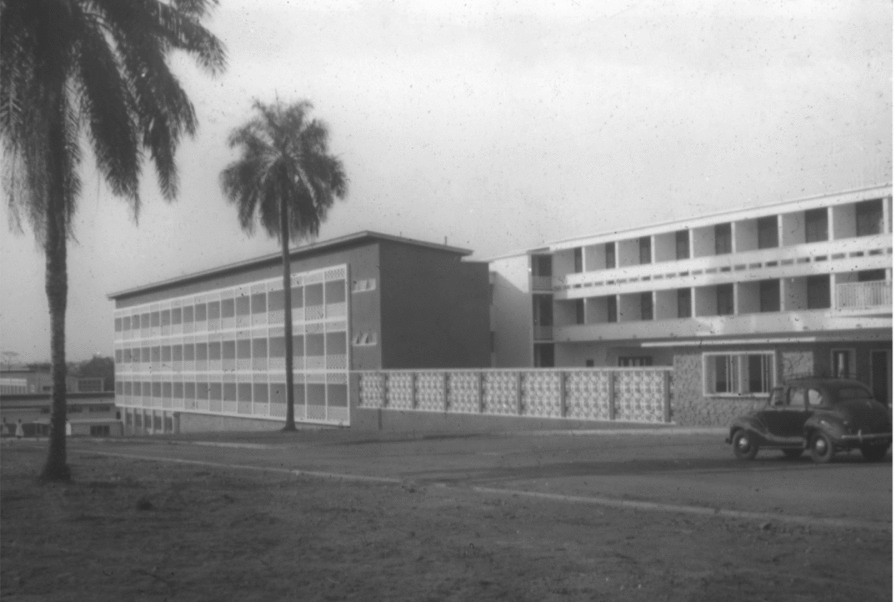
Metropolitan experts, distinctive figures of late colonialism, debated these issues. Academics like Mellanby and Hamilton Fyfe, and the architects Maxwell Fry and Jane Drew, had distinct visions for UCI. Nigerian-educated elites, a literate minority with an education and culture that looked to the west, expressed their aspirations for the university to the ‘Elliot’ Commission on Higher Education in West Africa during its 1944 tour.Footnote 3 British officials at the Colonial Office (CO) in London, and those serving the colonial government of Nigeria, had their own agendas. From 1948, the site located by Hamilton Fyfe was cleared, and Fry and Drew's university buildings rose in dazzling concrete: halls of residence, faculties, places of worship, a theatre and library, and the infrastructure to serve them (see Figure 1). They were spectacular. Even Nigerian nationalists, not easily impressed by the achievements of colonial development, were momentarily stunned.
A newly constructed UCI hall of residence, early 1950s. The inclusion of palms in the frame of this Inter-University Council photograph creates a distinctively colonial modern scene. Source: Cambridge University Library, Special Collections, RCS/Y3011KKK.

Yet then, as now, it was difficult to agree what development and modernity were. The post-Enlightenment world has often been termed ‘modern’, implying rapidly changing societies with rationalism in culture and thinking about development: how to achieve and manage modernity.Footnote 4 Reformers seeking to respond to the challenges of modernity have been termed modernists. In Britain, the 1930s has been seen as a crucial period when modernist architects and planners moved from being insurgents into the establishment, with their expert knowledge seen as the key to development.Footnote 5 The developmental style of colonialism after World War II, which produced UCI, drew on these modernist ideas.Footnote 6
By the 1960s, the euphoria around development was evaporating and experts were blamed for failing to deliver the development they had promised. Since then, development and modernity have been seen as particularly problematic. Frederick Cooper argues persuasively that modernity has been ‘a claim making concept’ rather than an objective condition, while Philip Zachernuk suggests that concepts of ‘tradition’ and ‘modernity’ are themselves historical artefacts that need interrogation.Footnote 7 This article heeds Zachernuk's call, asking how the space of UCI's campus was constructed as modern. It explores spatial expectations and practices in relation to the politics of colonial rule and decolonization.
A great deal of thinking on space in colonial contexts views it as a means of social control. Franz Fanon's binary vision of the colonial city divided between the zones of the colonizer and colonized, each with its own built forms, ways of life and moral associations, has been enormously influential.Footnote 8 Many scholars, including notably Anthony King and James Scott, have explored the relationships between built environments and authoritarian colonial power and there is now a large literature on the subject sharing some common arguments.Footnote 9 The recent edited collection Colonial Modern, for example, argues that post-war planners combined colonial mentalities with relentlessly rationalist planning practices, seeing colonies as a tabula rasa and designing buildings rooted in racialized assumptions. Although careful to note that development was negotiated rather than imposed, the argument that emerges emphasizes an authoritarian pact between modernist planning and late colonialism, that largely excluded colonized people from decision-making.Footnote 10
UCI architects Fry and Drew make regular appearances in this literature. Hannah le Roux argues that despite their progressive credentials, Fry and Drew's buildings were informed by conceptions of ‘tropical’ climate, ‘uncomfortable to expatriate and westernized bodies’, that were inextricable from colonial culture.Footnote 11 Rhodri Windsor-Liscombe sees their buildings as ‘officially sanctioned modernist design’ that lent colonial rule a progressive façade and reinforced hegemony by accommodating pressures for independence.Footnote 12 More generally, Apollos Nwauwa and others criticize colonial university buildings, including those of Fry and Drew, for their expense and the restrictions they imposed on university expansion.Footnote 13
An alternative historiographical approach has stressed colonial-era spatial hybridity. John Michael Vlatch and Catherine Coquery-Vidrovitch have in different ways suggested that the West African coast saw the formation of local forms of urban modernity before the advent of formal colonial rule.Footnote 14 They argue for the emergence of hybrid forms of African identity that included literacy, Christianity and buildings: a modernity ‘from below’ stimulated by movements of people associated with the slave trade and abolition. This work has shown colonial-era architecture from a new perspective, the buildings of post-war colonial development appearing as interventions in ongoing negotiations with modernity rather than wholly intrusive schemes.Footnote 15 Colonial building projects were most extensive in the last years of empire, which would be odd if these buildings did indeed uphold colonial power. Mark Crinson puts decolonization at the centre of the story of colonial modern architecture, initiating the exploration of the variety of responses to colonial building projects without dismissing their African advocates as ‘westernized’.Footnote 16
Approaching colonial modernity from a spatial perspective, Henri Lefebvre's stress on the variety of elements in making meanings associated with space is helpful. For Lefebvre, the abstract conceptions of planners are only one aspect of a triad completed by lived experiences of space and socially constructed associations.Footnote 17 A scholarly focus on the colonial modern world of pristine architectural plans and photographs can conceal the messier world of buildings’ reception and use through study of the short time in buildings’ lifecycle when planners are most powerful: when buildings are still on the drawing board.
This article considers what the study of UCI contributes to these debates, qualifying interpretations stressing the relationship between colonial power and space by highlighting the role of colonized people and their conceptions of modernity in the way UCI was planned and understood. It addresses first how understandings of modernity and space in southern Nigeria were formed before UCI; second, how modern space was conceived during the planning of UCI; and third, considers one type of the university building, student halls of residence, after they were opened.
Before UCI
University College Ibadan opened in 1948. While the new buildings were designed, the university was housed at a temporary site: in the mouldering huts of a wartime military hospital on the outskirts of the city. Wole Soyinka's semi-fictitious memoir of his student days recalls wooden huts, ‘partitioned into small rooms by fibre-mat walls, sometimes two, three or four students to a room, allowing little privacy, or, indeed, quiet’. Distractions were manifold: ‘dormitories, common rooms, reading rooms and even the library were eternally permeable to the depredations of raised voices, radios, record players and the sports fields’.Footnote 18 British college accountant Harold Preston remembered ‘no water borne sanitation’, noting that a ‘thunderbox, with sawdust and pail, has a lot to recommend it when pipe-borne water is in short supply’.Footnote 19 The temporary site exposed and confounded expectations of university space. The student J. Ajayi reported a 1948 scene:
a passing car slows down and a head pops out: ‘Please where is the way to the University?’ and I answer ‘This is the University College.’ Some succeed in hiding their surprise and merely park their cars and take a look round with suppressed expectation. Others don't quite succeed. They hesitate as if they still want convincing.Footnote 20
Nigerians evidently had expectations of university space before UCI was founded. The university intervened in existing conceptions of modernity formed through a long history of West African interactions. Critical early encounters with ideas of modernity predated formal colonial rule and often occurred through African intermediaries, particularly former enslaved peoples who returned to the Nigerian coast from Sierra Leone and Latin America from the late 1830s. They brought self-consciously modern notions of education, ways of life and the built environment, forming an urban elite even before the 1861 British annexation of Lagos.Footnote 21 They were crucial mediators for European missionaries in the hinterland. Missionaries too arrived before colonial rule, bringing churches, schools and foreign architecture, spreading a ‘culture of modernity’ in dialogue with the Yoruba of south-west Nigeria.Footnote 22 When formal colonial rule was subsequently established across southern Nigeria, educated, outward-looking Nigerian elites were in a good position to take up prestigious clerkships, work for western organizations and live in distinct, elite districts in houses distinguished by designs featuring two storeys and stucco façades.Footnote 23 The wealthiest sent their children to British universities.
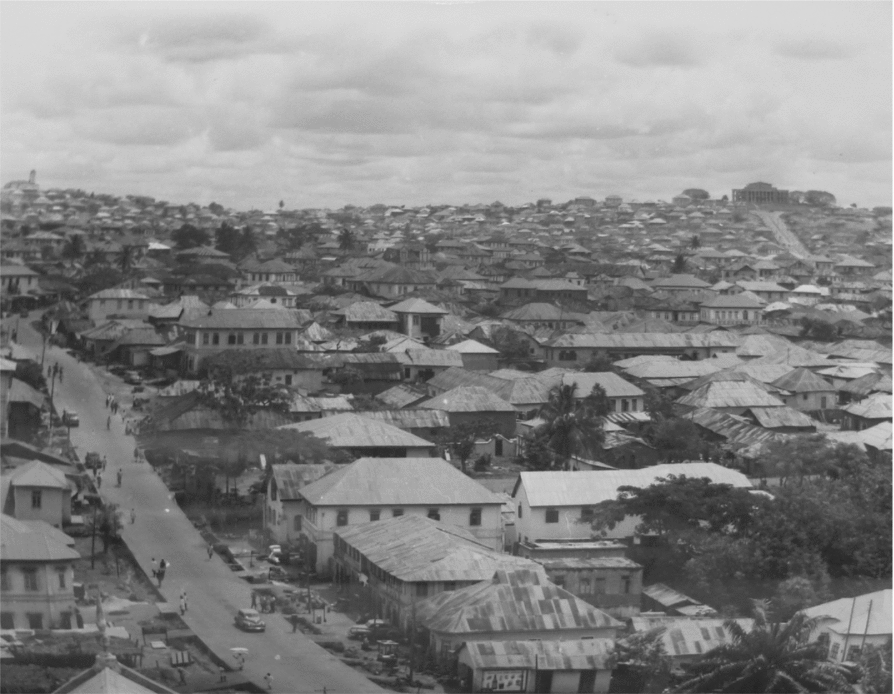
These elites had the most to lose from hardening British attitudes towards racial difference from around 1880, which saw colonial authorities challenge their modern self-perception. The African intelligentsia encountered narrowing opportunities, while Europeans increasingly lived and socialized separately. Ibadan, a metropolis of 100,000 people or more built across rolling hills, was annexed by Britain in 1893. The city was characterized by the compound, a rectangular complex of rooms opening onto a central courtyard, with a loose relationship to lineage groups and chieftaincy politics (see Figure 2). Europeans lived outside this world, in two districts on Ibadan's periphery.Footnote 24 These divisions were entrenched by Sir Frederick (later Lord) Lugard, governor general from 1913 to 1918. His doctrine of ‘indirect rule’ formed an alliance between colonial government and local chiefs, leaving little room for Nigerian educated elites. Under the 1917 Townships Ordinance, the status of ‘European Reservations’ was formalized. They were to be separated from indigenous settlements and usually comprised low-density groups of bungalows with infrastructure, including paved roads and running water, superior to neighbouring areas inhabited by Nigerians.Footnote 25 European Reservations became a focus for educated Nigerian agitation.Footnote 26 By the 1920s and 1930s, urban reform became a key campaigning point for southern Nigerian elites, who formed groups such as the Ibadan Progressive Union (1930) to call for improved roads, piped water and electricity, infrastructure that they increasingly perceived to define modern space.Footnote 27 For the intelligentsia, space was one aspect of the modernity from which colonial rule excluded them.
Ibadan in the later 1950s. The compound dwellings that were considered customary in the city can be seen on Mapo Hill to the left of this photograph by the Sierra Leonean doctor Robert Wellesley Cole, who captioned it ‘Old Ibadan – “a miracle”’. There are also many signs of development, however, such as new roads and colonial-era buildings including Mapo Hall, again on the left, which was opened in 1929. Source: SOAS Library, Archives and Special Collections, PP MS 35 Cole file 175 box 29.
These issues came together in the debate over Yaba Higher College. Founded by the colonial government in 1933, the college was mercilessly criticized for the standard of its qualifications, which were unrecognized outside of Nigeria and qualified students for only intermediate civil service posts. ‘Few issues united educated Nigerians of all shades of opinion in the late 1930s’, writes J.D.Y. Peel, ‘as much as opposition to the proposal that Yaba Higher College in Lagos should be “practical”, rather than academic, in the orientation of its courses’.Footnote 28 The disquiet had a spatial dimension. The Higher College was in a marginal position, in open country at the edge of Lagos municipality, in stark contrast to the prestigious boarding school King's College which was in a ‘European’ area of Lagos Island near the racecourse. At first, Higher College classes had been temporarily held at King's College.Footnote 29 H.O. Davies, secretary of the King's College Old Boys’ Association and a prominent nationalist, complained in 1934 that the Higher College should have been based at King's. He protested that instead of building on ‘the foundation already established’, the government ‘chose another and a less congenial site’.Footnote 30 Yaba Higher College remained symbolic of educated Nigerians’ anxieties about their status under colonialism.
In the later 1930s, British colonial policy embarked on a great turn. Indirect rule was blamed for social and economic stagnation, and a new developmental approach advocated an alliance with educated Africans. In July 1943, Secretary of State for the Colonies Oliver Stanley announced the new policy of ‘partnership’ to the House of Commons, appointing the Elliot Commission to investigate West African prospects for higher education.Footnote 31 A sign of the times was the inclusion of three West Africans on the fourteen-person commission, which travelled the four British colonies of the region collecting evidence. The controversy over Yaba Higher College meant many Nigerians strongly advocated a university with full British academic standards. During drafting, African commission members such as the Nigerian headmaster Rev. I.O. Ransome Kuti successfully argued for medical education to British standards, for example, rather than the award of a lesser diploma.Footnote 32 The nature of university space was also considered. Nigeria's most outspokenly nationalist newspaper of the time, the West African Pilot, argued in favour of student residence at the university, seeing it as important to ‘full university life’ with students ‘broadening one another's outlook unconsciously by continuous intercourse’.Footnote 33 Educated Nigerians thus sought a form of university space that would reflect their elite status.
The Elliot Report of 1945 was split between Majority and Minority versions, but they agreed on the need for a university at Ibadan and the importance of buildings to the programme.Footnote 34 The Majority Report called for ‘extensive building’ in Nigeria, and the use of existing buildings to allow for rapid expansion. The university was to encompass ‘not only the acquisition of knowledge, but a way of life’, and was envisaged as a centre looked to by local populations for ‘enlightened and progressive thought’.Footnote 35 The Minority placed more emphasis on buildings, hoping that ‘the best expert advice will be sought and that the buildings will be of fine architectural standard, fitting for the first University of West Africa, and providing inspiration to staff and students’.Footnote 36
The Elliot Report bore the mark of the West African intelligentsia's aspirations to modernity in education and space, expressing their equality with the British, and positioning them as progressive leaders of society. When Nigerians went to see the long-anticipated university after it opened in 1948, its rickety huts left them underwhelmed. ‘Is this the compound of the famous University College that I had been longing to enter?’, wondered one student.Footnote 37 The huts raised suspicions. According to the historian of education Babs Fafunwa, the temporary site ‘saddled the new college with the unfortunate legacy of local unpopularity which had belonged, however unfairly, to Yaba Higher College’.Footnote 38 The educated elite aspired to a full entry into modernity, and waited to see if it would be offered by the permanent site being planned by Fry and Drew.
Planning UCI
UCI's architects Maxwell Fry and Jane Drew had undoubted avant-garde credentials. Both had been active during the 1930s in the British MARS group of modernist architects, and the international group CIAM. Fry's 1936 design for Kensal House, a London workers’ housing project, came to symbolize the new architecture in Britain, appearing on book covers and reconstructionist wartime posters.Footnote 39 During the war, Fry and Drew married, and served as town planning advisers to the British Resident Minister in Accra. This experience left them ideally placed to take on architectural work associated with post-war development programmes. They designed schools and hospitals across the Gold Coast, the university at Ibadan and later worked with Le Corbusier designing housing for Chandigarh in India.Footnote 40
Although Fry and Drew saw themselves as developmentalist successors to colonialism, research into ‘colonial modernism’ has shown how they were part of the colonial establishment, sharing colonial-era attitudes.Footnote 41 Their work on UCI bears this out. Fry and Drew aspired to an architecture ‘connected with the set of ideas which have international validity, but reflecting conditions of climate, the habits of the people and the aspirations of countries’.Footnote 42 Yet at Ibadan, Fry and Drew adhered to their CO brief, which suggested halls of residence ‘probably be built on a “College” plan, each undergraduate having a separate study bedroom’, on the model of Oxford or Cambridge.Footnote 43 That they were prepared to accept such an idiosyncratically British model as having ‘international validity’ suggests the particularist assumptions underlying Fry and Drew's conception of rationalist development.
Similarly, the architects understood themselves as agents of a development that would supplant indigenous African cultures. Drew believed that Africa was shifting ‘to a loose westernized pattern, perhaps more like that of California than Europe’.Footnote 44 Universities were understood to drive and express this transformation. Their plans for the university reflected the architects’ conception of Nigerian university students as modern individuals who were shedding ‘tribal ideas’.Footnote 45 When designing for people they considered less modern, Fry and Drew at times tried to engage more with indigenous cultures.Footnote 46 Fry and Drew's buildings for the university, while adapted for climate, were not adapted for cultural differences they assumed to be disappearing. Their design for the Arts Theatre, for example, relied on a western model, making no reference to Nigerian forms of performance practice.Footnote 47
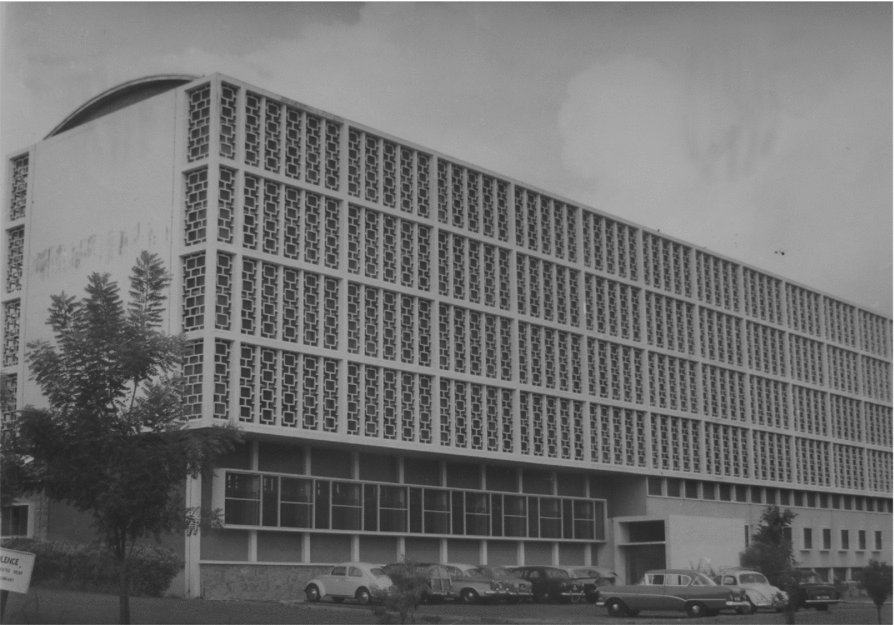
Fry and Drew's adaptation for climate was rooted in colonial-era conceptions of the ‘tropical’.Footnote 48 They considered it to be distinguished by extreme weather, unpleasant insects and ‘mysterious fungi’.Footnote 49 Fry and Drew emphasized the importance of planning buildings in relation to the sun and prevailing breezes, providing shade and natural ventilation, but their understandings of the tropical also involved a more subjective, almost moralistic, dimension. The UCI buildings were designed as a foil to the perceived effects of climate on people. The moulded concrete grilles were intended as ‘a response which is African; the sunshine and moisture and heavy overcast sky and feeling of lethargy seem to call forth moulded forms which are rhythmical and strong’ (see Figure 3).Footnote 50 Theirs was a genuine effort to engage with Africa, but one that did not transcend negative stereotypes of Africa and Africans as disordered and lazy. In their statements in architectural magazines and their handbooks on tropical architecture, Fry and Drew apparently conveyed rationalist professional knowledge, but it formed part of a construction of the tropics informed by colonial politics. The apparently neutral category of modernity incorporated racialized characteristics formed in relation to colonial rule.
UCI Library. Note the perforated concrete screen, which allowed the natural ventilation of the building, but also let in noise. The sign in the bottom left corner reads, ‘SILENCE REQUESTED NEAR LIBRARY’. Source: SOAS Library, Archives and Special Collections, PP MS 35 Cole file 175 box 29.

It would be a mistake, though, to see Fry and Drew as part of a seamless colonial establishment that consciously used the progressive associations of modernist architecture to conceal a hegemonic agenda. Fry and Drew's numerous West African commissions for the CO seem to support Mark Crinson's contention that modernist architecture represented ‘an apologia for colonialism’, or Rhodri Windsor-Liscombe's that it was ‘officially sanctioned’.Footnote 51 The October 1947 interview process for UCI architects suggests a different emphasis. Architectural style was scarcely mentioned. The stated criteria for architects included economy, experience in designing educational and ‘tropical’ buildings, and the capacity to employ Nigerians in construction.Footnote 52 An internal CO minute listed further criteria, including that architects were young enough to complete the buildings and have experience of large-scale projects and planning.Footnote 53 The three shortlisted architectural firms were not all associated with modernism. While Hugh Casson and Fry and Drew were, the firm of Sir Aston Webb & Son, which did not have a reputation for modernism, also made the shortlist.
Nor did the interviewers’ discussions hinge on architectural style. It was not mentioned in any of the notes that survive from the interviews.Footnote 54 The CO mandarins seem to have been neither opponents nor advocates of modernist architecture. This was reflected in the contemporary case of the University College of Gold Coast buildings designed by Austin Harrison, too ornamented to be considered modernist but showing the influence of his inter-war experience designing buildings around the Mediterranean.Footnote 55 Modernist architecture was known to British officialdom. Architects and colonial officials shared a culture in which modernist architecture and development were loosely linked, although these deliberations suggest that the CO's deliberate deployment of modernist architecture in development projects has been overstated. CO officials did not tactically deploy modernist architecture at UCI for political reasons.
The Ibadan university project brought together disparate individuals, from Nigerian chiefs to British development experts. Colonial modern arguments suggest that metropolitan experts’ knowledge was used to legitimize authoritarian interventions in colonial landscapes. These experts encountered other forms of legitimacy, however, such as the authority of the Ibadan chiefs, as seen in the process of securing land for the university.
The proposed permanent site, five miles outside of Ibadan, was selected by local colonial officials. Metropolitan experts saw the land assigned for UCI as essentially empty. University administrator Hamilton Fyfe perceived it as having ‘almost no farms on it, so that the problem of dispossession of farms, which the administration was so anxious to avoid, would scarcely arise’.Footnote 56 Mellanby found the site ‘primitive’, remembering: ‘in a few minutes you could be out of sight and sound of anything that reminded you of higher education or Western Civilisation’.Footnote 57 Local colonial officials corrected them, though. The same land appeared to them ‘heavily farmed’, including ‘40 or 50 villages of two or three mud huts’. The local District Officer concluded that ‘acquisition will be expensive’.Footnote 58 Metropolitan experts, their eyes unattuned to West African agriculture, indeed viewed the land as empty, as the colonial modern view suggests.
Local colonial officials saw it differently, as a patchwork of Nigerian interests that would have to be carefully assuaged. This involved working with the Ibadan ‘Native Authority’ (NA), the local council comprising senior chiefs and more recently admitted literate representatives.Footnote 59 The Ibadan chiefs had a record of supporting educational projects in their city. During the war, they evicted the occupants of sites for new schools without compensation.Footnote 60 The local businessman and diarist Akinpelu Obisisean advised the paramount chief of Ibadan not to oppose the grant of land for UCI, which he suggested was for ‘the purpose + of training of their own children, so that they may become sharers from its benefits’.Footnote 61 The NA refused to sell the land outright, preferring to make it available under a long lease to preserve their position as landlords.
It was also closely involved in compensating those farming the land, Chief Adetoun meticulously counting productive trees for which compensation would be paid, with rates agreed by a committee of chiefs and colonial officers.Footnote 62 The land was cultivated by 345 farmers, who received compensation for unexhausted agricultural improvements, including 54,000 cocoa trees at 5s 9d per tree. Just under £27,000 was paid in compensation for the first 1,600 acres, a figure Mellanby at least considered generous.Footnote 63 Many farmers used the money to build a house in Ibadan rather than take up the government offer of land 30 miles from the city, which was considered to be of inferior agricultural quality.Footnote 64 Nigerian NAs did not act freely in their dealings with colonial officials. In this case, however, it is hard to ignore evidence of their co-operation with the university scheme rooted in a perception of its developmental benefits to their community.
Nor did Fry and Drew's vision of development go unchallenged. Historians have chronicled disputes between metropolitan experts and local colonial officials. At Ibadan, there was an additional fracture that has been seldom noted: between development professionals.Footnote 65 Experts liked to imagine themselves as engaged in rational processes. But what if they disagreed? Unearthing these conflicts further qualifies the sense of colonial development as an integrated machine.
The design of UCI's buildings was marked by rancorous disagreements between architects and client. ‘Quality is the keynote of both the university and its expression in architecture’, Fry and Drew reflected in 1956.Footnote 66 But Kenneth Mellanby was ambivalent about the relationship of his university to its buildings. He warned a UCI audience at the 1948 ‘turning of the first sod’ at the permanent site: ‘let us not, even today, overestimate the importance of the material home of the university’. ‘Many great discoveries have been made in attics’, Mellanby continued.Footnote 67 In the less public arena of university meetings, he was blunter, calling for designs ‘as modest and economical as was consistent with the efficiency and minimum degree of dignity necessary to such buildings’.Footnote 68 Here was the root of a clash of experts. For the architects, fine buildings were at the heart of what a university was, while for the scholars they merely accommodated the university's academic functions.
This difference of outlook created a turbulent relationship between Mellanby and the architects. Fry and Drew saw Mellanby as vacillating and autocratic, and celebrated when his sole authority for building was replaced: ‘thank goodness for the committee’, Fry wrote to Drew from Ibadan in 1949.Footnote 69 Mellanby saw the architects as inept, questioning their claimed expertise. Fry and Drew were ‘undoubtedly extraordinarily incompetent’ argued Mellanby, accusing Fry, for example, of designing a lighting system ‘which, a simple calculation shows, would raise the internal temperature of the room by one degree a minute when the lighting was turned on’.Footnote 70 In the clash of development experts, each used their expertise to challenge the other.
The Inter-University Council prevented Mellanby from terminating the architects’ contracts. He embarked instead on an audacious guerrilla campaign to circumvent the architectural profession, commissioning ‘temporary’ buildings designed and constructed by the university under the supervision of his engineer brother John. This unorthodox arrangement infuriated the architects. ‘Little or no attempt has been made on your side to honour the spirit or the letter of agreement’, complained Drew. The CO agreed, pointing out that British funding conditions stipulated the employment of a registered architect.Footnote 71 A compromise was brokered in June 1950, which saw the UCI campus divided into two zones. In the central area containing Fry and Drew's main buildings, UCI had to consult the architects before commencing new buildings, but outside it the university was free to design its own.
The split between architects and academics shows the rarely considered fracture in colonial development between metropolitan experts. Development relied on professional expertise, but the goals of professions differed. The apparently implacable advent of colonial modernity was more contingent than it has seemed. Colonial development was not a seamless project as sometimes portrayed, but a shifting alliance between many actors and forms of knowledge, including those of chiefs, the Nigerian intelligentsia, colonial administrators in Nigeria, self-confident metropolitan experts and CO bureaucrats in London.
UCI in practice
When Fry and Drew's first permanent site buildings were opened in November 1952, they were widely acclaimed by elite Nigerians. ‘Only such buildings befit a great nation’, wrote Chuma Ajaegbu-Mgbakor, a Lagos businessman, in the Daily Times.Footnote 72 Fry and Drew's vision did not define what the buildings meant for long. Instead, their meanings were affected by the politics of decolonization, as educated elites sought to redefine their social and political status during the devolution of regional power to Nigerians in the 1950s and after full independence in 1960.
Despite criticisms of student residence in modern halls, it was often considered by students and Nigerian and British university administrators as a legitimate aspect of students’ elite self-perception. Constructions of UCI space as modern glossed over the lived experience of the buildings, but dovetailed with elite Nigerian and foreign views of Ibadan city as stubbornly traditional. In 1949, the student J. Ajayi suggested there were ‘two distinct Ibadans in one’, a divide visible at night as only modern parts of the city had electric lighting. Significantly, Ajayi linked the divide in infrastructure to other differences. The ‘conservative half’ of the city had irregular buildings on hills which were ‘the stronghold of the ancient bandits who founded the town’. Talk there was of chieftaincy politics and cocoa prices. In the other half, buildings were planned and conversation dwelt on newspapers, tennis and the university. Expatriates lived there, and it was ‘changing fast’.Footnote 73 This perception of a binary city informed understandings of university space. This final section explores the ways UCI buildings were understood as modern in practice by focusing on student halls of residence.
Fry and Drew's halls of residence allotted each student a personal study-bedroom. They incorporated lecturers’ flats, formal dining rooms with a raised ‘high table’ for staff and quadrangles with neat lawns. The buildings were expensive, accommodating a relatively small student body. Planning for UCI reflected late 1940s British assumptions of a leisurely progress towards the transfer of power, with Nigerian politicians and civil servants, including Ibadan graduates, gradually replacing the British. UCI was planned for 600 students, and by 1952 there were only 367.Footnote 74
It was not long before the buildings and the assumptions behind them were criticized as elitist, extravagant and a constraint to Nigerian development. UCI was funded in part by British grants, but mostly from the limited revenues of the Nigerian government, with Mellanby's chaotic financial stewardship necessitating ‘bail outs’ in 1952 and 1954.Footnote 75 An early critic was an International Bank for Reconstruction and Development commission, that visited Nigeria in 1953. It reported that student accommodation at Ibadan was ‘luxurious’, and recommended reducing costs to allow increased student numbers, providing trained development personnel. ‘Consideration should be given to placing two students in a room’, it concluded. ‘If this is done, there need be no new expenditure on dormitories for some time to come.’Footnote 76
The report was seized upon by Nigerian critics. In the context of the transition towards decolonization, student residence represented UCI's British elitism. The leading nationalist Nnamdi Azikiwe attacked the cost of the university, singling out residence. Describing UCI as a ‘million dollar baby’ Azikiwe told the House of Representatives in 1954 that there was ‘no intrinsic value in restricting the students of the university to residential status. Very few modern universities of the world adopt this rather restrictive and archaic practice.’Footnote 77 He proposed opening UCI to non-resident students and building cheaper halls. The membership of the Nigerian Union of Great Britain and Ireland concurred. They called in 1955 for plans ‘to accommodate more students in Ibadan’, and suggested, ‘if necessary, buildings should be acquired in town as Students’ Hostels’.Footnote 78
Even some British advisers started to agree that colonial universities were too detached from their societies. A 1957 Inter-University Council visitation recommended doubling Ibadan student numbers over five years. UCI was told to ‘urgently reconsider its policy on student residence’. The report suggested students share rooms, live in the temporary site huts or in Ibadan city.Footnote 79 As this British commentary suggests, debates about university residence were not specific to Nigeria. Well-established student residence models were also being challenged in Britain.Footnote 80 Nigerian debates were part of a transnational discourse re-evaluating student residence that was further energized by decolonization politics.
Many students, and Nigerian and British university administrators, resisted the criticisms. They perceived living in modern space as an essential element of university education despite its cost. In 1955, the chairman of the college council, Sir Sydney Phillipson, described the provision of halls as ‘a very substantial financial commitment, far more in fact than we have’, but justified them as a ‘melting pot’, that brought together diverse Nigerian students to create a new elite.Footnote 81 A British civil servant at the Federal Ministry of Education contended that ‘the general feeling is that the advantages of residence (good regular meals, close contact with fellow students, good conditions for study i.e. quiet rooms, library, etc.) outweigh the disadvantages’, showing how the space of the university was considered to possess a modern orderliness that the city lacked.Footnote 82 The UCI registrar, Nigerian historian S.O. Biobaku, gave a similar explanation to readers of the Western News: ‘there are no suitable lodgings for students at reasonable prices in the town of Ibadan; nor is there reliable public transport’. Biobaku argued that students re-sitting exams had lived in Ibadan as an experiment, but their experience was so bad, ‘they willingly accepted accommodation in rooms which were without light and water in an incomplete wing of a Hall of Residence’. Neither was room sharing satisfactory: ‘the rooms are really too small’.Footnote 83
Its supporters portrayed UCI as educating a modern elite in modern space: quiet, ordered, students mixing with a respectable sociability and underpinned by modern infrastructure. These perceptions were largely unaffected by the unreliability of university infrastructure and noisiness of halls. Telephones broke down, and water and electricity supplies were erratic. The louvred windows and perforated concrete screens of Fry and Drew's buildings allowed sound to carry easily, making lecturers’ flats in student halls of residence very unpopular.Footnote 84 Signs were put up around the library demanding silence (see Figure 3), and a regime of specified quiet times instituted, as it had been at the temporary site, during which the use of radios, record players and musical instruments was banned.Footnote 85 As Lefebvre argues, there could be a disconnect between the lived experience of halls and their socially constructed associations. Despite noise and infrastructure problems, UCI halls were still understood as the opposite of the city, with its associations of noise and disorder. There were no ‘suitable lodgings’ there, despite the campus sharing these qualities at times, and their variable applicability to the city, where, for example, suitable buildings were found to serve as maternity clinics.Footnote 86
UCI sought to compromise with their critics, increasing student numbers while preserving the principle of students residing in modern space. Principal J.H. Parry, a British historian, accommodated more students by reopening the temporary site huts in 1957. He noted that ‘the men themselves complain bitterly about being billeted out’, although the huts were evidently considered to offer a form of space preferable to the city.Footnote 87 Cheaper halls of residence were another way to keep students on campus. In 1958, the university requested plans for a new style of hall, called ‘Utility Hostel Buildings’.Footnote 88 The change in terminology was significant, as was the appointment of new architects, Fry and Drew's designs being seen as overly expensive. The bursar reported that the hostels ‘have been designed on economical lines’, with costs cut ‘by allowing for two students per room’.Footnote 89 The hostel had no formal dining hall, but a self-service cafeteria. The principle of students having their own rooms was abandoned to keep students living in modern space.
There was not, however, unanimity about space within the UCI community. Some students and lecturers preferred the informality of the temporary site huts, remembered by Wole Soyinka for their ‘openness to the real world’ in contrast to the ‘scrupulously geometric’ permanent site.Footnote 90 In 1957, some students attacked newly erected fences restricting their movement around halls, indicating the tensions between students and university authorities over who defined university space. Some students and staff sought a different kind of modern space in Ibadan's new nightclubs. The German lecturer Ulli Beier discovered highlife music, while as a student J.P. Clark remembered returning to UCI ‘at four or five o'clock in the morning’.Footnote 91 Clark's nocturnal journeys, three miles on foot if he missed a taxi, remind us that the university offered neither the sole location nor form of modern space in Ibadan.
Shortly before Nigerian independence in 1960, the distinguished historian Kenneth Onwuka Dike became UCI's first Nigerian principal. He continued to resist criticisms of student residence. The 1962 UNESCO Conference on Higher Education in Africa, held at Tananarive in Madagascar, called for residential universities to consider becoming ‘non-residential or only partly residential establishments’.Footnote 92 The conference found UCI was one of the costliest universities in Africa, having spent more on student and staff residence (the equivalent of $7.8m) than on academic buildings and equipment ($5.2m).Footnote 93 It argued residence removed students ‘from that sense of one-ness with their societies without which they cannot effectively serve their societies’.Footnote 94
The American development experts who arrived in Nigeria around independence often agreed. The economist Wolfgang Stolper considered in 1960 that ‘Ibadan should certainly use day students; and less elegant housing might lead to less alienation of students from their environment.’Footnote 95 In 1968, the American sociologist Pierre van den Burge found the UCI halls ‘both needlessly expensive in design and badly suited to their purposes . . . As they stand, the halls have an opulent outward shell, and inside appearance of a noisy, overcrowded semi-slum.’Footnote 96 Dike had agreed to room sharing in the older halls in 1963, making them noisier than ever with chronically overcrowded dining and bathing facilities, now used by twice the number of students for which they had been designed. For van den Burge, the university was not modernizing the city and nation as the Elliot Report had hoped in 1945. Rather, misconceived colonial development was turning the modern university into the ‘semi-slum’ that many westerners and elite Nigerians had long perceived Ibadan city to be.
Yet many educated Nigerians defended and promoted the idea of students living in modern halls. The first new Nigerian universities founded after independence were chiefly residential, including the University of Nigeria, founded by the erstwhile critic of student residence Nnamdi Azikiwe.Footnote 97 The National University Commission maintained in 1963 that halls gave students ‘the art of living together with other people in a well ordered and cultured society’.Footnote 98 Dike abandoned the residential principle only very reluctantly. A second ‘Utility Hostel’, ironically named after Azikiwe, was completed at UCI in 1963, and non-residential students were admitted in 1966.Footnote 99 ‘Much as we would like it, we simply cannot house all the students we plan to admit’, Dike told graduation day that year.Footnote 100 The construction of new suburbs made it increasingly possible to live in Ibadan in space considered modern. Some Nigerian lecturers started to live off campus: as modern space became more widespread, the elite status implied by university residence was gradually diluted.Footnote 101
It did not disappear, though. In a 1969 paper, the Nigerian economist J.D. Odufalu gave the usual reasons in defence of residential universities, including the lack of suitable housing in cities. He also located an often unspoken consideration, contesting that higher education was ‘the privilege of the few (and probably still is)’. Students ‘lived in a different world distinct from the rest of the illiterate public; they moved in “top circles”’. Odufalu associated this status with residence in halls: ‘the average student thinks it less in keeping with this tradition to live in other than halls of residence’.Footnote 102 Despite his observation that modern space lent students social distinction, Odufalu still considered that because of the lack of ‘suitable’ accommodation in Nigerian cities, the practice of providing halls would continue. Practical and symbolic considerations had become inseparably entangled.
This article has contended that development, and the state of modernity to which it aspired, had a spatial dimension. Development was made visible through interventions in landscapes, and individuals aspiring to modernity have often sought to inhabit modern space. It has also argued that to consider built environments historically, the contexts they intervened in and ways in which they were used are at least as important as their planning. Colonial modern literature has been enormously fruitful, revealing how the production of built environments has been entangled with colonial power. These insights, however, have sometimes come at the cost of fully exploring how the meanings of space in colonies were collectively, if unequally, created. A focus on plans can occlude blind spots in colonial power, the agency of colonized peoples and the complexities of the ways these buildings were perceived and used. Colonial modern interpretations may take modernistic development rhetoric too much at face value, and can be nuanced by considering the less heroic detail of how individual cases worked in practice.
The case-study of UCI shows how its context, the long history of educated West Africans’ aspirations, was important in shaping the buildings’ meanings. From before colonial rule, educated Nigerians perceived themselves as modern and inhabited space considered modern. These ideas fed into plans for UCI through the Yaba Higher College controversy and the Elliot Commission. At UCI, colonial development was not imposed entirely from without. It took place amidst cultures and assumptions flavoured by colonial rule, which were reflected, for example, in the thinking of Fry and Drew. But colonial modernity was also fragile. Even if metropolitan experts saw the land that became UCI's permanent site as a tabula rasa for development, local colonial officials did not, enlisting the legitimacy of the NA to obtain the land collaboratively. Even the co-operation of metropolitan experts could not be assumed. Colonial development in practice was contingent. It brought together disparate groups and ideas, and created spaces with hybrid meanings.
What the buildings came to mean to their users and other commentators had more to do with perceptions of the place of educated elites in a decolonizing society and the relationship of the university to the city than with the buildings’ intended or material qualities, or even the lived experience of their use. Student residence in elite university space was criticized, but for many it assumed a powerful prestige forming part of educated Nigerian identities that outlasted the colonial era. It was questioned more vigorously once the crisis in development assumptions emerged across the globe towards the end of the 1960s. As state funding and international aid to the university dried up in the 1970s, the increasingly poorly maintained buildings testified the problematic status of the university under military rule.
In a sense, then, Kenneth Mellanby's dream of founding a modern university in the primitive ‘bush’ was realized. UCI was indeed seen as a site of modernity, but its role in developing the city and nation was more contested than many had expected and hoped.