Introduction
Energy harvesting is the conversion of ambient energy into electrical energy for use in powering autonomous electronic devices or circuits. Energy can be harvested from mechanical sources (e.g., strain, displacements), thermal gradients, or incident light (photovoltaics). While numerous examples of such energy harvesters exist, incorporating the required materials into a textile presents unique challenges, in terms of both fabrication and implementation. This article discusses energy-harvesting materials that can be combined with textiles to enable the textile itself to act as the energy harvester.
Energy-harvesting textiles can be achieved by adding active materials as films on the surface of the textile, or as yarns that are woven or embroidered into the textile. The film approach enables low-cost printing processes to be used. This has the advantages of being familiar to the textile industry and can be used to deposit the material across large areas. It also enables the energy-harvesting ability to be added to a wide range of otherwise standard textiles. The disadvantages of this approach derive from processing challenges and constraints the textile places on the functional materials. Processing temperatures are limited to around 150°C, and the otherwise rough and “fluffy” surface requires the textile to be planarized with an interface layer.Reference Yang, Torah, Wei, Beeby and Tudor1 The printed films change the feel of the textile, and the printed area needs to be minimized to reduce this effect. Active yarns, however, can be fabricated separately and then woven into the textile, typically alongside standard textile yarns. This approach places fewer constraints on functional materials, but their positioning in the textile is limited to the warp and weft directions of the textile. The warp and weft of the fabric relate to the weave structure; yarns in the warp direction are held in tension longitudinally, and the weft yarns are drawn perpendicular to the warp, weaving over and under the warp yarns. The mechanical properties of the active yarns may also affect the feel of the textile, and they must be sufficiently robust to withstand the weaving, knitting, or embroidery process.
Textile energy harvesting can potentially be used as an alternative to batteries, which contain a finite amount of energy and require periodic replacement or recharging. In wearable textile applications, batteries are rigid bulky items that must be removed before washing. The development of energy-harvesting textiles is relatively new and has the potential to power “e-textiles” directly from the fabric itself.
Materials for mechanical energy harvesting
Piezoelectric materials are well suited for energy harvesting since their inherent energy transduction capability offers direct energy conversion that is subject to strain without the need for external conditioning or bias voltages. The level of energy transduction in a piezoelectric material is defined by the piezoelectric and voltage coefficients of the material. The piezoelectric coefficient, d (pC/N), correlates the generated charge to the applied stress, and the voltage coefficient, g (Vm/N), relates the generated electric field to the applied stress. The most commonly used piezoelectric materials for energy harvesting are piezoceramics with the perovskite structure,Reference Anton and Sodano2 such as lead zirconate titanate (PZT), which has a maximum piezoelectric coefficient, d 33, of approximately 600 pC/N, which is a significantly high value for use in energy harvesting. However, lead-based piezoelectric materials were recently exempted from use by the European Union directives regarding the use of toxic materials. Efforts have sought to identify alternative compositions that exhibit high electromechanical coupling. An example is a solid solution at the morphotropic phase boundary, Ba(Ti0.8Zr0.2)O3-(Ba0.7Ca0.3)TiO3, which shows a high piezoelectric coefficient of d 33 ∼ 620 pC/N at optimal composition.Reference Liu and Ren3
There are numerous methods for integrating piezoelectric materials into a textile; however, the brittle nature of ceramics leads to their application as a piezoelectric cladding on the surface of an inactive fiber. Sodano et al. developed examples of piezoceramic clad fibers using PZTReference Lin and Sodano4,Reference Lin, Shaffer and Sodano5 and barium titanateReference Bowland, Zhou and Sodano6 on conductive core fibers such that one electrode was internal to the fiber thus eliminating shorting. An alternative methodology to overcome the low strain to failure is through the use of nanoscale materials, such as vertically aligned ZnO nanowires that were demonstrated to harvest energy from the sliding contact between two separate fibers yielding high-energy extraction.Reference Qin, Wang and Wang7
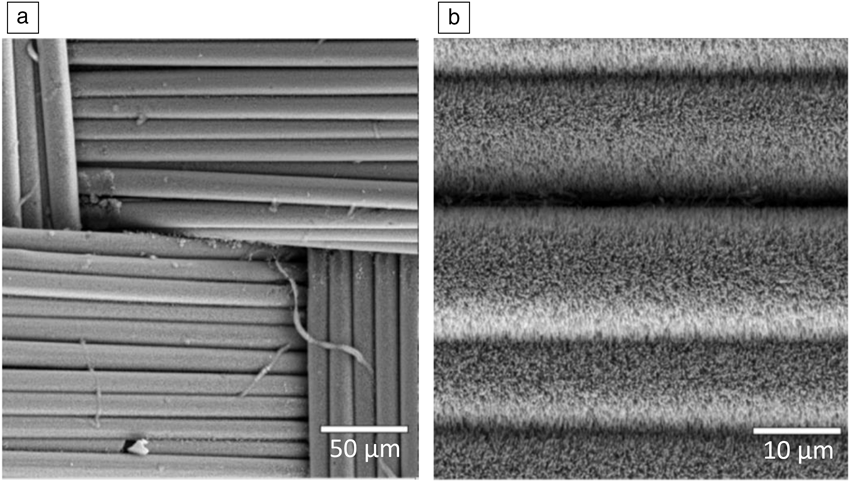
Malakooti et al.Reference Malakooti, Patterson, Hwang and Sodano8 grew ZnO nanowires directly on Kevlar fabrics and used these for energy harvesting (Figure 1). Rather than using a thin film on a fiber core, the electrospinning process allows the direct manufacture of nonwoven fabrics with sufficiently small diameters to enable a high degree of flexibility. This has also been applied to the formation of piezoceramic textiles, which can be used for wearable systems. Wu et al. electrospun nonwoven mats of PZT fibers for energy harvesting,Reference Wu, Bai, Yuan, Qin, Wang and Jing9 while Zheng et al. utilized a nanocomposite electrospun fiber to yield a wearable device.Reference Zeng, Tao, Chen, Shang, Chan and Choy10
Scanning electron micrographs of Kevlar fabric with ZnO nanowires grown on the surface to enable energy harvesting. (a) Kevlar fibers, and (b) magnified image, highlighting the ZnO nanowires.Reference Malakooti, Patterson, Hwang and Sodano8

An alternative material to piezoceramics are piezoelectric polymers such as poly(vinylidene fluoride) (PVDF), which is a highly durable and environmentally stable polymer well suited for the manufacture of piezoelectric yarns. The process of extracting electrical energy from a piezoelectric material relies on the material’s voltage coefficient, which is larger in many polymers than ceramics due to their low dielectric constant, allowing an increase in the electric field. Hadimani et al. developed a process to simultaneously spin and pole continuous PVDF fibers;Reference Hadimani, Bayramol, Sion, Shah, Qian, Shi and Siores11 they subsequently demonstrated the integration of the fibers into a three-layer knit in which the core transverse fibers were piezoelectric and the outer layers were conductive gold-coated nylon.Reference Soin, Shah, Anand, Geng, Pornwannachai, Mandal, Reid, Sharma, Hadimani, Bayramol and Siores12 This architecture leads to a fully integrated energy-harvesting textile and electrode system that provides strong energy-harvesting capability. Nanofiber poly(vinylidene fluoride-co-trifluoroethylene) (PVDF-TrFE) co-block polymers have also been demonstrated as a piezoelectric textile.Reference Persano, Dagdeviren, Su, Zhang, Girardo, Pisignano, Huang and Rogers13 The PVDF-TrFE textile is mechanically robust and produces 40 nA and 1.5 V under bending. The addition of a graphene oxide (GO) layer between the PVDF-TrFE film and the bottom electrode has been reported to increase voltage and power output.Reference Bhavanasi, Kumar, Parida, Wang and Lee14 This is due, in part, to the increased Young’s modulus of the GO film, which increases the energy coupled to the PVDF-TrFE film.
Piezoelectric films
An alternative to using piezoelectric yarns is to use a standard fabric and then deposit a piezoelectric layer on top. Elkjaer et al. developed a piezoelectric paint that can be applied to any fabric via pad or screen printing.Reference Elkjaer, Astafiev, Ringgaard and Zawada15 The piezopaint has a relatively high d 33 of 45 pC/N with a lead-free variant producing 25 pC/N; both of these are suitable for potential energy-harvesting applications.
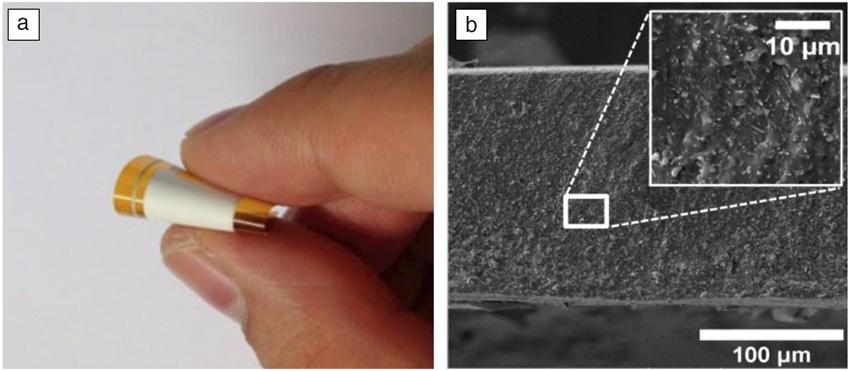
Almusallam et al. developed a similar printable piezoelectric polymer by combining PZT powder with a flexible polymer and optimizing this process (Figure 2).Reference Almusallam, Luo, Komolafe, Yang, Robinson, Torah and Beeby16 This material was printed directly onto the fabric using screen printing, producing a freestanding d 33 value of 98 pC/N. The electromechanical coupling of a piezoelectric paint or nanocomposite can be further enhanced through the use of acicular fillers such as nanowires. Zhou et al. demonstrated 7× greater energy harvesting from polymers with PZTReference Zhou, Tang and Sodano17 and 5Ba(Zr0.2Ti0.8)O3–0.5(Ba0.7Ca0.3)TiO3 (BZT-BCT)Reference Zhou, Bowland, Malakooti, Tang and Sodano18 nanowires embedded in the polymer over equiaxial fillers.
(a) Flexible lead zirconate titanate (PZT) composite film on Kapton and (b) a scanning electron microscope micrograph of a poly(dimethylsiloxane) nanocomposite with PZT nanowires dispersed in the film; (inset) the magnified section in (b) highlights the density of the piezoelectric layer.Reference Almusallam, Luo, Komolafe, Yang, Robinson, Torah and Beeby16

PVDF-TrFE is also available in printable form from Solvay, branded as Solvene electroactive polymers.19 Being a printable polymer ink, this material is in principle compatible with textiles, but in practice difficult to screen print, and the d 33 value is low at –25 pC/N.
Materials for thermoelectric energy harvesting
Thermoelectric generators collect energy from a temperature difference due to the Seebeck effect.Reference Goldsmid20 They are often made of semiconductor materials and work by thermally promoting electrons. The Seebeck effect is defined in Equation 1, where S is the Seebeck coefficient in VK–1, v is the potential produced by the thermal gradient in Volts, and ΔT is the temperature difference in degrees Kelvin, K.
 $$S = {v \over {\Delta T}}$$
However, S is just one aspect of a thermoelectric material, and a more complete picture of the relative merits of a material is given by the thermoelectric figure of merit ZT represented by Equation 2:
 $$ZT = {{{S^2}\sigma T} \over \kappa }$$,
where σ is the electrical conductivity in S m–1, κ is the thermal conductivity in Wm–1K –1, T is the absolute temperature of the system in K. This demonstrates that improving a thermoelectric material requires an increase in the Seebeck coefficient or electrical conductivity, or a reduction in the thermal conductivity. S 2σ is often referred to as the power factor as this shows the amount of energy that can be output in Wm–1K –1.
The choice of materials for wearable thermoelectric devices can be split into inorganic- and organic-based devices. Inorganic devices are predominantly based on bismuth telluride (Bi2Te3) for p-type and antimony telluride (Sb2Te3) for n-type.Reference Alam and Ramakrishna21 Organic thermoelectric devices are less common due to poor performing materials and limited availability of n-type polymers. However, those that have been demonstrated use the conducting polymer poly(3,4-ethylenedioxythiophene) (PEDOT) with various dopants (typically poly(styrene sulfonate) [PSS]).Reference Cowen, Atoyo, Carnie, Baran and Schroeder22
Flexible thermoelectric energy harvesters are covered in more detail in the Tian et al.Reference Tian, Wan, Hayashi, Aoai and Koumoto23 and Roundy and Trolier-McKinstryReference Roundy and Trolier-McKinstry24 articles within this issue. This article focuses on textile implementations. An early example of textile-based wearable thermoelectric devices used commercially available rigid ceramic-based thermoelectric generators (TEGs). These TEGs were simply stitched to clothing and were able to produce power outputs of 0.9 mW from a TEG area of 168 cm2 during sedentary activity.Reference Leonov, Van Hoof and Vullers25 This approach was taken a step further by using smaller TEGs and integrating them into clothing along with a heatsink that produced a 30% increase in power output.Reference Leonov26
Since these early examples, the focus has moved toward flexible devices often fabricated by printing.Reference Orrill and LeBlanc27 One example used inorganic thermoelectric materials mixed with a polymer binder to form a screen-printable paste.Reference Cao, Tudor, Torah and Beeby28 The ratio of the ingredients is important to achieve a balance between flexibility and performance. When using an epichlorohydrin polyglycol-based epoxy binder, it was found that for Bi1.8Te3.2 and Sb2Te3, 86 wt% inorganic material to binder was optimal for screen printing. A challenge for these materials is that high curing temperatures (>250°C) were required to reduce material resistivity, which is not compatible with most textiles. The printed thermoelectric materials were shown to have room-temperature ZT values of 0.135 and 0.095 for Bi1.8Te3.2 and Sb2Te3, respectively, which are close to the values of bulk materials and therefore very promising.
The current state of the art for organic thermoelectric materials is PEDOT:PSS,Reference Kim, Shao, Zhang and Pipe29 which was shown to have a room-temperature ZT of 0.42, a considerable improvement on the 0.025 value achieved using commercially available solutions. This figure of merit was achieved by optimizing the ratio of PEDOT to PSS and using dimethyl sulfoxide to improve electrical conductivity. The advantage of using polymer-based materials is their low processing temperature of ∼100°C, allowing them to be used on common fabrics.
Thermoelectric yarns have also been obtained using evaporated thin-film nickel and silver thermocouples on flexible fibers.Reference Yadav, Pipe and Shtein30 The materials were alternated along the length of the fiber, producing 10-mm-long thermocouples. This material combination yielded a Seebeck coefficient of 19.6 ± 0.6 μV K, and each thermocouple produced 1 μW from 100°C applied to the hot junction and with the cold junction at ambient.
Photovoltaic films on textiles
Fabric solar cells have great potential for powering wearable devices. However, the constraints imposed by the textile on the processes and materials that can be used result in the most significant challenge among the energy-harvesting techniques considered in this review. Existing solar cells on fabrics use conventional rigid silicon or plastic solar cells that are attached (stitched or glued) onto the fabric as a functional patch.Reference Schubert and Werner31 This approach makes the fabric inflexible and alters the feel of the textile dramatically, and the fabric itself has no added functionality. A new generation of flexible dye sensitized solar cells (DSSCs) and organic solar cells (OSCs) offers the potential for integrating the solar cells onto the fabric itself.
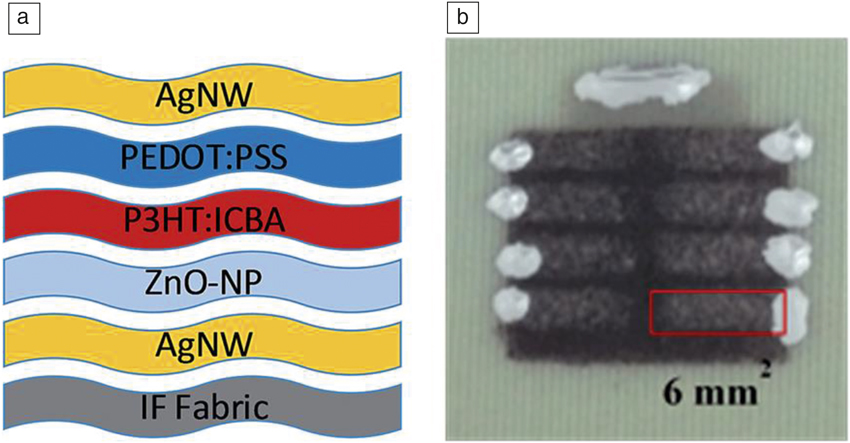
Bedeloglu et al. reported fabric OSCs by combining evaporation and spin coating.Reference Bedeloglu, Jimenez, Demir, Bozkurt, Maser and Sariciftci32 This work used a nonwoven polypropylene textile tape as the substrate, which is not representative of typical woven fabrics, and achieved a good power conversion efficiency of 0.2%. Lee et al. fabricated OSCs on a flexible poly(ethylene terephthalate) (PET)/indium tin oxide substrate, which was then attached to a conductive fabric that acted as the bottom electrode.Reference Lee, Lee, Park and Choi33 This approach does not add functionality to the textile itself and uses evaporation processes for some of the films. Recent research has investigated spray coating to deposit OSCs on a woven polyester cotton textile, as shown in Figure 3. The OSC is entirely solution processed, fabricated at low temperature (<150°C), and uses a poly(3-hexylthiophene) (P3HT):indene-C60 bisadduct (ICBA) formulation, manufactured by Plextronics, for the active layer. Spray coating provides a repeatable and reliable process capable of depositing thin films onto the textile interface layer. Areas of the fabric where no films are required can be easily masked. Early work demonstrated a 0.02% power-conversion efficiency (PCE).Reference Arumugam, Li, Senthilarasu, Torah, Kanibolotsky, Inigo, Skabara and Beeby34
(a) Device structure of a fully solution-processed spray-coated fabric substrate organic solar cell (OSC) and (b) a photograph of the plan view of fabric OSC. Note: NW, nanowire; PEDOT, poly(3,4-ethylenedioxythiophene); PSS, poly(styrene sulfonate); P3HT, poly(3-hexylthiophene); ICBA, indene-C60 bisadduct; NP, nanoparticle; IF, interface and coated fabrics.Reference Arumugam, Li, Senthilarasu, Torah, Kanibolotsky, Inigo, Skabara and Beeby34

Other research has explored fabricating a functional organic photovoltaic fiber that can then be woven into a textile.Reference Zou, Lv, Cai and Hou35 The fabrication of quality functional organic thin films on the surface of a fiber is challenging. One example of successfully thermally evaporated thin films on polyimide-coated silica fibers demonstrated a maximum efficiency of 0.5%.Reference O’Connor, Pipe and Shtein36 Lee et al. used a double-twisted structure based on a conducting polymer and a soluble fullerene derivative photoactive layer deposited on a 100-μm-diameter stainless-steel wire.Reference Lee, Eckert, Forberich, Dennler, Brabec and Gaudiana37 This arrangement demonstrated an efficiency of 3.7%, although the inevitable partial shading and varying angle of incident light detrimentally affected the fiber PV output.
DSSCs are thin-film photoelectrochemical cells based on a semiconductor formed between a photosensitized anode and an electrolyte. There are several approaches reported in the literature to realize DSSC textiles, with many based on the production of single photovoltaic yarns subsequently woven into a textile. The yarns demonstrate a high efficiency of more than 7%, but physical wear is a concern with deterioration apparent after 20 stretch cycles.Reference Yang, Deng, Sun, Li and Peng38 Similar yarns have been woven together to form a DSSC that demonstrated an efficiency of 1.3%.Reference Zhang, Chen, Huang, Guo, Yang, Du, Fan and Tao39 Connecting a number of crossed yarn solar cells and weaving these into a textile remains a challenge for practical applications. The compatibility of DSSC with roll-to-roll processes such as printing and the inherently flexible materials make printed cells on textiles a potential solution. Printed low-temperature processed DSSCs on woven polyester cotton textiles have been demonstrated with an efficiency of 2.78%.Reference Liu, Li, Arumugam, Tudor and Beeby40 However, these use a conventional liquid electrolyte, which requires resolving leakage, evaporation, and long-term stability issues in practical applications. Solid-state electrolytes are a potential way forward.
In recent years, perovskite solar cells (PSCs) have demonstrated rapid improvements in PCE up to a reported value of 22.1%.Reference Yang, Park, Jung, Jeon, Kim, Lee, Shin, Seo, Kim, Noh and Seok41 Most perovskite materials require high-temperature annealing at 450–500°C, which is too high for direct processing on textiles. However, there are several reports of flexible PSCs with low-temperature techniques such as atomic layer deposition or thermal evaporation on PET and polyethylene naphthalate polymer substrates with the highest reported PCE of 14.4%Reference Du, Cai, Bao, Xing, Wu, Xu, Huang, Ni, Li and Zhang42 and 12.2%,Reference Kim, Kim, Lee, Shin, Han, Hong, Mahmood, Ahn, Joo, Hong, Park, Lee and Jung43 respectively. Flexible PSCs have also been achieved by printing using roll-to-roll slot-die printing and spray coating, achieving an efficiency of 11.96%.Reference Hwang, Jung, Heo, Scholes, Watkins, Subbiah, Jones, Kim and Vak44 The processes used to realize flexible PSCs could be applied to textile substrates, but this has yet to be demonstrated. Qiu and Li et al. have also reported yarn-based flexible PSCs, both of which achieved a PCE of 3%.Reference Qiu, Deng, Lu, Yang and Peng45,Reference Li, Xiang, Tong, Zou and Li46
Conclusions
Numerous energy-harvesting textiles have been demonstrated that can successfully convert ambient energy into electrical energy for powering wearable and autonomous systems. Textiles are a challenging application for materials, limiting processing temperatures to typically 150°C. Active films and yarns should be as compliant as possible to minimize any change in the feel of the textile. Active yarns woven into the textile must survive the weaving/knitting/embroidery process, and the textile manufacturing process can limit their location in the textile. Once incorporated into the textile, however, the yarn approach will maintain textile properties such as breathability. Film-based approaches enable the textile to be functionalized, and this can be done immediately after textile fabrication or, for example, after garment assembly. Printed films can be deposited in any pattern, but films will typically reduce breathability. There are remaining research challenges around the performance, mechanical properties, and practicality of the materials. However, textiles are found in numerous applications and industries, not just clothing, and suitable energy-harvesting materials developed for energy harvesting will have many uses.

Russel Torah is a senior research fellow in the Department of Electronics and Computer Science at the University of Southampton, UK. He obtained his BEng degree in electronic engineering in 1999, his MSc degree in instrumentation and transducers in 2000, and his PhD degree in electronics in 2004, all from the University of Southampton. His research focuses on functional materials development and e-textiles applications. He is a co-founder (in 2011) of the Smart Fabric Inks Company, which specializes in printed smart fabrics. He has authored or co-authored 82 publications. Torah can be reached by phone at +44 (0)23 8059 2600 or by email at rnt@soton.ac.uk.

Jake Lawrie-Ashton is a doctoral candidate in the Smart Electronic Materials and Systems Group in the Department of Electronics and Computer Science at the University of Southampton, UK. He obtained his BSc degree in chemistry from the University of Southampton in 2016, with an electrochemistry focus. His current research interests include printable organic thermoelectric materials and wearable thermoelectric devices. Lawrie-Ashton can be reached by phone at +44 (0)23 8059 5362 or by email at jla1g13@soton.ac.uk.

Yi Li is a research fellow in the Department of Electronics and Computer Science at the University of Southampton, UK. He obtained his BEng degree in electronic engineering in 2008 from the University of Warwick, UK, his MSc degree in microsystem technology in 2009 and his PhD degree in printed smart fabrics in 2013 from the University of Southampton. His current research focuses on printed smart fabric-based electronic devices. Li can be reached by phone at +44 (0)23 8059 2353 or by email at yi.li@soton.ac.uk.

Sasikumar Arumugam has been a research fellow in the Smart Electronic Materials and Systems Group in the Department of Electronics and Computer Science at the University of Southampton, UK, since 2013. He received his BSc degree in 2005 and his MSc degree in 2007 in chemistry from Bishop Heber College, India. He was awarded a Scottish Overseas Research Award Scheme in 2010. His completed his doctoral studies in the Department of Chemistry at the University of Strathclyde, UK. His research focuses on printed textile solar cells. Arumugam can be reached by phone at +44 (0)23 8059 9318 or by email at S.Arumugam@soton.ac.uk.

Henry A. Sodano is a professor in the Departments of Aerospace Engineering, Materials Science and Engineering, and Macromolecular Science and Engineering at the University of Michigan. He received his BS degree in 2002, MS degree in 2003, and PhD degree in 2005 in mechanical engineering, all from Virginia Tech. His current research includes advanced materials, with a focus on composite materials, multifunctional materials, additive manufacturing, ceramics, and nanotechnology. His awards include the NSF CAREER Award in 2009, the American Society of Composites Young Researcher Award in 2012, the ASME Gary Anderson Award for Early Career Achievement in 2009, Virginia Tech’s 2010 Outstanding Recent Alumni Award, and Arizona State University’s 2009 Faculty Achievement Award in Research Excellence. He was inducted into Virginia Tech’s Academy of Engineering Excellence in 2010. He is a Fellow of ASME and an Associate Fellow of AIAA. Sodano can be reached by phone at 734-763-6728 or by email at hsodano@umich.edu.

Stephen P. Beeby has been a professor of electronic systems and devices with the Department of Electronics and Computer Science at the University of Southampton, UK, since 2011. His received his PhD degree from the University of Southampton. His research focuses on printed active materials, sensors, and energy harvesting. He was awarded a EPSRC Fellowship to investigate screen-printed active materials for energy harvesting on fabrics. He leads the UK’s Energy Harvesting Network and is a co-founder of Perpetuum Ltd. He is a Fellow of the IET and a member of the IEEE. He has more than 250 publications, eight patents, and an h-index of 42. Beeby can be reached by phone at +44 (0)23 8059 6663 or by email at spb@soton.ac.uk.