Introduction
Fetal and childhood growth and development are important determinants of adult health and human capital.Reference Jolly1–Reference Walker, Wachs and Meeks Gardner3 Neurodevelopment is a dynamic process and is influenced by genetic and environmental factors over the life course of an individual. In this model, intrauterine (including maternal nutrition and metabolism) and post-natal environment (events at birth, childhood illness, nutrition, socio-economic environment, education) have crucial influence. This is the central theme of the concept of Developmental Origins of Health and Disease (DOHaD).
Exposure of the fetus to adverse developmental influences such as famine during pregnancy (proxy for maternal-fetal undernourishment), maternal diabetes and poor socio-economic conditions have been studied in many populations,Reference Neelsen and Stratmann4–Reference Yamamoto, Benham and Deborah Dewey8 and shown to result in negative impacts on a range of health outcomes including neurocognitive outcomes.Reference Almond, Edlund, Li and Zhang9 Maternal macronutrient (glucose, lipids, amino acids) and micronutrient nutrition (Vitamins B12, folate, D and C, pyridoxine, and Iron) influence offspring neurocognitive development.Reference Veena, Krishnaveni and Srinivasan10 Low maternal folate and vitamin B12 are associated with neural tube defects,Reference Godbole, Deshmukh and Yajnik11 developmental delays and autistic spectrum disorders.Reference Schmidt, Tancredi and Ozonoff12 Babies born with low birth weight (LBW), small for gestational age (SGA) or intrauterine growth restriction and those born pre-erm have lower neurocognitive functioning scores in childhood.Reference Chaudhari, Otiv, Chitale, Pandit and Hoge13 In prospective follow-up studies in our birth cohorts we observed lower maternal B12 status during pregnancy to be associated with impaired neurocognitive performance of the offspring at 2 yearsReference Bhate, Joshi and Ladkat14 and 9 years of age.Reference Bhate, Deshpande and Bhat15 Poverty can lead to poor maternal nutrition, increased maternal stress and growth restriction and stunting in the offspring.Reference Bommer, Vollmer and Subramanian16 These factors have been associated with neurocognitive impairment, poorer school performance, and underachievement in adulthood which may lead to a perpetual intergenerational cycle of deprivation and impaired development.Reference Behrman, Schott and Duc17,Reference Victora, Adair and Fall18
The Pune Maternal Nutrition Study (PMNS) investigated nutritional and physiological determinants of fetal growth in a rural environment. The children born in this birth cohort have been followed up for their physical and neurocognitive development. In this study, we investigate the associations of in utero exposures (e.g., maternal nutrition and metabolism during pregnancy), birth size and post-natal factors (e.g., childhood nutrition, growth and development), as well as parental education and family socio-economic status with offspring neurocognitive development at age 12 years. Our work is novel in two ways. First, availability of prospective phenotypic data in the PMNS allows us to investigate the association of not only initial shocks (intrauterine factors), but also subsequent remedial changes in nutritional and socio-economic status across the life course of the child (until age 12 when the child takes the neurocognitive tests). Second, our study also introduces methodological advancements in terms of data analysis to this area of research. Instead of using a pre-selected set of ‘benchmark’ regression models (implicitly introducing unspecified prior knowledge about the outcome process), we employ Bayesian model averaging (BMA) methodsReference Raftery, Madigan and Hoeting19 that, instead of relying on any single regression model, produce robust estimates by assigning evidentiary weights based on the data to each model in the model space, and then taking an average of model-specific estimates using these weights. There is considerable evidence that BMA performs better than using any single model; BMA point estimators and prediction intervals have been shown to minimise mean squared error,Reference Raftery and Zheng20 and BMA predictive distributions have optimal performance measured according to the logarithmic scoring rule.Reference Madigan and Raftery21
Methods
Data: the PMNS birth cohort
The PMNS is a preconception birth cohortReference Yajnik, Katre and Joshi22 established in 1993 at Diabetes Unit, KEM Hospital Research Centre, Pune, India. The PMNS investigated the role of maternal and paternal influences on fetal growth and has followed up the offspring to study the risk of non-communicable disease in later life. The detailed design is reported in Yajnik et al (2008).Reference Yajnik, Deshpande and Jackson23 In short, 2466 women in reproductive age group were recruited from the farming communities of 6 villages near Pune. Approximately 800 pregnancies were investigated in detail (18 and 28 weeks of gestation) for maternal nutritional intake on a food frequency questionnaire,Reference Rao, Yajnik and Kanade24 physical activity,Reference Kanade, Rao, Yajnik, Margetts and Fall25 glucose tolerance, and circulating nutrient levels (vitamins B12, folate, C and D, pyridoxine and ferritin) and 762 live births occurred from June 1994 to April 1996. The babies were measured for size at birth. Using standard definitions26,Reference de Onis and Habicht27 based on birth weight and gestational age, LBW was defined as infants born with birth weight less than 2.5 kg, very low birthwWeight (VLBW) as infants born with birth weight less than 2 kg. SGA was defined as less than 10th centile of weight for gestational age. Preterm was defined as infants born at less than 37 weeks gestation.
The offspring were followed up every 6 months for physical growth. Every 6 years detailed cardio-metabolic measurements were made on parents and children. At 12 years of age, 686 (90% of live) offspring were followed up for physical growth and development, cardio-metabolic risk factors, nutrition, circulating micronutrient concentrations and neurocognitive performance. Stunting in the children was defined as height less than 2 standard deviation of height-for-age.Reference de Onis, Onyango and Borghi28 See Fig. 1 for timelines in the PMNS and participant recruitment.
Time lines in the PMNS cohort and participant recruitment.

Biochemical measurements
Biochemical measurements included haematological parameters, concentrations of circulating micronutrients and metabolic measurements in mothers during pregnancy and in children.Reference Yajnik, Bandopadhyay and Bhalerao29 Haemogram was measured on a Beckman Coulter analyser (AC.T diffTM Analyzer, Florida, USA). Plasma vitamin B12 and red cell folate were measured using a microbiological assay technique. Total homocysteine was measured by HPLC (PerkinElmer 200 Series, PerkinElmer, Shelton, CT, USA). Plasma glucose was measured using an Hitachi 911 automated analyser (Hitachi, Tokyo, Japan) by the glucose oxidase peroxidase method. Plasma insulin was measured using a DELFIA technique (Victor 2; Wallac, Turku, Finland) (Appendix C).
Socio-economic status assessment
The family’s socio-economic status (SES) was assessed using the Pareek and Trivedi Socio-economic status scale.Reference Parikh and Trivedi30 This is a validated scale for assessment of SES in the Indian rural population. It comprehensively measures SES on dimensions of caste, education, occupation, land holding, social participation, family type, type of housing, farm and material possession. A total score is derived and higher score indicates a higher SES.
Neurocognitive measurements
Data on our outcomes of interest were collected through neurocognitive assessments on 686 offspring at 12 years of age using 8 neuropsychological tests. The neurocognitive tests included Raven’s Coloured Progressive Matrices (CPM) that measures global neurocognitive ability, Block Design (BD) test that measures visuo-spatial processing, Picture Completion (PC) test that measures visual attention, Digit Span (Forward (DF) and Backward (DB)) tests that measure attention and working memory, Colour Trail Making (2 test types; TM A and TM B) tests that measure focused and divided attention, and Auditory Verbal Learning Test (AVLT) that measures verbal learning and memory (see Appendix A for a detailed description of all the tests). Data for these eight tests were collected and Indian normative percentiles and cut-off scores were used for scoring.Reference Manual31–Reference D’Elia, Satz, Uchiyama and White34 For all tests a higher score indicates better neurocognitive functioning except TM A and TM B, where higher time taken indicates a poorer outcome.
Statistical analysis
The purpose of our analysis was to determine the exposure variables over the life course significantly associated with cognitive outcomes at 12 years in the offspring. See Tables 1 and 2 for a description of the dependent (outcome) and independent (exposure) variables used in this analysis. For maternal pregnancy exposures we used an average of measurements made at 18 and 28 weeks’ gestation. All variables were transformed to Z scores (by subtracting sample mean and dividing by the sample standard deviation for each variable). Height and weight for age Z scores at birth were calculated using the INTERGROWTH criteria.Reference Villar, Ismail and Victora35 Height and BMI for age Z scores at 12 years were calculated according to the WHO reference 2007 using the WHO AnthroPlus software.Reference de Onis, Onyango, Borghi, Siyam, Nishida and Siekmann36 We then performed multivariate linear regression for each cognitive score as dependent variable. The significant associations are interpreted as the Standard Deviation (SD) change (standardised beta coefficient) in cognitive score for one SD change in the exposure variable.
Maternal and paternal characteristics during pregnancy (1994–1996) and child characteristics at 12 years (2006–2008)

BMI, Body Mass Index; Hb, Haemoglobin; Ht, Height; Wt, Weight.
a Height and weight for age Z scores at birth calculated using the INTERGROWTH criteria.
b Height and BMI for age Z scores at 12 years calculated according to WHO 2007 reference criteria.
Neurocognitive performance scores in the children at 12 years

* Significance at P < 0.05.
In addition to using the linear regression model, we used BMA methods to estimate the coefficients of interest, and to account for model uncertainty. We move away from using any ‘benchmark’ specification, as is often used in this literature because of the inherently open-ended nature of explanations for outcomes of interest such as child neurocognitive development, where the validity of one particular theory of neurocognitive development (e.g., in utero malnutrition) does not logically exclude other theories from also being relevant (e.g., socio-economic background). In fact, the possibility of concurrent multiple exposures is implied by the life course model.
BMA, begins by defining a model space that is generated from the set of covariates for the dependent variable. A model is simply a particular permutation of the set of covariates. To address model uncertainty, heuristically, BMA assigns an evidentiary weight (i.e., the posterior model probability) to each model in the model space given the data, and then calculates the posterior distribution of the parameter of interest (e.g., the effect of in utero maternal B12 concentrations on neurocognitive outcomes) by averaging across the set of models in the model space using these evidentiary weights (see Appendix B for technical details of the model). BMA analysis was performed using all the life course variables to provide a posterior mean and posterior inclusion probability (PIP) for every individual cognitive score.
As is standard in the literature, we report the posterior mean for each coefficient. The posterior mean is taken in the literature to be the model-averaged coefficient estimate for the effect. We also report the square root of the posterior variance as the corresponding standard error. Finally, we also report the PIP, the sum of the posterior probabilities of models that include that variable, for each covariate, which is a standard way to conduct inference for each regressor (supplementary material Appendix B). The standard way to conduct inference in the context of BMA is to reference the PIP for each regressor. Following the guidance provided by literature,Reference Eicher, Helfman and Lenkoski37,Reference Kass and Raftery38 we interpret a PIP < 50% as indicating a lack of evidence for an effect from that variable, a 50% < PIP < 75% as indicating weak evidence, a 75% < PIP < 95% as indicating positive evidence, a 95% < PIP < 99% as indicating strong evidence, and a 99% < PIP < 100% as indicating decisive evidence for an effect. Following standard practice,Reference Durlauf, Kourtellos and Tan39 we also report BMA posterior t statistics for coefficient estimates and interpret them in the classical sense. For the BMA results we report posterior means and posterior SD for associations with a PIP > 75%.
Results
The mothers were on average 21 years old with a BMI of 18.03 ± 1.88 kg/m2 at the start of their pregnancy (Table 1). The average years of education was 5.73 ± 3.93 years and 35% mothers had not completed primary school education. The proportion of mothers who were anaemic (Hb < 10 gm%) was 17.3%, average B12 level in mothers was 145.24 ± 66.99 pM, and 65% of mothers were B12 deficient (<150 pM). The mean Ferritin level in the mothers during pregnancy was 15.8 ± 14.59 mcg/l. All mothers were folate replete and 29% mothers had hyper-homocysteinemia (>10 mmol/L). Fathers had an average BMI of 19.44 ± 2.54 kg/m2 with 4% being overweight, 20% had not completed primary school education. The new-born children weighed an average of 2.63 ± 0.37 kg, 37% of offspring were LBW and only 2 offspring (0.3%) were VLBW. 53% offspring were SGA and 10% were born preterm. At 12 years 18% of the children showed stunting and 94% were under-weight. The mean years of schooling was 5.88 ± 1.28 years. Only 5 out of the 686 children had dropped out of school. The cognitive test scores are provided in Table 2. Boys performed better than girls on PC (visual attention) task (p = 0.002) while girls performed better on TM B (attention) and AVLT (verbal memory) tasks (p = 0.02 and 0.03 respectively). There was no difference in cognitive test scores between the offspring who were SGA compared to those born appropriate for gestational age (AGA) or between those born preterm or at term (supplementary table 1).
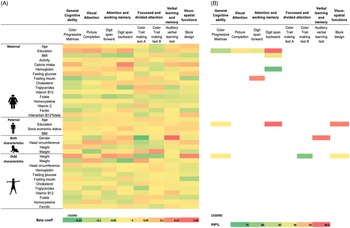
For conventional analysis, we present standardised beta coefficients, confidence intervals and significance level for the linear regression results for all the eight neurocognitive development outcomes in Tables 3 and 4. Each column represents one outcome. The corresponding BMA results are shown in Table 5. All the results are summarised in Fig. 2A, 2B. We show results in relation to major life course determinants.
(A) Represents linear regression beta coefficients for associations between life course variables and 12 year neurocognitive scores in the offspring. Figure (B) represents Bayesian model averaging (BMA) posterior inclusion probability (PIP) % for robust predictors.

Results of linear regression analysis between parental exposures and offspring neurocognitive scores at age 12

Significance at ***p < 0.001, **p < 0.01, *p < 0.05.
Each column represents a linear regression with the column heading as its dependent variable. The β-coefficients are included for each variable for each regression, with the 95% confidence interval in parentheses. All the regressions included maternal and paternal variables. # – The maternal variables are the mean of measurements made at 18 and 28-week pregnancy.
Results of linear regression analysis between childhood variables and offspring neurocognitive scores at age 12

Significance at ***p < 0.001, **p < 0.01, *p < 0.05.
Each column represents a linear regression with the column heading as its dependent variable. The β-coefficients are included for each variable for each regression, with the 95% confidence interval in parentheses. All the regressions included child at birth as well as child at 12-years variables.
Results of Bayesian analysis

***PIP > 99%, **>95% PIP < 99%, *>75% PIP < 95%. Each column represents a BMA regression with the column heading as its dependent variable. The posterior mean are shown in each cell of the table, and the square root of posterior variances are in parentheses.
Only robust predictors (PIP > 75%) are depicted in the table. # – The maternal variables are the mean of measurements made at 18 and 28-week pregnancy.
Maternal condition during pregnancy
We also found some evidence that maternal condition during pregnancy was associated with child’s neurocognitive outcomes. Higher maternal BMI was associated with poorer attention (lower scores on DF and DB β = −0.11 [95% CI −0.19, −0.02], β = −0.13 [95% CI −0.21, −0.05] respectively), higher physical activity scores was associated with poorer general cognitive ability (lower CPM scores β = −0.13 [95% CI −0.23, −0.03]) and higher fasting insulin levels with lower performance on tasks of memory and attention (DF β = −0.12 [95% CI −0.19, −0.06], and DB β = −0.1 [95% CI −0.16, −0.03]) and lower general cognitive ability (CPM β = −0.1 [95% CI −0.17, −0.03]). We observed small effects for higher maternal folate on better visuo-spatial ability (higher BD score β = 0.1 [95% CI 0.01, 0.18]) and higher maternal ferritin on better attention (higher DB score β = 0.08 [95% CI 0.01, 0.16]). Higher maternal haemoglobin was associated with poorer attention and verbal memory and higher maternal B12 with poorer general cognitive ability. The interaction term (maternal folate X B12) was not significantly associated with any of the cognitive outcomes.
Nevertheless, with two exceptions, our BMA results would suggest that the above findings are not robust. The exceptions were for higher mother’s fasting insulin levels being negatively associated with attention (DF scores 98.07% PIP) and higher pre-pregnancy BMI with lower DB scores (90% PIP).
Child’s birth characteristics and subsequent development
Girls performed significantly better than boys on attention and memory (longer TM A time β = −0.22 [95% CI −0.41, −0.03] and AVLT test scores β = 0.30 [95% CI 0.12, 0.48]). Larger head circumference at birth was associated with significantly better visual attention (PC scores β = 0.14 [95% CI 0.02, 0.27]), and higher birth weight with poorer focussed attention (TM B time β = 0.2 [95%CI 0.05, 0.36]). Higher height-for-age at age 12 was associated with better global neurocognitive function (CPM scores β = 0.19 [95% CI 0.04, 0.34]), attention (DF scores β = 0.14 [95% CI 0.04, 0.34], DB scores β = 0.15 [95% CI 0.01, 0.29]) and visuo-spatial abilities (BD scores β = 0.23 [95% CI 0.08, 0.38]). In addition, higher fasting insulin levels at 12 years were associated with poorer visuo-spatial abilities (lower BD scores β = −0.12 [95% CI −0.22, −0.02]) and higher triglyceride levels with better attention (TM A times β = −0.12 [95% CI −0.23, −0.01]). Micronutrient concentrations in the child were also significantly associated with neurocognitive performance: Higher B12 levels with better verbal learning (AVLT scores β = 0.09 [95% CI 0, 0.18]) and higher folate levels with worse general cognitive ability (CPM scores β = −0.08 [95% CI −0.16, 0]) .
BMA results suggest that only gender differences as well as the higher height-for-age at age 12 remain robustly associated with our outcome variables BD scores (99.8% PIP), CPM scores (92.1% PIP) and TM B time (78.3% PIP).
Parental education and family socio-economic status
The most consistent finding across the set of child’s neurocognitive outcomes is the positive association with parental education and their SES, especially the former. Neurocognitive performance in all the tests, with the exception of measures of attention (TM A and TM B), showed strong positive associations.
We found that parental education and SES were independently associated with global neurocognitive ability (CPM, β = 0.13 [95% CI 0.03, 0.23] and β = 0.1 [95% CI 0.002, 0.19] respectively). Father’s education was more strongly associated with tests of attention and working memory (DB, β = 0.23 [95% CI 0.14, 0.33]) than mother’s education (β = 0.16 [95% CI 0.06, 0.26]). Father’s education was associated with better performance on visuo-spatial abilities and memory (BD β = 0.13 [95% CI 0.03, 0.23] and AVLT β = 0.11 [95% CI 0, 0.21]) while mothers education correlated with higher visual attention (PC) (β = 0.16 [95% CI 0.06, 0.26]).
These findings were largely affirmed to be robust by our BMA exercises. Thus, father’s education was found to be a robust determinant of general cognitive ability(CPM 92.22% PIP), visuo-spatial abilities (BD 98.5% PIP), and attention (DB 99.99% PIP), while mother’s education for general cognitive ability (CPM 84.5% PIP), and attention (DB 92.69% PIP, DF 89.83% PIP, PC 99.86% PIP).
Discussion
Our BMA analysis supports a robust role for parental education, maternal pre-pregnancy BMI and pregnancy insulin concentrations, and child’s height in influencing neurocognitive outcomes in the offspring at 12 years of age. Associations of maternal nutritional status during pregnancy (folate and ferritin levels) and child’s birth measurements (head circumference) were less robustly associated. These results are in line with the recent literature that suggests that parental influence and family background play a vital role in children’s neurocognitive development.Reference Cunha and Heckman40,Reference Feinstein41
Parental education stood out as the most robust predictor on offspring cognitive outcome. This may influence the neurocognitive outcomes through many pathways. The effects of parental education on offspring cognition may operate through a more stimulating home environment and better opportunities for education.Reference Feinstein41,Reference Ursache and Noble42 This is supported by a two generation behavioural intervention study that showed that parental training to promote opportunities for children at school and home resulted in better school achievement and reduced behavioural problems in their offspring.Reference Hill, Bailey and Steeger43 The benefits of such improved home environment continued into the next offspring who also showed better early child developmental functioning. The Swedish sibling adoption study demonstrates the role of socio-economic environment on neurocognitive ability in the most definitive way.Reference Kendler, Turkheimer, Ohlsson, Sundquist and Sundquist44 This study examined the intelligence of sibling pairs at 18 years of age, where one sibling was reared by the biological parents and the other by adoptive parents who had a higher parental education. The results showed that the adoptive sibling scored 4.41 IQ points higher than the non-adoptive sibling. Each additional unit of education of the rearing parent, was associated with a 1.94 unit increase in IQ in the offspring.
Among the early developmental factors, starting from preconception we observed that higher pre-pregnancy BMI was associated with lower cognitive scores in the offspring. Findings from developed countries show an association between maternal obesity in pregnancy and a 2 point lower IQ in the offspring at age 7 years.Reference Huang, Yu, Keim, Li, Zhang and Zhang45 A meta-analysis of 32 studies found that maternal pre-pregnancy overweight or obesity was associated with higher odds of adverse neurodevelopmental outcomes in the offspring.Reference Sanchez, Barry and Sabhlok46 However, mothers in our study had a low BMI (average pre-pregnancy BMI ∼ 18) which makes it difficult to interpret the inverse association. One possible explanation may be related to the relatively high adiposity in Indians,Reference Yajnik47 so that the inverse association may reflect an effect of a more healthy body composition of the mother.Reference Neggers, Goldenberg, Ramey and Cliver48 Similarly, association of higher maternal fasting insulin with poor cognitive outcomes in the offspring is not easy to explain because insulin concentrations were quite low and mothers had a normal glucose tolerance. Overall, we interpret our results to indicate that maternal size, body composition and metabolism in pregnancy are important determinants of offspring brain development and subsequent cognitive performance but this needs further exploration in future studies.
Micronutrients vitamins B12, folate, C and D, pyridoxine and ferritin are cofactors in important cellular processes (DNA synthesis, epigenetic regulation, cell cycle regulation and energy metabolism) that impact neurodevelopment. Systematic reviews report associations between lower maternal concentrations of these micronutrients during pregnancy and enhanced risk for various adverse neurodevelopmental outcomes such as neural tube defects, autism and poorer cognitive performance in the offspring.Reference Veena, Gale, Krishnaveni, Kehoe, Srinivasan and Fall49,Reference Behere, Deshmukh, Otiv, Gupte and Yajnik50 We observed only small effects for maternal folate and ferritin on visuo-spatial ability and attention respectively at 12 years, which were not robust under BMA. We had earlier demonstrated in a small pilot study that offspring exposed to lowest decile (n = 49) of maternal B12 concentrations in utero had poorer cognitive performance at 9 years of age compared to offspring in the highest decile (n = 59) of maternal B12 concentrations during pregnancy.Reference Bhate, Deshpande and Bhat15 We did not observe such associations in the current analysis. This may suggest that the previous results were ‘fragile’ (in the sense of Leamer (1983)Reference Leamer51) and not robust to model uncertainty. The differences in findings of the pilot study and this current analysis could be due to differences in number of participants and different statistical methods used. However, recently we reported findings from a randomised controlled trial performed in the same cohort.Reference D’souza, Behere and Patni52 Two hundred and sixty six female participants of the cohort were randomised to receive either vitamin B12, B12+multiple micronutrients or placebo starting from preconception through pregnancy. Seventy-four offspring born in the trial were assessed at age 2–4 years for neurodevelopmental outcomes. The offspring of mothers who received B12 only supplementation showed better cognitive and language outcomes. These observations support a causal role for maternal vitamin B12 status in offspring neurodevelopment. It would be interesting to see if this effect lasts at a later age.
Among birth characteristics, being born with a LBW is consistently associated with adverse cognitive outcomes. A meta-analysis of 35 studies on neurocognitive outcomes in LBW children showed moderate to severe deficits in attention, executive functions and academic achievement.Reference Aarnoudse-Moens, Weisglas-Kuperus, van Goudoever and Oosterlaan53 In another meta-analysis of 13 studies, being born with VLBW or Very PreTerm (VPT – gestation <32 weeks) was associated with a 12 point lower IQ score in adulthood.Reference Eves, Mendonça and Baumann54 A prospective hospital based study, in infants born with VLBW from Pune India, found preterm children who were SGA to have lower IQ scores in adulthood.Reference Chaudhari, Otiv, Khairnar, Pandit, Hoge and Sayyad55 There were no differences in cognitive outcomes in offspring born SGA or AGA and between those born preterm or term There were modest associations between higher birth weight and lower head circumference with poorer scores on attention tasks. However none of the birth characteristics were robust predictors under BMA.
Among the post-natal developmental influences, we found stunting to be the most consistent predictor of poorer cognitive performance. Child’s height at 12 years was associated with many cognitive outcomes including generalised cognitive ability, attention and visuo-spatial ability. A meta-analysis of 68 studies found a 0.22 SD increase in cognitive function score per SD increase in height-for-age Z scores at age 5–11 years.Reference Sudfeld, McCoy and Danaei56 Other child anthropometric measures were not robustly associated under BMA.
Our BMA results generally find that only a few maternal biomarkers and initial conditions are significant, and that the most important factors determining children’s neurocognitive outcomes relate to parental education and socio-economic background. The pathways for this influence may be multiple. Parental education will influence their nutrition, metabolism and behaviour in many ways from before conception, during pregnancy and continue to influence the home environment (including diet, habits, intellectual stimulation and opportunities etc) in subsequent years. The much investigated nutritional and other biological exposures appear to be embedded in parental education. Developmental biology has stressed the most prominent window for such an influence to be early in life (pre- and periconceptional period, pregnancy and first two years of life) which is popularised by the term ‘first 1000 days’. An additional consideration is the ability of educated parents to take remedial action in response to a faltering signal. All these will influence the performance of the developing nervous system.Reference Walhovd, Krogsrud and Amlien57–Reference Vanderauwera, van Setten, Maurits and Maassen59
The strength of our study is the novelty of using a BMA on life course exposure variables to identify robust predictors of cognitive outcomes in childhood. The data represented in this study traces exposures over the life course from pre-pregnancy and pregnancy to12 years of age of the offspring. These observations are unique and allow us to test the DOHaD paradigm. These longitudinal exposures encompass socio-economic transition and impact of various Government of India schemes to improve childhood nutrition and development over the life course of these children (from 1993 to 2008). We acknowledge that the exposures will change with time. We continue to follow this cohort and performed neurocognitive assessments and brain imaging at 24 years of age which will allow us to examine more recent exposures and their impact on longer term cognitive outcomes into adulthood.Reference Behere, Deshpande, Bandyopadhyay and Yajnik60 An additional strength of our study is that we used a comprehensive, culturally relevant measure to assess socio-economic status of rural Indian parents. Family income alone is considered as an unreliable estimate of socio-economic statusReference Violato, Petrou, Gray and Redshaw61 and educational attainment and occupational status are known to be better indicators.Reference Farah62 One limitation of our study is that, because of unavailability of data, we were not able to specifically assess family home environment and parent child interactions which are known to moderate associations of SES with child neurocognitive performance. Finally, being an observational, non-randomised study we cannot be certain about the causality of associations.
Conclusion
In this study, we investigated the linkages that life course exposures to various biological and socio-economic factors have on neurocognitive performance at age 12 using data from the PMNS. The exposures included socio-economic background as well as a range of biometric measures for the mother and the child, from birth until the time at which the neurocognitive tests were taken. In our analysis, we explicitly account for the important issue of model uncertainty in regression exercises by exploiting the BMA methodology.
Across the measures of neurocognitive abilities, once we account for model uncertainty, we generally find overwhelming importance for the role of parental education in determining a child’s outcomes at age 12. The associations with child’s height indicate that remedial interventions in the post-natal life may have important and significant associations with neurocognitive development. Though nutritional deficiencies in utero or size at birth have long-term influence, those effects are potentially reversed by post-birth remediation. Coupled with the success of our vitamin B12 intervention trial, current results inform public health policy in India to consider social interventions in children born into families with low socio-economic status to improve human capital, over and above the already operational nutritional programmes.
Supplementary materials
For supplementary material for this article, please visit https://doi.org/10.1017/S2040174422000356
Acknowledgements
The authors thank Mrs. Aboli Bhalerao for her help with data management and statistical analysis.
Financial support
Tan thanks the Greg and Cindy Page Faculty Distribution Fund for financial support. The follow up of the PMNS is supported by the Wellcome Trust, the Medical Research Council, UK and the Dept of Biotechnology, Government of India. RVB is supported by DBT Wellcome India Alliance Intermediate Fellowship (IA/CPHI/1/6/1502665).
Conflicts of interest
None declared.
Ethical standards
Written informed consent was obtained from parents, offspring provided assent. Permission to perform the study was obtained from the village community leaders and the Institutional Ethics Committee of KEM Hospital Research Center, Pune.